Legacy wireless planning and procurement guidance
Ubiquiti airMAX 900 MHz Legacy Series in Dubai, UAE
The airMAX 900 MHz legacy range was used for outdoor point-to-point and point-to-multipoint connectivity where lower-frequency propagation could help in difficult terrain or partially obstructed paths. Today, the main buyer challenge is not simply finding a familiar product name. It is confirming the exact installed radio, antenna, firmware, regional frequency rules, replacement risk and a realistic migration route before money is committed.
Legacy radios require lifecycle checks
902–928 MHz on documented models
Mixing incompatible radios or antennas
Verify exact installed bill of materials
Direct answer for buyers
Ubiquiti airMAX 900 MHz Legacy Series is a collective description for older outdoor wireless radios and associated 900 MHz antenna products used in fixed wireless links. It was mainly deployed where the propagation characteristics of a sub-1 GHz band were helpful for rural, agricultural, utility or remote-site connectivity. Organisations maintaining an existing installation may still need replacement hardware, compatible antennas, configuration support or a staged migration. Before proceeding, confirm the exact radio model, frequency approval, firmware, antenna connection, power method, link budget, mounting arrangement and whether the objective is to preserve the old network or replace it with a currently supported design.
What the family was designed to do
The 900 MHz airMAX platform addressed fixed outdoor wireless links rather than ordinary indoor Wi-Fi. Depending on the exact model and network design, operators used it for point-to-point backhaul, point-to-multipoint access, remote telemetry connectivity and last-mile service in locations where conventional higher-frequency links were difficult. Lower frequencies can diffract and penetrate certain obstructions better than 2.4 GHz or 5 GHz, but they do not remove the need for a proper radio survey, legal channel planning, interference analysis or safe installation.
Who should consider this page
This guidance is most relevant to wireless internet operators, farms, industrial facilities, security integrators, utilities, remote compounds and organisations that already own RocketM900, NanoStation M900, NanoStation loco M900 or matching 900 MHz antennas. It is also useful for buyers who have received an old model number in a project document and need to know whether the same component can still be sourced. A greenfield deployment should not select a legacy platform merely because the frequency once solved a similar problem; current support, local regulation and long-term replacement availability must influence the decision.
Business challenges and practical responses
A failed radio in an old link
The fastest response is not always buying the first used unit found online. Confirm the exact hardware revision, country code, firmware family, power injector and antenna interface. A visually similar radio may not operate legally or reliably in the same installation.
An expansion request on a legacy base station
Adding subscribers or remote endpoints can increase airtime use, interference and support exposure. Review sector loading, channel width, signal levels, noise floor and expected service level before introducing another legacy client.
Uncertain replacement availability
Legacy products may appear through third-party channels without consistent warranty or provenance. Buyers should compare the risk of a one-for-one replacement against the cost and operational benefit of redesigning the link.
Regional frequency restrictions
A model designed around 902–928 MHz should never be assumed legal in every country. Licensing, permitted power, duty cycle, antenna gain and channel rules can differ. Regulatory confirmation is part of technical suitability.
Core capabilities associated with the 900 MHz design
Outdoor fixed wireless links
The platform was built for directional and sector-based links between fixed sites, not for general-purpose office wireless access.
airMAX network operation
Legacy M-series radios used Ubiquiti airMAX technology for managed wireless access. Exact feature availability depends on model and firmware.
Flexible antenna pairing
Rocket-class radios could be paired with suitable external antennas, while NanoStation variants integrated antenna and radio functions. Compatibility must be verified.
Remote network reach
Deployments often connected sites where trenching fibre or cable was impractical, subject to link engineering and local spectrum rules.
Product-family fit matrix
| Requirement | Potentially suitable when | Confirm before ordering |
|---|---|---|
| Replace one failed legacy radio | The matching model, region and firmware can be verified | Hardware revision, power, antenna, country code and seller warranty |
| Maintain a rural 900 MHz network | The installed system remains stable and compliant | Spare strategy, firmware exposure, interference and migration plan |
| Build a new obstructed-path link | Only after current alternatives and regulation are reviewed | Supported platform, legal band, capacity target and lifecycle |
| Reuse existing 900 MHz antennas | Electrical, mechanical and connector compatibility is proven | Frequency range, polarization, impedance, mounting and cable loss |
Verified family information and important limits
| Brand | Ubiquiti |
|---|---|
| Family description | airMAX 900 MHz legacy outdoor wireless radios and related antennas |
| Documented radio example | RocketM900 |
| Documented operating range | 902–928 MHz for RocketM900; regional use remains regulation dependent |
| Related antenna example | AM-9M13-120 sector antenna, documented for 902–928 MHz with approximately 13 dBi class gain |
| Directional antenna example | AMY-9M16 2×2 Yagi, documented for 902–928 MHz and 16 dBi gain on both polarizations |
| Management and software | Model and firmware dependent; legacy products may no longer receive updates or full future management-tool support |
| Power and mounting | Exact model dependent; confirm injector voltage, grounding, surge protection and mounting hardware |
| Availability | Contact FourTeck for current options. Legacy radios and current antenna listings must not be assumed to have the same lifecycle status. |
| Warranty guidance | Confirm seller, product condition, region and applicable warranty in the quotation |
Compatibility and lifecycle notice
Ubiquiti distinguishes legacy products from actively supported products. A legacy designation means the equipment has stopped receiving updates and is no longer distributed by the manufacturer, although third-party stock may still appear. Future software may not fully support it. This has direct procurement consequences: a replacement unit may restore service but still leave the organisation with an ageing platform, uncertain spare availability and increasing security or management limitations. Antennas can have a different lifecycle from radios, so the presence of a 900 MHz antenna in a current store listing does not prove that a matching legacy radio is current. FourTeck recommends a documented decision between short-term restoration and planned migration.
A practical purchase or migration journey
Identify the installed equipment
Collect labels, serial information, firmware versions, antenna models, injector details, cable types and photographs from both ends.
Measure the operational requirement
Record current throughput, required capacity, distance, obstruction, signal levels, noise, uptime expectation and number of endpoints.
Check legal and technical fit
Confirm spectrum permission, EIRP limits, antenna gain, channel plan, grounding, power and environmental suitability.
Compare restoration with migration
Evaluate the immediate cost of a matching spare against the lifecycle, performance and support value of a redesigned link.
Prepare the complete quotation
Include radios, antennas, brackets, PoE, surge protection, cable, grounding, configuration, installation and testing.
Propagation value does not replace link engineering
The attraction of 900 MHz is understandable. Compared with common higher-frequency unlicensed bands, a lower frequency can provide more forgiving propagation in some foliage, terrain and non-line-of-sight-adjacent situations. That does not mean the radio can reliably pass through every tree line, hill, wall or industrial obstruction. Link performance still depends on the complete path, Fresnel-zone clearance, antenna height, polarization, cable loss, noise floor, transmit limits, receive sensitivity and the modulation rate that can be sustained.
A buyer replacing a failed unit should ask whether the original link was engineered correctly or merely worked under favourable conditions. Seasonal foliage, new construction, weathering, corroded connectors and a changed interference environment can reduce margin over time. FourTeck can use the available site details to help define what should be measured before a purchase. For critical links, a field survey and a design with documented fade margin are preferable to assumptions based only on distance.
Capacity also matters. A legacy radio that provides connectivity may not meet a modern requirement for cloud applications, video surveillance, large file transfer or many concurrent users. The migration discussion should therefore start with the business service to be carried, not only the old product label.
Managing a mixed legacy network
Operators sometimes maintain a mixture of RocketM900 base stations, integrated NanoStation units, third-party antennas and multiple firmware versions. This can continue operating for years, but each variation adds support complexity. Configuration backups may not be consistent, password practices may have changed, and replacement staff may not understand why a channel width or antenna polarity was selected. A maintenance project should document the topology, IP addressing, wireless roles, firmware, VLAN use, power sources and physical mounting.
Before upgrading firmware on a legacy network, confirm release compatibility and keep a recovery plan. A change that appears routine can affect radio association, management access or stored configuration. Remote sites are especially sensitive because a failed update may require travel and climbing work. Where possible, test changes on spare equipment and schedule a maintenance window.
Security posture deserves attention as well. A radio continuing to pass traffic is not the same as a platform continuing to receive security fixes. Segment management interfaces, restrict administrative access, use strong credentials, monitor device reachability and plan replacement according to organisational risk. These controls do not turn unsupported equipment into a supported product, but they can reduce avoidable exposure during a transition.
Antennas, cabling and mechanical compatibility
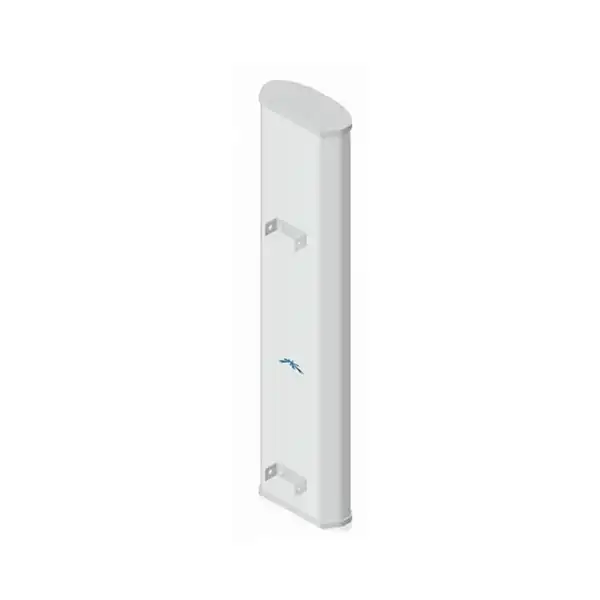
The antenna is not an interchangeable accessory chosen only by gain. Frequency range, polarization, connector type, impedance, beamwidth, front-to-back ratio, mounting method and environmental rating all affect suitability. A 120-degree sector such as the AM-9M13-120 serves a different purpose from a high-gain dual-polarized Yagi. The sector can support a point-to-multipoint coverage area when paired with a compatible radio, while a directional Yagi concentrates energy toward a narrower path. Neither should be selected without considering local interference and the intended topology.
Cable and jumper condition can be as important as the radio. Water ingress, loose weatherproofing, damaged connectors and long lossy cable runs can create intermittent faults that resemble radio failure. When replacing equipment, inspect grounding, surge protection, pole stability and cable routing. Reusing an old antenna can save cost only when its electrical and physical condition is known.
Wind loading is a practical engineering factor in rooftop, tower and mast installations. Larger antennas create force on the support structure. Mounting hardware, pole diameter and structural condition should be reviewed by competent installers. FourTeck can include relevant mounting and installation questions in the quotation process, but final structural responsibility must be addressed for the actual site.
Where legacy 900 MHz systems may still be encountered
Agriculture and estates
Links between farm buildings, gates, pump stations or remote offices where terrain and vegetation complicate higher-frequency paths.
Utilities and telemetry
Low-to-moderate data links supporting monitoring, control or maintenance access, subject to application latency and reliability needs.
Rural internet networks
Older fixed wireless access sectors and customer-premises links that were built before current product families became available.
Industrial and remote compounds
Connectivity between operational areas where trenching was difficult and the existing radio network remains part of the site infrastructure.
Perimeter and security systems
Legacy links carrying cameras or access-control traffic. Modern video bandwidth may exceed the original design, so capacity testing is important.
Temporary continuity measures
A verified spare can restore an essential link while a supported replacement design, budget and implementation schedule are prepared.
Operational and integration considerations
An airMAX radio is one component in a larger network. Its Ethernet connection may feed a switch, router, firewall, surveillance recorder, industrial controller or service-provider access network. A replacement project should preserve or intentionally revise VLANs, addressing, routing, quality of service and monitoring. It should also confirm whether the old link is transparent Layer 2 transport or performs routing functions.
Power-over-Ethernet arrangements require careful verification because legacy Ubiquiti products often used passive PoE rather than the standards commonly expected on modern enterprise switches. Connecting the wrong voltage or polarity can damage equipment. The exact injector, cable distance, surge protector and grounding scheme should be documented before installation.
For monitoring, decide how device availability, signal quality, noise, throughput and error rates will be observed. A migrated network may use a different management platform, which introduces credential, training and alerting requirements. Businesses should include management transition in the project scope rather than treating it as an afterthought.
Questions to resolve before ordering
Procurement checklist
- Exact radio or antenna model
- Hardware revision and country code
- Required quantity and spare quantity
- Deployment country and site coordinates
- Link distance and path profile
- Current signal and noise readings
- Antenna type, gain and polarization
- PoE injector voltage and cable length
- Mounting and weatherproofing needs
- Firmware and configuration backup
- Integration with switches, routers or firewalls
- Installation and migration scope
- Warranty and product-condition confirmation
- Target completion schedule
How FourTeck can assist
FourTeck can help convert an incomplete legacy-product request into a procurement specification. The process can include identifying model labels, reviewing whether an antenna is reusable, comparing a direct replacement with a supported alternative, preparing a bill of materials and defining installation or configuration work. Where a migration is preferred, the design discussion can cover required capacity, topology, management, PoE, mounting, cabling and service continuity.
For an accurate quotation, share photographs from the radio and antenna, current configuration details where available, destination, quantity, link distance, required throughput and any service deadline. FourTeck will confirm which items can be quoted and which facts remain dependent on vendor availability or site validation. Explore the wider business technology product range, review available installation and configuration services, or use the FourTeck contact page to submit the requirement.
UAE availability and support guidance
Contact FourTeck to confirm current UAE availability. Legacy radio supply may depend on the exact model, quantity, seller channel and vendor lead time, while matching antennas may have a different status. Delivery and project coordination can be discussed after the requirement is confirmed. Installation and configuration scope should be included in the quotation when required, particularly where tower access, replacement alignment, grounding or network reconfiguration is involved.
For Dubai projects, provide the site location, access conditions and whether the system is operational or already offline. This helps separate an emergency restoration requirement from a planned upgrade. FourTeck can also review requirements for organisations operating across the UAE and coordinate product, configuration and service discussions according to project scope.
Dubai, Abu Dhabi, Sharjah and Ajman coverage
Businesses with sites in Dubai, Abu Dhabi, Sharjah and Ajman can approach FourTeck with a combined requirement rather than treating each location as an unrelated purchase. A multi-site review can identify where the same legacy model is installed, which links have the highest operational risk, and whether a common migration standard is practical. Site access, tower work, spectrum conditions, civil requirements and support expectations can differ, so the final scope should define each location clearly. FourTeck can coordinate quotation details, bill-of-material review, installation planning and configuration discussions based on the information supplied, without assuming identical conditions at every site.
GCC Availability
FourTeck can assist GCC organisations that are maintaining or replacing airMAX 900 MHz legacy infrastructure by reviewing the exact model, deployment purpose and destination requirements before quotation. Projects in the United Arab Emirates, Saudi Arabia, Kuwait, Qatar, Bahrain and Oman may be subject to different spectrum rules, permitted power levels, import requirements and service conditions. Product availability, licensing, delivery schedules, site visits and vendor lead times can vary by country, model, quantity and project scope. Buyers should provide the destination country, required radio or antenna model, quantity, operating frequency, deployment location and expected schedule. Where a direct legacy replacement is not practical, FourTeck can help define a migration option, configuration scope and installation plan. For Kuwait-related coordination, businesses may also review FourTeck Kuwait technology support. No stock, customs outcome or fixed delivery period should be assumed until the exact requirement is reviewed.
Africa Availability
Organisations in Africa may still operate 900 MHz fixed wireless links at farms, utilities, estates, industrial sites and rural service networks. FourTeck can help evaluate whether the request concerns a replacement radio, compatible antenna, spare strategy, configuration service or a broader migration. Fulfilment may depend on the destination, exact model, quantity, frequency regulation, power requirements, shipping arrangements, vendor lead time and local installation conditions. Buyers should share the destination country, photographs of the installed equipment, quantity, required deployment schedule and any support expectations. For selected East African requirements, the Kenya technology team and Uganda project channel may support regional coordination, while broader enquiries can be directed through FourTeck Africa. Availability, customs handling, onsite coverage and delivery dates must be confirmed for the individual project rather than assumed.
Related products, services and alternatives to evaluate
900 MHz sector antennas
For compatible point-to-multipoint layouts. Confirm radio interface, frequency, polarization and lifecycle.
Dual-polarized Yagi antennas
For directional 900 MHz paths where narrow coverage is appropriate. Link design remains essential.
Current fixed wireless platforms
Potential migration options should be selected by capacity, spectrum, path, management and support requirements.
Outdoor switching and routing
Related network components may need review when PoE, VLAN, routing or management arrangements change.
Site survey and link planning
A survey can validate path conditions, interference, mounting and realistic performance before equipment is ordered.
Installation and migration support
Scope can include removal, mounting, alignment, configuration, testing, documentation and controlled cutover.
Why businesses contact FourTeck
Legacy wireless purchases are rarely solved by a catalogue search alone. Businesses contact FourTeck for requirement clarification, model identification, bill-of-material guidance, compatibility review, quotation coordination, installation planning and migration discussion. The goal is to avoid ordering a radio that cannot associate with the installed network, an antenna that does not match the intended topology, or a power accessory that is electrically unsuitable.
FourTeck can also help stakeholders explain the choice internally. Procurement teams may need a clear statement of availability risk, IT teams may need an integration plan, and management may need a comparison between short-term restoration and supported replacement. Learn more about FourTeck’s technology focus or submit project details through the contact channel.
Frequently asked questions
Is the Ubiquiti airMAX 900 MHz range still current?
Key 900 MHz radios such as the RocketM900 belong to Ubiquiti’s legacy product context. Legacy products may no longer receive updates or manufacturer distribution. Some related antennas can still appear in current listings, so verify each item separately.
Can I replace a failed RocketM900 with any 900 MHz radio?
No. Association method, firmware, frequency range, channel rules, antenna interface, power and network configuration must be compatible. A different platform may require replacing both ends or redesigning the sector.
Does 900 MHz work without clear line of sight?
It can be more tolerant of some foliage and obstructions than higher frequencies, but performance is not guaranteed. Terrain, Fresnel clearance, interference, antenna height and legal transmit limits still control link quality.
Can an existing 900 MHz antenna be reused?
Possibly, after confirming frequency range, gain, polarization, connectors, cable condition, mounting and compatibility with the proposed radio. Physical inspection is recommended.
Is 902–928 MHz permitted in the UAE?
Do not assume permission from a product data sheet. The intended use, power, antenna and local regulatory requirements must be checked for the specific project before operation.
What information is needed for a quotation?
Provide exact model labels, quantity, destination, antenna details, firmware, link distance, photos, required throughput, current fault description and whether installation or configuration is required.
Can FourTeck help migrate the link?
FourTeck can help review the requirement, compare supported technology options, prepare a bill of materials and define survey, configuration, installation and cutover scope.
Is a used legacy unit a safe purchase?
Condition, provenance, firmware, regional variant and warranty may be uncertain. A used unit may be useful as a temporary spare, but the operational and security risks should be documented.
Will a modern replacement provide the same coverage?
Not automatically. Frequency, antenna pattern, permitted power, receiver performance and site conditions differ. A new link design should be validated rather than assumed equivalent.
How is warranty handled for legacy equipment?
Warranty depends on the seller, product condition, region and quotation. Buyers should request written warranty confirmation before ordering.
Plan the next step with the exact model in hand
Send the model label, antenna details, site information and required outcome. FourTeck can help determine whether a verified replacement, spare strategy or supported migration is the more practical route.