
Fortinet Firewall Replacement in Dubai, UAE
Replacing a business firewall is a change to the network control point, not a routine hardware swap. FourTeck helps organisations review the existing FortiGate or third-party firewall, select an appropriate FortiGate replacement, map interfaces and policies, plan licensing, prepare migration steps, test business traffic, and coordinate a controlled cutover with a rollback path.
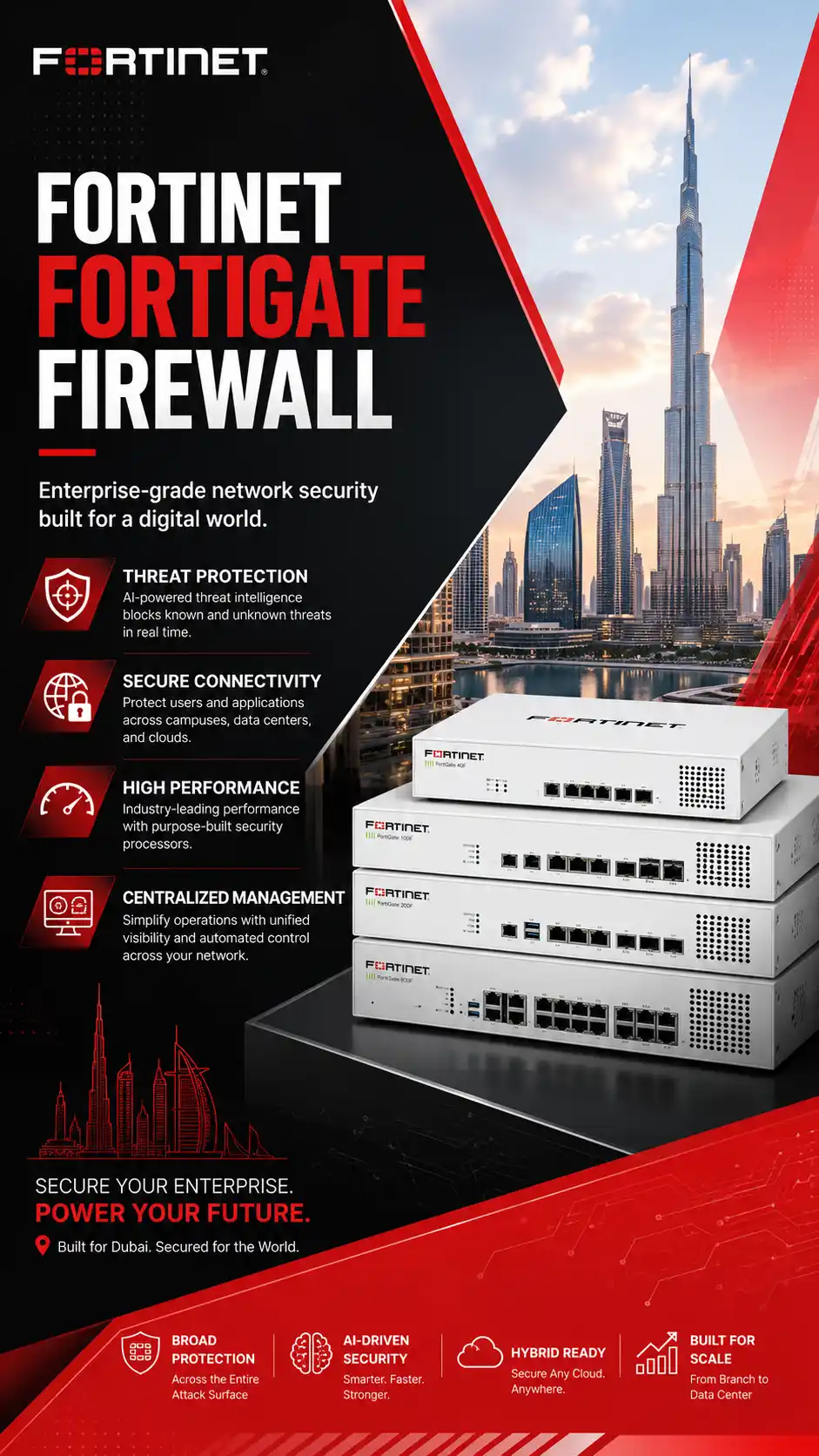
Controlled firewall refresh
Policies, objects, routing, VPN
Real inspected workload
Testing and rollback
Confirm per model and scope
Direct answer for buyers
Fortinet Firewall Replacement is the process of moving a live network from an existing firewall to a newer or better-suited FortiGate platform while preserving required connectivity and improving the configuration where appropriate. It is mainly used when hardware is approaching lifecycle limits, support or software options have become restrictive, the current unit is undersized, new interfaces are required, the network has grown, or the organisation wants a cleaner security design. Businesses should confirm present traffic levels, licensed security services, interface mapping, VPN dependencies, routing, authentication, high availability, logging and downstream Fortinet integration before proceeding. The target model and migration method should be selected only after those dependencies are understood.
What a replacement project actually does
A replacement project changes the device that sits at a critical point in the network path. That device may be handling internet access, NAT, public services, VLAN routing, site-to-site IPsec tunnels, remote access, SD-WAN, web controls, intrusion prevention, application controls, user authentication and logging. The migration therefore has to account for how each of those functions is used today. A sound project does not assume that every old rule should be copied or that every interface on the new unit maps one-to-one with the old appliance. The replacement is an opportunity to document the live design, remove obsolete objects where authorised, identify unsupported or legacy settings, and create an acceptance plan for business services before the maintenance window begins.
Who should consider it
The service suits organisations that already run a FortiGate and need to move to another model, as well as businesses replacing a firewall from another vendor with FortiGate. It is especially relevant when the existing unit is near its support milestone, when inspection features cause performance pressure, when internet bandwidth has increased substantially, when more branches or VPN users are being added, when interfaces or uplinks are changing, or when a high-availability design is being introduced. It is also useful after years of policy accumulation, because a migration can include a controlled configuration review rather than carrying every historic exception into the new appliance. The final scope depends on network complexity, security requirements and the level of cleanup the organisation approves.
Business situations that commonly trigger a FortiGate refresh
Lifecycle pressure
A device approaching end-of-support or constrained software support deserves early planning. Lifecycle review gives IT time to assess options before the firewall becomes a rushed procurement decision.
Capacity has changed
Internet circuits, cloud applications, TLS inspection, VPN usage and user counts often grow after the original purchase. The old appliance may still route traffic but no longer have comfortable headroom for the intended security profile.
Network design has evolved
New VLANs, branches, guest networks, voice systems, cloud connectivity, public services or SD-WAN requirements can make the original port layout and policy structure unsuitable.
Configuration debt
Years of temporary objects, duplicated rules and unexplained exceptions can make the firewall harder to operate. Replacement planning provides a controlled point to review what must remain and what can be retired with owner approval.
Core replacement capabilities
Review current model, user/device load, WAN bandwidth, inspected traffic, VPN use, public services and expected growth before selecting the target appliance.
Map interfaces, VLANs, routes, objects, policies, NAT, VPNs, certificates, authentication and administrative dependencies to the new design.
Choose between controlled manual rebuild, FortiGate-to-FortiGate configuration migration methods, FortiConverter assistance, or a mixed approach based on complexity.
Define acceptance tests, maintenance-window actions, business-owner checks, HA testing where relevant, and a rollback condition before production traffic moves.
Replacement fit matrix
| Requirement | Suitable when | Confirm before ordering |
|---|---|---|
| Like-for-like FortiGate refresh | The architecture remains broadly similar but the existing model needs replacement. | Port mapping, FortiOS compatibility, licenses, VPNs, HA and logging dependencies. |
| Performance-led upgrade | Security inspection, bandwidth or session demand is increasing. | Real inspected throughput requirement, growth margin and enabled security services. |
| Third-party firewall migration | The organisation is standardising on FortiGate or changing firewall vendors. | Feature mapping, VPN types, NAT behaviour, authentication, objects and any vendor-specific functions. |
| HA redesign | The business wants resilience beyond a single firewall. | Topology, switching, cabling, IP addressing, session requirements, license/support implications and failover tests. |
| Policy cleanup during replacement | The existing ruleset contains legacy entries and the business can validate ownership. | Which rules are approved for removal, required evidence, maintenance scope and change-control authority. |
Service information buyers should confirm
| Topic | Fortinet Firewall Replacement |
|---|---|
| Main purpose | Replace an existing firewall with a suitable FortiGate while controlling migration risk and preserving required business connectivity. |
| Suitable for | SME, branch, campus, enterprise, data-centre and distributed environments, subject to model sizing and architecture. |
| Assessment support | Can include current-state review, dependency discovery, sizing inputs and migration planning when quoted. |
| Configuration migration | Method depends on source firewall, target FortiGate, FortiOS versions, configuration complexity and approved cleanup scope. |
| License guidance | FortiCare, FortiGuard services and other entitlements should be confirmed against the required protection and support term. |
| Integration review | May include FortiManager, FortiAnalyzer, FortiSwitch, FortiAP, FortiExtender, identity, logging, monitoring or third-party dependencies. |
| Installation and cutover | Scope varies by site, cabling, rack/power, maintenance-window rules, remote or onsite access, and acceptance testing. |
| Availability | Contact FourTeck for current model, license and UAE project availability. |
| Important note | No target model should be selected solely from the old model name. Current workload, enabled services and expected growth need to be reviewed. |
Configuration, licensing and compatibility dependencies
Fortinet offers multiple ways to move configurations, including FortiConverter services for supported migration scenarios. That can reduce manual translation work, but a converted configuration still needs technical review and testing in the target environment. Interface names can change between models, capabilities may differ across FortiOS releases, and features from another firewall vendor do not always have a one-to-one FortiGate equivalent. Certificates, VPN peers, dynamic routing, authentication servers, SD-WAN rules, virtual domains, FortiLink relationships, central-management settings and logging destinations can all introduce dependencies that need to be identified before cutover.
Licensing is also part of the design. Security services and support coverage depend on the chosen FortiGate and purchased entitlement. Buyers should confirm the exact hardware model, bundle or subscription term, FortiCare level, FortiGuard services, and any cloud or management requirements in the bill of materials. Existing entitlements should not be assumed to transfer automatically between every device or deployment type. FourTeck can help prepare the required information for a quote and highlight questions that need vendor or support confirmation.
A controlled replacement journey
Discover the live environment
Collect configuration, diagrams, interface use, ISP details, VLANs, routes, VPNs, published services, identity sources, logging targets, Fortinet integrations, maintenance rules and business-critical applications.
Size and design
Select a target FortiGate based on inspected traffic, WAN speed, connections, VPN workload, interfaces, resilience and growth. Define whether the architecture stays the same or changes during the refresh.
Build and validate configuration
Translate or rebuild the configuration, correct interface mapping, confirm routes and VPNs, review policies, prepare management access and compare the target state against the approved migration scope.
Cut over and test
Move production traffic in the agreed maintenance window, execute acceptance tests, verify business functions and monitoring, test HA where applicable, and use the rollback plan if the defined success conditions are not met.
Sizing the new FortiGate around inspected traffic
The old appliance name is only one data point. A better sizing exercise looks at what the replacement will actually inspect. Two organisations with the same internet bandwidth may need different firewall capacity because one uses basic policy and IPsec while another enables multiple FortiGuard security functions, decrypts significant TLS traffic, supports many remote users, hosts public services, or routes traffic between multiple internal zones. Procurement teams should therefore ask for a sizing explanation rather than only a model recommendation.
Useful inputs include peak WAN throughput, realistic security-inspection profile, number of concurrent users and devices, VPN tunnel count, remote-access concurrency, expected session levels, number and speed of physical interfaces, VLAN count, SD-WAN design, internal segmentation traffic, public-facing services, anticipated growth and whether the appliance will operate as a single unit or an HA pair. Where the current firewall is already overloaded, its observed throughput may understate what the business actually needs because users may have adapted to slow applications or disabled inspection.
Fortinet publishes different performance figures for different functions. Buyers should compare the figures that resemble the intended production workload rather than choosing only the highest headline throughput. FourTeck can use the stated requirements to narrow suitable FortiGate options and identify where more detailed engineering input is needed.
Migrating configuration without carrying old mistakes forward
Fortinet migration guidance recommends auditing the existing configuration, removing unused objects or policies where appropriate, mapping the old firewall to the new FortiGate, configuring foundational settings, creating the used objects and policies, and preparing an acceptance plan before installation. That sequence matters because an old configuration may contain entries that were created for temporary projects, former applications, retired suppliers or network segments that no longer exist. Blindly importing all of those entries can preserve unnecessary exposure and make the new firewall difficult to understand from day one.
A migration decision usually falls into one of three patterns. A clean rebuild is useful when the current configuration is manageable and the organisation wants deliberate rule cleanup. A conversion-led migration can be useful when the ruleset is large or complex and supported tooling can reduce translation effort. A hybrid approach converts the bulk of the configuration but deliberately redesigns selected areas such as interfaces, zones, SD-WAN, remote access or segmentation. The right choice depends on project timing, technical complexity and how much policy ownership the business can validate.
Whatever method is used, the final configuration should be treated as a new production build that requires review and testing. Objects should resolve correctly, routes should point where intended, NAT should preserve published-service behaviour, VPNs should renegotiate as planned, certificates should be available, and management access should be restricted to the agreed sources.
Business continuity during the firewall cutover
The maintenance window is the point at which planning is tested. A well-prepared replacement has a clear pre-change checkpoint, cable and port mapping, configuration backup, contact list, test script, success criteria and rollback trigger. The team should know which services must be verified first: internet access, DNS, cloud applications, email, ERP, payment systems, voice services, site-to-site tunnels, remote users, published servers, partner connections, monitoring and any application with fixed source or destination addresses.
Where possible, staging the new FortiGate before the window reduces uncertainty. Interfaces can be named and prepared, firmware compatibility can be reviewed, licenses can be registered as appropriate, configuration can be loaded, and non-production validation can be performed. In larger projects, change managers may also require a communication plan so department representatives know when to test and how to report an issue. High-availability deployments add another layer: failover behaviour, state synchronization, switch paths and power arrangements should be part of acceptance testing rather than assumed.
Rollback should be practical, not just written. The old firewall configuration, cabling state and dependencies need to be recoverable within the approved window. If the project also changes addressing, routing or ISP handoff at the same time, the rollback steps become more complex and should be rehearsed on paper before production work begins.
Where replacement projects are commonly used
Head office internet edge
A central office may need a newer FortiGate to support faster circuits, deeper inspection, more VPN users, new cloud applications or increased internal segmentation.
Branch standardisation
Distributed businesses can use a refresh to standardise hardware generations, policy structures and management processes across multiple branches, provided each site is individually sized.
Data-centre perimeter or segmentation
Larger environments may need a replacement because of interface speeds, encrypted traffic, east-west inspection, resilience or central logging requirements. Design review is essential before choosing a model.
Retail and hospitality sites
Sites handling business systems, guest access, payment connectivity, CCTV, Wi-Fi and voice often benefit from better segmentation and clearer policy during a firewall refresh.
Clinics and professional offices
A replacement can be planned around secure internet access, application availability, remote support, VPN connectivity and separation of user, server and device networks.
Multi-vendor migration
Organisations moving from another firewall platform can use the project to translate required policy and routing behaviour while reviewing which FortiGate features should be adopted deliberately rather than copied mechanically.
Integration and operational considerations
A FortiGate may be part of a wider operating environment. If FortiManager is used, the replacement has to fit the management domain, policy packages, device settings and administrative workflow. If FortiAnalyzer is part of logging and reporting, device registration, log forwarding and retention expectations should be checked. FortiSwitch and FortiAP deployments managed through FortiGate can introduce FortiLink, VLAN, controller and firmware dependencies. FortiExtender, FortiClient, identity services, RADIUS, LDAP, SAML, syslog, SIEM, SNMP and automation integrations may also depend on the firewall identity or interface design.
The replacement window should therefore include an integration checklist, not only packet-flow tests. Administrators need to confirm that the new FortiGate appears where it should, sends logs, resolves time and DNS, reaches update services, authenticates users, maintains expected tunnel relationships and can be backed up through the intended management process. Where a central platform manages many sites, template inheritance and device-specific settings should be reviewed before pushing changes.
Operational ownership matters after cutover. The team should know how to back up the configuration, who can make policy changes, how firmware is reviewed, how license renewal dates are tracked, where logs are retained and what escalation path applies if a business service fails. Replacement is most valuable when it leaves the environment easier to operate than before.
Questions to resolve before requesting a quotation
Provide exact model, serial-dependent support details where available, FortiOS version, deployment type and whether it is standalone or HA.
Share WAN speeds, peak usage, security inspection in use, VPN traffic, user/device estimates and growth expectations.
Confirm copper, fibre, SFP/SFP+ requirements, link speeds, transceivers, WAN handoffs, bypass or rugged needs where relevant.
Define web, application, IPS, malware, DNS, sandboxing or other protection needs so the correct bundle and performance assumptions can be reviewed.
List VPN peers, switches, APs, authentication, central management, analyzers, SIEM, cloud services and any unusual legacy dependency.
Clarify whether the goal is strict migration, policy cleanup, redesign, segmentation, HA implementation, SD-WAN changes or a combination.
Procurement checklist for a replacement project
✓ Exact current firewall model and deployment mode
✓ Required quantity and target locations
✓ Internet circuit speeds and expected growth
✓ Security inspection functions to be enabled
✓ Copper, fibre and transceiver requirements
✓ VPN tunnels and remote-user needs
✓ FortiCare and FortiGuard service term
✓ High-availability requirement and topology
✓ FortiManager, FortiAnalyzer and Security Fabric dependencies
✓ Rack, power, cabling and onsite access conditions
✓ Migration method and policy-cleanup authority
✓ Maintenance window, test owners and rollback expectations
✓ Documentation and post-cutover support expectations
How FourTeck can support the replacement decision
FourTeck can assist at the point where technical details and procurement requirements meet. A replacement quote needs more than a model name. The useful starting point is a short current-state summary: existing firewall, WAN links, users, critical applications, VPNs, enabled security services, interface needs, management platforms and the reason for replacement. From there, FourTeck can help narrow a suitable FortiGate class, identify the licensing questions that affect the bill of materials, and define whether configuration migration, policy review, installation, testing or post-change assistance should be part of the quotation.
For complex networks, the discussion may involve FortiManager, FortiAnalyzer, FortiSwitch, FortiAP, FortiExtender, site-to-site tunnels, remote access, dynamic routing, public IP services, virtual domains or high availability. These dependencies influence both engineering time and the target design. FourTeck can coordinate the requirement so hardware, licenses and service scope are not treated as unrelated purchases.
Buyers can also review broader firewall services, browse firewall product options, or read the Fortinet firewall guidance before sending the final requirement.
UAE availability and support guidance
Contact FourTeck to confirm current UAE availability for the specific FortiGate model, FortiCare level, FortiGuard bundle, subscription term, accessories and professional-service scope required by your project. Availability can vary by model, quantity, license region, hardware revision and vendor lead time. A replacement schedule should therefore be planned around a confirmed bill of materials rather than assuming a model is available because it appears online.
Delivery and project coordination can be discussed after the exact requirement is confirmed. If installation, configuration, migration or cutover support is required, include that scope in the quotation so the engineering assumptions are visible before work begins. For business networks in Dubai, Abu Dhabi, Sharjah and Ajman, FourTeck can coordinate requirement review and project planning from one UAE discussion instead of treating each location as a separate product enquiry. Site access, maintenance windows and onsite needs remain project dependent.
GCC Availability
Fortinet firewall replacement projects across the GCC often involve more than shipping an appliance. Businesses may need the same hardware generation across several branches, consistent FortiCare and FortiGuard terms, documented configuration standards, central management, VPN continuity and coordinated maintenance windows. FourTeck can assist with requirement review, model and license selection, quotation coordination, delivery planning, configuration scope, installation planning, renewal guidance and regional project coordination for suitable requirements in the United Arab Emirates, Saudi Arabia, Kuwait, Qatar, Bahrain and Oman. The exact commercial and technical arrangement should be confirmed for the destination country.
Product availability, licensing, delivery schedules, service visits, project scope and vendor lead times can vary by country, target FortiGate model, quantity and requirement. Buyers should provide the destination country, existing firewall model, required quantity, desired license term, deployment location, WAN speeds, interface needs and expected timeline. If the migration includes multiple branches, share whether they should be cut over together or in phases. FourTeck can then help structure the enquiry so hardware, licensing and engineering dependencies are reviewed before commitments are made. For Kuwait-specific coordination, buyers may also use FourTeck Kuwait.
Africa Availability
Organisations planning FortiGate replacement across Africa should account for destination, model availability, power and rack conditions, shipping arrangements, licensing region, technical handover and the way remote sites will be supported after deployment. FourTeck can help businesses evaluate replacement models, licenses, accessories, subscriptions, migration requirements, configuration scope, support needs and renewal planning for suitable projects in East Africa and other African markets. For multi-country rollouts, a consistent design is useful, but each site still needs to be checked for WAN type, interface requirements, user load, local connectivity and maintenance-window constraints.
Availability and fulfilment depend on the destination, exact FortiGate model, quantity, license region, local project conditions and vendor lead time. Buyers should share the destination country, current firewall, required quantity, preferred deployment schedule, WAN specifications and any installation or support expectations. FourTeck can then provide appropriate sourcing and project guidance without assuming local inventory or immediate shipment. For focused regional discussions, buyers can use FourTeck Kenya, FourTeck Uganda, or FourTeck Africa as relevant to the project.
Related options to consider with the replacement
FortiGate hardware selection
Choose the target appliance after sizing inspected traffic, interfaces, VPN load and growth instead of matching the old model number automatically.
FortiCare and FortiGuard planning
Confirm the support level and security-service bundle needed for the target environment, including the term and renewal expectations.
Migration and configuration service
Define whether the project needs configuration conversion, manual rebuild, rule review, VPN migration, testing, documentation or onsite cutover.
Central management and analytics
Where several FortiGates are involved, assess whether FortiManager and FortiAnalyzer should remain, be introduced or be redesigned as part of the refresh.
What buyers are trying to solve before a firewall refresh
Most buyers do not begin by asking for a migration tool. They begin with a practical problem: the current firewall is old, renewals are becoming difficult to justify, internet performance no longer feels comfortable, the network has more users and cloud traffic than it did when the appliance was purchased, or the business wants to standardise several sites on a current FortiGate generation. The strongest replacement plan translates those concerns into measurable requirements. It asks what traffic is being protected, which business services cannot tolerate interruption, which controls must remain, and which limitations of the current environment should not be copied into the new one.
Do not use the old model as the only reference. Review today’s internet speed, inspection features, VPN workload, sessions, internal segmentation, interface speeds and growth. A newer appliance can be more efficient, but the sizing target should still come from the intended workload.
Sometimes configuration migration can be accelerated, especially between FortiGate models, but direct restoration is not a substitute for model-aware conversion and validation. Port names, hardware capabilities, FortiOS behaviour and connected systems may differ.
It is often a good opportunity, but cleanup requires ownership. Removing an apparently unused rule without confirming the business process can cause an outage. A safe approach identifies candidates, gets approval, documents changes and tests the resulting traffic.
Another common concern is licensing. Buyers want to know whether a new FortiGate includes everything needed for threat prevention, support, updates and reporting. The answer depends on the bundle and the way the appliance will be used. Fortinet offers FortiGuard security-service bundles and FortiCare support choices; the bill of materials should state the exact entitlement and term. If the firewall is part of a wider Security Fabric environment, central management, logging, endpoint access, switches, access points or other Fortinet products may also affect the final design. An accurate quote therefore includes more than the base appliance.
Migration timing is another high-value question. Buyers frequently ask whether a firewall can be replaced with no downtime. A better planning assumption is that any production gateway change can affect traffic and should have a defined maintenance window, testing sequence and rollback method. The actual interruption depends on cabling, ISP handoff, HA design, configuration readiness and application dependencies. In some environments the new firewall can be staged beside the old unit, which makes preparation easier, but the production traffic transition still needs change control.
Compatibility is easy to underestimate. A FortiGate may control or connect to FortiSwitch, FortiAP or FortiExtender devices; send logs to FortiAnalyzer; receive policy from FortiManager; authenticate against RADIUS, LDAP or SAML; connect to partner VPNs; publish servers with NAT; or use dynamic routing. A model change can expose firmware or feature compatibility questions that do not appear in a basic hardware comparison. Collecting these dependencies early avoids the situation where the new appliance is correctly sized for throughput but cannot be cut over because one external system was overlooked.
Buyers also ask how much replacement costs. Online prices can be misleading because hardware-only listings, support bundles, security subscriptions, transceivers, HA pairs and professional services are not directly comparable. A business quote should separate the target appliance, licenses, accessories and engineering scope so procurement can understand what is included. FourTeck can prepare this structure after the current firewall and target requirements are shared.
For a useful first discussion, send the current firewall model, quantity, current FortiOS version if known, internet bandwidth, number of sites, VPN requirements, key integrations, desired support term and the reason for replacement. That is enough to begin a meaningful sizing and migration conversation without forcing the buyer to document every firewall rule before the first call.
Important replacement questions answered before you shortlist
How do I know whether the problem is age or undersizing?
Check both lifecycle and workload. A supported firewall can still be too small if current inspection, bandwidth or VPN demand exceeds the design assumptions. An older firewall may also have acceptable utilisation but still need replacement because support milestones or software compatibility are approaching.
Is FortiConverter always the right migration method?
No single method fits every project. FortiConverter can translate supported configurations and reduce manual effort, but a small legacy ruleset may be cleaner to rebuild deliberately. A large multi-vendor migration may benefit more from conversion plus engineering review. Complexity and cleanup goals should drive the choice.
Can the firewall model be chosen from internet speed alone?
Internet speed is necessary but insufficient. Consider the security functions that will inspect traffic, encrypted traffic, sessions, VPN use, interface speeds, internal segmentation, SD-WAN, high availability and growth. The target is capacity under the intended feature set, not raw forwarding alone.
What usually causes surprises during cutover?
Unrecorded static routes, NAT rules, VPN peers, certificates, authentication dependencies, ISP settings, hard-coded application addresses and cable mapping are frequent sources of difficulty. A pre-change discovery checklist and acceptance test reduce these surprises.
Should the replacement include segmentation changes?
It can, but combining too many architecture changes with a hardware replacement increases scope and testing. Some organisations stage segmentation as a second phase. Others intentionally redesign during replacement because maintaining the old flat network would defeat the project goal. The decision should be documented.
What information produces a more accurate quote?
Provide model and quantity, WAN bandwidth, active inspection features, VPN requirements, required ports, HA preference, license term, management and logging integrations, site location, migration scope and desired schedule. The more clearly those factors are stated, the easier it is to avoid incomplete hardware-only comparisons.
Why businesses contact FourTeck for replacement planning
The practical value is requirement clarification. A firewall buyer may know that the existing appliance needs to be replaced but may not yet know whether the next model should be a direct refresh, a higher-capacity unit, an HA pair, or part of a wider change to SD-WAN, central management or segmentation. FourTeck can help turn the current-state information into a bill-of-material discussion that procurement and technical teams can both use.
The same applies to migration scope. Some organisations want the target to reproduce current behaviour with minimal change; others want to remove obsolete rules, rename objects, reorganise policy sections or adopt new FortiGate functions. FourTeck can help define which tasks belong in the quotation and which require separate approval or engineering work. That clarity matters because a replacement project can look simple until the team discovers dozens of VPNs, public services, authentication dependencies or undocumented routing.
For company information, visit About FourTeck. To discuss a specific replacement, use the FourTeck contact page and include the current model and target timeline.
Frequently asked questions
1. When should a business replace an existing FortiGate firewall?
Replacement should be considered when the device is approaching lifecycle or support limits, no longer has suitable performance headroom, lacks required interfaces or features, or the network has changed significantly. The decision should combine lifecycle status with real workload and future requirements rather than relying on device age alone.
2. Can FourTeck help choose the replacement FortiGate model?
Yes. Model guidance can be based on WAN bandwidth, inspected traffic, users and devices, VPN demand, interfaces, HA requirements, FortiGuard services, management needs and growth. Final selection depends on the confirmed requirement and current Fortinet options.
3. Can my existing FortiGate configuration be moved to the new appliance?
FortiGate-to-FortiGate migration can often be assisted by Fortinet migration methods, including FortiConverter in supported scenarios, but configuration should not be restored blindly between different models. Interface mapping, FortiOS compatibility, hardware differences and integrated services need review and validation.
4. Can FourTeck migrate from another firewall vendor to FortiGate?
A third-party firewall can be migrated to FortiGate where the required configuration and business behaviour can be mapped. FortiConverter supports a range of third-party firewall migrations, but vendor-specific features may not translate one-to-one. The project should include policy, NAT, routing, VPN, authentication and acceptance testing.
5. Are FortiCare and FortiGuard licenses included automatically with a replacement?
Do not assume they are included. The required support level, security-service bundle and subscription term should be listed in the quotation. Entitlement requirements depend on the selected model and the protection and support functions the organisation needs.
6. How much downtime is required to replace the firewall?
There is no fixed downtime figure. It depends on staging, cabling, ISP handoff, HA design, number of VPNs, routing complexity, application dependencies and test scope. The project should have a defined maintenance window, acceptance tests and rollback plan.
7. Should unused policies be removed during the migration?
Unused or obsolete rules can be candidates for cleanup, but removal should be based on evidence and business-owner approval. A migration is a good time to improve rule hygiene, yet an unverified deletion can interrupt a legitimate service.
8. What should I send FourTeck for a replacement quotation?
Send the current firewall model, quantity, WAN speeds, user/device estimates, VPN requirements, required ports, desired license term, HA preference, management and logging dependencies, site location, migration scope and target schedule. A configuration summary or backup can be reviewed only through an agreed technical process.
9. Is Fortinet firewall replacement available in Dubai and the UAE?
FourTeck can assist UAE buyers with requirement review, model and license guidance, quotation coordination, migration planning and deployment scope. Hardware, subscription and service availability must be confirmed for the exact model, quantity, location and project timeline.
Plan the replacement before the maintenance window
Share your current firewall model, WAN bandwidth, quantity, VPN needs, required interfaces, license term and target schedule. FourTeck can help structure the FortiGate replacement requirement and prepare quotation guidance for the UAE.