
Fortinet FortiGate 7121F Firewall in Dubai, UAE
The FortiGate 7121F is built for organisations that need security inspection at data-center scale without treating the firewall as a small edge appliance. Its modular 16U platform combines dedicated interface and processing modules, extremely high session capacity and multi-hundred-gigabit security performance for large enterprise cores, service-provider environments, high-speed interconnects and segmentation projects.
Before you request a quotation
Confirm the exact base SKU FG-7121F, required module population, interface speeds, transceiver types, subscription term, HA design and data-center power plan.
Published performance values are “up to” figures and vary with configuration, traffic mix, inspection profile and enabled services.
Direct answer for buyers
Fortinet FortiGate 7121F is an ultra-high-end, chassis-based next-generation firewall in the FortiGate 7000F family. It is mainly used where a business must inspect and control very large volumes of north-south or east-west traffic, support dense high-speed interfaces, terminate large VPN environments or segment major data-center networks. It is most relevant to large enterprises, carriers, cloud and hosting operators, government-scale networks and organisations consolidating several security functions into a high-capacity platform. Before proceeding, buyers should confirm the exact chassis variant, interface and processing modules, FortiOS compatibility, FortiGuard/FortiCare subscriptions, transceivers, HA architecture, power and cooling design, rack loading and realistic inspected-traffic requirement.
What the FortiGate 7121F does
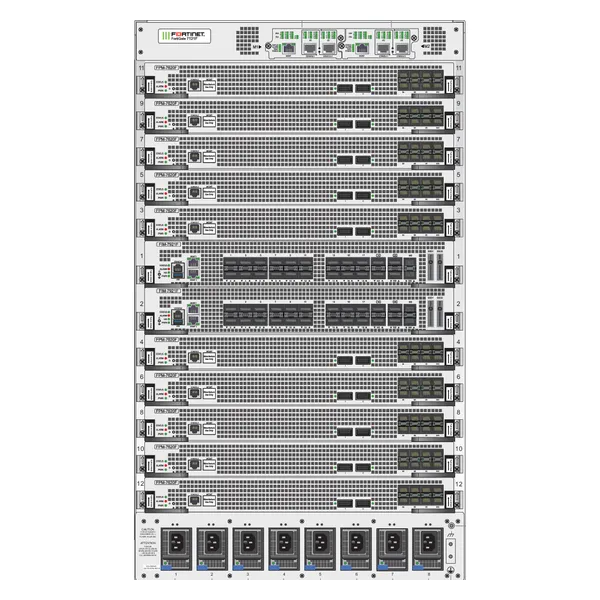
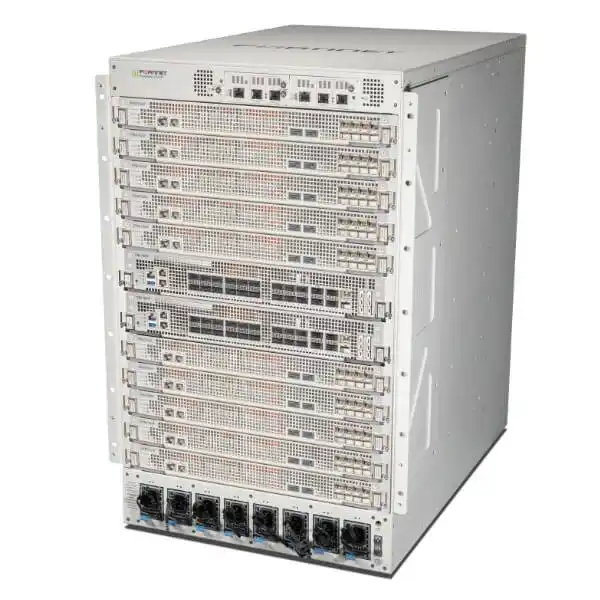
The 7121F sits at the point where firewalling becomes an infrastructure-scale engineering discipline. Rather than relying on a single fixed appliance, the chassis combines Fortinet FIM interface modules and FPM processing modules. The base FG-7121F configuration is supplied with two FPM-7620F processor modules, two FIM-7921F I/O modules, two management modules and eight hot-swappable redundant power supplies. Additional design choices depend on the project and should be confirmed against current Fortinet ordering guidance.
Its role can include next-generation firewall inspection, IPS, application control, SSL inspection, IPsec VPN, network segmentation, high-speed data-center interconnect protection and Fortinet Security Fabric integration. FortiGuard security services and FortiCare support are subscription or contract dependent; they should not be assumed to be included with the hardware unless the selected bundle explicitly includes them.
Who should consider it
A 7121F purchase makes sense when the security layer must keep pace with extremely large network fabrics, high connection rates and dense 25/100/400-gigabit links. It can be appropriate for large financial institutions, telecom operators, cloud providers, hyperscale-style enterprise data centers, national infrastructure, research environments and multi-tenant service platforms where firewall capacity is part of the core architecture rather than an edge afterthought.
It is generally not the right starting point for ordinary branch offices, small campuses or modest server rooms. Those buyers normally gain better economics and simpler operations from smaller FortiGate models. The important question is therefore not “how powerful is the 7121F?” but “does the real inspected traffic, session count, port density, resilience requirement and growth plan justify a chassis at this scale?” FourTeck can help structure that sizing discussion before a bill of materials is finalised.
Business challenges this platform is intended to address
Security at very high throughput
When a fixed firewall becomes the bottleneck on large data-center links, a modular chassis provides a path to far greater processing scale. The 7121F is published with up to 1.89 Tbps firewall throughput and 550 Gbps NGFW throughput, subject to Fortinet test conditions and installed configuration.
Encrypted traffic inspection
Large organisations increasingly need to inspect encrypted sessions without collapsing application performance. The platform is specified for up to 540 Gbps SSL inspection throughput under Fortinet test conditions, but cipher mix, certificate handling and policy design materially affect real deployments.
Massive session scale
Service-provider, cloud and large shared-service environments can generate extraordinary numbers of simultaneous sessions. Fortinet lists up to one billion concurrent TCP sessions and up to nine million new TCP sessions per second for the 7121F.
High-speed segmentation
Segmentation at data-center scale may require many 25, 100 or 400 GbE connections and policy enforcement between internal zones. The chassis architecture is designed for dense high-speed connectivity, but the exact port map depends on the FIM/FPM configuration and breakout choices.
FortiGate 7121F suitability matrix
| Requirement | Suitable when | Confirm before ordering |
|---|---|---|
| Data-center perimeter | Very high aggregate traffic and encrypted inspection are expected. | Peak/95th-percentile traffic, inspection profile and growth target. |
| East-west segmentation | Internal zones exchange large volumes across high-speed links. | VLAN/VXLAN design, interfaces, failover path and policy count. |
| Large VPN concentration | IPsec scale is measured in hundreds of gigabits or very large tunnel counts. | Encryption suites, tunnel architecture and remote-peer capabilities. |
| Carrier/service-provider use | High connection rates and multi-tenant segmentation are core requirements. | VDOM requirements, routing scale, operational model and support coverage. |
| Standard enterprise edge | Only when traffic and resilience needs genuinely justify this class of chassis. | Whether a smaller 3000F/4000F-class platform is more economical. |
Configuration, licensing and compatibility dependencies
The 7121F should never be quoted from the chassis name alone. Fortinet has AC and DC variants, different interface-module options and multiple FortiGuard/FortiCare bundles. The base FG-7121F is associated with FIM-7921F I/O modules, while other 7121F variants use different FIM combinations. Hardware generations and supported mixing rules also matter, so a design copied from an older bill of materials may not be appropriate for a new order.
Security services are similarly dependent on the selected subscription. IPS, malware protection, web filtering, DNS security, sandbox capabilities, data-loss-prevention functions, inline CASB, OT security, FortiManager/FortiAnalyzer services and support entitlements can be bundled or purchased according to current Fortinet programs. A hardware-only quote should not be treated as equivalent to a complete operational security stack.
Compatibility review should cover optics, breakout cables, upstream switching, routing protocols, MTU, link aggregation, HA heartbeat design, log destinations, FortiManager/FortiAnalyzer versions, FortiOS target release and any existing Security Fabric integrations. The safest procurement path is to confirm the entire architecture, not merely the firewall chassis.
Purchase and deployment journey
Measure the workload
Collect peak and sustained throughput, concurrent sessions, new-session rate, TLS inspection ratio, VPN load, policy count and traffic growth. Separate raw forwarding from inspected traffic.
Design ports and modules
Map every 400/100/25/10 GbE connection, optic, breakout, HA interface and management path. Confirm the FIM and FPM population needed for day-one and expansion.
Select subscriptions
Choose support and security services according to the use case. Confirm whether the quotation is hardware only or includes a FortiGuard/FortiCare bundle and for what term.
Validate facilities
Review 16U rack allocation, chassis depth and weight, PDU capacity, redundant feeds, cooling, service clearance, lifting method and installation-window requirements.
Plan migration and testing
Document policy migration, routing cutover, HA tests, failback, logging, monitoring, application validation and acceptance criteria before the production change.
Capacity without confusing firewall and inspected throughput
A common procurement error is to size on the highest firewall throughput number. The 1.89 Tbps headline describes a forwarding test profile, while inspected NGFW, IPS and threat-protection workloads have separate published figures. Real deployments also include routing, NAT, logging, TLS decryption, application identification and uneven packet sizes. Those factors change the effective ceiling.
For a serious 7121F project, build a traffic model that identifies which flows will use deep inspection and which will not. Add resilience headroom for node or module failure, maintenance, growth and burst traffic. FourTeck can use that model to discuss whether the 7121F is appropriate or whether a smaller or differently configured FortiGate would meet the requirement with less complexity.
Encrypted traffic and TLS inspection planning
SSL inspection is often the most demanding part of a modern firewall design because it combines cryptographic work, certificate policy and content inspection. Fortinet publishes up to 540 Gbps SSL inspection throughput for the 7121F under its stated test profile. That number is valuable for comparison, but it is not a promise for every cipher suite, object size, session duration or policy set.
Before enabling broad TLS inspection, identify applications that cannot be intercepted, legal or privacy exclusions, certificate-distribution requirements, pinned-certificate behaviour, SaaS dependencies and fail-open/fail-closed policy. Plan capacity from realistic encrypted traffic rather than total WAN bandwidth alone. A staged rollout with application monitoring and exception governance normally produces a safer operational result than turning on maximum inspection everywhere at once.
Modular scale, operations and serviceability
The 7121F chassis separates interface and processing roles through FIM and FPM modules. Fortinet documentation places FIMs in slots 1 and 2 and FPMs in slots 3 through 12. This architecture is valuable when a security platform must be engineered with high port density and substantial compute, but it also makes operational discipline more important than on a small fixed appliance.
Teams should document module placement, firmware strategy, spares, maintenance procedures, configuration backups and failure-handling processes. Hot-swappable components can reduce some maintenance constraints, but they do not remove the need for change control. Confirm the current hardware generation, replacement-part SKUs and FortiCare entitlement when creating the support plan.
Ideal environments and practical use cases
Large enterprise data-center edge
Where multiple high-capacity Internet, cloud and partner connections converge, the 7121F can provide a central policy and inspection layer. The design should account for asymmetric routing, DDoS architecture, upstream carrier links and failover bandwidth.
Internal data-center segmentation
Organisations can place security controls between application zones, tenant environments or trust boundaries. East-west traffic often has different packet and session characteristics from Internet traffic, so it should be measured separately during sizing.
Service-provider and carrier networks
High session rates, multi-tenancy and large address spaces make session capacity and VDOM scale important. Confirm routing design, logging architecture, per-tenant policy administration and operational separation before choosing the platform.
High-volume VPN and private interconnect
The published 630 Gbps IPsec figure and very large tunnel counts make the platform relevant to major VPN concentrator projects. Actual results depend on encryption algorithms, peer behaviour, packet size and traffic distribution.
Hybrid IT security control point
The appliance can participate in a wider Fortinet Security Fabric design spanning on-premises networks, cloud connectivity and security operations. Centralised management and logging should be sized independently and version compatibility confirmed.
High-performance research and AI infrastructure
Environments with 100/400 GbE fabrics may need security controls that can connect to those speeds. The 7121F can be considered where segmentation and inspection are required without reducing the network to low-speed firewall links.
Integration and operational considerations
A firewall of this size is normally part of a broader operational system. Routing adjacency, dynamic routing convergence, ECMP behaviour, link aggregation, VLAN and VXLAN segmentation, monitoring, time synchronisation, AAA, PKI, SIEM forwarding, central management and change control should all be agreed before deployment. Integration problems at this tier often come from surrounding design assumptions rather than from the chassis itself.
If FortiManager or FortiAnalyzer is used, validate supported versions, licensing, log-rate capacity and retention targets. If external SIEM or NDR systems receive logs or mirrored traffic, estimate the event and telemetry volume. If the platform enforces identity-aware policy, confirm directory, SSO and endpoint dependencies. Where the security architecture includes FortiSwitch, FortiAP, FortiClient, FortiNAC or other Fabric products, confirm that the proposed FortiOS release and management architecture support the required integrations.
High availability needs its own design workshop. Decide whether the business requires active-passive or active-active operation, how heartbeat links will be isolated, how upstream/downstream devices behave during failover, how session pickup is handled and whether both units are cabled symmetrically. HA only improves resilience when surrounding power, rack, switching and routing dependencies have also been made redundant.
Facility planning is part of the firewall project
The 7121F occupies 16U and has a published maximum configured weight of about 203.1 kg. It therefore requires rack engineering, safe lifting procedures, sufficient depth, cable-management space and appropriate floor/rack loading assessment.
The AC platform requires 200–240 VAC and uses multiple hot-swappable PSUs. Power draw varies with configuration; Fortinet data sheets publish high maximum values for a fully configured chassis. Do not size PDUs from a small base-module estimate. Confirm redundant A/B feeds, outlet types, circuit capacity, cooling and heat load with the data-center facilities team.
For DC variants, the exact DC chassis, combiner requirements and site electrical design must be validated separately. Do not substitute AC and DC ordering information.
Buyer questions to resolve before the quotation
Procurement and evaluation checklist
- Confirm exact model/SKU: FG-7121F or required variant.
- Confirm quantity and whether an HA pair is required.
- Document FIM and FPM module population.
- List every required high-speed optic, breakout and cable.
- Provide inspected-traffic, SSL and session sizing data.
- Select FortiGuard services and FortiCare term.
- Confirm FortiOS and management-platform compatibility.
- Validate 16U rack space, depth and chassis weight handling.
- Validate PDU feeds, electrical capacity and cooling.
- Define installation, configuration and migration scope.
- Agree logging, FortiAnalyzer/SIEM and retention design.
- Confirm destination, current availability and vendor lead time.
How FourTeck can support a 7121F project
FourTeck can help convert an architectural requirement into a quotation-ready bill of materials. That can include clarifying the exact chassis variant, checking published Fortinet specifications against the expected traffic mix, documenting interface and transceiver requirements, reviewing subscription choices and coordinating installation or configuration scope. The objective is to reduce the chance of buying an under-specified, over-specified or incomplete system.
For projects that involve replacing another firewall platform, FourTeck can also discuss migration planning, policy-conversion scope, HA design, routing cutover and acceptance testing. These activities are scope dependent and should be included explicitly in the quotation if required. Visit the FourTeck firewall services section for related implementation support, or review network security products when comparing adjacent FortiGate options.
For a wider Fortinet discussion, see FourTeck’s Fortinet firewall guidance in Dubai. Final availability, subscription structure, lead time, region code and delivery schedule must be confirmed for the specific order.
UAE availability and support guidance
For organisations planning a FortiGate 7121F deployment in the UAE, the first procurement step is to confirm the destination, exact FG-7121F variant, quantity, security-service bundle and deployment date. A chassis at this tier is often sourced against a project bill of materials rather than treated as a commodity shelf item. Availability can therefore depend on the model, module population, subscription, quantity, regional ordering code and vendor lead time. Contact FourTeck to confirm current UAE availability before relying on a project schedule.
Delivery coordination should include the receiving location, access restrictions, rack readiness and safe-handling plan because the fully configured chassis is large and heavy. If installation, configuration, migration or testing is required, those services should be defined as separate scope items in the quotation. Warranty and support terms should be tied to the selected FortiCare entitlement and current vendor policy rather than assumed from the hardware name alone.
Dubai, Abu Dhabi, Sharjah and Ajman coverage
FourTeck can coordinate requirement review and quotation discussions for businesses in Dubai, Abu Dhabi, Sharjah and Ajman as part of one UAE project conversation. Site access, delivery planning, installation windows, data-center procedures and on-site service expectations should be shared early so that the commercial and technical scope reflects the real deployment environment.
GCC Availability
For GCC projects, FourTeck can assist businesses that are assessing FortiGate 7121F for data-center, carrier, cloud or large-enterprise security requirements. The useful starting point is a complete requirement covering destination country, exact hardware variant, FIM/FPM configuration, high-speed optics, quantity, subscription term, HA design and required implementation services. Projects may involve the United Arab Emirates, Saudi Arabia, Kuwait, Qatar, Bahrain or Oman, but availability, licensing, delivery schedule, service visits and vendor lead time can vary by country and by the exact bill of materials. FourTeck can coordinate requirement review, sizing discussion, quotation preparation, configuration scope and delivery planning after those details are known. Buyers should not assume that a price or lead time seen for one market applies to another. Share the intended deployment location, expected timeline, required FortiGuard/FortiCare term and any installation or migration expectations so the proposal can be aligned to the actual project.
Africa Availability
FourTeck can also support organisations evaluating the FortiGate 7121F for projects in Africa, including selected requirements in East Africa and other regions where high-capacity network security platforms are needed. Because this chassis may involve multiple modules, optics, power choices, subscriptions and professional-services components, procurement should be planned around the exact destination and deployment architecture. Availability can depend on the country, model variant, quantity, license region, vendor lead time, shipping arrangements, electrical standards, rack readiness and local project conditions. Buyers in markets such as Kenya and Uganda can share the destination, required quantity, expected traffic, subscription term, preferred delivery window and any installation or support expectations with FourTeck for review. No assumption should be made about local inventory, customs outcomes or on-site coverage until the requirement has been checked. Regional planning works best when the hardware, licensing and deployment scope are discussed together.
What buyers are really trying to determine about the 7121F
Most organisations researching the FortiGate 7121F are not simply looking for another firewall. They are usually trying to solve one of four harder questions: how to inspect data-center traffic without forcing a network-speed downgrade, how to consolidate very large policy and VPN workloads, how to build security into 100/400-gigabit fabrics, or how to replace several smaller appliances with a platform that can be engineered for substantial growth. Those questions require more than a data-sheet comparison because traffic shape, security policy and physical infrastructure affect the outcome.
A second theme in buyer research is cost. Public online prices for this class of product vary widely because some listings are hardware-only while others include one-, three- or five-year FortiCare and FortiGuard bundles. A hardware price should therefore never be compared directly with a bundled subscription price. The quotation should show the exact SKU, included term, security services and optional components. This is particularly important for 7121F because the value of the security platform in production depends heavily on the services and operational tooling attached to it. For procurement teams, the cleanest comparison is a five-column sheet: hardware SKU, included modules, support level, security-service bundle, and term.
Another common question is whether the 7121F is “too large.” That depends on both performance and topology. A network with several 100G uplinks may still not need a 7121F if only a small portion of traffic crosses the firewall, while a service-provider environment can justify the chassis even when average bandwidth appears moderate because concurrent sessions, connection setup rates, multi-tenancy or HA reserve drive sizing. Count the security workload, not just the line-rate labels on your switches.
Buyers also investigate whether the 7121F can replace separate segmentation, VPN and perimeter devices. Technically, FortiOS provides a broad set of firewall, VPN, segmentation and networking functions, and the platform has the performance profile to support demanding combinations. Whether consolidation is operationally desirable is a different question. Some organisations prefer separate failure domains, administrative teams or policy stacks. Others value a common platform and centralised management. The architecture should therefore compare both capacity and blast radius: what happens to security services if one logical or physical platform is unavailable?
For deployment planning, power and rack logistics receive less attention during early research than they deserve. A fully configured 16U chassis weighing roughly 203 kg is not handled like a 1U firewall. Data-center teams need to approve rack loading, mounting method, clearances, PDU feeds, cable paths and service access. Power consumption can be several kilowatts depending on configuration, so redundant feeds and cooling must be designed with facilities staff. These requirements can affect rack selection and implementation schedule before any firewall rule is configured.
Licensing questions should be answered with the same care. FortiGuard services, FortiCare support, cloud management, central logging and advanced security functions are not a single universal entitlement. Current Fortinet bundles and a-la-carte services can differ by term and program. Buyers should decide which outcomes matter—IPS, advanced malware protection, web and DNS controls, inline application security, OT coverage, managed operations or enhanced support—then map those outcomes to the available subscription structure. If an existing Fortinet estate is already licensed, check whether current management and analytics platforms have adequate scale and compatible versions.
Finally, buyers want confidence that the quoted configuration will remain supportable over its planned life. That means documenting hardware generation, current FortiOS train, module compatibility, spares, firmware upgrade method and renewal ownership. FourTeck can help turn these research questions into a structured requirement so the final quotation represents the intended operating model rather than an isolated chassis purchase.
Decision questions that deserve a clear answer
How do I know whether the 7121F is oversized?
Start with the inspected workload, not the model name. Measure average and peak bandwidth, packet sizes, SSL percentage, concurrent sessions, new sessions per second, VPN traffic and growth. Then compare those requirements to the relevant IPS, NGFW, threat-protection and SSL-inspection figures with resilience headroom. If a much smaller FortiGate meets those figures and port requirements comfortably, the 7121F may add unnecessary cost and operational complexity.
What information produces an accurate quote?
Provide an architecture-level requirement. Include the exact destination, quantity, HA requirement, interface map, optics, FIM/FPM needs, traffic sizing, subscription term, required security services, support level, central management/logging, installation scope and target date. That allows the supplier to distinguish base hardware, optional components and services rather than returning a misleading single-line price.
Should I buy hardware only or a security bundle?
Choose based on the production use case. Hardware-only can make sense for specific lab, spare or narrowly licensed situations, but most production NGFW deployments need support and threat-intelligence services. Compare current FortiCare/FortiGuard options and the required term. Do not assume that IPS, web filtering, advanced malware or other services are automatically licensed because the hardware supports the function.
Does HA double usable throughput?
Do not size an HA design as if all advertised capacity is automatically additive. Active-passive is primarily a resilience model, while active-active behaviour depends on traffic and feature architecture. Design so the required workload remains supportable during a failover or maintenance event. Upstream and downstream network paths must also converge correctly when a member is unavailable.
What can make SSL inspection slower than the published number?
Real TLS traffic is more varied than a benchmark profile. Cipher suites, certificate validation, object size, session churn, application exceptions, decryption policy and enabled content inspection all affect results. Build a representative test or pilot policy and preserve headroom rather than planning the platform at the laboratory maximum.
What should be checked before a migration window is booked?
Validate facilities, software and network dependencies first. Confirm rack/power readiness, optics, FortiOS version, management connectivity, routes, HA links, policy conversion, object naming, NAT, VPN peers, logging, monitoring and rollback. A successful data-center firewall change depends as much on surrounding systems and acceptance testing as on the appliance itself.
Related FourTeck options and services
FortiGate alternativesReview adjacent firewall models when 7121F capacity is more than the project requires.
Installation and configurationDiscuss implementation, HA, policy migration and cutover scope.
About FourTeckLearn how FourTeck approaches technology procurement and project coordination.
Why businesses contact FourTeck for complex firewall projects
The useful value in a 7121F discussion is not a generic product description; it is requirement clarification. FourTeck can help buyers document the traffic profile, interface map, subscriptions, high-availability design and implementation needs that determine the correct bill of materials. This is especially important for chassis products where a small difference in module, optic, support or licensing assumptions can materially change both price and deployability.
FourTeck can also coordinate quotation revisions when procurement teams need alternative terms, reduced service scope, different subscription durations or a smaller FortiGate option for comparison. No unsupported claim is made about stock, fixed delivery times or guaranteed project outcomes. The goal is to get the technical and commercial assumptions visible before purchase approval.
Frequently asked questions
What is the Fortinet FortiGate 7121F designed for?
It is designed for very high-capacity enterprise, data-center and service-provider security deployments that need modular high-speed interfaces, large session scale and multi-hundred-gigabit inspected-security performance. It is not intended as a routine branch firewall.
What is included with the base FG-7121F hardware?
Fortinet ordering information lists a 16U 12-slot chassis with two FPM-7620F processor modules, two FIM-7921F I/O modules, two management modules and eight hot-swappable redundant power supplies. Subscriptions, extra modules, optics and services should be confirmed separately.
How much NGFW and threat-protection throughput does it provide?
Fortinet publishes up to 550 Gbps NGFW throughput and up to 520 Gbps threat-protection throughput for the 7121F under its defined enterprise traffic-mix tests. Actual performance varies with configuration, traffic and enabled features.
Does the FortiGate 7121F require FortiGuard licenses?
The hardware can run FortiOS functions, but many threat-intelligence and advanced security services depend on FortiGuard subscriptions, and support depends on the selected FortiCare entitlement. Choose the bundle or a-la-carte services that match the intended production use.
Can the 7121F be deployed in high availability?
Yes. Fortinet lists active-passive and active-active HA configurations. The specific architecture, heartbeat links, session behaviour and surrounding routing/switching design should be validated so the required workload remains supportable during a failure.
What should be checked for 400G and 100G connectivity?
Confirm the installed FIM/FPM modules, actual port mapping, breakout requirements, supported transceivers, fibre type and compatibility with adjacent switches or routers. Do not assume every published interface count is usable in every module configuration.
How should the 7121F be sized for SSL inspection?
Use the expected encrypted-traffic profile, cipher mix, session rate and security policy rather than the Internet circuit size alone. Fortinet publishes up to 540 Gbps SSL inspection under its test conditions, but real workloads can differ substantially.
Is FortiGate 7121F currently available in Dubai?
Current UAE availability should be confirmed with FourTeck for the exact model, quantity, module configuration, subscription and delivery requirement. Lead times can vary, so availability should not be assumed from an online listing.
What information does FourTeck need for a quotation?
Share the exact destination, quantity, required variant, HA design, traffic sizing, port and optic map, subscription term, FortiGuard/FortiCare level, management/logging requirement and any installation, configuration or migration scope.
Build the 7121F quotation around your real architecture
Send FourTeck your traffic profile, interface requirements, HA plan, subscription term and target deployment location. The team can help clarify the exact FG-7121F configuration and quotation scope before procurement approval.

Reviews
There are no reviews yet.