

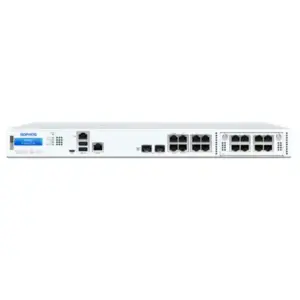
Fortinet FortiExtender 511G in Dubai, UAE
The FortiExtender 511G, model FEX-511G, gives businesses a flexible way to add 5G cellular WAN to branches, remote sites, continuity designs, and out-of-band management plans while retaining wired Ethernet and SFP connectivity for practical deployment.
Confirm before you order
Carrier and 5G/LTE band fit for the intended UAE network.
Whether a single-modem dual-SIM design meets your resilience target.
FortiGate-managed or FortiEdge Cloud management requirements.
PoE, DC adapter, SFP, installation, and support requirements.
Direct answer for buyers
Fortinet FortiExtender 511G is an indoor enterprise 5G/LTE gateway used to provide cellular WAN connectivity, backup connectivity, network extension, and out-of-band management at business sites. It is a strong candidate for organisations already using FortiGate or those wanting centrally managed cellular links at branches and remote locations. The model uses one 5G modem with dual SIM slots, so it can switch between carrier profiles but is not a dual-modem active/active cellular appliance. Before proceeding, confirm local carrier support, selected SIMs, required FortiCare or cloud-management subscriptions, the planned power source, SFP requirements, and whether the Wi-Fi-equipped 511G-WiFi variant is actually needed.
What the FortiExtender 511G does
The FEX-511G adds 5G Sub-6GHz and LTE connectivity to a business network without forcing the cellular radio to sit next to the firewall or switching cabinet. That matters because cellular signal quality is often better near a window, on a different floor, or in another part of the premises. The device can be positioned where the radio environment is more favourable while Ethernet or fiber links carry traffic back toward the FortiGate or network switch.
Its role can vary by design. At one site it may provide the primary WAN because fixed broadband is unavailable or slow to install. At another, it can provide backup connectivity when a wired circuit fails. In an out-of-band design, a separate cellular path may help administrators reach infrastructure when the normal WAN is unavailable. It can also participate in Fortinet LAN-extension and Secure SD-WAN designs, subject to the surrounding FortiGate configuration and software compatibility.
Who should consider it
The 511G is suited to IT teams that need a business-grade indoor cellular gateway rather than a consumer hotspot. Typical environments include retail branches, clinics, offices, temporary project sites, kiosks, distributed service locations, payment environments, and remote facilities where a second WAN technology can reduce dependence on one fixed carrier path.
It is particularly relevant when the organisation already operates FortiGate and wants cellular connectivity to be managed as part of the wider network. It can also be considered for FortiEdge Cloud-managed deployments. Buyers who need built-in Wi-Fi access should review the separate FEX-511G-WiFi instead. Sites exposed to weather, vibration, dust, or harsh industrial conditions should not treat this indoor model as a rugged gateway; the FortiExtender Rugged family is the more appropriate product class to evaluate.
Business challenges this gateway can help address
Wired circuit dependency
A branch that depends on one fiber, DSL, or cable service can use cellular as an alternate WAN technology. Final failover behaviour depends on the surrounding routing and SD-WAN policy.
Slow site turn-up
5G can provide an interim connectivity option while a fixed service is pending, provided the selected carrier has adequate coverage, capacity, and suitable commercial data plans.
Remote recovery access
Console and USB interfaces support out-of-band management scenarios, helping teams design a management path that is independent from the primary fixed WAN.
Poor cellular placement
PoE and the SFP option make it easier to place the gateway where radio conditions are better rather than extending long, lossy cellular antenna runs back to a comms cabinet.
Core capabilities that matter in a 511G deployment
The EM9291 modem supports 5G standalone and non-standalone modes across a broad range of bands, with actual carrier operation dependent on firmware, network configuration, region, and operator support.
Two physical SIM slots and a reserved eSIM provide carrier-selection and failover options. Because the appliance has one modem, only one cellular carrier connection is active through that modem at a time.
A 2.5GbE RJ45 WAN port supports faster wired handoff, while the shared Gigabit SFP/RJ45 interface gives deployment flexibility and can support fiber placement beyond normal copper Ethernet distance.
FortiGate-managed and FortiEdge Cloud-managed options are available with the relevant configuration and service entitlements, allowing teams to incorporate the cellular edge into wider operational workflows.
Is the FortiExtender 511G the right fit?
| Requirement | Suitable when | Confirm before ordering |
|---|---|---|
| 5G backup WAN | You need a separate cellular path in addition to a fixed WAN. | Carrier coverage, data plan, failover policy, antenna placement. |
| Primary cellular WAN | 5G is commercially and technically suitable for the expected traffic profile. | Signal quality, monthly data allowance, latency expectations, operator terms. |
| Carrier redundancy | Sequential dual-SIM switching meets the resilience requirement. | If simultaneous active/active cellular is required, assess a dual-modem model instead. |
| Longer physical placement | The cellular gateway must be located away from the rack for better signal. | PoE budget, fiber/SFP type, cabling route, mounting location. |
| Built-in Wi-Fi | The requirement is cellular WAN only, without an integrated Wi-Fi 6 AP. | Choose the 511G-WiFi variant if onboard Wi-Fi is required. |
Carrier, licensing, compatibility, and scope dependencies
A 5G gateway should never be purchased from hardware specifications alone. Cellular operation depends on the mobile operator, active bands at the specific site, modem firmware, SIM provisioning, data-plan policies, radio congestion, signal quality, and the software release installed on the FortiExtender. Fortinet documentation specifically notes that some carriers and regions may require additional certification or testing and identifies the Arabian Peninsula as an area where carrier-specific evaluation may be required. For a UAE deployment, the practical step is to confirm the intended operator and site before finalising the bill of materials.
The FEX-511G does not include built-in Wi-Fi access. If local wireless client access is part of the requirement, compare the FEX-511G-WiFi or use separate FortiAP access points as appropriate. The standard 511G also has a single cellular modem. Dual physical SIMs improve carrier choice and can support failover policies, but they do not create two simultaneous cellular radios. Organisations that specifically need active/active cellular should evaluate a dual-modem FortiExtender model and confirm that its regional support matches the project.
Management and support are also part of the purchase decision. FortiGate-managed operation can integrate the device into a Fortinet branch design, while FortiEdge Cloud-managed use requires the appropriate management and support entitlement. FortiCare Premium support SKUs and FortiEdge Cloud management SKUs are separate ordering items and should not be assumed to be included with the base hardware. FourTeck can help map the required appliance, support term, management option, accessories, and service scope into one quotation.
A practical purchase and deployment journey
Define the WAN role
Decide whether the 511G will be primary WAN, secondary WAN, temporary connectivity, an out-of-band path, or part of a broader SD-WAN design. The expected role influences SIM choice, routing, traffic policy, and support expectations.
Validate the radio environment
Check carrier coverage at the real installation position rather than relying only on a city-level coverage map. Building materials, glazing, floor level, nearby structures, and indoor placement can materially change signal behaviour.
Confirm the bill of materials
Confirm FEX-511G quantity, the chosen power method, SFP optics if used, suitable cabling, support entitlement, management subscription when required, mounting details, and any FortiGate-side requirements.
Configure and test
Provision SIMs, firmware, management, WAN policy, health checks, failover criteria, logging, and security controls. Test the actual failure cases the business cares about rather than only confirming that a 5G session connects.
Cellular resilience without confusing dual SIM with dual modem
One of the most important buying points is the difference between dual SIM and dual modem. The FortiExtender 511G is a single-modem appliance with dual physical SIM slots plus a reserved eSIM. A dual-SIM design lets the device choose between SIM profiles and can support failover from one carrier to another based on policy and network conditions. It does not mean that two independent 5G modems are transmitting at the same time. For many branches, that is exactly the right design: the objective is to have an alternative carrier if the preferred service becomes unavailable or unusable. It is simpler than managing two simultaneous cellular paths and may align well with an existing wired primary connection.
However, a project that needs simultaneous active/active cellular, traffic isolation across two cellular radios, or cellular load balancing at the modem level should not assume the 511G provides those capabilities. In that case, a dual-modem FortiExtender from the relevant product range may be a better fit. The decision should be made from the application requirement first, then the hardware. FourTeck can help compare the intended failover behaviour, number of carriers, traffic load, and management approach before the quote is finalised.
SFP and PoE make placement part of the network design
A cellular gateway performs best when the radio can be located where the signal is good, yet enterprise networks often terminate in a cabinet that is convenient for switches rather than radio reception. The 511G addresses this physical design problem with PoE power and an SFP interface. PoE can carry power and Ethernet over a suitable cable run, allowing the gateway to be moved away from the firewall. The SFP option is useful when the required separation exceeds practical copper Ethernet distance or when fiber is preferred for electrical isolation and building-to-building style cabling inside an approved design.
The SFP shares a combo interface with one of the Gigabit RJ45 connections, so the planned port map needs to be understood before installation. Buyers should confirm the SFP optic type, fiber media, distance, connector, and supported transceiver before ordering. The 2.5GbE RJ45 WAN port provides a higher-speed wired interface where the wider design can use it. None of these physical interfaces guarantee a particular internet speed: the end-to-end result still depends on 5G spectrum, carrier capacity, signal, core network conditions, VPN overhead, routing policy, and the performance of adjacent systems.
Management choices affect operations after installation
The purchase decision should include how the device will be monitored and managed after deployment. In a FortiGate-centric branch, FortiExtender can be integrated with the FortiGate so that the cellular connection becomes part of the wider Fortinet network design. This is useful for teams that want common visibility, SD-WAN policy, and central operational processes. Fortinet also offers FortiEdge Cloud management for FortiExtender, with management and support entitlements that are ordered separately where applicable.
Operational planning should cover firmware lifecycle, configuration backups, alerting, cellular usage, SIM changes, remote troubleshooting, and access-control policy. If the device is being purchased specifically for out-of-band management, the team should test a scenario where the normal wired WAN and primary management path are unavailable. That verifies not only the modem connection but also DNS, routing, authentication, firewall rules, and any upstream remote-access service needed by administrators. FourTeck can include configuration and handover requirements in the project discussion rather than treating the hardware shipment as the end of the work.
Where the FortiExtender 511G fits well
Branch offices
Use 5G as a secondary path behind fixed broadband, or as the primary WAN where commercial 5G is more practical. Confirm expected traffic, SD-WAN policy, and failover tests.
Retail and payment sites
Cellular can keep business systems connected when the fixed circuit has a fault. Payment and compliance requirements still need to be handled by the wider network and application design.
Temporary locations
Project offices, exhibitions, construction administration areas, and pop-up business sites may use cellular while permanent connectivity is unavailable, subject to coverage and data-plan suitability.
Remote infrastructure access
Out-of-band planning can provide administrators with a separate path for diagnosis and recovery. The management workflow should be designed and tested before an incident occurs.
Healthcare and service locations
Distributed sites may use an alternate WAN path to reduce reliance on a single fixed service. Application priority, privacy, and security remain functions of the overall architecture.
Private 5G evaluation
FortiExtender 5G models can participate in private cellular scenarios where spectrum, SIMs, bands, carrier/core compatibility, and local regulatory conditions align. Validate the complete ecosystem first.
Integration and operational considerations
The FortiExtender should be treated as part of the WAN architecture, not as an isolated modem. If a FortiGate is controlling failover, decide which health checks determine when the cellular path is used and when traffic should return to the preferred link. Aggressive switching thresholds can create instability if radio conditions fluctuate, while overly relaxed thresholds may keep traffic on a degraded path for too long. Applications such as voice, video, remote desktop, ERP, cloud security inspection, and large backups can react differently to WAN changes.
Network address translation and carrier-grade NAT may also affect services that expect inbound reachability. Some mobile operators offer enterprise APNs, public addressing, private APNs, or static options; others do not. If the use case requires inbound management, VPN initiation, or direct exposure of a service, confirm the carrier architecture before deployment. When the 511G is used as a backup path only, consider how much traffic could move onto a metered plan during an extended wired outage and whether application steering or rate controls are required.
Physical installation is equally important. The unit is an indoor appliance rated for 0°C to 40°C operation, so it should not be placed in an unconditioned outdoor cabinet simply because the 5G signal is stronger there. Wall mounting, antenna orientation, separation from interference sources, PoE switch capacity, surge protection strategy, cable route, and maintenance access should all be considered. For harsher environments, evaluate the purpose-built rugged FortiExtender models rather than extending the environmental limits of the indoor 511G.
Questions buyers should resolve before requesting a quotation
Primary WAN, backup WAN, temporary service, out-of-band access, or part of SD-WAN?
Share the carrier, SIM type, expected data plan, and site location so compatibility can be checked.
If the design needs two simultaneous cellular radios, a different FortiExtender model may be required.
Confirm PoE 802.3at budget or the correct regional DC adapter and power arrangement.
If yes, identify fiber type, distance, SFP module, and the port map because the SFP is part of a shared combo interface.
FortiGate-managed or FortiEdge Cloud-managed operation may require different entitlements and design decisions.
Procurement checklist for FEX-511G
✓ Exact model confirmed as FEX-511G, not FEX-511G-WiFi, FEV-511G, or FER-511G.
✓ Required quantity and intended deployment sites documented.
✓ UAE carrier and SIM strategy identified.
✓ 5G/LTE band and carrier compatibility reviewed for the site.
✓ Primary, backup, or out-of-band WAN role defined.
✓ PoE 802.3at or regional DC adapter requirement confirmed.
✓ SFP module and fiber specification identified if the SFP interface will be used.
✓ FortiGate model, FortiOS version, and integration expectations reviewed.
✓ FortiEdge Cloud management requirement checked if cloud operation is preferred.
✓ FortiCare support term and service level included where required.
✓ Installation, configuration, failover testing, and documentation scope agreed.
✓ Delivery destination and project timeline shared for availability planning.
How FourTeck can assist with the 511G project
FourTeck can help turn a general request for a 5G extender into a clear bill of materials and implementation scope. The useful starting point is not only the product name, but also the intended site, WAN role, FortiGate environment, mobile operator, required number of locations, and support expectation. From that information, the team can help confirm whether the standard 511G is the right model or whether a Wi-Fi, rugged, vehicle, lower-capacity, or dual-modem alternative should be assessed.
Planning can include appliance selection, accessories, support and cloud-management options, SFP requirements, placement, PoE, integration with Secure SD-WAN, and a configuration/testing scope. Businesses that need broader network services can also review FourTeck network and security services. For wider Fortinet portfolio information, visit the FourTeck Fortinet UAE resource. These planning steps help reduce the risk of purchasing the correct hardware name but the wrong carrier, power, management, or operational configuration.
UAE availability and support guidance
Contact FourTeck to confirm current UAE availability for the Fortinet FortiExtender 511G. Supply can vary according to quantity, vendor lead time, support term, accessory requirements, and any regional carrier considerations. A quotation can be prepared once the required model, quantity, destination, management method, and installation scope are known. Delivery and project coordination can then be discussed against the buyer’s schedule rather than assumed from a generic web listing.
For deployments across Dubai, Abu Dhabi, Sharjah, and Ajman, FourTeck can coordinate requirement review, quotation planning, delivery details, and optional installation or configuration scope in one combined UAE project discussion. The team can also help check whether separate site conditions require different SIM plans, SFP options, PoE arrangements, or failover policies.
GCC Availability
Organisations planning FortiExtender 511G deployments across the GCC can use FourTeck to coordinate the technical and commercial questions that vary between locations. A design used in the United Arab Emirates may not transfer unchanged to Saudi Arabia, Kuwait, Qatar, Bahrain, or Oman because mobile-operator bands, SIM policies, enterprise APN services, procurement procedures, and project logistics can differ. FourTeck can assist with requirement review, model selection, quotation coordination, support-term planning, configuration scope, and installation preparation where these services are part of the agreed project. Product availability, licensing, delivery schedules, service visits, and vendor lead times can vary by country, model, quantity, and requirement. Buyers should share the destination country, required quantity, preferred carrier, FortiGate environment, support term, and expected timeline so the correct options can be reviewed. For projects involving Kuwait, the FourTeck Kuwait resource can also support local project discussions.
Africa Availability
For African projects, cellular gateway selection should start with the exact destination and operator rather than assuming that a global-model description guarantees identical service everywhere. FourTeck can help organisations evaluate the FortiExtender 511G, support options, accessories, subscriptions, power requirements, configuration scope, and deployment dependencies for projects in East Africa and other regions. Availability and fulfilment may depend on destination country, quantity, mobile spectrum, operator support, power standards, shipping arrangements, vendor lead time, local project conditions, and any installation expectations. Buyers should provide the destination, exact hardware requirement, quantity, intended operator, deployment schedule, and support needs so the project can be scoped responsibly. Regional information and enquiry pathways are available through the FourTeck Africa site and the FourTeck Kenya site. Local inventory, immediate shipment, customs outcomes, and onsite coverage should always be confirmed rather than assumed.
Related options to evaluate alongside FEX-511G
FortiExtender 511G-WiFi
Choose this related model when the project needs integrated Wi-Fi 6 in addition to 5G cellular WAN. The Wi-Fi version has separate wireless access functionality and should not be confused with the standard 511G.
FortiExtender Rugged 511G
Consider the rugged model for outdoor or harsher environmental conditions. It is a different product with a different form factor and should be specified separately after checking the site environment.
FortiGate Secure SD-WAN
When the 511G will serve as one of several WAN links, FortiGate policy and health checks can determine how applications use fixed and cellular connectivity. Review the wider firewall design at the FourTeck firewall portal.
FortiEdge Cloud management
Cloud management can be appropriate for distributed FortiExtender estates, but the correct management and support entitlement must be included. Confirm subscription term and operational ownership before ordering.
Installation and configuration
Site placement, SIM activation, failover policy, monitoring, SFP selection, and acceptance testing can be included as a service scope. Browse deployment support options for related assistance.
What buyers are trying to clarify before choosing this 5G gateway
A large part of the buying decision is not whether the FortiExtender 511G supports 5G—it does—but whether its particular 5G architecture matches the job. The most useful comparison begins with the modem design. The 511G has one 5G Sub-6GHz modem, two physical SIM slots, and a reserved eSIM. That makes it well suited to a design where one cellular radio can switch between carrier profiles. It is different from a dual-modem model, which is chosen when two cellular links need to be active at the same time. Buyers often see “dual SIM” and interpret it as dual-radio connectivity; resolving that distinction early prevents an expensive mismatch.
The standard FEX-511G is the cellular gateway without a built-in Wi-Fi access point. FEX-511G-WiFi adds Wi-Fi 6. If a branch already has managed access points, the non-Wi-Fi model may be the cleaner choice.
The standard 511G is an indoor unit rated for 0°C to 40°C operation. Outdoor cabinets, vehicles, exposed industrial locations, or harsh environments should be matched to a rugged or vehicle product rather than stretching the indoor rating.
The SFP option is not simply another port. It lets the 5G gateway be placed farther from the firewall or switch over fiber, which can make a meaningful difference when the best signal location is distant from the communications room.
Another common question is whether a global carrier description means the unit will work immediately with every UAE SIM. It should not be interpreted that way. Fortinet documents a broad set of supported 5G and LTE bands for the EM9291 modem, but also states that band operation depends on modem firmware, FortiExtender software, and carrier-specific configuration. Its certification notes identify the Arabian Peninsula as a region where carrier-specific testing may be needed. For procurement, this means the buyer should name the intended operator and deployment location. A strong 5G signal on a phone is encouraging, but it is not a complete enterprise compatibility test because the carrier may use different bands, provisioning rules, APNs, or device policies.
Price comparisons also need context. Online hardware listings may show a base appliance price while leaving out FortiCare, FortiEdge Cloud management, region-specific power accessories, SFP modules, SIM contracts, installation, and configuration. Two quotations that appear far apart can therefore represent different bills of materials. The right way to compare them is line by line: exact FEX-511G hardware, quantity, support term, management entitlement, power method, optics, professional services, and delivery conditions. FourTeck can prepare a requirement-based quotation once those choices are known instead of presenting a hardware number that later expands during implementation.
Buyers also ask whether 5G automatically produces multi-gigabit application performance. The 511G includes a 2.5GbE WAN interface, but cellular throughput is still governed by radio spectrum, signal quality, carrier congestion, local 5G architecture, network slicing or APN policy where used, encryption overhead, and the capacity of the firewall and remote services. Fortinet publishes laboratory bandwidth figures for functions such as wired and cellular IPsec and LAN extension, but those figures are not a promise of internet speed at a specific site. For a business-critical deployment, measure signal and application behaviour where the gateway will actually be installed.
Power accessories are another source of ordering mistakes. The 511G supports IEEE 802.3at PoE and Fortinet ordering information also lists an optional DC adapter. A project using PoE should confirm that the upstream switch or injector has sufficient 802.3at budget at the chosen port and cable length. A project using DC power should specify the correct regional adapter rather than assuming one is included. If an SFP is being used, the transceiver and fiber type should be identified at the same time. These details are inexpensive compared with the gateway, but missing one can delay a site turn-up.
Finally, management should be decided before rollout. A single 511G can be configured and operated as part of a FortiGate-managed environment, while fleets of distributed devices may benefit from FortiEdge Cloud management. The preferred method affects subscriptions, administrative workflow, monitoring, firmware operations, and support responsibilities. Buyers should therefore include their FortiGate model and software version, desired cloud-management approach, number of sites, and support expectation when requesting a quote. That provides enough context to assess not only whether the 511G can connect, but whether it can be operated consistently after deployment.
Decision questions worth answering before the purchase order
Can one 5G modem provide enough resilience for our site?
If the main WAN is fixed broadband and the cellular link is backup, one 5G modem with dual SIM switching may be entirely appropriate. If the organisation wants two simultaneously active cellular services, the 511G is not the right architecture. Define the failure scenario first: carrier outage, tower congestion, wired circuit failure, or complete site-path diversity.
Do we need the Wi-Fi model if we already use FortiAP?
Usually the choice depends on whether local client Wi-Fi must be delivered by the same appliance. The standard 511G has no integrated Wi-Fi AP. A site that already has centrally managed FortiAP access points may not need the Wi-Fi variant. A compact site needing both cellular WAN and local Wi-Fi from one unit may prefer the 511G-WiFi after design review.
Can we mount the gateway in a hot outdoor cabinet?
The standard 511G is an indoor appliance with a published operating range of 0°C to 40°C. A location that regularly exceeds that range, is exposed to dust or moisture, or experiences vibration should be treated as a different environmental requirement. Evaluate the rugged or vehicle FortiExtender ranges instead of assuming the indoor unit can be enclosed outdoors.
What information is needed to check UAE carrier fit?
Provide the planned mobile operator, site address or general area, whether the SIM is consumer or enterprise, expected APN, and the role of the link. Band compatibility can be reviewed against Fortinet documentation, while the mobile operator should confirm any device approval, APN, public-IP, or enterprise-plan requirements that are specific to its network.
Should support and cloud management be quoted with the hardware?
If the organisation expects vendor support or FortiEdge Cloud management, those items should be included in the bill of materials from the start. The base hardware should not be assumed to include every support or management entitlement. State the desired term, support level, and operating model so FourTeck can prepare the relevant options.
How should we test failover before go-live?
Test the real failure paths: disconnect the wired circuit, degrade or remove the preferred SIM, confirm health-check behaviour, observe application sessions, verify DNS and VPN recovery, and check how traffic returns to the preferred path. If out-of-band management is a requirement, test it when the normal management path is genuinely unavailable.
Why businesses contact FourTeck for FortiExtender projects
The value of a procurement conversation is in resolving dependencies before hardware is shipped. FourTeck can help clarify the exact model, review whether the chosen 5G architecture fits the continuity goal, identify power and SFP requirements, map the device to an existing FortiGate design, include cloud-management or support options where required, and define an installation or configuration scope. This is especially useful when several branches have different carrier conditions or when the project spans more than one country.
For buyers comparing multiple Fortinet networking components, the FourTeck product portfolio provides a broader starting point. When the technical requirement is ready, use the FourTeck contact page to share quantity, deployment location, preferred carrier, FortiGate model, management method, support term, and required project timeline.
Frequently asked questions about FortiExtender 511G
1. What is the Fortinet FortiExtender 511G used for?
It is an indoor 5G/LTE wireless WAN gateway for business networks. It can provide primary cellular WAN, backup WAN, out-of-band connectivity, and network-extension functions in supported Fortinet designs. The final role depends on routing, FortiGate integration, carrier service, and configuration.
2. Does FEX-511G include Wi-Fi?
No. The standard FEX-511G does not provide a built-in Wi-Fi access point. Fortinet offers a separate FEX-511G-WiFi model with Wi-Fi 6. Choose the variant based on whether local wireless client access must come from the same appliance.
3. Is the 511G a dual-modem 5G gateway?
No. It has one 5G Sub-6GHz modem with dual physical SIM slots and a reserved eSIM. Dual SIM can support carrier switching and failover, but it is not the same as two simultaneous cellular modems.
4. Will the FortiExtender 511G work with every UAE mobile operator?
Do not assume universal operation from the hardware name alone. The modem supports a broad range of 5G/LTE bands, but actual service depends on operator bands, firmware, SIM provisioning, carrier policy, and regional certification. Confirm the intended UAE carrier and site before ordering.
5. Can the 511G be powered by PoE?
Yes. Fortinet specifies IEEE 802.3at PoE with a 25.5 W requirement on Port 4. Ordering information also lists optional DC adapter operation. Confirm the PoE budget or correct regional adapter in the bill of materials.
6. Why would I use the SFP port?
The SFP interface can support fiber connectivity when the gateway must be placed farther from the FortiGate or network switch than a normal copper Ethernet run allows, or where fiber is preferred. Confirm optic type, fiber, distance, and the shared combo-port behaviour.
7. Does the base appliance include FortiCare or FortiEdge Cloud management?
Support and cloud-management entitlements should be treated as separate ordering items unless a specific bundle states otherwise. Confirm the desired support level, subscription term, and management method when requesting the quotation.
8. Is FortiExtender 511G suitable for outdoor installation?
The FEX-511G is an indoor desktop or wall-mount appliance. For outdoor, vehicle, dusty, wet, high-temperature, or vibration-prone environments, evaluate a purpose-built rugged or vehicle FortiExtender model instead.
9. What details should I send FourTeck for an accurate quote?
Share the exact model, quantity, deployment location, intended carrier, WAN role, FortiGate model and software where relevant, power method, SFP needs, support term, management preference, installation scope, and required project timeline.
Plan the FortiExtender 511G around your real WAN requirement
Share your site count, UAE carrier, FortiGate environment, support term, and whether the gateway is for primary, backup, or out-of-band connectivity. FourTeck can help confirm the model, accessories, management option, and quotation scope.

Reviews
There are no reviews yet.