

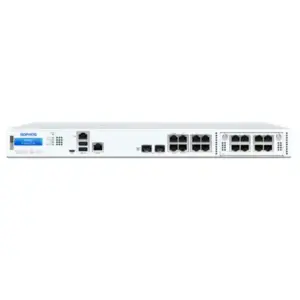
Fortinet FortiADC 4000G in Dubai, UAE
FortiADC 4000G is designed for enterprise and service-provider environments that need substantial application-delivery capacity, high-speed 40G/100G connectivity, SSL/TLS acceleration, server load balancing and application-security controls in a dedicated hardware platform. The buying decision should be based on real traffic behaviour, encrypted-session demand, redundancy objectives and the security services required, rather than headline throughput alone.
Plan the right 4000G configuration
Share expected traffic, application count, TLS profile, required interfaces, HA design and preferred security bundle. FourTeck can use those inputs to structure the quotation and implementation scope.
L4/L7 performance
TLS bulk encryption throughput
Maximum L4 concurrent connections
Dual hot-swap power supplies
Direct answer: where does the FortiADC 4000G fit?
Fortinet FortiADC 4000G is a hardware application delivery controller for large environments that need to distribute application traffic across servers or sites while handling substantial encrypted traffic and connection volumes. It should be considered by enterprises, hosting operators, service providers, financial organisations, public-sector environments and other businesses running critical web or application services at data-centre scale. Before proceeding, buyers should confirm that the 4000G capacity aligns with measured or forecast traffic, that the 40G and 100G interfaces match the switching design, that the chosen transceivers and cabling are appropriate, and that the selected FortiADC security and support bundle covers the services the project requires.
What the appliance does
An application delivery controller sits between users and application servers and makes traffic decisions that can improve availability, scale and operational control. FortiADC provides Layer 4 through Layer 7 load balancing, health checking, content-based routing, scripting, SSL/TLS services, global server load balancing, application optimisation and visibility functions. Depending on the selected bundle and services, the platform can also provide controls such as web application firewall capabilities, IP reputation, intrusion prevention, credential-stuffing defence, sandbox integration, data-loss-prevention functions, threat analytics and advanced bot protection.
For the 4000G specifically, the value is not just feature breadth. Its role is to provide these application-delivery functions at a scale appropriate for high-throughput environments and dense east-west or north-south application traffic.
Who should shortlist it
The FortiADC 4000G is most relevant where application delivery has become an infrastructure function rather than a small edge service. Typical candidates include multi-application data centres, organisations consolidating many virtual services, high-volume digital platforms, environments with strong TLS processing demand and businesses that want a dedicated ADC rather than depending only on application-server software or cloud-native load balancers.
It may be oversized for branch offices, modest internal applications or small web farms. A smaller FortiADC model, a virtual appliance or a cloud option can be more appropriate when traffic, interface density or concurrent connection requirements are substantially lower. FourTeck can help compare these options before a hardware purchase is committed.
Business problems the FortiADC 4000G helps address
The 4000G is useful when application delivery creates operational pressure in several places at once: server pools need better distribution, encrypted traffic consumes compute resources, applications span more than one location, or security and delivery teams need a consistent control point. The following challenges are common reasons to evaluate a dedicated ADC.
Uneven server utilisation
Advanced health checks and Layer 4–7 load-balancing policies can direct requests toward suitable healthy servers instead of allowing traffic to overwhelm one resource while another remains underused.
TLS processing overhead
Hardware SSL acceleration can offload encryption and decryption work from backend systems. This is especially relevant where encrypted application traffic is high and the server estate is already heavily utilised.
Multi-site application resilience
Global server load balancing can participate in distributing application access across data centres or regions, using criteria such as site state and policy. The wider disaster-recovery design still needs to be engineered end to end.
Fragmented application controls
FortiADC brings delivery, visibility and several application-security functions into one platform. Which protection services are available depends on the subscription bundle and current Fortinet licensing.
Core capabilities buyers should evaluate
L4–L7 load balancing
Policy-driven traffic distribution, persistence, advanced health checks, content routing and scripting can support complex application-delivery requirements beyond simple round-robin balancing.
SSL/TLS services
ASIC-based SSL acceleration supports high-volume cryptographic processing. Offload, inspection and visibility can be valuable when encrypted traffic dominates application delivery.
Application security
WAF, IPS, reputation controls and additional security services can be incorporated depending on bundle selection. Buyers should map each required control to the exact subscription before ordering.
Automation and visibility
FortiADC supports APIs, automation tools and integrations designed to make application changes more manageable while FortiView and related integrations provide operational insight.
FortiADC 4000G fit matrix
| Requirement | Suitable when | Confirm before ordering |
|---|---|---|
| High application throughput | Measured or forecast L4/L7 traffic justifies a platform rated at 150 Gbps under Fortinet test conditions. | Real traffic mix, packet sizes, features enabled and growth headroom. |
| Heavy encrypted traffic | TLS offload and high cryptographic transaction capacity are design priorities. | Cipher suites, certificate design, TLS termination points and inspection requirements. |
| 40G/100G data-centre links | The switching fabric already uses, or is planned around, QSFP/QSFP28 connectivity. | Optics, breakout requirements, fibre type, switch compatibility and port allocation. |
| Redundant application edge | The application design calls for high availability with dedicated HA interfaces and redundant power. | HA topology, rack/power diversity, state synchronisation and failover tests. |
| Integrated application controls | Application delivery and security services should be managed from a common ADC platform. | Exact FortiADC bundle, subscription term and services required. |
Verified FortiADC 4000G specifications
The values below reflect current Fortinet published information for the FortiADC 4000G. Performance measurements are laboratory results and real performance can vary with traffic characteristics, enabled services, network design and configuration. Where current Fortinet sources differ, the newer ordering information and current model page are used for the interface count.
| Brand | Fortinet |
| Product | FortiADC 4000G |
| Manufacturer SKU | FAD-4000G |
| Product type | Hardware application delivery controller |
| L4/L7 performance | 150 Gbps |
| L4 connections per second | 2.1 million |
| L4 HTTP requests per second | 11 million |
| L7 requests per second | 3 million |
| Maximum L4 concurrent connections | 200 million |
| SSL acceleration technology | ASIC |
| TLS bulk encryption throughput | 90 Gbps |
| TLS TPS, ECDHE-RSA-AES256-GCM-SHA384 | 85,000 |
| TLS TPS, ECDHE-ECDSA-AES256-GCM-SHA384 | 110,000 |
| Compression throughput | 75 Gbps |
| Virtual domains | Up to 120 |
| Memory | 256 GB |
| Data interfaces | 8 x 40G QSFP and 2 x 100G QSFP28 |
| Management / HA | 1 x 10/100/1000 management interface and 2 HA interfaces |
| Storage | 480 GB SSD |
| Management methods | HTTPS, SSH CLI, direct console CLI and SNMP |
| Power supplies | Dual, supporting hot swap |
| Trusted Platform Module | Yes |
| Form factor | 2U appliance |
| Dimensions | 440 x 88 x 600 mm |
| Weight | 15.68 kg / 34.56 lb |
| Input voltage | 100–240V AC, 50/60 Hz |
| Power consumption | 594 W average / 684 W maximum |
| Operating temperature | 0°C to 40°C |
| Airflow | Front to back |
| Availability | Contact FourTeck for current UAE availability and vendor lead time. |
Configuration, licensing and compatibility dependencies
A FortiADC 4000G purchase should be treated as a configured infrastructure solution, not simply a chassis purchase. Fortinet offers Network Security, Application Security and AI Security bundle families for current FortiADC appliances. The bundle choice affects which security services are available, while support term and service level affect lifecycle support and replacement options. FortiADC AI-Assist and advanced security functions also have their own service conditions. The exact commercial SKU therefore needs to be confirmed against the project requirement rather than assuming that every capability described for the platform is included with base hardware.
Interface planning deserves equal attention. QSFP and QSFP28 ports require compatible optics or cabling, and the bill of materials should match fibre type, distance, switch-side interfaces and any breakout design. High availability requires two appliances when appliance-level redundancy is required, plus a topology that accounts for upstream and downstream redundancy. Application compatibility should be reviewed for persistence behaviour, source IP handling, TLS termination, certificate chains, health checks, HTTP versions, authentication dependencies and any application-specific header or content-routing requirements.
A practical purchase and deployment journey
Measure the workload
Capture peak throughput, average throughput, connections per second, concurrent connections, request rates, TLS transaction volume and expected growth. Include seasonal or event-driven peaks rather than relying only on monthly averages.
Map applications and policies
List virtual services, server pools, persistence needs, health checks, certificates, routing policies, WAF requirements, authentication and any scripts or custom traffic logic that the ADC must support.
Build the bill of materials
Confirm appliance quantity, exact bundle SKU, support term, transceivers, cables, rack and power requirements. If high availability is required, verify both appliance and network redundancy components.
Plan migration and testing
Define staging, configuration, change windows, rollback criteria, health-check validation, SSL tests, load tests, failover tests and operational handover before production traffic is moved.
High-speed application delivery without ignoring real traffic behaviour
The 150 Gbps L4/L7 figure places the FortiADC 4000G in a high-capacity part of the current FortiADC hardware range, but buyers should avoid treating a single throughput number as a complete sizing answer. Application traffic varies significantly. A media platform may push large payloads and value raw throughput, while a transaction-heavy portal may create high request and connection rates with comparatively small payloads. An API platform may have intense TLS handshakes and strict latency requirements. A financial application may use persistence, complex health checks and application-layer decisions that introduce a different processing profile.
This is why sizing should combine several measurements. Fortinet publishes up to 2.1 million L4 connections per second, 11 million L4 HTTP requests per second, 3 million L7 requests per second and up to 200 million concurrent L4 connections for the 4000G. These metrics offer useful reference points, yet real results will depend on configuration, packet and request sizes, enabled security inspection, encryption parameters, network conditions and other factors. A well-sized ADC should have enough headroom for busy periods and failover conditions, not merely enough capacity to pass an average-day traffic test.
Buyers should also consider where the ADC sits in the architecture. If two data centres operate active-active, each location may need enough capacity for its normal share plus a defined amount of spillover when another site is impaired. In an active-standby design, the surviving system may need to absorb the full production workload. If the ADC is placed in front of several application tiers or internal services, east-west traffic can be as important as internet-facing traffic. FourTeck can help turn these architectural assumptions into sizing questions before the quotation is finalised.
SSL/TLS acceleration as an infrastructure design decision
Encrypted application traffic is now normal, which means the ADC often becomes part of the cryptographic path. FortiADC 4000G uses hardware-based SSL acceleration and is rated by Fortinet for 90 Gbps TLS bulk encryption throughput. Fortinet also publishes transaction-rate figures for specified ECDHE cipher suites. These figures matter when applications create many new encrypted sessions, when certificates are terminated at the ADC, or when the platform is used to provide visibility into encrypted flows before traffic reaches additional security controls or backend servers.
The key design question is not simply whether the appliance supports TLS, but where encryption should begin and end. Some organisations terminate TLS at the ADC and send clear traffic only across a protected internal segment. Others re-encrypt traffic from the ADC to application servers. Certain regulated or security-sensitive environments may require encryption throughout the path, stronger certificate-management processes or hardware security module integration. FortiADC also supports integration with an HSM for selected key-management designs, but exact interoperability and implementation requirements should be validated for the project.
Certificate lifecycle management should be included in operational planning. Teams need to know who owns certificate renewal, what certificate authorities are used, how private keys are protected, whether automated renewal is appropriate, and what happens if an application team changes hostnames or introduces new domains. Cipher suites, TLS versions, client compatibility and backend re-encryption also affect the design. Treating the 4000G as part of the application PKI and certificate lifecycle from the beginning can prevent avoidable outages later.
Application security and bundle selection
FortiADC combines delivery functions with multiple layers of application and network security, but the security-service mix depends on the selected bundle and current subscriptions. Fortinet’s current ordering guide identifies Network Security, Application Security and AI Security bundle families. Network Security covers foundational services such as Geo-IP and IP reputation, antivirus and intrusion prevention. Application Security adds web-security signatures and adaptive learning, credential-stuffing defence, FortiGuard Sandbox Cloud and FortiGuard DLP. The AI Security bundle extends the service set with Threat Analytics and FortiGuard Advanced Bot Protection. Buyers should verify the current bundle matrix at the time of quotation because service packaging can change.
This layered approach can be useful when the ADC is already the application traffic control point. A web application firewall can apply application-layer policies, IPS can inspect network traffic, reputation services can add intelligence to access decisions, and credential-stuffing or bot controls may address automated abuse. However, an ADC does not automatically replace every dedicated security product. A full application-security architecture may still include FortiWeb, FortiGate, API security, endpoint controls, SIEM or other systems depending on the threat model and compliance requirements.
The purchasing process should therefore start with the security outcome required, not with a bundle name alone. Ask which applications are public, which APIs are exposed, whether authentication is handled by the application or ADC, what attacks are already observed, which logs must be retained and whether centralised security analytics are required. Once those answers are known, FourTeck can help align the bundle, licensing term and surrounding components with the intended use.
Ideal environments and practical use cases
Large enterprise web platforms
Organisations delivering customer portals, e-commerce, online services or digital channels from sizeable server farms can use the 4000G to distribute sessions, monitor server health and manage encrypted connections at high scale.
Data-centre consolidation
When multiple applications are consolidated behind a common application-delivery tier, high concurrent connection capacity, virtual domains and automation features can support separation and operational consistency.
Service-provider environments
Hosting and managed-service designs may need dense application delivery, multi-tenancy and strong interface capacity. Tenant boundaries, logging, security bundles and management workflow should be mapped carefully.
Multi-site application resilience
GSLB capabilities can support application distribution between locations. The complete resilience plan still depends on DNS design, WAN reachability, application replication, data consistency and tested disaster-recovery procedures.
Integration and operational considerations
FortiADC should be designed as part of the application stack rather than added in isolation. Upstream, consider routers, data-centre switches, firewalls and external DNS. Downstream, map server networks, application platforms, containers, virtual machines and databases. FortiADC provides Fabric Connectors and integrations with technologies such as Kubernetes, cloud platforms and other Fortinet systems, while automation options include RESTful API, declarative API, Terraform, cloud-init and Ansible. Exact integration versions and supported workflows should be checked against the FortiADC software release chosen for deployment.
Operational visibility is equally important. FortiView can provide application and system information, and FortiADC can integrate with platforms such as FortiAnalyzer, FortiSIEM and Splunk. Logging architecture should define which events stay locally, which are forwarded, what retention period is required and who monitors alerts. Change management should define who can modify virtual servers, pools, certificates, WAF rules and scripts. In larger teams, these controls reduce the risk that an apparently small ADC change creates an application outage.
Finally, account for rack space, power draw, cooling and airflow. The 4000G is a 2U appliance with front-to-back airflow, and Fortinet publishes 594 W average and 684 W maximum power consumption. Dual power supplies support redundant power design, but the data-centre implementation should place them on appropriately diverse power feeds when resilience is required.
Buyer questions to resolve before requesting a quote
Real monitoring data makes appliance sizing more reliable than estimates based only on user count.
Certificate count, cipher profile and new-session rate influence cryptographic load and design.
A resilient design normally needs two appliances plus network and power redundancy, not only one chassis.
Bundle choice should map directly to required security controls and the preferred subscription term.
Confirm 40G/100G connectivity, fibre type, distance, breakout design and compatible transceivers.
Document virtual services, health checks, persistence, scripts, certificates, WAF policies and operational dependencies.
Procurement checklist for FortiADC 4000G
✓ Confirm manufacturer model FAD-4000G and required quantity.
✓ Confirm whether the design is standalone or high availability.
✓ Record peak L4/L7 throughput and forecast growth.
✓ Record connection, request and TLS transaction requirements.
✓ Select Network Security, Application Security or AI Security bundle as required.
✓ Confirm support level and subscription term.
✓ Specify 40G QSFP and 100G QSFP28 optics or direct-attach requirements.
✓ Confirm switch-side compatibility and cabling distances.
✓ Review rack, dual-power and cooling requirements.
✓ Define certificate ownership and SSL termination design.
✓ Document virtual servers, pools, health checks, persistence and scripts.
✓ Define installation, migration, testing and handover scope.
✓ Confirm logging, monitoring and management integrations.
✓ Confirm UAE delivery location and required project timeline.
How FourTeck can assist with FortiADC planning
FourTeck can help translate a business requirement into the information needed for an accurate product and service quotation. That may include reviewing current traffic data, discussing expected growth, identifying the right FortiADC form factor, checking whether the 4000G is proportionate to the workload, clarifying bundle choices, assembling transceiver and cabling requirements, and defining whether configuration or migration assistance should be included. For organisations already using Fortinet technologies, the discussion can also cover surrounding Fortinet firewall solutions and how application delivery integrates with the wider environment.
Buyers can review additional FourTeck technology products or discuss installation and configuration services. The objective is to make the bill of materials, licensing assumptions and implementation responsibilities clear before purchase approval. A quote can then distinguish hardware, subscriptions, support, accessories and professional services rather than combining them into an ambiguous single line.
UAE availability and support guidance
Contact FourTeck to confirm current FortiADC 4000G availability in the UAE. Availability may depend on the exact commercial SKU, bundle term, quantity, vendor lead time and any accessories required. Delivery and project coordination can be discussed after the final requirement is confirmed. Where configuration, migration or installation assistance is needed, the scope should be included in the quotation so responsibilities, prerequisites and testing expectations are understood before the project begins.
For organisations in Dubai, Abu Dhabi, Sharjah and Ajman, FourTeck can coordinate requirement review and quotation planning from a single UAE engagement. Buyers should provide the deployment site, quantity, desired timeline, high-availability requirement, preferred support term and any special data-centre access or change-window constraints. No delivery date, installation date or support response should be assumed until it has been confirmed in the relevant commercial documents.
GCC Availability
FourTeck can assist businesses planning FortiADC 4000G deployments across GCC markets by reviewing the requirement before procurement. A regional project may involve the United Arab Emirates, Saudi Arabia, Kuwait, Qatar, Bahrain or Oman, but the right approach is to confirm the destination country, exact appliance and bundle SKU, quantity, licence or subscription term, required transceivers, support expectation and installation scope for each site. Product availability, licensing, delivery schedules, service visits and vendor lead times can differ by country and by project. If the ADC is part of a multi-country application platform, it is also useful to document which locations will operate active traffic, which will provide disaster-recovery capacity and whether one configuration standard will be used across all sites. FourTeck can coordinate quotation and planning discussions, including regional delivery considerations and technical preparation. Buyers in Kuwait can also review FourTeck Kuwait resources where relevant.
Africa Availability
For African deployments, FourTeck can help organisations evaluate whether the FortiADC 4000G is suitable for the application scale and then structure the product, licensing, accessory and support requirement for regional procurement. Availability and fulfilment can depend on the destination country, appliance quantity, licensing region, vendor lead time, power and rack requirements, shipping arrangements and local project conditions. Buyers should share the exact deployment country, expected timeline, required quantity, preferred security bundle, high-availability design and whether implementation or remote support is expected. The same technical design may not be appropriate for every site, especially where network capacity or data-centre standards differ. FourTeck can coordinate requirement review for East Africa and other regions, with dedicated resources available through FourTeck Africa and FourTeck Kenya. Local inventory, customs outcomes and fixed delivery dates should be confirmed separately rather than assumed.
Related products, services and alternatives to evaluate
FortiADC 2000G
A lower-capacity G-series appliance that may suit projects where the 4000G provides more headroom than required. Compare throughput, interfaces, TLS demand and growth expectations.
FortiADC 5000G
The larger current hardware model for workloads that require substantially more throughput, TLS capacity or 100G interface density. Selection should be based on measured demand.
FortiADC security bundles
Network Security, Application Security and AI Security bundle choices affect the security services associated with the deployment. Confirm the current ordering code and term.
Configuration and migration support
A professional-services scope can cover design review, base configuration, virtual-service creation, migration planning, testing and operational handover according to the agreed project boundary.
Why businesses contact FourTeck for this type of project
The most valuable support during an ADC purchase is often clarification. A buyer may know that application availability is a problem but not yet know whether the answer is a larger appliance, a second appliance, better health checks, a revised network design, a security bundle change or a migration to a different deployment model. FourTeck can help organise those questions into a practical requirement before the order is placed.
That assistance can include model comparison, licensing review, bill-of-material preparation, compatibility discussion, quotation coordination, deployment planning and migration scoping. It can also help procurement teams understand which line items are hardware, which are subscriptions, which are support services and which are optional implementation tasks. For company background and wider technology coverage, visit About FourTeck. To move from evaluation to a project-specific discussion, use the FourTeck contact page.
What buyers usually need to understand before choosing a 4000G
Many buyers first encounter the FortiADC 4000G while searching for a high-throughput load balancer, an enterprise ADC with 100G connectivity, a platform for SSL offloading or a way to improve availability across large server farms. Those are reasonable starting points, but the shortlisting process becomes easier once the requirement is translated into application behaviour. An ADC is not sized in exactly the same way as a firewall, switch or server. The important measurements include throughput, connections per second, concurrent connections, requests per second, TLS handshakes, certificate use, persistence state and the complexity of Layer 7 decisions.
Is 150 Gbps the number that matters most?
It matters, but it is not the only sizing dimension. A transaction-heavy application can become constrained by session or TLS processing before raw bandwidth is exhausted. A large file-delivery platform can show the opposite behaviour. Compare several metrics and leave margin for failover and growth.
Does the 4000G include every security service?
No purchasing assumption should be made from a feature list alone. Fortinet offers multiple FortiADC bundles, and service entitlement depends on the selected bundle and term. Ask for the quotation to name the exact bundle SKU and support period.
Another common buyer question is whether a physical ADC is still necessary when cloud load balancers exist. The answer depends on architecture. Cloud-native services are convenient for workloads that live entirely inside a cloud platform, while a physical ADC can be attractive for on-premises data centres, hybrid designs, shared enterprise infrastructure and environments that want consistent application-delivery behaviour across many applications. FortiADC is also available in virtual and cloud forms, so organisations are not forced into one deployment model across every site. A hybrid organisation might use 4000G appliances in core data centres and virtual or cloud FortiADC instances elsewhere.
Port planning is another area where searches often focus on the headline “100G” label without considering the rest of the network. Current Fortinet information for the 4000G lists eight 40G QSFP ports and two 100G QSFP28 ports. Those ports only become useful when the upstream and downstream design supports the same speeds and physical media. The quotation should therefore address transceivers, direct-attach cables or fibre, switch interface type, distance and redundancy. If breakout cabling is planned, confirm the exact supported design and software behaviour rather than assuming any physical breakout arrangement will work.
Buyers also ask about price. Public online pricing for enterprise ADC hardware can vary substantially between resellers and may not reflect UAE channel pricing, support bundles, licensing terms, taxes, freight or project services. For that reason, a current FourTeck quotation is more useful than a public price found in isolation. Provide the exact quantity, bundle term and delivery location so the commercial response is based on the real requirement. If implementation is needed, ask for that work to be shown as a separate scope so procurement can distinguish product cost from professional services.
A final recurring concern is migration risk. Moving from another ADC is not simply a matter of importing IP addresses. Application delivery configurations contain persistence policies, server health checks, SSL profiles, certificates, content-routing rules, NAT behaviour, header modifications, scripts and security policies. Some of these can be translated directly; others need redesign because platforms implement features differently. A migration plan should identify each virtual service, map old behaviour to new behaviour, create a test plan and define rollback. Production cutover should happen only after backend health, client access, certificate chains, logging and HA failover have been tested.
For organisations comparing FortiADC 4000G with a smaller or larger model, the objective should be to find enough capacity with sensible resilience and growth margin. Buying the largest appliance without evidence can waste capital, while choosing too small a model can create another migration sooner than expected. FourTeck can help make the comparison using your actual traffic and operational requirements rather than generic user-count assumptions.
Questions that shape the final design
How much capacity should remain unused at normal peak?
There is no universal percentage. Headroom should account for growth, traffic bursts, maintenance events and HA failover. If two appliances normally share traffic, determine what happens when one unit is unavailable and size the surviving path accordingly.
Should TLS terminate on the ADC or on the application servers?
Both designs are possible. Terminating on the ADC can reduce server cryptographic workload and enables application-layer processing. Re-encryption to the backend may be required by security policy. Certificate ownership and key protection should be defined before configuration.
Can FortiADC replace a dedicated WAF?
FortiADC offers WAF and related application-security functions depending on licensing, but whether it can replace a dedicated WAF depends on the application’s security requirements, policy depth, API needs, organisational controls and compliance expectations. Evaluate the use case rather than assuming equivalence.
What information speeds up a quotation?
Provide model, quantity, HA requirement, bundle preference, support term, deployment country, needed interfaces, optics, target timeline and whether installation or migration is required. For sizing, add peak throughput, request, session and TLS data where available.
What if the current ADC is from another vendor?
Treat the project as a behaviour migration. Inventory virtual services, pools, monitors, persistence, NAT, SSL profiles, scripts and security rules. Map each behaviour to FortiADC and test it. Do not assume configuration syntax or feature semantics are identical across vendors.
When is a smaller FortiADC more sensible?
If measured traffic, TLS demand and interface requirements are comfortably below the 4000G’s capacity and future growth is modest, a smaller appliance can be more proportionate. The comparison should include resilience needs and the cost of an earlier future upgrade.
These questions help separate a product purchase from a successful application-delivery design. FourTeck can use the answers to advise on sizing, bundle selection, bill of materials, configuration scope and quotation structure. Where the answer depends on an application owner, network team, security team or data-centre provider, collecting those inputs early reduces uncertainty later in the project.
Frequently asked questions about FortiADC 4000G
What is the Fortinet FortiADC 4000G mainly used for?
It is used to distribute and manage application traffic at large scale, with Layer 4–7 load balancing, health checks, SSL/TLS services, global server load balancing, application optimisation and security capabilities. It is most relevant to high-capacity data-centre and enterprise application environments.
What throughput does the FortiADC 4000G support?
Fortinet publishes 150 Gbps L4/L7 performance for the 4000G under its test conditions. Actual performance can vary with traffic patterns, enabled services, configuration and network conditions, so sizing should include more than one metric.
Which high-speed ports are on the current 4000G?
Current Fortinet model and ordering information lists eight 40G QSFP ports and two 100G QSFP28 ports, plus management and HA interfaces. Confirm optics, cabling and switch compatibility before ordering.
Does FortiADC 4000G include web application firewall capability?
FortiADC supports WAF functionality, but security-service entitlement depends on the bundle and subscription selected. Ask for the quotation to identify the exact bundle and term rather than assuming every service is included with the chassis.
Can FortiADC 4000G be deployed in high availability?
Yes, FortiADC supports high-availability designs and the appliance includes dedicated HA interfaces. A resilient production architecture generally requires two appliances plus suitable network and power redundancy. The exact HA mode and failover design should be planned for the application.
What FortiADC 4000G security bundles are available?
Fortinet’s current ordering guide identifies Network Security, Application Security and AI Security bundle families for the 4000G. Feature entitlement and subscription details should be confirmed against the latest ordering information when the quote is prepared.
Is the FortiADC 4000G suitable for a small office?
Usually it would be disproportionate for a small office because it is a high-capacity 2U data-centre appliance. Smaller FortiADC hardware, virtual appliances or cloud options may fit lower-scale requirements better. Sizing should be based on measured demand.
Can FourTeck help with migration from another ADC?
Migration assistance can be discussed as part of the project scope. A useful starting point is an inventory of virtual services, pools, health checks, persistence policies, certificates, SSL profiles, scripts, NAT behaviour and security rules so the migration effort can be assessed.
How do I get a FortiADC 4000G price and UAE availability?
Contact FourTeck with the required quantity, deployment location, bundle preference, support term, HA requirement and needed accessories. Current UAE availability, lead time and commercial terms should be confirmed through a project-specific quotation.
Turn the 4000G specification into a deployment-ready quote
Send FourTeck your traffic requirements, HA design, interface plan, security bundle preference and delivery location. The quotation can then be prepared around the exact appliance, subscriptions, optics, support and implementation scope rather than a generic product line.

Reviews
There are no reviews yet.