
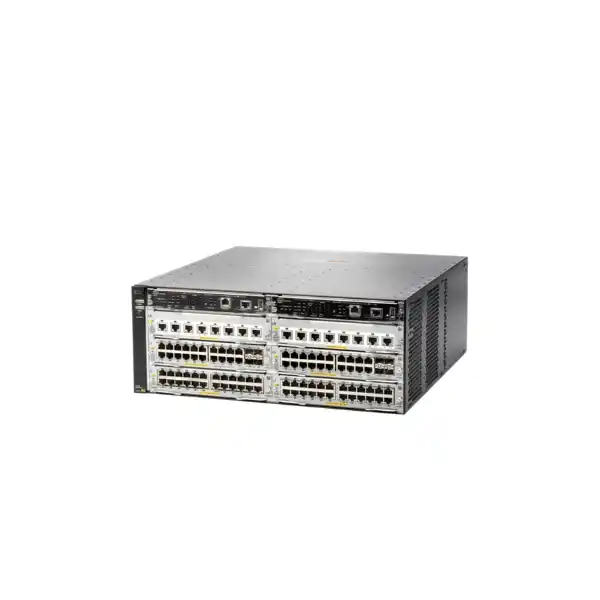
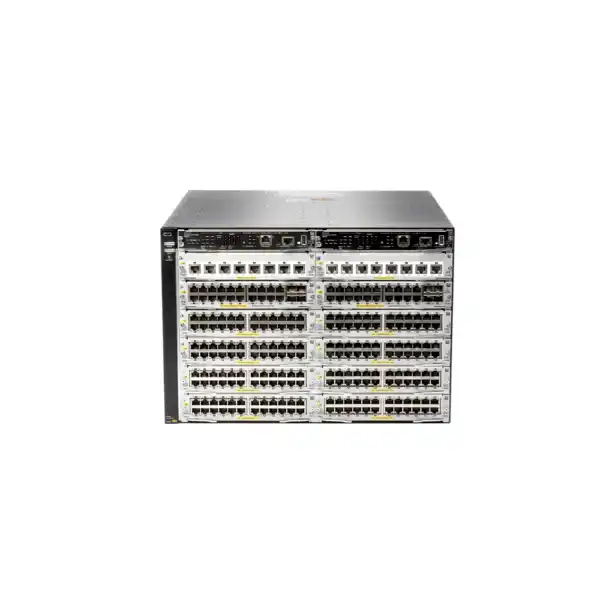
HPE Aruba Networking 5400R zl2 Switch Series in Dubai
A resilient modular switching family for organizations that need to combine high-density access ports, multi-gigabit wireless connectivity, fibre uplinks, Layer 3 routing and redundancy in a chassis-based platform. The key buying decision is not simply “5400R or not”; it is choosing the right 5406R or 5412R chassis, module generation, port mix, PoE budget, uplink media and management design for the actual network.
Direct answer: what is the HPE Aruba Networking 5400R zl2?
The HPE Aruba Networking 5400R zl2 Switch Series is a modular enterprise Layer 3 switching platform built around the 5406R and 5412R chassis. It is mainly used for campus access and aggregation where a business wants a configurable mix of high-density Gigabit Ethernet, PoE+, fibre, 10GbE, HPE Smart Rate multi-gigabit and 40GbE connectivity, together with routing, policy, resiliency and centralized management capabilities.
It should be considered by organizations with larger wiring closets, campus distribution requirements, high access-point density, demanding PoE environments, or a need for modular growth rather than a fixed-port switch. The most important factor to confirm is the complete chassis configuration: slot count, interface modules, v2/v3 feature requirements, power-supply capacity, PoE budget, uplink optics, redundancy and management method. FourTeck can help translate user counts, AP density, endpoint ports, uplink speeds and resilience targets into a bill of materials suitable for Dubai and UAE deployment.
Where the 5400R zl2 fits in an enterprise network
The 5400R zl2 is not a single fixed-port switch. It is a chassis family intended for networks where the port mix, density and resilience requirements justify modular hardware. In a campus access role, a 5406R can consolidate many copper endpoints, wireless access points, phones, cameras and IoT devices while leaving room for fibre or high-speed uplinks. In a larger building or aggregation role, the 5412R provides twice the interface-module slot count and can support much higher port density from one chassis. This distinction matters because a buyer who only asks for “one Aruba 5400R” has not yet defined a complete solution.
The platform uses HPE Aruba Networking’s ProVision architecture and combines Layer 2 switching with substantial Layer 3 functionality. HPE documents support for OSPF, OSPFv3, IPv4 BGP, static routing, policy-based routing, IPv6 functions, QoS, ACLs, VRRP, dynamic segmentation and other campus features. For organizations that already operate Aruba wireless, NAC or management tools, the 5400R can also participate in an integrated wired-and-wireless operating model. That can reduce operational fragmentation, but it does not remove the need to validate software versions, supported modules and the management subscription model for the intended deployment.
The 5400R family is particularly relevant when a network team values long-lived modular capacity. A fixed switch may be simpler and more economical for a small office or a predictable 24- or 48-port closet. A modular chassis becomes more compelling when the closet needs mixed media, hundreds of powered ports, redundant management, redundant power, higher-speed uplinks, or staged capacity expansion. The trade-off is that modular platforms require more design discipline: chassis, modules, management modules, power supplies, transceivers, cables and support coverage all need to be aligned.
5406R versus 5412R: the first sizing decision
| Decision point | 5406R zl2 | 5412R zl2 |
|---|---|---|
| Open module slots | 6 | 12 |
| Maximum 1GbE access ports | Up to 144 | Up to 288 |
| Maximum SFP+ / Smart Rate ports | Up to 48 | Up to 96 |
| Maximum 40GbE ports | Up to 12 | Up to 24 |
| Power supply slots | 2; at least 1 PSU required | 4; at least 2 PSUs required |
| Typical reason to choose | Moderate-density access, mixed-media closet, aggregation with lower slot demand | High-density access, larger PoE estate, larger growth reserve or consolidated campus distribution |
These are platform ceilings, not a guarantee that every port combination can be populated simultaneously without further checks. Module type, slot usage, generation, PoE load, power supply selection and software requirements influence the practical configuration. If a project needs 120 copper PoE+ ports today but expects significant AP growth, for example, a 5406R may technically fit while a 5412R may offer a cleaner expansion path. Conversely, purchasing a 12-slot chassis for a stable 48-port environment can add cost, rack space and power capacity that the network never uses.
Interface modules: why the exact port mix matters
A major advantage of the 5400R is the breadth of supported zl2 interface modules. HPE lists v3 modules for 24-port 10/100/1000BASE-T PoE+ with MACsec, 24-port Gigabit copper without PoE, 24-port 1GbE SFP, mixed 12-port copper PoE+ plus 12-port SFP, 20-port copper PoE+ plus four 1/10GbE SFP+, 20-port copper PoE+ plus four HPE Smart Rate multi-gigabit ports, 20-port copper PoE+ plus one 40GbE QSFP+ port, eight-port SFP+, eight-port HPE Smart Rate, and two-port 40GbE QSFP+. Older v2 zl modules also exist in the ecosystem, so a replacement or expansion order should identify the installed module generation instead of assuming all functions are identical.
High-density copper
Best suited to desks, phones, cameras and standard Ethernet endpoints. Decide whether PoE+ is required and calculate the aggregate powered-device budget rather than counting ports alone.
HPE Smart Rate
1/2.5/5/10GBASE-T options are useful where multi-gigabit AP or device links must exceed 1GbE over copper. Cabling quality and endpoint negotiation capabilities must also support the intended rate.
SFP/SFP+ fibre
Useful for building links, server connections and aggregation. The switch module is only one part of the link; optic type, fibre grade, wavelength and distance must match both ends.
40GbE QSFP+
Provides higher-capacity aggregation where traffic from many access ports converges. A 40GbE module should be justified by upstream capability and traffic design, not added automatically.
PoE+ planning is a power-budget exercise, not a port-count exercise
The 5400R zl2 supports IEEE 802.3at PoE+, allowing suitable modules to deliver up to 30 watts per port for devices such as wireless access points, IP phones and security cameras. The 5412R platform can reach very high powered-port density, but the available PoE budget depends on the installed power supplies and the load profile of the connected devices. A design with 200 ports does not necessarily mean 200 devices draw maximum PoE power at the same time, yet a safe procurement plan should still model realistic maximum consumption, startup behavior and resilience goals.
For a resilient deployment, ask whether the network must maintain all powered endpoints after one power supply fails. That requirement can materially change the number and size of PSUs needed. The same applies to access points: newer APs may require more power and may also benefit from Smart Rate links, so endpoint model numbers are valuable quotation inputs. FourTeck can calculate the chassis power arrangement after receiving the expected device list, quantity by type and desired failure tolerance.
Resiliency: management, power and VSF should be designed together
The 5400R architecture supports redundant management and hot-swappable power supplies. HPE describes dual management-module operation in which switching can continue during an active-to-standby management failover. This can be valuable for building distribution and access environments where a single management component should not become a maintenance risk. Redundant power can similarly protect against a PSU failure, provided the installed supplies and power budget are sized for the desired failure scenario.
Virtual Switching Framework, or VSF, can combine two supported 5400R systems into one virtual resilient switch. HPE documents VSF with v3 modules, allowing downstream servers or switches to use standard LACP across members for load balancing and availability. Fast software upgrade for a VSF stack can reduce service interruption by sequentially upgrading members, again subject to the required v3 environment. These capabilities are significant, but they should be treated as an architecture choice rather than a checkbox. A VSF pair requires appropriate inter-switch connectivity, compatible software and a clear understanding of failure domains.
Some networks may instead prefer independent routed distribution switches, VRRP, ECMP or another redundancy model. The 5400R supports VRRP for highly available routed environments and a range of spanning-tree and link-aggregation mechanisms. The most suitable design depends on existing topology, operational standards and change-control practices. For an upgrade project, preserving the previous logical design may be less disruptive; for a new campus, simplifying the topology with VSF may be attractive if all feature prerequisites are met.
Layer 3, policy and automation capabilities
HPE positions the 5400R zl2 as an advanced Layer 2 and Layer 3 modular switch. The documented feature set includes IPv4 and IPv6 routing, OSPF, OSPFv3, IPv4 BGP, policy-based routing, VRRP, ACLs, QoS and multicast-related functions. The platform also supports REST APIs and OpenFlow interfaces for automation and software-defined networking use cases. For many campus networks, these capabilities allow the switch to act as more than a basic access-layer device, particularly where local routing or distribution functions are required.
Dynamic Segmentation can apply user- and device-oriented policy across Aruba wired and wireless environments, with traffic tunneling to an Aruba controller in supported designs and identity information supplied by Aruba NAC capabilities. That can be useful for organizations trying to apply consistent policy to employees, guests, IoT devices and other endpoint classes. However, a buyer should not assume that purchasing a chassis alone delivers a complete segmentation solution. NAC, controller/gateway, software versions and broader architecture must be compatible with the desired workflow.
The hardware’s core Layer 2/Layer 3 feature set is documented as not requiring a separate switch software feature license, but cloud management through HPE Aruba Networking Central is a different commercial consideration. HPE currently lists Central switch subscriptions in its QuickSpecs. Therefore, teams that want cloud-based management should define the required subscription term and service level as part of the bill of materials rather than treating cloud management as automatically included with the switch.
Management and operations
HPE documents support for HPE Aruba Networking Central and legacy management software, along with zero-touch provisioning workflows, REST API automation, RMON/XRMON, sFlow, LLDP, remote intelligent mirroring and dual software images. For an operations team, the practical question is which tool will be authoritative for configuration, monitoring and change control. A network already standardized on Central may want the 5400R integrated into that operational model, while another organization may continue with an on-premises or CLI-led approach.
Before migration, capture the existing VLANs, trunks, routing protocols, ACLs, QoS policies, authentication settings, spanning-tree design, SNMP/monitoring configuration and any device-specific scripting. Modular chassis replacements often look simple physically but can carry years of accumulated configuration. A controlled migration should separate features that must be preserved from obsolete settings that should not be copied forward. This is also the right time to verify firmware targets and the supported feature set of the exact module generation.
Compatibility and procurement risks to check before ordering
Performance and scale: interpret the headline numbers correctly
The series architecture is specified with a 2 Tbps crossbar switching fabric and up to 785.7 million packets per second across the purpose-built ProVision ASIC architecture. The chassis-specific QuickSpecs list up to 960 Gbps routing/switching capacity for the 5406R and up to 1.92 Tbps for the 5412R, with corresponding throughput figures that reflect their different scale. HPE also lists low-latency forwarding, with figures varying by interface speed. These numbers show that the platform was designed for line-rate campus switching rather than low-end access duties.
A buyer should still size around traffic paths, not only fabric capacity. If hundreds of access ports aggregate into a small number of uplinks, the uplink design may become the practical bottleneck first. Wireless-heavy sites should consider how many APs can actually produce multi-gigabit traffic, how traffic is distributed across uplinks, and whether 10GbE or 40GbE aggregation is justified. Server or storage traffic may have different burst and latency characteristics than ordinary user access. The modular design gives flexibility, but the useful configuration depends on where bandwidth converges.
Practical Dubai and UAE deployment scenarios
Large office or headquarters access
A 5406R or 5412R can combine user ports, IP phones, cameras and wireless APs in one modular wiring-closet platform. The correct choice depends on total port count, PoE reserve and planned growth.
Wireless-dense campus
Smart Rate ports can support compatible multi-gigabit AP uplinks while 10GbE or 40GbE modules aggregate traffic upstream. Cable category and AP power needs should be checked together.
Education or hospitality
High endpoint density and broad PoE requirements can favor a chassis platform. Segmentation, guest access, cameras and APs should be mapped to security and power requirements before module selection.
Campus distribution
Fibre, 10GbE and 40GbE modules can position the platform for aggregation roles. Routing protocols, redundancy and uplink diversity determine whether it is the right fit for the distribution architecture.
When another switch family may be a better fit
The 5400R zl2 remains a capable modular platform, but modularity should solve a real problem. A smaller fixed-port Aruba switch may be more appropriate when a site needs only 24 or 48 ports, has modest PoE requirements and does not need chassis redundancy. Fixed switches can reduce rack consumption, simplify sparing and make per-closet expansion more granular. Buyers should therefore compare the operational benefit of a chassis with the cost and complexity of maintaining it.
At the other end of the scale, a project that expects substantially higher-speed campus aggregation, newer architectural requirements, or a broader modern data-center feature set should evaluate current Aruba switching families alongside the 5400R. The right comparison depends on whether the requirement is primarily access density, campus core/distribution, EVPN/VXLAN, higher-speed uplinks, cloud-native operations, or long-term standardization. The supplied product name should not be treated as a predetermined technical decision when the network goals point elsewhere.
For an installed-base expansion, the decision can be different. If a customer already has a healthy 5400R chassis, compatible spare slots and a validated software baseline, adding supported modules may be less disruptive than replacing the platform. In that case, exact current chassis model, management module, existing v2/v3 modules, firmware version and support status become the most useful starting information.
Migration and installation planning
Inventory
Record current ports, VLANs, uplinks, optics, PoE endpoints, routes, ACLs, modules and firmware.
Design
Select chassis size, module mix, management redundancy, PSU count, PoE reserve and upstream bandwidth.
Stage
Assemble hardware, validate software, preconfigure management and test representative endpoint connectivity.
Cut over
Move uplinks and access blocks in a controlled sequence, checking routing, PoE, authentication and monitoring after each phase.
Site preparation should include 19-inch rack space, safe chassis handling, the required power feeds, cable management and environmental conditions. The 5406R is a 4U-class chassis while the 5412R occupies 7U, so rack-space planning differs materially. For business-critical cutovers, retain rollback paths and do not assume that configuration syntax or interface numbering will map one-to-one from a different switch family.
Frequently asked buyer questions
Is the 5400R one specific switch model?
No. The 5400R zl2 is a series built around multiple chassis and configured models, most notably the 5406R and 5412R. A quotation must identify the exact chassis SKU and the required modules, supplies and accessories.
Does the chassis include power supplies?
The base chassis and several configured models are specified without power supplies. The 5406R has two PSU slots and needs at least one supply; the 5412R has four PSU slots and requires at least two. Redundant and PoE-heavy designs may need additional capacity.
Can the 5400R support multi-gigabit access points?
Yes, with supported HPE Smart Rate v3 modules providing 1/2.5/5/10GBASE-T connectivity. Endpoint support, copper cabling and PoE requirements still have to be validated.
Does it support redundant switching?
The series supports redundant management and power options, and VSF can create one virtual resilient switch from two systems in supported v3 configurations. The final redundancy design should match the intended failure tolerance and topology.
Is Aruba Central included?
Cloud management capability is supported, but Central subscription terms are a separate commercial item. Specify whether Central is required and the desired subscription duration when requesting a quote.
Can existing zl modules be reused?
The family supports a range of v2 and v3 zl/zl2 modules, but compatibility and feature behavior should be checked for the exact part number. Do not assume an older module supports every v3-dependent feature.
Decision recap for an accurate 5400R purchase
Choose 5406R or 5412R according to slot demand, density, rack space and growth.
Define copper, PoE+, Smart Rate, SFP/SFP+, QSFP+ and expected future interfaces.
Size PSUs for endpoint load and decide whether PoE must survive a PSU failure.
Confirm v2/v3 modules, software version, optics, cabling and peer devices.
Decide on dual management, redundant power, VSF or an alternative high-availability model.
Define CLI/on-premises operations or Aruba Central and any required subscription term.
What FourTeck needs from you for a quotation
If some of these details are not yet known, provide the user/device count, number of floors or wiring closets, current switch models and expected growth. That is usually enough to begin a technical sizing discussion and identify the information that must be confirmed before commercial quotation.
Build the right HPE Aruba Networking 5400R configuration for your Dubai network
Send FourTeck your port count, PoE devices, uplink speeds and resilience requirements. We can help determine the appropriate 5406R or 5412R chassis, module mix, power supplies, optics, management requirements and deployment scope before you commit to a bill of materials.

Reviews
There are no reviews yet.