
HPE Aruba Networking 9012 Gateway Dubai
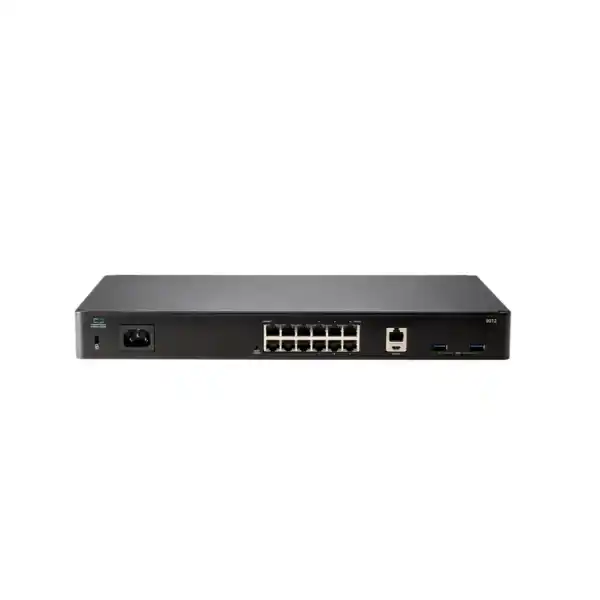
A 12-port branch gateway for organisations that need higher port density than compact desktop gateways, integrated PoE+ for selected edge devices, secure WAN services, WLAN gateway operation and HPE Aruba Networking Central-managed SD-Branch capability. The 9012 is best evaluated as part of a complete branch design rather than as a simple router replacement.
Fast buyer signal
The 9012 makes most sense where a branch needs more copper interfaces, local PoE delivery and materially more firewall headroom than the 9004 family.
Do not size on port count alone. Client count, encrypted traffic, security inspection, Central subscription tier, WAN topology and growth all affect the final design.
What is the HPE Aruba Networking 9012 Gateway?
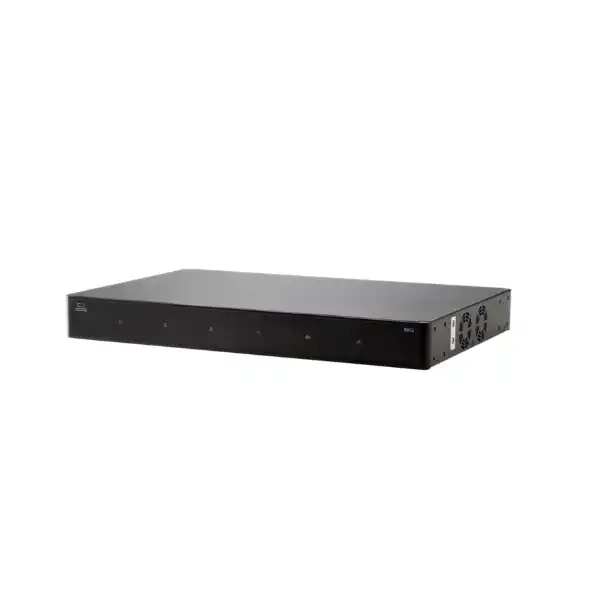
The HPE Aruba Networking 9012 is a rack-mount 9000 Series branch gateway built to combine branch WAN connectivity, stateful firewalling, secure tunnelling and WLAN gateway functions in a centrally managed platform. It is commonly considered for small-to-medium branch environments that need more physical interfaces and local PoE capability than the 9004-class appliance.
Main use: secure branch connectivity and SD-Branch or WLAN gateway roles under the appropriate HPE Aruba Networking software and Central licensing model. Who should consider it: organisations with distributed sites, retail or service branches, education or healthcare locations, enterprise offices and managed environments that standardise on HPE Aruba Networking. Most important factor to confirm: the intended deployment mode and subscription tier, because licensing, client scale, security services and management expectations must align with the hardware design.
FourTeck can help determine whether the 9012 has the right throughput, client scale, port mix, PoE budget and subscription profile for the branch, and whether a newer or larger HPE Aruba Networking gateway should be compared before procurement.
Where the 9012 fits
Within the 9000 Series branch gateway family, the 9012 is the higher-density fixed-port option compared with the 9004. Its twelve 1GbE interfaces and six PoE+ ports make it useful where the gateway may terminate multiple WAN and LAN connections or power a limited set of edge devices without adding a separate PoE switch solely for those endpoints.
What it is not
The 9012 should not be treated as a universal firewall, a high-density campus core, or an automatic replacement for every dedicated SD-WAN appliance. It is a branch gateway with a specific performance envelope. Sites requiring 10GbE or 25GbE uplinks, materially higher IDS/IPS performance, thousands more clients, or larger session scale should compare newer 9100 or 9200 Series platforms.
Dubai procurement note
Regional ordering matters. HPE lists different 9012 regulatory SKUs, including a Rest-of-World variant. UAE buyers should have the exact regional part number, power requirements, support entitlement, Central subscription and any rack or accessory requirements confirmed on the quotation rather than ordering by model name alone.
HPE Aruba Networking 9012 key specifications
| Ethernet interfaces | 12 × 100/1000BASE-T Gigabit Ethernet interfaces |
| PoE capability | 6 × PoE+ ports with up to 120W total PoE budget |
| Firewall throughput | Up to 6Gbps |
| Encrypted GRE throughput | Up to 6Gbps |
| AES-CBC encrypted throughput | Up to 4Gbps for AES-CBC-128 and AES-CBC-256 |
| AES-GCM encrypted throughput | Up to 6Gbps for AES-GCM-128 and AES-GCM-256 |
| Maximum clients | Up to 2,048 clients, subject to deployment and licensing considerations |
| Maximum access points | Up to 32 APs in supported designs |
| Maximum VLANs | 128 |
| Active firewall sessions | Up to 128,000 |
| IDS/IPS throughput | Up to approximately 1.1Gbps in HPE reference architecture data; actual security-service performance depends on configuration and traffic |
| Form factor | Rack-mount |
| Dimensions | Approximately 4.37cm × 39.5cm × 26.0cm |
| Weight | Approximately 3.42kg |
| Maximum power consumption | Up to 160W when using the full 120W PoE allocation |
| Operating temperature | 0°C to 40°C |
Published throughput values are platform ratings, not a promise of identical application performance in every production network. Features enabled, packet size, encryption choice, security inspection, traffic mix, software release and topology can all affect observed throughput.
Why twelve 1GbE ports can matter at a branch
Port density is one of the clearest reasons to shortlist the 9012. A branch gateway is frequently asked to connect more than one internet circuit, an MPLS or private WAN handoff, local LAN segments, operational technology, voice infrastructure, guest networks or service-provider equipment. With twelve copper Gigabit Ethernet interfaces, the 9012 gives architects more flexibility to separate those connections physically when the design calls for it.
The six PoE+ capable ports add another practical dimension. They can provide power to selected compatible devices while drawing from a total 120W PoE budget. That can simplify a small edge cabinet where only a handful of powered endpoints are required. It does not remove the need to perform a power calculation. Six connected PoE+ devices can collectively request more than 120W, and real deployments should account for each endpoint’s maximum expected draw rather than assuming every port can deliver its theoretical maximum simultaneously.
This is also why a buyer should distinguish between “has six PoE+ ports” and “is a full access switching platform.” The 9012 is a gateway first. If the site needs dozens of powered APs, phones or cameras, a dedicated HPE Aruba Networking access switch may provide better density, switching features, power resiliency and operational separation.
6Gbps firewall headroom
HPE rates the 9012 at up to 6Gbps firewall throughput. This gives it more raw firewall capacity than the 9004 family and can make it a better fit for branches with faster WAN circuits or more east-west policy enforcement. The number should still be compared with expected encrypted traffic and enabled security services, not just ISP link speed.
Cipher choice affects the ceiling
The published 9012 figures show up to 6Gbps for GRE and AES-GCM encrypted traffic, while AES-CBC-128 and AES-CBC-256 are rated up to 4Gbps. That difference is relevant when the branch design has a heavy tunnel requirement. An existing enterprise standard based on a particular cipher suite should therefore be included in sizing discussions.
Inspection can become the constraint
HPE’s EdgeConnect SD-Branch reference architecture lists IDS/IPS throughput for the 9012 at up to about 1.1Gbps. A site expecting multi-gigabit inspected traffic should not size from the 6Gbps firewall figure alone. Security subscriptions, inspection policy and the amount of traffic actually sent through inspection need to be part of the design.
HPE Aruba Networking Central licensing: confirm the subscription before ordering
The 9012 hardware specification is only part of the purchase. HPE Aruba Networking Central uses gateway subscription tiers, and the selected tier changes what the branch can do and how it is managed. Current Central documentation lists Foundation, Foundation-Base and Advanced options for gateway families, with additional security-enabled variants available for supported 9000 Series gateways such as the 9012.
A particularly important distinction is Foundation-Base. HPE states that Foundation-Base can be assigned to the 9012 but carries a capacity limit of up to 75 client devices per branch. That is very different from the hardware platform’s published maximum client scale of 2,048. A buyer can therefore purchase a gateway that is physically capable of much more than the selected subscription allows. For larger branches, the license decision should be made from the actual client population and required features, not from a desire to minimise subscription cost in isolation.
Foundation subscriptions provide the core SD-Branch functions required for supported branch or headend use cases. Advanced subscriptions add advanced capabilities such as SaaS Express in the Classic Central model, while subscriptions with security enable additional security services such as IDS/IPS on supported gateways. HPE also documents operational considerations when enabling or removing security subscriptions because the traffic inspection engine can require a gateway reboot. Planned maintenance windows matter if a security tier is being introduced into an existing site.
For an accurate Dubai quotation, identify whether the gateway will be used primarily for SD-Branch, WLAN gateway services or another supported mode, how many clients will be served, whether advanced WAN optimisation or SaaS capabilities are required, whether traffic inspection is part of the design, and the desired subscription term. Licensing is not an afterthought on this platform; it is part of the architecture.
Software compatibility and operating mode
HPE continues to list the 9012 as a supported 9000 Series gateway platform in current HPE Aruba Networking Central documentation. For AOS 10, HPE’s supported platform table identifies AOS 10.3.1.1 SSR as the minimum general software release for the 9000 Series gateways. HPE QuickSpecs also list earlier minimum software requirements for AOS 8 WLAN gateway operation and SD-Branch software trains. The practical conclusion is that an existing environment should be checked for software train, Central architecture and feature compatibility before a 9012 is added.
A branch refresh can expose version mismatches that are easy to miss during hardware procurement. A gateway may be technically supported but still require a software upgrade, configuration migration, template change or planned reboot before it can join the intended management group. Environments with tightly controlled change windows should confirm the approved release before purchase rather than discovering the requirement during installation.
For migrations from older controllers or gateways, document current VLANs, routed interfaces, tunnel topology, firewall policies, DHCP or relay functions, authentication dependencies, WAN addressing, VPN peers, dynamic routing, public IP requirements and existing Central groups. That inventory makes it easier to decide whether the 9012 is a straightforward replacement or whether the branch architecture itself should be modernised.
Sizing the Aruba 9012 for a real branch
A useful sizing conversation therefore begins with traffic and business continuity, not with a single throughput number. A branch with 500Mbps internet but strict security inspection and uptime requirements can demand more design work than a lightly protected 1Gbps branch. Conversely, a site with modest traffic but many separate physical handoffs may value the 9012 primarily for its port density.
Deployment scenarios where the 9012 can be a strong fit
Multi-circuit enterprise branch
A branch using primary and secondary internet, a private WAN or provider handoff, segmented LANs and dedicated management can consume interfaces quickly. Twelve GbE ports allow a cleaner physical layout than a four-port gateway.
Retail or service location
A location with point-of-sale systems, staff traffic, guest services and centrally managed branch policy can use the 9012 as part of a standardised SD-Branch design, provided client count and security inspection remain within the required operating envelope.
Education or healthcare edge
Smaller sites that need central policy, multiple network segments and controlled guest or device traffic can benefit from a gateway architecture, but regulatory, segmentation and high-availability requirements should be reviewed carefully.
Aruba-standardised campus satellite
For organisations already operating HPE Aruba Networking Central, the 9012 can fit a repeatable branch standard where administrators value a common operational model across access points, switches and gateways.
When to compare a smaller gateway
The 9012 may be more hardware than a very small office needs. A branch with low client count, modest bandwidth, no local PoE requirement and only a few physical handoffs can justify comparing the 9004 family. A smaller appliance may reduce hardware cost and rack demand while still meeting the branch objective.
The comparison should not be based purely on current traffic. If the branch is likely to add a second WAN circuit, more segmentation or powered edge devices, the extra interfaces of the 9012 may provide useful lifecycle headroom.
When to compare a larger or newer gateway
HPE’s current EdgeConnect SD-Branch reference architecture positions the 9012 for small-to-medium deployment scale and lists newer 9106, 9114 and 9240 models with higher client, session, firewall and IDS/IPS capacities. The 9012 should therefore be challenged when a site needs multi-gigabit inspected traffic, 10GbE or faster uplinks, several thousand clients, large VLAN scale or stronger long-term expansion headroom.
A comparison is especially sensible for greenfield projects where the customer is not constrained by an existing 9000 Series standard. Lifecycle planning often favours evaluating the current higher-performance family even when the 9012 satisfies today’s minimum requirement.
Installation planning for Dubai and UAE sites
The 9012 is a forced-air-cooled rack-mount gateway rather than a fanless desktop appliance. HPE specifies an operating range of 0°C to 40°C. In UAE deployments, that makes the quality of the equipment room or rack environment important. The gateway should not be treated as suitable for an uncontrolled hot space simply because it is enterprise network hardware. Rack ventilation, air-conditioning, dust management and front-to-back clearance should be considered as part of installation.
Power planning is equally important. The internal power supply accepts a broad AC input range, and the system’s maximum consumption can reach 160W when the full PoE budget is in use. A UPS should be sized for the gateway plus any devices receiving PoE from it, with the desired runtime and growth margin. If resilience is critical, the branch design should also consider whether a single power source, single gateway or single WAN provider is an acceptable business risk.
Cabling should be planned before the change window. Identify the service-provider handoff, LAN trunks or access connections, management path and any endpoints using PoE. Label the target ports, record existing VLAN and IP details, and confirm the first-boot provisioning path. HPE documents that gateways can automatically connect to the HPE GreenLake platform during provisioning when a suitable DHCP-connected uplink is available, so outbound connectivity, DNS, DHCP and account onboarding should be prepared in advance.
For operationally sensitive sites, create a rollback plan. Preserve the previous gateway configuration, note cable positions, maintain access to the old hardware until validation is complete, and test internet access, VPNs, application reachability, DNS, authentication, guest services, voice and monitoring after cutover. A branch gateway touches enough functions that a successful power-on is only the start of acceptance testing.
Procurement details that prevent quotation errors
The name “Aruba 9012” is not enough information for a clean enterprise purchase order. HPE publishes multiple region-specific and TAA variants. For example, the HPE QuickSpecs list the 9012 Rest-of-World gateway as part number R1B32A and a separate Rest-of-World TAA variant as R1B37A. The correct choice depends on regulatory region, procurement policy and availability. UAE buyers should confirm the exact part number on the commercial quote rather than relying on a generic web listing.
The subscription term should also be explicit. HPE Central licensing is sold in defined terms and differs by gateway role and feature tier. If a quote includes hardware but no required Central subscription, or uses Foundation-Base for a branch that will exceed 75 clients, the proposal may not match the intended design. Likewise, a security requirement should identify the subscription variant needed to enable the expected inspection features.
Support is a separate decision from subscription functionality. Buyers should identify the desired warranty or support coverage, response expectation, software entitlement and operational support model. A distributed enterprise with many branches may value consistent support coverage more than a single-site customer that maintains local spares. If the 9012 is being purchased for replacement stock, serial-number ownership, existing subscriptions and software versions should be checked before the spare is treated as drop-in.
Accessories are usually less complex than on a modular chassis, but the rack arrangement, console connectivity, WAN cabling, any USB use and downstream PoE needs should still be captured. The goal is to receive a quote that can actually be installed, not merely a line item with the correct model family.
Migration and operational considerations
Configuration translation
Moving from a legacy controller, firewall or router may require policy and routing logic to be translated rather than copied verbatim. Identify NAT, ACL, VPN, DHCP, routing and segmentation behaviour that the business depends on.
Management onboarding
Confirm that the organisation has the appropriate HPE Aruba Networking Central tenant, device subscription and administrative access. Zero-touch workflows are only useful when account and network prerequisites are ready.
Change-window testing
Test more than basic internet reachability. Validate VPN resilience, branch-to-branch or branch-to-datacentre paths, DNS, authentication, application performance, guest access and monitoring alarms before closing the change.
Monitoring baseline
After cutover, establish normal CPU, memory, WAN utilisation, tunnel state, packet loss, client count and security-event levels. A baseline makes future troubleshooting faster and helps identify whether the branch is approaching a sizing limit.
Frequently asked buyer questions
Does the Aruba 9012 include PoE?
Yes. Six of the twelve GbE interfaces support PoE+, with a shared total PoE power budget of up to 120W. The actual device mix must be checked against that total budget.
How many clients can the 9012 support?
HPE reference architecture data lists up to 2,048 clients for the platform. A Foundation-Base Central gateway subscription, however, is limited to 75 clients per branch, so licensing can impose a much lower operational limit.
How many APs can it support?
HPE QuickSpecs identify the 9012 as a 32-AP branch gateway. The complete WLAN design should still account for software mode, licensing, client scale and RF architecture.
Is the firewall throughput 6Gbps?
HPE rates firewall throughput at up to 6Gbps. Encrypted and inspected traffic have their own ratings, so a security-heavy design should not use the firewall-only figure as its sole sizing metric.
Is Aruba Central required?
Central subscriptions are central to HPE’s cloud-managed SD-Branch operating model. The exact subscription requirement depends on deployment mode and desired functionality, so the intended architecture should be confirmed before purchase.
Can it replace a dedicated firewall?
It provides stateful firewall and optional security capabilities in supported designs, but replacement suitability depends on required security functions, inspection performance, compliance, logging integrations and existing policy complexity.
Is it suitable for a hot telecom room?
HPE specifies a 0°C to 40°C operating temperature range and forced cooling. UAE installations should provide a controlled, ventilated rack environment rather than relying on ambient tolerance at the edge of the specification.
Which regional SKU should Dubai buyers order?
HPE lists multiple regulatory variants. The Rest-of-World 9012 is listed as R1B32A in current QuickSpecs, but the correct UAE part number and local availability should be confirmed on the supplier quotation.
Six decisions that determine whether the 9012 is the right branch gateway
Choose the 9012 when its 12-port density, small-to-medium branch scale and PoE capability match the site. Compare 9004 for smaller branches and 9100/9200 Series where scale is materially higher.
Size firewall, encryption and IDS/IPS separately. The 6Gbps firewall rating does not mean 6Gbps for every security function and cipher combination.
Match Central Foundation, Foundation-Base, Advanced or security-enabled subscriptions to the actual client count and required features.
Confirm AOS release, Central architecture, VPN topology, authentication dependencies and migration path before the install date.
Plan rack cooling, UPS load, cabling, WAN handoffs, PoE demand and a rollback procedure suitable for the site’s change window.
Specify the regional SKU, quantity, subscription term, support coverage and any associated services so that the quote reflects a deployable solution.
Inputs for an accurate 9012 quotation
A few technical details allow the quote to be built around the branch rather than around a generic hardware line item.
Plan the HPE Aruba Networking 9012 around your branch requirements
Share the site count, WAN bandwidth, client population, security requirement and preferred subscription term. FourTeck can help you compare the 9012 with nearby HPE Aruba Networking gateway options and prepare a Dubai/UAE quotation that includes the correct regional hardware, licensing and deployment requirements.

Reviews
There are no reviews yet.