
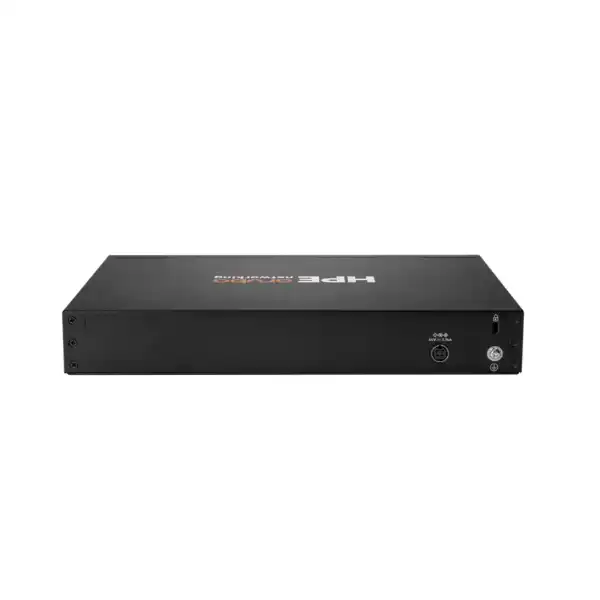
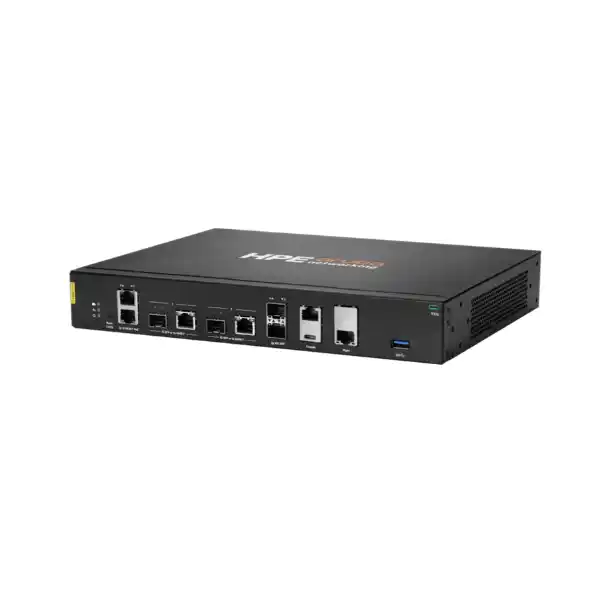
HPE Aruba Networking 9106 Gateway Dubai
A compact enterprise gateway for large branches and small campuses that combines high-speed wired connectivity, cloud-managed wireless services, SD-Branch functions and VPN concentrator capability in one platform.
Direct answer: what the 9106 is and when it makes sense
The HPE Aruba Networking 9106 is a 9100 Series hybrid gateway that can serve as a cloud-managed wireless gateway, an SD-Branch gateway or a VPN concentrator, depending on the selected architecture and software mode.
It is designed for large branch and small campus environments that need centralized wireless services, secure tunnel termination, role-based policy enforcement, WAN orchestration or local routing without moving to a larger chassis platform.
Enterprises standardizing on HPE Aruba Networking Central, organizations refreshing controller or gateway infrastructure, and distributed businesses that need stronger branch scale than entry-level gateways should shortlist the 9106.
Confirm the intended operating mode, AOS release, Central subscription, tunnel and client scale, uplink design and optics before ordering. The hardware is versatile, but the right license and software architecture determine what it can do.
FourTeck can help map the 9106 to your AP count, user base, WAN design, fibre/copper interfaces, high-availability plan, UAE power requirements, Central subscription and migration scope for a more accurate quotation.
Why the 9106 occupies a useful middle ground
The 9106 is best understood as a high-capacity edge appliance rather than simply a wireless controller. HPE positions the 9100 Series for cloud-optimized enterprise edge deployments, with the 9106 aimed at large branch and small campus requirements. That positioning matters because it gives buyers more headroom than small-branch gateways while avoiding the size and port density of larger platforms when they are not needed.
For an organization with multiple access points, thousands of users or devices, encrypted site connectivity and a requirement for local services, the 9106 can consolidate several functions. In AOS-10 designs it can provide wireless gateway services, participate in dynamic segmentation, terminate encrypted tunnels and support SD-Branch functions managed through HPE Aruba Networking Central. It can also operate as a VPN concentrator for remote network and client VPN connectivity.
The model is not automatically the right choice for every branch. Small offices with modest bandwidth, few access points and simple internet breakout may be better served by a smaller gateway. At the other end, a campus that expects materially more access points, higher aggregate throughput, more 10GbE interfaces or denser headend requirements should compare the 9114 or larger platforms. The value of the 9106 comes from matching its scale and interfaces to the actual topology rather than buying solely on headline throughput.
AOS-10, AOS-8 and Central: decide the software path first
Current HPE documentation lists the 9106 with support for AOS-10 and supported AOS-8 releases. This is important for customers in Dubai that may be balancing a new cloud-managed architecture with an existing Aruba controller environment. The same hardware can participate in different operational models, but capacity values, clustering behavior and feature workflows differ by software family.
In an AOS-10 deployment, HPE Aruba Networking Central provides cloud-based management and control. The platform is designed around distributed services, automation, role-based policy enforcement and centralized visibility. HPE lists minimum software support beginning with AOS 10.7.2.1 for the 9106 in current QuickSpecs, although buyers should always validate the release train required by their AP models, features and organization standards at the time of purchase.
For AOS-8, HPE lists support beginning with AOS 8.13.1 on current 9106 documentation. AOS-8 scaling differs from AOS-10; for example, HPE lists up to 256 campus or remote APs and up to 8,000 concurrent users/devices for the 9106 under AOS-8 specifications. That means a migration project cannot simply carry AOS-10 scale assumptions into an AOS-8 design or vice versa.
The licensing discussion therefore belongs near the start of the project. Determine whether the gateway will be cloud managed, whether Central subscriptions are already available, whether the organization needs SD-Branch services, and whether an AOS-8 transition phase is part of the plan. Hardware, subscription term and software architecture should be quoted together.
HPE Aruba Networking 9106 technical specifications that affect buying decisions
The numbers below are useful for initial qualification, but they should be read in the context of the chosen operating mode, software release and traffic mix. Real deployments can be constrained by security inspection, tunnel behavior, uplink design, high availability, application mix and future growth even when a headline maximum appears sufficient.
| Area | 9106 value | Buyer relevance |
|---|---|---|
| Firewall throughput | 10 Gbps | Useful as a platform ceiling for qualification; size with encrypted, inspected and real application traffic in mind. |
| Encrypted throughput | 10 Gbps for listed GRE and AES modes | Important for branch VPN, campus tunnel and headend designs where encrypted traffic is dominant. |
| AOS-10 clients | Up to 8,000 per gateway | Count users, IoT endpoints and device churn rather than employee headcount alone. |
| AOS-10 APs | Up to 2,000 per gateway | Provides substantial branch/small-campus headroom; cluster design and feature requirements still need validation. |
| Firewall sessions | Up to 2 million | High-session environments should estimate concurrent application, guest and IoT behavior. |
| Concurrent IPsec tunnels | Up to 16,000 in listed AOS-10 specifications | Relevant for VPN-heavy deployments; mode-specific SD-WAN design limits should be checked separately. |
| Cluster size | Up to 6 in listed AOS-10 specifications | Useful for resilience and scale, but high-availability architecture must be designed rather than assumed. |
| 10GbE interfaces | 2 × SFP+ | Check optic type, fibre medium, distance and upstream switch compatibility before ordering transceivers. |
| Combo interfaces | 2 × 1GbE combo, SFP or copper | Provides flexible 1GbE uplink/downlink options, but each combo interface is one logical port path at a time. |
| PoE access interfaces | 2 × 1GbE PoE+ with shared 60W budget | Useful for selected edge devices; confirm total powered-device consumption rather than assuming full power on every attached device. |
| Management and console | 1 × RJ45 management, USB-C and RJ45 console | Supports out-of-band and local administrative workflows, valuable for commissioning and recovery. |
| Physical size | 43.7 × 294.8 × 201.05 mm; 2.305 kg | Compact footprint, but rack, shelf, airflow, power and cable-routing arrangements should still be planned. |
Ports, optics and PoE: small details that can delay a deployment
10GbE SFP+ uplinks
The two SFP+ ports are the obvious choice for higher-speed uplinks, aggregation or data-centre connectivity. The gateway does not remove the need to select the correct optics. Fibre type, wavelength, reach, connector plan and switch-side compatibility should be confirmed before the purchase order is finalized.
1GbE combo flexibility
Two 1GbE combo interfaces can be used as SFP or copper, which is useful when integrating the gateway into mixed fibre and copper environments. A combo port does not provide two independent links simultaneously; the design should treat each pair as one interface choice.
PoE budget
The two 1GbE access ports support PoE+ with a shared 60W budget. This can simplify a compact edge installation, but powered-device requirements should be added together. Cameras, access points or other devices with higher draw may require separate switching or power design.
Management path
A dedicated 1GbE RJ45 management port plus USB-C and RJ45 console access supports commissioning and troubleshooting. For remote UAE branches, keeping a documented out-of-band access method can significantly reduce dependence on site visits during a fault.
The most common procurement mistake is to quote only the appliance and leave optics, patching, mounting, power, licenses and support until later. A complete bill of materials should reflect the actual link plan and operating model.
Sizing the 9106 for a real branch or small campus
Gateway sizing should start with the workload, not the product table. An 8,000-client limit does not mean every environment with fewer than 8,000 users is automatically a good fit. The design must account for how many endpoints are concurrently active, how many sessions they create, whether traffic is tunneled, how much traffic is encrypted, where internet breakout occurs, whether security inspection is enabled and how much growth is expected during the planned service life.
Access-point count is equally important. Under AOS-10, HPE lists up to 2,000 APs for a single 9106 and up to 4,000 devices in the listed cluster specification. That is substantial capacity, but a campus with thousands of APs also needs careful consideration of redundancy, failure domains, maintenance windows and how clients redistribute if a node becomes unavailable. The practical design target should preserve operating margin rather than aim to consume every published maximum.
WAN bandwidth can be the simplest filter. If a branch expects multi-gigabit encrypted traffic with sustained growth, the 10 Gbps firewall and encrypted-throughput figures make the 9106 much more appropriate than smaller gateways. Conversely, when traffic is well below 1 Gbps, the business may gain more value from an entry model unless the 9106 is needed for scale, port types, software architecture or standardization.
Session count can become a hidden constraint in guest-heavy, IoT-heavy or application-dense locations. HPE lists up to two million datapath/firewall sessions for the 9106. Large device populations, SaaS applications, security cameras, building systems and short-lived connections can create far more sessions than the employee count suggests. A useful sizing workshop therefore looks at users, devices, sessions, tunnels, APs and traffic together.
High availability, clustering and maintenance planning
HPE positions the 9100 Series with high-availability capabilities that include clustering and live-upgrade support in appropriate architectures. These capabilities are valuable for hospitality, healthcare, retail, education and corporate sites in Dubai where a gateway maintenance event should not become a broad wireless outage. They do not, however, replace topology design.
Redundancy begins with failure domains. Two gateways in the same cabinet, powered from the same electrical feed and connected through the same upstream path do not provide the same resilience as devices designed with independent power, switching and uplink considerations. If the site has a genuine requirement for continuous operation, the quotation should include the second gateway, duplicate optics where required, resilient upstream connectivity and the relevant licenses or subscriptions.
Cluster scale also needs software-context awareness. HPE lists an AOS-10 cluster size of up to six for the 9106, while current AOS-8 figures list a cluster size of four. The design team should confirm the intended software family and validated architecture before treating any cluster figure as a procurement target. High availability is about controlled failure behavior, not simply buying two appliances.
Operational procedures matter as much as hardware. Document the expected upgrade method, configuration ownership, Central group structure, change window, rollback procedure and monitoring alarms. A well-sized 9106 deployment with poorly planned operations can still create avoidable downtime; a smaller, carefully managed deployment may deliver better service quality.
Deployment modes and practical use cases
Cloud-managed wireless gateway
Use the 9106 when an Aruba wireless architecture needs gateway services with centralized operations through HPE Aruba Networking Central. This is particularly relevant when the organization wants consistent role-based policy and operational visibility across distributed sites.
SD-Branch gateway
In an SD-Branch design, the 9106 can support routing, secure tunnel orchestration, WAN management and policy functions. It suits larger branches where internet, WAN and campus-edge requirements are converging and where Central is part of the operating model.
VPN concentrator
The gateway can be used as a VPN concentrator for remote network and client VPN connectivity. For headend use, tunnel scale, encrypted throughput, data-centre connectivity and resilience become the primary design variables rather than local PoE or branch access ports.
AOS-8 mobility controller transition
Current 9106 models can support AOS-8 in supported releases, which can be useful for organizations that need controller-based WLAN services while planning a longer-term architecture transition. AOS-8 capacity and clustering values must be sized separately.
Installation and environmental planning in the UAE
The 9106 is compact at approximately 43.7 mm high, 294.8 mm wide and 201.05 mm deep, with a listed device weight of about 2.305 kg. Its size makes it practical for branch communications rooms, compact network cabinets and installations where a full-depth chassis would be inconvenient. Physical fit should still be checked against the intended mounting method, cable bend radius, airflow and service access.
HPE lists an operating temperature range of 0°C to 40°C and 10% to 90% relative humidity, non-condensing. Those limits are especially relevant in the UAE because communications rooms can become hot quickly if cooling is undersized or fails. The gateway should not be treated as an outdoor or uncontrolled-space device. A site survey should check sustained cabinet temperature, ventilation, dust exposure, electrical quality and whether other devices in the same enclosure are adding significant heat.
Maximum power consumption is listed at 150W, with a 165W power source for the 9106. The PoE budget can contribute to power and heat when powered devices are connected. For business-critical sites, the power plan should also consider UPS runtime, outlet type, PDU arrangement and recovery after an electrical event. The exact HPE regional power option supplied should match the UAE installation requirement.
Zero Touch Provisioning can reduce onsite effort in distributed branch deployments by allowing a correctly prepared gateway to retrieve configuration and license information after connectivity is established. That does not eliminate pre-deployment work. The Central tenant, groups, subscriptions, addressing, WAN handoff, DNS, NTP, security policy and site naming should be prepared before the appliance reaches the location. A staged configuration and acceptance checklist makes installation faster and less dependent on specialist engineers being physically present at every branch.
Licensing, subscriptions and compatibility checks
The 9106 hardware is only one part of a complete solution. HPE Aruba Networking Central is central to AOS-10 operations, so subscription requirements should be confirmed against the deployment role and the organization’s existing Central entitlement. Buyers should avoid comparing appliance-only pricing when the project actually requires cloud management, SD-Branch services, support and multi-year subscriptions.
Compatibility should be reviewed in both directions. On the access side, confirm that the intended Aruba AP models and software versions are supported in the chosen release. On the network side, confirm that switches, transceivers, fibre plant, VLAN design, routing protocols, DHCP services, DNS and authentication systems align with the intended configuration. For security policy, identity sources and role mapping may also affect the design.
Optics deserve a specific bill-of-materials line. The 10GbE SFP+ and 1GbE SFP options allow flexible fibre connectivity, but the required transceiver depends on media and distance. Using an existing optic without confirming support can create an avoidable commissioning problem. The same applies to copper handoffs, patch leads and any rack accessories.
Support coverage should match the operational importance of the site. A branch that can tolerate next-business-day replacement has different needs from a healthcare, hospitality or finance location where loss of the gateway could affect many users. The commercial proposal should state the appliance SKU, regional power option, support term, Central subscription, optics, installation scope and any migration services separately enough for the buyer to see what is included.
When to compare another HPE Aruba gateway
Compare a smaller platform when the site has limited bandwidth, a modest AP count, a small number of users and no foreseeable requirement for the 9106 scale or 10GbE uplinks. A smaller gateway can reduce acquisition cost and may simplify the branch design without compromising requirements.
Compare the 9114 when the project needs greater throughput or more high-speed interfaces. HPE lists 20 Gbps firewall and encrypted throughput for the 9114, four 10GbE SFP+ ports and four 1GbE combo ports. It also scales to more APs and clients in AOS-10. That makes it a logical adjacent comparison when the 9106 would run close to its limits or when port density is a deciding factor.
Compare larger campus or headend platforms when the requirement extends beyond a small campus, when very high client counts or 25GbE interfaces are needed, or when the gateway will aggregate a large number of remote sites. Platform selection should follow capacity and architecture rather than simply choosing the newest model.
The 9106 is strongest when a buyer needs more than entry-level branch performance but does not need the larger physical and interface profile of the 9114. Its compact dimensions, dual 10GbE uplinks, high session scale and flexible software options give it a clear position for large branch and small-campus deployments.
A practical 9106 deployment journey
Define the role
Choose wireless gateway, SD-Branch gateway, VPN concentrator or AOS-8 mobility-controller use. The answer determines software, subscription and scale assumptions.
Measure demand
Record AP count, clients, devices, sessions, tunnels, WAN bandwidth, security features and expected growth. Include resilience targets rather than sizing one unit in isolation.
Map interfaces
Identify every 10GbE, 1GbE fibre and copper handoff. Select compatible optics, patching, upstream switch ports and any PoE-connected devices.
Prepare management
Confirm Central tenant readiness, subscription term, software release, device groups, addressing, routing, identity integration and change-control ownership.
Stage and test
Validate configuration, connectivity, failover behavior, tunnel establishment, policy enforcement, monitoring and logging before a critical migration window.
Buyer questions about the HPE Aruba Networking 9106
Is the 9106 only a wireless controller?
No. HPE positions it as a hybrid gateway. Depending on software and design, it can operate as a wireless gateway, SD-Branch gateway, VPN concentrator or, on supported current 9106 models, in an AOS-8 mobility-controller role.
Does it support 10GbE?
Yes. The 9106 has two SFP+ interfaces supporting 10GbE, plus two 1GbE combo ports and two 1GbE PoE+ access ports. Transceivers must be selected to match the fibre environment and supported interface requirements.
Can it power devices directly?
The two 1GbE access ports support PoE+ with a shared 60W budget. This can power suitable edge devices, but the power draw of all connected equipment must fit within the available budget.
What is its listed performance?
HPE lists 10 Gbps firewall throughput and 10 Gbps encrypted throughput across the listed GRE and AES modes. Real application performance depends on enabled features, traffic mix and architecture.
How many APs can it support?
In current AOS-10 specifications, HPE lists up to 2,000 APs per 9106. AOS-8 specifications are different, with HPE listing up to 256 campus or remote APs, so software mode must be confirmed.
Is Central required?
HPE Aruba Networking Central is the management and control platform associated with AOS-10 deployments. Exact subscription requirements depend on the intended role and services, so the commercial configuration should be validated before ordering.
Is it suitable for a small office?
It can operate there, but it may be unnecessary if bandwidth, AP count and tunnel requirements are modest. A smaller branch gateway may be more economical unless the organization is standardizing on the 9106 or needs its specific interfaces and scale.
What should be included in a Dubai quotation?
The appliance SKU and regional power option should be paired with required Central subscriptions, support, SFP/SFP+ optics, patching, mounting needs, installation, configuration and migration services where applicable.
Decision recap for UAE buyers
Best suited to large branch and small-campus designs that need more scale and 10GbE connectivity than entry-level gateways.
Check APs, clients, sessions, tunnels and sustained encrypted traffic together, with margin for growth and failover.
Choose AOS-10 or supported AOS-8 deployment logic deliberately; capacities and operating workflows differ.
Include Central subscription and feature requirements in the commercial design, not as an afterthought.
Confirm SFP+ optics, 1GbE combo-port choices, PoE load and upstream switch compatibility.
If downtime matters, design the second gateway, power, uplinks and maintenance process as one HA solution.
What FourTeck needs for an accurate 9106 quotation
A good quotation is based on the deployment rather than a model number alone. Sending the information below helps reduce revisions and exposes any missing optics, subscriptions or services before the order is placed.
Plan the HPE Aruba 9106 around your actual network, not just its maximum numbers
FourTeck can help qualify the gateway against your branch or campus scale, confirm the right regional hardware option, identify optics and subscriptions, and define installation or migration requirements for Dubai and UAE deployments. If the 9106 is larger or smaller than the workload needs, the comparison can be adjusted before procurement.

Reviews
There are no reviews yet.