
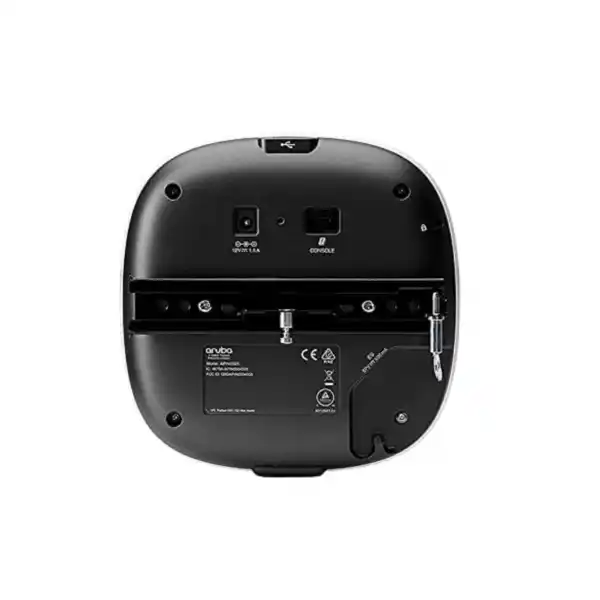
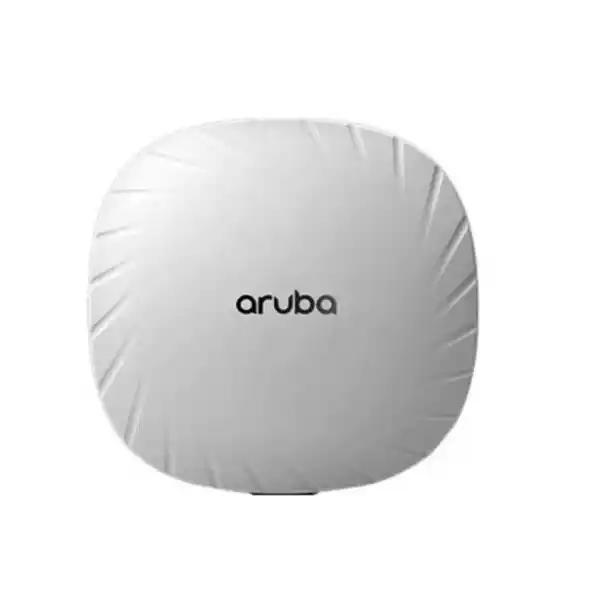
HPE Aruba Networking AP-505 in Dubai, UAE
The AP-505 is a compact HPE Aruba Networking 500 Series campus access point for organisations that want Wi-Fi 6 efficiency, integrated antennas and flexible enterprise management in indoor low- to medium-density environments. It is a practical choice when the wireless design calls for controlled client density, Gigabit Ethernet uplink capacity and straightforward ceiling or wall deployment rather than the extra radio capacity of a higher-tier access point.

Wi-Fi 6 (802.11ax), dual 2×2 radios
Up to 1.49 Gbps per HPE 500 Series data sheet
One 10/100/1000BASE-T Ethernet port
R2H28A for the RW regional model
Direct answer for buyers
HPE Aruba Networking AP-505 is an indoor, dual-radio Wi-Fi 6 access point with internal antennas, aimed at low- and medium-density workplaces such as offices, education areas and retail environments. It is mainly used to provide managed enterprise wireless access while improving airtime efficiency with technologies such as OFDMA and MU-MIMO. Organisations should consider it when 2×2 radio capacity and a 1GbE uplink match the expected client and application load. Before ordering, confirm the regional model, required quantity, mounting kit, available PoE budget or DC option, preferred management platform, software or subscription requirements, and whether a higher-density access point would be more appropriate for busy meeting zones or demanding application areas.
What the AP-505 does
The access point connects wireless users and devices to an organisation’s wired network over 2.4 GHz and 5 GHz Wi-Fi. HPE positions the 500 Series as a cost-conscious Wi-Fi 6 platform for indoor environments where usage is not at the extreme-density end of the spectrum. The AP-505 combines integrated dual-band antennas, two spatial streams, a single Gigabit Ethernet interface and a built-in Bluetooth 5 and Zigbee-capable IoT radio. It can be operated in HPE Aruba Networking architectures that use cloud or on-premises management, with the exact operating model depending on the selected software, configuration and licensing.
Who it suits
The AP-505 is well aligned with branch offices, standard open-plan offices, classrooms, retail floors, reception areas, smaller meeting zones and similar indoor spaces where traffic demand is predictable and coverage can be planned properly. It may also be useful when an organisation wants to add Wi-Fi 6 support while staying with a 1GbE wired edge. It is not automatically the right choice for every floor or every room. High-concurrency auditoriums, large training rooms, heavy multimedia zones or locations that need more radio streams or multigigabit uplinks should be assessed separately rather than assuming one access-point model fits an entire property.
Business problems this access point can help address
Growing device counts
Wi-Fi 6 features such as OFDMA help share airtime more efficiently among compatible clients, which can improve the way many everyday transactions are scheduled on a busy channel.
Client roaming friction
HPE ClientMatch is designed to steer supported clients toward a better access point based on network conditions, helping reduce the operational impact of devices remaining attached to a less suitable AP.
Guest and device security
WPA3 and Enhanced Open support can strengthen authentication or improve privacy on compatible wireless deployments. Policy enforcement features depend on the wider Aruba architecture and configuration.
IoT infrastructure sprawl
The integrated Bluetooth 5 and 802.15.4 radio can support relevant IoT, location and gateway use cases, potentially reducing the need for separate radio infrastructure in suitable designs.
AP-505 capability band
Divides channel resources into smaller units so compatible Wi-Fi 6 clients can be served more efficiently.
Supports multi-user transmissions as part of the Wi-Fi 6 efficiency feature set.
Can help compatible battery-powered devices schedule communication and reduce unnecessary wake periods.
Helps improve client association decisions in multi-AP environments when supported by the deployed Aruba architecture.
Integrated Bluetooth 5 and Zigbee support for appropriate location, sensor or gateway projects.
Supports cloud and on-premises management paths; licenses, software versions and architecture must be confirmed.
Product-fit matrix
| Requirement | Suitable when | Confirm before ordering |
|---|---|---|
| Wi-Fi generation | A dual-band Wi-Fi 6 access layer meets the requirement | Client mix and whether Wi-Fi 6E or Wi-Fi 7 is required for the project |
| Client density | Low to medium density with planned RF coverage | Peak simultaneous clients, application mix and meeting-space concurrency |
| Wired edge | A 1GbE AP uplink fits the design | Switch port speed, PoE class and upstream capacity |
| Mounting | Ceiling or suitable wall mounting is practical | Correct AP-MNT kit for the ceiling rail, solid surface or wall-box requirement |
| Management | Aruba cloud or on-premises operations fit the IT model | Management platform, software release, license or subscription term |
| IoT integration | Bluetooth 5, Zigbee or supported USB expansion is useful | Application compatibility, gateway workflow and power budget |
Verified AP-505 technical information
The table below uses HPE 500 Series data-sheet and QuickSpecs information for the AP-505. Where a commercial choice varies by geography or deployment, it is shown as a confirmation item rather than a fixed inclusion.
| Brand | HPE Aruba Networking |
|---|---|
| Model | AP-505 |
| Product type | Indoor unified campus access point |
| UAE / RW part number reference | R2H28A; regional variant must be confirmed for the destination |
| Wireless standard | Wi-Fi 6 (802.11ax) |
| Radios | Dual 2×2 radios for 2.4 GHz and 5 GHz operation |
| Maximum combined data rate | Up to 1.49 Gbps in HPE 500 Series specifications |
| Channel bandwidth | 20/40 MHz on 2.4 GHz; 20/40/80 MHz on 5 GHz |
| Integrated antennas | Two dual-band downtilt omnidirectional antennas for 2×2 MIMO, designed around horizontal ceiling-mounted orientation |
| Wired network interface | 1 × 10/100/1000BASE-T RJ-45, auto-sensing, PoE-PD |
| PoE support | IEEE 802.3af / 802.3at; unrestricted operation is specified with DC or 802.3at, while 802.3af can introduce feature restrictions depending on IPM and load |
| DC input | 12 Vdc nominal; power source is sold separately |
| Maximum power consumption | Up to 16.5 W in the HPE worst-case PoE calculation with an attached USB device; actual consumption depends on power source and USB use |
| IoT support | Integrated Bluetooth 5 and IEEE 802.15.4 / Zigbee radio; USB 2.0 Type-A expansion |
| Security features | WPA3, Enhanced Open (OWE), TPM; policy enforcement and dynamic segmentation capabilities depend on the Aruba architecture and configuration |
| Management | Cloud and on-premises choices, including HPE Aruba Networking Central in supported deployments |
| Dimensions | 160 mm W × 161 mm D × 37 mm H, excluding mount bracket |
| Weight | 500 g, excluding mount bracket |
| Operating temperature | 0°C to 50°C |
| Mounting | Mount kit is selected separately; available kits cover different ceiling-rail, solid-surface and wall-box requirements |
| Warranty guidance | HPE documentation lists a limited lifetime warranty for the 500 Series; applicable terms and regional coverage should be confirmed for the ordered SKU |
Configuration, licensing and compatibility dependencies
The AP-505 hardware should not be quoted in isolation from the network architecture. A buyer first needs to decide how the wireless estate will be managed. HPE supports cloud and on-premises approaches across the 500 Series, but software releases, Central subscriptions, gateway design, policy functions and operational features are not automatically the same in every deployment. Where HPE Aruba Networking Central is selected, confirm the appropriate subscription and term for the intended operational model. For controller- or gateway-based deployments, verify platform compatibility, software version and any required licenses before the bill of materials is approved.
Power is another dependency. The AP can use DC or Power over Ethernet. HPE states that DC or 802.3at PoE supports unrestricted operation, while an 802.3af power budget can disable or dynamically restrict functions depending on the Intelligent Power Monitoring configuration and attached USB load. This means the switch model, available PoE class, total PoE budget and cable path matter to the wireless design. A switch may have enough Ethernet ports but still lack enough available PoE capacity for the planned number of APs.
Mount kits are selected separately. The pre-installed bracket on the AP attaches to a compatible mounting kit, so the ceiling rail profile, solid-surface installation or wall-box requirement should be documented before ordering. For UAE projects, FourTeck can help translate the floor plan and switch details into a clearer material list before the quotation is finalised.
A practical purchase and deployment journey
Map the wireless demand
Record floor area, wall materials, expected users, device types, application mix and peak concurrency. A simple headcount alone is not enough for wireless sizing.
Validate the AP class
Confirm that dual 2×2 radios and a 1GbE uplink fit the expected workload. Flag dense collaboration zones that may need a different model or additional AP capacity.
Confirm infrastructure
Check switch PoE budget, cabling, VLAN design, DHCP, DNS, upstream capacity and mounting surfaces. Identify any cabling or switch remediation before installation day.
Select management
Choose cloud or on-premises operations, verify software compatibility and include any required licenses or subscriptions in the quotation.
Build the material list
Confirm the regional AP SKU, quantity, mount kits, power components if needed, subscriptions, gateways and any installation or configuration service scope.
Deploy and validate
After configuration and placement, validate coverage, client association, roaming, authentication and application performance against the intended design rather than relying only on AP status lights.
Wi-Fi 6 efficiency where it matters
The strongest reason to choose the AP-505 is not simply that the product carries the Wi-Fi 6 label. Its value comes from how Wi-Fi 6 features can improve channel use when the client mix and RF plan allow them to work effectively. OFDMA lets an access point divide a channel into smaller resource units, so compatible devices can be served in a more scheduled manner rather than every small transaction consuming an entire channel allocation. In a business environment filled with laptops, phones, scanners, meeting-room devices and IoT endpoints, this can help reduce airtime inefficiency during busy periods.
Bidirectional MU-MIMO and Target Wake Time are also part of the supported feature set. MU-MIMO is relevant when multiple compatible clients can be served simultaneously, while TWT can help battery-powered devices that communicate intermittently by scheduling wake periods. Neither feature removes the need for RF planning. Interference, overlapping channels, building materials, client radio capability and excessive transmit power can still undermine performance. Wi-Fi 6 efficiency is therefore best treated as one layer of the design rather than a substitute for careful placement and channel planning.
For buyers upgrading from older access points, the more useful question is whether the existing wired edge, authentication services and management platform are ready for the new access layer. FourTeck can help review those dependencies as part of a broader networking service scope rather than treating the access point as a standalone box.
Management, visibility and policy choices
HPE Aruba Networking positions the 500 Series with flexible operational choices, including cloud and on-premises management. That flexibility is useful for organisations with different operational models, but it creates an important procurement checkpoint: the AP hardware does not by itself define how monitoring, configuration, firmware, analytics, policy and support will be delivered. An organisation already standardised on HPE Aruba Networking Central may want the AP-505 incorporated into that management plane, while another business may have an existing controller or gateway architecture that must be checked for software compatibility.
Security-related functions also need architectural context. The AP-505 supports WPA3 and Enhanced Open, and HPE documents platform capabilities such as dynamic segmentation and policy enforcement. Those features depend on the selected operating model, client compatibility and supporting infrastructure. A procurement team should therefore avoid using a feature name as proof that a specific policy outcome is included in every installation. The quotation and configuration scope should state which management platform, authentication method, VLAN or role design, guest access method and policy enforcement functions are expected.
Operationally, the same discipline applies to visibility. Centralised management can make it easier to see health, clients and events across many locations, but the available analytics and workflows depend on subscription level and current vendor packaging. FourTeck can help turn the desired operational outcome into a list of hardware, management and service dependencies before purchase.
Power, mounting and physical deployment
Physical installation is often where an otherwise correct access-point order runs into delays. The AP-505 measures about 160 × 161 × 37 mm and weighs about 500 g excluding the mount bracket. HPE provides a pre-installed bracket on the unit, but the compatible mount kit that secures the AP to the ceiling rail, wall-box or solid surface is selected separately. HPE lists multiple AP-MNT options for different suspended ceiling rails and solid-surface requirements. That means the installer should identify the actual ceiling system rather than ordering a generic bracket based only on a floor plan.
Power planning deserves similar attention. A PoE switch with 802.3at can provide unrestricted AP operation according to HPE specifications, while 802.3af may invoke power-management restrictions under some conditions, especially when USB power is required. If the switch is already supporting IP phones, cameras or other PoE devices, the total chassis power budget matters as much as the individual port standard. A high port count does not guarantee enough watts for every connected device at full demand.
Placement should also match the antenna design. The AP-505 uses integrated downtilt omnidirectional antennas intended around horizontal ceiling-mount orientation. Wall mounting may be practical in specific designs, but the radio pattern and room geometry should be considered rather than assuming every mounting surface produces the same coverage. For a new site or significant refresh, a predictive design or survey can provide more reliable placement guidance.
Where the AP-505 can fit well
Standard office floors
Suitable where employee device density is moderate, applications are typical business SaaS, voice and collaboration workloads, and the RF plan uses several APs to provide consistent coverage.
Classrooms and training rooms
Can fit smaller education spaces when concurrent device counts and traffic are within the design target. Large lecture halls should be assessed for higher-density requirements.
Retail and customer areas
Useful for staff mobility, handheld terminals and guest connectivity where coverage and policy design are planned around the store layout, back office and point-of-service areas.
Branch environments
A practical option for standard branch wireless where centralised operations, secure user access and moderate capacity are more important than extreme radio density.
Healthcare-adjacent indoor areas
The model has relevant regulatory certifications in HPE documentation, but each healthcare use case still requires site-specific compliance, RF and application review.
IoT-enabled spaces
The integrated Bluetooth and Zigbee-capable radio can support appropriate location or sensor projects when the application, management platform and integration workflow are verified.
Integration and operational considerations
An AP refresh affects more than radio coverage. Authentication infrastructure must be able to handle the intended security method, VLAN or role assignment should be defined, DHCP scopes need enough capacity, DNS should be reachable, and firewall policies must allow the required management and user traffic. Where 802.1X is used, certificate handling and RADIUS reachability become important. Guest access may have different policy, captive-portal and internet-breakout requirements from corporate wireless.
The wired network also determines how much of the wireless capability can be used. The AP-505 has one Gigabit Ethernet interface, so organisations planning high per-AP wired throughput should recognise that architectural limit. For many low- and medium-density sites it is a reasonable match; for heavier areas a different access-point class and multigigabit switching may be more appropriate. The switch firmware, LLDP behaviour, PoE settings and VLAN trunk configuration should be checked before bulk rollout.
Finally, plan how firmware and configuration changes will be controlled. A wireless network should have a defined process for software compatibility checks, maintenance windows, backup or rollback strategy where applicable, and post-change validation. FourTeck can help include these items in a configuration or installation engagement when required.
Questions to resolve before requesting a quote
This is more useful than total registered users because radio capacity is affected by peak concurrency and application demand.
Check both the individual port standard and the total available PoE watts after existing phones, cameras or other devices are included.
Cloud, gateway/controller and other supported management paths have different software, licensing and operational dependencies.
Ceiling-rail type, solid surface and wall-box installations can require different AP-MNT kits.
Large meeting rooms, auditoriums and heavy multimedia spaces can have very different capacity needs from corridors and ordinary offices.
Survey, design, installation, configuration, migration, testing and handover should be priced explicitly when they are part of the project.
Procurement checklist for AP-505 projects
How FourTeck can assist with an AP-505 requirement
A useful quotation starts with the deployment requirement rather than just a model number. FourTeck can help review the intended coverage area, quantity, user density, wired switching, PoE capacity, mounting type and management preference before the bill of materials is finalised. This reduces the risk of ordering access points without the correct mounting hardware, choosing a management route without the necessary subscription, or discovering after delivery that the existing switches have insufficient power budget.
Where an organisation already operates HPE Aruba Networking infrastructure, the review can focus on compatibility, software version and how the new APs should fit the existing operational model. For a new deployment, the conversation can cover initial wireless design, VLAN and SSID structure, authentication approach, guest access, device policy, installation sequence and post-installation validation. These activities are scope dependent and should be included explicitly in the quotation when required.
You can also explore FourTeck’s wider business technology product range, review available technology services, or send the project requirement to FourTeck for sizing and quotation coordination.
UAE availability and support guidance
HPE lists the AP-505 RW variant R2H28A on its UAE storefront, but commercial availability, quantity, lead time and final reseller pricing can change. Contact FourTeck to confirm current UAE availability for the required quantity and to ensure the correct regional variant is quoted. Do not assume that a part number sourced for another regulatory domain can be used for a UAE project without checking the destination and ordering rules.
If the requirement includes installation or configuration, share the deployment address, floor-plan information, preferred date window and the state of the existing switching and cabling. Delivery coordination and project scheduling can be discussed after the exact material list and service scope are confirmed. Hardware warranty guidance should also be tied to the quoted SKU and vendor terms rather than treated as a generic promise.
Dubai, Abu Dhabi, Sharjah and Ajman project coverage
For organisations planning AP-505 deployments across Dubai, Abu Dhabi, Sharjah and Ajman, FourTeck can coordinate requirement review around a common design while still accounting for the practical differences between sites. One branch may need only a few ceiling-mounted access points, while another may have dense meeting areas, limited PoE capacity or a different mounting surface. Sharing the site list, approximate AP quantity, floor plans, switch models, management preference and expected installation scope helps create a more accurate quotation. Multi-site orders should also identify whether configuration needs to be standardised, staged centrally or completed per site, and whether the customer will handle cabling and mounting or wants those activities included in the project scope.
GCC Availability
FourTeck can assist GCC organisations evaluating the HPE Aruba Networking AP-505 with requirement review, regional model selection, quotation coordination, mounting and power planning, management-platform choices and installation scope. Projects may involve the United Arab Emirates, Saudi Arabia, Kuwait, Qatar, Bahrain or Oman, but the correct part number, commercial availability, license packaging and delivery route can vary by destination. Buyers should provide the destination country, required AP quantity, preferred management method, license or subscription term, mounting conditions, PoE environment and expected project timeline. For multi-country wireless rollouts, it is especially important to confirm regulatory domain and vendor ordering rules instead of assuming the same SKU can be shipped everywhere. Product availability, vendor lead time, service visits and project scheduling remain country and scope dependent. FourTeck can help prepare a consistent technical requirement while allowing the final bill of materials to reflect each site’s local needs. GCC customers can also review FourTeck’s regional technology coverage when planning wider projects.
Africa Availability
For organisations sourcing the AP-505 for African projects, FourTeck can help review the exact model requirement, quantity, management approach, mounting accessories, power method, configuration scope and support expectations before procurement. Availability and fulfilment can depend on the destination, vendor lead time, regulatory domain, shipping arrangement, local power and cabling conditions, and whether installation or post-delivery configuration is part of the request. Buyers in East Africa and other regions should share the destination country, project site, expected quantity, preferred deployment schedule and any licensing or support requirement. A network intended for Kenya or Uganda, for example, may use the same AP family but still needs regional-ordering and project checks before the material list is confirmed. FourTeck can coordinate technical and commercial planning without assuming local inventory or a guaranteed shipment date. For wider regional planning, visit FourTeck’s Africa technology portal.
Related options and services to consider
AP-504
A related 500 Series option that uses external antenna connectors. Consider it only where the RF design specifically calls for external antennas and confirm the correct antenna and mount components.
AP-515
A higher-capacity Wi-Fi 6 model that may be more appropriate for heavier client density or radio demand. Compare actual site requirements rather than assuming it is always a direct replacement.
HPE Aruba Networking Central
Cloud-based management can be considered for organisations that want centralised operations. Subscription level and term should be confirmed against the required features.
AP mounting kits
R3J15A, R3J16A, R3J17A, R3J18A and R3J19A cover different ceiling, solid-surface and wall-box mounting scenarios. Select the kit that matches the physical site.
Wireless design and survey
Useful when a floor plan, wall construction, density or interference pattern makes AP placement difficult to estimate reliably from room area alone.
Installation and configuration
Can include mounting coordination, switch-port preparation, SSIDs, VLANs, authentication, management onboarding and post-installation validation when defined in the project scope.
What buyers are comparing before choosing the AP-505
Business buyers researching the AP-505 usually reach the same practical decision points: whether its 2×2 Wi-Fi 6 radio design is enough for their user density, how it compares with a higher-capacity AP such as the AP-515, whether Aruba Central is mandatory, which PoE level is needed, whether the mounting bracket is included, and what part number should be ordered for the destination. Answering those questions in the right order helps prevent a technically capable AP from being placed into the wrong environment.
2×2 does not mean basic office use only
A 2×2 access point can be entirely appropriate for many enterprise areas. The question is whether its capacity matches the actual concurrency and traffic profile. A quiet branch floor with business applications may be a good fit, while a large collaboration room with dozens of active video sessions can justify a higher radio class. The decision should follow usage, not a blanket rule that every newer or larger AP is automatically better.
AP-505 versus AP-515 is mainly a density decision
The AP-505 uses dual 2×2 radios, while the AP-515 family is positioned with more radio capacity, including 4×4 capability on 5 GHz. That makes the AP-515 more relevant to heavier concurrency, but a higher-tier AP can be unnecessary in ordinary office spaces. A mixed design is often more sensible: use the model that matches each zone rather than standardising blindly on the highest specification.
Another common question is whether a Central subscription is required for the AP to operate. HPE’s unified access points support more than one operational model, so the correct answer depends on how the organisation intends to manage the wireless estate. If Central is selected, the subscription and term become part of the commercial design. If another supported Aruba architecture is used, compatibility and software requirements should be confirmed instead. Buyers should therefore describe the desired management outcome rather than simply ask whether a license is included with the box.
Power questions are equally important. The AP accepts PoE and DC power, but HPE distinguishes between unrestricted operation on DC or 802.3at and potential feature restrictions under 802.3af depending on the power-management state and USB use. For a small order this may be a straightforward port-level check. For a floor with many APs, the total switch PoE budget can become the limiting factor. The right pre-sales question is not just “does my switch support PoE?” but “how many watts remain available after every other powered device is counted?”
Mounting is another area where product-page photos can be misleading. The AP has a bracket on the chassis, but the site-specific mount kit is a separate ordering item. Suspended ceiling rails come in different profiles and widths, and solid-surface or wall-box mounting needs different hardware. Asking the installer to identify the mounting condition before the quotation is usually cheaper than changing brackets after APs arrive on site.
Pricing searches also produce very different numbers because listings may refer to different regional SKUs, stock situations, taxes, warranty terms or reseller promotions. Treat online prices as context rather than a reliable project price. A business quotation should state the exact part number, quantity, included accessories, management subscription, support, tax position, delivery conditions and service scope. FourTeck can build the quotation around those confirmed items so procurement is comparing like with like.
For existing Wi-Fi networks, buyers should also ask whether the AP-505 will coexist with older APs during migration. Mixed-generation estates are common, but roaming behaviour, software compatibility, radio settings and management support need to be considered. A staged rollout can be practical when the existing platform supports it, but it should be planned rather than assumed. If the old network uses different authentication or VLAN designs, the project may include configuration cleanup as well as hardware replacement.
Finally, coverage should never be estimated only from the theoretical capability of an access point. Walls, glass, shelving, ceiling height, interference, client transmit power and local channel conditions all change the effective design. The AP-505 can be a strong fit for many standard indoor areas, but the number of units and placement should come from the building and workload. That is why a floor plan, expected client counts and switch information are among the most useful items to send with a quotation request.
Practical decisions before you request a quotation
Do I need the RW part number for a UAE project?
HPE lists R2H28A as the AP-505 RW model and shows it on the UAE storefront. That makes it an appropriate reference for UAE planning, but the final quotation should still confirm regulatory domain, destination and current ordering status. Do not substitute a US, Japan, Israel or Egypt-specific SKU simply because the hardware name looks the same.
How many AP-505 units do I need?
There is no reliable quantity based only on square metres. The design should account for wall construction, room layout, expected simultaneous users, application demand, channel reuse and the transmit capability of client devices. A predictive design or survey is useful when coverage or capacity is business critical.
Can I power it from an existing PoE switch?
Possibly. The AP supports 802.3af and 802.3at, but HPE documents unrestricted operation with 802.3at or DC power. Under 802.3af, some functions can be limited depending on Intelligent Power Monitoring and USB load. Check both the port standard and total switch power budget before rollout.
Is the ceiling mount included?
The AP has a chassis bracket, but the site-specific mount kit is ordered separately. HPE provides different kits for 9/16-inch or 15/16-inch suspended ceiling rails, profile rails, solid surfaces and wall boxes. Identify the installation surface before confirming the bill of materials.
Should I choose AP-505 or a higher-density model?
Choose the AP-505 when its dual 2×2 radios, 1GbE uplink and expected medium-density role match the site. Consider a higher-capacity model for rooms with much heavier concurrency, more demanding traffic or a design that benefits from additional spatial streams or multigigabit uplinks. Many buildings use more than one AP class.
What should I send FourTeck for an accurate quote?
Provide the site location, approximate floor area, quantity if known, floor plan, expected users, existing switch models, management preference, authentication requirement, mounting type and whether installation or configuration is needed. If you are replacing older Aruba APs, include the current controller or management platform and software version where possible.
Why businesses contact FourTeck for wireless projects
Wireless procurement often fails at the edges of the bill of materials: the AP model may be correct, but the mount, power source, software, subscription, switch capacity or installation assumptions are incomplete. FourTeck’s role is to help clarify those dependencies before the order is placed. That can include confirming the exact regional model, reviewing the requested quantity, identifying compatible mounting choices, checking switch and PoE information, discussing management options and coordinating a quotation that separates hardware from optional services.
For deployment work, FourTeck can discuss survey, installation, configuration, migration and validation activities according to project scope. For support and lifecycle planning, the conversation can cover warranty guidance, software compatibility, subscription renewal or a move to a newer wireless platform when that is more appropriate than expanding an older design. The objective is not to force the AP-505 into every requirement, but to help determine whether it is the right fit for the stated business and technical need.
Learn more about FourTeck’s technology focus or use the contact page to send a wireless requirement for review.
Frequently asked questions
Is the HPE Aruba Networking AP-505 a Wi-Fi 6 access point?
Yes. HPE specifies the AP-505 as an indoor dual-radio Wi-Fi 6 (802.11ax) access point with 2×2 MIMO on 2.4 GHz and 5 GHz.
What is the maximum combined data rate of the AP-505?
HPE’s current 500 Series documentation states a maximum combined data rate of 1.49 Gbps. Real application throughput will depend on client capability, RF conditions, channel width, interference and network design.
Does the AP-505 support PoE?
Yes. It supports 802.3af and 802.3at PoE. HPE specifies unrestricted operation with 802.3at or DC power, while 802.3af can introduce feature restrictions depending on the power-management configuration and USB load.
Is a mounting kit included with the AP-505?
A mounting bracket is installed on the AP, but the site-specific mount kit is selected separately. The correct kit depends on the ceiling rail, solid surface or wall-box installation.
Can the AP-505 be managed with HPE Aruba Networking Central?
Yes, the 500 Series supports management with HPE Aruba Networking Central in supported deployments. Subscription level, term, software compatibility and required features should be confirmed for the project.
Does the AP-505 support Bluetooth and Zigbee?
Yes. HPE documents an integrated Bluetooth 5 and IEEE 802.15.4 radio with Zigbee support, plus a USB 2.0 Type-A port for supported expansion.
Which AP-505 part number is relevant for the UAE?
HPE lists R2H28A as the AP-505 RW model and shows it on the UAE storefront. The final quote should still confirm the regional SKU, destination and current ordering status.
Is the AP-505 suitable for high-density venues?
It is positioned for low- to medium-density environments. High-concurrency venues or demanding collaboration areas should be evaluated for a higher-capacity AP or a different RF design.
How can I request an AP-505 quotation in Dubai?
Send FourTeck the required quantity, site location, floor plan if available, switch and PoE information, management preference, mounting type and any installation or configuration requirement. FourTeck can then confirm current UAE availability and quotation scope.
Plan the AP-505 around your real network requirement
Share the site, quantity, user density, switch model, PoE budget, management preference and installation scope. FourTeck can help confirm the AP-505 regional model, accessories and commercial requirements before you place the order.

Reviews
There are no reviews yet.