
Outdoor Wi-Fi 6 for directional enterprise coverage
HPE Aruba Networking AP-587 in Dubai, UAE
The AP-587 is the directional-antenna member of the HPE Aruba Networking 580 Series outdoor Wi-Fi 6 platform. It is intended for large outdoor and industrial wireless designs where RF coverage should be aimed toward a specific sector, corridor, yard, stand, open work zone or other defined area. The RW version commonly relevant to UAE projects is manufacturer part R7T10A. Its value is not simply higher radio capability; the key buying decision is whether its integrated directional pattern, power requirements, mounting position and wired uplink options match the actual site design.

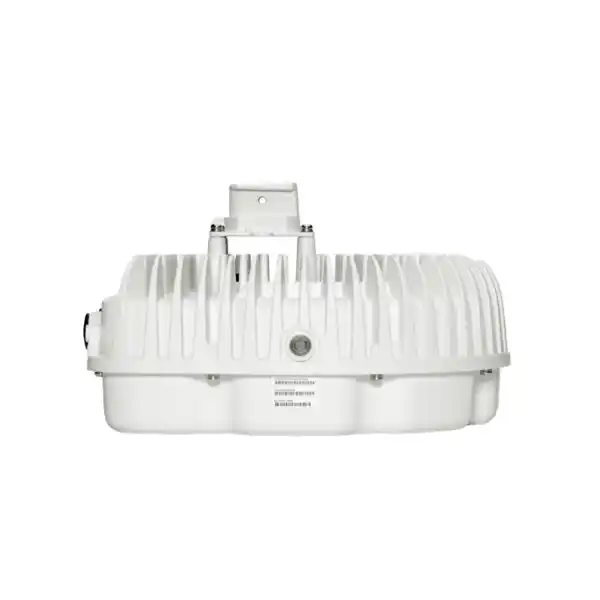
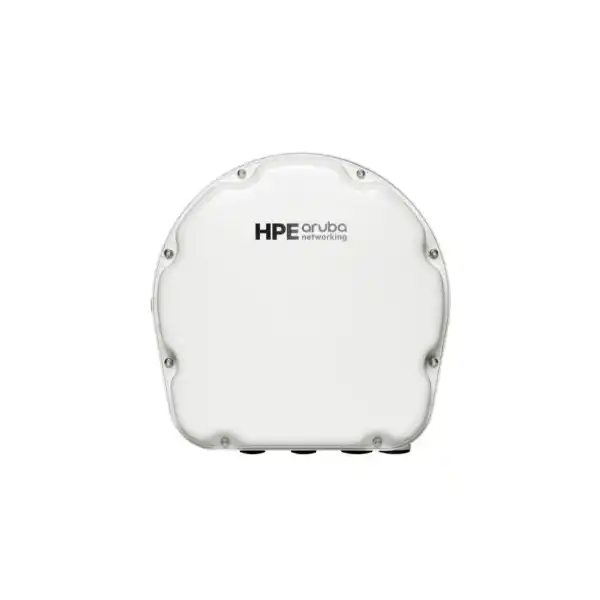
Product image shown for identification. Confirm the exact regional SKU, accessories and ordering configuration before purchase.
Direct answer for buyers
HPE Aruba Networking AP-587 is an outdoor Wi-Fi 6 access point with four integrated directional dual-band antennas designed to concentrate coverage into a defined sector. It is mainly used in enterprise, campus and industrial outdoor networks where a directional RF footprint is more appropriate than an omni-directional pattern. Buyers should consider it when the wireless design calls for 4×4 operation, hardened outdoor construction, multi-gigabit uplink flexibility and integration with an Aruba networking environment. Before proceeding, confirm the RW regulatory-domain SKU for the destination, the required mount, available PoE or AC power, copper or fibre uplink, management and license approach, and the RF plan. A directional AP should be selected from a coverage design, not from distance claims alone.
What the AP-587 does
The AP-587 provides concurrent 2.4 GHz and 5 GHz 802.11ax wireless service using 4×4 MIMO radios and integrated directional antennas. HPE specifies a peak aggregate data rate of 2.97 Gbps for the 580 Series. The AP-587 antenna system is built around four integrated 90-degree horizontal by 90-degree vertical dual-band directional elements, with peak antenna gain listed at 5.8 dBi on 2.4 GHz and 6.6 dBi on 5 GHz. That makes the model particularly relevant when an RF designer wants to shape coverage toward a defined area instead of radiating broadly in all directions.
The device also supports multi-gigabit copper, SFP+ fibre-capable uplink connectivity, a separate 1 GbE port with PoE power sourcing capability under appropriate power conditions, Bluetooth 5 and 802.15.4/Zigbee functions, and a GNSS receiver. These are infrastructure capabilities rather than a guarantee of application performance. Actual client throughput, coverage and capacity depend on channel planning, client capabilities, interference, regulatory limits, mounting height, antenna orientation, available power and network design.
Who should consider it
The AP-587 may suit organisations designing Wi-Fi for outdoor campuses, loading areas, logistics yards, manufacturing and process environments, education grounds, transport-adjacent spaces, public venues, warehouse exteriors, resort or hospitality grounds, utility facilities and other enterprise estates. It is especially worth considering where a wall or pole can be positioned so the integrated directional pattern points toward the target service zone.
It is not automatically the right choice for every outdoor site. If the design needs broad 360-degree coverage around the mounting point, the AP-585 with integrated omni-directional antennas may be more natural. If specialist external antennas are needed to shape RF around unusual structures or long paths, the AP-584 may warrant comparison. Hazardous-location projects require a separate product and certification review; the standard AP-587 should not be substituted for an EX model merely because the enclosure is outdoor hardened.
Business problems this model can help address
Outdoor wireless problems usually come from a combination of RF geometry, client density, physical exposure, uplink limitations and operational visibility. The AP-587 addresses several of these areas, but only when selected as part of a proper design.
Coverage aimed at a defined zone
The integrated directional pattern can be useful where coverage must be projected toward a yard, courtyard, seating area, walkway or work area while avoiding unnecessary radiation behind the AP. The benefit depends on correct orientation and installation position.
Harsh outdoor deployment
IP66/67 construction, an operating range from -40°C to +65°C with full solar loading, and environmental hardening allow the platform to be considered for exposed installations. Cabling, grounding, surge protection and mount selection remain part of the overall outdoor design.
High-capacity wired uplinks
A 5 GbE Smart Rate copper interface and a 10GBASE-R SFP+ interface provide options when the switching and fibre architecture must avoid a 1 GbE uplink bottleneck. The selected interface should match switch ports, optics, cable distance and power design.
Mixed Wi-Fi and IoT estates
Integrated Bluetooth 5 and 802.15.4/Zigbee radios can support IoT-oriented network strategies. Actual business use depends on the Aruba platform, application, device ecosystem and configuration rather than the presence of the radio alone.
Product-fit matrix
| Requirement | Suitable when | Confirm before ordering |
|---|---|---|
| Directional outdoor coverage | The target service area lies mainly in front of the mounting position. | Predictive design or survey, mounting height, azimuth and tilt. |
| Wi-Fi 6 capacity | Client mix and airtime demand justify 4×4 dual-radio 802.11ax capability. | Client radio capability, channel width, interference and density assumptions. |
| Multi-gigabit copper | The access switch supports suitable Smart Rate / 802.3bz connectivity. | Switch port speed, cable category, distance and PoE capability. |
| Fibre uplink | The site benefits from SFP/SFP+ connectivity because of distance or topology. | Supported industrial-temperature optics, fibre type and separate power source. |
| PoE downstream device | The E2 PSE function is part of the design and enough input power is available. | PoE class, thermal conditions and IPM policy. |
| Outdoor resilience | The deployment requires an IP66/67 hardened AP. | Site-specific lightning, surge, grounding, corrosion and mounting requirements. |
Verified technical information for AP-587 (RW)
Manufacturer SKU R7T10A. Values below are based on HPE Aruba Networking 580 Series product documentation and should be rechecked against the current quotation and regional ordering guide.
| Brand | HPE Aruba Networking |
| Product | AP-587 (RW) Dual Radio 4×4 Wi-Fi 6 Internal Directional Outdoor Access Point |
| Manufacturer part number | R7T10A |
| Product family | HPE Aruba Networking 580 Series Outdoor Access Points |
| Wireless platform | Dual-radio 2.4 GHz and 5 GHz 802.11ax, 4×4 MIMO |
| Peak aggregate data rate | Up to 2.97 Gbps for the 580 Series; real throughput is environment and client dependent |
| 5 GHz radio | Up to 2.4 Gbps with supported 4SS HE80 or 2SS HE160 client conditions |
| 2.4 GHz radio | Up to 1,150 Mbps with supported 4SS HE40 conditions |
| Integrated antennas | Four 90° H x 90° V dual-band directional antennas; peak gain 5.8 dBi at 2.4 GHz and 6.6 dBi at 5 GHz |
| E0 network interface | 100/1000/2500/5000Base-T, 5 Gbps Smart Rate, PoE PD support |
| E1 network interface | 10GBASE-R SFP+ cage; HPE expects this to be the primary uplink when used |
| E2 network interface | 10/100/1000Base-T with 802.3af PoE PSE support under appropriate power conditions |
| IoT / location | Bluetooth 5.0, 802.15.4/Zigbee radio, GNSS receiver supporting GPS, Galileo, GLONASS and BeiDou signals |
| Power options | Direct AC 110–240V with required connector kit, or PoE on E0. Power sources are sold separately. |
| Full-function PoE guidance | 802.3bt Class 6 supports unrestricted AP operation with 802.3af PSE output; lower PoE classes impose restrictions |
| Maximum power consumption | Up to 71W on AC; up to 49.5W on 802.3bt Class 6 PoE under stated conditions |
| Dimensions | 302 mm W x 300 mm D x 174 mm H |
| Weight | 4.51 kg unit only |
| Operating environment | -40°C to +65°C with full solar loading; 5% to 93% non-condensing humidity |
| Ingress protection | IP66/67 |
| Regulatory model | APEX0587 |
| Mounting | Mount kit is not included; common AP-587 wall/pole options include H1, H2 and H3 kits depending on orientation |
| Warranty guidance | HPE currently lists limited lifetime hardware warranty coverage for R7T10A; confirm applicable terms and support entitlement for the destination |
| UAE availability | Contact FourTeck for current options, lead time and quotation |
Configuration and dependency notice
The AP-587 should be quoted as part of a complete deployment bill of materials rather than as an isolated access point. HPE states that power sources are sold separately, and the chassis does not ship with a mounting bracket. If the AP is powered by 802.3at, both radios are reduced to two chains and PSE output is disabled. On 802.3af, the unit can boot but the radios do not enable. For unrestricted operation under PoE, 802.3bt Class 6 is the important reference point, although exact behaviour also depends on Intelligent Power Monitoring policy and connected loads. AC is another option but requires the appropriate AC connector kit.
Management and software also deserve confirmation. The AP-587 is supported in Aruba controller-based and controller-less environments depending on software generation, and it can be managed through HPE Aruba Networking platforms such as Central where the chosen architecture and subscription support it. Do not assume a cloud subscription is included with the AP hardware. License requirements, software support and Central subscription terms should be checked against the intended deployment and procurement period.
A practical purchase and deployment journey
Define the service zone
Map the exact area that needs wireless coverage, the expected client density, application requirements and any non-Wi-Fi devices. Determine whether a 90-degree directional pattern suits the geometry.
Validate RF placement
Use a predictive design, survey or both to choose wall or pole location, mounting height, direction, tilt and channel plan. Do not select spacing from a generic maximum-distance claim.
Build the physical BOM
Confirm R7T10A for the relevant RW regulatory domain, mount kit, shielded cabling, surge approach, switch port, PoE class or AC connector, and SFP/SFP+ optics if fibre is used.
Confirm software and management
Match the AP to the current Aruba operating architecture, Central subscription or other management method. Confirm required licenses and support before finalising the order.
Install and verify
After safe mounting and cabling, validate RF coverage, client behaviour, uplink performance, power state, management visibility and any IoT functions against the design objectives.
Directional RF design is the defining capability
The AP-587 is often compared with the AP-585 because the two models share the same broader 580 Series radio platform but use different integrated antenna patterns. The AP-585 is built for omni-directional coverage, while the AP-587 uses integrated directional antennas. That distinction matters more than a simple comparison of antenna-gain numbers. A directional AP concentrates its useful energy toward a sector, which can improve design efficiency when the clients are mainly in front of the unit, but it can create poor service behind or outside that sector if placement is wrong.
HPE specifies four integrated 90° H x 90° V dual-band directional antennas and recommends a vertically oriented wall or pole installation. A buyer should therefore ask where the AP can physically be mounted, what it will face, how high it will be, and whether tilt is required. The H1 and H3 mount options are commonly referenced for AP-587 wall or pole installation because they provide useful positioning flexibility. A flat or flush mounting requirement may point toward another approved bracket.
Coverage distance should not be purchased from a headline number. Outdoor Wi-Fi range changes with client transmit power, antenna characteristics, interference, channel bandwidth, local EIRP rules, required data rate and obstruction profile. A phone that can hear an AP is not necessarily capable of sustaining the same uplink performance back to it. For this reason, RF planning should be based on application thresholds and client types, not on how far an SSID might be visible.
Directional design questions
- Is the target area mainly within a 90-degree sector?
- Can the AP be mounted vertically and aimed correctly?
- Will clients need usable service behind the AP?
- What minimum RSSI, SNR and application throughput are required?
- What client devices and antenna types dominate the environment?
- Could an omni-directional or external-antenna model create a cleaner design?
Power architecture can change available functionality
The AP-587 is more power-sensitive than buyers may expect from ordinary indoor access points because it combines two 4×4 radios, multi-gigabit networking, IoT functions and a downstream PoE-capable Ethernet interface. HPE documents direct AC and PoE input on E0. When both AC and PoE are connected, AC takes priority. With 802.3bt Class 6 PoE, the AP can operate without radio restrictions and can provide 802.3af PSE support on E2. Class 5 with LLDP can support full AP function but does not provide PSE output. With 802.3at, both Wi-Fi radios are reduced to two chains and PSE output is disabled. With 802.3af, the AP can boot but its Wi-Fi radios remain disabled.
This makes switch selection part of access-point selection. A project may have a switch port labelled PoE+, yet still not deliver the intended AP operating mode. The design team should check switch PoE standard, available per-port wattage, total PoE budget, cable run and any power-negotiation requirements. Where the E2 port will power another device, that load must be considered as well.
Direct AC can be useful where the uplink is fibre or where switch-supplied PoE is not practical. HPE specifies 110–240V AC through an appropriate AP-AC-MLX connector kit, which is not simply an ordinary indoor power lead. Outdoor electrical work, weatherproofing and local installation practices should be handled by suitably qualified personnel. FourTeck can help incorporate the correct power components into the quotation after the chosen mounting and uplink method are known.
Flexible uplinks for copper, fibre and edge devices
Outdoor access points are often installed farther from switching rooms than indoor APs, so the AP-587 offers several wired interfaces. E0 supports 100 Mbps, 1 GbE, 2.5 GbE and 5 GbE copper and accepts PoE input. E1 is a 10GBASE-R SFP+ cage, and HPE documentation notes that when E1 is used it is expected to be the primary uplink. E2 supports 10/100/1000Base-T and can source 802.3af PoE when the AP itself has enough input power.
The presence of SFP+ does not mean any optic should be inserted. HPE recommends industrial-temperature SFP/SFP+ modules for optimal performance in these outdoor conditions. The exact optic must match fibre type, wavelength, distance, switch interface and supported transceiver list. If fibre is selected, a separate power method is still required because fibre does not carry PoE.
For copper, shielded twisted-pair cabling is important. HPE specifically instructs the use of STP Ethernet cable on all Ethernet interfaces for proper surge protection. That statement should be interpreted as part of a wider outdoor cabling and grounding design, not as a complete lightning-protection prescription. Building entry, surge devices, bonding, local electrical codes and cable route exposure all matter. The purchasing process should therefore coordinate networking, facilities and installation teams rather than treating the AP as a self-contained item.
Ideal environments and use cases
Industrial yards and production exteriors
A directional AP can be useful when outdoor workstations, handheld scanners, maintenance tablets or mobility devices operate in a defined area adjacent to a building or structure. The site still needs an RF design that considers metal surfaces, moving equipment and interference.
Campus courtyards and walkways
Education and enterprise campuses may use AP-587 units to project coverage from building edges toward outdoor gathering areas or paths. Capacity should be designed around busy periods, not average occupancy.
Logistics and loading zones
Directional coverage can support vehicle-side terminals and handhelds in loading lanes or dock approaches. The RF survey should account for trailers, containers and changing obstruction patterns.
Hospitality and venue grounds
Outdoor guest and operational Wi-Fi may benefit where seating or activity areas are sector-shaped. Guest capacity, roaming, security policy and backhaul should be planned with the same care as the RF layer.
Utilities and remote enterprise sites
The hardened enclosure, flexible uplink choices and IoT radios may fit remote infrastructure. Any hazardous-area classification, however, requires a specific certification review and should not be addressed by the standard AP-587 automatically.
Large public outdoor areas
Sectorised designs can be preferable to a few very loud omni APs. Capacity, client distribution and interference management normally matter more than simply increasing transmit power.
Integration and operational considerations
An AP-587 deployment should be considered within the complete switching, management, security and lifecycle architecture. Verify that access switches support the desired uplink speed and PoE class. Confirm VLAN, routing, gateway, DHCP, DNS and time services as appropriate to the chosen Aruba architecture. If Aruba Central is used, identify the correct subscription and tenancy process; hardware purchase alone should not be treated as proof that a Central license is included.
Operational teams should also decide how outdoor AP health will be monitored, how failed devices are accessed physically, how firmware upgrades are governed and who owns change control. Mounting an AP high on a pole may improve RF geometry but increase maintenance complexity. Cable service loops, safe access, labelling and documentation can reduce future support time.
Security and device assurance
The 580 Series supports modern WLAN security capabilities such as WPA3 and can participate in Aruba policy and segmentation architectures. HPE also includes a Trusted Platform Module for protected storage of credentials, keys and boot code. These platform features are useful, but secure deployment still depends on identity design, authentication method, certificate management, administrative access controls, logging, segmentation policy and software maintenance.
For IoT projects, Bluetooth or Zigbee radio presence should not be confused with automatic device security. Determine which devices will communicate, how they are onboarded, what application consumes the telemetry and whether the required Aruba software feature or external integration is licensed and supported.
Questions to resolve before you request a quotation
Provide a site plan, mounting surface, approximate height and target coverage direction. This is needed to confirm whether AP-587 directional antennas are suitable.
Share expected concurrent users or devices, primary applications and busy-period behaviour rather than only total registered device count.
Confirm available PoE standard and switch budget, or identify whether AC power is required. Lower PoE classes can reduce AP capability.
Choose between copper Smart Rate and SFP/SFP+ based on distance, switch architecture and environmental constraints.
Identify controller-based, Instant or AOS 10 / Central design requirements and verify current software support and subscription terms.
Clarify hardware warranty expectations, vendor support, configuration assistance, remote support and any onsite scope before the order is approved.
Procurement checklist for AP-587 projects
- Confirm exact model: AP-587 (RW) and manufacturer SKU R7T10A for the intended UAE deployment.
- Confirm quantity and the RF design location for every unit.
- Choose a supported AP-587 wall or pole mounting kit and required tilt.
- Confirm E0 copper or E1 SFP/SFP+ uplink and matching switch interfaces.
- Verify shielded cabling, surge protection and grounding scope.
- Confirm PoE class and switch power budget, or specify the required AC connector and power design.
- Identify whether E2 PoE output is required for another device.
- Validate Aruba software version, operating mode and management architecture.
- Confirm any Aruba Central subscription or other license separately from the hardware.
- List any industrial-temperature SFP/SFP+ optics and fibre components.
- Define installation, configuration, testing and documentation scope.
- Confirm current UAE lead time, warranty terms and support entitlement in the quotation.
How FourTeck can assist
FourTeck can help turn a model request into a more complete procurement specification. That may include reviewing whether AP-587 directional coverage fits the target area, checking the proposed quantity against the RF design, identifying common mounting options, discussing copper versus fibre uplinks, and checking whether the available switch power can support the intended feature set.
For projects that require more than hardware supply, installation and configuration scope can be added to the quotation after the site requirements are understood. The exact scope should state who provides mounting structures, power, cabling, fibre, switching, licenses, IP addressing, network access, work permits and testing criteria. This avoids assuming that a hardware quotation automatically includes all project services.
You can also explore FourTeck technology products and networking and technology services when building a wider project requirement.
What to send for an accurate quotation
A useful request includes the destination, required quantity, whether R7T10A has already been specified by a consultant, the target installation date, the intended management environment, and whether the APs will use PoE or AC. If possible, provide the switch model, proposed uplink medium, mount type and any requirement to power a downstream device from E2.
For a new design, provide drawings or site dimensions, outdoor coverage zones, client types, expected concurrent usage and important applications. FourTeck can then discuss whether the AP-587 remains the right antenna form factor or whether an omni-directional or external-antenna alternative should be evaluated. Use the FourTeck contact page to share the project requirement.
UAE availability and support guidance
HPE lists the AP-587 (RW) R7T10A on its UAE product catalogue, but a catalogue listing should not be interpreted as FourTeck stock confirmation. Contact FourTeck to confirm current UAE availability, quantity, vendor lead time and the final bill of materials. Regional availability can change, and a complete order may depend on mounting kits, power components, optics, licenses or support items that have different lead times from the AP itself.
When installation or configuration support is required, include that scope in the quotation rather than assuming it accompanies the hardware. Outdoor Wi-Fi work may need a site survey, access equipment, work permits, mounting infrastructure, cabling and power preparation. FourTeck can coordinate the commercial discussion after the requirement is defined, but dates, site access and installation duration remain project dependent.
Dubai, Abu Dhabi, Sharjah and Ajman coverage
For UAE projects in Dubai, Abu Dhabi, Sharjah and Ajman, FourTeck can assist with requirement review, quotation coordination and discussion of optional installation or configuration support. A multi-site project should identify the quantity and deployment conditions for each location because outdoor mounting, power availability, fibre distance and RF geometry may differ even when the same AP model is proposed throughout the estate. If the customer has an existing Aruba environment, include the current controller, Central or operating-system information so the AP-587 can be evaluated within that architecture. Delivery coordination and project scheduling should be agreed only after the exact product list, quantities, destination and service scope have been confirmed.
GCC Availability
Organisations planning HPE Aruba Networking AP-587 deployments across the GCC can use FourTeck for requirement review, model and accessory selection, quotation coordination, installation planning and regional project discussion. Projects in the United Arab Emirates, Saudi Arabia, Kuwait, Qatar, Bahrain or Oman should confirm the destination country before the order is finalised because regulatory-domain selection, licensing, delivery schedules, service availability and vendor lead times can vary. The AP-587 also depends on mounting hardware, power design and uplink components, so a regional bill of materials should include more than the access point SKU. For multi-country rollouts, share the quantity per destination, proposed Aruba management architecture, license term if applicable, mounting environment, PoE or AC plan and expected deployment window. FourTeck can then help structure the quotation and identify points that need vendor or regional confirmation. Current product availability, local service scope and project scheduling remain dependent on country, quantity and the final requirement.
Explore FourTeck Kuwait resources for relevant regional technology support information.
Africa Availability
FourTeck can also assist organisations evaluating AP-587 deployments for selected African markets, including projects in East Africa and other regions where outdoor enterprise connectivity is required. Buyers should first confirm the destination country, exact model requirement, quantity, intended mounting location, management platform and any installation or support expectations. Availability and fulfilment can depend on regional SKU rules, vendor lead time, shipping arrangements, local power and regulatory requirements, and whether the bill of materials includes mounts, optics, power components or subscriptions. Outdoor deployments may also need site-specific surveys because coverage assumptions from one country or facility should not be reused blindly at another site. FourTeck can help review product selection and procurement scope, but local inventory, customs outcomes, onsite coverage and delivery timing should not be assumed until confirmed for the destination and project. For additional regional information, see FourTeck Africa, FourTeck Kenya or FourTeck Uganda.
Related products and services to evaluate
HPE Aruba Networking AP-585
Consider the AP-585 when the design calls for integrated omni-directional outdoor antennas rather than a directional sector. Radio platform similarities do not make the antenna patterns interchangeable.
HPE Aruba Networking AP-584
The AP-584 supports external antennas and may suit sites that need a specialist antenna pattern. Antenna choice, cable losses and regulatory limits must be engineered correctly.
AP-587EX hazardous-location model
Where a hazardous-location certification is required, evaluate the EX family rather than assuming the standard AP-587 is acceptable. Site classification and exact certification must be confirmed.
Outdoor mounting accessories
AP-587 does not ship with a mounting bracket. H1, H2 and H3 options serve different wall, pole and tilt needs and should be selected from the installation plan.
Aruba management and subscriptions
Confirm the required Central subscription or other management architecture separately. License terms and software support can change and should be aligned with the operational design.
Installation and configuration support
For new outdoor deployments, include survey, mounting, cabling, switch configuration, WLAN configuration, validation and documentation in scope where needed. See FourTeck services.
How buyers are evaluating AP-587 in real projects
Most buyers searching for the AP-587 are not really asking only for a datasheet. They are trying to answer a set of practical questions: whether the directional antenna is right for the site, whether the AP can be powered by the existing switch, whether fibre is possible, what mount is needed, whether Aruba Central licensing is included, and how the model differs from AP-585 or AP-584. Those questions are connected. A technically correct AP can still become a poor procurement choice if the surrounding design is incomplete.
AP-587 versus AP-585
The clearest distinction is antenna pattern. AP-587 uses integrated directional antennas, while AP-585 uses integrated omni-directional antennas. If clients are located mainly in one direction from a wall or pole, AP-587 can fit the geometry. If clients surround the AP, an omni model may simplify coverage. The final answer should come from RF planning, not from choosing whichever model has the higher-looking gain figure.
Can the existing PoE switch run it?
Possibly, but the PoE class matters. HPE documents full unrestricted AP operation with 802.3bt Class 6 and reduced function on lower PoE classes. A common mistake is to see “PoE supported” and assume any PoE+ port is equivalent. The switch model, per-port power class and total PoE budget should be checked before ordering.
Does it support fibre?
Yes, the AP includes a 10GBASE-R SFP+ cage. Fibre can be useful for distance, electrical isolation strategy or campus topology, but it does not provide power. A fibre design therefore needs AC power or another supported power arrangement. Use a suitable industrial-temperature optic and match it to the switch and fibre plant.
Another recurring question concerns distance. There is no single responsible “coverage radius” for an enterprise outdoor AP because useful service depends on client capability, required throughput, interference, channel width, mounting, antenna orientation and local transmit-power limits. A handheld scanner, rugged tablet and modern laptop can have very different link budgets. In addition, the return path from the client to the AP can fail before the AP-to-client signal appears weak. Buyers preparing an RFQ should therefore specify the area, client types and application thresholds rather than asking only for the farthest possible range.
Mounting is equally important. HPE’s installation guidance states that the AP-587 does not ship with a mount kit. H1 and H3 options are commonly used for wall or pole mounting with tilt flexibility, while the H2 option supports flush-wall installation. This means a purchase order for access points alone may arrive without the hardware required to install them. The correct bracket should be selected after the installer knows the pole diameter or wall structure, desired orientation and maintenance access.
Licensing questions also deserve careful wording. AP-587 hardware can operate in supported Aruba architectures, but management subscriptions are not something a buyer should assume are bundled. If Aruba Central is planned, confirm the current subscription requirement and term. If an existing controller or Instant deployment is being expanded, check the supported software version and the organisation’s lifecycle plan. A hardware model can remain physically capable for years while the software architecture evolves around it.
Outdoor environmental specifications are another reason buyers shortlist this model. IP66/67 sealing and a -40°C to +65°C operating range with full solar loading are valuable for exposed deployments, yet they do not eliminate the need for correct cable glands, shielded cabling, surge protection, grounding and installation practice. The weakest element in an outdoor design is often not the AP enclosure itself but the way power and data enter the site.
For quotation planning, the most useful package of information is concise: exact SKU if known, quantity, destination, site plan, preferred mount, power method, uplink method, management platform, license term if required, and whether installation or configuration assistance is expected. With those inputs, FourTeck can help structure a more complete quotation and highlight where a vendor or project confirmation is still needed. If the design is not yet complete, start with the coverage requirement rather than forcing the AP-587 into the project simply because it was the first model found online.
Decision questions buyers ask before approving AP-587
Is AP-587 the right model if I need long outdoor range?
Long range by itself is not enough to choose the model. AP-587 is appropriate when the coverage geometry benefits from a directional 90-degree sector. The acceptable distance depends on the weakest client, required data rate, channel plan, interference and local RF limits. A survey or predictive design should define the coverage objective first.
What happens if my switch provides only 802.3at?
HPE documents reduced operation: both Wi-Fi radios are limited to two chains and PSE output is disabled when the AP is powered by 802.3at with IPM disabled. If full 4×4 operation is part of the design, the PoE plan should be upgraded or AC power considered. Check the exact switch model and power budget.
Do I need to order a mount separately?
Yes. HPE documentation states that the 580 Series chassis does not ship with a mounting bracket. AP-587 commonly uses H1 or H3 wall/pole brackets where tilt is useful, while H2 supports flush wall mounting. The bracket should match the exact physical installation rather than being added generically.
Can I connect the AP directly to fibre?
The E1 interface accepts SFP/SFP+ connectivity and supports 10GBASE-R. HPE recommends suitable industrial-temperature modules. Fibre handles the data uplink only, so the AP still needs power from AC or a supported PoE design on E0 if copper is also used for power.
Is Aruba Central required?
Not in every architecture. AP-587 can operate in supported controller-based and controller-less environments, while Central is a management option associated with the chosen Aruba architecture. If Central is planned, confirm the current subscription type and term. Do not assume a Central subscription is included in the AP hardware price.
What should I provide FourTeck before asking for price?
Provide quantity, destination, whether R7T10A is mandatory, target installation window, management architecture, power method, uplink preference, required mount and any installation or configuration scope. If the model has not yet been engineered, include site drawings and the coverage objective so an unsuitable antenna pattern is not quoted by default.
Why businesses contact FourTeck for this product
The most useful assistance with an AP-587 project is often requirement clarification rather than a generic product summary. FourTeck can help check that the requested R7T10A regional model aligns with the destination, identify commonly required accessories, review whether the planned switch provides appropriate PoE, and discuss the difference between directional, omni-directional and external-antenna alternatives. This can reduce the risk of ordering the correct AP chassis with the wrong mount, insufficient power or an incomplete management plan.
Where customers are replacing, expanding or standardising an Aruba estate, FourTeck can also discuss bill-of-material alignment, license and subscription questions, configuration scope and deployment sequencing. Any compatibility conclusion should be based on the actual controller, switching, software, optics and cabling environment. For company information, visit about FourTeck, or review the wider FourTeck UAE technology portfolio.
Frequently asked questions
What is HPE Aruba Networking AP-587?
AP-587 is an outdoor hardened Wi-Fi 6 access point in the HPE Aruba Networking 580 Series. The RW model R7T10A uses dual 4×4 radios and integrated directional antennas intended for sector-style outdoor coverage.
What is the difference between AP-587 and AP-585?
The key physical difference is antenna pattern. AP-587 uses integrated directional antennas, while AP-585 uses integrated omni-directional antennas. Choose between them according to RF geometry and survey results, not only radio specifications.
Does AP-587 include a mounting bracket?
No. HPE states that the 580 Series AP chassis does not ship with a mounting kit. The appropriate H1, H2 or H3 option should be chosen for the required wall, pole, flush or tilt arrangement.
Can AP-587 run from PoE+?
It can power from 802.3at, but HPE documents reduced capability: both radios are reduced to two chains and PSE output is disabled. 802.3bt Class 6 is the reference for unrestricted PoE operation with 802.3af PSE output.
Does AP-587 support a fibre uplink?
Yes. The AP includes a 10GBASE-R SFP+ cage. HPE recommends suitable industrial-temperature SFP/SFP+ modules. Fibre does not power the AP, so the power method must be planned separately.
Is Aruba Central licensing included with R7T10A?
Do not assume it is included. Management and subscription requirements depend on the selected Aruba architecture and current vendor licensing. Ask FourTeck to confirm the required subscription or support items for the project.
Is AP-587 suitable for very hot outdoor sites?
HPE specifies operation from -40°C to +65°C with full solar loading and IP66/67 environmental ratings. Site design must still account for power limits, cabling, surge protection, mounting and local environmental conditions.
Can AP-587 be used in hazardous locations?
The standard AP-587 should not be assumed suitable for a classified hazardous location. HPE offers separate EX models. The exact site classification and required certifications must be reviewed before selection.
How do I get an AP-587 quotation in Dubai or the UAE?
Send FourTeck the required quantity, destination, preferred deployment timing and any mount, power, uplink, management, license or installation requirements. FourTeck can then confirm current UAE availability and prepare the appropriate quotation.
Plan the AP-587 requirement before you order
For a useful quotation, include the quantity, UAE destination, mounting location, power method, uplink type and intended Aruba management environment. If the RF design is still open, share the coverage area and client requirements so FourTeck can discuss whether the directional AP-587 is the right fit or whether another 580 Series antenna option should be evaluated.

Reviews
There are no reviews yet.