
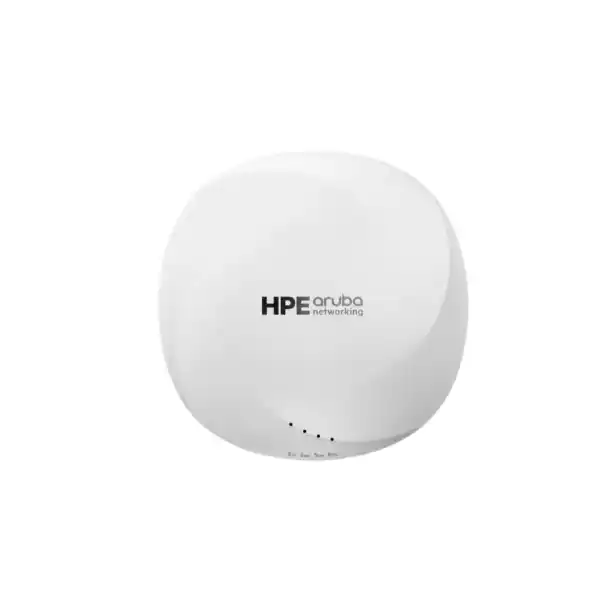
Enterprise Wi-Fi 6E for modern indoor networks
HPE Aruba Networking AP-615 in Dubai, UAE
The HPE Aruba Networking AP-615 is a compact 610 Series campus access point designed for organisations moving toward Wi-Fi 6E and the additional capacity available in the 6 GHz band. It combines dual software-configurable radios, 2×2 MIMO, a 2.5 GbE Smart Rate uplink, integrated indoor antennas, location-aware functions and IoT radios in a form factor suited to office, education, healthcare, retail and similar indoor environments. The key buying question is not simply whether an AP-615 can provide fast wireless service; it is whether the chosen radio mode, switching, PoE, management software, regional SKU, mounting and client estate fit the intended network design.

Before requesting a quotation
Confirm quantity, deployment country, required radio bands, switch uplinks, PoE class, mount kits, software or cloud-management choice, installation scope and whether a single unit or multi-AP 6 GHz design is planned.
Wi-Fi 6E / 802.11ax including 6 GHz
Two radios, any two of three bands simultaneously
One 100/1000/2500BASE-T Smart Rate port
PoE or 12 VDC; check power-mode implications
Direct answer for buyers
The AP-615 is an indoor HPE Aruba Networking 610 Series access point for enterprises that want Wi-Fi 6E capability without moving to a larger tri-radio platform. It is mainly used to add 6 GHz capacity, support modern 802.11ax clients and improve wireless design flexibility in multi-AP environments. It suits organisations with compatible switching, PoE and WLAN management and with enough Wi-Fi 6E client adoption to justify 6 GHz planning. Before proceeding, confirm the country-specific ordering model, software support, mount kit, PoE source, desired radio combination, 6 GHz regulatory availability, client compatibility and whether management is controller-based, Instant or a supported AOS 10 environment.
What the AP-615 does
The AP-615 provides indoor enterprise WLAN access using two 2×2 radios that can be assigned to 2.4 GHz, 5 GHz or 6 GHz. Because only two radios operate simultaneously, the design is intentionally flexible rather than fully tri-radio in one unit. A deployment can run 2.4 + 5 GHz for broad legacy and current client support, 5 + 6 GHz where higher-band capacity is the priority, or 2.4 + 6 GHz for specific RF plans. In larger multi-AP designs, different units can be configured so the site receives practical coverage across all three bands.
The access point also includes a 2.5 GbE interface to reduce the chance that the wired uplink becomes a bottleneck, plus BLE 5.0 and Zigbee radio capability for location and IoT-oriented use cases. Built-in GNSS support, Fine Time Measurement and Open Locate-related capabilities can contribute to location-aware deployments when the wider software and design prerequisites are present.
Who should consider it
The AP-615 is most relevant to organisations refreshing an Aruba wireless estate, opening new indoor sites, increasing client density, preparing for Wi-Fi 6E devices or trying to reduce congestion in heavily used 5 GHz environments. IT teams may consider it for offices, classrooms, clinics, branch locations, retail premises and other indoor spaces where 2×2 radio capacity is appropriate.
It may be less suitable where the project requires three simultaneous client-serving radios in every AP, higher spatial-stream counts, outdoor environmental protection, dedicated high-density characteristics beyond the 610 Series design, or specialised antenna options. A WLAN survey and capacity estimate should decide the access-point model and quantity. FourTeck can review the AP-615 alongside nearby HPE Aruba Networking options rather than assuming one model is suitable for every floor or facility.
Business problems the AP-615 can help address
Crowded 5 GHz spectrum
Where approved and supported by client devices, 6 GHz can provide additional clean spectrum and wider channel options. The AP-615 lets network designers use 6 GHz while retaining one other serving band.
Modern application demand
Video collaboration, cloud applications and increasingly capable client devices can raise wireless demand. Wi-Fi 6E, OFDMA, MU-MIMO and 160 MHz channel support can help when the RF design and client mix are suitable.
Wired uplink headroom
The 2.5 GbE Smart Rate uplink gives the AP more wired capacity than a standard 1 GbE connection. The access switch must also support the desired multigigabit speed and sufficient PoE.
Operational consistency
For organisations already using Aruba WLAN architecture, the AP-615 can fit into supported controller, Instant or AOS 10 designs, subject to the required software versions and the organisation’s management strategy.
Core capabilities at a glance
2.4, 5 and 6 GHz support with two active radios at a time.
HPE states the maximum when configured for 5 GHz + 6 GHz operation.
Two spatial streams in 2.4, 5 and 6 GHz radio modes.
Downtilt omni-directional antennas optimized for horizontal ceiling mounting.
Bluetooth Low Energy 5.0 and Zigbee (802.15.4) capabilities are integrated.
GNSS, 802.11mc Fine Time Measurement and Open Locate support are part of the platform capability set.
AP-615 fit matrix
| Requirement | Suitable when | Confirm before ordering |
|---|---|---|
| Wi-Fi 6E adoption | You have or expect 6 GHz-capable client devices and want to expand available spectrum. | Country rules, client support, channel design and radio mode. |
| Two-radio design | Any two of 2.4, 5 and 6 GHz at a time are sufficient per AP. | Whether every location needs simultaneous service on all three bands. |
| Multigigabit uplink | Your access switch can provide 2.5 GbE and the intended PoE class. | Switch port speed, cabling category, PoE budget and oversubscription. |
| Indoor ceiling deployment | Horizontal ceiling mounting matches the RF plan and building structure. | Mount kit type, ceiling material, plenum requirements and cable route. |
| Aruba management | The WLAN uses a supported HPE Aruba Networking software architecture. | Minimum software version, management mode, licensing and upgrade path. |
| IoT / location services | BLE, Zigbee or location-aware features are part of the solution design. | Application platform, configuration, licensing and integration requirements. |
Verified technical information
The following data is based on current HPE Aruba Networking 610 Series information for the AP-615. Regional SKU, regulatory approvals, accessories, support terms and software entitlements still need to be confirmed for the destination and bill of materials.
| Brand | HPE Aruba Networking |
| Product | AP-615, HPE Aruba Networking 610 Series Campus Access Point |
| Common RW ordering SKU | R7J49A. Confirm the correct regional SKU for the UAE quotation before ordering. |
| Product type | Indoor enterprise campus wireless access point |
| Wireless standard | 802.11ax / Wi-Fi 6E with legacy 802.11a/b/g/n/ac support as applicable by band |
| Radio architecture | Dual radio, tri-band capable; any two of 2.4 GHz, 5 GHz and 6 GHz operate simultaneously |
| Spatial streams | 2×2 MIMO in supported 2.4, 5 and 6 GHz modes |
| Combined peak data rate | Up to 3.6 Gbps when configured for 5 GHz + 6 GHz operation; real application throughput is lower and environment dependent |
| 6 GHz channels | Support for up to seven 160 MHz channels where permitted by regulation and design |
| Ethernet | 1 x E0 RJ-45, auto-sensing 100/1000/2500BASE-T, NBase-T / IEEE 802.3bz compliant at 2.5 GbE |
| PoE | 802.3af/at PoE supported; unrestricted operation with 802.3at Class 4. Class 3 can impose default restrictions such as disabling USB when IPM is not used. |
| DC power | 12 VDC nominal input supported; power sources are sold separately according to ordering guidance |
| USB | USB 2.0 Type-A host interface, capable of supplying up to 1 A / 5 W to an attached device |
| IoT radio | Bluetooth Low Energy 5.0 and Zigbee (802.15.4) |
| Location features | GNSS receiver supporting GPS, Galileo, GLONASS and BeiDou signals; Fine Time Measurement and Open Locate-related capabilities |
| Security hardware | Built-in Trusted Platform Module (TPM) |
| Wi-Fi security certifications | WPA, WPA2 and WPA3 options; Wi-Fi CERTIFIED 6E |
| Antennas | Integrated downtilt omni-directional antennas optimized for horizontal ceiling mounting |
| Unit dimensions | 160 mm x 160 mm x 39 mm, excluding mount bracket |
| Unit weight | Approximately 520 g, excluding mount bracket |
| Operating temperature | Indoor operating conditions are specified by HPE; confirm the current data sheet for project environmental limits and local installation requirements |
| Minimum software versions | AOS / InstantOS 8.11.0.0 or HPE Aruba Networking AOS 10.5.0.0 according to current QuickSpecs; verify compatibility with the planned architecture and current release guidance |
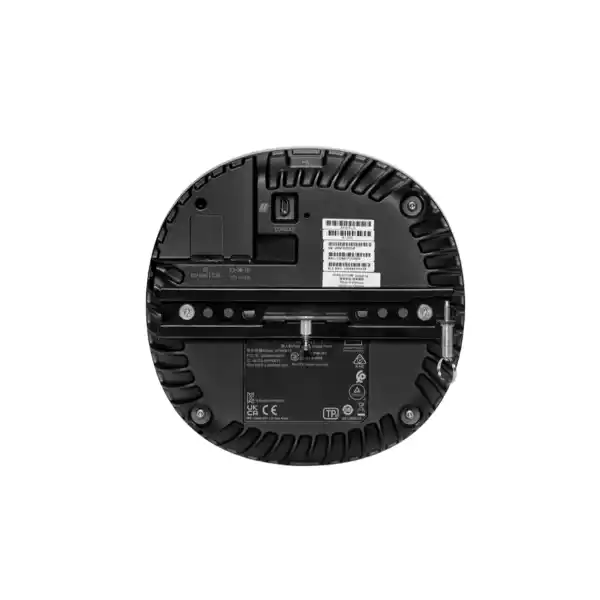
| Mounting | A bracket is pre-installed on the AP; compatible mount kits are ordered separately according to the ceiling or mounting surface |
| Availability | Contact FourTeck to confirm current UAE regional SKU, quantity availability, lead time, accessories and quotation scope |
Configuration, licensing and compatibility dependencies
The AP-615 should be purchased as part of a network design, not as an isolated hardware decision. The first dependency is radio mode. A single AP-615 does not serve 2.4, 5 and 6 GHz simultaneously because it has two radios. If a site needs all three bands, the RF plan must use multiple APs or a different access-point architecture. This is especially important where older 2.4 GHz devices must coexist with modern 6 GHz clients.
The second dependency is switching and PoE. Although the AP supports operation from 802.3af Class 3 power, HPE documents a restricted mode when IPM is disabled, including the USB port being disabled. For a straightforward unrestricted deployment, 802.3at Class 4 PoE is the safer design target. If the network expects to use the 2.5 GbE uplink, the switch, cabling and port configuration must also support multigigabit Ethernet.
Management and software are equally important. Controller-based ArubaOS, Instant and AOS 10 environments have different architecture and licensing implications. Existing customers should confirm their software release, controller or gateway compatibility, cloud-management plan, subscription terms and upgrade pathway. New deployments should define the management model before the bill of materials is finalized. FourTeck can help collect these dependencies for quotation, but the exact license or support package should be selected against the customer’s current environment and HPE policy at the time of order.
From requirement to live wireless service
Define the service expectation
List business applications, device types, user density, guest access, voice or video requirements, IoT devices and areas where reliable roaming matters. A statement such as “we need Wi-Fi 6E” is not enough to determine quantity or placement.
Review the RF environment
Use floor plans and, where appropriate, a site survey to consider walls, ceilings, neighboring WLANs, interference sources, room capacity and likely AP mounting positions. A good Wi-Fi 6E design balances coverage and capacity rather than maximizing transmit power.
Choose the radio strategy
Decide where the AP-615 should use 2.4 + 5 GHz, 5 + 6 GHz or another supported combination. Consider whether legacy 2.4 GHz devices remain critical and what percentage of the endpoint estate can actually use 6 GHz.
Validate the wired edge
Check switch port count, 2.5 GbE support, PoE class and total power budget, VLAN design, uplink capacity and cabling. This prevents a modern AP from being connected to an access layer that cannot supply the expected power or bandwidth.
Confirm software and licenses
Identify the intended Aruba management architecture, software release and subscription or support needs. Existing WLAN customers should confirm interoperability with controllers, gateways, Central management and their planned migration roadmap.
Build the bill of materials
Confirm the regional AP SKU, quantity, mount kits, power accessories if required, licenses or subscriptions, support services, switch upgrades and any deployment materials. Treat the AP hardware as one part of the complete requirement.
Install and configure
Mount the APs according to the survey or design, validate cabling and PoE, adopt them into the chosen management platform, apply SSIDs and security policy, and implement the planned RF settings. Installation scope should be explicitly included in the quotation where required.
Test and document
Verify client association, roaming, 6 GHz behavior, application performance and monitoring. Record AP names, locations, switch ports, management status and any deviations from the planned design so future support and expansion are easier.
Why the flexible two-radio architecture matters
The AP-615’s defining design choice is flexibility. Each access point contains two radios that can be tuned across three Wi-Fi bands. That allows an administrator or RF design to emphasize the bands that make sense for a particular site or stage of migration. In an office with many older endpoints, 2.4 + 5 GHz may remain practical. In a modern collaboration floor where most laptops and mobile devices support Wi-Fi 6E, 5 + 6 GHz may be a better use of airtime. In a multi-AP building, a planner can distribute roles to provide service across all three bands without requiring every device to run three client radios at once.
This flexibility does not remove the need for RF engineering. Moving a radio to 6 GHz changes coverage characteristics, client eligibility and channel planning. The higher frequency can provide useful capacity and cleaner spectrum, but it does not travel through building materials in the same way as lower bands. The right response is usually to design for the application and floor plan rather than simply mirroring an existing 5 GHz AP placement plan.
For procurement teams, the practical lesson is to ask the network team how the APs will be configured. If the answer assumes every AP will simultaneously serve 2.4, 5 and 6 GHz, the requirement should be reviewed before a purchase order is placed. FourTeck can help turn the RF and management assumptions into a clearer bill of materials so that the AP-615 is selected for a reason rather than because Wi-Fi 6E appears on a specification sheet.
2.5 GbE and PoE planning at the wired edge
Wireless performance is only one side of an access-point deployment. The AP-615 includes a single Ethernet interface that can negotiate at 100 Mbps, 1 Gbps or 2.5 Gbps. The multigigabit option is useful because a modern AP can aggregate traffic from many clients and because high-capacity radio modes may exceed the comfort zone of a 1 GbE uplink under demanding conditions. To benefit, the connected switch port and cabling must support the negotiated speed. If the access layer is limited to 1 GbE, the AP will still operate, but the design should understand that constraint.
PoE deserves equal attention. HPE documents support for 802.3af and 802.3at power, with unrestricted operation on 802.3at Class 4. On Class 3 power, the default restrictions can include disabling the USB port when Intelligent Power Monitoring is not used. This distinction matters if the USB interface is intended for an attached device or if the organisation wants a predictable full-feature configuration without dynamic power compromises.
A switch review should therefore cover port speed, PoE class, total chassis power budget, uplink capacity, VLAN support and software compatibility. Large refresh projects can fail budget planning when AP costs are calculated independently from access-switch upgrades. FourTeck can assist with a combined requirement review so that wireless, switching and power assumptions are aligned before quotation.
Location awareness, BLE and Zigbee as platform features
The AP-615 is more than a Wi-Fi radio endpoint. It includes Bluetooth Low Energy 5.0 and Zigbee functionality, along with a GNSS receiver and support for location-related technologies such as Fine Time Measurement. These capabilities can support organisations that want their WLAN to become part of a broader location, asset-awareness or IoT architecture. Examples can include proximity experiences, device discovery, sensor integration or improved AP location context for operations.
However, the presence of integrated radios does not mean a complete IoT or indoor-location solution is automatically included. A useful deployment can require software services, subscriptions, compatible endpoints, APIs, positioning design, application logic and operational ownership. The business should define the outcome first: for example, whether it wants to locate managed assets, improve wayfinding, connect sensors or simply preserve the option for future use.
That distinction helps buyers avoid overestimating what an AP can do on its own. If IoT or location is part of the project, include the required application platform and integration scope in the technical discovery stage. If it is not yet required, the integrated capabilities still provide a pathway for future design without needing a separate Wi-Fi access point purely for those radios.
Ideal business environments and practical use cases
Corporate offices
Suitable for meeting spaces, desk areas and collaboration zones where newer laptops and phones can use Wi-Fi 6E. The design should still account for 2.4 GHz IoT endpoints and older client devices.
Education environments
Classrooms and training areas can generate high simultaneous demand. AP quantity should be based on room occupancy, device count, application type and RF survey findings rather than a simple square-meter formula.
Healthcare and clinics
Wi-Fi 6E can support modern staff and application devices, but biomedical equipment, roaming behavior, security policy and building materials make careful validation especially important.
Retail and branches
Compact indoor sites may benefit from flexible radio modes, zero-touch deployment workflows and consistent central management. Back-office, POS, guest and IoT traffic should be segmented and prioritized appropriately.
Hospitality common areas
Lounges, meeting facilities and indoor public areas can use added 6 GHz capacity for compatible guests. Room-by-room hospitality designs may require a different AP form factor, so model selection should follow the building plan.
Technology-forward campuses
Sites introducing Wi-Fi 6E clients at scale can use the AP-615 where 2×2 radio capacity fits. Higher-density or more demanding spaces should be evaluated against other Aruba campus AP models.
Integration and operational considerations
A successful AP-615 deployment needs alignment with authentication, switching, addressing, monitoring and security policy. Enterprises using 802.1X should confirm RADIUS or identity-platform design, certificate handling and role assignment. Guest WLANs may need captive portal, segmentation and Internet-only policy. Voice or latency-sensitive applications require appropriate QoS and roaming design. IoT endpoints may need dedicated SSIDs or policy roles, especially if they depend on 2.4 GHz.
The wired access layer should be prepared for the AP’s 2.5 GbE interface and PoE requirements. Network teams should also consider switch uplinks, because a floor with many multigigabit AP ports can increase aggregate traffic toward distribution switches. Configuration templates, naming standards and monitoring tags help operations teams identify each AP and its serving location quickly.
If the organisation is migrating from an older ArubaOS or Instant estate, the project should include software and architecture review before hardware rollout. Mixed-generation WLANs can be entirely workable, but the controller, gateway, management and licensing path must be confirmed. The correct upgrade sequence can be as important as the access-point purchase itself.
Questions to resolve before ordering
Quantity should come from coverage, capacity and client-density requirements. Floor size alone can be misleading because walls, room occupancy and application demand materially affect placement.
Decide whether 2.4 + 5, 5 + 6 or another supported combination makes sense. Consider legacy endpoints, Wi-Fi 6E adoption and multi-AP band distribution.
If not, understand the negotiated speed and power-mode limitations. Include switch upgrades in the project if they are necessary to meet the design objective.
Controller, Instant and AOS 10 designs differ. Confirm current software, gateway or controller platforms, Central subscriptions and support status before finalising the BOM.
The AP has a pre-installed bracket, but the final mounting kit depends on the ceiling rail, surface or installation method. Do not assume a suitable kit is included for every site.
HPE uses region-specific AP variants. Confirm the destination country and current regional ordering code rather than buying a US, RW or other model solely because it appears online.
Procurement checklist for an AP-615 quotation
✓ Exact deployment country and required regional model
✓ Required access-point quantity and floor locations
✓ Expected concurrent users and device categories
✓ Planned 2.4, 5 and 6 GHz radio strategy
✓ 2.5 GbE switch-port availability and cabling condition
✓ PoE class and total switch power budget
✓ Required mount kits and installation surfaces
✓ Current Aruba controllers, gateways or Central environment
✓ Current software release and upgrade requirements
✓ License, subscription and support-term requirements
✓ Installation, configuration and testing scope
✓ Required delivery location and target project schedule
How FourTeck can assist with sizing and quotation
FourTeck can help translate the WLAN requirement into a more complete purchasing scope. That can include reviewing the intended AP quantity, radio-band strategy, switch and PoE readiness, mount kits, management architecture, software compatibility, subscriptions, support options and deployment services. This is particularly useful when an organisation is upgrading from older Wi-Fi generations and the project affects both the access points and the wired edge.
For a quotation, provide the deployment country, site type, estimated number of users or devices, floor plans where available, current Aruba environment, preferred management approach, switch model information and required timeline. FourTeck can then coordinate the product and service scope more accurately. If a predictive or on-site wireless survey is required, that should be discussed as part of the project rather than assumed to be included with hardware supply.
You can review additional business networking products, discuss deployment and configuration services, or send the project details through the FourTeck contact page.
UAE availability and support guidance
Contact FourTeck to confirm current UAE availability for the HPE Aruba Networking AP-615, the correct regional model, quantity options and vendor lead time. Online pages can show multiple AP-615 variants, including US and rest-of-world models, so the destination country should be treated as part of the ordering specification. The quotation should also state whether mount kits, power accessories, management subscriptions, support coverage, installation or configuration services are required.
Delivery and project coordination can be discussed after the exact requirement is confirmed. FourTeck can support business enquiries for Dubai and coordinate requirements that include Abu Dhabi, Sharjah and Ajman within one UAE project scope. Availability, licensing and deployment scheduling can vary by quantity, regional model, service requirement and vendor lead time, so confirm these items before setting internal installation dates.
GCC Availability
Organisations planning AP-615 deployments across the Gulf can ask FourTeck to coordinate requirement review, model selection, quotation planning and deployment scope for multi-country projects. The United Arab Emirates, Saudi Arabia, Kuwait, Qatar, Bahrain and Oman may have different regulatory, commercial, licensing and logistics considerations, particularly for wireless products using the 6 GHz band. A regional request should identify the destination country for each batch, the required quantity, preferred radio architecture, management platform, support expectation and target schedule. Product availability, regional SKUs, software subscriptions, delivery timing, installation scope and vendor lead times can vary by country and requirement. FourTeck can help align the bill of materials and service assumptions, but customers should not assume that a SKU quoted for one Gulf market is automatically the correct choice for another. For Kuwait-specific coordination, buyers can also review FourTeck Kuwait resources.
Africa Availability
FourTeck can also assist organisations evaluating HPE Aruba Networking wireless projects for African operations, including regional procurement planning, AP model review, license or subscription requirements, accessories, configuration scope and support considerations. For AP-615 projects, the destination matters because wireless regulatory rules, approved variants, power and mounting requirements, shipping arrangements and local project conditions can differ. Share the destination country, exact quantity, site type, management architecture, preferred deployment schedule and any installation or remote-support expectations so the requirement can be assessed properly. Availability and fulfilment may depend on vendor lead time, regional SKU, quantity, project scope and logistics. For East African enquiries, buyers may use FourTeck Kenya or FourTeck Uganda, while broader regional information is available through FourTeck Africa.
Related options and services to consider
If three simultaneous bands, higher spatial streams or a different density profile is required, compare the AP-615 with other current HPE Aruba Networking campus AP models before final selection.
A suitable switch can provide 2.5 GbE and sufficient PoE for the APs. Switching should be included in the capacity review, especially for large refresh projects.
Select the ceiling or surface mount appropriate for the site and validate copper cabling for the desired multigigabit link speed.
Predictive or on-site survey services can help decide AP count, placement, channel strategy and expected coverage for new or challenging facilities.
Existing Aruba customers may need software upgrades, controller or gateway planning, template changes or phased migration work before AP-615 rollout.
Review the applicable hardware warranty and any support service required by the organisation’s operating model. Confirm current terms at the time of quotation.
Why businesses contact FourTeck for Aruba wireless projects
Wireless procurement becomes more reliable when the hardware order reflects the real network. FourTeck can help buyers clarify which AP model matches the site, whether 6 GHz is relevant to the client estate, whether the switch layer can support multigigabit PoE, which mounting accessories are needed and how the management architecture affects licensing or software prerequisites. This reduces the risk of receiving access points without the supporting components or planning required to deploy them effectively.
For existing Aruba environments, a compatibility review can cover current controller, gateway, Instant or Central usage and the software path needed for the AP-615. For new environments, the discussion can start with capacity, coverage, segmentation, authentication and support requirements before a specific bill of materials is proposed. Procurement teams can then compare a better-defined scope instead of comparing only unit prices.
FourTeck’s role can include requirement clarification, quotation coordination, installation planning, configuration scope and support coordination according to the project. For more information about the company, visit About FourTeck.
What buyers are trying to understand before choosing the AP-615
A frequent question around the AP-615 is whether “tri-band” means three radios are transmitting at the same time. For this model, it does not. The AP is tri-band capable because its radios can use the 2.4, 5 and 6 GHz bands, but it has two active radios. That distinction changes planning. A buyer who needs to preserve 2.4 GHz for printers, handhelds or older IoT devices while also serving 5 GHz and introducing 6 GHz must consider how multiple APs will distribute those bands. A site that has already removed most 2.4 GHz dependencies may instead prioritize 5 + 6 GHz in suitable areas.
No. Wi-Fi 6E can add capacity and cleaner spectrum, but end-to-end performance also depends on the client, channel width, signal quality, contention, switch uplink, firewall, WAN service and application. The AP’s combined peak data-rate figure is a radio-layer maximum, not a promise that every user will see that speed.
Clients can continue using supported legacy bands and standards when those bands are enabled. A 6 GHz radio serves Wi-Fi 6E-capable devices, so older devices do not gain 6 GHz capability simply because the AP supports it. This is why client inventory matters during design.
Not necessarily. Wider channels can increase peak throughput for compatible clients, but channel reuse, neighboring networks, device support and density influence the best choice. In many enterprise designs, channel width is selected to balance capacity, interference and predictable reuse.
Possibly, but that is not the same as saying it is the right design. The AP supports 802.3af Class 3, yet HPE documents restrictions in that power mode. Check both per-port PoE capability and total switch power budget before assuming an existing switch is adequate.
Another common buying concern is the part number. Search results can surface AP-615-US, AP-615-RW and other country variants. Wireless access points are regulated radio devices, so buyers should not select a regional version based only on availability or online price. HPE QuickSpecs list a rest-of-world AP-615 SKU as R7J49A and country-specific variants for certain markets. The safest procurement workflow for a UAE project is to state the destination and ask for the current approved regional ordering code in the quotation.
Buyers also compare the AP-615 with higher-end Wi-Fi 6E access points. The AP-615 is attractive when 2×2 radios and the flexible two-radio approach match the site. A larger model may make more sense where each AP must serve more spatial streams, where three simultaneous radios are required, or where a specific high-density design calls for greater radio resources. The right comparison is therefore based on user density, client capabilities, application profile, AP placement and wired infrastructure rather than simply choosing the model with the highest advertised maximum.
The cost conversation should also go beyond the AP hardware. A complete deployment can include mount kits, multigigabit PoE switches, software subscriptions, support, cabling remediation, installation, survey work and migration services. If the WLAN is managed through a new architecture, gateways or other infrastructure may also be relevant. Procurement teams get a more useful quote when these dependencies are identified early, because a low AP unit price does not represent the total project cost.
For Dubai and UAE organisations, a practical first step is to share the current WLAN environment and target outcome. A short description such as “replace 40 older APs across two floors, keep barcode devices on 2.4 GHz, introduce 6 GHz for staff laptops, existing switches are 1 GbE PoE+” is far more useful than asking only for “40 AP-615 units.” FourTeck can use that information to flag switching, mount, software or model-selection questions before the quotation is finalized.
Decision questions that deserve a direct answer
Should we buy the AP-615 if most devices are still Wi-Fi 5 or Wi-Fi 6?
It can still be a sensible refresh platform, but the immediate value of 6 GHz will be limited until more clients support Wi-Fi 6E. If the organisation expects to keep the WLAN hardware for several years and has a client-refresh roadmap, that future capacity may justify the choice. If almost all devices will remain older for the expected AP lifecycle, compare the cost and design against alternatives.
How do we know whether one AP per room is necessary?
You do not determine that from the product model alone. Room geometry, wall construction, user count, application demand and 6 GHz coverage objectives all matter. Predictive planning can provide a starting point, while an on-site survey is valuable for complex or high-importance environments. Buying a fixed “APs per square meter” quantity without RF context can lead to both under-coverage and excessive contention.
Do we need to replace our access switches?
Not always. First check whether the current switches support the required PoE class, total power budget and desired Ethernet speed. The AP can work at 1 GbE, so 2.5 GbE is not mandatory for basic operation. The decision should consider expected traffic and whether retaining 1 GbE creates an avoidable bottleneck in the new design.
Is a separate power adapter included?
Power accessories should not be assumed. HPE’s ordering information treats power sources as separate ordering considerations. Most enterprise deployments use PoE from the access switch, but if DC power is required, confirm the supported supply and include it in the bill of materials.
What information is needed for an accurate quote?
Provide deployment country, quantity, current WLAN platform, software version, switch models, PoE capability, required mount type, expected management method, target installation date and whether survey, installation, configuration or migration services are required. For multi-site projects, list quantities by country or site rather than combining them into one undifferentiated total.
How should we compare the AP-615 with another Aruba AP?
Compare radio count, spatial streams, supported bands, Ethernet interfaces, PoE requirements, antenna design, environmental rating, software compatibility and intended density. Then map those differences to the actual site. A higher-spec model is not automatically better if the extra radio capacity or interfaces are not needed.
Frequently asked questions
Is the HPE Aruba Networking AP-615 a Wi-Fi 6E access point?
Yes. The AP-615 is part of the 610 Series and supports 802.11ax across 2.4, 5 and 6 GHz. Its two radios can operate on any two of those three bands simultaneously.
Does one AP-615 provide 2.4, 5 and 6 GHz at the same time?
No. It is dual-radio and tri-band capable. A single unit serves two bands at a time. Broader tri-band coverage can be created across a multi-AP deployment by assigning radio roles appropriately.
What Ethernet connection does the AP-615 use?
It has one RJ-45 E0 port supporting 100 Mbps, 1 GbE and 2.5 GbE Smart Rate connectivity. To use 2.5 GbE, the access switch and cabling must support the required multigigabit link.
Can the AP-615 run on standard PoE?
The AP supports 802.3af and 802.3at PoE. HPE documents unrestricted operation with 802.3at Class 4. Class 3 operation can apply feature restrictions, so verify the switch power design before deployment.
Is a mounting kit included?
The AP has a pre-installed bracket, but the final mount kit for the ceiling rail or surface is ordered according to installation needs. Confirm the correct kit for each site.
What software version is required?
Current HPE QuickSpecs list support from ArubaOS / InstantOS 8.11.0.0 and AOS 10.5.0.0. Compatibility depends on the planned architecture, so verify the current release and controller, gateway or Central requirements before ordering.
Does the AP-615 support Bluetooth and Zigbee?
Yes. It includes Bluetooth Low Energy 5.0 and Zigbee (802.15.4) radio capability. Using those radios in a business solution may require additional software, integration or subscriptions depending on the use case.
Which AP-615 SKU should be ordered in the UAE?
HPE uses region-specific models. R7J49A is listed as an AP-615 RW model in current QuickSpecs, but buyers should confirm the current UAE-approved ordering SKU in the quotation rather than relying on a generic online listing.
What should we send FourTeck for a quotation?
Send quantity, deployment country, floor plans or site description, current wireless platform, switch models, PoE capability, mounting requirement, management preference, required support term and any survey, installation or configuration services needed.
Is the AP-615 currently available in Dubai?
Availability can change by regional SKU, quantity and vendor lead time. Contact FourTeck to confirm current UAE availability and the correct model before committing to a project schedule.
Build the AP-615 requirement around your actual network
Share your site count, AP quantity, current Aruba environment, switch and PoE details, planned 6 GHz use, mount requirements and required deployment services. FourTeck can help review the scope and coordinate a UAE quotation without assuming stock, licensing or accessories that have not been confirmed.

Reviews
There are no reviews yet.