
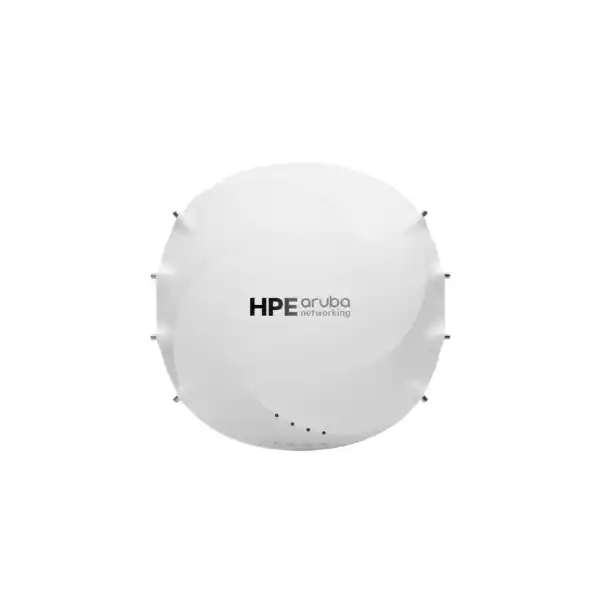
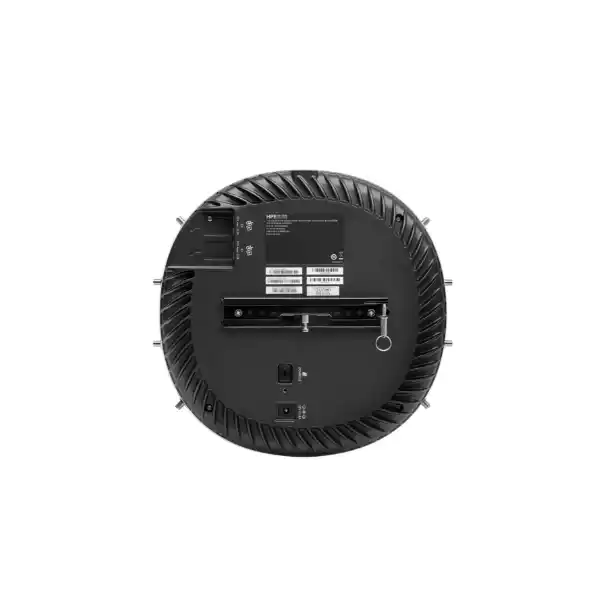
Enterprise Wi-Fi 6E • External Antenna Campus AP
HPE Aruba Networking AP-654 in Dubai, UAE
The AP-654 is the connectorized external-antenna member of the HPE Aruba Networking 650 Series, built for demanding indoor wireless environments where RF design, client capacity and controlled antenna patterns matter. It combines three 4×4 radios for 2.4 GHz, 5 GHz and 6 GHz with dual multigigabit Ethernet interfaces, enterprise security functions, IoT radios and flexible management options. For UAE projects, the important buying decision is not only the access point itself: the regulatory variant, antennas, mount, power source, software release, management platform and switching design should all be confirmed together.

Wi-Fi 6E, 802.11ax with 6 GHz
Tri-band 4×4:4 radios
Two 5 GbE interfaces
External RP-SMA connectors
RW S1G53A for many non-US markets
Direct answer for buyers
The HPE Aruba Networking AP-654 is an indoor enterprise Wi-Fi 6E access point for high-density campus and business networks. Its defining characteristic is the external-antenna design, with two sets of four RP-SMA connectors that allow a qualified RF design to use suitable tri-band omnidirectional or directional antennas. Organisations considering it should usually have a genuine need for controlled RF coverage, 6 GHz capacity, multigigabit switching and enterprise wireless management. Before proceeding, confirm the regulatory SKU, external antenna choice, mounting method, PoE or DC power budget, switch port capacity, 6 GHz software support, management subscriptions or controller architecture, and whether installation includes survey, cabling, configuration and validation.
What the AP-654 does
The AP-654 extends an enterprise wired network into a high-capacity wireless access layer across 2.4 GHz, 5 GHz and 6 GHz. It is designed for environments where many users, modern laptops and phones, real-time collaboration, cloud applications and connected devices need predictable access. The 6 GHz band can provide additional clean spectrum and wider channels where local regulation and client support allow it. The access point also carries BLE and Zigbee radios for IoT use cases, supports location functions, and offers dual 5 GbE ports for high-speed uplink design and resiliency options.
Who should consider it
The AP-654 suits organisations that require more RF design freedom than an internal-antenna access point provides. Examples include higher-density offices, auditoriums, education facilities, healthcare environments, hospitality or event areas, distribution spaces and specialist indoor locations where antenna direction or mounting position needs careful control. It is not automatically the best choice for a simple standard office ceiling deployment; where an integrated antenna pattern is sufficient, a different model may simplify installation. FourTeck can help compare the AP-654 with internal-antenna or lower-capacity alternatives based on floor plans, device mix, client density and existing switching.
Business challenges this access point can help address
Crowded wireless spectrum
Tri-band operation introduces 6 GHz alongside 2.4 and 5 GHz, giving capable clients access to additional spectrum. Actual channel availability remains country dependent, and the value of 6 GHz depends on client capability and RF design.
High client demand
Three 4×4 radios, MU-MIMO and OFDMA provide a strong platform for dense enterprise environments. Capacity planning should still be based on application use, airtime demand, client mix and cell design rather than an advertised client maximum alone.
Complex coverage geometry
External antenna connectors allow different antenna patterns to be selected for the deployment. This can be useful when coverage must be shaped around a hall, corridor, high ceiling, industrial area or another non-standard indoor layout.
Uplink bottlenecks
Dual ports support multigigabit Ethernet up to 5 GbE, allowing the wired edge to keep pace with high-capacity wireless design when compatible switches, cabling and power are present.
AP-654 fit matrix
| Requirement | Suitable when | Confirm before ordering |
|---|---|---|
| External antenna design | Coverage needs directional or custom antenna patterns. | Exact antenna model, quantity, cable loss and mounting method. |
| 6 GHz capability | Modern Wi-Fi 6E clients and extra spectrum are part of the design. | UAE regulatory allowance, software release and client support. |
| High-density access | Many active users and demanding applications share the same area. | RF survey, channel plan, expected concurrency and traffic profile. |
| Multigigabit uplinks | The switching layer can provide 2.5/5 GbE and appropriate PoE. | Switch model, cable category, PoE budget and redundancy design. |
| Enterprise management | Centralised policy, monitoring and operational visibility are required. | Central subscription or supported controller/management architecture. |
Verified technical information
The following values are based on current HPE Aruba Networking 650 Series technical documentation and the AP-654 RW product listing. Country-specific radio rules and some software behaviour remain configuration dependent.
| Brand | HPE Aruba Networking |
| Product | AP-654 External Antennas Campus Access Point |
| Recommended regional variant to verify | AP-654 (RW), manufacturer SKU S1G53A |
| Deployment | Indoor campus |
| Wireless generation | Wi-Fi 6E, IEEE 802.11ax with 6 GHz |
| Wi-Fi radios | Three 4×4:4 radios for 2.4 GHz, 5 GHz and 6 GHz |
| Maximum combined peak data rate | Up to 7.8 Gbps across the three bands |
| Channel bandwidth | 20/40 MHz on 2.4 GHz; 20/40/80/(80+80) MHz on 5 GHz; 20/40/80/160 MHz on 6 GHz |
| Antenna interface | Two sets of four female RP-SMA connectors for external antennas |
| Wired network | 2 × RJ-45 ports, auto-sensing 100/1000/2500/5000BASE-T |
| Link aggregation | LACP supported between both network ports |
| Power | Direct 12 VDC or PoE on E0/E1; unrestricted operation requires appropriate power budget |
| Maximum power consumption | Up to 36.0 W DC or 40.3 W PoE without USB device; higher with USB load |
| IoT radio | Bluetooth Low Energy 5.0 and Zigbee 802.15.4 |
| USB | USB 2.0 host, Type A |
| Location functions | 802.11 FTM and integrated GNSS receiver |
| Security capabilities | WPA3, Enhanced Open, TPM and policy functions dependent on architecture |
| Management | On-premises, public cloud, VPC and as-a-service options depending on selected HPE Aruba Networking architecture |
| Operating environment | 0°C to 50°C, 5% to 95% relative humidity; indoor, plenum-rated application |
| Mounting | Mount kit sold separately; select according to ceiling, wall or surface requirement |
| UAE availability note | Contact FourTeck to confirm current regional SKU, regulatory support, antenna availability and lead time. |
Configuration and regulatory dependencies to resolve first
The AP-654 is not a product to order by model name alone. HPE publishes separate regulatory variants, and 6 GHz operation with connectorized antennas depends on local rules. The RW model S1G53A is the non-US variant listed by HPE for broad international availability, but the actual deployment country must still be checked. In addition, 6 GHz support is tied to minimum software releases. A buyer should therefore confirm the intended architecture and software before planning a 6 GHz rollout.
Power also deserves early attention. The access point can use DC or PoE, but unrestricted operation requires a sufficient power source. A single lower-budget PoE source may trigger restrictions through intelligent power management, and 802.3af is not supported for normal operation. External antennas and the AP mounting kit are separate ordering items, so a quote that contains only the AP chassis is unlikely to represent a complete installation package.
A practical purchase and deployment journey
Document users, active devices, application mix, performance expectations, room dimensions and likely Wi-Fi 6E client adoption. This establishes whether the AP-654 is appropriately sized.
Choose antenna type and orientation from the coverage objective. High ceilings, aisles, auditoriums and directional areas need different patterns from conventional office spaces.
Check switch multigigabit ports, PoE capacity, cable category, uplink redundancy and VLAN design so the wired infrastructure does not constrain the wireless layer.
Decide whether the network will use HPE Aruba Networking Central, an on-premises design or another supported architecture, then align subscriptions and software versions.
Finalise AP SKU, antennas, mounts, power equipment if required, management subscriptions, switching dependencies and any installation or configuration services.
Mount, cable, configure and test the APs, then validate coverage, roaming, channel use, capacity, security policy and client experience against the design assumptions.
Why the external-antenna design matters
The AP-654 differs from the AP-655 primarily in antenna strategy. The AP-655 uses integrated antennas, while the AP-654 exposes two sets of four RP-SMA connectors. One connector group serves the 2.4 GHz and 5 GHz radio chains and the other serves the 6 GHz chains. This makes the AP-654 a design tool rather than simply a ceiling access point. A directional antenna can focus energy into a specific area, while an omnidirectional option can support more conventional coverage. The right choice depends on height, obstructions, materials, user location, desired cell size and interference constraints.
External antennas can improve design flexibility, but they also increase the importance of engineering discipline. Antenna gain affects effective radiated power, and regulatory limits must be respected. Cable length and connector loss can reduce signal levels. Incorrect antenna selection may create strong coverage in one direction but leave client transmit power unable to complete the return path. This is why a floor plan and site survey are more valuable than simply choosing the highest-gain antenna.
HPE lists tri-band antenna options for the AP-654, including direct-mount dipoles, cabled omnidirectional antennas and directional panel choices. Not every antenna is appropriate for every location, and specific mounting accessories may be required. FourTeck can help assemble the AP, antenna, mount and power components as one bill of materials rather than treating them as unrelated line items.
Tri-band capacity with 6 GHz planning
Wi-Fi 6E extends 802.11ax into the 6 GHz band. For a business, this is useful because modern clients can move some traffic away from crowded 2.4 GHz and 5 GHz channels. The AP-654 supports up to 160 MHz channel width in 6 GHz, while the three radios together have a stated maximum combined peak data rate of 7.8 Gbps. Those figures describe radio capability, not a guaranteed application throughput result. Real performance depends on channel width, signal-to-noise ratio, client spatial streams, airtime use, wired uplink capacity, interference and network design.
The most important 6 GHz design question is client readiness. If the current device estate is largely Wi-Fi 5 or ordinary Wi-Fi 6, the immediate value of the 6 GHz radio may be lower than in a fleet with Wi-Fi 6E and newer devices. However, a refresh project can use 6 GHz as a capacity and lifecycle planning decision. FourTeck can help estimate how much of the active client base can actually use 6 GHz and whether the network should prioritise coverage, capacity or future device growth.
6 GHz buyer checks
- Is 6 GHz permitted for the selected AP-654 regulatory mode in the deployment country?
- Are the planned clients Wi-Fi 6E capable?
- Is the required software release in place?
- Will 160 MHz channels be practical in the RF design?
- Does the switching layer provide enough wired capacity and power?
- Are external antenna gain and local EIRP limits understood?
Management, security and operational control
Wireless performance is only one part of an enterprise deployment. The AP-654 can participate in HPE Aruba Networking management architectures that include cloud and on-premises options. HPE Aruba Networking Central can provide unified configuration, monitoring and policy workflows across supported network infrastructure. Subscription level and term should be treated as part of procurement rather than an afterthought, because management capabilities and operational workflow depend on the selected architecture.
Security functions documented for the 650 Series include WPA3, Enhanced Open, a trusted platform module for protected credential storage, and policy enforcement functions that can work within a wider Aruba architecture. Dynamic segmentation can help organisations apply role-based policy rather than relying only on static VLAN mapping. The exact behaviour depends on gateway, controller, software and subscription choices, so it is important to map security requirements to the proposed design rather than assuming every feature is active in a standalone AP.
For IT operations, features such as ClientMatch, zero-touch provisioning and centralised visibility can reduce the effort required to bring multiple APs online and maintain consistent policy. The benefit is greatest when the wireless network is planned as part of a managed enterprise system with documented configuration standards, firmware strategy, monitoring responsibilities and escalation paths.
Where the AP-654 can make sense
Large offices and headquarters
Suitable where dense collaboration areas, meeting zones and modern client fleets justify high-capacity tri-band access, especially when antenna placement needs adjustment around architecture or ceiling constraints.
Education environments
Lecture halls, libraries and learning spaces can create intense concurrency. External antennas can help shape coverage, but channel reuse and client behaviour still need careful engineering.
Healthcare facilities
Hospitals and clinics may require dependable roaming, IoT connectivity and controlled coverage. Site-specific RF validation and compatibility checks for clinical devices are essential.
Auditoriums and event spaces
High concentrations of users benefit from engineered cell design. Directional antennas can be useful when coverage must be focused toward seating zones rather than nearby service areas.
Warehousing and distribution
Connectorized antennas may be valuable for aisles or elevated mounting. Client type, scanner behaviour and building materials should be surveyed before antenna selection.
Hospitality and public venues
Where user density varies sharply by zone, the AP-654 can support tailored RF design, but guest access, security segmentation and upstream Internet capacity should be planned at the same time.
Integration and operational considerations
A successful AP-654 rollout depends on more than RF. The wired network should provide compatible multigigabit ports and sufficient PoE. Existing copper runs should be assessed for the intended speed, especially where 5 GbE is expected. If dual-port redundancy or link aggregation is part of the design, confirm how the switches, spanning-tree behaviour, LACP configuration and power feeds will be implemented. The uplink from the access layer must also have enough capacity to carry aggregated traffic from multiple high-performance APs.
Network services such as DHCP, DNS, RADIUS, directory integration, guest access and firewall policy should be included in the implementation plan. For organisations migrating from another wireless vendor or an older Aruba platform, SSID names can often be retained, but authentication methods, certificates, role mapping, VLANs and roaming expectations may require redesign rather than a simple one-for-one hardware replacement.
Operations teams should define who owns firmware upgrades, configuration backup, alert review, capacity monitoring and subscription renewal. A strong deployment includes documentation of AP names, locations, switch ports, cable paths, antenna models, orientation, radio settings, management groups and support contacts. These details become valuable when troubleshooting months or years after installation.
Questions to resolve before requesting a quotation
How many active clients are expected per coverage area?
Device count alone is not enough. Share expected concurrency, application types, video use, voice requirements and peak periods so capacity can be estimated realistically.
Why are external antennas required?
The answer should relate to a coverage or installation requirement. If no custom RF pattern is needed, an internal-antenna model may be operationally simpler.
What switching is already installed?
Provide switch models, available multigigabit ports, PoE class and remaining power budget. This can expose hidden upgrade costs before the AP order is placed.
How will the APs be managed?
Confirm cloud, on-premises or other supported Aruba architecture, plus subscription term and feature requirements.
Is 6 GHz a current or future requirement?
This influences client planning, software selection, RF survey assumptions and the business case for choosing Wi-Fi 6E now.
What implementation support is expected?
Clarify whether the quotation should include survey, design, cabling, mounting, configuration, migration, testing, documentation, training or post-installation support.
Procurement checklist for the AP-654
How FourTeck can assist with design and quotation
FourTeck can help turn a model request into a usable deployment plan. That can begin with requirement clarification: number of sites, room types, user density, existing switch estate, target applications, Wi-Fi 6E client mix, authentication requirements and preferred management architecture. Where external antennas are needed, the bill of materials should include the correct antenna quantity and mounting accessories instead of treating the access point as a standalone item.
For projects that involve an existing network, FourTeck can review whether the access switches provide the required multigigabit interfaces and PoE budget, whether new cabling is needed, and whether the proposed software and subscription structure fits the desired operating model. Installation and configuration requirements can be included in the quotation when required, with scope based on the site information provided.
You can browse other business technology products, review available FourTeck services, or contact FourTeck with a floor plan, required quantity and deployment timeline for a more accurate quotation.
UAE availability and support guidance
Contact FourTeck to confirm current UAE availability for the HPE Aruba Networking AP-654, the appropriate RW regulatory SKU, matching antenna options, mount kits and any required management subscriptions. Availability may depend on regional product rules, quantity, vendor lead time and the exact accessory set. A useful request includes the number of APs, site type, required antenna pattern, preferred management method, target installation date and whether switching, cabling or configuration services are also needed.
Delivery and project coordination can be discussed once the requirement is defined. If your deployment spans Dubai, Abu Dhabi, Sharjah and Ajman, FourTeck can help consolidate the product and service requirement into one project discussion rather than treating each location as a separate technical design. Site conditions may still require different antenna, mounting or cabling choices. For business technology planning beyond wireless, visit the FourTeck UAE website.
GCC Availability
For GCC projects, FourTeck can assist organisations that are evaluating the AP-654 for offices, campuses, education, healthcare, hospitality or other indoor environments. The requirement review can cover regulatory model selection, external antenna choice, mount and power components, HPE Aruba Networking management subscriptions, switching dependencies, configuration scope and installation planning. Availability, licensing, permitted 6 GHz operation, delivery schedules, service visits and vendor lead times can vary by country, model and quantity across markets such as the United Arab Emirates, Saudi Arabia, Kuwait, Qatar, Bahrain and Oman. Buyers should share the destination country, required quantity, preferred antenna approach, management architecture, project timeline and any onsite support expectations before a quotation is finalised. For Kuwait-related enquiries, the FourTeck Kuwait resource can provide a regional point of reference. No cross-border stock, customs outcome or fixed installation date should be assumed until the specific project has been reviewed.
Africa Availability
FourTeck can also assist organisations planning HPE Aruba Networking wireless projects in African markets, including businesses with regional offices, education sites, hospitality properties, healthcare facilities and distribution operations. For the AP-654, procurement planning should consider the destination country, local 6 GHz rules, regulatory SKU, antenna approval and gain, power and mounting choices, management subscriptions, shipping arrangements and the availability of suitable switching infrastructure. Conditions can differ significantly between East Africa, West Africa, Southern Africa and Central Africa, so the same bill of materials should not be assumed for every destination. Share the exact country, quantity, site type, desired deployment schedule and whether survey, configuration, installation or support is required. FourTeck can then help review the requirement and coordinate an appropriate quotation. Regional resources are available through FourTeck Africa and the FourTeck Kenya site. Availability and fulfilment remain dependent on the specific destination and project.
Related products and services to consider
HPE Aruba Networking AP-655
Consider the AP-655 when an integrated antenna design is suitable and external RF pattern control is not required. It belongs to the same 650 Series but has internal antennas.
AP-654 external antenna options
Tri-band direct-mount and cabled antenna options can be selected according to the coverage objective. Compatibility, quantity and mounting should be confirmed in the bill of materials.
HPE Aruba Networking Central
Cloud or on-premises Central subscriptions may be relevant where unified management, policy and operational visibility are required. Subscription tier and term should be selected deliberately.
Wireless survey and design
For connectorized APs, a predictive or onsite survey can help select antenna type, AP position, channel plan and expected cell boundaries before hardware is installed.
Multigigabit PoE switching
High-capacity Wi-Fi 6E is most useful when the wired access layer offers enough speed and power. Existing switch capability should be verified before the AP order is placed.
Why businesses contact FourTeck for AP-654 projects
The value of assistance is in reducing procurement ambiguity. The AP-654 can require regulatory model selection, antenna design, mount kit selection, power planning, software alignment and management subscriptions. FourTeck can help check these dependencies before the quotation is issued, so the customer has a clearer view of the complete bill of materials and implementation scope.
For more complex projects, the discussion can include floor plans, client density, switch inventory, cabling, identity services, security policy, roaming requirements, IoT use, deployment windows and documentation. This helps distinguish what belongs in the product purchase from what should be scoped as installation, configuration or migration work.
The objective is not to assume that one access point model fits every site. It is to establish whether AP-654 is appropriate, what supporting components are needed, and what information must be confirmed before money is committed.
What buyers commonly need to know before selecting the AP-654
A search for the AP-654 often starts with a specification question, but the buying decision usually turns on deployment details. Many buyers want to know whether it is simply a faster access point, whether it needs special antennas, whether their current switches can power it, whether 6 GHz works in their country, and whether HPE Aruba Networking Central is mandatory. These are sensible questions because the AP-654 sits at the intersection of RF design, wired infrastructure, licensing and regulatory policy.
The AP-654 uses external connectors. That makes it attractive when the deployment needs a specific coverage pattern, but it also means the antenna set must be designed and ordered. A buyer who expects an all-in-one ceiling AP should compare it with the AP-655 or another integrated-antenna product.
The published 7.8 Gbps figure is the combined theoretical peak across the radios. Actual application speed is lower and depends on the client, channel width, RF conditions, contention, protocol overhead and wired path. Capacity planning should focus on active users and applications.
The AP must be allowed to operate in the intended regulatory mode, the software must support that mode, the antenna design must comply with local rules, and the client devices must support Wi-Fi 6E. If one element is missing, the expected 6 GHz benefit may not materialise.
The AP can operate from DC or PoE, but the available power class matters. If the switch provides less power than the unrestricted design expects, intelligent power management can apply feature restrictions. Check the PoE class and switch budget before deployment.
Another common comparison is AP-654 versus AP-655. The two models are from the same high-performance 650 Series and share the same general Wi-Fi 6E platform, but the antenna implementation changes the installation approach. The AP-655 is often easier where standard ceiling coverage is appropriate because the antennas are integrated. The AP-654 becomes more valuable where RF needs to be shaped with external antennas. This is not a simple better-or-worse comparison; it is a design choice.
Buyers also ask whether two 5 GbE ports mean that both must be connected. They do not have to be used in every design. A single compatible uplink may be enough for some deployments, while dual links can support redundancy, increased capacity or dual power concepts depending on the architecture. The right decision should come from switch capability, resiliency requirements and the expected traffic load. If the network edge currently offers only 1 GbE and modest PoE, the AP may still function under supported conditions, but the investment should be reviewed because the wired infrastructure could limit the value of a high-capacity radio platform.
Licensing is another area where confusion can occur. The AP hardware and the management service are related but separate purchasing decisions. HPE Aruba Networking Central subscription options are available in multiple tiers and terms, and an on-premises model may also be possible. The correct choice depends on how the organisation wants to configure, monitor and support the wireless network. A quotation should state the selected management subscription clearly instead of leaving the customer to discover later that the desired operational model requires additional licensing.
For organisations replacing an older Wi-Fi generation, it is useful to distinguish coverage from capacity. A newer AP may not automatically cover a dramatically larger physical area. In fact, high-capacity designs often use controlled cell sizes so that many APs can reuse spectrum efficiently. The 6 GHz band has different propagation characteristics from lower frequencies and should be surveyed accordingly. A proper refresh therefore considers AP placement, antenna pattern, channel plan, client distribution and switch uplinks rather than performing a simple one-for-one hardware swap.
Quotation preparation is much easier when the buyer provides a concise deployment brief. Include the number of sites, expected AP quantity, floor plan, ceiling height, room use, active client estimate, current switch models, cable type, authentication method, guest-network requirements, preferred management platform and whether installation or survey work is needed. For an AP-654 project, also include why external antennas are preferred. If the reason is not yet known, that is a useful signal to review whether another model would simplify the project.
For Dubai and UAE buyers, availability should be confirmed at the exact SKU and accessory level rather than assumed from the family name. The AP-654 RW S1G53A is the international regulatory variant referenced by HPE, but 6 GHz operation and connectorized antenna rules still need country-specific confirmation. FourTeck can help review these dependencies and prepare a quotation that includes the AP, antennas, mount, power components, subscriptions and project services relevant to the intended deployment.
Decision questions that prevent the wrong wireless purchase
Do we need the AP-654 because of performance, or because of its antenna flexibility?
Performance and antenna design are separate decisions. The 650 Series is a high-capacity platform, but the reason to choose AP-654 over an internal-antenna sibling should usually be the need for connectorized external antennas. If the site has conventional ceilings and a predictable open-office layout, an integrated antenna can be simpler. If the site has high ceilings, long aisles, auditoriums or areas where signal must be directed, AP-654 becomes more compelling.
Will our users actually benefit from 6 GHz now?
Check the active client fleet. Wi-Fi 6E support is required to use the 6 GHz band. If most devices are older, the AP will still serve 2.4 and 5 GHz clients, but the business case for 6 GHz may be more about future refresh cycles than immediate user speed. A staged device inventory can help quantify the percentage of clients likely to use 6 GHz during the expected AP lifecycle.
Can our existing access switches support the intended design?
Provide the switch model and power budget before ordering. The AP supports multigigabit Ethernet and has meaningful PoE requirements. If the switch is limited to 1 GbE or cannot provide sufficient power, the project may need a switching upgrade, power injector strategy or deliberate acceptance of operational constraints. Cabling should also be checked if 2.5 or 5 GbE is expected.
Is HPE Aruba Networking Central required for our operating model?
Central is a common choice for cloud-managed operations, but the correct management architecture depends on the organisation. Determine whether the project needs cloud management, on-premises control, a gateway-based design, centralised policy, advanced visibility or specific subscription functions. That decision determines which licenses or subscriptions belong in the quotation.
What should we send FourTeck for an accurate quotation?
Send the required quantity, deployment country, floor plan if available, ceiling height, main use case, active client estimate, current switch models, preferred antenna type if known, management platform, desired subscription term and target project date. Also state whether the quote should include mount kits, injectors or DC power, installation, survey, configuration, migration or post-installation support.
How do we reduce risk when migrating from an older WLAN?
Avoid treating the change as only a hardware replacement. Export current SSIDs, authentication settings, VLAN mappings, guest policies and device requirements, then decide what should be preserved and what should be modernised. Test representative clients before broad rollout. If the existing network has coverage problems, perform a fresh RF assessment rather than copying old AP locations automatically.
Frequently asked questions
Is the HPE Aruba Networking AP-654 a Wi-Fi 6E access point?
Yes. It is an indoor 802.11ax Wi-Fi 6E access point with radios for 2.4 GHz, 5 GHz and 6 GHz. The availability and permitted use of 6 GHz remain country and software dependent.
Does the AP-654 include built-in Wi-Fi antennas?
No. The AP-654 is the external-antenna model and provides two sets of four female RP-SMA connectors. Suitable antennas must be selected for the intended RF design.
What is the difference between AP-654 and AP-655?
Both are in the 650 Series, but AP-654 uses external antenna connectors while AP-655 uses integrated antennas. The correct choice depends mainly on the required antenna pattern and installation design.
Which AP-654 SKU should be considered for the UAE?
HPE lists S1G53A as the AP-654 RW variant for broad international markets. The exact regulatory availability and permitted 6 GHz operating mode in the UAE should be confirmed before ordering.
Does the AP-654 need PoE?
It can be powered by PoE or supported DC power. The PoE class and available budget matter because lower power sources can create operational restrictions. The switch design should be checked with the intended AP configuration.
Does the access point support 5 GbE?
Yes. It has two RJ-45 interfaces that can auto-negotiate up to 5 GbE. The actual link speed depends on compatible switching and cabling.
Is HPE Aruba Networking Central mandatory?
Not in every possible architecture. HPE supports multiple management approaches. The selected management platform, software and subscription should be matched to the customer’s operational requirements.
Can FourTeck provide antennas, mounts and installation with the AP?
These items can be included in a quotation when required. The exact antenna, mount and installation scope should be selected from the site conditions and RF design rather than assumed.
How can I check current Dubai or UAE availability?
Contact FourTeck with the required quantity, deployment location and accessory requirements. Availability can vary by regulatory SKU, quantity, antenna choice and vendor lead time.
Build the AP-654 requirement before you place the order
Share your site type, quantity, floor plan, expected client density, switch model, preferred management approach and installation requirements. FourTeck can help confirm the AP-654 regulatory variant, external antennas, mount kits, power components, subscriptions and project scope, then prepare a UAE quotation based on the complete requirement.

Reviews
There are no reviews yet.