
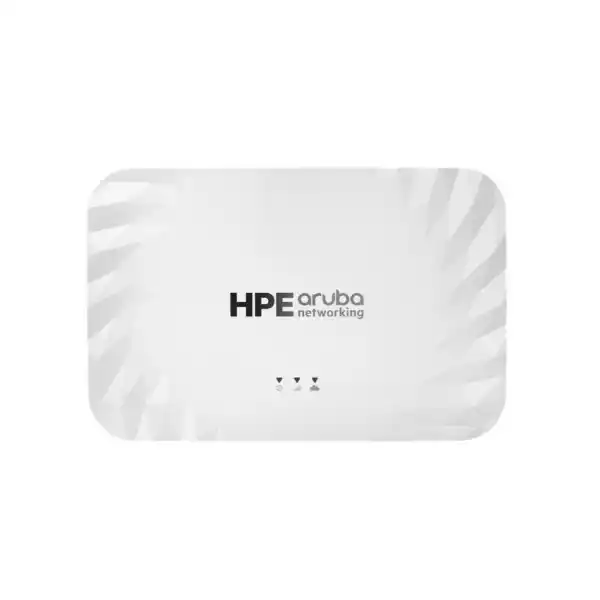
2 × 2.5 GbE
HPE Aruba Networking Central
HPE Aruba Networking BR-150 5G Ethernet Bridge Dubai
The BR-150 is a dedicated cellular bridge designed to bring 5G fixed wireless access into HPE Aruba Networking branch and edge environments. It is particularly relevant where an organization needs a fast primary WAN, a diverse secondary path, or a resilient cellular backup connection without replacing its existing Ethernet-based edge architecture.
Direct answer for business buyers
A 5G cellular Ethernet bridge in the HPE Aruba Networking 100 Series, intended to provide cellular WAN connectivity to compatible HPE edge environments.
Primary, secondary, or backup internet access for branch offices, remote sites, pop-up locations, and distributed network edges.
Organizations already using or planning HPE Aruba Networking Central, AOS-10, EdgeConnect, SD-Branch, or related HPE edge infrastructure.
Confirm UAE carrier service, cellular band suitability, subscription licensing, physical placement, and the intended WAN failover design before ordering.
The required unit count, power method, management subscription term, mounting or IP55 accessories, and how the bridge should connect to the existing branch edge.
Where the BR-150 fits
The BR-150 is not a general-purpose router with a built-in 5G modem presented as an all-in-one appliance. HPE positions the 100 Series Cellular Bridge as a bridge for other HPE edge devices. That distinction matters because the purchase decision should start with the architecture: the BR-150 brings cellular transport into the branch, while routing, SD-WAN policy, security policy, wired switching, or WLAN services are handled by the surrounding HPE environment.
This approach is useful when an enterprise wants cellular diversity but prefers to keep WAN orchestration and branch policy centralized in its existing HPE Aruba Networking design. A company that only needs a standalone consumer-style 5G router may find the BR-150 more integrated and managed than necessary. A company running distributed HPE branches, on the other hand, can evaluate it as a purpose-built way to add fixed wireless access without creating a separate management island.
Why 5G can matter at a branch
A cellular path can solve several different business problems. It can be the initial connection for a new office while a fixed circuit is pending, a diverse backup path for a site that cannot tolerate a single-carrier outage, or the primary WAN for temporary and hard-to-cable locations. The BR-150 supports 5G Standalone and Non-Standalone modes and retains LTE Cat 18 and WCDMA fallback capabilities, which gives the device a broad cellular technology range.
Real-world performance will still depend on the mobile operator, subscribed service, radio conditions, spectrum availability, network congestion, indoor penetration, and installation position. The headline modem rates are therefore best treated as capability ceilings rather than guaranteed application throughput. For a Dubai deployment, a site survey or at minimum a signal and carrier check at the intended installation point is far more valuable than buying solely from a theoretical 5G speed figure.
Verified BR-150 technical specifications
The following values are based on HPE Aruba Networking 100 Series Cellular Bridge QuickSpecs, worldwide version 4 dated 20 July 2026. They are useful for procurement and design, but carrier service and software entitlement should still be validated for the intended UAE deployment.
| HPE product number | S0Q22A for the standard BR-150; HPE also lists a separate TAA model S3M47A. |
| 5G SA | Up to 2.4 Gbps download and 900 Mbps upload at the modem capability level. |
| 5G NSA | Up to 3.4 Gbps download and 500 Mbps upload at the modem capability level. |
| LTE | LTE Cat 18, with up to 1.6 Gbps download and 200 Mbps upload capability. |
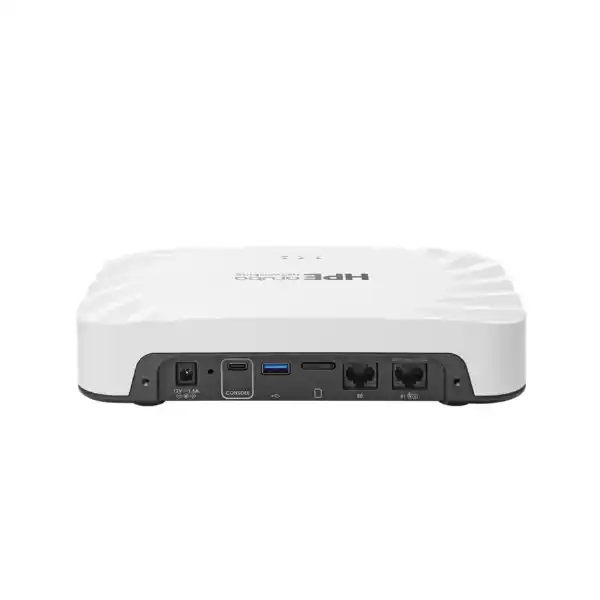
| Wired interfaces | 2 × 2.5 Gbps Ethernet interfaces. |
| USB | 1 × USB-A data port and 1 × USB-C console port. |
| SIM | 1 × Nano SIM. HPE also lists 1 × eSIM with a note that the eSIM feature is available in a future software release, so current availability must be checked rather than assumed. |
| Power | 802.3at PoE or 12V DC. The DC power adapter is not included and must be ordered separately if required. |
| Maximum power consumption | 19.1W with PoE; 17.5W with the DC adapter. |
| Dimensions | 51 mm high × 223 mm wide × 145 mm deep. With the optional IP55 kit, depth increases to 177 mm. |
| Weight | 1.54 kg. |
| Operating environment | 0°C to +50°C operating temperature and 5% to 93% relative humidity. |
| Protection option | IP55 support with optional HPE Aruba Networking BR-150 IP55 Kit S3M48A. |
| Minimum software | AOS-10.7.1 according to current HPE QuickSpecs. |
Cellular performance: what the numbers do and do not mean
The BR-150 supports a wide set of 5G NR bands and can operate in both 5G SA and NSA environments. HPE lists modem capabilities of up to 2.4 Gbps downstream and 900 Mbps upstream for 5G SA, and up to 3.4 Gbps downstream and 500 Mbps upstream for 5G NSA. Those figures are technically important because they show that the cellular radio can exceed conventional 1 GbE levels under ideal conditions; this is also why the device uses 2.5 GbE interfaces rather than limiting the wired handoff to 1 GbE.
However, a procurement team should not turn those modem figures into a guaranteed site bandwidth expectation. Mobile networks are shared, signal quality can vary from room to room, building glass and concrete can attenuate radio signals, and individual carrier plans may apply traffic management or service limits. A branch that needs a committed symmetric service-level agreement should compare cellular against suitable fixed enterprise circuits. A branch that needs rapid activation, path diversity, or a high-capacity wireless backup can find 5G far more compelling.
The best design therefore starts with the business requirement. Define the minimum application bandwidth needed during normal operation and during failover, then test the intended carrier at the installation point. If the BR-150 is being used as a backup WAN, it is often unnecessary to size the cellular service for every peak workload; critical applications can be prioritized at the branch edge. If it is the primary WAN, more careful testing of sustained performance, latency, signal stability, and carrier coverage is appropriate.
Primary cellular WAN
Suitable for remote, temporary, or rapidly deployed sites where wired service is unavailable, delayed, or operationally inconvenient. The design should include a carrier plan appropriate to expected data volume and business criticality.
Secondary WAN path
Useful when a branch already has a fixed circuit but needs path diversity. Cellular can reduce dependence on the same physical last-mile infrastructure used by two nominally different fixed carriers.
Failover connectivity
For continuity planning, the BR-150 can provide an alternate internet path while the branch gateway applies the organization’s failover, security, routing, and application policy.
Day-one branch activation
A mobile connection can bring a new location online before a leased line is installed. The device can then be retained as a resilience path after the permanent WAN becomes active.
HPE Aruba Networking Central licensing is part of the decision
The 100 Series Cellular Bridge requires HPE Aruba Networking Central subscription-based licensing on a per-device basis. HPE currently lists subscription increments of 1, 3, 5, 7, and 10 years. This means the hardware purchase should not be treated as the complete commercial requirement. The selected subscription term must match the organization’s operating model, budget cycle, lifecycle plan, and the rest of the managed HPE estate.
For organizations already standardized on Central, the BR-150 can fit into a familiar management model rather than introducing a separate cellular appliance console. For a buyer who does not use Central and has no plan to adopt the HPE Aruba Networking management stack, the licensing requirement can materially change the cost and operational fit. That is a valid reason to compare other 5G WAN products rather than assuming the BR-150 is automatically the best choice.
When requesting a quotation, specify the preferred subscription duration and whether the bridge is joining an existing Central tenant. If the deployment includes new gateways, access points, or switches, it is worth reviewing all subscription terms together so renewal dates and management ownership remain manageable.
Power, cabling, and physical placement
The BR-150 can be powered by an 802.3at-compliant PoE source or by 12V DC. HPE lists the compatible AP-AC2-12B 12V/48W desktop power adapter, part number R3K00A, as an optional accessory. The DC adapter is not included with the standard bridge. If PoE is available from the connected switching environment, it can simplify deployment by reducing the need for a local power outlet at the final radio position. This is especially useful when the best cellular reception point is not beside the network rack.
Placement should be chosen for radio quality, cable reach, environmental conditions, and maintainability. A neat location deep inside a metal cabinet may be poor for cellular reception. Conversely, the strongest signal point may not be suitable if it is exposed to heat, moisture, direct weather, tampering, or an impractical cable route. The standard operating range is 0°C to +50°C. Dubai installations in unconditioned or sun-exposed areas therefore need particular attention to enclosure temperature and environmental exposure.
HPE supports an optional IP55 transformation kit, but IP55 capability should not be interpreted as permission to ignore installation conditions. Confirm whether the selected mounting location, orientation, enclosure, cable entries, heat exposure, and maintenance access are suitable. HPE documentation also provides for compatible wall or ceiling mounting kits sold separately. The right accessory combination depends on where the bridge will actually be installed, not simply on whether a wall exists nearby.
UAE carrier compatibility
The BR-150 supports a broad set of 5G and LTE bands, but a band list alone does not prove that a specific service plan will operate exactly as intended in the UAE. Carrier certification, SIM provisioning, enterprise APN requirements, private networking options, and local service policy can all affect deployment.
For a Dubai quotation, identify the intended operator and whether the service is public internet, enterprise APN, private cellular, or another managed mobile service. A practical test SIM at the target site is strongly recommended for critical installations.
Nano SIM versus eSIM
HPE lists one Nano SIM and one eSIM for the platform, but the current QuickSpecs explicitly mark eSIM as a feature available in a future software release. Buyers should therefore plan around the physically supported Nano SIM unless the required software release and eSIM activation are confirmed for the actual deployment date.
This is a good example of why quoting should use current software and entitlement information rather than relying only on a hardware feature table copied from an older document.
Security and operational assurance
HPE includes a Trusted Platform Module in the 100 Series Cellular Bridge for secure storage of credentials, keys, and boot code. The unit also has a Kensington lock slot for physical security. These features are relevant in distributed deployments because a cellular bridge may be placed closer to exterior walls, ceilings, reception zones, temporary workspaces, or other locations outside the core network room.
Security still depends on the complete architecture. The bridge supplies cellular connectivity; the surrounding edge design must define routing, segmentation, firewall policy, SD-WAN behavior, remote administration, and response to loss of the primary circuit. For branches carrying regulated or sensitive traffic, the WAN design should also address logging, configuration ownership, administrator access, and whether the cellular provider offers enterprise APN or private transport options that fit the organization’s policy.
Centralized monitoring is especially useful when multiple BR-150 units are deployed across a branch estate. Instead of treating each cellular link as an emergency-only device that is forgotten until an outage, the operations team can include it in normal health, inventory, and lifecycle processes. That operational discipline is often more valuable than the raw modem speed.
Deployment patterns in Dubai and the UAE
Use cellular as a resilient secondary WAN for payment, inventory, cloud application, and communications continuity when the primary fixed circuit is unavailable.
Bring up managed connectivity quickly where fixed infrastructure is temporary, incomplete, or subject to project timelines. Environmental and enclosure conditions require careful review.
Provide a practical WAN option where a conventional leased circuit is difficult to justify or takes too long to install, while retaining centralized enterprise management.
Support events, temporary offices, seasonal locations, training centers, and relocation scenarios that need connectivity without permanent WAN construction.
Create physical-medium diversity by pairing a fixed circuit with cellular transport, then use the branch gateway to control failover and application priority.
Provide a temporary safety path during circuit migration, office move, ISP change, or SD-WAN rollout so the branch is not dependent on a single cutover event.
When the BR-150 may not be the right choice
A technically capable product is not automatically the correct product. The BR-150 is most compelling when its cellular function fits an HPE Aruba Networking managed branch architecture. If the requirement is simply a low-cost standalone 5G router for a single small site with no Aruba management requirement, a simpler product may be more economical. If the branch needs integrated routing, firewalling, Wi-Fi, and 5G in one chassis, compare architectures rather than assuming an external cellular bridge is preferable.
Likewise, the device should not be selected solely because a carrier advertises 5G in the area. Indoor signal conditions can still be weak, and the BR-150 uses internal antennas. Sites with difficult RF conditions may need a different cellular design, a different placement strategy, or another service technology. A proof-of-connectivity test is sensible for critical or unusual sites.
For highly exposed outdoor use, very high ambient temperatures, specialist industrial environments, or deployments that require a different ingress-protection rating, confirm whether the optional IP55 kit and the BR-150 environmental specifications are sufficient. If not, an alternative platform or protected enclosure approach should be evaluated.
Accessories and quotation dependencies
HPE lists several BR-150-related accessories that can change the bill of materials. The BR-150 IP55 Kit is part number S3M48A. The AP-AC2-12B 12V/48W AC/DC desktop power adapter with 2.1/5.5 mm connector is part number R3K00A. HPE also lists a BR-150 SIM Spare Tray Kit under part number S4P36A. Mounting requirements should be checked separately because the installation design may need a compatible wall or ceiling mount kit.
The most common quotation mistake is to price the bridge hardware alone without matching it to power, management subscription, carrier service, mounting location, and the branch device that will consume the cellular connection. A correct quote should describe the complete intended deployment. For example, a PoE-powered indoor backup-WAN unit joining an existing Central tenant has a different bill of materials from a wall-mounted primary-WAN unit that needs a DC adapter, IP55 protection, new Central licensing, and installation services.
FourTeck can structure the quotation around the actual site requirement so that optional items are included only where necessary. This also makes it easier for procurement to compare offers on equivalent scope instead of comparing one bare hardware price with another fully configured solution.
A practical BR-150 deployment journey
Define the WAN role
Decide whether cellular is primary, secondary, temporary, or emergency connectivity. This determines the bandwidth, resilience, and service expectations.
Validate carrier service
Check the intended UAE operator, SIM plan, 5G coverage, enterprise APN needs, and signal quality at the actual site.
Confirm architecture
Identify the HPE gateway or edge platform, Ethernet handoff, failover policy, routing behavior, and how Central management will be used.
Select power and mounting
Choose PoE or DC, then confirm desktop, wall, or ceiling location and whether IP55 protection is appropriate.
License and onboard
Select the Central subscription term, onboard the device, apply configuration, and verify normal and failover behavior.
Procurement questions worth answering before purchase
The standard BR-150 is S0Q22A, while HPE lists the BR-150 TAA model separately as S3M47A. The required compliance profile should be stated in the RFQ.
If not, include the appropriate DC power adapter and verify that an accessible AC outlet is available.
If the installation requires additional protection, evaluate the S3M48A IP55 kit and the suitability of the complete mounting environment.
HPE offers 1-, 3-, 5-, 7-, and 10-year licensing increments. Align the term with the rest of the branch estate where practical.
Define which applications remain active, whether traffic is rate-limited, how sessions recover, and how the edge device returns to the primary WAN.
For business-critical use, verify signal and service quality at the intended mounting position rather than relying on an outdoor coverage map alone.
Frequently asked buyer questions
Does the BR-150 create a private 5G network?
No. HPE describes the 100 Series Cellular Bridge as a device that interoperates with public or private cellular services to provide connectivity to HPE edge devices; it does not itself create a private cellular network.
Can it be used as the main internet connection?
Yes, HPE positions the platform for primary, secondary, or backup connectivity. Whether primary 5G is appropriate depends on carrier performance, data plan, latency, business applications, and the organization’s service-level requirements.
Does it include a DC power adapter?
No. The BR-150 can use 802.3at PoE or 12V DC, but HPE states that the DC adapter is ordered separately.
Is an HPE Aruba Networking Central subscription required?
Yes. HPE QuickSpecs state that the 100 Series Cellular Bridge requires a Central subscription-based license purchased per device.
Can it be placed outdoors?
The device supports IP55 protection when used with the optional IP55 kit, but the complete installation must remain within the supported environmental and mounting conditions. Outdoor or exposed placement should be engineered rather than assumed from the IP rating alone.
Is eSIM ready to use?
HPE lists eSIM but currently notes that it is a future software feature. Treat Nano SIM as the confirmed physical option unless the required software capability has been verified for the deployment.
Decision recap
Best aligned with HPE Aruba Networking branch and edge environments that need managed cellular WAN connectivity.
2.5 GbE interfaces prevent a 1 GbE handoff bottleneck, but actual WAN speed depends on the mobile network and site conditions.
A per-device HPE Aruba Networking Central subscription is required and should be quoted with the hardware.
Choose PoE or DC, validate RF placement, and add mounting or IP55 accessories only when the site requires them.
Confirm UAE operator service, SIM provisioning, coverage, APN requirements, and real-world signal at the location.
Define how the BR-150 connects to the branch edge and which device controls routing, SD-WAN, security, and failover policy.
What FourTeck needs for an accurate BR-150 quotation
Plan the BR-150 around the branch, not just the modem
The strongest BR-150 deployment is one where the carrier service, 5G signal, HPE edge architecture, Central subscription, power method, mounting position, and failover behavior are considered together. Share your site count, current branch equipment, intended WAN role, and preferred mobile operator with FourTeck to build a quotation that reflects the complete Dubai or UAE deployment rather than only the bridge hardware.

Reviews
There are no reviews yet.