
HPE Aruba Networking CX 6200F 48G Class4 PoE 4SFP+ 740W Switch
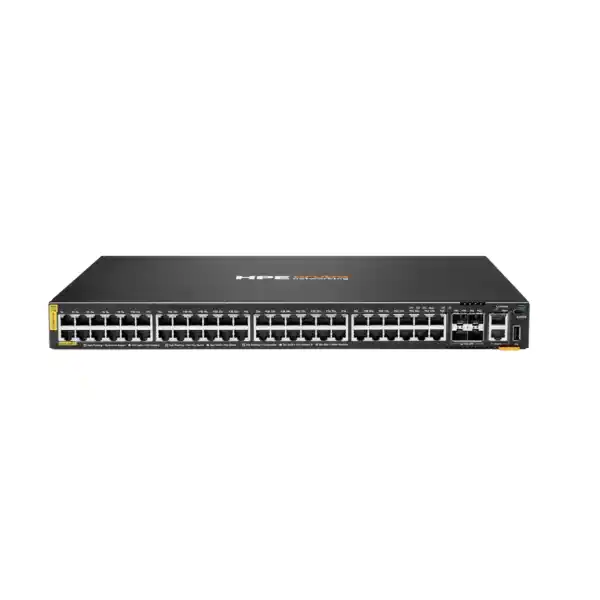
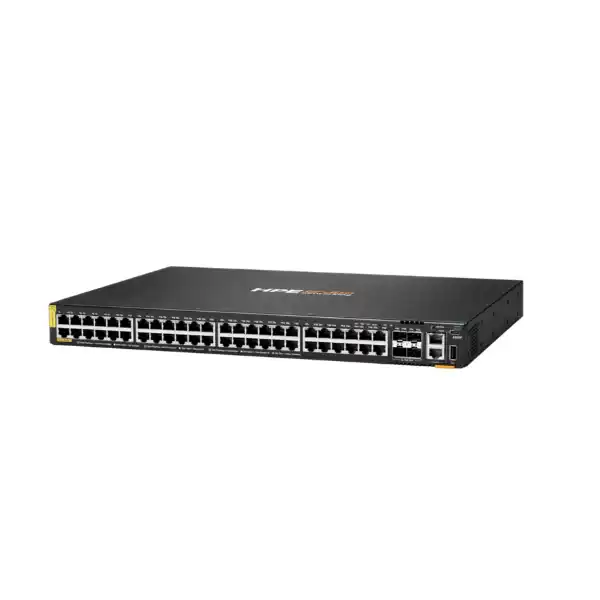
A fixed-configuration AOS-CX access switch for branch, campus and business networks that need 48 Gigabit PoE edge ports, four 1/10GbE SFP+ uplinks, scalable VSF stacking and a comparatively large shared PoE budget.
Fixed-port Layer 2/3 managed access switch running AOS-CX.
IEEE 802.3af/802.3at Class 4, up to 30 W per access port, subject to the total 740 W budget.
Front-plane VSF stacking, up to eight members using SFP+ connectivity.
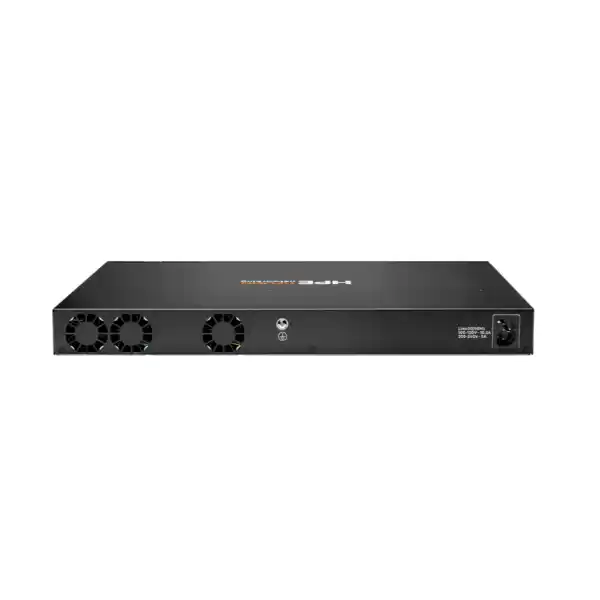
Fixed internal power supply and fixed fans on the CX 6200F platform.
Direct answer: what is this switch and who should consider it?
The HPE Aruba Networking CX 6200F 48G Class4 PoE 4SFP+ 740W configuration is a 48-port enterprise access switch intended to connect wired users and powered edge devices while providing high-speed fiber or copper-transceiver uplinks through four SFP+ interfaces. It is a practical candidate for branch offices, campus access closets, education sites, hospitality environments and other networks where a single rack unit must serve many 1GbE endpoints and where the total PoE requirement is significant. The most important pre-order check is the combined PoE draw of all phones, cameras, access points and other powered devices because 740 W is shared across the access ports. FourTeck can help confirm the exact orderable revision, transceivers, stacking topology, PoE calculation, management method, licensing, rack and power requirements, configuration services and UAE quotation scope.
What the CX 6200F 48G 740W model does at the access layer
The CX 6200F 48G 740W model is designed for the part of the network where user devices, wireless infrastructure and operational endpoints physically connect. Its 48 10/100/1000BASE-T ports provide standard Gigabit Ethernet access, and each port is capable of Class 4 PoE/PoE+ operation up to 30 W when the connected device and the available switch power budget permit it. This makes the unit relevant where many endpoints need both network connectivity and electrical power through the same Ethernet cable. Common examples include IP telephones, conventional Wi-Fi access points, fixed security cameras, door controllers, building-system interfaces, sensors and compact IoT gateways.
The four 1/10GbE SFP+ interfaces provide the higher-speed links normally used toward aggregation or core switching, between access closets, or for VSF stacking. A buyer should not treat all four uplink interfaces as automatically available for upstream connectivity if some of them are allocated to a stacking topology. The physical design therefore needs to be considered as a complete port plan: how many access devices will connect, how much PoE they will consume, how many uplinks are required, which uplink media will be used, whether redundant links are needed, and whether the switch will operate alone or as part of a stack.
The switch uses HPE Aruba Networking AOS-CX, placing it in the same operating-system family as other CX switching platforms. That consistency can be useful for organizations standardizing management, configuration syntax, telemetry and operational processes across multiple access switches. The platform supports common enterprise access functions including VLANs, access control lists, quality of service and Layer 3 routing features such as static routes and access OSPF. The exact feature set available to a deployment should still be checked against the planned AOS-CX software version and the organization’s network design rather than assumed from a broad family description.
For procurement teams, the important point is that the CX 6200F is a fixed-configuration model. Its internal power supply and fans are not the modular, hot-swappable architecture found on selected CX 6200M models. The fixed design can be appropriate where the priority is a dense, straightforward access switch with substantial PoE capacity. Environments that require field-replaceable, redundant power supplies or more specialized multigigabit access capabilities should compare the relevant CX 6200M or higher-tier options before standardizing on this model.
Verified technical specification summary
The following specification set reflects the HPE documentation for the CX 6200F 48G Class4 PoE 4SFP+ 740W configuration. HPE currently lists both JL728A and a newer JL728B revision in CX 6200 documentation. Because the user-supplied product name does not specify a part revision, FourTeck should confirm the exact orderable SKU for the UAE quotation. Where a physical detail differs between revisions, the project bill of materials should follow the exact quoted part number rather than a generic family assumption.
| Specification | CX 6200F 48G Class4 PoE 4SFP+ 740W |
|---|---|
| Manufacturer | HPE Aruba Networking |
| Product family | HPE Aruba Networking CX 6200 Switch Series |
| Documented part revisions | JL728A and JL728B; exact regional orderable part must be confirmed at quotation |
| Access ports | 48 × 10/100/1000BASE-T Class 4 PoE ports |
| PoE standards | IEEE 802.3af and IEEE 802.3at; up to 30 W per supported access port, subject to total power budget |
| Total PoE budget | Up to 740 W of Class 4 PoE power |
| Uplink ports | 4 × 1/10GbE SFP+ on the documented JL728A configuration; confirm transceiver and exact revision support |
| Switching capacity | 176 Gbps |
| Throughput | Up to 130.9 Mpps in HPE digital data sheet for JL728A |
| Latency | 1Gbps: 2.28 µs; 10Gbps: 1.46 µs for JL728A reference |
| Processor | Quad-core Arm Cortex-A72 at 1.8 GHz |
| Memory / flash | 8 GB DDR4 / 16 GB eMMC |
| VSF stack size | Up to 8 members using front-plane SFP+ connectivity |
| Maximum documented stacking distance | Up to 10 km with suitable long-range transceivers; topology and optics must be validated |
| Management interfaces | USB-C console, USB Type-A host, out-of-band management; JL728A documentation also lists Bluetooth adapter use with the CX Mobile app |
| Management methods | CLI, web GUI, HPE Aruba Networking Central and HPE Aruba Networking Switch Multi-Edit Software, subject to applicable software and subscription requirements |
| Power supply | Fixed internal power supply; JL728A data sheet lists 950 W supply and up to 740 W available for Class 4 PoE |
| Input voltage | 100–120 V / 200–240 V AC, 50/60 Hz |
| Published chassis power consumption | JL728A: 76 W at 230 V AC at 100% traffic in HPE electrical data; facility sizing must also account for attached PoE load |
| Dimensions | JL728A reference: 4.39 × 44.2 × 32.7 cm (H × W × D) |
| Weight | JL728A reference: 5.10 kg |
| Operating temperature | 0°C to 45°C up to 5,000 ft; derate 1°C per 1,000 ft from 5,000 to 10,000 ft |
| Warranty guidance | HPE data sheet states limited lifetime warranty; exact entitlement and regional terms should be confirmed for the quoted SKU |
PoE planning: why the 740 W figure matters more than the port count
A 48-port PoE switch should never be selected on port count alone. The CX 6200F 48G 740W model allows Class 4 delivery on its copper access interfaces, with up to 30 W available to an individual supported endpoint. The aggregate power budget, however, is 740 W. If all 48 connected devices attempted to draw 30 W simultaneously, the theoretical endpoint demand would be 1,440 W, well above the switch’s available PoE budget. In real deployments, most devices do not all draw their maximum rating at the same time, but design should not depend on optimistic assumptions about average consumption.
A useful procurement exercise is to list every powered endpoint by device type, quantity and worst-case draw. For example, an office might have a mixture of VoIP phones that consume modest power, indoor wireless access points with higher requirements and IP cameras with variable load. A hospitality site might add door controllers, room systems or IoT bridges. A school could have dense wireless coverage plus cameras. The switch can be a strong fit when the sum of these requirements, including a sensible planning margin, remains within the available 740 W. If the calculated requirement approaches or exceeds the budget, the design should consider distributing devices across multiple switches, moving higher-power endpoints to a different PoE class platform, or selecting a modular CX model with a power architecture better suited to the load.
Power negotiation standards also matter. This model supports IEEE 802.3af and 802.3at. Equipment that genuinely needs IEEE 802.3bt power levels above 30 W per port should not be assumed to operate at its intended capability from this switch. Some higher-performance access points, pan-tilt-zoom cameras, displays or building devices can require more than Class 4 power. Those endpoints should be checked individually against their vendor power requirements. If a device can run in a reduced mode on 802.3at, confirm what functionality is lost before accepting that compromise.
PoE planning also affects electrical and thermal design in the communications room. A switch delivering hundreds of watts to endpoints draws corresponding energy from the facility and creates additional heat. The published 76 W chassis consumption at 230 V AC for JL728A is useful for understanding the switch electronics under traffic, but it should not be treated as the total facility draw when PoE loads are active. UPS capacity, PDU capacity, circuit rating, rack ventilation and cooling should be sized for the operating scenario, not simply the chassis-only figure.
PoE information FourTeck should receive before quotation
Provide the quantity and model of each powered endpoint, the maximum power requirement shown by the endpoint vendor, any planned future devices, whether endpoints must remain powered during UPS operation, and whether any device requires 802.3bt or more than 30 W. With this information, the proposed 740 W budget can be assessed against a realistic worst-case requirement instead of a simple average.
Uplinks, optics and bandwidth design
The four SFP+ interfaces are one of the most important architectural features of this configuration because they connect the access switch to the rest of the network and can also be used for VSF stacking. The JL728A reference supports 1GbE and 10GbE operation on these ports. A procurement list therefore needs more than the switch itself: the design should identify the required optical or copper transceiver type, fiber grade, connector type, distance, upstream switch interface and desired level of link redundancy.
For a simple branch deployment, a single 10GbE uplink may be sufficient from a bandwidth perspective, but that leaves a single physical path and may not satisfy continuity requirements. Dual uplinks, link aggregation or connection to redundant aggregation devices may be more appropriate depending on the topology. The upstream switch must support the corresponding port speed and optical standard. Transceiver compatibility should be validated against the exact CX 6200 part revision and current HPE support matrix before ordering. A transceiver that physically fits an SFP+ slot is not automatically a supported or appropriate optic for the design.
Bandwidth planning should consider the traffic generated by the combined access ports rather than simply multiplying every 1GbE port by its maximum speed. User access traffic is bursty, voice traffic is relatively light, cameras can produce sustained flows, and wireless access points can aggregate traffic from many clients. The important design question is whether the intended uplink or aggregated uplinks can carry peak application, backup, security-camera, wireless and inter-VLAN traffic without creating avoidable congestion. Where an access layer serves dense Wi-Fi or high-volume video, a more detailed utilization model is useful.
When VSF is enabled, some SFP+ resources are used for the stack fabric. That changes how many ports remain available for normal uplink duties and may affect the preferred stack topology. A ring-style stack can improve resilience compared with a simple chain, but it consumes the necessary front-plane links. The stack should therefore be designed together with the upstream connectivity rather than added as an afterthought. If the required combination of stacking links and production uplinks creates a port constraint, another CX model or a different architecture may be more suitable.
VSF stacking for larger access deployments
HPE Aruba Networking Virtual Switching Framework allows compatible CX 6200 switches to operate as a logical stack, and the documented maximum for this family is eight members. For a 48-port model, an eight-member stack can represent a large access-port footprint, although the practical design is driven by rack location, cabling, failure domains, uplink strategy and operational policy rather than by the theoretical maximum member count.
Stacking can simplify management because administrators work with a coordinated switching system instead of treating every access unit as a completely separate operational island. It can also make link aggregation and expansion easier in a structured access layer. However, stacking does not remove the need to design physical resilience. Each CX 6200F member still has fixed internal power and fixed fans. If a particular member loses its local power source or experiences a hardware fault, endpoints connected to that member are affected even if the remaining stack continues operating. For environments where power-supply redundancy inside each chassis is a mandatory requirement, fixed CX 6200F hardware may not be the preferred architecture.
The front-plane stacking design uses SFP+ connectivity. HPE documentation states that stacking can span up to 10 km with appropriate long-range transceivers, but distance capability alone should not be used as a reason to stretch a stack across locations without careful design. Long-distance stack links introduce dependencies on fiber routes, optics, failure domains and maintenance processes. A distributed campus may be better served by routed access or separate stacks connected through a resilient aggregation layer, depending on business continuity requirements and operational practice.
Before selecting the number of stack members, the project should map current port requirements, planned growth, PoE demand per closet, upstream bandwidth, available rack space and power circuits. A stack that is technically possible but concentrates too many users and powered devices into one electrical or physical failure domain may not meet the organization’s resilience objectives. FourTeck can review these inputs and help determine whether a single switch, a small VSF stack, multiple independent stacks or a different CX family is a better fit.
AOS-CX management and operational choices
The CX 6200 platform runs AOS-CX and supports several management approaches. HPE documentation lists the command-line interface, web GUI, HPE Aruba Networking Central and HPE Aruba Networking Switch Multi-Edit Software among the management options for this family. That flexibility allows organizations to choose a method that matches their operational maturity, scale and governance requirements, but it also means the management model should be decided before deployment rather than left undefined.
Local CLI management remains important for engineers who need precise configuration and troubleshooting. The web interface can be useful for selected administrative workflows, especially in smaller environments. HPE Aruba Networking Central provides centralized cloud-based management capabilities for supported AOS-CX switches. Central use requires the applicable subscription or licensing arrangement, and the current entitlement should be confirmed at quotation because cloud management terms can change over a product lifecycle. The switch itself should not be described as requiring a Central subscription merely to perform its basic local switching role.
For multi-site organizations, centralized management can provide operational consistency and reduce the burden of accessing individual devices one by one. It can also support common configuration practices, visibility and lifecycle workflows. The value is greatest when the network team defines naming standards, VLAN models, software-management policy, monitoring expectations, administrative roles and change-control processes. A management platform cannot compensate for an undefined network standard.
The product family also supports telemetry and analytics capabilities associated with the CX architecture. These can help network teams investigate performance and configuration conditions, but any automated action or analytics workflow should be introduced with clear operational controls. Production teams should decide who receives alerts, which events require human review, what data retention is needed and how configuration changes are approved. When integration with authentication, policy or network-access-control systems is planned, the design should identify those dependencies explicitly rather than assuming the access switch alone delivers the entire policy solution.
Licensing and subscription requirements
Basic local switching does not automatically require a cloud-management subscription. The CX 6200F can be configured and operated through supported local methods. However, organizations that want HPE Aruba Networking Central cloud management should budget for the appropriate Central licensing or subscription for the switch. Current subscription names, terms and entitlements should be confirmed against the quotation because vendor packaging and licensing models can evolve.
If the switch will participate in a Central-managed stack, the organization should verify licensing for all members. HPE Central documentation for AOS-CX indicates that switches used in a managed stack need appropriate licensing assigned. A project that purchases hardware without considering management entitlements can therefore create an avoidable operational gap: the physical devices may be installed, but the intended centralized management workflow may not be available until subscriptions are assigned.
Advanced segmentation, identity-based access or application policy can also depend on other components in the network architecture. These may include HPE Aruba Networking Central services, ClearPass or other policy infrastructure, depending on the design. The correct approach is to separate the switch’s supported capabilities from the complete solution requirement. FourTeck can help map the desired outcome—such as centralized policy, role-based access, dynamic segmentation or multi-site visibility—to the hardware, software and service components needed to implement it.
Licensing questions should be resolved with the exact deployment scope. Useful inputs include the number of switches, expected subscription term, whether Central is already in use, whether an existing subscription pool is available, whether switches are standalone or stacked, and which management or security workflows the customer expects. This prevents a quotation from including unnecessary subscriptions or omitting a component that the operational plan depends on.
Compatibility and integration checks before ordering
The CX 6200F 48G 740W model sits at an integration point between endpoint devices, upstream switching, management systems, authentication services and power infrastructure. Compatibility checking should therefore extend beyond a basic question of whether an Ethernet cable can be connected.
Endpoint power compatibility
Confirm the IEEE PoE standard and maximum draw for every high-power endpoint. Devices requiring more than 30 W per port or IEEE 802.3bt should be evaluated carefully. Even when a device can negotiate lower power, verify whether reduced power changes radio capability, camera heaters, USB functions or other endpoint features.
Uplink and transceiver compatibility
Confirm the exact SFP/SFP+ module, speed, wavelength, fiber type, distance and connector. The upstream switch must support the corresponding interface. Optics should be checked against the current HPE compatibility documentation for the exact switch revision rather than selected only by generic standards terminology.
Stack compatibility
If the unit will join an existing VSF stack, verify that the existing members, AOS-CX versions, topology and stacking ports are compatible with the proposed part. Mixing revisions or models may be supported in some CX 6200 contexts, but the intended combination should be checked against the current VSF guide before change implementation.
Network policy compatibility
Where 802.1X, MAC authentication, VLAN assignment, ACLs or role-based policies are used, the switch configuration must align with the organization’s RADIUS, ClearPass, directory and security design. The access switch is one component in that chain. Authentication failure behavior, guest or IoT roles, voice VLAN handling and device profiling should be designed before production cutover.
Physical and electrical compatibility
Check rack depth, rail or mounting requirements, PDU outlet type, mains voltage, UPS capacity, cooling and cable-management space. The JL728A reference is approximately 44.2 cm wide, 32.7 cm deep and 1U high. The exact quoted revision may differ slightly in dimension or included accessories, so rack planning should use the final bill of materials.
Where this configuration fits in the CX 6200 family
The CX 6200 family includes fixed CX 6200F switches and modular CX 6200M switches. Within the fixed 48-port group, buyers can distinguish between non-PoE, 370 W PoE and 740 W PoE configurations. The 740 W model is the logical fixed-port choice when the access-port count is high and the planned powered-device load exceeds what a 370 W budget can comfortably support.
A 370 W 48-port model can be suitable when many ports connect ordinary non-PoE users or low-power phones and only a subset of ports powers access points or cameras. Choosing 740 W simply because it is the larger number may increase cost and electrical capacity without delivering practical benefit. Conversely, choosing 370 W for a dense wireless or surveillance floor can lead to power-budget pressure and force a second switch or midspan power solution later. The decision should therefore be based on endpoint inventory and growth, not on a generic preference for the higher or lower model.
The non-PoE 48-port variant is relevant where powered endpoints are not required or where power is provided separately. It can reduce complexity in locations such as server-adjacent wired device zones, lab environments or access areas with no PoE requirement. For a mixed deployment, organizations may find that combining PoE and non-PoE switches is more economical than using 740 W units in every rack.
The CX 6200M range should be considered when the fixed CX 6200F architecture does not meet resilience, port-speed or serviceability requirements. Selected 6200M models support modular, hot-swappable redundant power supplies and fans, and some variants provide HPE Smart Rate multigigabit ports with higher PoE classes. This distinction matters for modern high-performance wireless access points that may need more than 1GbE access or more than 30 W of power. A buyer planning new high-density Wi-Fi should check the selected AP uplink speed and power requirement before deciding that a 1GbE Class 4 access switch is sufficient.
Product-fit matrix for UAE access-network projects
When this switch may be a strong fit
Branch offices with many powered devices. A branch with dozens of phones, cameras and access points can benefit from the combination of 48 access ports and a 740 W shared budget, provided the endpoint inventory stays within the available power envelope. The four SFP+ interfaces can connect the branch access layer to a distribution switch or routed core.
Campus access closets using a standardized CX operating model. Organizations already using AOS-CX can extend common configuration and operational practices into additional closets. VSF can reduce the number of individually managed access devices where stacking aligns with the campus architecture.
Education and training facilities. Classrooms and labs often combine wired endpoints, wireless access points, phones, cameras and specialist devices. The 48-port format provides density, while the 740 W budget can support a substantial PoE mix. The actual design should reserve spare power for future devices rather than consuming the budget to its limit on day one.
Hospitality, retail and multi-service edge networks. These environments can place several low- and medium-power devices on the same access switch. Segmentation through VLANs, ACLs and policy integrations can help keep device groups logically separated, but the security outcome depends on the complete configuration and supporting identity or policy systems.
Office floors where 1GbE remains appropriate. Many ordinary desktops, phones and existing access points do not require multigigabit copper. For such environments, 48 Gigabit access ports can be a sensible balance of density and cost. If a major Wi-Fi refresh is planned, the AP specifications should be reviewed first because modern high-end access points may benefit from multigigabit Ethernet and higher PoE classes that this fixed model does not provide.
When another switch should be evaluated
The CX 6200F 48G 740W should not be selected automatically for every 48-port requirement. A different model can be more appropriate when the network’s technical or operational needs fall outside this switch’s design strengths.
Evaluate a lower-PoE option when 740 W is unnecessary. If only a small number of ports power phones or cameras and the calculated load is comfortably below 370 W, a lower-budget PoE model may satisfy the requirement with less unused capacity. A non-PoE variant may be better if powered devices are not part of the access design.
Evaluate multigigabit Class 6 PoE models for high-end wireless. Access points using 2.5GbE or 5GbE copper links and needing up to 60 W cannot be fully served by a 1GbE, Class 4 port specification. Relevant CX 6200M Smart Rate variants or other HPE Aruba Networking families should be considered when the wireless design calls for those capabilities.
Evaluate modular hardware when power or fan redundancy is mandatory. The CX 6200F has fixed power and cooling components. Selected CX 6200M models provide hot-swappable, redundant power supplies and fans. Sites with strict serviceability or hardware-level redundancy policies may therefore prefer a modular platform even if the basic port count is similar.
Evaluate higher-tier switching when routing scale or advanced architecture demands more. The CX 6200 series is an access platform. Large routing tables, extensive segmentation, high-capacity aggregation, specialized security, very high uplink speeds or core/distribution roles may be better served by higher CX families. The correct comparison depends on the full network role, not only on port density.
Evaluate a smaller switch when the closet has limited endpoints. Installing a 48-port 740 W device for a requirement of only a dozen low-power endpoints can leave substantial unused hardware. Smaller CX 6200F configurations may provide a cleaner fit where growth projections do not justify 48 ports.
Deployment and installation considerations in Dubai and the UAE
UAE installations should treat the switch as part of a controlled communications-room environment. The documented operating temperature for JL728A is 0°C to 45°C up to 5,000 ft, with altitude derating above that level. This does not mean a rack should be allowed to operate near the upper temperature limit continuously. Reliable network operation benefits from appropriately conditioned rooms, unobstructed airflow, clean rack layouts and monitored environmental conditions, especially because PoE switches can handle substantial power.
Rack planning should confirm the available rack unit, chassis depth, cable-management route and front/rear clearance. The JL728A reference is approximately 4.39 cm high, 44.2 cm wide and 32.7 cm deep. Patch-panel density can become significant with 48 copper access connections plus uplinks, so labeling and cable management should be included in the implementation plan rather than treated as cosmetic extras.
Electrical planning should identify mains voltage, PDU outlet compatibility, circuit capacity, UPS sizing and desired runtime. The switch accepts 100–120 V or 200–240 V AC, but the exact regional power cord or ordering suffix must be confirmed. For a PoE-heavy deployment, UPS sizing should include the powered endpoints because the switch becomes the electrical source for those devices. A UPS that supports the switch chassis but not the downstream PoE load may deliver much shorter runtime than expected during an outage.
Before installation, the network team should document VLANs, IP management addressing, default gateway or routing requirements, uplink trunks, spanning-tree or loop-prevention policy, link aggregation, authentication method, QoS requirements, PoE priorities and monitoring destinations. Where the switch replaces an older unit, the migration plan should also map old port numbers to new ports and identify devices that cannot tolerate a long interruption.
Post-installation validation should include link speed, duplex, PoE negotiation, VLAN placement, uplink redundancy, stack health where applicable, management reachability, log forwarding, NTP, authentication, configuration backup and basic failure tests. A successful installation is not simply a switch that powers on; it is a switch integrated into the operational and security standards of the environment.
Network design questions that affect quotation accuracy
A quotation for this switch becomes more useful when it includes the surrounding bill of materials and implementation scope. FourTeck should know whether the customer needs only the switch hardware or a complete access-layer package with transceivers, patching, rack accessories, subscriptions, configuration, installation and support coordination.
How many ports are needed on day one and after planned growth? A 48-port switch can be fully consumed quickly when phones, desktops, printers, cameras and access points are counted individually. Reserve capacity should be intentional.
Which devices need PoE and what is their maximum draw? This determines whether the 740 W budget is sufficient and whether Class 4 is suitable for every endpoint.
How will the switch connect upstream? Provide the upstream switch model, port type, distance and fiber or copper media. This determines the correct transceivers and whether 1GbE, 10GbE, redundant uplinks or link aggregation are appropriate.
Will the switch be standalone or part of a VSF stack? Stacking changes the SFP+ port allocation and may require additional optics or cables. Existing stack members and AOS-CX versions should be identified.
What management model is required? Local CLI/web management, HPE Aruba Networking Central, Switch Multi-Edit or another operational workflow affects licensing and configuration scope.
What security controls are expected at the access layer? Requirements such as 802.1X, MAC authentication, role assignment, RADIUS, ACL policy or ClearPass integration require design inputs beyond basic hardware ordering.
Does the site require redundant internal power supplies? If yes, the fixed CX 6200F power architecture may not satisfy the requirement and a modular model should be reviewed before quotation.
Practical access-layer use cases
Office floor with voice, users and wireless access
A typical office floor might connect IP phones, desktop workstations, multifunction printers and several wireless access points. The switch can provide 1GbE access and PoE to the phones and APs while using SFP+ uplinks toward the building distribution layer. The design should calculate the combined AP and phone power, confirm whether any new AP requires multigigabit Ethernet, and reserve ports for growth or temporary equipment.
IP surveillance access network
A camera network can use the 48 PoE ports efficiently, but camera power varies substantially by model. Fixed cameras may consume relatively modest power, while PTZ units, heaters or infrared systems can draw more. Video traffic is also sustained rather than bursty. Uplink sizing should therefore consider the aggregate camera bitrate and recording architecture, and power calculations should use worst-case vendor values.
Education campus closet
Schools and universities often combine classroom access points, teacher devices, phones, cameras and lab endpoints. VSF can simplify access-switch organization in a large closet, but each member remains a separate physical device with local fixed power. The network team should map each member’s endpoint load so a single hardware failure does not unexpectedly remove all devices for a critical area.
Retail or hospitality branch
A branch may connect POS-supporting infrastructure, phones, cameras, access points, signage controllers and back-office systems. Segmentation can keep operational device classes separate, while centralized management may simplify support across locations. The project should identify whether the site has reliable WAN connectivity for cloud operations, what local access remains available during WAN outages, and how replacement or support procedures will work.
IoT-enabled building zone
Building devices are increasingly Ethernet-connected and may use PoE. The switch can support many Class 4 endpoints, but device security and lifecycle deserve attention. IoT systems can remain in service for many years, so VLAN design, authentication options, firmware responsibility and monitoring should be agreed with the building or operational technology team before the ports are placed into production.
Security, segmentation and access policy considerations
The access switch is often the first network enforcement point encountered by a user or device. The CX 6200 family supports enterprise access controls such as ACLs and integration into broader segmentation and policy designs. The security value comes from how these functions are configured and integrated; merely installing the switch does not automatically create a segmented or authenticated network.
For user access, the design can use VLANs to separate logical groups and 802.1X or other authentication methods to determine whether a device is permitted onto the network. Where RADIUS or HPE Aruba Networking ClearPass is involved, the switch must be configured consistently with the authentication server, certificates, fallback behavior and role assignment. The project should decide what happens when authentication fails, when a device cannot perform 802.1X, or when an emergency phone or building controller must remain reachable.
For IoT and camera deployments, static port assignments can be simple but create operational overhead when devices move. Identity- or role-based approaches can be more flexible, but they depend on accurate profiling and policy infrastructure. FourTeck can help clarify whether the requirement is basic VLAN separation or a broader dynamic segmentation architecture and identify which additional components or subscriptions may be needed.
Access control lists can restrict communication between networks or device types, but ACL design must consider business flows such as DHCP, DNS, NTP, management, monitoring, voice signaling, camera recording and software updates. An overly restrictive policy can break legitimate services, while a permissive policy may fail to reduce risk. Rules should therefore be based on documented application requirements and tested before broad deployment.
Operational security should also include switch administration. Use controlled management networks, role-appropriate administrator access, secure protocols, time synchronization, centralized logging and configuration backups. If cloud management is adopted, administrator identity, multifactor authentication, tenant governance and subscription lifecycle should be included in the operational model.
Performance and capacity context
HPE documents 176 Gbps switching capacity and up to 130.9 Mpps throughput for the JL728A configuration. These figures indicate that the switching silicon is designed for wire-speed access operation within the model’s port architecture. For most enterprise access deployments, user experience is more likely to be influenced by uplink design, oversubscription, endpoint speed, wireless capacity, server response or WAN bandwidth than by the raw forwarding limit of a correctly configured switch.
The model also supports 128 dual-stack switched virtual interfaces, an 8,192-entry IPv4 host table, an 8,192-entry IPv6 neighbor table, 2,048 IPv4 unicast routes and 1,024 IPv6 unicast routes in the HPE product information reference. These values reinforce the intended enterprise access role: the switch can perform meaningful Layer 3 functions, but it is not positioned as a large core routing platform. A design that expects extensive route scale, internet edge duties or very large segmentation tables should compare the requirement with higher CX families.
Latency is documented at approximately 2.28 microseconds for 1Gbps and 1.46 microseconds for 10Gbps on JL728A using HPE’s stated test context. These numbers are useful as technical reference points, but application latency in a real network includes endpoint processing, uplink paths, routing, security services, WAN or internet transport and server response. Buyers should avoid treating a switch data-sheet latency number as a guarantee of end-to-end application performance.
For capacity planning, the most actionable questions are how much traffic each endpoint class creates, how much is local versus routed upstream, whether backup or video flows create sustained load, and whether uplinks are redundant. A 10GbE uplink can be more than sufficient for many office access blocks, while camera-heavy or high-density wireless environments may benefit from more careful measurements and multiple uplinks. Existing switch utilization data can provide a strong baseline for migration planning.
Power, cooling and continuity planning
PoE switches concentrate two infrastructure responsibilities in one chassis: packet forwarding and power delivery. This is operationally convenient, but it means a power event can affect both network connectivity and downstream device availability. A UPS plan should therefore be based on business impact. If IP phones, cameras or access points must remain online during short outages, the UPS needs to support the switch plus the actual PoE load for the desired runtime.
The CX 6200F fixed power design should be considered in continuity planning. An external UPS can protect against mains interruption, but it does not make the internal switch power supply redundant. Organizations that require power-supply replacement without chassis downtime should evaluate modular CX 6200M models or another platform with redundant, hot-swappable power supplies. This is a design requirement rather than a criticism of the fixed model; many access closets do not require chassis-level PSU redundancy and can use fixed hardware effectively.
Cooling capacity should reflect the switch’s workload and the other equipment in the rack. Communications rooms in the UAE can face high ambient conditions if building cooling is interrupted. The documented 45°C operating maximum should not be treated as a target operating temperature. Keeping rack inlet temperature comfortably within the supported range provides better environmental margin, particularly when multiple PoE switches are installed together.
Cable bundles can also influence airflow and serviceability. Forty-eight copper cables, fiber patch cords, power leads and console or management connections can create congestion in a compact rack. Horizontal and vertical cable managers, clear labeling and separation of power and data paths help technicians replace or troubleshoot equipment without disturbing unrelated circuits.
Migration from an existing access switch
Replacing an existing 48-port switch is not simply a hardware swap. A migration should start with an inventory of current port configurations and connected devices. Record VLAN membership, trunk links, voice settings, PoE use, authentication, static MAC behavior, port descriptions, link aggregation, spanning-tree settings, monitoring, routing interfaces and any special ACLs. This creates a basis for translating the existing intent into AOS-CX rather than copying commands blindly from a different operating system.
Endpoint discovery is particularly important in older environments where patch-panel labels may not match actual devices. LLDP/CDP information, MAC tables, PoE status and current interface counters can help identify phones, APs, cameras and uplinks. Devices that require fixed maintenance windows should be flagged in advance. If the switch supports building systems, security controls or life-safety-adjacent infrastructure, migration coordination may need additional stakeholders.
A staged migration can reduce risk. Preconfigure management addressing, VLANs, authentication and uplink settings before the change window where operational processes permit. Test transceivers and fiber paths, confirm configuration backups and verify administrator access. During cutover, move critical links in a controlled order and validate each device class rather than transferring all cables at once without testing.
Post-migration checks should compare the new switch against the pre-change baseline. Validate interface status, error counters, PoE draw, learned MAC addresses, authentication results, VLAN reachability, DHCP, DNS, voice registration, AP adoption, camera streams, uplink load and monitoring alerts. If a VSF stack is involved, validate member roles and stack links. These steps are often more valuable to long-term reliability than the physical rack installation itself.
Buyer questions before ordering
Does every port provide 30 W at the same time?
No. An individual Class 4 port can support up to 30 W, but the switch has a shared 740 W PoE budget. The total worst-case endpoint demand must fit inside that budget.
Can it power 802.3bt devices?
The documented fixed 48G 740W configuration supports 802.3af and 802.3at Class 4. Devices that require 802.3bt or more than 30 W per port should be matched to a suitable higher-power platform.
Are SFP+ transceivers included?
Do not assume optics are included. The required transceivers depend on uplink speed, fiber type, distance and upstream interface. Confirm the bill of materials before purchase.
Is Aruba Central mandatory?
No for basic local operation. Central is an optional centralized management approach that requires the applicable subscription or licensing arrangement when used.
Can this model use redundant hot-swap power supplies?
No. The CX 6200F uses a fixed power supply. Buyers who require modular, redundant hot-swappable power should compare suitable CX 6200M options.
Which part number should UAE buyers order?
HPE documentation lists JL728A and JL728B revisions for this configuration. The current regional orderable SKU, power-cord suffix and availability should be confirmed on the quotation.
Procurement checklist for the CX 6200F 48G 740W configuration
- Exact orderable revision: confirm whether the project quotation uses JL728A, JL728B or another current region-specific equivalent identified by HPE.
- Quantity: include current switch count, spare requirements and projected access-layer growth.
- Port requirement: count all copper endpoints and reserve an agreed percentage of free ports for growth and maintenance.
- PoE inventory: list endpoint quantities, IEEE class and maximum wattage so the 740 W budget can be validated.
- Uplink design: define 1GbE or 10GbE speed, number of links, redundancy, link aggregation and upstream switch ports.
- Optics and media: specify fiber type, connector, distance and supported transceivers or DACs as applicable.
- VSF design: state whether the switch is standalone or stacked and identify existing stack members if it will join an installed environment.
- Management requirement: choose local CLI/web management, HPE Aruba Networking Central or another supported workflow and confirm subscriptions where necessary.
- Security integration: identify RADIUS, ClearPass, 802.1X, MAC authentication, ACL or role-based policy requirements.
- Rack requirements: confirm rack unit space, depth, mounting accessories, patch-panel layout and cable-management capacity.
- Power and UPS: confirm mains voltage, PDU outlet, UPS sizing and required runtime including PoE endpoint load.
- Installation scope: define whether FourTeck is required for rack installation, patching coordination, configuration, migration, testing or documentation.
- Support expectation: confirm required HPE support entitlement, internal escalation process and any spares strategy.
- Delivery location: provide the Dubai or UAE project location so lead time and delivery coordination can be checked against the exact quantity and SKU.
FourTeck assistance for selection, quotation and deployment
FourTeck can support the practical work between identifying this switch and placing it into a production network. The starting point is requirement clarification: confirming whether 48 Gigabit access ports, Class 4 PoE, a 740 W shared power budget and four 1/10GbE SFP+ interfaces match the endpoint and uplink design. This avoids treating a familiar product name as proof of architectural fit.
For quotation preparation, FourTeck can help structure a bill of materials around the switch. Depending on the project, this can include supported optics, stacking connectivity, management subscriptions, power accessories and installation or configuration services. Items should be added because the design requires them, not simply because they are common accessories.
For deployment planning, FourTeck can review VLANs, uplink configuration, management addressing, VSF requirements, authentication, PoE priorities and migration sequencing. The precise implementation scope should be agreed in the quotation. Complex identity, segmentation or multi-site changes may require discovery and design work before an accurate configuration scope can be established.
Customers can also use FourTeck to compare nearby HPE Aruba Networking options when the CX 6200F fixed architecture is not the right fit. This may include 370 W PoE variants, non-PoE fixed models, smaller 24-port CX 6200F models or CX 6200M choices with modular power and Smart Rate options. The comparison should be based on port density, PoE class, total power, uplink needs, resilience, software management and expected lifecycle.
For related infrastructure planning, review FourTeck’s business technology products and installation and configuration services. For a project-specific bill of materials, use the FourTeck contact page with the endpoint count, PoE requirement, uplink topology and project location.
UAE availability and ordering guidance
Contact FourTeck to confirm current UAE availability for the HPE Aruba Networking CX 6200F 48G Class4 PoE 4SFP+ 740W configuration. Availability can depend on the exact part revision, regional ordering suffix, quantity, vendor lead time and project requirements. HPE documentation currently identifies JL728A and JL728B revisions for this configuration, so the final quotation should state the exact orderable part instead of relying only on the family name.
Delivery and project coordination can be discussed after the quantity and bill of materials are confirmed. If installation or configuration is required, include that scope in the quotation so site access, rack preparation, change windows, network parameters and testing responsibilities are understood before delivery. FourTeck does not need to assume that every order includes onsite services; hardware supply and implementation scope should remain separate and explicit.
Related options to compare
CX 6200F 48G Class4 PoE 370W
Consider when the 48-port density is needed but the calculated PoE load is comfortably below the 740 W requirement.
CX 6200F 48G non-PoE
A better fit when most or all connected devices use separate power and PoE capability would remain unused.
CX 6200F 24G PoE
Useful for smaller access closets where 48 copper ports would create unnecessary unused capacity.
CX 6200M Smart Rate / modular models
Evaluate where multigigabit access, higher PoE class, modular power or improved hardware serviceability is required.
Frequently asked questions
What is the exact HPE Aruba Networking CX 6200F 48G 740W switch configuration?
It is a fixed CX 6200F access switch with 48 10/100/1000BASE-T Class 4 PoE ports, four SFP+ uplink ports, a shared PoE budget of up to 740 W and support for AOS-CX management and VSF stacking. HPE documentation lists JL728A and JL728B revisions, so the current UAE orderable part should be confirmed on the quotation.
How many PoE devices can it power?
The answer depends on each device’s actual and maximum power requirement. The switch has 48 PoE-capable access ports but only 740 W of aggregate PoE budget. A port can deliver up to 30 W to a supported Class 4 endpoint, so a full 48-port deployment requires a power calculation rather than assuming every port can draw 30 W simultaneously.
Can the switch support Wi-Fi access points?
Yes, when the selected access points are compatible with Gigabit Ethernet and IEEE 802.3af/at Class 4 power. High-performance APs that require multigigabit copper or more than 30 W should be checked against a different switch model with the required Smart Rate and PoE class.
Does the CX 6200F 48G 740W support stacking?
Yes. The CX 6200 supports HPE Aruba Networking Virtual Switching Framework with up to eight members. Stacking uses front-plane SFP+ connectivity, so the stack topology and production uplink requirements must be designed together.
Does it include redundant power supplies?
No. The CX 6200F uses a fixed internal power supply and fixed fans. If hot-swappable redundant power supplies or fans are a project requirement, compare suitable CX 6200M models or another platform designed for that serviceability level.
Is HPE Aruba Networking Central required to manage the switch?
Central is not required for basic local operation. The platform supports local CLI and web management. Central can provide centralized management for supported AOS-CX deployments, but the appropriate subscription or license must be confirmed when that management model is selected.
What information is needed for a Dubai quotation?
Provide quantity, exact site or project location, current and future port count, PoE endpoint list, uplink speed and fiber details, stacking requirement, management preference, subscription term if Central is required, rack and power constraints, and whether installation or configuration services are needed.
Is the CX 6200F 48G 740W currently available in the UAE?
Availability should be confirmed at the time of request. It can depend on the exact orderable revision, quantity and vendor lead time. FourTeck can coordinate a current quotation after the required SKU and project scope are established.
Decision recap
48-port enterprise access closets needing standard Gigabit Ethernet and significant Class 4 PoE.
Combined worst-case PoE load must remain inside the 740 W shared budget with suitable headroom.
Choose supported SFP+ optics and account for any SFP+ ports allocated to VSF stacking.
Compare CX 6200M when redundant modular power, Smart Rate or higher PoE class is required.
What FourTeck needs to prepare an accurate switch proposal
Send the practical project inputs below so hardware, optics, PoE and service scope can be matched to the requirement rather than quoted as an isolated switch.
Confirm the right CX 6200F configuration before you order
FourTeck can help verify whether the 48-port 740 W Class 4 PoE configuration matches your endpoint power, uplink, stacking and management requirements. We can also identify the current UAE orderable part revision, required optics and subscription components, and define installation or configuration scope for the project.

Reviews
There are no reviews yet.