
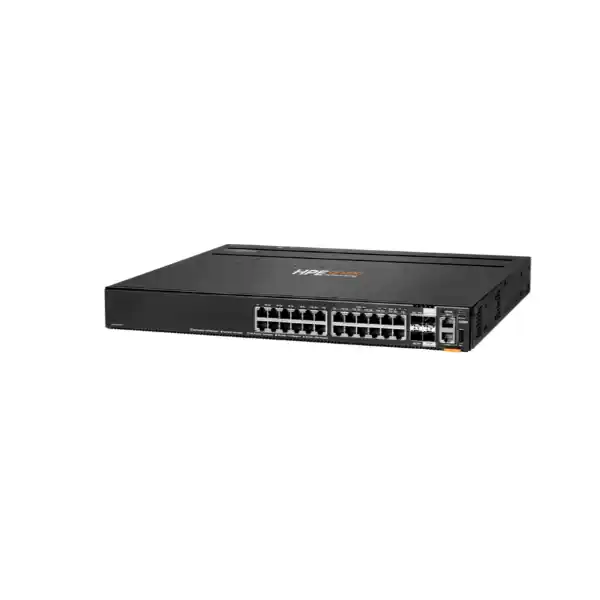
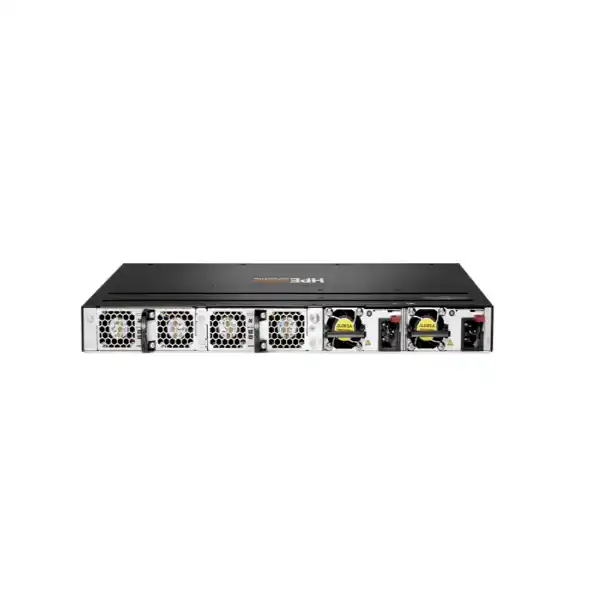
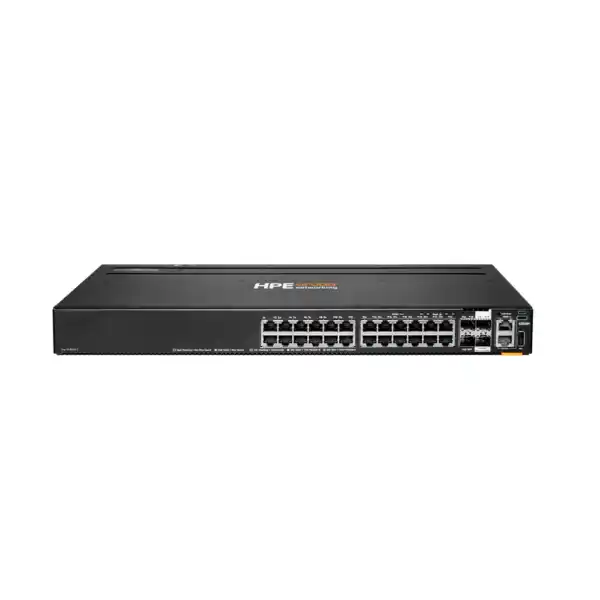
HPE Aruba Networking CX 6200M 24G 4SFP+ Switch in Dubai
The HPE Aruba Networking CX 6200M 24G 4SFP+ Switch is a modular Layer 2/Layer 3 access switch for organisations that need 24 standard Gigabit Ethernet copper access ports, four 1/10GbE SFP+ uplinks and the operational flexibility of field-replaceable power supplies and fan trays. For a Dubai or UAE deployment, the key decision is not simply whether 24 ports are enough. Buyers should also confirm PoE requirements, uplink media, power redundancy, rack conditions, software-management plans, stacking design and the complete bill of materials before the order is placed.
Direct answer: what is the CX 6200M 24G R8Q67A?
The HPE Aruba Networking CX 6200M 24G 4SFP+ Switch, R8Q67A, is a stackable enterprise access switch in the CX 6200 family. It is mainly used to connect wired business endpoints through 24 Gigabit Ethernet copper ports and provide upstream connectivity through four 1/10GbE SFP+ ports. It suits branch offices, campus access layers, SMB networks and structured enterprise deployments that do not require PoE from these 24 access ports. The most important pre-order check is the complete design around the chassis: required optics, power-supply selection, redundancy, stacking and management. FourTeck can help confirm the exact model, compare PoE and higher-port-density alternatives, prepare the bill of materials and define configuration or installation scope.
What the HPE Aruba Networking CX 6200M 24G is designed to do
The R8Q67A is positioned as an enterprise access-layer switch rather than a data-centre aggregation platform or a compact unmanaged edge device. Its job is to provide controlled, managed Ethernet access for users, workstations, printers, servers, appliances, controllers and other devices that connect at 10/100/1000BASE-T. The four SFP+ interfaces give the switch dedicated fibre or DAC-capable uplink positions that can operate at 1GbE or 10GbE when paired with supported transceivers and cabling. This distinction is useful in a structured network because access-port capacity and uplink design can be planned separately.
The switch runs the AOS-CX software platform used across HPE Aruba Networking CX switching. That gives network teams a consistent operational model for configuration, automation and monitoring across supported CX environments. The CX 6200 family also supports HPE Aruba Networking Virtual Stacking Framework, allowing compatible 24-port and 48-port CX 6200F and CX 6200M switches to be combined into an eight-member stack. A stack can simplify logical management and provide a practical path for expanding access capacity without treating every switch as an isolated configuration island.
R8Q67A is specifically the non-PoE 24-port modular model. That matters because the model name can be confused with R8Q68A, which is the 24-port Class 4 PoE member of the same CX 6200M range. Selecting R8Q67A is appropriate when endpoints do not need power from the Ethernet access ports, when phones and access points are powered by another design, or when the switch is serving devices such as desktops, servers, appliances and non-PoE infrastructure. If the access layer must power Wi-Fi access points, IP phones, cameras or IoT devices directly, the PoE variant should be evaluated instead of assuming power delivery can be enabled later by software.
When this model can be a strong fit
Choose the CX 6200M 24G when the design calls for up to 24 copper Gigabit access connections, no access-port PoE, four SFP+ uplinks, AOS-CX operations and modular power/fan serviceability. It is particularly relevant where a 24-port footprint is sufficient but fixed internal power is less desirable.
When another option should be evaluated
Compare another CX 6200M model if PoE is required, if more than 24 copper access ports are needed per switch, or if multi-gigabit Smart Rate access is part of the requirement. A higher platform family may also be more suitable when the design needs capabilities beyond the CX 6200 access role.
Verified CX 6200M 24G R8Q67A specifications
For procurement, exact model identity matters more than family-level headline specifications. The table below is centred on R8Q67A and separates chassis facts from items that require a compatible accessory, software choice or design decision. Because manufacturer documentation can be revised over time, the final quotation should still reconfirm the current ordering guide, supported accessories and software support position for the specific UAE project.
| Specification | HPE Aruba Networking CX 6200M 24G 4SFP+ R8Q67A |
|---|---|
| Product type | Managed, stackable enterprise access switch |
| Copper access ports | 24 × 10/100/1000BASE-T |
| PoE on access ports | No; R8Q67A is the non-PoE model |
| Uplink ports | 4 × 1G/10G SFP+; two support LRM and two support LRM/MACsec 256 |
| Management / service interfaces | 1 × RJ-45 console, 1 × USB-C console, 1 × OOBM, 1 × USB Type-A host |
| Switching capacity | 128 Gbps |
| Throughput | Up to 95.2 Mpps |
| Latency | Approx. 3.6 μs at 1Gbps and 2.9 μs at 10Gbps for 64-byte packets under the stated HPE test method |
| Processor | Quad-core Arm Cortex-A72 at 1.8GHz |
| System memory | 8 GB DDR4 |
| Flash | 16 GB eMMC |
| Packet buffer | 6 MB |
| MAC address table | 32,768 entries |
| Dual-stack SVIs | 256 |
| IPv4 ARP table | 8,000 |
| IPv6 neighbour table | 8,000 |
| IPv4 unicast routes | 2,000 |
| VSF stack size | Up to 8 compatible 24/48-port CX 6200F and CX 6200M members; 12-port CX 6200F models are not part of this stack support |
| Stacking bandwidth | 40 Gbps |
| Maximum stacking distance | Up to 10 km when supported long-range transceivers and design conditions are used |
| Power-supply slots | 2 field-replaceable, hot-swappable PSU slots; at least one PSU is required and is ordered separately; current HPE QuickSpecs list JL085A support for this model |
| Fan system | 2 fan-tray slots; one fan tray included; minimum one required; optional second tray ordered separately; trays are field-replaceable and hot-swappable |
| Dimensions | 4.4 cm H × 44.2 cm W × 38.5 cm D |
| Configuration weight | 5.59 kg in current HPE QuickSpecs; documentation revisions should be reconfirmed for logistics planning |
| Rack mounting | EIA-standard 19-inch rack/cabinet; horizontal mounting; current HPE documentation lists a 2-post rack kit |
| Operating temperature | 0°C to 45°C up to 5,000 ft, with altitude derating above that level |
| Primary airflow | Front and side-to-back |
Why 24 Gigabit copper ports can be the right access-layer size
Port count should be matched to the real endpoint plan, not selected from a generic preference for either 24-port or 48-port switches. A 24-port access switch can be efficient in smaller wiring zones, branches, server rooms, specialised equipment areas and floors where endpoint density is moderate. It can also reduce the number of unused ports when the organisation intentionally keeps smaller failure or change domains. For a new project, count current wired endpoints, reserve capacity for growth, identify ports consumed by infrastructure devices and decide whether dual-homed devices will use more than one interface. This produces a more defensible choice than simply choosing 24 ports because it is the smaller model.
The R8Q67A provides exactly 24 10/100/1000BASE-T access interfaces. These are conventional copper Gigabit Ethernet ports and do not offer PoE on this model. That makes the switch practical for desks, fixed workstations, non-PoE servers, appliances, printers, controllers and other equipment with its own power source. It also means a project that includes IP phones, cameras or wireless access points must deliberately address how those endpoints receive power. External injectors may be technically possible in some environments, but a PoE switch is usually operationally cleaner when many powered endpoints are involved.
A 24-port model can also be useful where rack space is available but switch-level serviceability matters. CX 6200M differs from fixed CX 6200F configurations because the modular chassis provides replaceable power and fan elements. This can be valuable in environments where the access layer is expected to remain in service while a power-supply or fan component is replaced. The value of that design only materialises when the bill of materials includes the desired redundant components and the electrical design supports them. Ordering the chassis alone does not automatically create redundancy.
Four SFP+ uplinks: what buyers should confirm
The four SFP+ positions are central to how R8Q67A connects to upstream switches, servers, fibre distribution or a VSF design. Each can operate at 1GbE or 10GbE with supported optics or direct-attach media, subject to the HPE transceiver support matrix and the physical network design. Two uplinks are identified by HPE with LRM support and two with LRM/MACsec 256 capability. MACsec, or Media Access Control Security, is a link-layer encryption technology used to protect Ethernet traffic on supported links. Its presence on designated interfaces can matter in security-sensitive inter-switch or building links, but it should not be assumed to apply identically to every SFP+ port or every topology.
Before ordering optics, confirm the medium, distance, connector type, fibre type and speed at both ends of each link. A 10GbE uplink to a distribution switch may use short-range multimode optics in one building, long-range single-mode optics between facilities, or a compatible DAC in the same rack. The fact that the switch has SFP+ cages does not mean transceivers are included. Optics are normally part of the project bill of materials and should be validated against the current HPE Aruba Networking transceiver guide.
Uplink capacity also needs to be considered in relation to downstream utilisation. Twenty-four 1GbE endpoints can theoretically produce more aggregate traffic than a single 10GbE uplink can carry at one moment, although real office traffic is often bursty and far below line rate on every port. Critical environments may use multiple uplinks, link aggregation, redundant upstream paths or a stack design. FourTeck can help map expected access traffic, distribution-layer availability requirements and fibre constraints before selecting the uplink components.
Modular power design and the real meaning of redundancy
One of the most important differences between a modular switch and a fixed-power switch is that component redundancy must be designed rather than assumed. R8Q67A provides two field-replaceable, hot-swappable power-supply slots, but HPE specifies that at least one supported PSU is required and ordered separately. Current QuickSpecs identify JL085A support for this model. If the organisation wants redundant power supplies, the final bill of materials must include the required second supported unit and the rack must provide suitable independent power feeds where that is part of the resiliency plan.
Two installed PSUs connected to the same power strip do not protect against every power failure. To make redundancy meaningful, designers commonly consider separate PDUs, separate UPS circuits or separate electrical feeds according to site standards. The switch chassis can provide a hardware basis for power-supply redundancy, but the surrounding electrical architecture determines whether a single upstream power event can still interrupt both supplies. This is why quotation inputs should include not only the switch quantity but also the desired redundancy level and rack power arrangement.
Power consumption information can vary between HPE documentation revisions and test/configuration conditions. Rather than using a single generic number for project electrical sizing, FourTeck recommends confirming the current QuickSpecs and the selected PSU configuration at quotation time, especially when designing UPS runtime or thermal load for a dense cabinet. The AC input characteristics published for this platform support common enterprise power environments, but facility engineers should still validate voltage, frequency, available current, power cords, PDU receptacles and any country-specific electrical requirements before installation.
Fan serviceability, airflow and rack planning
The CX 6200M chassis provides two fan-tray slots. HPE states that one tray is included and one tray is the minimum requirement; a second can be ordered separately. Fan trays are field-replaceable and hot-swappable, and each tray contains two fans. This architecture gives buyers a serviceability option that is worth considering for sites where a simple fixed-fan access switch would create an undesirable maintenance risk. As with power redundancy, however, operational value depends on buying and installing the required additional component and maintaining the switch within its documented environmental limits.
R8Q67A uses front and side-to-back airflow. Rack planners should avoid blocking intake or exhaust areas with cable bundles, blanking arrangements or neighbouring equipment. The chassis dimensions are approximately 4.4 cm high, 44.2 cm wide and 38.5 cm deep, making it a 1U-class rack device that fits standard 19-inch infrastructure when installed according to HPE guidance. Depth matters because small wall cabinets and shallow communications racks can have limited space once rear power cabling and fibre bend radius are included.
For Dubai and UAE sites, cooling should be treated as an infrastructure requirement rather than an afterthought. HPE specifies operation from 0°C to 45°C up to 5,000 feet, with temperature derating at higher altitude. A network room that regularly approaches the upper limit can reduce operational margin, especially when several switches, UPS systems and other heat-producing devices share a compact cabinet. Site surveys should therefore confirm ambient temperature, ventilation, dust exposure, rack clearance and whether cooling remains available during building power events.
AOS-CX management and operational consistency
The CX 6200 family runs HPE Aruba Networking AOS-CX, a modern network operating system used across multiple CX switching platforms. For an IT team, this matters because switch value is not limited to forwarding packets. Day-to-day operations include configuration control, firmware management, troubleshooting, visibility, role separation, backups, change validation and integration with automation tools. AOS-CX provides a common operating model that can reduce the learning gap when an environment already uses other HPE Aruba Networking CX switches.
HPE documentation identifies REST APIs and programmable management as part of the CX platform approach. APIs are useful when a network team wants repeatable configuration, integration with orchestration workflows or data collection without relying entirely on manual CLI work. Automation should still be governed with change control. A programmable switch can make good changes faster, but it can also propagate an incorrect configuration quickly if templates, variables and testing are poorly controlled. Organisations should decide which configuration source is authoritative and how emergency changes are reconciled with automation.
The switch also provides dedicated management and console interfaces, including an out-of-band management port, RJ-45 console, USB-C console and USB Type-A host interface. Out-of-band management can be valuable because it separates administrative access from the production data path when the surrounding management network is designed accordingly. For a deployment, FourTeck can help define management VLANs, addressing, administrator access, time synchronisation, logging targets, firmware strategy and configuration backup expectations rather than treating initial setup as a collection of isolated commands.
HPE Aruba Networking Central: optional cloud-management planning
HPE Aruba Networking Central supports the AOS-CX 6200 Switch Series, allowing supported switches and software versions to be managed through the Central platform. This can be useful for organisations that want centralised visibility, configuration workflows, monitoring and policy operations across multiple sites. The ability to use Central does not mean that every R8Q67A purchase automatically includes a cloud-management subscription. Licensing and subscription entitlements for Central should be confirmed separately based on the organisation’s management architecture and commercial term.
A business with a single local branch may decide that local AOS-CX management meets its operational model. A distributed organisation with many UAE or regional sites may value centralised operations more strongly. The decision should consider who owns the network, how many devices must be managed, whether remote troubleshooting is common, what change-control process is used, how logs and alerts are handled, and whether the organisation already has HPE Aruba Networking Central subscriptions for access points, gateways or other switches.
Software compatibility must also be considered. Central support is tied to supported AOS-CX software releases, and those support matrices evolve. For a new deployment, the switch should be placed on an appropriate currently supported release rather than relying on whatever version happened to ship from distribution. Firmware planning should include release validation, maintenance windows, configuration backup, rollback considerations and stack interoperability. FourTeck can assist with defining the management approach and identifying whether Central licensing needs to be included in the commercial proposal.
Virtual Stacking Framework and growth planning
R8Q67A supports HPE Aruba Networking Virtual Stacking Framework, commonly shortened to VSF. HPE lists support for stacks of up to eight members when using compatible 24-port and 48-port CX 6200F and CX 6200M switches; 12-port CX 6200F models are excluded from this stack support. HPE also lists 40 Gbps stacking bandwidth and a maximum stacking distance of up to 10 km when suitable long-range transceivers and design conditions are used. These capabilities can be helpful when a business wants multiple physical switches to operate as a coordinated access-layer system.
Stacking is not simply a way to obtain more ports. It affects topology, uplink redundancy, maintenance procedures and failure domains. A stack can simplify configuration because members are managed as a coordinated system, but the designer still needs to plan stack links, member roles, software consistency, cabling paths and upstream connectivity. If a stack spans rooms or buildings, fibre type, supported optics, distance and physical-path diversity become part of the design. Long-distance stacking should never be selected solely because a maximum distance is published; the operational consequence of coupling distant access blocks into one logical stack should also be understood.
For growth planning, a 24-port R8Q67A can be deployed initially and later combined with compatible 24-port or 48-port CX 6200 switches where the architecture permits. This gives organisations flexibility to expand port density while retaining a common CX 6200 management model. If projected growth is rapid, however, purchasing a 48-port model from the beginning may reduce rack units, power feeds and uplink consumption. FourTeck can compare both approaches using current endpoint counts, reserve-port targets and the expected expansion horizon.
Layer 2 and Layer 3 access design considerations
The CX 6200 family is positioned for Layer 2 and Layer 3 access switching. In practical terms, a business can use the switch not only to place endpoints into VLANs but also to perform selected routing functions within the access architecture where that design is appropriate. HPE lists support for static routing and access OSPF in the series, along with enterprise functions such as ACLs and quality of service. The exact configuration should be matched to the network architecture rather than enabling every available feature by default.
Some networks centralise all routing on distribution or core switches. Others place routed interfaces closer to the access layer to reduce Layer 2 fault domains or simplify site segmentation. R8Q67A supports up to 256 dual-stack switched virtual interfaces, and HPE publishes host and route table capacities for the model. Those numbers are useful as technical boundaries, but capacity alone does not determine whether the access switch should become a routing boundary. The decision also depends on redundancy, routing convergence, firewall placement, IP-addressing policy, operational skills and the design of upstream links.
For a branch, a typical plan may include user, voice, management, printer and server VLANs with selected routing upstream. For a campus edge, policies can become more granular, and identity or role-based controls may be integrated with the wider HPE Aruba Networking environment. FourTeck can help translate business segmentation requirements into VLAN, SVI, ACL and uplink decisions while keeping the configuration supportable by the customer’s operations team.
Security, segmentation and MACsec context
Access-layer security is most effective when it combines switch configuration with identity, endpoint, authentication and upstream security controls. The CX 6200 family supports functions used for segmentation and access enforcement, and HPE describes Dynamic Segmentation capabilities across its wired and wireless architecture. In a project, the switch can participate in policies that separate users and devices according to the intended design, but the full outcome can depend on authentication services, management platforms, gateways, software versions and licensing.
On R8Q67A, two SFP+ ports are identified by HPE as LRM/MACsec 256 capable. MACsec can protect Ethernet frames over supported links, which is relevant where an organisation wants link-layer encryption between network devices. The design must confirm that the peer device, transceiver/media choice, software configuration and desired security policy support the required MACsec mode. The fact that two ports are MACsec-capable does not imply that every uplink is automatically encrypted or that MACsec replaces higher-layer security such as VPNs, application encryption or firewall controls.
Access control lists and role-based segmentation should also be planned with operational visibility. Rules that are too broad may not provide meaningful isolation, while excessively complex rule sets can become difficult to troubleshoot. A useful project starts with business zones, permitted traffic flows and identity requirements, then maps those requirements to switch and policy configuration. Logging and monitoring should be included so administrators can diagnose why traffic was allowed or denied instead of relying on guesswork after deployment.
Performance numbers in practical buyer terms
HPE specifies 128 Gbps switching capacity and throughput up to 95.2 million packets per second for R8Q67A. These figures describe the forwarding capability of the switch under defined conditions and show that the platform is engineered for line-rate access switching within its port configuration. HPE also publishes average latency figures of approximately 3.6 microseconds at 1Gbps and 2.9 microseconds at 10Gbps for 64-byte packets using its stated test methodology. These are useful platform characteristics, but they should not be treated as a prediction of end-to-end application latency.
User experience depends on many components beyond the access switch: endpoint performance, cabling, Wi-Fi, server response time, WAN links, firewalls, DNS, internet paths, application design and congestion elsewhere in the network. A switch with strong forwarding performance cannot compensate for an undersized WAN circuit or overloaded server. Conversely, an access-layer bottleneck can appear if uplinks are badly sized or if the design concentrates too much traffic on a single path.
For procurement, the most useful performance question is whether the port speeds, uplink capacity and table sizes align with the intended role. If the switch will connect 24 general office devices and uplink at 10GbE, R8Q67A can be a logical access choice. If the project expects multi-gigabit endpoints, dense high-throughput wireless aggregation or substantially higher access speeds, another model or family should be evaluated because the 24 copper ports on this switch are 1GbE interfaces.
Compatibility and bill-of-material checks before ordering
A correct switch part number is only the first line of a usable bill of materials. R8Q67A requires at least one supported power supply, and the desired redundancy level may require a second. The project may also need an additional fan tray, SFP/SFP+ transceivers, DAC cables, fibre patch cords, rack accessories, console connectivity, structured copper patching and management subscriptions. Each accessory should be selected against current HPE compatibility guidance and the site design.
Optics deserve particular attention because SFP+ cages are not universal sockets for every third-party transceiver. Supported media can change by software release and hardware platform, and features such as LRM or MACsec may have interface-specific conditions. The safest procurement method is to define each link by endpoint, speed, fibre type, connector and distance, then choose supported optics for both ends. This reduces the risk of receiving physically compatible modules that are unsupported or unsuitable for the installed cabling plant.
Power and rack compatibility must also be confirmed. The chassis depth, airflow path and PSU power cords need to fit the cabinet. For a redundant-power design, verify the available PDU outlets and electrical diversity. For stack deployments, include the required stacking media and define member placement. For cloud management, include the applicable HPE Aruba Networking Central subscription or service entitlement where required. FourTeck can consolidate these items into a project-level quotation so the switch does not arrive without the components needed to put it into service.
Product-fit matrix for R8Q67A
| Requirement | Suitable when | Confirm before ordering |
|---|---|---|
| 24 copper access ports | The live endpoint count plus growth reserve fits within 24 × 1GbE ports. | Port reserve, dual-connected devices and future desk growth. |
| No PoE required | Connected devices have their own power or use another power strategy. | Any phones, cameras, APs or IoT endpoints that would benefit from PoE. |
| 10GbE uplink path | Distribution links can use supported 1/10GbE SFP+ media. | Optic type, fibre, distance, peer compatibility and redundancy. |
| Serviceable power/fans | The site values field-replaceable PSU and fan components. | Second PSU/fan requirement, PDU feeds and spare strategy. |
| Stacked CX 6200 access | Multiple compatible 24/48-port 6200 switches need coordinated management. | Member compatibility, topology, stack media and software level. |
| Cloud operations | The organisation plans to manage supported CX switches through HPE Aruba Networking Central. | Central entitlement, supported software release and operational ownership. |
When the PoE CX 6200M 24G model is a better choice
The closest alternative to R8Q67A is R8Q68A, the HPE Aruba Networking CX 6200M 24G Class 4 PoE 4SFP+ Switch. The port count and uplink class are similar, but R8Q68A provides Class 4 PoE on its 24 copper ports. This difference is fundamental, not cosmetic. A software licence cannot turn the non-PoE R8Q67A into a PoE switch because power delivery requires different hardware.
R8Q68A should be considered when the wiring closet is expected to power IP phones, wireless access points, cameras or other IEEE PoE-compatible endpoints directly over Ethernet. A PoE design can simplify endpoint power and enable central UPS protection for devices, but it also introduces power-budget calculations. The project must determine how many powered endpoints exist, their expected wattage, future device requirements and whether the selected power-supply configuration supports the intended PoE budget.
R8Q67A can still be the more appropriate purchase where PoE has no business value. Paying for power-delivery hardware that will remain unused may add cost and complexity without improving the network. Non-PoE switching can be especially sensible for server connectivity, back-office wired users, lab devices, non-powered infrastructure and environments where powered endpoints are concentrated on different dedicated switches. FourTeck can compare the R8Q67A and R8Q68A based on the actual endpoint list rather than recommending PoE by default.
When a 48-port CX 6200M should be compared
HPE also offers 48-port CX 6200M models, including R8Q69A for non-PoE access and R8Q70A for Class 4 PoE. A 48-port switch can reduce rack-space consumption per copper port and may lower the number of uplink connections required in a dense wiring closet. It can be efficient when endpoint counts are already near or above the comfortable limit of a 24-port switch and when growth is expected in the same cabinet.
The smaller R8Q67A can still be preferable when the network intentionally splits endpoints across more access switches, when a room has fewer devices, or when a 48-port chassis would leave a large percentage of ports unused for years. Resiliency design can also influence the choice. For example, two 24-port switches may allow endpoints to be distributed across separate physical devices, whereas a single 48-port switch concentrates more access connections into one chassis. The right approach depends on network architecture, uplink redundancy and how endpoints are cabled.
Port-count decisions should therefore use a worksheet rather than instinct. Record current active ports, ports reserved for facilities, management devices, printers and special equipment, then add a realistic growth allowance. Include patch-panel capacity and rack-unit availability. Once those numbers are visible, FourTeck can compare 24-port and 48-port models and calculate the optics, power and stacking accessories required by each design.
When multi-gigabit access should move the project to another model
R8Q67A provides 1GbE on each of its 24 copper access ports. That is adequate for many business endpoints, but modern wireless access points, high-performance workstations and selected edge devices can require more than 1Gbps over copper. If the project includes endpoints that need 2.5GbE, 5GbE or other Smart Rate speeds, buyers should evaluate a model designed for those interfaces instead of assuming the 24G designation includes multi-gigabit copper.
Within the CX 6200M family, HPE lists a 36G 12SR5 Class6 PoE model, R8Q71A, that combines conventional Gigabit ports with Smart Rate interfaces and higher PoE class support. It serves a different deployment requirement and should not be treated as an interchangeable price step. Smart Rate access is particularly relevant when deploying high-performance wireless APs whose aggregate wireless capacity can exceed 1Gbps or when a wired device has a multi-gigabit NIC.
The decision should start with endpoint interface requirements. If nearly every device is 1GbE and no PoE is needed, R8Q67A remains a focused, sensible configuration. If several strategic endpoints need multi-gigabit access, creating a mixed design may be more economical than upgrading every access port. FourTeck can help identify which switch locations require Smart Rate and which can remain on standard Gigabit Ethernet.
Deployment planning for a Dubai or UAE business
A UAE network deployment usually involves more than delivering a sealed switch. The switch must fit the existing cabling, rack, UPS, distribution layer and operational standards. For a Dubai office, branch or campus, the first planning task is to identify the physical location of the switch and the endpoints it will serve. Confirm patch-panel capacity, copper cable category, fibre paths, rack depth, PDU outlets and cooling. If the closet is shared with other equipment, verify that airflow is not blocked and that the temperature remains within the manufacturer’s operating specification.
Next, define the logical role. Decide whether the switch will be standalone or a VSF member, which VLANs it will carry, how it will reach the management network, what upstream interfaces it will use and whether routing will occur locally or higher in the network. Security controls such as authentication, ACLs, segmentation and MACsec should be identified during design rather than added after users have been connected. The same applies to monitoring, syslog, SNMP or API integrations and configuration backups.
Finally, define the implementation boundary in the quotation. Supply-only pricing is different from a project that includes rack installation, optic installation, patching, firmware updates, configuration, migration, testing and documentation. FourTeck can help scope these activities so the commercial proposal reflects what the customer expects on deployment day. Availability and lead time should be confirmed for the exact R8Q67A chassis and associated accessories because regional supply can change.
Migration from an existing access switch
Replacing an existing 24-port switch can look simple until configuration and cabling dependencies are documented. A controlled migration begins by capturing the current port map: device, VLAN, speed, duplex, authentication settings, voice configuration, trunking, uplink topology and any special ACL or QoS requirement. Legacy configurations should not be copied line by line into AOS-CX without review because syntax, default behaviour and supported features can differ between operating systems and switch generations.
Physical migration should also be sequenced. Label patch leads, confirm new rack positions, pre-stage optics and verify power feeds. If the old switch provides PoE but R8Q67A does not, the migration design is wrong unless powered endpoints are moved elsewhere or given a separate power solution. If the old device uses 1GbE fibre uplinks and the new design moves to 10GbE, confirm that the distribution switch, transceivers and fibre plant support the intended upgrade.
AOS-CX software should be staged at an approved release before production cutover. The configuration can then be loaded, reviewed and tested on a controlled port set. During cutover, verify endpoint reachability, VLAN assignment, DHCP, DNS, routing, monitoring and upstream redundancy. For sites where downtime is sensitive, rollback criteria should be agreed in advance. FourTeck can assist with migration planning and configuration support when these services are included in the quotation.
Configuration scope: what should be agreed before implementation
Configuration projects become easier to quote and deliver when the scope is expressed as outcomes. For R8Q67A, useful scope inputs include the number of VLANs, IP addressing plan, whether the switch performs Layer 3 routing, uplink design, link aggregation, VSF requirements, access-port templates, authentication, ACLs, management access and monitoring integration. If HPE Aruba Networking Central will be used, include device onboarding, group assignment and the agreed configuration method.
Standardisation is especially valuable when several switches are being installed. A port template can define expected settings for user devices, printers, servers or special appliances. Consistent descriptions and VLAN naming improve support later. For stacked systems, member numbering and stack-link design should be documented. For out-of-band management, define management IP addresses, gateway reachability and administrator access control. Configuration backups should be created after commissioning and retained according to customer policy.
Testing should be part of the scope rather than assumed. A practical acceptance plan can include access-port link tests, VLAN and gateway reachability, uplink failover where redundancy is designed, management access, time synchronisation, logging and monitoring. If MACsec is configured on supported uplinks, verify secure link establishment with the peer. If the switch is integrated with authentication or dynamic segmentation, validate representative user and device roles. This turns installation from a physical task into a controlled network change.
Licensing and subscription questions buyers should ask
The base R8Q67A hardware and AOS-CX switching functions should be distinguished from optional cloud-management services and environment-dependent policy capabilities. If the switch will be managed locally, a Central subscription may not be part of the required bill of materials. If HPE Aruba Networking Central is selected for cloud operations, the appropriate device-management entitlement and subscription term should be confirmed. Commercial names, packaging and supported feature sets can change, so current licensing should be validated at quote time.
Buyers should also ask whether any planned security, policy or visibility function depends on other HPE Aruba Networking components. Dynamic segmentation, identity-driven access and broader campus policy can involve management platforms, gateways or authentication systems beyond the switch itself. The switch may support participation in the architecture, but the project should not assume that purchasing R8Q67A alone creates the full policy system.
A useful licensing discussion therefore starts with desired outcomes: local management or cloud management, number of switches, subscription duration, sites, monitoring requirements and any wider HPE Aruba Networking architecture. FourTeck can then separate mandatory hardware, optional subscriptions and services in the quotation. This avoids two common problems: paying for management features the organisation will not use, or purchasing the switch without the subscription needed for the intended operational model.
Resiliency planning beyond the chassis
R8Q67A gives designers useful building blocks for resiliency, including two PSU slots, two fan-tray positions, four SFP+ uplinks and VSF support. None of these features automatically makes the overall access service highly available. Resiliency is an end-to-end property that includes power, cabling, upstream switches, stack topology, routing and operational process.
For power, install the required redundant PSU only when the business needs that protection, and connect supplies to appropriately diverse power sources where available. For uplinks, decide whether one or more paths will connect to distribution. If two links are used, determine whether they form a link aggregation group, terminate on a redundant upstream architecture or serve separate purposes. For VSF, document the stack topology and what happens if a member or stack link fails. For access endpoints that are critical, remember that a single-homed device remains dependent on its individual switch port and chassis even if the wider stack is redundant.
Maintenance resilience matters too. Hot-swappable components can reduce downtime for certain hardware replacements, but spare availability and operational procedures should be planned. Firmware upgrades and configuration changes should follow maintenance policies. FourTeck can help customers distinguish between component redundancy, switch redundancy and service redundancy so the bill of materials aligns with the actual continuity requirement rather than simply adding duplicate parts.
Network analytics and troubleshooting value
The CX 6200 family incorporates the HPE Aruba Networking CX Network Analytics Engine as part of the platform’s operational approach. The concept is important for administrators because troubleshooting becomes more effective when the switch can provide telemetry and programmable insight instead of acting as a black box. Network teams can use available monitoring and automation capabilities to observe conditions, identify changes and build more repeatable diagnostic workflows.
Operational value still depends on what the team monitors. Useful baselines can include uplink utilisation, interface errors, port flaps, spanning-tree events, routing state, CPU and memory conditions, temperature, authentication failures and client connectivity patterns. Alerts should be designed to point to actionable conditions rather than generating constant noise. In a Central-managed environment, some monitoring is consolidated in the cloud platform; in locally managed environments, organisations may integrate the switch with their own monitoring and logging tools.
For supportability, document normal link states, uplink topology and expected VLANs during commissioning. This creates a reference when a fault occurs months later. If a user reports poor application performance, the switch telemetry can help determine whether the access port is dropping frames, whether an uplink is saturated or whether the problem likely lies elsewhere. FourTeck can include monitoring integration and baseline documentation in the implementation scope when required.
Practical use cases for the non-PoE 24-port model
Branch office access: A branch with desktops, printers and appliances that all have local power may need managed Gigabit access without a PoE budget. R8Q67A can provide 24 copper ports and 10GbE-capable uplinks while keeping the branch on the AOS-CX platform. If phones or APs are part of the same wiring plan, the branch should either use separate PoE switching or reconsider R8Q68A.
Server or appliance edge: Some technical rooms contain firewalls, appliances, management interfaces, console servers and rack equipment whose Ethernet ports are 1GbE and self-powered. A non-PoE access switch can be appropriate here, especially when modular PSU/fan serviceability is valued. Uplink optics and link aggregation should be designed around the traffic role rather than assuming every connected device requires full 1Gbps simultaneously.
Campus wiring zone with moderate density: A floor or department with fewer than 24 wired endpoints can use a 24-port switch while preserving growth headroom. VSF can support expansion with compatible CX 6200 members. The design should confirm whether future wireless APs or phones will create a PoE requirement that would make a mixed or PoE model more appropriate.
Network refresh: Organisations standardising on AOS-CX may use R8Q67A to replace older non-PoE access switches where Gigabit edge ports and 10GbE uplinks meet the target architecture. The migration should include syntax review, firmware planning, VLAN mapping, monitoring integration and rollback preparation.
Buyer questions before requesting a quotation
Do any endpoints require PoE?
If yes, R8Q67A may not be the right access switch for those ports. Identify phones, cameras, APs and IoT devices before choosing between the non-PoE R8Q67A and a PoE CX 6200M alternative.
How many ports are needed after growth reserve?
Count live connections, near-term projects and spare capacity. If the requirement approaches 24 ports immediately, a 48-port model may provide better expansion headroom.
What uplink media is required?
Specify 1GbE or 10GbE, multimode or single-mode fibre, approximate distance, connector type and the upstream switch model so supported transceivers can be selected accurately.
Is redundant power required?
The chassis has two PSU slots, but at least one supported PSU must be ordered separately. A resilient design may require a second PSU and independent PDU or UPS feeds.
Standalone or VSF stack?
Stacking affects software, member compatibility, stack media, uplinks and maintenance. Decide the target topology before finalising the BOM.
Local or Central management?
If HPE Aruba Networking Central is part of the operational design, confirm current subscription requirements and supported AOS-CX software versions.
Procurement checklist for the CX 6200M 24G project
A quotation is more useful when it reflects the complete deployment rather than only the switch chassis. Use the following checklist as a starting point and remove items that do not apply to the project.
- Exact product identity: HPE Aruba Networking CX 6200M 24G 4SFP+ Switch, R8Q67A.
- Quantity: number of standalone switches or stack members required.
- Access endpoint count: current ports plus planned growth reserve.
- PoE check: confirmation that devices on these 24 access ports do not need switch-delivered power.
- Power supplies: required supported PSU quantity per chassis and desired redundancy level.
- Fan redundancy: whether the optional second fan tray is required by the operating standard.
- Uplink design: speed, quantity, aggregation and upstream termination.
- Optics and cabling: supported transceiver or DAC type, fibre category, connector and distance.
- Stacking: VSF topology, member count and required interconnect media.
- Management: local AOS-CX operations or HPE Aruba Networking Central, including required entitlement.
- Rack environment: 19-inch rack position, depth, airflow, cooling and PDU capacity.
- Configuration scope: VLANs, routing, ACLs, authentication, management, logging and monitoring.
- Installation scope: supply only, rack-and-stack, migration, testing, documentation or support.
- UAE delivery location: site information needed for logistics and project coordination; availability and lead time must be confirmed at quotation.
What FourTeck can help validate
FourTeck can assist buyers by turning the switch requirement into an orderable, deployment-aware bill of materials. The first step is validating that R8Q67A is the intended model rather than the similar PoE or 48-port variants. That validation should use endpoint count, PoE demand, uplink requirements and future growth. If the 24-port non-PoE profile fits, the next step is to identify the accessories and services needed around the chassis.
For optics, FourTeck can review link speed, fibre type, distance and peer device so the required transceivers can be selected from current compatibility information. For power, the quotation can account for the mandatory supported PSU and any redundancy requirement. For stacked deployments, the proposal can include stack-design considerations and member compatibility. For cloud-managed environments, HPE Aruba Networking Central requirements can be discussed separately from the base switch hardware.
Implementation assistance can include planning, configuration and migration scope when requested. That may cover VLAN and uplink configuration, management setup, firmware preparation, VSF planning, monitoring integration and acceptance testing. The exact service scope should be agreed in the quotation because site conditions and customer responsibilities vary. For broader networking support, visit FourTeck technology services, review business technology products or contact FourTeck for model and BOM guidance.
UAE availability and ordering guidance
Contact FourTeck to confirm current UAE availability for the HPE Aruba Networking CX 6200M 24G 4SFP+ Switch R8Q67A. Availability can depend on the exact model, quantity, accessory requirements, regional distribution position and vendor lead time. The switch should not be treated as ready stock unless current inventory has been explicitly confirmed for the specific quotation.
For a useful quotation, provide the deployment location, quantity, required delivery window, desired power redundancy, uplink specification and whether configuration or installation is needed. If the switch will be part of a larger refresh, include the existing switch models and upstream devices where possible. This lets FourTeck review compatibility and identify whether optics, power supplies, additional fan trays, management subscriptions or migration services belong in the proposal.
Delivery and project coordination can be discussed after the requirement is defined. For UAE organisations with multiple offices, it is often more efficient to standardise the BOM and configuration baseline before ordering devices for every site. This reduces variation in optics, firmware, VLAN naming and support procedures. Any warranty, support-service or lifecycle requirement should be reconfirmed against the current HPE terms applicable to the final order.
Related CX 6200M options worth comparing
R8Q68A — CX 6200M 24G Class4 PoE 4SFP+: compare this model when the same 24-port access density must directly power devices such as IP phones, cameras or wireless access points. The PoE budget and supported PSU configuration need to be sized to the endpoint load.
R8Q69A — CX 6200M 48G 4SFP+: consider this non-PoE model when the site requires more copper access capacity in one chassis. It can reduce rack units per port but may concentrate more endpoints on a single device, so resiliency and growth should be considered together.
R8Q70A — CX 6200M 48G Class4 PoE 4SFP+: suitable for higher-density powered access environments where both 48 copper ports and PoE are required. Power-budget planning becomes a major design input.
R8Q71A — CX 6200M 36G 12SR5 Class6 PoE 4SFP+: evaluate when the access layer needs a mix of standard Gigabit and Smart Rate multi-gigabit copper with higher PoE capability. This is a different endpoint profile from R8Q67A and should be justified by actual AP or device requirements.
R8V08A — CX 6200M 24G 4SFP+ TAA: organisations with procurement or compliance requirements around TAA may need the TAA-specific variant. The applicability of TAA requirements should be confirmed by the buyer’s procurement team rather than assumed for a standard UAE commercial deployment.
Frequently asked questions
Is R8Q67A a PoE switch?
No. R8Q67A is the 24-port non-PoE CX 6200M model. If connected endpoints require power over Ethernet, compare the R8Q68A Class 4 PoE version or another suitable powered-access model.
Does the switch include a power supply?
The chassis has two hot-swappable PSU slots, and HPE states that at least one supported power supply is required and ordered separately. Current QuickSpecs list JL085A support for R8Q67A. Confirm the current BOM before purchase.
How many uplink ports are available?
R8Q67A provides four 1/10GbE SFP+ ports. The project must select supported transceivers or DACs based on link speed, fibre type, distance and the upstream device.
Can CX 6200M switches be stacked?
Yes. HPE lists VSF support for up to eight compatible 24-port and 48-port CX 6200F and CX 6200M members. Stack topology, software and media should be designed before ordering.
Can it be managed with HPE Aruba Networking Central?
Yes, the CX 6200 series is supported by HPE Aruba Networking Central on supported AOS-CX releases. Appropriate Central entitlement or subscription requirements should be confirmed separately for the intended management model.
What is the switching capacity?
HPE specifies 128 Gbps switching capacity and throughput up to 95.2 Mpps for the R8Q67A model. End-to-end application performance still depends on the complete network path and workload.
What should be supplied for an accurate Dubai quote?
Provide quantity, site, endpoint count, PoE requirements, uplink media and distance, redundancy needs, management preference and whether installation or configuration services are required.
Is R8Q67A always the best 24-port choice?
No. It is appropriate when standard 1GbE non-PoE access meets the requirement. PoE, Smart Rate, higher port density or a different feature set may justify another CX model or platform family.
A deeper look at sizing for real access-layer traffic
Network sizing should distinguish physical port count from traffic demand. A switch can have enough sockets while still being connected to an undersized uplink architecture. Start by grouping endpoints into traffic profiles. General office devices typically produce intermittent bursts. Backup targets, local servers, imaging stations and high-volume application endpoints can generate sustained traffic. Even when each access port is only 1GbE, several busy devices can create simultaneous demand that should be considered when choosing one or more 10GbE uplinks.
The four SFP+ uplinks give R8Q67A flexibility, but their use should be intentional. One link may be adequate for a lightly loaded branch, while a larger office may use link aggregation or redundant uplinks. A stack can provide additional design options, but uplink placement across members should be planned so a single member failure does not isolate all upstream paths. The distribution switches must also support the intended link aggregation, routing or multi-chassis design.
Table capacities can matter in larger segmented environments. HPE publishes 32,768 MAC entries, 8,000 IPv4 ARP entries, 8,000 IPv6 neighbour entries and 2,000 IPv4 unicast routes for R8Q67A. Most branch and typical access deployments will operate far below those limits, but the figures provide boundaries for more complex designs. If the access layer will carry unusually large endpoint populations, routing tables or segmentation structures, capacity should be reviewed against the full architecture rather than relying on a generic branch assumption.
Cabling and optic planning can prevent avoidable deployment delays
Many switch deployments are delayed not by the switch itself but by overlooked physical media. Copper access ports need correctly terminated structured cabling and patch leads that support the intended 1GbE links. Fibre uplinks need known fibre type, clean connectors, correct polarity and compatible optics at both ends. If the building uses legacy multimode fibre, the project should check whether the intended speed and distance are supported with the selected transceiver and whether LRM capability is relevant.
Document each uplink as a pair of endpoints. For example: R8Q67A uplink 1 to distribution switch A, 10GbE, OM4 multimode, LC connector, 80 metres. That single line provides enough context to narrow optic selection far more reliably than a request for a generic 10G SFP. Repeat the same process for redundant links, inter-building fibre and stack connections. If MACsec is required, identify which R8Q67A ports support it and confirm the peer capability before ordering optics.
Fibre management inside the rack should preserve bend radius and serviceability. Dense patching can obstruct airflow or make hot-swappable components difficult to access. Use cable management that keeps the front and rear service zones clear. For multi-site UAE deployments, standardising optic types where the distances permit can simplify spares, but only after the fibre plant at each location has been validated.
Operational handover and documentation
A production switch should not be considered complete when the final patch lead is connected. The handover package should provide enough information for another administrator to understand the device without reverse-engineering the deployment. At minimum, document hostname, management IP, software version, rack location, serial/asset details, VSF member information where applicable, uplink destinations, VLANs, routing role and monitoring integrations.
Configuration backups should be stored in an approved repository with access control. If the environment uses templates or automation, document the source of truth and how emergency local changes are handled. If HPE Aruba Networking Central is used, record group assignment, site assignment and subscription ownership. For standalone management, record the authorised access method and the systems that receive logs or alerts.
The physical BOM should also be retained. Knowing which PSU, fan tray and transceivers were installed helps future replacement and support decisions. If the network uses a spare-parts strategy, confirm whether replacement optics, fan trays or PSUs are held locally. Handover testing should verify expected uplink status, representative endpoint connectivity, management access and any designed failover. FourTeck can include documentation and handover tasks in the implementation scope when required.
Lifecycle, firmware and support planning
Network switches remain in service for years, so the purchase decision should include an operational lifecycle plan. Confirm the current support status of R8Q67A and the applicable HPE support or warranty terms at the time of order rather than relying on an old product page. Hardware lifecycle, software releases and recommended management versions can change while the physical model remains familiar in the market.
AOS-CX firmware should be managed deliberately. Before upgrading, review release notes, compatibility, resolved issues and known issues that affect the installed topology. Stacks require particular discipline because members should run compatible software and the upgrade path may have specific requirements. Maintenance windows should account for the expected reboot or service impact. Keep configuration backups and define rollback criteria before significant changes.
Support planning should also define who owns first-line diagnosis, who can access the switch, how hardware faults are escalated and whether spare components are held onsite. Modular fans and power supplies can improve serviceability, but replacement logistics still matter. In a business-critical site, faster access to a spare component may be more valuable than relying on procurement after failure. FourTeck can discuss support coordination and spare strategy as part of the project requirement without assuming a particular service level unless it is included in the final contract.
Common purchasing mistakes to avoid
Confusing R8Q67A with the PoE model: The names are similar, but R8Q67A does not provide PoE on its 24 copper ports. Verify powered-endpoint needs before ordering.
Ordering the chassis without the required PSU: HPE specifies at least one supported PSU is required and ordered separately. If the bill of materials lists only the switch, the installation may be incomplete.
Assuming optics are included: SFP+ ports require the correct supported transceivers or compatible direct-attach media for the actual link. Choose optics from link requirements, not from port shape alone.
Ignoring redundancy architecture: Two PSU slots are useful, but redundancy may also require a second PSU, separate power sources and redundant upstream connectivity. Hardware capability is not the same as a complete resilient design.
Choosing 24 ports with no growth reserve: A switch that is nearly full on day one may force another purchase sooner than expected. Compare the 48-port model if growth is predictable.
Assuming cloud management is automatically included: HPE Aruba Networking Central support exists for the CX 6200 series, but subscription and entitlement requirements should be confirmed for the intended deployment.
Reusing a legacy configuration without review: Migration to AOS-CX should map intent, not blindly copy commands from another operating system or platform generation.
Decision recap for the HPE Aruba Networking CX 6200M 24G
What FourTeck needs to build the right quote
A few precise project inputs are more valuable than a generic request for a 24-port switch. Share the items below and the quotation can be aligned to the complete R8Q67A deployment.
Current + planned endpoint count
PoE requirement confirmation
Uplink speed and fibre distance
PSU redundancy requirement
Standalone or VSF stack
Local or Central management
Dubai/UAE delivery site
Configuration / migration scope
Confirm the R8Q67A design before you order
FourTeck can help verify whether the non-PoE 24-port CX 6200M is the correct fit, then confirm supported power supplies, uplink optics, stacking requirements, management approach and deployment services. A project-specific review is especially useful when the switch will replace an older platform or join an existing HPE Aruba Networking environment. Current UAE availability, lead time and support options can be confirmed as part of the quotation.

Reviews
There are no reviews yet.