
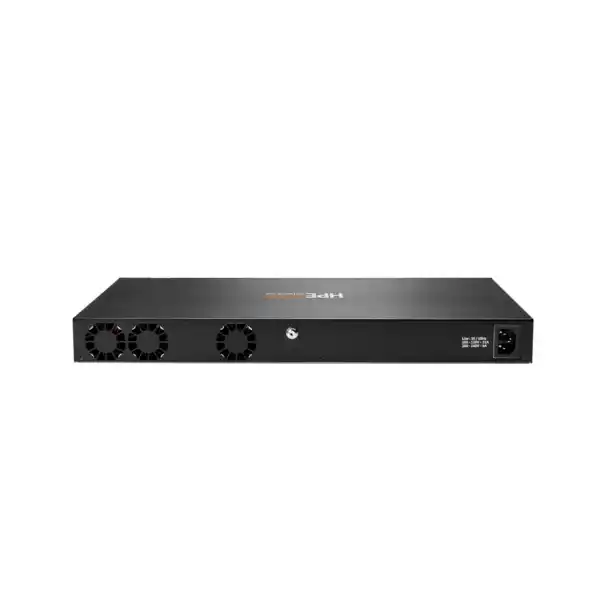
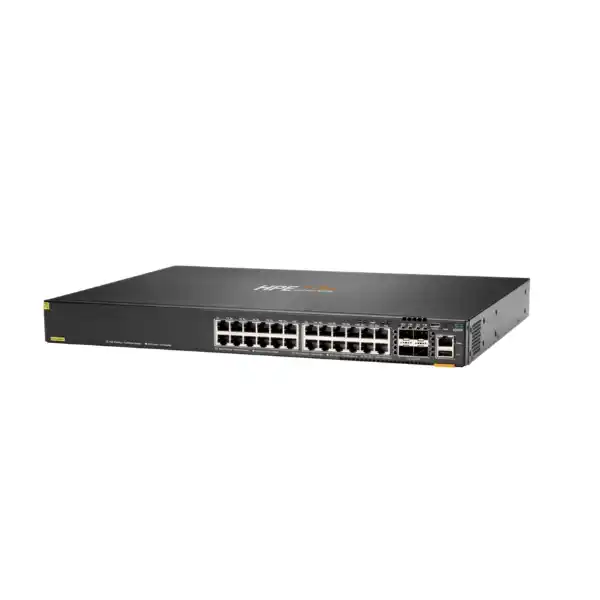
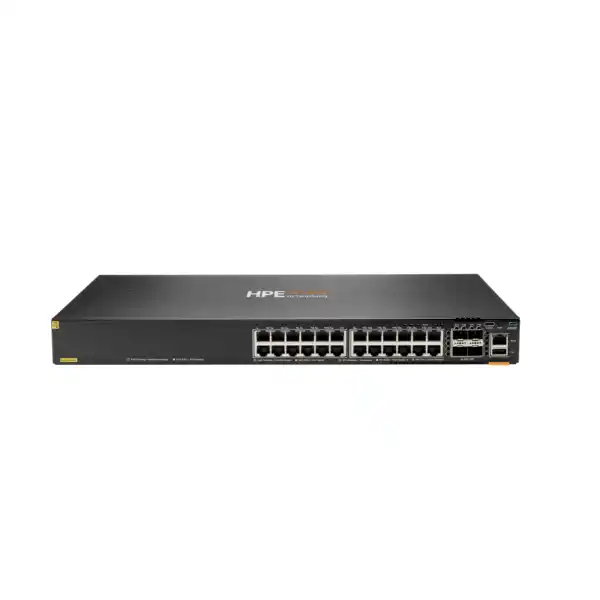
Direct answer: what is the CX 6300F JL666A?
The HPE Aruba Networking CX 6300F JL666A is a fixed-port Layer 3 managed switch intended for business access networks that need 24 Gigabit Ethernet PoE connections and faster fiber uplinks. It is mainly used to connect and power devices such as IP phones, cameras, IoT endpoints and suitable wireless access points while linking the access layer to distribution or core infrastructure through up to 50GbE SFP56 ports. IT teams should consider it when 1GbE edge connectivity and a 370W total PoE budget match the endpoint requirement. Before proceeding, confirm PoE demand, uplink optics, stacking design, local-versus-cloud management and licensing. FourTeck can help validate those choices and build a quotation around the exact UAE deployment.
What the JL666A does in a business network
The JL666A is designed to sit where users and powered devices enter the wired network. Its 24 copper access ports support 10Mbps, 100Mbps and 1Gbps Ethernet, so existing endpoint estates can be migrated without requiring every connected device to operate at the same speed. Each copper port can provide Class 4 PoE up to 30W when the connected device and power budget allow it. This makes one switch capable of carrying both network traffic and electrical power to many common edge devices, reducing the need for separate local power adapters at desks, ceilings and equipment locations.
The important distinction is that the switch is not a multi-gigabit copper access model. The 24 edge ports are 1GbE ports, while the high-speed capability is concentrated in the four SFP56 uplinks. That architecture is a good match for many conventional office, branch, surveillance and voice deployments where individual clients do not require more than 1Gbps, but aggregate traffic from multiple access ports must move upstream at 10GbE, 25GbE or 50GbE. If the project includes Wi-Fi access points that specifically require 2.5GbE, 5GbE or 10GbE copper interfaces, another CX 6300 model with HPE Smart Rate ports should be evaluated rather than assuming the JL666A provides multi-gigabit edge connectivity.
HPE positions the CX 6300 family for access, aggregation and selected top-of-rack use cases, and the series runs AOS-CX. For the JL666A, the practical buyer value comes from combining enterprise routing and policy capabilities with manageable access density, four flexible high-speed uplinks, PoE, and stacking. An organisation can start with a single switch for a smaller floor or branch and later use Virtual Switching Framework, or VSF, to operate multiple compatible CX 6300 members as one logical stack. HPE documents support for up to ten members in a CX 6300 VSF stack, allowing port density to increase without turning every switch into an entirely separate operational island.
That scalability should still be planned deliberately. A stack does not eliminate the need to calculate uplink bandwidth, power, rack space, cable pathways or failure domains. In a high-density design, the value of VSF is consistent management and logical scale, but the physical network still depends on correctly selected stack links, uplinks, optics, cabling and redundancy. FourTeck can review these elements when the requirement is more than simply replacing one access switch with another.
Who should consider the HPE Aruba CX 6300F 24-Port PoE switch?
Office and campus access
The JL666A can serve a floor, department or building zone where desktops, phones, printers and other Ethernet devices need reliable 1GbE access. Its PoE capability is useful when the access layer must also power voice devices or ceiling-mounted endpoints. The four SFP56 uplinks provide room to design faster connections back to a distribution or core layer without consuming copper user ports.
IP surveillance and IoT
Camera and IoT projects often combine many moderate-bandwidth endpoints with a meaningful power requirement. The switch can fit when each device stays within the supported Class 4 PoE profile and the combined design remains within the 370W PoE budget. Surge protection, outdoor cabling, intermediary devices and environmental conditions remain separate design considerations.
Branch and distributed sites
A 24-port fixed switch can be preferable to a 48-port unit where rack space, endpoint count and growth expectations are moderate. Branch buyers gain the same CX 6300 family management approach while avoiding unused access-port density. The fixed PSU design means redundancy expectations must be reviewed separately for sites where power-supply resilience is a strict requirement.
Standard 1GbE wireless edge
The switch can power access points that operate within its Ethernet speed and PoE limits. It should not be selected merely because the CX 6300 family includes Smart Rate and higher-power PoE variants. The exact JL666A has 1GbE copper access ports and Class 4 PoE, so Wi-Fi designs requiring multi-gigabit wired backhaul or more than 30W per AP should compare other models.
Verified technical specifications for JL666A
The values below are specific to HPE product number JL666A in the current HPE data sheet. They should not be blended with Smart Rate, higher-power PoE or redundant-power specifications from other CX 6300 models.
| Manufacturer | HPE Aruba Networking |
|---|---|
| Product family | CX 6300F, part of the CX 6300 Switch Series |
| Product number | JL666A |
| Product type | Fixed-port Layer 3 managed Ethernet switch with PoE |
| Copper access ports | 24 x 10/100/1000BASE-T |
| PoE per access port | Up to 30W per port, Class 4 PoE/PoE+ |
| PoE standards | IEEE 802.3af and IEEE 802.3at |
| Maximum PoE power | 370W total PoE budget |
| Uplink ports | 4 x SFP56 supporting 1GbE, 10GbE, 25GbE and 50GbE options subject to compatible optics/cabling |
| Console / service ports | 1 x USB-C console, 1 x USB Type-A host, 1 x out-of-band management port |
| Switching capacity | 448Gbps |
| Throughput | 334Mpps |
| Latency | 2.28µs at 1Gbps; 1.46µs at 10Gbps; 1.90µs at 25Gbps; 3.49µs at 50Gbps |
| Stacking | VSF support for up to 10 stack members in supported CX 6300 designs |
| Processor / memory | Dual-core Arm Cortex-A9 at 1.8GHz; 8GB DDR4; 32GB eMMC; flash value is model/configuration dependent |
| Power supply | Internal fixed 950W PSU |
| Input voltage | 100–120V / 200–240V AC |
| Power consumption | 52W idle; 67W at 100% traffic rate as stated by HPE, before planning endpoint PoE load |
| Management | HPE Aruba Networking Central, Web GUI, CLI and HPE Aruba Networking Switch Multi-Edit Software |
| Operating temperature | 0°C to 45°C up to 5,000 ft, with HPE altitude derating guidance above that elevation |
| Shipping weight | 4.95kg |
| Shipping dimensions | 4.4 x 44.2 x 32.7cm as listed in the HPE data sheet |
| Warranty guidance | HPE lists a limited lifetime warranty; exact regional terms and service entitlements must be confirmed for the supplied unit |
Product-fit matrix: when the JL666A makes sense
| Requirement | Suitable when | Confirm before ordering |
|---|---|---|
| 24-port access density | The site needs up to 24 copper access connections with sensible growth margin. | Count live ports, planned additions, spare ports and whether a 48-port model would consolidate racks more effectively. |
| 1GbE endpoint speed | Users, phones, cameras, printers and other endpoints are adequately served by 1GbE. | Check whether any Wi-Fi APs, servers or specialist devices require 2.5/5/10GbE copper. |
| PoE/PoE+ endpoints | Powered devices stay within Class 4, up to 30W per port. | Build a port-by-port wattage schedule and keep the combined expected draw within the 370W PoE budget. |
| High-speed uplink | The access layer needs 10, 25 or 50GbE fiber connectivity upstream. | Confirm the remote switch interface, optic type, fiber grade, connector, distance and speed compatibility. |
| Stacking | Several access switches should operate within a common VSF design. | Confirm compatible members, software version, topology, link media and redundancy design. |
| Fixed power architecture | A fixed internal PSU is acceptable for the site resilience plan. | If field-replaceable or redundant power supplies are mandatory, evaluate a model designed for that requirement. |
PoE planning: the 370W budget is the key sizing number
The JL666A can supply up to 30W on an individual access port, but the switch has a maximum PoE budget of 370W. Those two numbers must be read together. A buyer should not multiply 24 ports by 30W and assume the switch can continuously deliver 720W to endpoints. If every access port were active, the 370W total would average roughly 15.4W per port before any engineering headroom is considered. Real deployments rarely draw exactly the same power on every port, so a port-by-port calculation is more useful than an average.
For example, a mixed edge cabinet may have desk phones drawing comparatively little power, several cameras drawing more, and wireless access points with higher peak requirements. The correct process is to record the vendor-rated or measured maximum consumption for each powered device, group devices by port, calculate the expected concurrent draw, and preserve a safety margin for boot events, future additions and replacements. Devices can also negotiate PoE differently depending on model and software. FourTeck can review a proposed powered-device list so that the quotation reflects the actual site rather than simply the switch port count.
The Class 4 designation matters because the JL666A supports IEEE 802.3af and 802.3at on its copper ports and HPE states up to 30W per port. It is not the correct choice for an endpoint that requires 60W or 90W from a single Ethernet port. Some CX 6300 family members provide higher PoE classes, but those capabilities must not be transferred to JL666A. If a new Wi-Fi access point, camera enclosure, display, building system or specialist IoT unit needs more than Class 4 power, the switch model should be reconsidered before procurement.
PoE design also affects UPS sizing. A network cabinet with a 950W fixed switch power supply and a substantial connected PoE load can present a very different backup requirement from a non-PoE access switch. The HPE data sheet lists 52W idle and 67W at 100 percent traffic rate for the switch itself, but endpoint power drawn through PoE must be included when selecting UPS capacity and runtime. A project that requires thirty minutes or an hour of continued operation during mains loss must calculate the complete cabinet load, including the switch, powered endpoints, uplink equipment and any other rack devices.
In Dubai and the wider UAE, powered-device design should also account for the physical environment. Cameras in outdoor or semi-exposed areas may use heaters, illuminators or accessories that alter power draw. Wireless access points installed in hot ceiling voids may have environmental limits that differ from those of the switch in an air-conditioned communications room. The JL666A itself is specified for 0°C to 45°C operation up to 5,000 feet under HPE guidance. The network designer should therefore treat PoE capacity and environmental suitability as two related but separate checks.
Ports and SFP56 uplinks: how to plan the physical connections
The front-line access role of the JL666A is defined by 24 RJ-45 10/100/1000BASE-T interfaces. These are appropriate for conventional Category 5e or better structured cabling within normal Ethernet channel-length rules. Before purchase, the buyer should verify that the installed copper plant has been tested and labelled, especially in older offices where legacy patching, damaged outlets or intermediate couplers can reduce link stability. A managed switch can report port status and errors, but it cannot compensate for a poor physical cabling path.
At the uplink side, the switch provides four SFP56 ports that HPE lists for 1GbE, 10GbE, 25GbE and 50GbE operation. This flexibility lets the same access switch connect to different generations of distribution infrastructure, but the port itself is only one part of the link. The transceiver or direct-attach component, remote switch port, fiber type, connector, wavelength and link distance must all be compatible. A 50GbE-capable cage does not make every installed SFP module or existing fiber run operate at 50GbE.
For a new building, it can be sensible to design the uplink around future growth even if the initial traffic level does not require the maximum speed. For an existing building, the more economical choice may be to reuse a compatible 10GbE or 25GbE optical standard and upgrade later. The right answer depends on the distribution switch, fiber plant and bandwidth forecast. FourTeck can include compatible transceiver selection and link-speed confirmation as part of the bill-of-material review rather than treating optics as an afterthought.
Uplink capacity should be based on traffic patterns, not only endpoint count. Twenty-four users performing general productivity work may consume far less aggregate bandwidth than a smaller number of cameras, engineering workstations, backup clients or local data-intensive systems. Likewise, two uplinks might be used for redundancy or link aggregation instead of simply adding their headline rates. The design should identify whether the objective is capacity, path resilience, stack connectivity or a combination of those goals.
The switch also includes a USB-C console port, a USB Type-A host port and a dedicated out-of-band management interface. The OOBM interface is useful when an organisation maintains a separate management network because it provides an administrative path distinct from normal production data interfaces. Whether that path is truly out-of-band in operational terms depends on how the customer designs the management network. The console interface remains valuable for initial setup and recovery workflows where direct local access is required.
Performance capacity and what the numbers mean
HPE specifies 448Gbps switching capacity and 334Mpps throughput for JL666A. The switching-capacity value corresponds to the aggregate bidirectional forwarding potential of the port architecture and is useful when comparing the internal forwarding envelope of similar switches. Packet-per-second throughput is particularly relevant when traffic includes many small packets, where packet-processing rate can matter as much as raw gigabits per second. These headline figures establish that the hardware is designed for wire-speed enterprise switching within its port configuration, but they do not remove the need to size upstream links and network services correctly.
Latency is also documented by HPE at different interface speeds: 2.28 microseconds at 1Gbps, 1.46 microseconds at 10Gbps, 1.90 microseconds at 25Gbps and 3.49 microseconds at 50Gbps. Buyers should avoid treating one isolated latency number as a complete application-performance guarantee. End-to-end delay also includes the client, access medium, uplinks, routers, firewalls, WAN links, servers and applications. The value of the switch specifications is to show the device’s forwarding characteristics within the wider path.
For most access deployments, the more important planning question is oversubscription. The copper edge presents up to 24Gbps of nominal one-way access capacity if every port is active at 1Gbps. A single 10GbE uplink may be sufficient for many office workloads, while denser or more data-intensive sites may justify 25GbE, 50GbE or multiple uplinks. The best ratio depends on measured utilization, application behavior, growth expectations and redundancy policy. Capacity planning should therefore use monitoring data where available instead of selecting the fastest optic simply because the switch supports it.
AOS-CX management, visibility and automation
The CX 6300 series runs HPE Aruba Networking AOS-CX, giving the JL666A an operational model intended for enterprise switching rather than simple unmanaged access. HPE lists management through Aruba Networking Central, the Web GUI, CLI and Switch Multi-Edit Software. This means the switch can participate in a broader management strategy ranging from direct local administration to centralized operations, depending on the customer’s tooling and licensing choices.
Local CLI management is often preferred for detailed configuration, change control and troubleshooting by experienced network teams. The Web GUI can provide a more visual local interface for selected workflows. Aruba Networking Central is designed to unify management across wired, wireless and WAN environments, but a buyer planning Central should confirm the appropriate subscription, device onboarding method, tenant design and feature entitlement for the intended deployment. The physical switch can operate as a network device without making cloud management the only possible administrative path; the selected operating model should reflect the organisation’s governance and support practices.
The CX 6300 family also includes the Network Analytics Engine, or NAE, which HPE describes as providing real-time network insight and actions using operational data. The platform maintains time-series operational information that can help teams investigate events and changes rather than relying only on a snapshot taken after a problem is reported. The practical value is strongest when monitoring is planned as part of operations: teams need useful alerts, change processes, baseline expectations and people responsible for acting on what the system reports.
Switch Multi-Edit is another management option HPE highlights for network-wide configuration workflows. It can assist with search, edit, validation, deployment and auditing tasks across supported switches. That can reduce manual effort where multiple access switches must maintain consistent policy. It does not eliminate the need for change review. A bulk configuration error can scale as efficiently as a correct configuration, so templates, peer review, backups and staged rollouts remain important in production networks.
For UAE organisations with several offices, the management decision should be made before rollout. If every site is configured independently, operational consistency may deteriorate as the estate grows. If centralized management is chosen, the project must address subscription terms, internet reachability, administrative roles, authentication, logging and support ownership. FourTeck can help map the desired management approach to the switch configuration and quotation so that hardware, licensing and services are considered together.
Layer 3, segmentation and security capabilities
The current HPE CX 6300 series data sheet identifies a broad Layer 3 feature set including BGP, OSPF, VRF, EVPN and VXLAN, together with robust quality of service and other advanced capabilities. These functions allow the platform to take on responsibilities beyond basic VLAN access switching when the network design calls for it. The presence of a feature in the family does not mean every project should enable it. Routing protocols, overlay technologies and virtual routing instances add architectural flexibility but also require appropriate software, operational knowledge and a clear reason to be part of the design.
For a conventional office access layer, the JL666A may simply provide VLAN-based segmentation, access control and resilient uplinks toward a routed distribution layer. In a more distributed architecture, routing can move closer to the edge to reduce broadcast domains or create clearer fault boundaries. The correct approach depends on the existing core, firewall policy, IP addressing plan, authentication method and operational model. A switch purchase should therefore be accompanied by a configuration design when it changes where routing or policy enforcement occurs.
HPE also describes Dynamic Segmentation across Aruba wired and wireless infrastructure. The purpose is to apply user- and device-aware policy more consistently rather than depending only on physical switch ports. This can be valuable in environments with employees, contractors, phones, cameras and IoT devices sharing the same access infrastructure. Policy effectiveness still depends on accurate identity, role definition, authentication, upstream services and correct configuration; the switch alone cannot determine an organisation’s security policy.
Application recognition and control are called out by HPE as capabilities available through the CX Advanced Feature Pack. That dependency should be explicit during procurement. Buyers who need those advanced functions should verify the current feature-pack entitlement, software version and subscription or licensing model rather than assuming all capabilities are included with the base hardware. FourTeck can include license clarification in the quotation process when advanced policy or application-level visibility is part of the requirement.
The CX 6300 data sheet also lists MACsec 256 among series capabilities. MACsec can protect Ethernet links at Layer 2 when supported and correctly configured at both ends of the connection. It is not a substitute for every other security control, and link compatibility must be established before it is included in the design. Where encrypted switch-to-switch links are required, the project should specify the exact peer device, port type, software release and desired key-management approach.
Security planning around the JL666A should also cover management access. Administrative interfaces should be placed in appropriate management networks, protected with strong authentication, limited to authorized sources and logged. The out-of-band management port can support separation of management traffic, but the overall design must include the upstream management network, access controls and recovery procedures. A technically capable switch is most useful when its management plane is treated as part of the security architecture rather than as an installation detail.
VSF stacking and availability considerations
HPE supports Virtual Switching Framework stacking for up to ten CX 6300 members. VSF allows multiple physical switches to operate as a single logical system for management and configuration, which is valuable when a floor or campus block needs more than 24 access ports. Stacking can simplify uplink design, VLAN consistency and administration compared with treating every switch as a separate standalone device.
However, a stack should be engineered rather than assembled ad hoc. The stack-member mix, software version, link speed, topology and split-detection method should be validated. HPE documentation distinguishes CX 6300L stacking from the rest of the CX 6300 family, so a proposed mixed stack should always be checked against current compatibility information. If a customer already owns CX 6300 switches, FourTeck can use the exact part numbers and installed software versions to determine whether the planned JL666A addition fits the intended VSF design.
Stacking also changes failure-domain thinking. A single logical stack may make daily operations easier, but the design should still identify what happens if one member fails, a stack link is interrupted, an uplink fails or the active control role changes. Critical devices can be distributed across members where appropriate, and upstream connectivity can be designed with resilient paths. The objective is not merely to reach ten members; it is to use the topology that gives the site the right balance of manageability, scale and resilience.
HPE also describes Virtual Switching Extension, or VSX, as a two-member active-active high-availability technology in the CX 6300 series. VSX and VSF solve different design problems, so they should not be treated as interchangeable labels. A project seeking chassis-like redundancy, multi-chassis link behavior or independent control planes should define that objective first and then validate whether a VSX design on the selected models is appropriate. For a straightforward access stack, VSF may be the more natural model.
Licensing, subscriptions and optional functionality
The JL666A hardware can be managed locally, while HPE Aruba Networking Central provides a centralized cloud-based operations option. Organisations planning Central should confirm the current device subscription or license requirement, term length and feature level during quotation. Licensing models and product names can change over time, so the correct entitlement should be tied to the specific project date and operational requirement rather than copied from an older deployment.
Advanced capabilities may also have separate entitlements. HPE specifically identifies application recognition and control as available through the CX Advanced Feature Pack. If the buyer’s design depends on that functionality, the bill of materials should include the appropriate entitlement and the configuration scope should state how the feature will be used. If the project only needs standard switching, routing, VLANs, PoE and local management, an advanced feature package should not be added without a defined purpose.
Support services are another procurement dimension. HPE lists a limited lifetime warranty for the hardware in the current data sheet, but warranty and support should not be treated as identical. A warranty addresses defined hardware coverage under its terms; a support service can include different response, software and assistance entitlements. UAE buyers should confirm the service level, registration requirements, product serial coverage and any region-specific conditions that matter to their operational policy.
FourTeck can separate the quote into hardware, optics/accessories, cloud-management subscriptions where requested, advanced-feature entitlements where required, and installation or configuration services. This makes optional components visible and reduces the risk of discovering after delivery that a desired management or policy capability needs an additional purchase.
Compatibility and integration checks before purchase
The first compatibility check is the uplink. Record the make, model and exact port type of the distribution or core switch that will receive the JL666A uplink. Then define the required speed and physical medium. A 10GbE single-mode link, a 25GbE multimode link and a short 50GbE direct-attach connection require different components. The far-end port must support the same speed and standard. Optics should be selected using current HPE compatibility guidance and the actual fiber path, not solely by connector appearance.
The second check is endpoint speed. The 24 access ports are 1GbE copper. That is appropriate for many phones, cameras, printers, desktop PCs and traditional wireless APs, but it may restrict newer wireless access points or workstations that are designed for multi-gigabit Ethernet. If the project includes Wi-Fi 6E or Wi-Fi 7 APs, do not assume compatibility based only on PoE. Verify both the AP’s Ethernet speed and its maximum power requirement. Some APs can operate in reduced modes on lower-speed or lower-power connections, but such behavior is device-specific and should not be assumed.
The third check is PoE class and budget. Every powered device should have a documented maximum draw, and the total should fit inside 370W with practical margin. If one endpoint requires more than 30W, the JL666A cannot meet that port-level requirement through its Class 4 PoE interface. If the aggregate requirement exceeds 370W, a different switch, additional switch or changed endpoint distribution may be necessary.
The fourth check is management and authentication integration. If the organisation uses Aruba Networking Central, network access control, role-based access, RADIUS, TACACS, syslog, SNMP or other operations platforms, document the desired integrations before configuration. Feature support can depend on AOS-CX version and license. Existing monitoring platforms may also need updated templates or credentials when replacing a different switch family.
Finally, verify physical deployment requirements: rack depth, airflow, available AC circuit, UPS capacity, earthing practice, cable management and environmental temperature. HPE lists a fixed 950W PSU and 100–120V / 200–240V input range for JL666A. The shipping dimensions are 4.4 x 44.2 x 32.7cm and shipping weight 4.95kg in the current data sheet. These numbers help with logistics, but the installer should still review the actual rack and mounting hardware supplied for the region.
Where JL666A fits within the CX 6300 family
The CX 6300 range includes fixed CX 6300F models and modular CX 6300M models, along with newer CX 6300L options positioned differently. The JL666A occupies a clear place: it is a 24-port fixed copper access model with 1GbE Class 4 PoE and four SFP56 uplinks. That combination is attractive when the buyer wants enterprise CX features and PoE without paying for copper access speeds or power classes that the endpoints will not use.
A close comparison is the JL668A, which HPE lists as a CX 6300F 24-port 1GbE model with four SFP56 ports but without the Class 4 PoE access-port specification of JL666A. If a cabinet connects desktops, printers or other devices that have their own power and no meaningful PoE requirement, the non-PoE alternative may deserve evaluation. If phones, cameras or access points need switch-delivered power, JL666A is the more relevant fixed 24-port option.
Another comparison is JL665A, the 48-port 1GbE Class 4 PoE CX 6300F model with four SFP56 ports. The key buyer question is port density. Two 24-port switches may offer different failure-domain and rack-layout possibilities than one 48-port switch, while a 48-port unit may reduce device count and management overhead in a dense cabinet. The correct choice depends on port growth, stack design, PoE distribution, rack capacity and operational preferences rather than on a simple larger-is-better assumption.
For higher-performance wireless access, the CX 6300M family includes models with HPE Smart Rate multi-gigabit copper and higher PoE classes. HPE lists JL660A, for example, as a 24-port Smart Rate 1/2.5/5GbE Class 6 PoE model with SFP56 uplinks. That type of switch should be considered where APs or other edge devices need more than 1Gbps over copper or more than 30W per port. The distinction is important because marketing for the broader CX 6300 family often references Smart Rate and high-power PoE, while the exact JL666A does not provide those access-port characteristics.
The fixed-versus-modular decision also affects power architecture. JL666A uses an internal fixed 950W PSU. Organisations that require a different power-supply strategy, field-replaceable components or more advanced redundancy options should compare appropriate CX 6300M configurations rather than assuming the F model can be upgraded later to the same hardware architecture. Buying the correct platform at the outset is usually simpler than redesigning around a structural limitation after deployment.
Deployment and installation considerations in Dubai and the UAE
A successful switch installation begins with the cabinet, not the CLI. Confirm that the rack has suitable space, depth and cable management, that the switch can be mounted securely, and that airflow is not obstructed by bundles of patch leads. HPE specifies an operating range of 0°C to 45°C up to 5,000 feet for JL666A, with derating guidance above that altitude. Most Dubai enterprise deployments are at low elevation, but equipment rooms can still exceed acceptable temperatures quickly if cooling fails. Monitoring the communications-room environment is therefore part of reliable network operation.
Power should be planned from both capacity and resilience perspectives. The switch accepts 100–120V or 200–240V input and uses a fixed internal 950W PSU. The cabinet’s UPS and power distribution unit should be sized for the complete expected load, especially when the switch supplies PoE to multiple endpoints. If business continuity requirements expect phones, cameras or wireless devices to remain online during a utility interruption, their PoE consumption contributes directly to required UPS runtime.
Copper patching should be labelled before migration. During replacement projects, it is common to discover that old switch-port numbers do not match wall-outlet labels or that unused cables remain connected. A migration worksheet mapping old port, new port, VLAN, PoE device, endpoint owner and special configuration can reduce cutover risk. Where voice VLANs, cameras, printers or building systems have static assumptions, those should be documented before cables are moved.
Uplink changes deserve a separate method of procedure. If the old switch uses 1GbE or 10GbE and the new design moves to 25GbE or 50GbE, optics and far-end configuration must be ready before the access switch is commissioned. Duplex, speed, link aggregation, VLAN tagging, routing and spanning-tree behavior should be confirmed. A high-speed port that comes up physically but carries the wrong VLAN or routing configuration can create a longer outage than a failed optic.
For stacked deployments, stage the switches before taking them to the site whenever practical. Align software versions, identify stack members, define the intended conductor/standby behavior, verify stack links and load the baseline configuration in a controlled environment. Staging also creates an opportunity to check serial numbers, accessories and labels against the bill of materials. Onsite time can then focus on physical installation, cabling, validation and integration rather than basic preparation.
Post-installation testing should be specific. Confirm link speed on every critical uplink, PoE delivery to representative endpoints, VLAN assignment, default-gateway reachability, routing adjacencies where used, management access, logging, time synchronization and monitoring. If the switch is managed in Aruba Networking Central, confirm successful onboarding and that the intended configuration group, subscription and monitoring data are visible. A handover should record the final software version, management address, stack topology, uplink ports, optics, support information and configuration backup location.
Sizing the switch for real endpoint demand
Start with port count, but do not stop there. List every device expected in the cabinet during the next realistic planning period, then classify each as data-only, PoE, special VLAN, high-availability or future. If the requirement already approaches 24 active ports, retaining only one or two spare ports may be poor planning. A 48-port model or a second switch might provide a cleaner growth path. Conversely, purchasing 48 ports for a small stable branch can create unnecessary cost and power consumption.
Next, classify Ethernet speed. JL666A is strongest when 1GbE is sufficient at the edge. Desktop PCs, phones, many cameras and numerous IoT devices fit this profile. High-end workstations, modern wireless access points, storage appliances and some edge compute systems may need faster copper. Those requirements should be separated because they can change the model choice even when the port count is low.
Then calculate PoE. Record both typical and maximum device draw if available. Pay special attention to devices that change power usage when accessories are enabled. Sum the maximum expected concurrent demand and compare it with 370W, leaving operating margin. If the design requires all 24 ports to supply close to 30W simultaneously, JL666A is not sized for that scenario because the total would exceed its PoE budget.
Finally, size the uplink. The access-port total provides an upper theoretical traffic envelope, but real utilization determines the needed uplink speed. Existing monitoring can reveal peak throughput and growth. For greenfield sites, application mix is the next best indicator. A typical office may be comfortable on 10GbE, while high-resolution surveillance, engineering data or dense wireless aggregation could justify 25GbE or 50GbE. Redundancy may require two links even when one link has enough bandwidth.
This four-part method—ports, edge speed, PoE and uplink—usually identifies whether JL666A is a good fit before more advanced features are considered. FourTeck can use the same information to compare adjacent CX models and avoid quoting a switch that is technically capable but mismatched to the site’s actual bottleneck.
Typical deployment scenarios
Corporate floor with phones and user devices
A business floor may use the 24 copper ports for a mixture of IP phones, desktop connections, printers and a small number of access points. The switch can provide PoE to phones and compatible APs while carrying data for PCs and other endpoints. The main checks are whether 24 ports leave enough growth room, whether the APs are satisfied by 1GbE and Class 4 power, and whether the combined PoE draw remains within 370W. A 10GbE or 25GbE uplink may be enough depending on measured user traffic and application mix.
Surveillance access cabinet
For IP cameras, the switch can combine network connectivity and power in one device. The buyer should map camera quantity, maximum wattage, stream bitrate and uplink path. High-resolution cameras can create sustained traffic that differs from bursty office use, so uplink sizing should account for continuous aggregate video. Outdoor cameras or devices with IR illumination may draw more power under certain conditions. The 370W total budget must be tested against the worst credible concurrent load, not only daytime average consumption.
Branch-office access and routing
A branch with fewer than 24 wired endpoints may use JL666A as the main access switch while routing remains on a firewall or distribution device. In other architectures, selected Layer 3 functions can be placed on the switch. The decision should align with WAN design, security policy and remote support capability. Because the PSU is fixed, branches that demand hardware power redundancy should compare a different platform or include resilience elsewhere in the design.
Campus access stack
Multiple JL666A or compatible CX 6300 switches can be used in a VSF stack to increase density and simplify management. This is suitable when several access switches share a cabinet or logical role. The stack design should define member numbering, stack links, uplinks, split detection, software versions and how critical endpoints are distributed. Scaling to many members is possible, but a smaller stack may be operationally preferable if it creates cleaner fault domains.
Mixed wired and wireless edge
The JL666A can be part of a unified Aruba environment where wired access and compatible wireless infrastructure are managed through common tools. The limiting check is the exact AP interface requirement. If all access points work correctly on 1GbE and within 30W, the model can be suitable. If new APs require 2.5GbE or higher wired speeds or greater power, a Smart Rate and higher-power PoE model should be considered for those ports.
When another switch should be evaluated
Choose a non-PoE model when powered endpoints are not required. If the cabinet mainly connects desktops, servers or devices with independent power, paying for PoE capacity may not create value. The 24-port non-PoE CX 6300F JL668A is one family option worth comparing where the rest of the port and uplink profile fits.
Choose a 48-port PoE model when density is the primary issue. If the site needs substantially more than 24 powered access ports in one cabinet, the CX 6300F JL665A provides 48 1GbE Class 4 PoE access ports with SFP56 uplinks. Compare physical density, PoE demand, device count and resilience rather than purchasing two 24-port units automatically.
Choose a Smart Rate model when access points or clients need multi-gigabit copper. JL666A does not provide 2.5GbE, 5GbE or 10GbE on its 24 RJ-45 access interfaces. A CX 6300M Smart Rate model is more appropriate when modern wireless access points or specialized devices would otherwise be bottlenecked by 1GbE.
Choose higher per-port PoE when any endpoint needs more than 30W. The exact JL666A is Class 4. If a device requires 60W or 90W, it should not be connected with the expectation that the switch will satisfy that requirement. Compare a CX 6300 configuration with the required PoE class and confirm the total budget as well.
Choose another power architecture when redundant or field-replaceable PSUs are mandatory. JL666A uses a fixed internal power supply. If the organisation’s standard requires redundant hot-swappable power supplies at the access layer, select a platform designed for that requirement instead of trying to work around it.
Buyer questions to answer before ordering JL666A
Do we really need PoE on all 24 ports?
Not necessarily. JL666A is appropriate when PoE is valuable across part or all of the access layer, but the business case depends on powered endpoints. If only a few ports need power, compare the cost and operational simplicity of this model with alternatives. If no ports need PoE, JL668A or another non-PoE switch may be a cleaner fit.
Can every port deliver 30W at the same time?
No. HPE lists up to 30W per port but a 370W maximum total PoE budget. Twenty-four ports at 30W would require 720W, so the deployment must be sized from the combined endpoint load. This distinction is one of the most important procurement checks for JL666A.
Does it provide multi-gigabit copper?
No. The 24 RJ-45 ports are 10/100/1000BASE-T. Multi-gigabit speeds are available on other CX 6300 models with HPE Smart Rate. The four JL666A SFP56 uplinks can operate at higher speeds, but that does not change the 1GbE access-port limit.
Which uplink speed should we use?
Choose 10, 25 or 50GbE according to measured or forecast aggregate traffic, redundancy and the capabilities of the upstream switch and fiber plant. A faster interface is useful only when both ends, optics and cabling support it. Many office access layers do not need 50GbE on day one.
Is Aruba Networking Central required?
Central is a supported management option, not the only way to administer the switch. HPE also lists Web GUI, CLI and Switch Multi-Edit. If Central is selected, confirm the current subscription and entitlement required for the desired management features.
Can we add it to an existing CX 6300 stack?
Potentially, but compatibility should be validated using the exact existing models and AOS-CX software versions. HPE supports up to ten CX 6300 members in VSF, while CX 6300L has specific stacking restrictions. Do not assume every product carrying 6300 in its name can be mixed freely.
Are transceivers included?
The switch provides SFP56 cages, but the exact optical or DAC components required depend on the link design and should be confirmed as separate bill-of-material items unless a specific bundle explicitly includes them. Speed, wavelength, fiber type, distance and far-end compatibility must match.
What information makes the quote accurate?
Provide quantity, installation location, endpoint count, PoE devices and wattage, uplink speed and distance, existing core/distribution model, stacking requirement, management preference, subscription term if applicable, installation scope and support requirement. These inputs prevent missing optics, licenses or services.
Procurement checklist for a complete JL666A bill of materials
- Exact hardware: confirm HPE product number JL666A and any region-specific ordering suffix required for the UAE supply route.
- Quantity: include production units, planned stack members and any agreed spare strategy.
- Port count: document current active ports and realistic growth so 24 ports remain sufficient.
- PoE schedule: list powered devices, per-device maximum draw and total expected requirement against the 370W budget.
- Access speed: verify that every intended RJ-45 endpoint is suitable for 1GbE or lower.
- Uplinks: specify 1/10/25/50GbE speed, quantity, redundancy approach and far-end interface.
- Optics and media: select compatible transceivers, DAC/AOC assemblies or fiber components based on distance and cabling.
- Stacking: confirm VSF member compatibility, link plan and software requirements if more than one switch will operate as a stack.
- Management: choose local administration, Aruba Networking Central or a combined approach and include required subscriptions.
- Advanced features: identify whether CX Advanced Feature Pack capabilities are needed.
- Power and UPS: validate AC supply, PDU, UPS capacity and runtime including PoE endpoint load.
- Installation scope: define rack mounting, patching, labeling, configuration, migration, testing and documentation responsibilities.
- Support: confirm the required HPE support or warranty handling model and regional entitlement.
- Delivery location: provide the Dubai or UAE project location and requested schedule so lead time can be checked without assuming stock.
Configuration and migration planning
Replacing an existing switch is not just a hardware swap when the old unit carries VLANs, trunks, access policies, voice settings, routing, monitoring and authentication. A migration should start by exporting or documenting the existing configuration and then deciding which settings are still required. Copying every legacy command into a new AOS-CX environment can preserve years of outdated policy. A cleaner method is to translate the intended network behavior into the new platform and validate each dependency.
Port profiles can simplify a migration. User ports, voice ports, cameras, printers, access points and uplinks usually have different VLAN and security requirements. Grouping those functions into defined configuration patterns makes it easier to verify that a cable moved from the old switch lands on a port with the correct role. For larger deployments, Aruba management tools and templates can help maintain consistency, but a small pilot should be tested before pushing changes across many switches.
Routing and gateway placement require particular care. If the old access switch performs inter-VLAN routing, dynamic routing or first-hop functions, the new configuration must preserve the intended paths and firewall boundaries. If the migration is also an opportunity to move routing upstream, the IP addressing and cutover method may change. FourTeck can help distinguish a direct replacement from an architecture change so the implementation effort is quoted realistically.
Authentication is another dependency. Networks using 802.1X, MAC authentication, RADIUS roles or dynamic segmentation need coordination with identity and policy systems. A switch may be physically online yet still prevent users from connecting if authentication policies are incomplete. Testing should include representative endpoint types, failure behavior when authentication servers are unavailable, and the expected treatment of devices that cannot perform 802.1X.
After cutover, monitoring should be reviewed rather than assumed. Confirm that the network-management platform recognizes the new device, that SNMP or telemetry is working as intended, that syslog reaches the correct collector and that alerts are meaningful. If Aruba Networking Central is used, validate device health, configuration status and license assignment. Operational handover is complete only when the support team can see, manage and troubleshoot the switch using its normal workflow.
How FourTeck can assist with HPE Aruba CX 6300F JL666A
FourTeck can help turn the switch model into a complete requirement rather than a single-line hardware request. For a new deployment, that can begin with endpoint quantity, PoE demand, access speed and uplink design. For a replacement, the review can include the current switch model, existing VLANs, uplink optics, stack topology and any operational problems the new design is expected to address.
Bill-of-material guidance can cover the JL666A itself, compatible uplink components, required accessories, management subscriptions where selected, advanced feature entitlements where relevant and support options. The objective is to expose dependencies before purchase. An apparently lower-cost quote that omits optics, licenses or implementation effort can become more expensive once the missing components are discovered during installation.
FourTeck can also discuss configuration and deployment scope. Depending on the project, this may include baseline configuration, VLANs, trunks, uplinks, VSF planning, routing, management access, monitoring integration, PoE validation, migration assistance and documentation. The final scope should be agreed against the customer’s network design rather than assumed from the hardware model.
For multi-site UAE projects, standardization can be part of the review. Using a consistent access-switch model, software baseline, port-profile structure, management method and documentation format can simplify operations. At the same time, sites with different density or wireless requirements may need different members of the CX family. FourTeck can compare those needs rather than forcing one model into every location.
Explore FourTeck networking products, discuss network installation and configuration services, or contact FourTeck for model and BOM review when the final switch, optics, licensing and deployment scope still need confirmation.
UAE availability and ordering guidance
Availability can depend on the exact JL666A regional SKU, quantity, vendor lead time and current channel conditions. FourTeck does not need to assume local stock to prepare a useful quotation. The first step is to confirm the exact technical requirement, then check current UAE supply options for that configuration. HPE documentation shows regional ordering suffixes for JL666A, including variants associated with different power or localization requirements, so the supplied item should be matched to the destination and project needs.
Delivery planning should also account for optics, licenses and implementation services. A switch may be available before a particular transceiver or subscription, and a project cannot be considered ready if a critical dependency is missing. For larger quantities, phased delivery or pre-staging may be worth discussing. Installation and configuration should be included in the quotation when required, with the project location, rack readiness, migration window and customer responsibilities clearly defined.
Contact FourTeck to confirm current Dubai and UAE availability, lead time, regional SKU, support options and quotation terms for the required quantity. No stock level, delivery date or installation date should be assumed until the specific requirement is checked.
Related CX 6300 options worth comparing
CX 6300F JL668A
A 24-port 1GbE fixed model with four SFP56 uplinks for projects that do not need PoE on the access ports. Compare it when endpoints have independent power and the 24-port density still fits.
CX 6300F JL665A
A 48-port 1GbE Class 4 PoE fixed model with four SFP56 uplinks. It is relevant when a single cabinet needs substantially more powered copper ports than JL666A provides.
CX 6300M Smart Rate models
Evaluate modular Smart Rate variants when access devices need 2.5GbE, 5GbE or higher copper speeds, greater PoE classes, or a different power architecture. Exact model selection should follow the endpoint and resilience requirement.
Aruba Networking Central
Central can provide unified cloud-based management for supported wired and wireless infrastructure. Confirm the current subscription and feature entitlement if centralized operations are part of the project.
Frequently asked questions
What is the exact part number for the 24-port PoE CX 6300F?
The exact HPE product number is JL666A for the HPE Aruba Networking CX 6300F 24-port 1GbE Class 4 PoE and 4-port SFP56 Switch. Regional orderable suffixes can vary, so the final quotation should confirm the version appropriate for the UAE project rather than relying only on the base part number.
How much PoE power does JL666A provide?
HPE specifies Class 4 PoE/PoE+ with up to 30W on an individual copper port and a maximum total PoE budget of 370W. The design must therefore calculate the combined endpoint load. The switch cannot provide 30W simultaneously to all 24 ports because that would exceed the total budget.
Does the switch support 2.5GbE or 5GbE on the RJ-45 ports?
No. JL666A has 24 x 10/100/1000BASE-T access ports. The CX 6300 family also includes HPE Smart Rate models, but those multi-gigabit copper capabilities belong to different part numbers. Select a Smart Rate model when the endpoint requires more than 1GbE over copper.
What speeds are available on the SFP56 uplinks?
The four uplink ports are listed by HPE for 1GbE, 10GbE, 25GbE and 50GbE operation. The actual link depends on a compatible transceiver or cable, the remote switch port, fiber type and supported software combination. Optics should be selected as part of the complete link design.
How many CX 6300 switches can be stacked?
HPE documents VSF stacking for up to ten CX 6300 members. The exact member mix, AOS-CX release and stack topology must be checked, particularly because CX 6300L models have specific stacking rules. Existing switch part numbers should be provided when adding JL666A to an installed stack.
Does JL666A require an Aruba Networking Central subscription?
A Central subscription is relevant when the organisation wants to manage the switch through Aruba Networking Central. HPE also lists local Web GUI, CLI and Switch Multi-Edit management options. The current Central subscription term and feature level should be confirmed if cloud management is selected.
What should we provide to FourTeck for a quotation?
Provide the required quantity, project location, current and future port count, list of PoE devices with power requirements, desired uplink speed and distance, upstream switch model, stacking requirement, preferred management method, any advanced feature need, installation/configuration scope and support expectation. These details help identify optics, subscriptions and services that a hardware-only request can miss.
Is the JL666A suitable for a new Wi-Fi 7 deployment?
It can connect an access point only when that AP can operate within a 1GbE copper link and Class 4 power envelope. Many newer high-performance AP designs benefit from multi-gigabit Ethernet and may require higher PoE classes. For those deployments, compare Smart Rate CX 6300 models instead of assuming the JL666A is suitable because the broader family supports Wi-Fi 7-oriented access architectures.
Decision recap for the CX 6300F JL666A
What FourTeck needs to validate your switch selection
A short technical input set is usually enough to confirm whether JL666A fits or whether another CX 6300 model would reduce a power, speed or capacity constraint.
Current and future port count
PoE device list and watts
Uplink speed and distance
Existing core switch
Stacking requirement
Central or local management
Installation and configuration scope
Confirm the JL666A before you finalize the UAE network BOM
FourTeck can review your port count, powered-device load, SFP56 uplink requirement, stacking plan, management choice and installation scope before quotation. That review helps determine whether the 24-port Class 4 PoE JL666A is the correct fit or whether a 48-port, Smart Rate, higher-power or different power-architecture CX model should be compared. Current UAE availability and regional orderable options can then be checked against the confirmed requirement.

Reviews
There are no reviews yet.