
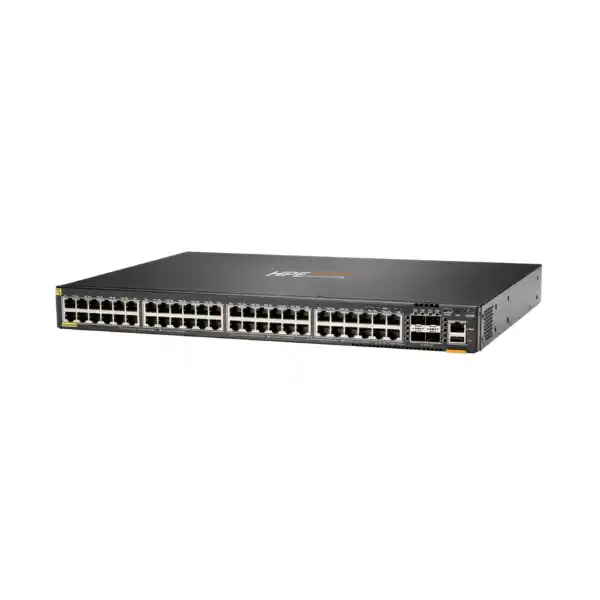
48-port Gigabit access with high-speed SFP56 uplinks
HPE Aruba Networking CX 6300F 48-Port Switch JL667A in Dubai
The HPE Aruba Networking CX 6300F JL667A is a fixed-port, stackable Layer 3 switch built for organizations that need forty-eight 1GbE copper access connections, four high-speed SFP56 uplinks and the operational model of AOS-CX. Its practical value is not simply port count: the model combines dense non-PoE access, routing, VSF stacking, telemetry and modern management options in a compact 1U platform. For UAE projects, the most important question is whether this exact non-PoE configuration matches the endpoint, uplink, redundancy and management requirements before optics, cables and software subscriptions are finalized.
Direct answer for buyers considering JL667A
The HPE Aruba Networking CX 6300F JL667A is a 48-port, non-PoE Gigabit Ethernet switch in the CX 6300 family, with four SFP56 uplink interfaces and AOS-CX software. It is mainly used where a business needs dense wired access or aggregation without supplying power to endpoints from the switch. IT teams, network administrators and procurement groups should consider it when 48 copper 1GbE ports, Layer 3 capability and stackability align with the design. The most important pre-order check is whether the environment needs PoE, multigigabit edge ports, a particular optic or DAC, or a different redundancy model. FourTeck can help confirm the exact JL667A configuration, uplink media, VSF design, software subscription requirements, mounting, quantity and deployment scope before quotation.
What the CX 6300F JL667A does in an enterprise network
The JL667A is best understood as a dense wired switching platform for environments that still have a substantial requirement for standard 1GbE copper Ethernet. Its forty-eight 10/100/1000BASE-T interfaces can connect user workstations, printers, non-PoE cameras through separate injectors or power arrangements, servers with 1GbE interfaces, management ports, building systems, appliances and other Ethernet endpoints. Because this particular model is the non-PoE 48-port CX 6300F, it is most attractive when endpoint power is not expected from the access switch or when power is delivered by another method. That distinction matters during procurement: the visually similar JL665A is the 48-port Class 4 PoE model, while JL667A should not be purchased for an edge design that expects the switch itself to power access points, phones or other PoE devices.
The four SFP56 interfaces give the platform a much faster path upstream than the 1GbE access edge. Depending on the selected supported media and design, these interfaces can be used at 1, 10 or 25GbE, and HPE documents 50GbE connectivity for supported direct-attach cable use. That makes the switch suitable for connecting to aggregation or core switching with significantly more bandwidth than an individual access port, or for forming high-speed Virtual Switching Framework links between CX 6300 members. The uplink design should be treated as a bill-of-material decision, not an afterthought. The required distance, fiber type, connector, optic family, DAC length, port speed and peer-device capability must be checked together because an SFP56 cage does not mean every transceiver type or every distance is automatically supported at every speed.
The platform runs AOS-CX, HPE Aruba Networking’s modern switch operating system. For buyers, the importance of AOS-CX is operational consistency across supported CX platforms: the switch can participate in a modern enterprise network using Layer 2 switching, Layer 3 routing, quality-of-service controls, telemetry, automation and role-based policy capabilities. Current CX 6300 family documentation lists BGP, EVPN, VXLAN, VRF and OSPF among the supported routing and virtualization technologies for the series. Those terms should not be read as a requirement to deploy a complex fabric. A branch, office or campus access design can use a much simpler configuration, while larger organizations can use the same platform in more structured routed access or overlay designs when their architecture requires it.
The JL667A can therefore occupy more than one place in a topology. In a conventional campus, it can act as a high-density access switch with multiple uplinks to distribution. In a compact site, it can provide both access and Layer 3 gateway functions when the design and resiliency requirements permit. HPE also positions the broader CX 6300 family for access, aggregation and selected top-of-rack use. The correct role depends on bandwidth, failure-domain expectations, server connectivity, redundancy, power architecture and how much future growth must be accommodated. FourTeck can use those variables to determine whether JL667A is the right density and interface mix or whether a PoE, Smart Rate, modular CX 6300M, higher-speed or higher-capacity alternative deserves comparison.
Who should consider the 48-port non-PoE CX 6300F
Dense office access
Organizations with many fixed 1GbE endpoints can consolidate up to forty-eight copper connections in a 1U switch while reserving high-speed SFP56 interfaces for upstream connectivity. This is useful when endpoint power is not required from the switch and rack space is valuable.
Non-PoE server or appliance rows
The model can fit technical rooms with many 1GbE copper management, appliance or server interfaces, especially when high-speed uplinks are available toward aggregation. For a true data-center top-of-rack design, airflow, redundancy and server-speed requirements should be reviewed carefully against CX 6300M and dedicated data-center platforms.
Routed campus access
Teams moving from large Layer 2 domains toward routed access can use the Layer 3 capabilities of the CX 6300 family where appropriate. The final protocol set, segmentation model and operational tooling should be defined before licenses and configuration services are ordered.
Standardized CX estates
Businesses already operating AOS-CX may value consistency in software, automation and monitoring practices. JL667A can extend that operating model to locations that need standard 1GbE density rather than PoE or multigigabit edge access.
The model is less compelling when most connected devices require switch-delivered power, when Wi-Fi access points need 2.5/5GbE Smart Rate connectivity, when dual hot-swappable power supplies are mandatory, or when the design needs higher-speed server-facing ports as standard. In those cases, the question is not whether JL667A is a capable switch; it is whether its fixed power and interface profile is the right match for the project. That distinction keeps the selection process focused on fit rather than feature count.
Verified JL667A specification snapshot
| Manufacturer | HPE Aruba Networking |
| Exact model / part number | CX 6300F 48-port 1GbE and 4-port SFP56 Switch / JL667A |
| Product type | Fixed-port Layer 3 managed Ethernet switch |
| Copper access ports | 48 × 10/100/1000BASE-T |
| PoE on access ports | No — JL667A is the non-PoE 48-port model |
| High-speed interfaces | 4 × SFP56, supporting 1/10/25GbE and supported 50GbE DAC connectivity |
| Additional management ports | USB-C console, out-of-band management, USB Type-A host |
| Model switching capacity | 496 Gbps |
| Model throughput capacity | 369 Mpps |
| VSF stack size | Up to 10 members; stacking design and supported media must be confirmed |
| Stacking bandwidth | Up to 200 Gbps (400 Gbps full duplex) |
| Memory / storage | 8 GB DDR4 and 32 GB eMMC |
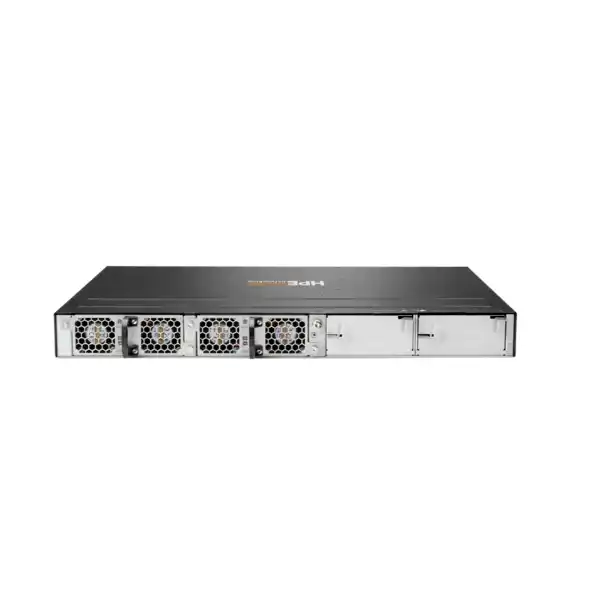
| Power supply | Internal fixed 200W power supply in current HPE QuickSpecs |
| Fans | Fixed fans |
| Dimensions | 44.2 × 32.7 × 4.39 cm (W × D × H) |
| Approximate weight | 4.46 kg |
| Mounting | EIA-standard 19-inch rack; 2-post rack kit documented as included |
| Operating system | AOS-CX |
Specification interpretation matters. HPE publishes both system-level and exact-model performance figures for the CX 6300 family. The buyer-facing values above use the JL667A model figures where available. Software features can depend on AOS-CX release, topology, feature-pack status and configuration, so a configuration review should accompany any advanced design.
Ports and connectivity: what to confirm before choosing optics or DACs
The access-side decision is straightforward: JL667A supplies forty-eight RJ-45 ports for 10/100/1000BASE-T Ethernet. These interfaces are useful where endpoint NICs and structured cabling are designed around standard copper Gigabit Ethernet. Because the model does not provide PoE, a connected device that needs electrical power over the network cable will require another power method. A desktop PC or printer normally has its own power supply, so non-PoE may be entirely appropriate. A Wi-Fi access point, VoIP handset, badge reader, camera or IoT gateway may be different. Before quantity is finalized, the endpoint schedule should be checked device by device rather than assuming every copper port has the same power requirement.
The four SFP56 ports deserve more detailed planning. HPE positions these interfaces as built-in high-speed uplinks that can operate at 1, 10 and 25GbE, with 50GbE connectivity using supported 50GbE direct-attach cables. A buyer should not simply order an arbitrary 50GbE optic because the cage name includes SFP56. HPE’s current documentation specifically calls out 50GbE DAC usage. For longer runs or fiber uplinks, the exact supported transceiver at the intended speed and distance must be selected from HPE compatibility information. The peer switch also has to support the same speed, physical media, breakout behavior if any, and link configuration.
Uplink capacity should be sized from traffic patterns, not just from the number of edge ports. Forty-eight 1GbE access ports do not automatically require forty-eight gigabits of sustained uplink throughput, because office endpoints rarely transmit at line rate simultaneously. On the other hand, environments with backups, imaging, virtual desktop workloads, large file transfers, surveillance streams, engineering datasets or dense east-west traffic can drive aggregation much harder than an ordinary office. A 10GbE uplink may be more than enough for some sites and a constraint for others. Dual 25GbE links or a different topology may be preferable when oversubscription must be lower or when growth is expected.
Uplink resiliency also changes the bill of materials. A design might use two physical links to separate upstream switches, multiple links inside an aggregation group, or ports reserved for VSF stacking. The same four cages cannot be independently promised to every function. If two are allocated to stacking and two to production uplinks, the remaining interface budget is different from a standalone switch using all four as uplinks. When multiple JL667A units form a stack, plan the VSF topology and bandwidth first, then calculate how many ports remain for northbound connections.
FourTeck can help translate the topology into a precise list of transceivers, DACs, patch leads and peer-port requirements. For a Dubai office where the distribution layer sits in the same cabinet, a short DAC may be attractive at supported speeds. For an inter-floor or inter-building fiber path, fiber type and distance become primary. For a multi-site standardized design, part-number consistency and spares strategy may matter more than the cost of a single optic. These are procurement decisions that should be solved before the purchase order, not after the switch is installed.
Performance and scale in practical terms
HPE lists a model switching capacity of 496 Gbps and a model throughput capacity of 369 Mpps for JL667A. These figures describe the forwarding capability of the switch and help show that the platform is designed to move traffic at enterprise access and aggregation scale. They should not be converted into an application-performance guarantee. User experience depends on the whole path: endpoint speed, VLAN and routing design, uplink congestion, upstream switching, firewalls, WAN capacity, server performance, wireless conditions, QoS policy and application behavior can all become the limiting factor.
The distinction between system and model figures is worth noting because HPE’s CX 6300 documentation also presents higher family-level system values. JL667A’s exact published model capacity is the safer number to use when planning this product. Procurement teams comparing specifications across vendors should make sure they are comparing equivalent values rather than one vendor’s family maximum with another vendor’s model-specific figure. The same principle applies to routing table limits, packet buffers and latency data: use the exact hardware and current software documentation for the specific deployment question.
For access-layer sizing, port density and uplink oversubscription often matter more than the headline switching number. A single JL667A gives forty-eight edge ports in one rack unit. Two switches offer ninety-six ports, but once availability requirements are added, the design may use a stack, dual upstream paths, redundant VLAN gateways or a different architecture. Capacity planning should therefore begin with users and devices, then map those requirements into ports, uplinks and failure domains. A simple count of current wall outlets may miss spare capacity for growth, staging ports, out-of-band devices or migration overlap.
The model also has 8 GB DDR4 memory and 32 GB eMMC storage in current HPE material, supporting the AOS-CX operating environment and associated management functions. Buyers do not normally size an enterprise switch by RAM in the same way they size a server, but the published hardware profile is still useful when validating the exact device and comparing related models. It reinforces that JL667A is an enterprise network platform rather than an unmanaged or lightly managed access switch.
VSF stacking: scale without treating ten switches as ten separate islands
HPE Aruba Networking Virtual Switching Framework, usually shortened to VSF, allows supported CX 6300 switches to operate as a coordinated stack. Current HPE information specifies up to ten members for the CX 6300F JL667A. The operational advantage is that multiple physical switches can be managed as a logical system for many day-to-day tasks, while links and VLANs can be distributed across members according to the design. For a building with several adjacent access switches, this can simplify management and provide a structured way to scale port density.
Stacking is not free capacity, however. The stack interconnect consumes high-speed ports and must be designed for the traffic that could cross between members. HPE documents up to 200 Gbps stacking bandwidth, or 400 Gbps full duplex. The physical stack topology, supported cables or transceivers, distance between members and software configuration all matter. HPE also notes that VSF stacking is not supported on the 1GbE ports, so the high-speed interfaces are part of the stacking plan. A rack with a single JL667A today and a second unit expected later should still be designed with enough uplink interfaces reserved for that future stack.
A ten-member maximum does not mean every network should build a ten-switch stack. Large stacks can simplify one aspect of operations while increasing the size of the logical failure and change domain. Network teams should decide how many access ports they want to group together, how maintenance will be performed, how upstream connectivity is distributed and what happens if a stack link or member fails. Sometimes two or four members are operationally cleaner than maximizing the platform limit. In other cases, a larger stack reduces the number of individually managed devices and simplifies edge expansion.
If uninterrupted operation during maintenance is a strict requirement, the design conversation should extend beyond the words “supports stacking.” Current CX 6300 family material also discusses in-service software upgrade orchestration under supported conditions and software releases. The exact behavior, version prerequisites and stack topology should be verified before a maintenance strategy is committed. FourTeck can help document the proposed member count, interconnect speed, cable type, uplink allocation and maintenance expectations so the hardware order reflects the operational design.
Layer 3 routing, segmentation and policy capabilities
The CX 6300 family is positioned as a stackable Layer 3 platform, and current HPE documentation identifies routing technologies including OSPF and BGP as well as VRF, EVPN and VXLAN support. For buyers, these features provide several architectural choices. A simple office may use static routing or a straightforward interior routing design. A larger campus can use OSPF to exchange routes dynamically. Organizations building distributed fabrics may use BGP EVPN with VXLAN where that architecture has been deliberately selected. VRF capability allows multiple routing domains to coexist on the same physical infrastructure, helping isolate traffic between business units, tenants, operational networks or other logical environments.
The existence of these features does not remove the need for design. Routing protocols require addressing plans, route policies, convergence goals and an understanding of how access switches interact with firewalls, WAN routers and core switches. EVPN-VXLAN requires even more deliberate architecture: underlays, overlays, VTEPs, route-targets, segmentation and control-plane behavior need to be planned across multiple devices. If the objective is simply to connect forty-eight office users to a core, deploying the most complex feature set available can add unnecessary operational overhead.
Dynamic Segmentation is another capability associated with the CX family and HPE Aruba Networking Central ecosystem. Its purpose is to apply consistent identity- and role-aware policy across wired and wireless access rather than relying only on static port-by-port VLAN configuration. This can be valuable where users and IoT devices move between connection points or where policy consistency matters more than physical switchport location. The practical deployment depends on authentication, user-role design, Central licensing and the wider Aruba architecture, so it should be discussed as a solution rather than assumed to be automatically active because a CX 6300 switch is present.
Security features likewise need dependency-aware interpretation. Current HPE material for the CX 6300 family references MACsec 256 support, and the AOS-CX software model separates native enterprise functionality from selected advanced feature-pack capabilities. The exact security policy, interface use, software release and subscription status should be confirmed for the intended feature. FourTeck can help distinguish the security capabilities already available in the base AOS-CX environment from optional functions that require a CX Advanced Feature Pack or HPE Aruba Networking Central Advanced subscription.
AOS-CX management, visibility and automation
AOS-CX is central to why enterprises shortlist the CX 6300 family. The operating system is designed around programmable, database-driven network operations and supports HPE’s Network Analytics Engine. NAE can monitor network state and provide data that helps operations teams investigate events and anomalies. For an organization replacing older switching platforms, the benefit is not simply a different command-line interface; it is the opportunity to standardize troubleshooting, telemetry and automation across a modern CX estate.
JL667A can be operated locally through normal switch-management methods, and HPE Aruba Networking Central can provide cloud-based management for supported deployments. Current HPE material describes Central capabilities including onboarding, configuration, monitoring, troubleshooting and reporting. Central may be useful when many switches are distributed across branches, offices or campuses and the organization wants a unified operational view. A local-only deployment may be preferable for an isolated environment or a site whose policy does not allow cloud management. The switch purchase should therefore be accompanied by a management decision: local AOS-CX operations, Central, another supported operational method, or a mixed approach.
Central subscription tiers affect available management and advanced capabilities. A Foundation subscription provides broad switch-management functions, while Central Advanced adds additional capabilities. HPE also states that a Central Advanced subscription for CX 6300 can enable the CX Advanced Feature Pack functionality, removing the need to buy that feature pack separately for the covered device. This is important for BOM accuracy. A team that already owns or plans Central Advanced may not need a duplicate advanced feature-pack subscription, while an organization running the switch without Central may buy the optional CX Advanced Feature Pack when its required features are in that pack.
Automation should also be approached as an operational program rather than a checkbox. Configuration templates, APIs and centralized tools can reduce repetitive changes, but they introduce the need for naming standards, role-based access, change control, backup and validation practices. A poorly defined automated configuration can propagate errors faster than a manual one. Organizations with multiple CX sites should create a standard baseline covering management IPs, NTP, DNS, AAA, syslog, SNMP or telemetry, VLANs, routing, security and firmware policy before mass deployment.
FourTeck can scope the management outcome during quotation. Useful questions include whether the switch will be standalone or part of an existing Central tenant, whether the customer already has HPE subscriptions, what AOS-CX release standard is used internally, whether zero-touch onboarding is desired, and who will own ongoing administration. Answering those questions early prevents a hardware-only quote from overlooking the operational components required after delivery.
Licensing and subscription requirements
The JL667A does not require a cloud subscription merely to exist as an AOS-CX Ethernet switch. HPE documents native enterprise features in AOS-CX and separately offers optional feature packs and Central subscriptions. This distinction is important for buyers who want to avoid two opposite mistakes: purchasing unnecessary software, or assuming an advanced feature is included when it actually depends on a subscription.
For the CX 6300 series running appropriate AOS-CX releases, HPE offers an optional CX Advanced Feature Pack on a term basis. HPE’s feature-pack documentation lists advanced functions for the 6300 family such as application-based policies, selected reflexive policy functions, MACsec extensions for WAN use and drop exceptions. The exact list can evolve with software versions, so it should be checked against the intended AOS-CX release at the time of purchase. If none of the required functions is in the advanced pack, there is no reason to add it simply because it exists.
HPE Aruba Networking Central is a separate management subscription path. A Central Foundation subscription provides core cloud management functions for supported switches. Central Advanced expands the management and security toolset. HPE states that for the CX 6300, a Central Advanced subscription automatically enables the CX Advanced Feature Pack capabilities, so a separate CX Advanced Feature Pack is not needed for that device under that licensing model. Procurement teams should therefore check existing subscription entitlements, intended management mode and subscription term before adding software SKUs to the purchase order.
Subscription term is another commercial variable. HPE publishes multiple term options for CX Advanced software and Central subscriptions. A one-year term may suit a temporary project or budget structure, while a longer term can align with an infrastructure lifecycle. There is no universal best term. Organizations should align switch software subscriptions with their hardware support strategy, expected refresh date, budgeting model and renewal process. If multiple switches form a VSF stack, feature-pack planning should also consider consistency across stack members where the advanced functionality is required.
FourTeck can review the feature requirement instead of treating licensing as a generic add-on. Provide the desired functions, current Central environment if any, number of switches and expected term. FourTeck can then identify what requires confirmation from HPE documentation and include the appropriate subscription line items in the quotation. This approach keeps the bill of materials tied to the intended operating outcome rather than to a broad list of optional software.
Compatibility and integration checks
Switch compatibility has several layers. The first is physical connectivity: copper cable category, fiber type, connector, transceiver, DAC length and peer-port speed must match. The second is protocol compatibility: VLAN tagging, LACP, spanning tree, routing protocols, multicast behavior, authentication and management integration must be designed consistently across vendors and platforms. The third is operational compatibility: monitoring systems, logging, automation, AAA, IP address management and security processes need to work with the chosen switch and software release.
For uplinks, the exact HPE-supported optic or cable should be confirmed. Using the words “SFP56” as a generic purchasing instruction is too vague. A four-meter 50GbE DAC for two devices in one rack is a different item from a 10GbE single-mode optic for an inter-building link. The upstream switch might have SFP+, SFP28, SFP56 or QSFP interfaces and may require a specific supported media combination. Link speed negotiation and transceiver support should be verified on both ends.
For endpoint integration, the main JL667A limitation is clear: its forty-eight copper access ports are 1GbE and do not provide PoE. If a new Wi-Fi deployment uses multigigabit access points, this model may be the wrong edge switch even if those APs can fall back to 1GbE, because the design may be leaving performance or power requirements unmet. If phones and cameras require PoE, external injectors would add complexity that a PoE switch could avoid. Conversely, paying for PoE hardware where every endpoint is separately powered can be unnecessary.
For stack integration, confirm which CX 6300 models will be combined and what AOS-CX versions are required. HPE’s current portfolio includes CX 6300F fixed models, CX 6300M modular-power models and CX 6300L Layer 2-oriented variants. Not every family member has identical stacking rules or capabilities. A mixed design should be validated against current HPE support documentation rather than assuming every product with “6300” in the name can be used interchangeably.
For security and identity integration, confirm RADIUS or TACACS+ services, 802.1X design, certificate requirements, user roles, Dynamic Segmentation architecture and firewall or NAC dependencies. A switch can provide the enforcement point for policy, but the surrounding identity and control systems determine how that policy is assigned. FourTeck’s pre-sales review can turn these dependencies into a checklist so the purchase includes the necessary hardware, subscriptions and services without implying that every advanced feature is automatically included.
Where JL667A fits in the CX 6300 family
The CX 6300 family contains several interface and power variants, which is why the exact part number matters. JL667A is the 48-port 1GbE non-PoE CX 6300F with four SFP56 interfaces. The closest fixed-port alternatives include JL668A, which provides 24 non-PoE 1GbE ports with four SFP56 interfaces, and JL665A, which provides 48 1GbE Class 4 PoE ports with four SFP56 interfaces. Those three models can appear similar in a catalog but solve different physical access requirements.
Choose JL667A over the 24-port JL668A when the site genuinely needs higher copper density in the same general switch class. If a wiring closet has only twelve to eighteen endpoints and modest growth, a 48-port switch may consume budget and power without creating meaningful operational value. If the closet already has forty endpoints and is expected to grow, selecting 24 ports could force another switch sooner than planned. The right density is therefore based on installed endpoints, near-term additions, spare-port policy and redundancy design.
Choose the PoE-capable JL665A or another PoE/Smart Rate model instead of JL667A when the access layer must power endpoints. The decision should consider both total PoE power and per-port power class. Standard IP phones may need relatively little power, while modern wireless access points and some IoT devices can require significantly more. For Wi-Fi 6E or Wi-Fi 7 projects, multigigabit Ethernet may also matter because a 1GbE copper port can become the bottleneck even if power delivery is adequate. HPE’s broader CX 6300 portfolio includes Smart Rate and higher-power PoE options for those scenarios.
CX 6300M models should be evaluated when the project needs modular power supplies, different airflow, Smart Rate interfaces or additional hardware flexibility. JL667A uses a fixed internal power supply and fixed fans. That is efficient for many campus closets, but a data center or high-availability design may specify field-replaceable, redundant power as a baseline requirement. A model with the same port count but a different power architecture can therefore be a better fit even if JL667A’s forwarding performance is otherwise sufficient.
CX 6300L models should not be treated as direct drop-in equivalents for every JL667A use case because HPE positions them differently and documents Layer 2-oriented capabilities and distinct stacking behavior. When a project uses advanced Layer 3 routing, EVPN-VXLAN or feature-pack functions, model-family distinctions need to be validated carefully. FourTeck can compare the exact requirement against the current HPE portfolio rather than selecting solely by number of ports.
Product-fit matrix
| Requirement | JL667A may be suitable when | Confirm before ordering |
|---|---|---|
| Copper access density | The site needs up to 48 standard 1GbE RJ-45 endpoints per switch. | Current port count, growth reserve and whether 24 or 48 ports is the better density. |
| Endpoint power | Connected endpoints have their own power or use another power method. | Any phones, APs, cameras or IoT devices that need PoE. |
| Uplink speed | 1/10/25GbE fiber or supported high-speed DAC connectivity meets the design. | Exact peer port, distance, transceiver/DAC and required number of uplinks. |
| Stacking | Multiple CX 6300 members should be managed as a VSF stack. | Member count, stack links, software version and high-speed port allocation. |
| Layer 3 services | The campus requires enterprise routing and segmentation capabilities. | Required protocols, topology, advanced-feature dependencies and design ownership. |
| Cloud management | HPE Aruba Networking Central is desired for unified management. | Foundation versus Advanced subscription, existing tenant and term. |
| Power redundancy | A fixed internal power supply aligns with the site’s risk model. | Whether redundant hot-swappable power is a mandatory design requirement. |
When another model should be evaluated
A different switch should be evaluated when the requirement departs from JL667A’s defining strengths: dense 1GbE copper, non-PoE access, fixed power and four high-speed uplink cages. The most common reason is PoE. If a closet powers dozens of phones, cameras or access points, external injectors would be operationally awkward and can complicate UPS sizing, cabling and troubleshooting. A CX 6300F PoE model or another appropriate PoE platform can integrate power delivery directly into the access layer.
Multigigabit access is another reason. Modern wireless access points can exceed 1GbE of aggregate traffic and may be designed for 2.5GbE, 5GbE or faster copper. JL667A’s 48 access ports are standard Gigabit Ethernet, so an HPE Smart Rate model should be reviewed if Wi-Fi edge performance is a core requirement. Buying a 48-port 1GbE switch for a new multigigabit wireless rollout can create a bottleneck that is difficult to justify over the life of the infrastructure.
Power and fan serviceability may also drive the decision toward CX 6300M or another platform. JL667A has a fixed internal power supply and fixed fans. Many enterprise access closets accept this design because redundancy is achieved at the switch or stack level, but some organizations require redundant field-replaceable power in every critical device. That requirement should be documented before procurement rather than discovered during technical approval.
A higher-capacity aggregation or core platform may be more suitable when the switch is expected to terminate many high-speed uplinks, provide 100GbE or faster connectivity, or serve as a heavily utilized network core. HPE positions the CX 6300 family for access, aggregation and selected top-of-rack use, but campus cores with large bandwidth, extensive redundancy or many high-speed links can justify a different series. Likewise, a very small site may not need forty-eight access ports; a 24-port model can reduce unused capacity while preserving similar operating concepts.
The useful procurement question is therefore not “Is CX 6300F good?” but “Does JL667A’s exact port, power and resiliency profile fit this specific location?” FourTeck can compare the answer against nearby CX models and document why the selected part is appropriate.
Deployment and installation considerations for UAE projects
The physical installation is straightforward but still needs planning. JL667A is a 1U switch measuring approximately 44.2 cm wide, 32.7 cm deep and 4.39 cm high, with an approximate weight of 4.46 kg. HPE documents mounting in a standard 19-inch rack and a two-post rack kit. The cabinet should provide adequate depth, front and rear access, cable-management space and ventilation. Power distribution should be checked against the exact regional power cord and PDU arrangement, particularly where a standardized rack design is used across multiple UAE sites.
Because the switch has fixed fans and a fixed internal power supply, airflow and maintenance access deserve attention. A crowded cabinet with poor ventilation can create thermal problems even when each device individually meets specification. Do not block ventilation with cable bundles or place the switch in an unconditioned area without checking environmental limits. In Dubai and the wider UAE, network closets can experience high ambient temperatures when building cooling is inadequate or interrupted. The room design, not only the switch specification, determines whether the environment remains within supported conditions.
Cabling should be prepared before cutover. Label copper patch panels and switch ports, identify trunk and uplink paths, confirm fiber polarity, and stage optics or DACs. If the switch replaces an older 48-port unit, port-by-port migration mapping can reduce downtime and configuration mistakes. The old configuration should not be copied blindly: VLAN numbering, spanning-tree roles, port-security settings, link aggregation, routing, authentication and management services should be reviewed for compatibility with AOS-CX and the target architecture.
Initial configuration normally includes management addressing, administrator authentication, DNS, NTP, logging, SNMP or other monitoring, VLANs, trunks, access ports, routing, security policy and software version validation. In a stack, member numbering and interconnects must be planned before production connections are moved. If HPE Aruba Networking Central is used, onboarding and group assignment should also be part of the deployment workflow. These tasks can be templated, but the template should reflect the customer’s standards rather than a generic configuration.
Testing should verify more than basic link lights. Confirm access VLAN placement, DHCP reachability, routing, DNS, authentication, upstream redundancy, LACP, failover behavior, monitoring, logging and any policy controls that are part of the project. Where a VSF stack is used, test member and link failure scenarios that the organization considers important. If change windows are limited, define success and rollback criteria in advance so the migration can be controlled.
FourTeck’s network installation and configuration services can be scoped separately from the hardware supply. A quotation should state whether the requirement is product-only, remote configuration, on-site installation, migration from an existing switch, stack build, optics installation, testing, documentation or post-change support. Keeping scope explicit avoids assuming that every hardware purchase automatically includes every service activity.
Practical use cases for JL667A
Corporate floor with separately powered endpoints
A corporate floor may have desktop PCs, printers, room systems and specialized appliances that receive power independently. If there are thirty-five to forty-five copper endpoints and the organization expects modest growth, JL667A offers enough port density to consolidate the floor in one switch while leaving high-speed interfaces for upstream connectivity. The non-PoE design avoids buying a large PoE budget that is not needed. The key checks are uplink redundancy, spare ports, whether any phones or APs actually require PoE, and how the switch integrates into the campus VLAN and routing design.
Server-room management and appliance connectivity
Many technical rooms still contain substantial numbers of 1GbE management ports, appliance interfaces, backup devices and infrastructure components. JL667A can aggregate those copper links and send traffic upstream over faster SFP56 ports. This use case should be separated from a high-performance server fabric: if the connected servers need 10/25/100GbE data interfaces, a different data-center switching platform may be appropriate. For management and lower-speed appliance networks, however, dense 1GbE can remain practical and cost-effective.
Campus access with routed edge
An organization redesigning a campus may move routing closer to the access layer to reduce large Layer 2 fault domains. Because the CX 6300 family supports enterprise Layer 3 features, JL667A can participate in that architecture where the port and power profile fits. The design should define gateway placement, routing protocol, route summarization, uplink addressing, multicast needs and failure behavior. If the project also uses EVPN-VXLAN, the overlay and licensing requirements should be documented separately.
Multi-floor deployment using VSF
Where several switches are installed in the same telecommunications room, VSF can reduce management overhead by presenting multiple members as a stack. The project can distribute user ports across members and use high-speed links for stack connectivity and upstream paths. Before deploying a large stack, the network team should decide how many members belong in one operational domain and how maintenance is handled. The maximum supported stack size is a capability, not a design target.
Standardized branch switching
A business with many medium-to-large branches may standardize on a common CX 6300 operating model while choosing 24-port, 48-port, PoE and non-PoE variants by site. JL667A can serve branches where copper density is high but endpoint power is not required. Standardization can simplify spares, configuration templates, training and monitoring, but the BOM should still be site-specific because port counts, uplinks, optics and subscriptions vary.
Buyer questions to answer before ordering
Does JL667A provide PoE?
No. JL667A is the 48-port non-PoE CX 6300F model. If connected phones, cameras, access points or IoT devices need power from the switch, evaluate a PoE-capable model and calculate both total PoE budget and per-port power requirements.
Are the four SFP56 ports automatically 50GbE fiber ports?
No. The interfaces support multiple speeds, and HPE specifically documents 50GbE capability for supported direct-attach cables. The exact 1/10/25/50GbE media combination must be checked against current HPE transceiver and cable support. For fiber, confirm the required distance, optic and peer interface instead of assuming any SFP56 optic will work.
Can JL667A be stacked?
Yes. HPE documents VSF stacking for the CX 6300F and up to ten members for JL667A. Stack links use supported high-speed interfaces, and 1GbE ports are not used for VSF stacking. Member count, interconnect media, software versions and uplink allocation should be planned before ordering.
Is HPE Aruba Networking Central mandatory?
No. The switch runs AOS-CX and can be operated without a Central subscription. Central is an optional management platform that may be selected for unified cloud-based operations. If Central is used, choose the subscription tier and term based on required capabilities.
Do advanced AOS-CX features require a license?
Some do. HPE separates native enterprise features from an optional CX Advanced Feature Pack on the 6300 series. A Central Advanced subscription can enable the advanced feature-pack capabilities without a separate CX Advanced Feature Pack for the covered CX 6300 device. The required feature set should be mapped to current licensing documentation.
Can JL667A be used in a data center?
HPE positions the broader CX 6300 family for access, aggregation and selected top-of-rack use. JL667A can fit environments with many 1GbE copper interfaces, but data-center buyers should confirm airflow, power redundancy, server-port speed and high-speed uplink requirements. A CX 6300M or a dedicated data-center switch may fit better when those requirements are more demanding.
What is the most important sizing input?
Start with the endpoint schedule: quantity, speed and power requirement per device. Then calculate uplink traffic, redundancy, stack member count and growth reserve. A port-count-only estimate can select the wrong switch if PoE, multigigabit access or uplink speed is overlooked.
What information improves quotation accuracy?
Provide quantity, desired delivery location, uplink speeds and distances, peer-switch models, optic or DAC preference, stacking plan, Central or advanced feature requirements, installation scope and any support expectations. This enables a quote that includes the required accessories and software rather than just the base chassis.
Procurement checklist for the CX 6300F 48-port JL667A
Operational planning after the purchase
A production switch should enter service with a lifecycle plan, not merely an initial configuration. Define who owns AOS-CX software updates, how new releases are evaluated, where configuration backups are stored and what maintenance window is available. If the switch participates in a VSF stack, the upgrade method and version compatibility should be part of the runbook. HPE’s software capabilities continue to evolve, so an organization that never reviews software may miss fixes, security updates and new supported functions.
Monitoring should include switch health, interface errors, utilization, link changes, CPU and memory trends, environmental alerts and important routing or stacking events. HPE’s Network Analytics Engine can provide additional visibility on supported AOS-CX deployments, while Central can consolidate monitoring across many sites when subscribed. The monitoring system should be configured before handover so a failed uplink, optic problem or growing error counter is visible to the operations team rather than discovered from user complaints.
Configuration control is equally important. Standardize VLAN naming, interface descriptions, AAA, NTP, DNS, syslog, management ACLs and backup procedures. For multi-site estates, use repeatable templates but preserve site-specific values such as management addresses, uplinks and local VLANs. Changes should be reviewed and validated because switch misconfiguration can affect an entire floor or branch in seconds.
Spares strategy depends on business criticality. A small office may accept vendor replacement lead time, while a 24-hour facility may keep a compatible spare switch, transceivers and DACs on hand. If JL667A becomes part of a standardized estate, keeping one spare can be more efficient than holding different replacements for each site. The correct policy depends on support contract, business impact, shipping lead time and whether alternate ports or switches can temporarily carry the load.
Finally, document the physical and logical topology. Record rack location, serial number, management IP, uplink ports, cable IDs, stack member information, VLANs, routing neighbors, software release, subscriptions and support details. Good documentation shortens troubleshooting and makes future migration less dependent on individual staff knowledge.
FourTeck assistance for model selection, quotation and configuration
FourTeck can help turn an initial request for “a 48-port Aruba switch” into an exact bill of materials. That normally starts by confirming whether JL667A’s non-PoE 1GbE access profile is correct. The next step is to define uplinks, stacking and management. From there, optics or DACs, software subscriptions, support items and service scope can be added only where they are required.
For an existing network, provide the current switch model, upstream switch model, endpoint types and a simple topology. FourTeck can help identify whether the new switch is a like-for-like replacement, a capacity expansion or part of a wider redesign. For a new site, provide the number of users and devices, Wi-Fi design, phone and camera requirements, cabling, rack and WAN/core connection. These inputs make it easier to determine whether JL667A should remain the preferred model or whether a PoE or Smart Rate alternative better matches the project.
Configuration assistance can be scoped around the intended outcome: initial switch setup, VLANs, Layer 3 routing, uplink aggregation, VSF stacking, authentication, management integration, Central onboarding, migration and testing. Advanced features such as EVPN-VXLAN or identity-driven segmentation should be treated as architecture work with clearly defined dependencies rather than bundled into a generic “configuration” line.
Visit FourTeck contact to request a quotation or discuss the network requirement. For broader product browsing, see the FourTeck product catalogue. Current availability, accessories, license terms and delivery planning should be confirmed for the exact order and UAE project location.
UAE availability and quotation guidance
Contact FourTeck to confirm current UAE availability for HPE Aruba Networking CX 6300F JL667A. Availability can vary with quantity, regional supply, vendor lead time, requested transceivers, software subscriptions and project schedule. Delivery and installation dates should be coordinated only after the exact bill of materials is accepted. FourTeck can prepare a Dubai or UAE quotation that separates the base switch, optics or DACs, software, support and optional installation/configuration services so procurement teams can see which components are hardware requirements and which are project-dependent additions.
Related options worth comparing
CX 6300F JL668A
A 24-port 1GbE non-PoE option with four SFP56 interfaces. Compare it when the site needs fewer copper endpoints and a 48-port chassis would leave excessive unused capacity.
CX 6300F JL665A
A 48-port 1GbE Class 4 PoE model with four SFP56 interfaces. It is more appropriate when many endpoints require power from the access switch.
CX 6300M variants
Evaluate modular-power CX 6300M models when redundant or field-replaceable power, Smart Rate access or a different hardware profile is a design requirement.
Central subscriptions and CX Advanced
Software should be selected only after the management and advanced-feature requirement is clear. Existing Central Advanced entitlement can affect whether a separate CX Advanced Feature Pack is needed.
Frequently asked questions
What is the exact HPE part number for this 48-port non-PoE CX 6300F?
The exact part number is JL667A. HPE names it the HPE Aruba Networking CX 6300F 48-port 1GbE and 4-port SFP56 Switch. Buyers should use JL667A in quotations to avoid confusion with the JL665A PoE model or other 48-port CX 6300 variants.
How many copper Ethernet ports does JL667A have?
JL667A has forty-eight 10/100/1000BASE-T RJ-45 ports. They provide standard Gigabit Ethernet access and do not provide PoE. If the design needs multigigabit copper or switch-delivered power, compare another CX model.
What speeds are available on the four uplink ports?
HPE documents the four SFP56 interfaces for 1/10/25GbE and supported 50GbE connectivity using DACs. The exact optic or cable must match the intended speed, link distance and peer switch. Do not assume that every 50GbE transceiver is supported.
What are the JL667A switching capacity and throughput?
HPE lists a model switching capacity of 496 Gbps and model throughput capacity of 369 Mpps for JL667A. Actual application performance still depends on network architecture, uplinks, traffic patterns and other devices in the path.
How many CX 6300F switches can be placed in one VSF stack?
HPE documents up to ten members for the CX 6300 VSF stack. The optimal number may be lower depending on operational practice, failure-domain size, uplink design and maintenance strategy. Stack links and supported media must be planned before ordering.
Does JL667A have redundant power supplies?
No. Current HPE QuickSpecs list an internal fixed 200W power supply and fixed fans for JL667A. If device-level power redundancy or field-replaceable power is mandatory, evaluate a CX 6300M or another platform with the required power architecture.
Can the switch be managed through HPE Aruba Networking Central?
Yes. HPE supports CX 6300 management through HPE Aruba Networking Central. The appropriate Central subscription tier and term should be selected according to the desired management, security and advanced capabilities. Central is not required simply to operate AOS-CX locally.
Is a CX Advanced Feature Pack always required?
No. HPE provides many native enterprise features in AOS-CX and offers the CX Advanced Feature Pack for selected advanced functions. A Central Advanced subscription can enable the advanced feature-pack capabilities for a covered CX 6300, so licensing should be based on the required feature set and management model.
Decision recap for the JL667A
What FourTeck needs to prepare an accurate quote
A useful quotation is more than one switch part number. Send the main deployment inputs below and the hardware, media, licensing and service scope can be aligned to the actual requirement.
Endpoint types
PoE requirement: yes/no
Uplink speed and distance
Peer switch model
VSF member count
Central subscription status
Advanced feature needs
Rack and power details
Dubai/UAE project location
Installation or migration scope
Confirm the right CX 6300F configuration before you order
FourTeck can help confirm whether JL667A is the correct 48-port switch for your deployment, identify the required uplink media, review VSF stacking and separate native AOS-CX capability from optional subscriptions. Share the endpoint count, uplink design and project location so the quotation can include the correct switch, accessories and service scope without assuming PoE, optics, software or installation that may not be needed.

Reviews
There are no reviews yet.