
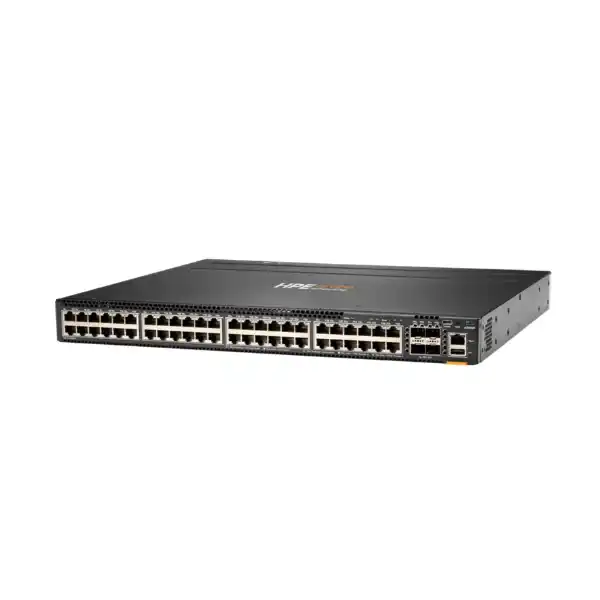
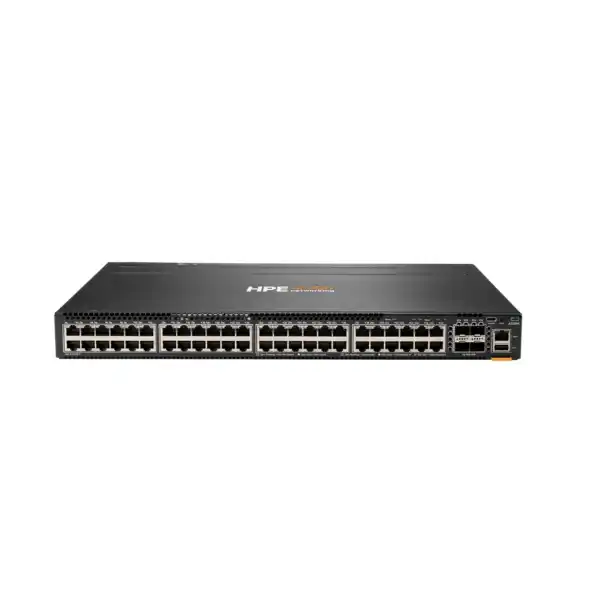
HPE Aruba Networking CX 6300M 48-Port SFP Switch S4P43A
The HPE Aruba Networking CX 6300M 48-Port SFP Switch is the fibre-focused S4P43A model in the CX 6300M family. It is intended for organisations that need a large number of 1GbE optical access ports while retaining faster 25GbE and 50GbE options for aggregation, stacking or upstream connectivity. Unlike the copper and PoE versions in the CX 6300 range, S4P43A is a non-PoE switch built around 48 SFP access interfaces. That distinction matters when a project is connecting fibre-fed endpoints, remote distribution points, industrial links, campus buildings or other network devices that do not require power delivery from the switch.
For buyers in Dubai and the wider UAE, this model is particularly relevant where an existing network already uses significant amounts of 1GbE fibre and the design needs a managed Layer 3 platform that can be integrated with modern HPE Aruba Networking operations. The switch provides 48 x 1G SFP ports, two SFP28 interfaces supporting 10/25GbE and two SFP56 interfaces supporting 10/25/50GbE. The two SFP28 ports provide MACsec capability, while the higher-speed SFP56 pair can be used where 50GbE connectivity is required. Optical modules are not something to select generically: fibre type, connector, reach, speed and HPE compatibility should all be matched to the actual links in the project.
Exact Model Position: Why S4P43A Matters
The CX 6300M name covers several substantially different port layouts. S4P43A is the 48-port SFP model, not the 48-port copper 1GbE JL663A, not the 48-port PoE JL661A, and not the 24-port SFP+ JL658A. This makes the product number an important part of procurement. A quotation that states only “CX 6300M 48-port switch” can be ambiguous because the family includes copper, Smart Rate, PoE and fibre-oriented variants with different power, interface and transceiver requirements.
S4P43A is best understood as a fibre-density model: forty-eight 1GbE SFP access ports form the main interface block, with four additional high-speed SFP-family interfaces split between two SFP28 and two SFP56 ports. If the application requires forty-eight 10GbE access ports rather than forty-eight 1GbE SFP ports, this is not the correct interpretation of the product. Buyers should separate access-port speed requirements from uplink-speed requirements at the design stage to avoid ordering a switch that has the right connector family but the wrong supported speed profile.
Key Technical Specifications
| Product | HPE Aruba Networking CX 6300M 48p SFP 1G 2p SFP56 50G 2p SFP28 25G MACsec Switch |
|---|---|
| Manufacturer Product Number | S4P43A |
| Primary Access Ports | 48 x 1G SFP |
| High-Speed Ports | 2 x 10/25G SFP28 and 2 x 10/25/50G SFP56 |
| MACsec | Available on the two SFP28 high-speed ports |
| PoE | Non-PoE |
| Switching Capacity | 396 Gbps |
| Throughput | 295 Mpps |
| Latency | Approximately 3.4 microseconds at 1Gbps and 2.1 microseconds at 50Gbps, according to HPE product specifications |
| Stacking | Up to 10 CX 6300 members per stack |
| Processor | Dual-core Arm Cortex-A9 at 1.8GHz |
| Memory | 8GB DDR4 and 32GB eMMC |
| Management Ports | 1 x USB-C console, 1 x USB Type-A host, 1 x OOBM |
| Power Supply | Two field-replaceable, hot-swappable PSU slots; at least one supported PSU is required and ordered separately |
| Supported PSU Options | JL085A AC PSU and JL757A DC PSU, subject to final configuration requirements |
| Operating Temperature | 0°C to 45°C up to the altitude conditions stated by HPE; environmental derating applies at higher altitude |
Fibre-Dense Access and Aggregation
The main reason to select S4P43A is its concentration of 1GbE SFP interfaces. In campus and multi-building networks, fibre may already be the preferred medium because of distance, electrical isolation or the need to connect separate wiring locations. A copper access switch would introduce unnecessary media conversion in these designs. With 48 optical access ports in one unit, the CX 6300M can consolidate many fibre links while keeping four higher-speed interfaces available for upstream connectivity or network architecture requirements.
The high-speed port mix also gives the switch a clear role in network evolution. Two SFP28 ports can operate at 10GbE or 25GbE, while two SFP56 ports can operate at 10GbE, 25GbE or 50GbE. This means the upstream design does not have to remain fixed at 10GbE when the aggregation layer is capable of higher speeds. The useful outcome is not simply “faster uplinks”; it is the ability to match uplink capacity more closely to the number of active fibre access links, oversubscription targets and resilience strategy.
AOS-CX and Layer 3 Network Functions
The CX 6300 family runs the AOS-CX operating system and is positioned by HPE as a stackable Layer 3 switching platform. The current CX 6300 family supports routing and data-centre-oriented capabilities including OSPF, BGP, VRF, EVPN and VXLAN, together with quality-of-service and automation functions. These features allow the platform to serve beyond basic Layer 2 access where the project requires routed access, network segmentation, resilient distribution or integration with a more advanced fabric design.
The practical value of those functions depends on the intended architecture. A branch or campus access deployment may use only a subset of the routing feature set, while an aggregation or top-of-rack design can place much greater emphasis on VRFs, routing protocols or overlay technologies. Feature availability should therefore be assessed against the AOS-CX software version and the exact operational design rather than treating the presence of an enterprise feature name as proof that every deployment requirement is automatically satisfied.
Management Options
HPE lists HPE Aruba Networking Central, the switch Web GUI, CLI and HPE Aruba Networking Switch Multi-Edit among the management options for this platform. This gives organisations flexibility between local administration and broader centralised operations. The out-of-band management interface is useful when management traffic needs to be separated from production forwarding paths, while the USB-C console connection supports local commissioning and recovery workflows.
For environments already standardised on HPE Aruba Networking Central, bringing the CX 6300M into the same management framework can reduce the operational divide between wired and wireless infrastructure. However, management platform subscription, licensing, onboarding method and feature entitlement should be checked as part of the project scope. Hardware capability and cloud-management entitlement are separate procurement decisions.
Stacking and Resilience Considerations
S4P43A can participate in a CX 6300 stack of up to 10 members. Stacking is valuable when multiple physical switches need to be operated as a more unified logical system, but the design should account for the high-speed interfaces consumed by the chosen stacking topology and the bandwidth required between members. A switch with four high-speed ports offers flexibility, yet those ports may also be needed for uplinks, so the final port plan must allocate them deliberately.
Power resilience is another separate design choice. The chassis provides two field-replaceable, hot-swappable power-supply slots and requires at least one supported PSU. A second PSU can be evaluated where the availability requirement justifies redundant power. The correct PSU also depends on whether the site is designed around AC or supported DC input. Since power supplies are selected separately, the base switch should not be treated as a complete power configuration by itself.
Power Consumption and Thermal Planning
HPE publishes different power-consumption figures depending on the selected PSU. With the JL085A AC PSU, HPE lists approximately 67W at idle and 127W at 100% traffic rate. With the JL757A DC PSU, the corresponding published values are approximately 61W and 123W. These figures are useful for rack power planning, UPS sizing and heat-load estimates, but actual site consumption can vary with configuration and operating conditions.
The published operating temperature is 0°C to 45°C under the stated altitude conditions, with derating at higher elevation and support for short temperature excursions under HPE-defined conditions. In Dubai deployments, the critical issue is the temperature inside the equipment space rather than the outdoor climate. Data rooms, telecom cabinets and edge enclosures need sufficient cooling and airflow to maintain the switch within its supported operating environment.
Transceiver Selection Is Part of the Purchase
A 48-port SFP switch is only useful when the optical modules match the physical network. For each link, the design should identify whether the fibre is single-mode or multimode, the required distance, connector arrangement, target speed and the HPE-supported transceiver family. Existing optics should not be assumed compatible merely because they fit the SFP form factor. Support can depend on transceiver type, generation, software release and the exact port involved.
The high-speed interfaces deserve particular attention because the two SFP28 and two SFP56 ports do not have identical maximum capabilities. The SFP56 pair supports up to 50GbE, while the SFP28 pair supports up to 25GbE and is the pair identified with MACsec. This difference can influence where encrypted inter-switch links, uplinks or stacking connections should be placed. A port map prepared before ordering is far safer than selecting optics after the switch has already arrived.
MACsec on the High-Speed SFP28 Ports
The S4P43A specification identifies MACsec on the two 10/25G SFP28 ports. MACsec can be relevant where Layer 2 link encryption is required between compatible network devices, for example across selected building interconnects or trusted-but-exposed transport paths. It should not be treated as a blanket statement that all 48 access ports provide the same MACsec behaviour. Projects that depend on encrypted links should map the security requirement to the specific port capabilities and validate peer compatibility.
Suitable Deployment Scenarios
Fibre aggregation in a campus: The 48 x 1G SFP layout is suitable when many remote closets, buildings or network devices terminate on 1GbE fibre and need to be consolidated into a Layer 3 switch with faster uplinks.
High-density optical access: Organisations with fibre-to-desk, industrial, transport, security or specialised endpoint requirements can use the large SFP count without paying for PoE circuitry that the endpoints do not use.
Migration from older 1GbE fibre switches: The platform can replace ageing fibre access hardware while introducing modern AOS-CX operations and providing 25/50GbE headroom on the uplink side. The existing transceiver estate still needs a compatibility check.
Selected top-of-rack or infrastructure connectivity: HPE positions the CX 6300 family for access, aggregation and selected top-of-rack use. S4P43A makes the most sense in that role when 1GbE SFP density is the real requirement. A server environment dominated by 10/25GbE downlinks may be better served by a switch designed around those access speeds.
When Another CX 6300 Model May Be Better
S4P43A is not automatically the best CX 6300M simply because it has 48 ports. If the endpoints use RJ-45 copper, a copper CX 6300 variant avoids unnecessary optical conversion. If access points, cameras, phones or other devices need power from the switch, a PoE or Smart Rate PoE model should be evaluated instead. If the project needs 10GbE across a large number of fibre access ports, the 48 x 1G SFP layout is a limiting factor and a different interface architecture should be selected.
The 24-port SFP-oriented CX 6300M can also make more sense where the fibre count is lower and rack density is less important. Conversely, a design that expects rapid growth beyond forty-eight 1GbE fibre links should compare the cost and operational implications of stacking multiple CX 6300 units against moving to a chassis or higher-capacity aggregation platform. The right choice depends on the actual port matrix, not only the family name.
What to Confirm Before Ordering in Dubai
- Confirm that the required model is S4P43A and that 48 x 1G SFP access ports match the design.
- List the required 1G optical transceivers by fibre type, distance and connector.
- Define which high-speed links require 10GbE, 25GbE or 50GbE.
- Identify whether MACsec is required and map those links to the appropriate SFP28 interfaces.
- Decide whether the switch will operate standalone or as part of a CX 6300 stack.
- Reserve high-speed ports for stacking and upstream links before calculating available uplink capacity.
- Select at least one supported power supply and determine whether redundant power is required.
- Confirm AC versus supported DC power requirements and the available rack power infrastructure.
- Check transceiver support against the intended AOS-CX software release.
- Confirm the management approach, including any HPE Aruba Networking Central subscription or entitlement required by the organisation.
- Validate rack depth, airflow, ambient temperature and UPS capacity for the installation site.
Information Needed for an Accurate FourTeck Quotation
For a useful quotation, provide the switch quantity, required SFP/SFP28/SFP56 optics, fibre type and approximate link distances, desired uplink speeds, stacking requirement, power-supply redundancy requirement and whether HPE Aruba Networking Central licensing or support services are part of the project. If the switch is replacing an existing fibre platform, sharing the current switch model and transceiver part numbers can help identify migration and compatibility issues before hardware is ordered.
Where the network design is still being finalised, a simple port schedule is usually enough to expose the important decisions: number of 1GbE fibre links, number and speed of uplinks, stacking topology, optical reach and power architecture. This avoids quoting a technically correct base switch with missing optics, insufficient high-speed ports or an incomplete power configuration.
Why the CX 6300M 48-Port SFP Model Fits Specific Networks
The strongest case for S4P43A is a network that genuinely needs many 1GbE fibre interfaces in a modern, stackable Layer 3 platform. Its value comes from the combination of 48 optical access ports, 25/50GbE high-speed connectivity, MACsec on the designated SFP28 ports, AOS-CX operations and the option to build a larger CX 6300 stack. Those characteristics make it different from the more common copper and PoE access-switch configurations.
It is equally important to recognise its boundaries. The switch does not provide PoE, its forty-eight primary SFP ports are 1GbE rather than 10GbE, and the base hardware still requires separately selected power and optical components. When those conditions match the deployment, S4P43A can be a precise fit. When they do not, choosing another model early is preferable to compensating later with media converters, unnecessary optics or an avoidable redesign.

Reviews
There are no reviews yet.