
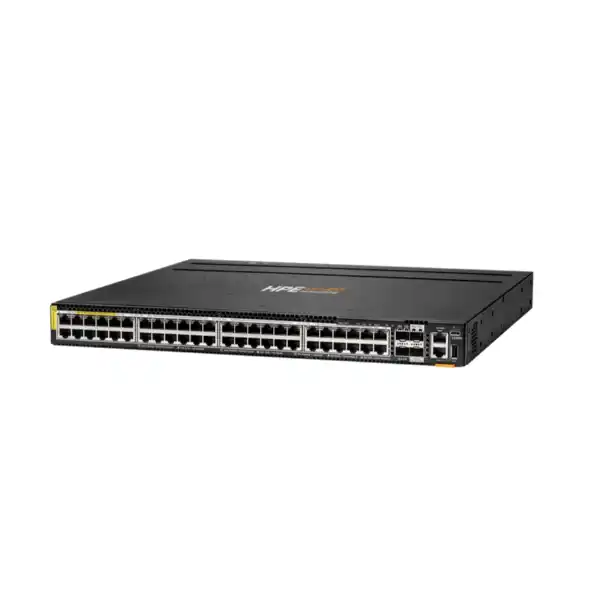
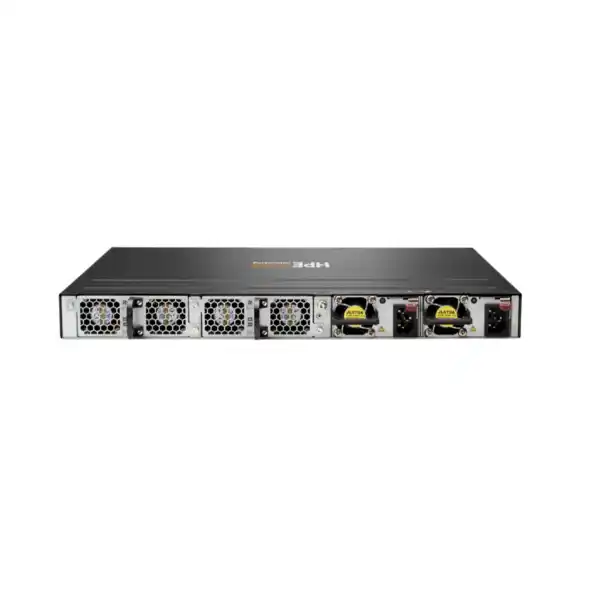
HPE Aruba Networking CX 6300M 48-Port Smart Rate PoE Switch JL659A
The HPE Aruba Networking CX 6300M 48-Port Smart Rate PoE Switch, part number JL659A, is designed for enterprise networks that need more from the access layer than conventional 1GbE switching. Its 48 HPE Smart Rate copper ports support 1, 2.5 and 5GbE operation and are paired with Class 6 PoE capability, while four SFP56 ports provide high-speed connectivity for uplinks, stacking or aggregation designs. This combination makes the switch particularly relevant for Wi-Fi access layers, high-density office environments, connected buildings and branch or campus networks where endpoint bandwidth and power requirements are increasing.
The important purchasing distinction is that JL659A is not simply a 48-port PoE switch. Its value is in the combination of multi-gigabit copper access, higher-power PoE capability, high-speed SFP56 interfaces and the software features of the HPE Aruba Networking CX 6300 platform. Buyers comparing it with a standard 1GbE access switch should therefore assess the actual speed capability of connected access points, workstations, cameras and other powered devices, rather than selecting purely by port count.
Key specifications buyers should know
| Manufacturer | HPE Aruba Networking |
|---|---|
| Series | CX 6300M |
| Part number | JL659A |
| Access ports | 48 HPE Smart Rate 1/2.5/5GbE copper ports |
| PoE class | Class 6 PoE |
| High-speed ports | 4 SFP56 ports |
| Switch family type | Stackable enterprise Layer 3 switching platform |
| Management | AOS-CX platform with support for HPE Aruba Networking Central |
Why Smart Rate matters at the access layer
Many organizations still have structured cabling that was originally installed for Gigabit Ethernet, yet modern wireless access points and selected endpoints can exceed 1Gbps of practical network demand. HPE Smart Rate allows the JL659A to negotiate 1GbE, 2.5GbE or 5GbE on its access interfaces, so an organization can increase edge bandwidth without automatically redesigning the entire campus around 10GbE copper.
This is especially useful when deploying newer wireless access points. A high-capacity AP may have an Ethernet interface faster than 1GbE, and connecting that AP to a conventional 1GbE switch can create an avoidable wired-side bottleneck. The CX 6300M JL659A gives the network designer a practical multi-gigabit access tier while retaining familiar RJ45-style copper connectivity.
Cabling remains a deployment dependency. The negotiated speed that can be used reliably depends on cable category, cable length, installation quality, patching and the capabilities of the attached device. A quotation should therefore distinguish between the switch capability and the speed that the existing cabling plant can actually support.
Class 6 PoE for demanding powered devices
JL659A combines its Smart Rate interfaces with Class 6 PoE. This is valuable where access points, cameras, collaboration endpoints, sensors or other network devices require more power than a basic PoE access layer can provide. The CX 6300 family supports multiple PoE power configurations, so total usable PoE capacity depends on the selected power-supply arrangement rather than on port count alone.
For procurement, the correct question is not only how many PoE devices will be connected, but how much power those devices can request at the same time. A design with 48 powered endpoints can have a very different requirement from a design with 48 high-performance wireless access points. Power-supply selection, redundancy objectives and expected PoE load should therefore be calculated together.
Where maximum resiliency is required, the design should also consider what happens to the available PoE budget after a power-supply failure. A configuration that can power all endpoints under normal conditions may need additional headroom if the requirement is to maintain those endpoints during a PSU fault.
Four SFP56 ports for uplinks and scalable designs
The four SFP56 ports are an important reason to select this CX 6300M model. HPE positions the CX 6300 platform with high-speed uplink and front-plane stacking options, enabling the access layer to connect upstream without forcing all traffic through low-capacity uplinks. Depending on the approved transceiver, cable and configuration, the CX 6300 family supports high-speed connections including 10, 25, 50 and 100GbE use cases.
Optics and direct-attach cables should be treated as separate design items. The correct choice depends on required speed, fiber type, distance, connector type and the interface on the device at the opposite end. Existing optics should not be assumed compatible simply because the physical form factor appears similar.
Layer 3 switching and modern campus architecture
The CX 6300 series is a Layer 3 switching family with capabilities that include OSPF, BGP, VRF, EVPN and VXLAN. These functions allow the platform to participate in routed campus designs, segmentation architectures and more advanced network fabrics rather than operating only as a Layer 2 edge device.
That breadth is useful, but it also means the switch should be selected as part of an architecture rather than as an isolated hardware purchase. A customer replacing a basic access switch may use only a subset of these functions initially, while an organization building a routed access or segmented campus can make much broader use of the platform. Feature licensing, software release and management design should be checked against the intended configuration.
VSF stacking and VSX high availability
HPE supports Virtual Switching Framework on the CX 6300 series for multi-member stacking, allowing a group of switches to be operated as a coordinated logical system. HPE also supports two-member Virtual Switching Extension designs for active-active resiliency. These are different architectural approaches and should not be treated as features that are used simultaneously on the same switch.
VSF can be attractive for access-layer scale and simplified operations, while VSX can be appropriate where an active-active pair with independent control planes is required. The better design depends on fault-domain requirements, maintenance practices, uplink topology, desired scale and how the rest of the network is built.
AOS-CX operations, analytics and centralized management
The CX 6300 platform runs HPE Aruba Networking AOS-CX and includes operational capabilities such as the CX Network Analytics Engine. The platform can collect and analyze network state to improve visibility into events that affect network health. For larger environments, HPE Aruba Networking Central provides centralized management across wired, wireless and WAN infrastructure.
Organizations considering Central should define whether the requirement is local switch management, cloud-based centralized operations, unified policy management or a broader HPE Aruba Networking architecture. The required subscription and feature entitlement should be confirmed for the intended management model instead of assuming every cloud capability is automatically included with the hardware.
Security and segmentation capabilities
The CX 6300 family includes enterprise security features such as MACsec 256 and supports dynamic segmentation approaches that can apply role-aware policy across wired and wireless networks. HPE also lists device profiling, role-based access control and application-aware functions within the broader CX platform feature set.
Some advanced functions can depend on software packages, licensing or surrounding HPE Aruba Networking infrastructure. Buyers planning segmentation, policy enforcement or application visibility should identify those objectives during design so that the switch, software entitlement and management platform are quoted as one solution.
Where the JL659A fits well
- Enterprise Wi-Fi access layers where access points can use 2.5GbE or 5GbE wired connectivity.
- Campus networks needing 48 multi-gigabit PoE access ports in a single switch.
- Office or education environments with a mix of high-bandwidth powered endpoints.
- IoT and connected-building deployments where PoE capacity and policy control are important.
- Access networks that require high-speed SFP56 uplinks rather than basic 1GbE or 10GbE uplinks.
- Organizations standardizing on HPE Aruba Networking AOS-CX and Aruba Central operations.
- Designs that may use VSF stacking or a two-switch VSX high-availability architecture.
When another switch may be a better fit
JL659A may be more capable than necessary for sites where every endpoint is limited to 1GbE and PoE demand is modest. In those cases, a CX 6300 model with standard 1GbE access ports, or another lower-cost access platform, may meet the requirement without paying for multi-gigabit capability that will not be used.
At the other end of the scale, projects requiring 10GbE copper on a large number of access ports, substantially different interface mixes, chassis-based modularity or a different redundancy model should be evaluated against higher-capacity or differently configured HPE Aruba Networking platforms. The correct choice depends on endpoint speed, uplink design, growth horizon and the role of the switch in the overall network.
What to confirm before ordering in Dubai
A reliable quotation for the HPE Aruba Networking CX 6300M JL659A should include more than the switch part number. The bill of materials should be based on the complete deployment requirement.
- Endpoint count: number of active copper ports required now and expected growth.
- Endpoint speed: which devices require 2.5GbE or 5GbE rather than 1GbE.
- PoE requirement: maximum power demand for each powered endpoint and total simultaneous PoE load.
- Power supplies: required PSU capacity and whether power redundancy is mandatory.
- Uplink speed: required 10/25/50/100GbE connectivity and upstream switch compatibility.
- Optics and cabling: fiber type, link distance, connector requirements, DAC/AOC use and approved transceiver selection.
- Stacking or resiliency: standalone switch, VSF stack or VSX pair.
- Management: local management versus HPE Aruba Networking Central and any required subscriptions.
- Software features: routing, segmentation, analytics and advanced feature requirements.
- Rack and power environment: rack space, airflow, power feeds and UPS capacity.
Procurement guidance for Wi-Fi upgrade projects
When the switch is being purchased as part of a wireless upgrade, the access-point model should be reviewed at the same time. The AP determines the practical Ethernet speed, PoE class and sometimes redundancy requirements that the switch must support. Buying a multi-gigabit PoE switch without checking the AP specification can lead either to unnecessary cost or to an underpowered design.
The same applies to the uplink. Forty-eight high-performance access ports can aggregate substantial traffic, so upstream bandwidth should be selected according to expected concurrency and application load rather than simply reusing an existing low-speed uplink. The four SFP56 interfaces give the design room to scale, but the final architecture should be sized to the actual traffic profile.
HPE Aruba Networking CX 6300M JL659A supply in Dubai
FourTeck can prepare a Dubai quotation for the HPE Aruba Networking CX 6300M JL659A with the supporting components required for a complete deployment. For an accurate bill of materials, provide the quantity of switches, connected device types, required PoE load, uplink speed and distance, preferred fiber or DAC connectivity, redundancy requirement and whether Aruba Central management is required.
This approach helps ensure that power supplies, optics, cables, management subscriptions and resiliency components are selected around the actual network rather than added after the switch has already been ordered.

Reviews
There are no reviews yet.