
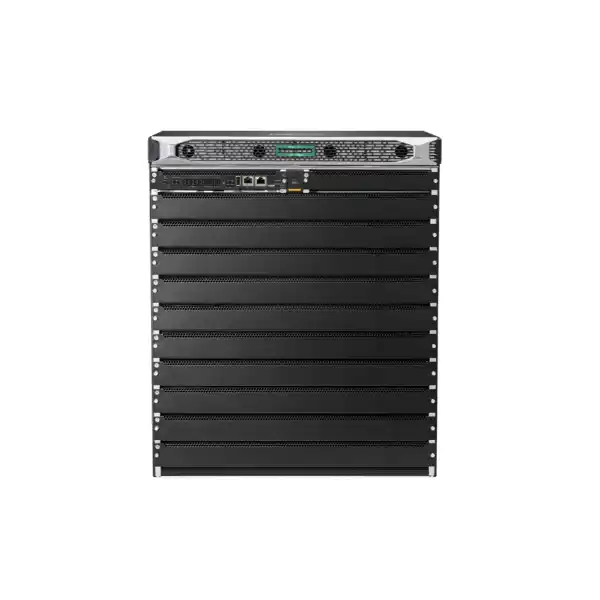
HPE Aruba Networking CX 6410 in Dubai
A 10-slot enterprise switching chassis for organizations that need scalable copper, multi-gigabit and high-speed fibre connectivity in a single resilient platform. The CX 6410 is built for demanding campus networks and can also serve aggregation or selected data-center roles when its interface mix and routing scale match the design.
Direct answer for buyers
Why the CX 6410 is a different buying decision
The CX 6410 is not a switch that should be quoted by chassis name alone. Its value comes from being a modular system. The chassis provides the fabric, management framework, fan locations and module bays, but the usable port mix depends on the line modules selected. Two CX 6410 deployments can therefore be technically very different even though the front label is the same.
This matters in Dubai projects because access-layer demand often mixes ordinary 1GbE user ports, higher-power wireless access points, multi-gigabit endpoints, fibre uplinks and building-to-building links. A modular chassis can consolidate those requirements, but only when the port plan is deliberate. Ordering too many high-cost modules wastes budget; ordering the wrong mix may force external switches or redesign later.
Current model identity matters
HPE currently lists the HPE Aruba Networking CX 6410 v2 as product number R0X27C. It includes the R0X25C v2 chassis, one R0X31A management module and four R0X32A fan trays, with ten open line-module slots. Power supplies are not included in the base switch and must be selected separately.
Earlier CX 6410 hardware such as R0X27A also exists in documentation and installed networks. For expansion of an existing chassis, the exact hardware revision and current compatibility matrix should be checked rather than assuming every newer line card is valid. For a new project, the quotation should identify the precise manufacturer SKU so the buyer knows whether the proposal is for v2 hardware or another revision.
CX 6410 technical profile
| Area | CX 6410 buyer-relevant detail | Why it matters |
|---|---|---|
| Chassis | 10 line-module slots on CX 6410 v2; 12U rack height | Allows high port density and mixed interface types, but requires meaningful rack-space planning. |
| Switching capacity | 28 Tbps system switching capacity | Provides substantial chassis fabric headroom for dense access, aggregation and core designs. |
| High-speed interfaces | Line-card choices cover 1GbE, 10GbE, 25GbE, 40GbE and 100GbE, with 50G capability in supported contexts | The chassis can combine edge connectivity with high-speed uplinks and aggregation links. |
| Management modules | Two management-module slots; base v2 includes one R0X31A | A second module can be considered when chassis-level management redundancy is required. |
| Power | Four PSU slots; supported R0X35A and R0X36A supplies; PSUs ordered separately | PSU quantity and wattage affect redundancy and available PoE budget. |
| Cooling | Four field-replaceable fan trays; front-to-back airflow | Rack airflow and hot/cold aisle orientation need to agree with the switch airflow direction. |
| PoE | Supported line-card combinations can deliver IEEE 802.3af, 802.3at and 802.3bt PoE | The actual PoE budget is configuration-dependent, not a single fixed chassis number. |
| Operating system | HPE Aruba Networking CX operating system with programmable APIs, analytics and Layer 2/Layer 3 functions | Operational model, automation and licensing should be reviewed alongside hardware. |
Performance and scale depend on hardware revision, line-card population and software release. Exact feature and transceiver support should be validated against the current HPE compatibility and ordering documentation for the proposed build.
Choosing line cards: the heart of the CX 6410 design
A 6410 chassis does not provide production access ports until line modules are installed. That makes module selection the most consequential part of the bill of materials. The current v2 chassis supports a broad mix of modules, including 48-port 1GbE PoE variants, modules with additional SFP56 uplinks, HPE Smart Rate multi-gigabit PoE options, 10G copper, SFP+ connectivity, dense 1/10/25G SFP28 and 40/100G QSFP28 choices. Not every module solves the same problem, and the correct mix should be tied to endpoint counts rather than simply filling all ten slots.
1GbE access density
For conventional desktops, phones, printers and standard edge devices, 48-port 1GbE copper modules can deliver large access density. Where phones, cameras or standard access points need power, choose the appropriate PoE class and calculate aggregate wattage across the chassis.
Multi-gigabit access
HPE Smart Rate modules are relevant when Wi‑Fi access points or specialist endpoints need 2.5GbE or 5GbE over copper. This avoids treating every access port as a 10GbE requirement while still supporting higher-than-gigabit edge performance.
Fibre aggregation
SFP28-oriented modules can provide dense 1/10/25GbE links for access-switch aggregation, servers or distribution connectivity. Optics, fibre type and distance must be selected separately; a port alone does not define the optical link.
40/100GbE uplinks
QSFP28 modules are useful where the chassis needs high-capacity core, aggregation or inter-chassis links. Link speed should be derived from real traffic concentration, oversubscription targets and resilience design rather than selected only for headline bandwidth.
PoE planning is a chassis-level exercise
The CX 6410 can support high-power PoE through suitable line cards, but buyers should not translate the maximum per-port PoE standard into an assumption that every populated port can simultaneously deliver that power. The real budget depends on the selected line cards, management modules, fan trays, power-supply type, number of installed PSUs, input voltage and the redundancy policy. HPE explicitly notes that available PoE depends on the system configuration.
For a campus refresh, build a device power schedule. Count access points by model and maximum draw, IP phones, cameras, door controllers, room-booking panels and other powered devices. Separate normal operating demand from a conservative design reserve. If high-power Wi‑Fi access points are a major load, include their negotiated power class and likely future quantity rather than sizing only for today’s installed base.
A resilient design also needs a decision about what should happen during a PSU failure. Keeping full PoE output after losing one supply may require more PSU capacity than a design that tolerates reduction of noncritical loads. This is a business-continuity choice as much as an electrical one, and it should be documented before quotation.
Resilience with VSX and redundant components
HPE Aruba Networking Virtual Switching Extension, or VSX, is a central resilience capability in the CX 6400 family. VSX allows two switches to operate as a highly available pair while retaining independent control planes. This can be attractive for campus core and aggregation designs because maintenance can be planned around redundancy rather than concentrating risk in one logical control plane.
The chassis also provides redundant-component options: two management-module slots, four power-supply slots and four field-replaceable fan trays. Redundancy still has to be purchased and engineered. The base CX 6410 v2 includes one management module and no power supplies, so a proposal described simply as “one CX 6410” is incomplete for production deployment.
For a critical core, buyers should define acceptable failure scenarios. Examples include loss of one PSU, one management module, one uplink, one line card or an entire chassis. The answer determines whether the design needs a second management module, additional PSUs, dual-homed links and a second CX chassis in VSX.
Routing and segmentation capability
The CX 6400 family supports advanced Layer 3 functions used in modern enterprise designs, including OSPF, BGP, VRF, EVPN and VXLAN. That lets the platform operate beyond basic access switching when the architecture requires routed aggregation, campus fabrics or segmentation between business services.
Feature support should be matched to the intended topology. A simple building-access deployment may require only VLANs, access control, gateway redundancy and conventional routing. A multi-building fabric may justify EVPN/VXLAN and role-based policy. Choosing complexity without an operational reason can increase deployment and troubleshooting burden.
For organizations migrating from older ArubaOS-Switch or another vendor, the important task is not to reproduce every legacy command. It is to translate routing policy, VLAN design, spanning-tree behavior, authentication, QoS and monitoring intent into the AOS-CX operating model and validate it before cutover.
AOS-CX operations, analytics and management
The CX 6410 runs HPE Aruba Networking CX software, a database-driven operating system designed for programmability, telemetry and automation. HPE includes the CX Foundation license with CX switches and offers higher-tier functionality through CX Advanced where applicable. The platform also integrates with HPE Aruba Networking Central for centralized management, with subscription choices depending on the operational model and desired capabilities.
The Network Analytics Engine can monitor switch state and help operations teams investigate changes over time. REST APIs and Python support are useful for organizations that automate configuration, inventory or compliance workflows. These capabilities become especially relevant on a modular chassis because a large number of user, uplink and routing interfaces can concentrate into one system.
Licensing must be separated into two questions. First, identify the features required on the switch itself. Second, decide whether the network will be managed through HPE Aruba Networking Central and, if so, which Central subscription is appropriate. HPE documentation notes that Central Foundation and Central Advanced provide different management and security capabilities, and that Central Advanced can overlap with capabilities otherwise associated with CX Advanced. The commercial configuration should therefore avoid duplicate or unnecessary licensing.
For an existing Aruba environment, confirm whether the organization already has Central subscriptions, support entitlements, configuration-management workflows or automation tools that should be retained. For a greenfield network, the choice between local management, Central cloud management and on-premises Central should be made as part of the operating model, not after the hardware is delivered.
Where the CX 6410 fits well
Large campus access
A single chassis can concentrate many access ports while mixing ordinary Gigabit Ethernet, PoE, higher-power edge connectivity and fast uplinks. This can simplify large wiring-closet designs when rack space, power and fault domains are appropriate.
Building aggregation
Dense SFP28 or QSFP28 modules can aggregate multiple access switches, while Layer 3 routing and VSX support resilient distribution architectures. The exact uplink plan should account for traffic concentration and path diversity.
Campus core
The 28 Tbps chassis capacity and 100GbE options make the 6410 relevant to many enterprise cores. Suitability still depends on route scale, interface density, segmentation requirements and the organization’s preference for modular versus fixed-form-factor core switches.
Mixed-speed modernization
Organizations can migrate in stages by combining 1GbE user access, multi-gigabit wireless access and 25/100GbE uplinks in one chassis instead of forcing every connection onto a single speed tier.
When a different switch should be evaluated
The CX 6410 is powerful, but it is not automatically the best fit for every network. In a small office or branch, a 12U modular chassis may consume more rack space, power and budget than the requirement justifies. A fixed-port Aruba CX switch can be simpler to purchase, operate and replace. Even in a campus, a distributed fixed-switch architecture may provide a more appropriate fault domain than concentrating too many users in one chassis.
Physical and electrical planning for Dubai deployments
The CX 6410 v2 is approximately 44.26 cm wide, 44.85 cm deep and 52.88 cm high, with a 12U rack footprint. A chassis of this size should be treated as infrastructure equipment rather than an ordinary 1U access switch. Verify usable rack depth, mounting hardware, front and rear service clearance, cable-management space and the path for heavy bundles of copper and fibre patch leads.
Airflow is front-to-back, so rack orientation and data-room cooling should support that direction. HPE specifies operation up to 45°C at lower elevations, with a reduced maximum as altitude increases. In Dubai, the network room should still be designed as a controlled indoor environment; regional outdoor temperature is not a valid operating target for enterprise switching equipment. Cooling capacity needs to account for the switch, PSUs, PoE delivery losses and adjacent devices in the rack.
The platform supports R0X35A and R0X36A power supplies, with input ranges covering 110–127V and 200–240V AC. Available output differs by PSU type and input voltage. Local electrical design should confirm the intended supply voltage, socket and PDU compatibility, circuit capacity and whether redundant feeds originate from independent UPS or distribution paths.
A complete quotation should also include suitable power cords or locking cords where required, optics and DACs, fibre patch leads, spare transceivers if operational policy calls for them, and any rack accessories needed for the installation. These items are easy to omit when the chassis is discussed only at a high level.
Migration and implementation journey
Inventory the existing network
Capture switch models, active ports, VLANs, routed interfaces, PoE endpoints, optics, uplink speeds, redundancy links, authentication and management dependencies.
Design the module mix
Translate real port counts into line cards, leaving sensible growth capacity without buying empty capacity that has no foreseeable use.
Size power and resilience
Calculate PoE demand, choose PSU type and quantity, determine management-module redundancy and confirm whether the network uses a second chassis with VSX.
Validate configuration
Build and peer-review AOS-CX configuration, routing adjacencies, access controls, QoS, authentication, management and monitoring before the production change window.
Stage and cut over
Install modules, PSUs and optics, update to the approved software release, test redundant paths, then migrate services in a sequence that preserves rollback options.
Optics and cabling compatibility
SFP, SFP+, SFP28, SFP56 and QSFP28 ports are physical cages, not automatic guarantees that every transceiver will operate at every speed. The chosen line card, AOS-CX software release, optic type, connector, wavelength and link distance all need to align. HPE’s current transceiver compatibility information should be checked for each proposed optic.
For an existing fibre plant, confirm whether links are multimode or single-mode, connector type, strand availability, approximate distance and existing optic standards. If 25GbE or 100GbE is being introduced, check that the fibre and patching environment supports the intended transceivers rather than assuming an older 10GbE link can be upgraded by swapping optics alone.
Software release and lifecycle planning
A modular chassis is normally purchased with a multi-year life in mind, so software planning is part of the investment. The organization should define an approved AOS-CX release train, change-control process and maintenance cadence. Features that appear in current product literature may depend on specific software versions or supported module revisions.
For installed-base expansions, check the chassis revision, management module, existing line cards and active software before adding newer modules. Some enhanced scale values in the CX 6400 family depend on particular newer line cards throughout the system; mixing older and newer modules can reduce the platform to the lower scale profile.
Procurement questions that prevent the wrong CX 6410 quote
Expansion requires exact installed hardware and software details. A new chassis allows the bill of materials to be optimized from scratch.
Count by device type and power requirement. Do not quote PoE from total copper-port count alone.
Specify current and growth bandwidth, media type, distance and redundancy so the correct SFP28 or QSFP28 modules and optics can be selected.
Define whether the chassis needs dual management modules, multiple PSUs and a second switch in VSX.
Local CLI/API, HPE Aruba Networking Central, Multi-Edit or another operational workflow can affect subscription and implementation requirements.
Routing, VLANs, ACLs, authentication, QoS, multicast, monitoring and change windows should be documented before the cutover plan is priced.
Frequently asked buyer questions
Does the CX 6410 include line cards?
The base CX 6410 v2 is specified with ten open line-module slots. Line modules are selected according to the required copper, PoE, multi-gigabit and fibre port mix. Bundled configurations may differ, so the quotation should list exactly what is included.
Are power supplies included?
No. HPE specifies power supplies as separately ordered for the CX 6410 v2. The chassis supports up to four modular supplies, and the correct quantity depends on system load, PoE demand and redundancy objectives.
Can the CX 6410 be used as a core switch?
Yes, the CX 6400 family is positioned for access, aggregation and core. Whether the 6410 is the right core for a particular organization depends on port density, route scale, high-availability design, uplink speeds and operational architecture.
Does it support 100GbE?
Yes. The family supports 100GbE through compatible high-speed line modules and optics. The specific module, optic, link distance and software compatibility must be confirmed as part of the build.
Is HPE Aruba Networking Central mandatory?
Central is a management option rather than the only way to operate the switch. If Central is selected, the appropriate subscription tier should be included in the commercial design. Existing licensing may change what needs to be purchased.
What should be checked before adding a new module?
Confirm chassis revision, module compatibility, active AOS-CX version, optics compatibility, remaining power and PoE headroom, slot availability and whether the new module changes system scale assumptions.
Decision recap for the HPE Aruba Networking CX 6410
What FourTeck needs for an accurate CX 6410 quotation
Build a CX 6410 configuration that matches the network, not just the chassis name
For Dubai and UAE enterprise projects, FourTeck can turn your port schedule, PoE demand, fibre links, resilience target and management preference into a defined HPE Aruba Networking CX 6410 bill of materials. That means the quotation can identify the exact chassis revision, modules, PSUs, optics and software requirements before procurement.

Reviews
There are no reviews yet.