
HPE Aruba Networking CX 8325 Switch Series Dubai
A high-performance AOS-CX switching family for organizations that need dense 25GbE or 100GbE connectivity, resilient core and aggregation designs, and scalable data center fabrics without moving to a modular chassis.
Direct answer for CX 8325 buyers
The HPE Aruba Networking CX 8325 is a family of high-performance fixed switches running AOS-CX. The family includes multiple port layouts rather than one universal configuration.
It is primarily used for campus core or aggregation and for data center top-of-rack, end-of-row and leaf-spine deployments that need 25GbE and 100GbE connectivity.
Enterprises, data center operators and organizations refreshing older 10/40GbE infrastructure or building higher-bandwidth server, storage and uplink fabrics.
Confirm the exact CX 8325 variant, airflow direction, AC or DC bundle, optics and breakout requirements. Those choices directly affect rack compatibility and the final bill of materials.
Fourteck can help map server, storage and uplink speeds to the correct model, transceivers, cables, management approach, redundancy design and support requirements for a Dubai or UAE deployment.
Why the CX 8325 family matters in modern enterprise networks
The HPE Aruba Networking CX 8325 occupies a useful position between traditional enterprise aggregation switches and larger modular data center platforms. It combines substantial forwarding capacity with a compact fixed-port design, making it relevant where rack space, predictable port density and operational consistency matter. HPE positions the family for next-generation core and aggregation as well as data center top-of-rack and end-of-row roles. For buyers, that means the same platform family can support several architectural patterns, but the correct model must be selected according to actual link speeds and port counts rather than the family name alone.
The full-width CX 8325 platform offers up to 6.4 Tbps of bidirectional switching capacity and forwarding performance up to 2,000 Mpps. It supports line-rate connectivity across 1GbE, 10GbE, 25GbE, 40GbE and 100GbE depending on the selected model and transceiver. This is especially useful during phased refresh projects. A business may still have 10GbE server connections today while planning for 25GbE server or storage interfaces and 100GbE fabric links over the next lifecycle. The platform can therefore reduce the need to redesign the switching tier simply because endpoint bandwidth increases.
AOS-CX is equally important to the value proposition. The operating system is designed around a stateful, database-driven architecture and exposes automation through REST APIs and Python scripting. That matters for teams seeking repeatable configuration, programmatic operations, analytics and more controlled change management. The hardware is only one part of the buying decision; organizations should also evaluate how they intend to operate the switch, whether through CLI, HPE Aruba Networking Central, HPE Aruba Networking Fabric Composer, NetConductor or other supported workflows.
Choose the port architecture before choosing the SKU
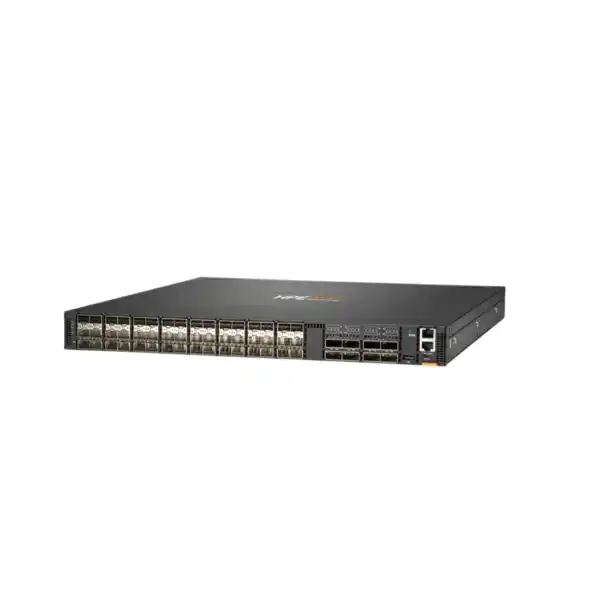
CX 8325-48Y8C
This model provides 48 ports supporting 1/10/25GbE using SFP, SFP+ and SFP28 interfaces, plus eight 40/100GbE QSFP+/QSFP28 ports. It is often the natural fit when a rack or aggregation layer needs many 10GbE or 25GbE downlinks with a smaller number of high-speed 100GbE uplinks.
This layout can be attractive for server and storage connectivity, virtualization clusters and leaf roles where 25GbE is the dominant access speed. HPE also documents 1GBASE-T transceiver support and limited 10GBASE-T transceiver support, so copper-transceiver use should be checked against the exact supported transceiver matrix rather than assumed.
CX 8325-32C
This model provides 32 ports of 40/100GbE using QSFP+/QSFP28. HPE documents optional breakout into 4×10 or 4×25 configurations. The 32C is therefore better suited when the design is centered on high-density 100GbE fabric links or when breakout flexibility is intentionally built into the cabling plan.
A 32C should not be selected merely because it has a higher-speed port format. Breakout changes the physical cabling, optics and operational layout, so buyers should model how many native 100GbE links and how many lower-speed breakout links are required at day one and at projected growth points.
CX 8325H and CX 8325P
The wider CX 8325 family also includes half-width CX 8325H models and the specialized CX 8325P platform. CX 8325H is intended for environments where rack density and smaller footprint are important, including smaller, edge or colocation data centers. CX 8325P adds timing capabilities aimed at telecom and 5G transport use cases.
These variants should be evaluated only when their physical or timing characteristics match the requirement. A general enterprise data center buyer should not assume that the half-width or provider-focused model is a direct substitute for the full-width 48Y8C or 32C design.
Technical characteristics that influence design
| Area | CX 8325 family capability | Buyer implication |
|---|---|---|
| Switching performance | Up to 6.4 Tbps bidirectional switching and up to 2,000 Mpps forwarding. | Appropriate for bandwidth-intensive aggregation and data center fabrics when port-speed and oversubscription planning are aligned to workload requirements. |
| Layer 2/3 | Includes BGP, OSPF, VRF-Lite, IPv6, multicast and other enterprise routing and switching functions. | Can support routed core, aggregation and fabric roles without requiring a separate routing platform for many common enterprise designs. |
| Fabric technology | Dynamic VXLAN with BGP-EVPN is supported. | Useful where scalable overlays, segmentation and leaf-spine architecture are part of the target design; the underlay and overlay design still needs deliberate planning. |
| High availability | VSX, VRRP, BFD, LACP and redundant hot-swappable cooling and power options. | Supports resilient paired-switch architectures, but actual redundancy depends on dual devices, independent power, cabling and upstream/downstream design. |
| Jumbo frames | Maximum frame size up to 9K bytes. | Relevant for storage, backup and data center traffic where end-to-end MTU consistency must be maintained. |
| Management | AOS-CX with REST APIs, Python, analytics and support for HPE Aruba Networking Central and other HPE management tools. | Operational tooling and subscription choices should be planned with the network operating model, not added as an afterthought. |
AOS-CX automation and observability
AOS-CX is designed as a modern network operating system with a stateful database architecture. For network teams, this supports a more programmable operating model than relying only on device-by-device CLI changes. REST APIs and Python scripting can be used for automation, while the built-in time-series database supports historical troubleshooting and analysis of operational state.
HPE Aruba Networking Network Analytics Engine can monitor conditions that affect network health and use telemetry to help identify operational issues. This is valuable in environments where visibility, repeatable remediation and capacity trends matter. The practical benefit depends on how the organization integrates telemetry and automation into its processes; buying a capable switch does not by itself create an automated network.
VSX for resilient switching pairs
Virtual Switching Extension, or VSX, enables a pair of switches to operate in a distributed high-availability architecture while each switch maintains independent control. Configuration state can be synchronized across the pair, supporting active-active network designs and maintenance scenarios that are difficult to achieve with a single switch.
For a buyer, the key point is that VSX is an architectural feature rather than a substitute for redundancy planning. A resilient deployment normally requires two appropriately sized switches, diverse links, redundant power sources and careful failure-domain design. If only one CX 8325 is purchased, the network does not inherit the availability benefits of a dual-switch topology.
Storage and lossless Ethernet considerations
The CX 8325 is relevant to storage-focused Ethernet networks because HPE documents Data Center Bridging features and storage solution support including iSCSI, lossless iSCSI, RDMA over Converged Ethernet and NVMe over Fabrics use cases. Priority Flow Control, Enhanced Transmission Selection and related congestion-management functions can be used in designs where packet loss and deterministic behavior matter.
HPE also describes the CX 8325 as storage optimized and validates it within HPE connectivity guidance for selected server, storage and hyperconverged solutions. This does not mean every storage array, NIC, optic and firmware combination is automatically compatible. Storage fabrics are sensitive to firmware levels, NIC settings, MTU, PFC classes, congestion configuration and vendor interoperability. For production SAN-like Ethernet designs, the supported solution matrix should be checked against the exact storage platform and host adapters.
A procurement conversation should therefore include the storage vendor, protocol, number of hosts, desired link speed, redundancy model and expected east-west traffic. That information helps determine whether a CX 8325-48Y8C with dense 25GbE server-facing ports is appropriate, whether a 32C breakout design is preferable, or whether another switch family would offer a cleaner fit.
Optics, breakout cables and port compatibility
Optical and direct-attach connectivity is one of the most important parts of a CX 8325 order. The switch model determines the physical port format, but the transceiver or cable determines how each link is actually built. SFP28 and QSFP28 connectivity may use different optics, DACs, active optical cables or breakout assemblies depending on distance, media and endpoint hardware. A quote that contains only the switch chassis is incomplete if the design requires new transceivers or cables.
The 8325-48Y8C is attractive when many 1/10/25GbE links are needed directly from the switch. The eight 40/100GbE ports can be used for high-speed uplinks or, where supported, breakout connections. The 8325-32C starts with 32 QSFP-class 40/100GbE ports and can use breakout for lower-speed connectivity. The two layouts can therefore produce similar logical speeds in some designs but require very different physical cabling and port-management practices.
HPE documents an Unsupported Transceiver Mode that can enable certain unsupported 1G and 10G transceivers and cables. Buyers should understand the tradeoff: the switch may allow the device to be enabled, but HPE does not provide warranty or support for the unsupported transceiver or cable used in that mode. For critical production infrastructure, supported optics and cables are generally the safer procurement path.
Before ordering, provide the required link speed, fiber type, connector type, distance and remote device model for every connection class. A 100GbE link to another switch, a 25GbE link to a server NIC and a storage interconnect may all require different physical components even when they terminate on the same CX 8325.
Airflow, power and rack planning are part of the model selection
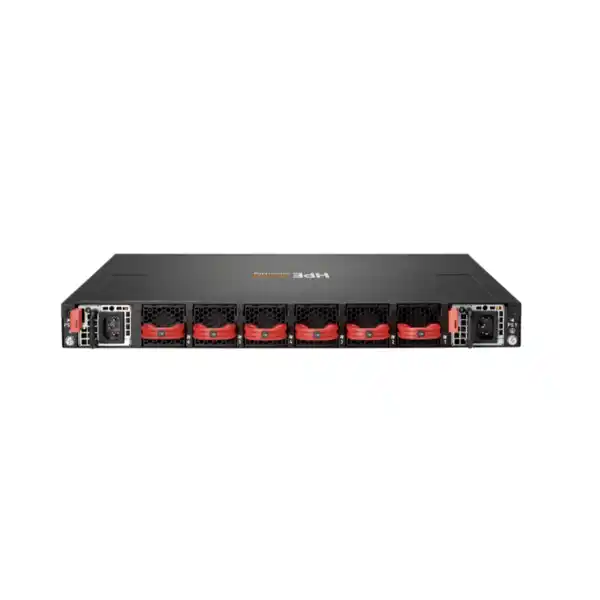
Full-width CX 8325 bundles are offered with front-to-back or back-to-front airflow. This is not a cosmetic option. Airflow direction should match the rack hot-aisle/cold-aisle strategy and the orientation of adjacent servers, storage and switches. Mixing airflow directions can create recirculation and thermal problems even when the rack appears to have enough cooling capacity.
HPE lists full-width systems with redundant, hot-swappable fan and power designs, and both AC and DC bundle options exist for selected models. Current HPE technical information lists AC input at 100–240 VAC, 50/60 Hz for the common AC bundles. Power consumption differs by model and operating condition, so rack power and UPS sizing should use the exact ordered SKU rather than a generic family estimate.
The common full-width chassis measures approximately 4.3 cm high, 43.8 cm wide and 53.6 cm deep, which corresponds to a 1U rack format. Rack depth, cable bend radius, rail or mounting kit requirements and service clearance should still be checked. The physical switch may occupy 1U, but dense 100GbE cabling can require careful front-of-rack cable management to keep optics accessible and airflow unobstructed.
Licensing and management: what is included and what may be additional
Every CX switch includes AOS-CX with a perpetual set of native foundational features used for enterprise switching, routing, resiliency, security, QoS and troubleshooting. HPE also offers additional software and subscriptions for expanded capabilities. The required software combination depends on whether the switch will be operated primarily through local CLI and APIs, cloud management, a data center orchestration platform or a broader policy-based architecture.
HPE Aruba Networking Central can provide cloud-based configuration, onboarding, monitoring, troubleshooting and reporting for supported switches. HPE states that Central Advanced expands functionality with additional security and AIOps capabilities and includes CX Advanced features, reducing the need to track a separate CX Advanced license in that management scenario. Subscription terms and current entitlement details should be confirmed at quotation because commercial packaging can change over time.
NetEdit is another operational option for automated switch configuration and validation, and HPE documents it as separately licensed. HPE Aruba Networking Fabric Composer can also be relevant in rack-scale compute and storage fabrics. The best choice is driven less by the switch itself and more by the team’s desired workflow, number of devices, compliance requirements and existing HPE Aruba Networking management estate.
When requesting a quote, specify whether you need only the hardware and base software, a cloud-management subscription, advanced feature entitlements, orchestration software or vendor support. This prevents a low initial hardware price from obscuring subscriptions that are necessary for the intended operating model.
A practical deployment journey
Identify whether the switch will be campus core, campus aggregation, data center leaf, top-of-rack, end-of-row or a storage-focused node. Each role changes the expected port mix and resilience model.
Count 10GbE, 25GbE, 40GbE and 100GbE links separately. Include server, storage, firewall, WAN edge, inter-switch, VSX and future-growth connections.
Use native port density as the deciding factor. Avoid designing a breakout-heavy 32C deployment if a 48Y8C directly matches the required 25GbE access pattern, and vice versa.
Document fiber type, link distance, connector format, DAC/AOC preference and remote-interface compatibility. This creates the transceiver and cable bill of materials.
Decide whether two switches will form a VSX pair, how downstream devices will dual-home, where routing adjacencies terminate and how power failure domains are separated.
Choose CLI/API, Central, Fabric Composer, NetEdit or a mixed workflow. Confirm subscription terms, software features and support before final purchase approval.
Where the CX 8325 can be a strong fit
Campus core refresh
Organizations replacing older core switches can use the CX 8325 where high-speed routed uplinks, redundancy and compact 1U hardware are sufficient. A paired VSX design can support active-active architectures without requiring a modular chassis.
25GbE server aggregation
The 48Y8C model is particularly relevant where many servers or storage nodes connect at 25GbE and the fabric uplinks at 100GbE. This can suit virtualization, private cloud and HCI clusters with increasing east-west traffic.
100GbE leaf-spine fabrics
The 32C model can fit designs that need a high concentration of 100GbE interfaces or structured breakout. BGP-EVPN and VXLAN support make the platform relevant to modern routed underlay and overlay fabrics.
Storage Ethernet
Data Center Bridging, congestion controls and HPE’s storage-oriented validation make the family worth considering for iSCSI, RoCE and NVMe-over-Fabrics environments where Ethernet behavior must be carefully engineered.
When another switch should be evaluated
The CX 8325 is not automatically the right choice simply because 100GbE appears in the requirement. A smaller platform may be more economical when only a few high-speed uplinks are required and most access ports are 1GbE or PoE. Conversely, a larger or newer data center platform may be better when the design needs substantially more 400GbE connectivity, larger scale, higher port density, a modular chassis, or a different buffering and hardware architecture.
The CX 8325H should be compared when rack space is constrained and the half-width form factor offers a meaningful advantage. The CX 8325P should be evaluated for service-provider or telecom edge requirements that specifically need precision timing features such as PTP and SyncE. These are purpose-driven alternatives rather than simple upgrades.
A good shortlist begins with workload and topology requirements, then chooses the platform. Starting with a model name and forcing the network design around it often creates avoidable optic costs, breakout complexity or underused high-speed ports.
Dubai and UAE deployment considerations
For Dubai data centers, enterprise server rooms and colocation facilities, the environmental requirement should be interpreted at the equipment intake rather than against outdoor ambient temperature. HPE lists the common full-width CX 8325 operating range at 0°C to 40°C, with operating relative humidity from 5% to 95% at 40°C non-condensing. The rack cooling design must therefore keep intake air within the supported envelope even when external UAE temperatures are much higher.
Airflow orientation is especially important in dense racks. Front-to-back and back-to-front bundle choices should align with the facility’s cold-aisle and hot-aisle design. Power feed type, PDU connector requirements, UPS headroom and dual-feed resilience should also be documented before the purchase order is issued.
Fourteck can prepare a UAE quotation around the exact port layout, airflow and power bundle required. Availability, lead time and final commercial terms depend on the requested SKU, quantity, optics, subscriptions and support package, so these should be confirmed in the live quotation rather than assumed from the family name.
Procurement details that prevent ordering mistakes
State whether the requirement is 8325-48Y8C, 8325-32C, 8325H or 8325P. The family name alone does not define the ports.
Specify front-to-back or back-to-front based on rack layout. Do not treat airflow as an interchangeable accessory decision.
Confirm AC or DC bundle, input power, redundancy and PDU requirements. Check the exact power consumption for the selected SKU.
List speed, distance, media and remote device for each link class. Breakout cables should be designed, not improvised after installation.
Identify Central, advanced features, NetEdit, Fabric Composer or other software expectations and the desired subscription duration.
Define support coverage, installation, migration and configuration assistance according to the operational criticality of the network.
Frequently asked buyer questions
Is the CX 8325 a 25GbE switch or a 100GbE switch?
It can be either, depending on the model. The 8325-48Y8C combines 48 ports of 1/10/25GbE with eight 40/100GbE ports. The 8325-32C provides 32 ports of 40/100GbE and supports breakout options. Selecting the exact model is therefore the first step in any quotation.
Can it be used as a campus core?
Yes. HPE positions the CX 8325 for core and aggregation use as well as data center roles. Suitability still depends on required port density, routing scale, resilience, uplink speeds and projected growth. A paired VSX design is commonly more appropriate than a single device where core availability is important.
Does the CX 8325 support EVPN-VXLAN?
Yes. HPE documents dynamic VXLAN with BGP-EVPN within the platform feature set. This makes the family suitable for leaf-spine overlays and segmentation designs, but the complete fabric architecture, routing policy and operational tooling still require engineering.
Does it support redundant power and fans?
The full-width CX 8325 platform is offered with redundant, hot-swappable power and cooling configurations. Current bundle descriptions commonly include two power supplies and multiple fans. The exact bundle and airflow direction should be checked against the final part number.
Can I use third-party optics?
HPE documents Unsupported Transceiver Mode for certain unsupported 1G and 10G transceivers and cables, but HPE does not provide warranty or support for the unsupported transceiver or cable used in that mode. Production buyers should weigh support risk carefully and verify the current supported transceiver matrix.
Is Aruba Central mandatory?
No. AOS-CX can be operated using native management and automation methods. Aruba Central is an available cloud-management option and may be chosen when centralized onboarding, monitoring, troubleshooting, reporting, AIOps or policy workflows are required. Subscription needs should be aligned with the desired management model.
What information is needed for an accurate quote?
At minimum, provide the required model or port counts, quantity, airflow direction, power type, link speeds, fiber or copper media, distances, breakout requirements, management subscriptions, support term and installation scope. Server and storage endpoint models are useful when optics or compatibility must be validated.
Is the 8325 suitable for storage networks?
It can be. HPE documents Data Center Bridging and storage-focused Ethernet capabilities for iSCSI, RoCE and NVMe-over-Fabrics use cases. The switch still needs to be configured as part of an end-to-end validated design that includes NICs, storage systems, firmware, congestion settings and MTU consistency.
Decision recap: what determines the right CX 8325 configuration
What Fourteck needs from you for an accurate CX 8325 quotation
A short technical brief helps avoid mismatched airflow, missing optics or an unsuitable port layout. Share as many of the following details as are available:
Build the right HPE Aruba Networking CX 8325 configuration for your Dubai network
Whether you are refreshing a campus core, designing a 25GbE server layer, building a 100GbE leaf-spine fabric or validating a storage network, the model, optics, airflow, power, licensing and resilience plan should be selected together. Fourteck can turn your topology and endpoint requirements into a practical bill of materials and quotation for the UAE.

Reviews
There are no reviews yet.