
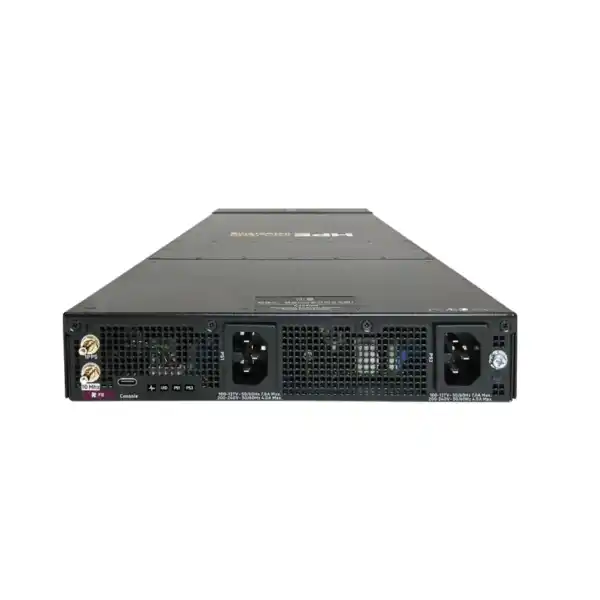
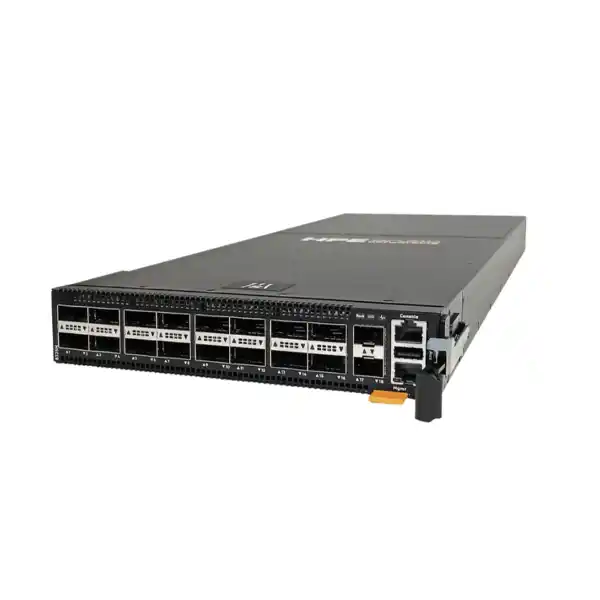
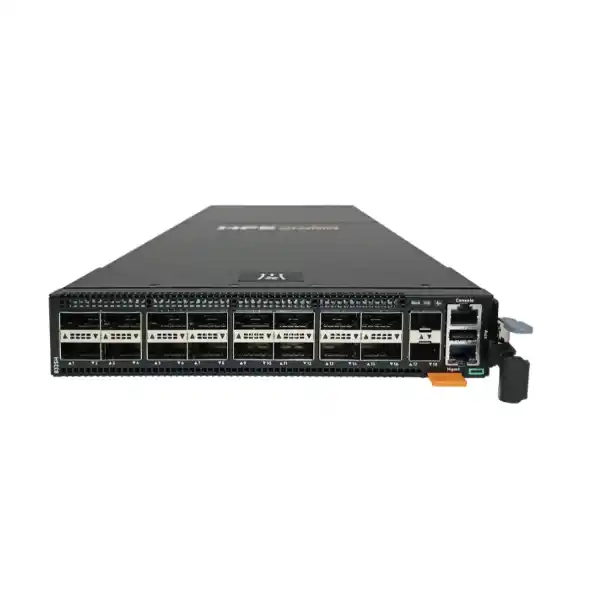
HPE Aruba Networking CX 8325H in Dubai
The CX 8325H brings high-speed 25GbE and 100GbE switching into a compact half-width form factor for server, storage, edge and colocation environments. The key purchasing decision is not simply “CX 8325H”: buyers must choose the correct port architecture, airflow direction, optics, rack mounting and exact HPE SKU for the intended fabric.
Direct answer: what is the HPE Aruba Networking CX 8325H?
Why the CX 8325H is a distinct choice
The “H” models are not simply smaller versions of a conventional campus access switch. HPE positions the CX 8325H around high-performance, high-density 1/10/25/40/100GbE connectivity in a half-width, single-rack-unit format with fixed redundancy for power and cooling. That physical format is particularly relevant when rack space is expensive or constrained, such as compact data rooms, colocation racks, edge data centers and server pods where two half-width devices can be planned within a standard rack width using the correct mounting arrangement.
The practical benefit is architectural flexibility: one CX 8325H option is optimized for a mix of lower-speed server-facing ports and 100GbE uplinks, while the other is built around a denser set of QSFP28 interfaces. A buyer can therefore choose the port personality that matches actual compute and storage attachment rather than paying for an unsuitable port mix. This is also why a quotation should identify the exact variant instead of treating “CX 8325H” as a single universal configuration.
Best-fit environments
- Top-of-rack switching for high-speed servers and hyperconverged infrastructure.
- Storage Ethernet networks where latency, lossless behavior and validated interoperability matter.
- Compact leaf-spine fabrics requiring 25GbE host attachment and 100GbE fabric links.
- Edge and colocation deployments where rack footprint and redundancy are important.
- Campus core or aggregation designs that specifically fit the available port count and resiliency model.
- Environments adopting AOS-CX automation, REST interfaces, Python-based workflows, VSX, EVPN or VXLAN.
CX 8325H port architectures to compare
| CX 8325H variation | Fixed ports | Published switching throughput | Typical design logic |
|---|---|---|---|
| 18Y4C style | 18 × SFP28 supporting 1/10/25GbE plus 4 × QSFP28 supporting 40/100GbE | 2.16 Tbps | Strong fit when many server or storage links are 10/25GbE and a smaller number of 100GbE uplinks are required. |
| 16C style | 16 × QSFP28 supporting 40/100GbE, with breakout possibilities depending on the intended configuration and supported cabling | 4 Tbps | Better suited when the design needs a higher concentration of 100GbE interfaces or structured breakouts rather than native SFP28 access ports. |
This comparison is the first major buying checkpoint. If most attached servers expose 10GbE or 25GbE NICs, the 18-port SFP28 model may reduce cabling complexity because those connections terminate directly in SFP-family interfaces. If the fabric is dominated by 100GbE links, or the design intentionally relies on supported breakout cables, the 16-port QSFP28 model may be more appropriate. A switch with more aggregate throughput is not automatically the better purchase; the useful choice is the one whose physical interfaces match the endpoint and uplink plan without forcing unnecessary adapters or leaving expensive ports idle.
AOS-CX operating model
AOS-CX is central to the value of the CX 8325H. HPE’s architecture supports programmatic control through built-in REST APIs and Python scripting, allowing operations teams to move beyond repetitive CLI-only administration. For organizations standardizing on infrastructure automation, that can reduce configuration drift and make switch changes easier to integrate into broader provisioning workflows. The operational model should still be matched to the buyer’s skills, change-control process and monitoring platform; advanced automation is useful only when the network team has a plan to operate it consistently.
VSX high availability
HPE Aruba Networking Virtual Switching Extension, or VSX, is designed for redundant active-active network architectures while keeping independent control planes. It can synchronize configuration and state across paired switches and supports resilient Layer 2 and Layer 3 designs. In purchasing terms, VSX normally means planning two compatible switches, the inter-switch connectivity, uplinks and endpoint attachment as a complete design rather than pricing one switch in isolation. The result can be strong service continuity, but only when the physical links, routing, LACP strategy and failure domains are designed correctly.
EVPN and VXLAN readiness
The CX 8325 family supports advanced Layer 3 and data center fabric functions including BGP, OSPF, VRF, VXLAN and EVPN. These features are relevant to organizations building scalable leaf-spine fabrics, extending Layer 2 segments in a controlled way or introducing segmentation across a routed underlay. They also increase design complexity. The correct question is not merely whether the switch “supports VXLAN,” but whether the complete network has a defined underlay, overlay, route-target strategy, addressing plan, redundancy model and operational tooling.
Storage and compute networking: where the CX 8325H can be valuable
HPE specifically positions the CX 8325 platform for data center, cloud and storage use cases, including top-of-rack server and storage connectivity and scale-out leaf-spine fabrics. HPE also documents storage-oriented enhancements in AOS-CX and validates relevant configurations through its Single Point of Connectivity Knowledge program. For a storage buyer, this matters because Ethernet storage is not simply a question of raw port speed. Buffering behavior, lossless configuration, priority flow control where required, congestion management, host NIC settings, storage-array support statements and tested combinations can all influence whether a design behaves predictably under load.
The CX 8325H should therefore be evaluated as part of an end-to-end storage path. A 25GbE storage host may fit naturally on the 18Y4C-style model, while a high-bandwidth spine, all-flash storage fabric or dense east-west compute environment might make greater use of 100GbE QSFP28 connectivity. However, the exact HPE server, storage array, NIC, optic, cable and software combination should be validated for the intended deployment rather than assumed from generic Ethernet compatibility.
For UAE data centers, this end-to-end check is especially useful before equipment is shipped to a live site. It reduces the risk of discovering during installation that the switch port is correct but the chosen optic is unsupported, the DAC length is wrong, the server NIC requires a different breakout arrangement, or the airflow conflicts with the rack’s hot-aisle/cold-aisle design. The best quotation therefore describes the entire connection plan, not just the switch chassis.
Interfaces, optics and cabling decisions
HPE publishes a transceiver guide for AOS-CX platforms and updates it independently of the switch chassis documentation. This is important for procurement because optical support can evolve over time and can depend on software release. A design using short-reach multimode optics in one rack has different requirements from a data center interconnect using single-mode fibre, and a direct-attach copper cable between adjacent devices has different distance and compatibility constraints again. FourTeck can build the quote around the actual media plan so the buyer receives a usable switch configuration rather than a bare chassis that still needs critical connectivity components.
Airflow and rack planning are purchase-critical
HPE offers CX 8325H configurations in front-to-back and back-to-front airflow variants. That is not a cosmetic distinction. Data centers use controlled airflow to keep cold intake air and hot exhaust air separated, so the switch must be oriented consistently with the servers, storage and rack aisle design. Ordering the wrong airflow direction can create recirculation, increase inlet temperatures and complicate an otherwise straightforward deployment.
The half-width chassis also changes how rack mounting should be considered. Current HPE configuration guidance identifies rack-kit selection as a separate requirement for specific CX 8325H configurations. The quotation should therefore confirm whether the switch will be installed singly, paired side by side, or used in a rack layout with a specific mounting accessory. Buyers moving from conventional full-width switches should not assume that an existing generic rail or shelf is the correct installation method.
Power planning follows the same principle. The CX 8325H family is designed with redundant power and cooling, but the site still needs suitable circuits, PDUs and power cords for the selected regional configuration. A resilient network design is weakened if both power feeds ultimately depend on the same upstream circuit. For critical deployments, power diversity should be reviewed alongside network path diversity.
Rack-readiness checklist
- Confirm rack unit and half-width mounting plan.
- Match front-to-back or back-to-front airflow to the aisle.
- Specify the correct rack kit rather than assuming it is included.
- Confirm PDU outlet type and power-cord requirement.
- Plan independent power paths where resilience is required.
- Allow cable-management space for high-density fibre or DACs.
- Check transceiver clearance, bend radius and service access before installation.
Management, monitoring and operational fit
A switch can be technically capable and still be the wrong operational fit if the network team cannot support its management model. AOS-CX provides familiar command-line administration, programmatic REST access, Python scripting and the Network Analytics Engine for telemetry and troubleshooting workflows. These capabilities can help teams detect anomalies, automate repetitive configuration and create more consistent operational practices across a CX estate. They are particularly valuable in data centers where small errors can affect a large number of east-west flows.
Centralized management should be treated as a design decision rather than assumed as part of the bare switch. HPE Aruba Networking offers management platforms and subscription options, but the required entitlement depends on how the customer intends to manage the environment. Some organizations may operate the switch through local AOS-CX workflows and existing monitoring tools; others may want centralized visibility and policy. The quotation should distinguish hardware, any required software subscriptions, support services and implementation work so the buyer can see the complete lifecycle cost.
Software-release planning also matters. HPE continues to publish AOS-CX release notes, feature guides, transceiver guidance and compatibility documentation for the CX 8325 family. For production deployments, the selected release should be aligned with the required features, approved optics and the organization’s upgrade policy. Chasing the newest release is not always the right operational choice; stability, validated interoperability and planned maintenance windows often matter more.
High-availability design: what VSX does and what it does not replace
For procurement, this means that a “two-switch” quote should be reviewed as an architecture rather than simply doubling the quantity. Port consumption for VSX links, upstream connectivity and dual-attached hosts must be included in capacity calculations. A switch that appears to offer sufficient ports on paper may become constrained after resilience links are allocated. FourTeck can model those reserved ports during the bill-of-materials stage so the design has practical headroom.
Sizing the CX 8325H for a real deployment
Port count is the most visible sizing metric, but it is not the only one. Start with the number of physical endpoints and their actual interface speeds. A rack with twelve dual-port 25GbE servers can consume twenty-four switch-facing connections if every NIC link is used. If resilience is provided by two switches, those connections may be split across the pair rather than concentrated on one device. Add storage links, management or service appliances, inter-switch connectivity, fabric uplinks and expansion capacity before deciding whether one CX 8325H pair has enough ports.
Next, distinguish access bandwidth from oversubscription. A group of 25GbE servers does not necessarily need an equal amount of 100GbE uplink capacity at every moment, but some workloads—backup, distributed storage, virtualization migration, analytics and AI-adjacent data movement—can generate sustained east-west traffic. The right uplink ratio depends on workload behavior, not a generic rule. Where traffic patterns are uncertain, telemetry from the existing network can provide more useful evidence than estimates based only on NIC line rate.
Finally, reserve practical growth. Using every available high-speed port on day one leaves no room for a new host, an additional storage node or an unexpected resilience link. A small amount of spare capacity is usually cheaper than an early redesign. If growth is likely to exceed the half-width platform’s port density, a larger CX 8325 configuration or another HPE Aruba Networking switching family should be evaluated instead of forcing the CX 8325H beyond its natural fit.
When the 18-port SFP28 model is attractive
Choose this direction when the rack contains many 10/25GbE servers or storage nodes and only a few 100GbE fabric links are needed. Native SFP28 ports can simplify direct host attachment and make the port map easy to understand. It is also a sensible candidate for compact storage networks where the endpoint count fits comfortably within the available interfaces and the four QSFP28 ports are sufficient for uplink and redundancy requirements.
When the 16-port QSFP28 model deserves attention
Evaluate the 16C-style option when 100GbE density is more important than native SFP28 access. It can suit high-bandwidth interconnects, compact spine roles or environments that intentionally use supported breakouts. The trade-off is that a server estate dominated by individual 10/25GbE links may require a more deliberate breakout and cabling plan, so the apparent simplicity of “more 100G ports” should be tested against actual endpoint connectivity.
When to compare a larger switch
If the planned port count is already close to the platform limit, if many 100GbE uplinks are required in addition to dense 25GbE access, or if future expansion will quickly consume the available half-width interfaces, compare a larger CX 8325 model or a different Aruba CX family. The CX 8325H earns its place through compactness and a focused port mix; it should not be selected when a higher-density chassis better matches the growth plan.
Current HPE part-number choices to validate
HPE’s current CX 8325 QuickSpecs list separate CX 8325H hardware SKUs by interface layout and airflow direction. Part numbers can also have regional or compliance-related variants, so the list below should be treated as a procurement map rather than a substitute for a final configuration check.
| Part number | Port layout | Airflow | Buyer note |
|---|---|---|---|
| S4B20A | 18 × 1/10/25G SFP28 + 4 × 40/100G QSFP28 | Front-to-back | Good reference point for mixed 25G host and 100G uplink designs. |
| S4B21A | 18 × 1/10/25G SFP28 + 4 × 40/100G QSFP28 | Back-to-front | Same port concept with opposite airflow orientation. |
| S4B22A | 16 × 40/100G QSFP28 | Front-to-back | For higher 100G interface density and planned breakout use where supported. |
| S4B23A | 16 × 40/100G QSFP28 | Back-to-front | Opposite-airflow counterpart for 100G-focused deployments. |
HPE also lists TAA-compliant versions and option suffixes for certain power, PDU and localization configurations. UAE buyers normally benefit from quoting the exact installation environment rather than selecting a suffix from a global list without context. The final bill of materials should match local power, support, rack and logistics requirements.
Deployment journey for a Dubai or UAE data center
This sequence is especially useful when replacing older 10GbE switching. The technical upgrade may look simple because Ethernet remains Ethernet, but 25GbE and 100GbE migrations often introduce new optics, lane breakouts, NIC firmware considerations and a different oversubscription model. Staging reduces the number of variables that reach the production change window.
Licensing, support and lifecycle considerations
Hardware pricing is only one part of the lifecycle decision. The desired management platform, support coverage, software access, implementation service and spare strategy can affect total cost. Buyers should identify whether they require centralized cloud or on-premises management, whether the organization already has compatible HPE Aruba Networking subscriptions, and what response time is expected for a production failure. These items should be separated clearly in the commercial proposal so optional services are not confused with chassis functionality.
Support planning is particularly important for a data center role. A core, leaf or storage switch may sit in the path of many business services, making next-business-day replacement insufficient for some environments. The appropriate support level depends on redundancy, local spare inventory and the cost of downtime. A highly redundant VSX pair may tolerate a longer replacement interval than a single switch serving a non-redundant edge site, but this should be a conscious risk decision.
Lifecycle review should also include software and transceiver compatibility over the planned service period. HPE maintains current documentation and software releases for the CX 8325 family, but feature behavior can depend on release train and supported hardware combinations. A project plan should therefore record the chosen software baseline and approved optic list at deployment, then manage upgrades through change control rather than treating the switch as a set-and-forget appliance.
Potential mismatch: too few ports
If the design consumes most interfaces immediately after accounting for VSX, uplinks and dual-homed servers, the half-width platform may be too constrained. Choosing a larger switch can be more economical than adding a second pair early simply to recover port density.
Potential mismatch: wrong port personality
A 16-port QSFP28 switch can be powerful, but it may be awkward for a rack filled with individual 25GbE endpoints if every connection relies on breakouts. Conversely, an 18-port SFP28 design may not provide enough native 100GbE ports for a high-density spine role.
Potential mismatch: access-layer requirements
The CX 8325H is designed around data center and high-speed aggregation use cases. If the requirement is conventional user access with large numbers of copper ports, PoE endpoints and branch-oriented features, another Aruba CX family is likely to be a more natural fit.
Frequently asked buyer questions
Is CX 8325H one exact hardware model?
No. CX 8325H describes a family of half-width variants. The main current choices differ by SFP28/QSFP28 port layout and airflow direction, with additional regional or compliance-oriented ordering options.
Can it be used for 25GbE servers?
Yes. The 18-port SFP28 version is specifically well aligned to 1/10/25GbE connectivity. The 16-port QSFP28 model can also support lower-speed breakout scenarios where HPE documentation and cabling support the intended arrangement.
Does it support 100GbE?
Yes. Both CX 8325H design directions include QSFP28 100GbE capability. The difference is density: four QSFP28 ports on the mixed 18Y4C-style model versus sixteen QSFP28 ports on the 16C-style model.
Are optics included automatically?
They should be treated as separate configuration items unless the specific bundle explicitly states otherwise. The optic or cable must match speed, distance, fibre type, connector and current HPE support guidance.
Can two CX 8325H switches be used for redundancy?
Yes. VSX is a major high-availability capability of AOS-CX. A redundant pair still requires a complete design for inter-switch links, upstream paths, endpoint dual-homing and power diversity.
Is the rack kit important?
Yes. The half-width form factor makes mounting a real part of the bill of materials. Current HPE configuration information calls for rack-kit selection on relevant models, so mounting should be confirmed during quotation.
Is Aruba Central mandatory?
Management requirements depend on the customer’s operating model. Centralized management and subscription options can be quoted where needed, but the hardware decision should be separated from optional management services and support entitlements.
What information is needed for a UAE quote?
Provide quantities, endpoint speeds, 25G/100G port counts, airflow, rack arrangement, optics or cable distances, redundancy requirements, support level, deployment location and whether installation or migration services are needed.
UAE procurement and availability guidance
Enterprise switches are often ordered as configured solutions rather than simple shelf items. For the HPE Aruba Networking CX 8325H, availability can depend on the chosen port variant, airflow direction, rack kit, regional power option, optics, support coverage and project quantity. FourTeck can prepare a Dubai/UAE quotation around the required configuration and confirm the commercially relevant part numbers at the time of purchase.
For projects with a fixed migration date, provide the deployment schedule early. This allows the bill of materials to be checked for long-lead accessories such as specific optics or cables and gives the implementation team time to validate the software and configuration plan. Where business continuity is critical, it can also be sensible to price a spare optic set or a documented replacement strategy instead of treating every component as equally replaceable.
Six decisions that determine whether CX 8325H fits
Inputs for an accurate CX 8325H quotation
Plan the right HPE Aruba Networking CX 8325H configuration
Share your server, storage, uplink and rack requirements with FourTeck. We can help determine the correct CX 8325H port variant, airflow, optics, mounting, redundancy and support scope for a Dubai or UAE deployment before the order is finalized.

Reviews
There are no reviews yet.