
HPE Aruba Networking CX 8325P Dubai
A 1U high-performance switching platform built for 5G transport, RAN backhaul, edge computing and dense 40/100GbE aggregation where precise network timing matters as much as throughput.
Direct answer: what is the CX 8325P and who is it for?
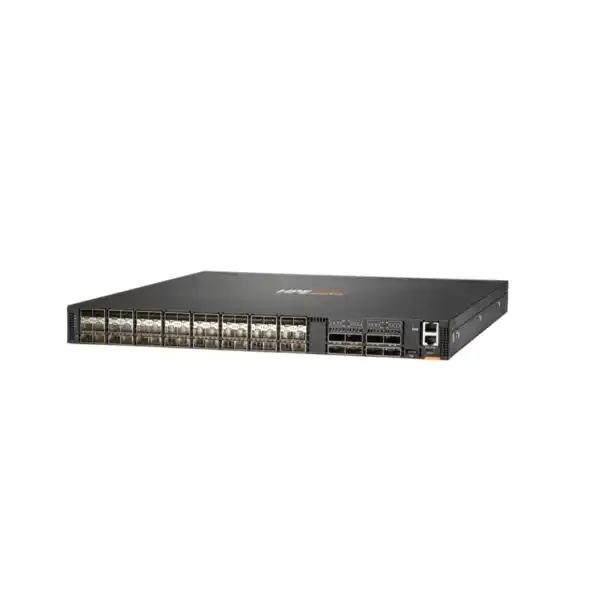
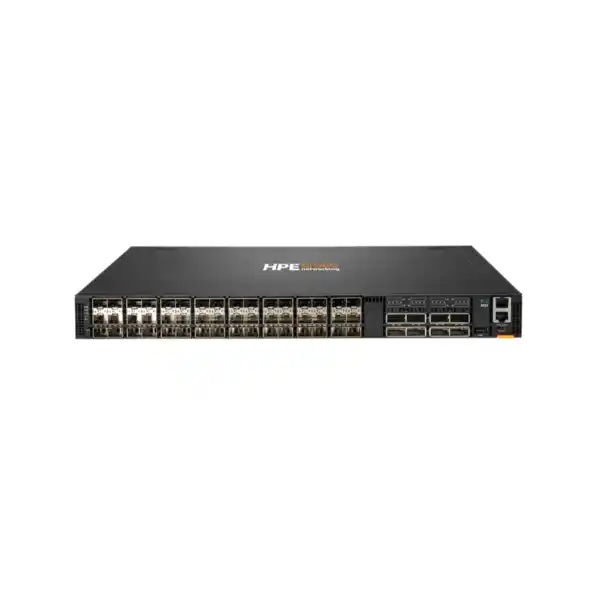
The HPE Aruba Networking CX 8325P is the provider-oriented member of the CX 8325 family. The CX 8325P-32C uses 32 QSFP+/QSFP28 interfaces for 40GbE and 100GbE links and adds telecom timing capabilities that distinguish it from a conventional data-centre-only switch.
Its strongest fit is high-speed aggregation for 5G Radio Access Network backhaul, mobile transport, distributed edge sites and other environments that need precise PTP and Synchronous Ethernet timing alongside Layer 2/3 switching.
Telecom operators, service providers, large enterprises and infrastructure teams that need dense 100GbE, resilient AOS-CX operations, EVPN-VXLAN capability and timing-aware transport should shortlist the platform.
Confirm the exact bundle: AC or DC power, airflow direction, optics or DAC/AOC media, breakout design, software subscription requirements and timing architecture. The family name alone is not enough for a correct purchase order.
What FourTeck can determine: the appropriate CX 8325P bundle for the rack, power feed and airflow plan; expected port and breakout usage; compatible transceiver requirements; management and licensing choices; and whether the CX 8325P is a better fit than a standard CX 8325, CX 8325H or another aggregation platform.
Why the CX 8325P is different
The CX 8325P is not simply a CX 8325 with a different product suffix. HPE positions the P model specifically for provider 5G Radio Access Network and edge-computing deployments. That changes the buying conversation. A conventional enterprise aggregation switch is normally selected around port speed, forwarding scale, redundancy and management. With the CX 8325P, those criteria remain important, but timing accuracy, synchronization architecture, GNSS integration, AC or DC power and rack airflow become part of the core design.
The CX 8325P-32C supports Precision Time Protocol based on IEEE 1588v2, SMPTE timing use, telecom profiles G.8275.1 and G.8275.2 with Class C performance, and Synchronous Ethernet aligned to G.8262.1. HPE also provides timing interfaces for 1PPS, 10 MHz and Time of Day plus 1PPS input/output, together with a GNSS antenna input interface. These functions are particularly relevant when the switch is transporting latency-sensitive mobile traffic or participating in a telecom timing chain.
A family name is not an orderable configuration
“HPE Aruba Networking CX 8325P” identifies the platform family, but the quotation must resolve the actual bundle. Current HPE ordering information includes front-to-back and back-to-front airflow versions and both AC and DC power configurations. TAA variants also exist. For example, HPE lists non-TAA AC bundles such as S4A51A for front-to-back airflow and S4A52A for back-to-front airflow, while other bundle codes cover DC power and TAA requirements.
This distinction matters in Dubai data centres, telecom rooms and edge facilities because airflow must align with the rack hot-aisle/cold-aisle design, and the power feed must match the site. Choosing the wrong airflow direction can create thermal recirculation. Choosing an AC bundle for a -48 VDC telecom plant, or vice versa, creates an obvious deployment problem. The safest procurement approach is to treat the switch, power configuration, airflow, optical media and software requirement as one design package rather than independent line items.
CX 8325P-32C technical profile
| Primary port configuration | 32 × 40/100GbE QSFP+/QSFP28 ports |
| Breakout flexibility | Optional 4 × 10GbE and 4 × 25GbE breakout, subject to port and cable/transceiver design |
| Switching capacity | Up to 6.4 Tb/s bidirectional switching capacity |
| Forwarding performance | Up to 2,000 Mpps |
| Timing | PTP IEEE 1588v2, SMPTE, G.8275.1, G.8275.2 Class C, SyncE G.8262.1, 1PPS, 10 MHz, ToD + 1PPS and GNSS support |
| Routing scale | HPE publishes 131,072 IPv4 unicast routes and 32,732 IPv6 unicast routes for the CX 8325P-32C technical profile |
| MAC table | 98,304 entries |
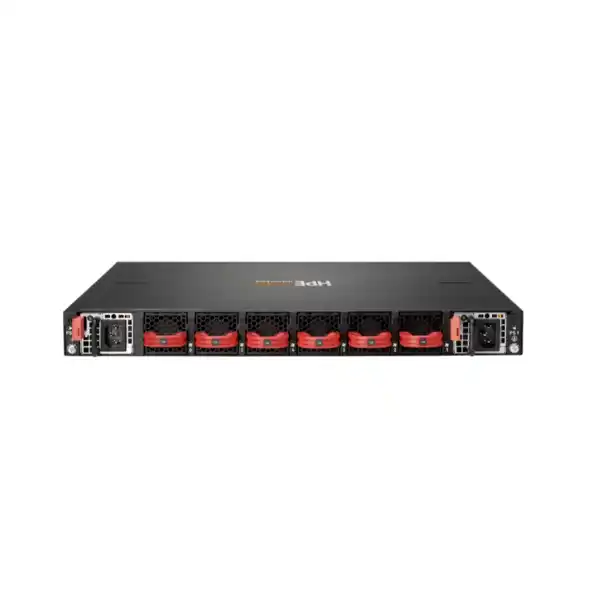
| High availability | VSX redundancy, redundant hot-swappable power supplies and up to six hot-swappable fans |
| Power options | AC and DC bundle options; published CX 8325P-32C maximum power consumption is 632 W |
| Environment | 0°C to 40°C operating range, 5% to 95% non-condensing relative humidity, up to 3,048 m operating altitude |
| Form factor | 1U full-width platform; exact depth depends on power/bundle configuration |
Published platform limits describe hardware capability, not a guarantee that every feature, scale value and port combination can be used simultaneously. Software release, feature interaction and design requirements should be validated for production architecture.
Port density, breakout and media planning
The CX 8325P-32C is centred on 32 native 40/100GbE QSFP ports. For a pure 100GbE aggregation layer, this gives a straightforward high-density interface layout. In mixed-speed networks, breakout can extend the design to 10GbE or 25GbE server, radio, appliance or downstream-switch connections. HPE indicates optional 4 × 10G and 4 × 25G breakout capability, with current product documentation noting that breakout availability can depend on the specific port and configuration. This is why a port map is one of the most useful inputs for a quotation.
A buyer should identify which links are intended as 100GbE trunks, which require 40GbE compatibility, and which need breakout to 25GbE or 10GbE. The physical media must then be selected to match distance and interface type. Short in-rack connections may be practical with direct-attach copper or active optical cables where supported, while longer runs generally require compatible optical transceivers and the correct fibre plant. Single-mode versus multimode fibre, connector type, wavelength, reach and patching all affect the bill of materials.
Do not assume that a QSFP28 port automatically makes every QSFP28 optic or third-party cable appropriate. HPE publishes supported transceiver matrices and also documents an unsupported transceiver mode for certain use cases, but unsupported optics can alter support expectations. For a production network, especially a telecom transport path, the better procurement practice is to validate each optic, DAC, AOC or breakout cable against the intended AOS-CX software release and link design.
5G RAN backhaul
The P model is particularly relevant when the aggregation switch carries Radio Access Network backhaul traffic and must distribute or recover accurate timing. PTP, SyncE and external timing interfaces make it suitable for designs where frequency and phase synchronization are part of service quality rather than an optional feature.
Edge aggregation
At an edge site with substantial east-west traffic, 100GbE uplinks and multiple high-speed downstream devices, the CX 8325P can consolidate transport while keeping the 1U footprint compact. The design still needs redundancy, optical reach, cooling and management planning rather than treating the switch as a standalone appliance.
Provider transport
For service-provider access or aggregation, routing scale, QoS, multicast, EVPN-VXLAN and synchronization can be evaluated together. The value of the CX 8325P is strongest where those capabilities are required in the same platform and where AC/DC deployment flexibility supports varied site infrastructure.
Enterprise timing-sensitive networks
Some broadcast, media, industrial and precision-timing environments can also benefit from PTP and SMPTE-related capability. Suitability depends on the exact profile, topology and endpoint requirements; the presence of timing features alone should not replace an end-to-end timing design.
Timing architecture: the main reason to choose the P model
Precise timing is the defining reason to evaluate the CX 8325P rather than a standard high-speed data-centre switch. In mobile networks, synchronized radio nodes can depend on accurate frequency, phase and time distribution. PTP provides packet-based time transfer, while SyncE carries frequency synchronization over Ethernet. The CX 8325P supports both, allowing architects to design for the timing model required by the wider transport network.
The platform also exposes dedicated timing interfaces, including 1PPS, 10 MHz and Time of Day plus 1PPS inputs and outputs, as well as GNSS antenna input capability. These interfaces matter when the switch must connect to external timing sources or participate as a boundary clock. HPE describes support for Telco Boundary Clock functionality and notes future Telco Grand Master Clock support in its documentation, so buyers should verify the exact software release and currently supported role before defining the switch as the primary grandmaster source.
Timing design should be treated as an end-to-end system. The switch cannot compensate for an unsuitable GNSS antenna location, poor holdover strategy, unsupported timing profile in downstream equipment, asymmetric transport path or incorrect Quality of Service configuration. A useful design review therefore identifies clock sources, boundary and transparent clock roles, expected PTP profile, redundancy, failure behaviour and how SyncE interacts with packet timing. This is especially important where service-level objectives depend on synchronization.
AOS-CX operations and automation
The CX 8325P runs HPE Aruba Networking CX Operating System, a database-driven network operating system designed for automation, programmability and resilient operations. Native capabilities include Layer 2 switching, Layer 3 services and routing, multicast, quality of service, network security, high availability and Network Analytics Engine functions. REST APIs and Python scripting provide programmatic access for teams that want to automate configuration, validation or operational workflows.
For troubleshooting, the time-series database and Network Analytics Engine can help teams inspect state changes and monitor conditions over time rather than relying only on snapshots. That is useful in high-speed aggregation networks where intermittent congestion, route changes or interface events can be difficult to reconstruct after the incident.
Management choices and licensing
The switch can be managed through CLI-based workflows and can also integrate with HPE Aruba Networking Central and other HPE management/orchestration tools. Central is subscription-based, so cloud management should be budgeted separately where required. HPE also offers CX software capabilities in foundational and advanced licensing constructs, and current Central Advanced subscriptions include advanced CX features according to HPE documentation.
Licensing should be mapped to the actual operational model instead of added automatically. A site that needs local CLI and native switching features has different requirements from a multi-site operator that wants cloud onboarding, policy, AIOps, reporting and fabric orchestration. The quote should therefore state the desired management platform, subscription term, number of switches and any advanced feature requirements.
High availability is a design, not just a feature list
The CX 8325 family supports Virtual Switching Extension (VSX) for resilient active-active designs. In a production aggregation layer, a pair of switches can be designed so downstream and upstream devices use redundant paths while the two switches synchronize operational state. This approach can reduce the impact of a single chassis or link failure and supports maintenance strategies that are more practical than a standalone core switch.
Physical resilience is also built around field-replaceable, hot-swappable components. CX 8325P bundles support redundant power supplies and up to six fans, with front-to-back or back-to-front cooling choices. However, redundancy only delivers the intended outcome when power feeds are separated, cabling avoids shared failure points and upstream/downstream topology has redundant paths. Two power supplies connected to the same failed PDU are not true power-path resilience, and two switches fed through the same single optical route can still share a transport failure domain.
For change control, HPE documents VSX Live Upgrade with LACP traffic draining as part of the platform’s availability approach. Operations teams should still validate the release-specific procedure, supported upgrade path and application tolerance before maintenance. High availability should be proven with a failover plan that covers switch reboot, power loss, link loss, peer-link failure and routing convergence.
Power, airflow and Dubai deployment conditions
HPE offers CX 8325P-32C bundles with AC and DC power. The AC technical profile is 100–240 VAC, while the DC variant is designed for -36 to -72 VDC environments, making it suitable for telecom facilities that use nominal -48 VDC plants. HPE publishes a maximum power consumption of 632 W for the CX 8325P-32C, with idle figures differing between AC and DC configurations. Power design should include both the switch maximum and the characteristics of the wider rack, UPS/PDU capacity, A/B feed architecture and expected redundancy mode.
Airflow is equally important. HPE provides front-to-back and back-to-front bundles so the switch can match the intended cold-aisle/hot-aisle layout. The CX 8325P’s published operating range is 0°C to 40°C with non-condensing relative humidity up to 95% and an operating altitude up to 3,048 metres. Those specifications do not remove the need for controlled room conditions. In Dubai, outside ambient temperature is irrelevant to a properly conditioned data hall but extremely relevant to poorly cooled edge rooms, shelters and cabinets. Thermal load, dust control, filter maintenance and HVAC redundancy should be assessed for remote edge installations.
When ordering, airflow should be documented explicitly because fan and power-supply direction must remain consistent. If a replacement component is later installed with the wrong airflow orientation, the switch may work electrically while disrupting the rack cooling design. Asset records should therefore include the exact bundle and airflow direction, not simply “CX 8325P”.
How to size the CX 8325P for a real network
List every 100G, 40G, 25G and 10G connection, then identify which QSFP ports will remain native and which require breakout. Reserve capacity for growth rather than filling every usable interface on day one.
Port count is not the same as traffic demand. Model peak aggregate throughput, oversubscription, east-west flows, uplink ratios, multicast and expected growth. A 100G physical link does not mean every application needs 100G continuously.
Check route, MAC, multicast, VRF and policy scale against the intended design. Published hardware limits should be tested against the specific features enabled simultaneously in the chosen AOS-CX release.
Specify PTP profile, clock role, GNSS source, SyncE requirements, failover and holdover expectations. This determines whether the CX 8325P’s provider features are truly required.
Decide whether one switch is acceptable or whether a VSX pair is required. Include dual power feeds, redundant optical paths and maintenance objectives in the design.
Choose CLI, Central or other HPE management tooling. Add subscription terms only where they support the operations model, compliance requirements and troubleshooting workflow.
When the CX 8325P may not be the best choice
The CX 8325P is compelling when dense 40/100GbE and telecom timing are both important. It can be excessive when the requirement is primarily 1/10/25GbE server access with only a handful of 100GbE uplinks. In that case, the broader CX 8325 family includes configurations such as the 48Y8C that provide many SFP/SFP+/SFP28 access ports plus 40/100GbE uplinks, potentially reducing reliance on breakout cables.
For smaller edge or colocation environments where rack space and port density are modest, the CX 8325H half-width models can also merit comparison. HPE positions those systems for high-performance 1/10/25/40/100G connectivity in a smaller physical footprint. Conversely, if the network needs substantially more scale, modular chassis resilience or a different port architecture, a larger switching platform may be a better long-term choice.
Timing is another filter. If the design does not need PTP telecom profiles, SyncE, GNSS or external timing interfaces, paying for and operationally managing a provider-oriented model may not create a practical advantage. Selection should be based on the architectural requirement, not on choosing the most feature-rich device available.
Migration and implementation journey
Discovery
Capture current topology, link speeds, routing protocols, VLAN/VRF design, multicast, timing sources, rack power and airflow.
Bill of materials
Select the exact CX 8325P bundle, optics, DAC/AOC or breakout cables, rack accessories, management subscriptions and support services.
Staging
Set the approved AOS-CX version, establish management access, load base configuration, verify optics and test PTP/SyncE where required.
Cutover
Migrate links in a controlled sequence, monitor routing and timing convergence, and keep rollback paths available until service validation is complete.
Validation
Confirm redundancy, latency, errors, route scale, PTP offset, SyncE state, power-feed resilience and monitoring visibility against the design.
Procurement details that prevent costly mistakes
A CX 8325P quote should make the configuration explicit enough that the receiving and implementation teams know exactly what is being delivered. The most important procurement fields are airflow direction, AC or DC power, TAA requirement if applicable, quantity, support term, optics, cable type and management subscription. When 100GbE breakouts are involved, the bill of materials should state whether the link uses 4 × 25G or 4 × 10G and identify the matching cable or optical components at both ends.
HPE’s current QuickSpecs show several bundle codes for the CX 8325P-32C. Examples include S4A51A for a front-to-back AC bundle and S4A52A for a back-to-front AC bundle; related part numbers cover DC and TAA variants. Part availability and regional orderability can change, so the final UAE quotation should use the current HPE channel configuration rather than a part number copied from an older project or another country.
Support requirements should also be clear. A critical RAN aggregation site may justify stronger response objectives, spare strategy and lifecycle planning than a lab or development edge cluster. If the design depends on specific timing behaviour, optical compatibility or software features, those dependencies should be documented in the implementation acceptance criteria so there is a measurable definition of a successful deployment.
Frequently asked buyer questions
Is the CX 8325P a PoE switch?
No. The “P” in CX 8325P identifies the provider-oriented timing model; it does not mean Power over Ethernet. The platform is designed around high-speed QSFP switching and telecom timing, not powering access points, phones or cameras.
How many 100GbE ports are available?
The CX 8325P-32C provides 32 QSFP+/QSFP28 ports supporting 40GbE and 100GbE. Some ports can be used with supported breakout configurations for lower-speed 10GbE or 25GbE connectivity.
Does it support PTP and SyncE?
Yes. HPE lists IEEE 1588v2 PTP, SMPTE, telecom profiles G.8275.1 and G.8275.2 with Class C performance, plus Synchronous Ethernet G.8262.1. The exact timing role and software release should be validated for the production design.
Can I order AC or DC power?
Yes. HPE offers CX 8325P-32C bundle variants for AC and DC power, with matching front-to-back and back-to-front airflow choices. The selected power supplies and fans must match the airflow direction.
Does it require Aruba Central?
No. AOS-CX provides native switch functionality and CLI management. HPE Aruba Networking Central is an optional subscription-based management platform that can add cloud operations, monitoring, workflow and advanced capabilities depending on the license.
Is it suitable for a standard data centre?
It can operate as a high-speed aggregation platform, but if telecom timing is unnecessary, a standard CX 8325 or CX 8325H configuration may be more appropriate. Port mix, rack space, management and cost should drive the comparison.
Are transceivers included?
The required optics and interconnects should be treated as separate design items unless the specific quoted bundle explicitly includes them. Fibre type, reach, connector, breakout and supported transceiver list must be matched to the link plan.
What information is needed for a Dubai quote?
Provide quantity, desired AC/DC power, airflow, 100G/40G/25G/10G port map, optical distances, timing profile, management preference, redundancy plan, support term and installation requirement. This allows the quotation to reflect a usable design rather than only the chassis.
Decision recap
What FourTeck needs from you for an accurate CX 8325P quotation
Specify the right HPE Aruba Networking CX 8325P for your Dubai network
A strong CX 8325P deployment starts with the exact port map, timing role, airflow and power configuration—not just the switch family name. FourTeck can help translate your RAN, edge or aggregation requirement into a current UAE bill of materials with the correct bundle, media, subscriptions, support and implementation scope.

Reviews
There are no reviews yet.