
HPE Aruba Networking EdgeConnect 10106 SD-WAN Gateway Dubai
A compact EdgeConnect appliance for small branches and remote offices that need secure, centrally managed SD-WAN, flexible copper and fibre connectivity, and up to 1,000 Mbps of bidirectional WAN capacity.
Direct answer for buyers
The EdgeConnect 10106, model EC-10106, is a physical HPE Aruba Networking SD-WAN gateway intended primarily for small branch and remote-office deployments.
It steers and secures branch WAN traffic across internet, MPLS and cellular-based transport while centralizing policy, monitoring and overlay management through EdgeConnect SD-WAN Orchestrator.
Organizations with a small branch that needs up to 1 Gbps of bidirectional WAN capacity, fibre or copper handoffs, segmentation, application-aware SD-WAN and centrally managed operations.
Confirm actual WAN bandwidth, license tier, required security features, fibre optics, PoE use, high-availability expectations and whether a single power adapter is acceptable for the site.
FourTeck can help map the branch design to the correct EdgeConnect hardware, subscription bandwidth, accessories, migration plan and UAE deployment scope.
Where the EC-10106 fits
HPE positions the EdgeConnect 10106 as a small-branch gateway with typical WAN bandwidth from 2 Mbps to 1,000 Mbps bidirectionally. That positioning is important because SD-WAN appliance selection should start with the real traffic profile rather than the nominal speed printed on an ISP contract. If a Dubai branch has two internet circuits, an MPLS service, or a combination of broadband and 4G/5G, the sizing exercise should consider the total provisioned WAN bandwidth, peak use, encryption, security inspection and expected growth.
The appliance supports hybrid WAN designs using MPLS, internet and 4G/5G/LTE transport. It is therefore suitable for organizations replacing traditional router-centric branch designs with policy-based path selection, or for existing EdgeConnect customers adding a smaller site to a centrally managed fabric. The 10106 is not automatically the right choice for every branch: HPE places the 10104 below it at up to 500 Mbps and the 10108 above it at up to 2,000 Mbps. A branch likely to exceed 1 Gbps should be evaluated against the 10108 or another higher-capacity platform instead of buying the 10106 with insufficient headroom.
Buyer signal: capacity is more than circuit speed
The EC-10106 data sheet states up to 1,000 Mbps WAN bandwidth and 256,000 simultaneous connections. HPE also publishes IDS/IPS figures of up to 1,000 Mbps in Performant mode and up to 750 Mbps in Inline mode. Those figures should not be treated as a promise that every combination of routing, inspection, optimization, segmentation and logging will run at every maximum simultaneously. Feature mix, software version, traffic characteristics and licensing affect the design.
For a new deployment, provide both current and expected bandwidth, the number of WAN links, major SaaS applications, voice or real-time traffic, branch user count, VLAN or VRF requirements, and whether advanced security inspection is planned. This gives a more defensible sizing result than selecting solely by the fastest circuit.
Connectivity and branch design flexibility
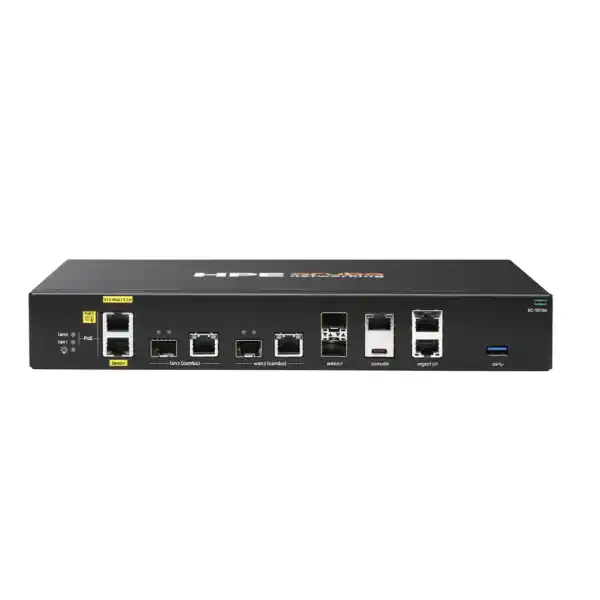
Two 1G/10G SFP+ ports
Useful where the carrier handoff or LAN uplink is fibre-based, or where the design requires 10 Gigabit-capable physical interfaces even though the appliance WAN capacity remains in the 1 Gbps class.
Two combo ports
Each combo position can use RJ45 or SFP connectivity, allowing the same appliance to accommodate different service-provider handoffs without consuming a dedicated interface type unnecessarily.
Two Gigabit RJ45 PoE ports
Integrated PoE can simplify selected branch designs. HPE states support for PoE devices up to 60 W. The intended endpoint type and power requirement should be checked before the PoE function is included in the final design.
Dedicated management access
The appliance includes two 10/100/1000 management RJ45 ports, RJ45 and USB-C console access, plus one USB 3.0 Type-A port, giving administrators several ways to handle installation and local recovery.
The six data ports can be used in WAN or LAN roles and support up to 64 IEEE 802.1Q VLANs. That flexibility is useful in branch modernization because the gateway can sit at the site perimeter as a next-hop device while connecting to diverse upstream and downstream networks. HPE documents BGP and OSPF routing, WAN-link redundancy through business-intent overlays with multiple link-bonding options, and LAN-side protection using VRRP and BGP. The exact routing and failover design should be aligned with the existing core switch, firewall architecture, carrier routing and any requirement to maintain deterministic failover behaviour.
Verified EC-10106 technical specifications
| Area | Published specification | Buyer relevance |
|---|---|---|
| WAN bandwidth | 2 to 1,000 Mbps bidirectional | Appropriate for a small branch where total WAN demand and growth remain within the platform class. |
| Simultaneous connections | 256,000 | Useful capacity reference when comparing branch scale and security workloads. |
| Recommended WAN Optimization | Up to 350 Mbps in HPE’s current EC-10106 data sheet | WAN optimization is optional and should be licensed and sized only where latency mitigation or data reduction is needed. |
| IDS/IPS capacity | Up to 1,000 Mbps Performant mode; up to 750 Mbps Inline mode | Security mode influences realistic branch throughput and should be part of sizing. |
| Storage and memory | 120 GB SSD; 16 GB ECC RAM | Hardware platform detail relevant to operations and lifecycle planning. |
| Encryption | AES-128 disk encryption; IPsec AES-256 network encryption | Supports encrypted branch overlays and protection of local storage. |
| Power | 100–240 VAC, 50–60 Hz; 165 W stated power consumption; single adapter | A single adapter means the hardware itself does not provide dual hot-swappable PSU redundancy. |
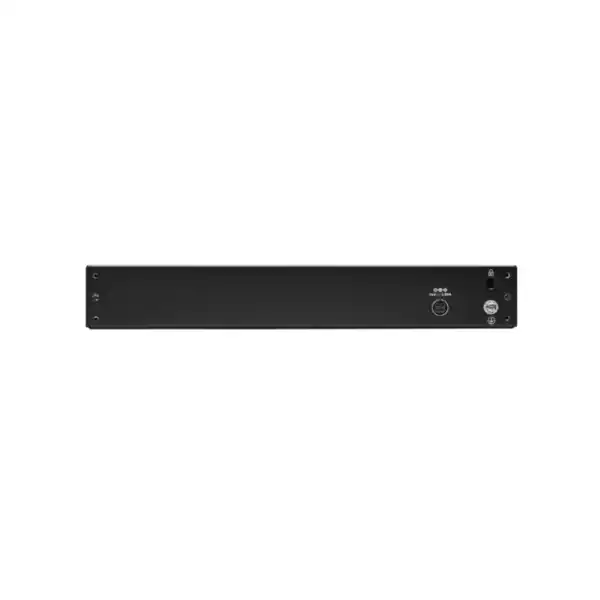
| Dimensions | 43.7 mm H × 294.8 mm W × 201.05 mm D; 2.305 kg | Compact form factor, but rack placement, power access and cable bend radius still need planning. |
| Operating environment | 0°C to 40°C; 10% to 90% RH noncondensing | Dubai installations should keep the device in a controlled indoor network space that remains inside the published environmental limits. |
EdgeConnect SD-WAN Orchestrator and day-to-day management
The EC-10106 is not intended to operate as an isolated box that must be configured independently at every branch. HPE’s EdgeConnect architecture uses SD-WAN Orchestrator for centralized configuration, monitoring and management across multiple gateways. The platform can apply business-intent policies, build secure overlays, segment traffic and provide centralized visibility. For IT teams managing many UAE branches, this reduces the operational inconsistency that often develops when every site is managed with local CLI changes and one-off routing decisions.
For appliance-level administration, EdgeConnect Operating System provides a web interface and REST API, while the EC-10106 also supports a full-featured CLI over console or SSH. HPE documents SNMPv3, SSH and HTTPS secure access, secure syslog with configurable levels, email alerts, local database authentication, RADIUS and TACACS+. Real-time and historical graphing, NetFlow and IPFIX are also supported. These functions matter during procurement because the branch gateway has to fit the organization’s existing monitoring, AAA and logging standards, not simply pass traffic.
Before migration, decide where logs will be collected, which administrators need access, how authentication will integrate with corporate identity services, and whether the operations team requires API integration. A technically successful cutover can still create operational risk if monitoring and access-control workflows are left for later.
Licensing is part of the product decision
EdgeConnect SD-WAN software is subscription licensed. HPE currently documents Foundation and Advanced cloud-hosted subscription tiers, with bandwidth-based term licensing, and also documents an On-Prem option for customers that host Orchestrator in their own environment. The hardware purchase alone therefore does not define the finished solution. The selected subscription determines available bandwidth tiers and access to specific SD-WAN capabilities.
Foundation is aimed at essential SD-WAN use cases and includes a cloud-hosted Orchestrator service. Advanced expands available functionality and flexibility, including broader topology, VRF and business-intent capabilities. HPE also lists optional feature add-ons such as WAN Optimization and Dynamic Threat Defense or advanced security functions. Because licensing evolves over time, the quotation should use the current HPE ordering and subscription rules rather than an old bill of materials.
For the EC-10106, do not buy a higher software bandwidth tier on the assumption that it turns the appliance into a higher-throughput model. Hardware platform capacity still matters. If branch demand is moving beyond the 1 Gbps class, compare the 10108 or a larger gateway instead.
Important resilience limitation
HPE lists a single power adapter for the EC-10106. That is a significant design point for sites with strict uptime requirements. Multiple WAN links can improve carrier resilience, and routing or overlay mechanisms can improve path resilience, but they do not eliminate the appliance or power-supply failure domain of a single physical gateway.
Where the branch cannot tolerate a gateway outage, evaluate a dual-appliance high-availability design and separate power paths rather than assuming that link redundancy alone is equivalent to device redundancy. The final architecture should also consider switch-side connectivity, VRRP or BGP design, upstream carrier diversity and whether the rack has independent protected power feeds.
This is one of the main reasons the 10106 should be selected as part of a branch architecture rather than as an isolated SKU. Availability objectives determine whether one compact gateway is enough or whether the site needs duplicated hardware.
When the EdgeConnect 10106 is a strong fit
Small office with dual internet
A branch using two broadband circuits can use business-intent policies to steer applications and maintain service when one transport deteriorates or fails, subject to the overall capacity and license design.
Hybrid MPLS and internet
Organizations retaining MPLS for selected traffic while introducing internet-based connectivity can use EdgeConnect overlays to make transport choice policy-driven instead of application-blind.
Fibre-equipped branch
The 1G/10G SFP+ interfaces and combo ports suit branches where carrier or LAN handoffs require fibre. Compatible optics must be selected according to the actual media and distance.
EdgeConnect estate expansion
Existing EdgeConnect customers can add a smaller branch while retaining the same centralized operational model, provided software versions, licensing and policy design are planned consistently.
Branch segmentation
With support for multiple VLANs, routing and EdgeConnect segmentation capabilities, the gateway can participate in designs that separate corporate, guest, IoT or other traffic classes according to policy.
SASE transition
EdgeConnect SD-WAN can integrate with HPE Aruba Networking SSE and third-party SSE providers, allowing the branch WAN design to support a broader secure-access architecture rather than operating only as a transport router.
Installation and migration planning in Dubai
Confirm rack or shelf placement, AC power, grounding, cable routing and ventilation. The published operating limit is 0°C to 40°C, so hot or poorly ventilated communications closets need attention before installation.
Identify each ISP or MPLS handoff, LAN uplink, management connection and fibre optic requirement. Combo ports should be assigned deliberately so copper and SFP requirements do not conflict during cutover.
Select the subscription tier and bandwidth level against actual WAN demand. Add optional optimization or advanced security only where the branch design requires those functions.
Define business-intent overlays, segmentation, routing, link priorities, security policy and monitoring before the change window. Zero-touch provisioning is most effective when the central configuration is already validated.
Document the current router or firewall dependencies, public addressing, BGP or OSPF neighbours, VLANs, NAT ownership and DNS or DHCP dependencies. A rollback path should be available until application tests are complete.
After routing is established, test voice, SaaS, ERP, VPN, internet breakout and critical branch applications under normal and failover conditions. Path steering should be verified with real traffic rather than assumed from link status alone.
Dubai and UAE deployments often combine several carrier handoff types across different buildings and branch sizes. Standardizing on EdgeConnect can simplify policy, but the physical installation remains site-specific. Optics, patch leads, rack kits, power arrangements and local carrier demarcation should be confirmed for each location. HPE’s ordering information identifies accessories for the EC-10106/10108 family, including a 54 V power adapter and accessory kit; the exact package and regional orderable should be checked in the final quotation rather than assumed from another country’s listing.
10104 vs 10106 vs 10108: choosing branch headroom
| Model | Typical HPE positioning | Typical WAN bandwidth | Selection guidance |
|---|---|---|---|
| EdgeConnect 10104 | Small branch / home office | Up to 500 Mbps | Evaluate when the site is clearly below the 10106 capacity class and does not need its interface mix. |
| EdgeConnect 10106 | Small branch | Up to 1,000 Mbps | Balanced option for a small branch that needs up to 1 Gbps and the EC-10106 copper/fibre port flexibility. |
| EdgeConnect 10108 | Medium branch | Up to 2,000 Mbps | Evaluate when current or near-term WAN demand could push beyond 1 Gbps or when extra platform headroom is strategically important. |
A branch running 700–800 Mbps today may technically fit the 10106, but a growth plan to add a second high-speed circuit, local cloud breakout or heavier inline security could reduce comfortable headroom. Conversely, a 100–200 Mbps branch with modest requirements may not need the 10106 at all. Selecting the correct model means balancing present demand, growth, interface needs, feature mix and resilience rather than automatically choosing the largest appliance available.
Procurement details that can change the final quotation
HPE’s current EC-10106 data sheet lists several orderable identifiers, including S0E22A for the standard EC-10106 SD-WAN gateway, S0E24A for an NFR version and S3N71A for a NAL variant. These are manufacturer ordering references, not substitutes for the FourTeck product-page SKU. Regional availability and package contents should be confirmed for the UAE because not every country-specific orderable is intended for every market.
Optics are another common source of incomplete quotes. The appliance provides SFP and SFP+ capable interfaces, but the required transceivers depend on the service-provider handoff, fibre type, wavelength and distance. HPE specifically directs buyers to its supported-transceiver guidance. A fibre circuit described only as “1G” is not enough information to select the correct optic.
The software subscription must also match the intended design. The quote should state the bandwidth tier, subscription tier, term and any optional feature licenses. If the branch needs WAN Optimization or advanced security features, those requirements should be made explicit rather than assumed to be included with every hardware purchase.
Finally, clarify installation responsibility. Hardware supply only, remote configuration, on-site rack installation, migration from an existing router, policy conversion, carrier coordination and post-cutover testing are different scopes of work. A complete bill of materials is much more accurate when technical services are defined at the same time as hardware and licensing.
Security considerations
The EC-10106 supports encrypted IPsec overlays using AES-256, AES-128 disk encryption and zone-based stateful firewall capabilities. HPE also publishes IDS/IPS throughput for the platform and offers advanced security functions through appropriate licensing. Buyers should decide whether the EdgeConnect appliance will act as the primary branch security enforcement point, work alongside an existing firewall, or steer traffic to cloud-delivered security services.
That architectural decision affects traffic flow, NAT ownership, inspection placement and failure domains. It should be made before implementation rather than during the cutover window.
SASE and cloud access
HPE positions EdgeConnect SD-WAN as part of its broader SASE strategy. The platform integrates with HPE Aruba Networking SSE and also supports integration with third-party SSE providers. For organizations moving more applications to SaaS and cloud services, this enables a branch design in which path selection and secure access are coordinated rather than managed as unrelated projects.
A SASE plan should identify which traffic exits locally, which traffic is tunnelled to security services, where inspection occurs, and what happens during cloud-security or transport outages.
Common buyer questions
Can the EC-10106 handle a 1 Gbps internet circuit?
HPE states WAN bandwidth up to 1,000 Mbps bidirectionally. A design should still account for security mode, optimization, traffic pattern and future growth. A site that must sustain near-maximum throughput with little headroom may justify evaluating the 10108.
Does it support fibre?
Yes. The EC-10106 includes two 1G/10G SFP+ ports and two combo ports that can use RJ45 or SFP. The supported transceiver must match the actual fibre environment and HPE compatibility guidance.
Is PoE built in?
The two Gigabit RJ45 data ports provide PoE support, and HPE highlights support for connected devices up to 60 W. Confirm the planned endpoint and power requirement before relying on the gateway to power branch devices.
Does the hardware include all SD-WAN software?
The solution uses term-based software licensing. Subscription tier, bandwidth level and optional features are commercial choices that must be included in the solution design and quotation.
Can it be centrally managed?
Yes. EdgeConnect SD-WAN Orchestrator provides centralized configuration, monitoring and management for multiple EdgeConnect gateways. Appliance-level web, API and CLI management are also available.
Is it suitable for an uncooled outdoor cabinet?
The published operating temperature is 0°C to 40°C with noncondensing humidity limits. Outdoor or poorly conditioned locations that can exceed those limits require an environmental solution or a different deployment approach.
Decision recap for the HPE Aruba EdgeConnect 10106
Best aligned to small branches that remain within the 1 Gbps WAN class.
Confirm copper, SFP and SFP+ handoffs plus required supported optics.
Specify subscription tier, WAN bandwidth, term and optional features.
A single power adapter makes hardware-availability design an explicit decision.
Keep deployment within the published 0°C to 40°C operating range.
Map routing, VLANs, NAT, monitoring, carrier handoffs and rollback before cutover.
What FourTeck needs for an accurate Dubai quotation
Confirm the right EC-10106 design before you order
For a useful quotation, match the HPE Aruba Networking EdgeConnect 10106 hardware to the branch’s real WAN demand, EdgeConnect subscription, optics, security features and resilience target. FourTeck can review those inputs and prepare a Dubai/UAE supply and deployment proposal without over-sizing the branch or leaving required licenses and accessories out of the bill of materials.

Reviews
There are no reviews yet.