
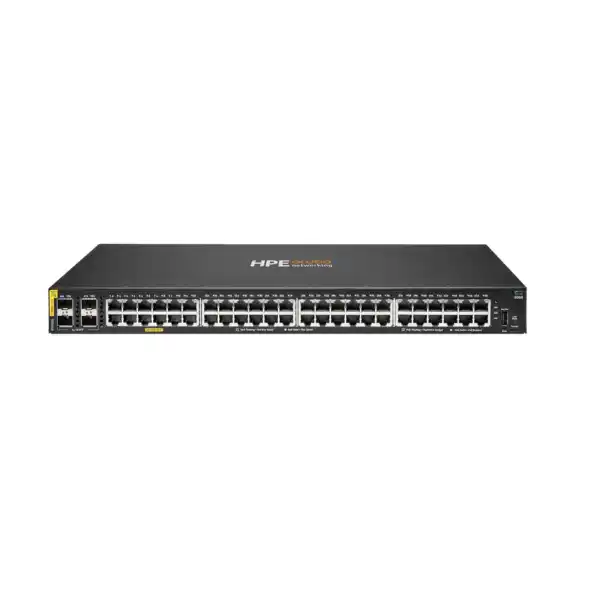
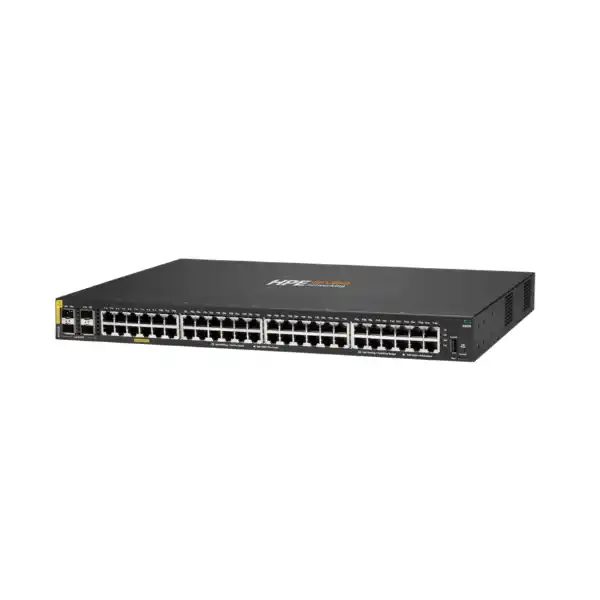
HPE Aruba Networking CX 6000 48G Class4 PoE 4SFP 740W Switch (R9Y03B)
A 48-port managed Gigabit access switch for organizations that need dense PoE+ connectivity, four 1G SFP uplinks and the consistent AOS-CX operating model across the HPE Aruba Networking CX portfolio.
What buyers should know first
The HPE Aruba Networking CX 6000 R9Y03B is an entry-level enterprise access switch intended for branch, midsize and small-enterprise wired networks. Its main role is to connect users and powered edge devices through 48 Gigabit Ethernet Class 4 PoE ports while providing four 1G SFP uplinks to the upstream network. It is a strong candidate when many phones, access points, cameras or IoT devices must be powered from one switch. The most important points to confirm are the total PoE requirement and whether 1G SFP uplinks meet the design. FourTeck can help calculate the power budget, review transceiver and cabling choices, determine the required management approach and prepare an appropriate bill of materials for a UAE deployment.
Where the CX 6000 R9Y03B fits
The CX 6000 family is positioned by HPE Aruba Networking as an entry-level access switching platform for branch offices, midsize businesses and small enterprises. The R9Y03B is the high-PoE 48-port member for environments where endpoint density and power draw are both significant. It runs AOS-CX, giving administrators a management experience aligned with the broader CX switching portfolio.
Typical uses include user access switching, IP telephony, Wi-Fi access point connectivity, IP surveillance and IoT aggregation. Because the switch combines 48 copper access ports with a 740W PoE model designation, it can reduce the need for separate power injectors when the connected devices remain within the supported IEEE 802.3af/802.3at power classes and the switch’s overall power budget.
Verified technical specifications
| Manufacturer | HPE Aruba Networking |
|---|---|
| Exact model / part number | R9Y03B |
| Product family | HPE Aruba Networking CX 6000 Switch Series |
| Copper access ports | 48 × 10/100/1000BASE-T Class 4 PoE |
| PoE standards | IEEE 802.3af and IEEE 802.3at |
| Uplink ports | 4 × 1G SFP |
| Console / host interfaces | 1 × USB-C console, 1 × USB Type-A host |
| Switching capacity | 104 Gbps |
| Throughput | 77.3 Mpps |
| Average latency | 1.9 µs at 1 Gbps, LIFO, 64-byte packets |
| Memory / storage | 2 GB DDR3, 8 GB eMMC, 128 MB Flash ROM |
| MAC table | 8,192 entries |
| Switched virtual interfaces | 16 dual-stack SVIs |
| Power supply | Fixed 950W power supply |
| Cooling | Fixed fans |
| Dimensions | 4.39 cm H × 44.25 cm W × 30.44 cm D |
| Configuration weight | 4.33 kg |
Specifications should be matched to the exact R9Y03B part number. Transceivers, subscriptions, accessories and project services are separate considerations unless specifically included in a quotation.
Dense PoE access
All 48 copper access ports support Class 4 PoE, allowing the switch to carry both data and power for compatible endpoints. Buyers should total the maximum expected draw of phones, cameras and wireless APs rather than selecting solely by port count.
Four 1G SFP uplinks
The four SFP interfaces support 1G fiber or compatible SFP connectivity. This is useful for common access-to-distribution links, but designs requiring 10G uplinks should evaluate a higher CX family instead of assuming SFP+ capability.
AOS-CX operations
The switch uses the programmable AOS-CX operating system. HPE Aruba Networking Central supports the CX 6000 platform, subject to supported software versions and the applicable Central subscription or licensing arrangement.
Product-fit matrix
| Requirement | Suitable when | Confirm before ordering |
|---|---|---|
| High port density | Up to 48 Gigabit copper edge connections are required in one access switch. | Actual active port count, growth allowance and rack position. |
| PoE-powered endpoints | Many 802.3af/at devices must be powered centrally. | Per-device wattage, simultaneous load and PoE headroom. |
| Fiber uplinks | 1G SFP uplinks are sufficient for the access design. | Fiber type, distance, optic compatibility and whether 10G is required. |
| Centralized operations | The organization wants AOS-CX consistency and may use HPE Aruba Networking Central. | Software version, management architecture and subscription requirements. |
When another CX model should be evaluated
The R9Y03B is not automatically the right choice for every 48-port deployment. A 370W CX 6000 model may be more economical where the connected PoE load is modest. A 24-port model may suit smaller branches with limited growth. If the design requires 10G uplinks, stacking, higher Layer 3 scale, more advanced resiliency or broader campus aggregation capabilities, compare the requirement with higher CX series such as the CX 6200 family rather than treating the CX 6000 as a direct substitute.
Management, licensing and integration considerations
The CX 6000 uses AOS-CX and can be managed according to the selected operational model. HPE documentation lists the CX 6000 as a supported platform in HPE Aruba Networking Central. Central functionality is subscription dependent, so the switch hardware and any required management subscriptions should be quoted separately and matched to the intended term and platform.
Before deployment, confirm VLAN design, IP addressing, uplink topology, SFP type, authentication requirements, endpoint power classes and firmware policy. If the switch will join an existing HPE Aruba Networking environment, software compatibility and management conventions should also be reviewed before migration or replacement work begins.
Deployment considerations for UAE businesses
- Calculate the PoE requirement: list every powered endpoint and its maximum expected consumption, then retain reasonable headroom.
- Validate uplinks: confirm whether 1G SFP links are sufficient and select optics appropriate to fiber type and distance.
- Plan rack and power: account for the 44.25 cm width, 30.44 cm depth, fixed 950W power supply and fixed cooling arrangement.
- Agree the management model: decide whether local administration, HPE Aruba Networking Central or another supported operational workflow will be used.
- Define configuration scope: include VLANs, uplinks, PoE policies, access controls, monitoring and handover requirements in the project plan.
Procurement checklist for R9Y03B
- Exact R9Y03B part number and quantity
- Current endpoint count and expected growth
- Total PoE wattage required
- 1G SFP uplink quantity
- Fiber type and distance
- Required compatible transceivers
- Rack space and installation conditions
- Available power and UPS capacity
- AOS-CX software policy
- HPE Aruba Networking Central requirement
- Configuration and migration scope
- Support and delivery coordination requirements
How FourTeck can assist
FourTeck can review the port count, PoE load, uplink requirement, compatible optics, management approach and deployment scope before quotation. This helps reduce the risk of ordering a switch with insufficient power capacity or unsuitable uplink capability.
For broader infrastructure planning, visit FourTeck technology services or browse business technology products.
UAE availability guidance
Availability can depend on the exact model, quantity, vendor lead time and project schedule. Contact FourTeck to confirm current UAE availability for R9Y03B. Delivery coordination, transceiver requirements and installation or configuration scope can be included in the quotation where required.
Frequently asked questions
Does the R9Y03B provide PoE on all 48 access ports?
Yes. HPE specifies 48 10/100/1000BASE-T Class 4 PoE ports supporting IEEE 802.3af and 802.3at. The total endpoint load must still be checked against the switch’s available PoE budget.
Are the uplinks 10 Gigabit?
No. The R9Y03B is specified with four 1G SFP uplink ports. If 10G SFP+ uplinks are required, a different CX model or family should be evaluated.
Can the CX 6000 be managed through HPE Aruba Networking Central?
Yes, HPE lists the CX 6000 as a supported AOS-CX platform in Central. Supported software versions and the applicable management subscription should be confirmed for the intended deployment.
What should be confirmed before requesting a quotation?
Provide the required quantity, port count, powered-device list, expected PoE draw, uplink media and distance, management preference, required transceivers, installation location and configuration scope.
Is the 740W model necessary for every 48-port deployment?
No. The higher PoE capacity is most useful when many endpoints draw meaningful power. Where overall PoE consumption is lower, a 370W variant may meet the requirement more economically.
Is current Dubai or UAE stock guaranteed?
No. Current availability, lead time and quantity should be confirmed at the time of quotation. FourTeck can coordinate the requirement after the exact model and deployment scope are established.
Confirm the switch, PoE budget and uplink design
Share your endpoint count, PoE requirements, uplink distances and management preference so FourTeck can help prepare an accurate R9Y03B quotation and deployment scope.

Reviews
There are no reviews yet.