
HPE Aruba Networking CX 6200 Series • Dubai & UAE
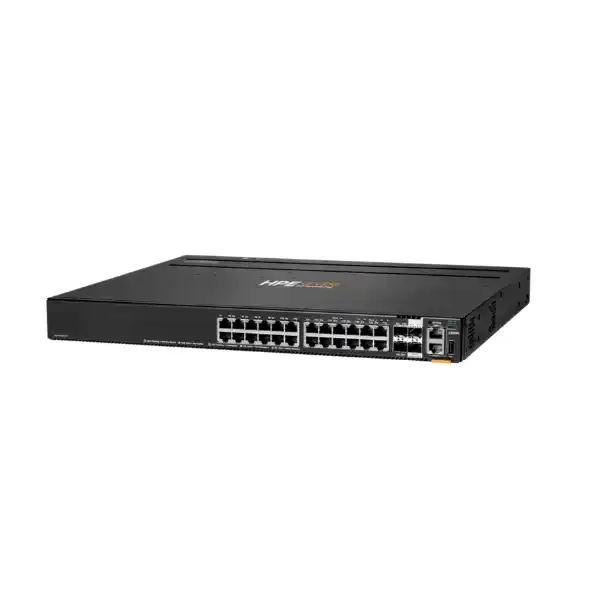
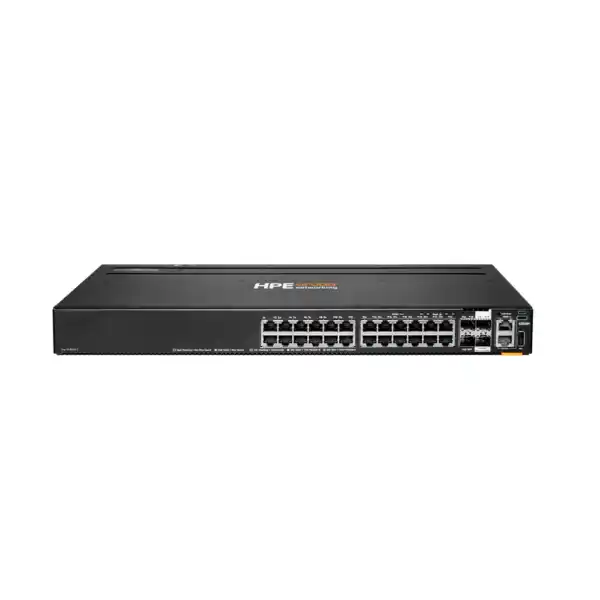
HPE Aruba Networking CX 6200M 24G Class4 PoE 4SFP+ Switch R8Q68A
A modular, stackable access switch built for organizations that need 24 Gigabit Ethernet PoE access ports, 10GbE-capable uplinks, flexible management and a power architecture that can be sized to the actual endpoint load. The R8Q68A is particularly relevant when a branch, office floor, school, hospitality site or campus access layer needs reliable wired connectivity for users and powered edge devices without moving immediately to a 48-port access switch.
Up to 30W per access port, subject to the selected PSU and total PoE budget.
Useful for fiber uplinks, aggregation connectivity or front-plane VSF stacking.
VSF can simplify operation where several compatible CX 6200 switches are deployed together.
A supported power supply is required and ordered separately; size it to the real PoE demand.
Direct answer: what is the CX 6200M 24G PoE switch?
The HPE Aruba Networking CX 6200M 24G Class4 PoE 4SFP+ Switch R8Q68A is a stackable enterprise access switch with 24 Gigabit Ethernet PoE ports and four 1/10GbE SFP+ interfaces. It is mainly used to connect and power edge devices while providing managed Layer 2/3 access, uplink capacity, segmentation and centralized or local administration. It suits organizations that need a 24-port PoE access layer and want modular power rather than a fixed-power design. The most important item to confirm before ordering is the complete bill of materials: switch, PSU, PoE budget, optics or DACs, stacking plan and management subscription if HPE Aruba Networking Central will be used. FourTeck can review those dependencies before a UAE quotation is prepared.
Why R8Q68A is a distinct choice in the CX 6200 family
R8Q68A is not simply a 24-port switch with PoE added as an afterthought. Its purchasing logic is defined by the combination of 24 Class 4 PoE access ports, four SFP+ uplink interfaces and the modular 6200M power architecture. That combination is useful when an organization wants to keep the access-port count at 24 while retaining flexibility around power supply selection and hardware resiliency. In a branch office or single-floor deployment, this can avoid purchasing unused access ports while still giving the network team 10GbE-capable uplink options and a path to stack additional compatible CX 6200 units.
The switch sits at the access layer rather than being positioned as a high-density core platform. Its 24 copper ports are 10/100/1000BASE-T, so endpoint connectivity is Gigabit Ethernet rather than multi-gigabit Smart Rate. For ordinary desktops, phones, printers, building devices and many cameras this may be entirely appropriate. For current or planned wireless access points that require 2.5GbE, 5GbE or higher copper access speeds, a Smart Rate model should be evaluated instead of assuming that a 1GbE access port will meet the application requirement.
The four SFP+ ports support 1GbE or 10GbE operation. That gives the design team choices for uplinks to an aggregation layer, fiber links between communications rooms, or VSF stacking. However, these are shared physical resources in the design. If some SFP+ ports are allocated to stacking, the number remaining for other uplinks changes. A correct design therefore considers uplink count, redundancy, stack topology and transceiver type together rather than treating the four SFP+ interfaces as four permanently free uplinks.
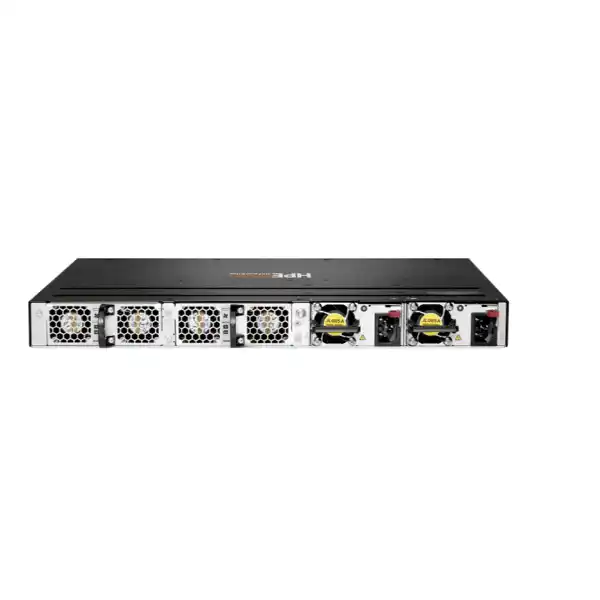
The modular power design is another meaningful difference from fixed-power alternatives. The switch chassis requires at least one supported power supply and that power supply is ordered separately. This makes the PSU an essential BOM item, not an accessory that can be decided after the switch arrives. HPE supports the JL086A and JL087A supplies for this PoE model. The lower-power JL086A can provide up to 370W of PoE power, while JL087A can provide up to 740W. Because 24 ports at the per-port maximum could represent a substantial aggregate demand, endpoint power calculations should be completed before choosing the supply configuration.
Verified technical specifications for R8Q68A
The values below are model-specific to the HPE Aruba Networking CX 6200M 24G Class4 PoE 4SFP+ Switch R8Q68A. They are intended to help with shortlisting and BOM planning. Final quotations should still confirm the exact regional item, power supply, optics, software release and support terms because vendor documentation and ordering combinations can change over the product lifecycle.
| Manufacturer | HPE Aruba Networking |
|---|---|
| Exact model | CX 6200M 24G Class4 PoE 4SFP+ Switch |
| Manufacturer product number | R8Q68A |
| Access interfaces | 24 × 10/100/1000BASE-T Class 4 PoE ports |
| Per-port PoE | Up to 30W per access port; IEEE 802.3af and 802.3at |
| Uplink interfaces | 4 × 1/10GbE SFP+; HPE documentation identifies 2 × LRM and 2 × LRM/MACsec 256 capability |
| Other interfaces | RJ-45 console, USB-C console, OOBM and USB Type-A host port |
| Switching capacity | 128 Gbps |
| Throughput | Up to 95.2 Mpps |
| Published latency | 1Gbps: 2.28 µs; 10Gbps: 1.46 µs in current HPE digital data sheet |
| Processor | Quad-core Arm Cortex-A72 at 1.8 GHz |
| Memory / flash | 8 GB DDR4 / 16 GB eMMC |
| Stacking | VSF, up to 8 members; 40 Gbps stacking bandwidth is published for the 24-port 6200M model |
| Maximum stacking distance | Up to 10 km with appropriate long-range transceivers, subject to supported optics and design |
| Power supplies | Two PSU slots; minimum one PSU required and ordered separately; supported PoE PSU options include JL086A and JL087A |
| PoE budget | Up to 370W with JL086A or up to 740W with JL087A, subject to supported configuration |
| Input voltage | System documentation lists 100–120V / 200–240V; PSU-specific input ranges must be checked for the selected supply |
| Published power consumption | 76W at 230 VAC in HPE’s current digital data sheet; facility planning must also account for PoE load |
| Dimensions | 4.4 cm high × 44.2 cm wide × 38.5 cm deep |
| Weight | Approximately 5.8 kg; HPE documentation revisions show minor configuration-weight variation |
| Operating temperature | 0°C to 45°C up to 5,000 ft, with altitude derating; short-duration excursion limits are documented by HPE |
| Management | HPE Aruba Networking Central, Web GUI, CLI and HPE Aruba Networking Switch Multi-Edit Software |
| Warranty guidance | HPE currently lists limited lifetime warranty; exact regional terms and support entitlement should be confirmed for the quoted item |
Note: official HPE documents can differ slightly as hardware documentation is revised. For example, recent material has not always described fan implementation identically. FourTeck should therefore validate the current R8Q68A BOM and installation documentation at quotation stage rather than treating a historical accessory list as guaranteed for every shipment.
24 Gigabit PoE ports: what the access layer can support
The 24 copper access ports are designed for ordinary Gigabit Ethernet edge connections. Each port supports Class 4 PoE up to 30W, covering IEEE 802.3af and IEEE 802.3at powered-device classes. In practical terms, that makes the switch relevant to many office IP phones, standard PoE wireless access points, compatible surveillance cameras, door-access controllers and other Ethernet-powered endpoints. The phrase “up to 30W per port” describes the per-port capability; it does not guarantee that every port can simultaneously deliver 30W under every PSU choice. Total available PoE power is determined by the installed power supply configuration and the switch’s supported power budget.
This distinction matters during sizing. Twenty-four devices drawing 8W each represent a very different power requirement from twenty-four devices approaching 25W or 30W. A network diagram that counts ports but ignores endpoint wattage can produce a switch that has enough Ethernet interfaces yet an insufficient power budget. FourTeck can review the planned endpoint models or their maximum power requirements, apply an engineering margin, and then determine whether the 370W or 740W PoE option is more appropriate.
The 1GbE port speed should also be reviewed against the endpoint’s data requirement. Many phones and cameras do not need multi-gigabit throughput, so 1GbE may be more than adequate. Modern high-performance wireless access points are different: some can benefit from 2.5GbE or higher wired uplinks. If the project’s wireless design includes multi-gigabit AP Ethernet interfaces, selecting R8Q68A only because it has PoE would create a performance mismatch. A Smart Rate CX model should be compared where access-side bandwidth above 1GbE is a requirement.
For mixed-device access networks, the switch remains attractive because port-level PoE can remove local power adapters and simplify cabling. That benefit is operational rather than absolute: structured cabling must still meet the required Ethernet standards, cable length and environmental conditions; endpoint power compatibility must be checked; and critical devices may justify UPS-backed switch power. A PoE design is strongest when power, cabling, switch capacity and resilience are planned as one system.
JL086A: moderate PoE demand
HPE identifies JL086A as an X372 54VDC 680W power supply for applicable PoE switches, with up to 370W of PoE power. It can be appropriate where the endpoint power calculation sits comfortably below that budget. The decision should be based on actual device wattage plus growth allowance, not on a desire to minimize PSU cost alone.
JL087A: higher PoE budget
JL087A is the higher-capacity X372 54VDC 1050W supply option documented for R8Q68A and can provide up to 740W of PoE power for this model. It is the relevant choice when the deployment has a high aggregate powered-device load or needs greater headroom, subject to the final supported configuration and facility power design.
Four 1/10GbE SFP+ ports for uplinks and VSF design
R8Q68A includes four 1/10GbE SFP+ interfaces. At the access layer these interfaces can connect the switch to upstream aggregation equipment, provide fiber links between racks or communications rooms, or participate in HPE Aruba Networking Virtual Switching Framework stacking. Because the interfaces can operate at 1GbE or 10GbE, the exact optic or direct-attach cable must be matched to the link speed, distance, fiber type and peer interface.
HPE documentation identifies two of the SFP+ ports as LRM capable and two as LRM/MACsec 256 capable. Buyers should not infer that every transceiver type or every encryption design is automatically supported. The correct transceiver matrix, AOS-CX release and deployment topology should be checked before ordering optics. This is especially important when the switch must connect to existing non-Aruba equipment, when long fiber distances are involved, or when MACsec is part of a formal security requirement.
For stacking, the CX 6200 family uses front-plane VSF through SFP+ ports. This avoids a proprietary rear stacking module but introduces a design trade-off: ports allocated to VSF are no longer available for ordinary uplink use. A two-switch design, for example, may use links between the members while still requiring resilient upstream connectivity. The exact number of physical SFP+ ports consumed depends on the stack topology and redundancy objectives. This is why the switch count, stack topology and upstream design should be completed before transceivers are quoted.
The platform supports stacks of up to eight compatible members and HPE publishes 40 Gbps stacking bandwidth for the 24-port CX 6200M model. HPE also documents a maximum stacking distance of up to 10 km with suitable long-range transceivers. “Up to 10 km” should be treated as a supported design ceiling under the right optics and link conditions, not as a guarantee for any fiber plant. Optical budget, connector loss, fiber specification, transceiver support and peer configuration still need validation.
Stack compatibility also deserves attention in mixed CX 6200 deployments. HPE’s current guidance allows stacking with compatible 24-port and 48-port CX 6200F and CX 6200M switches, while the 12-port CX 6200F models are excluded from this stack relationship. If an organization intends to reuse existing CX 6200 equipment, the precise part numbers and software versions should be listed during design review rather than relying only on family names.
Management choices: local operation or HPE Aruba Networking Central
The CX 6200M can be administered through several methods, including the AOS-CX Web GUI, command-line interface, HPE Aruba Networking Switch Multi-Edit Software and HPE Aruba Networking Central. This flexibility matters because organizations do not all operate access switches in the same way. A small IT team may prefer centralized cloud visibility across multiple offices, while an organization with established on-premises network procedures may keep day-to-day configuration in CLI or local tools.
HPE Aruba Networking Central is a subscription-based management platform. For AOS-CX switches, current Central licensing includes Foundation and Advanced switch license types, with capabilities differing by tier. If Central is selected, the correct switch license should be included for each managed device. HPE also specifies that all switches in a stack need appropriate Central licensing when the stack is managed by Central. This makes license quantity a direct function of the physical switch count, not merely the number of logical stacks.
Central is not the only way to administer the R8Q68A. The switch also supports local Web GUI and CLI management. That distinction is useful for buyers who want the hardware without immediately committing to cloud management, or for sites with specific operational policies. However, the chosen management method influences workflows, monitoring, backup practices, role separation and support procedures. It should be documented during implementation rather than left as an informal decision after deployment.
The AOS-CX platform also provides automation and programmability capabilities such as REST APIs, and the CX family incorporates the Network Analytics Engine for telemetry and event-oriented visibility. These features can help skilled network teams standardize changes and troubleshoot issues, but their value depends on how the organization intends to operate the network. A switch does not become “automated” merely because APIs are available; templates, access control, change procedures and monitoring ownership still need to be designed.
FourTeck can help define a management approach before quotation: standalone versus stack, local versus Central-managed operation, subscription term, software compatibility, administrative access, backup expectations and handover requirements. This prevents a hardware-only quote from omitting the software and operational components required by the customer’s intended management model.
Layer 2/3 access, segmentation and network policy
HPE positions the CX 6200 series as a Layer 2/3 access platform for branch, campus and SMB environments. The family supports common enterprise controls including access control lists, quality of service and routing functions such as static and access OSPF routing. For buyers, these capabilities are most useful when translated into a design: VLANs can separate business functions, QoS can prioritize appropriate real-time traffic, ACLs can constrain communication paths, and routing at the access layer can be considered where the network architecture calls for it.
The CX platform also supports HPE Aruba Networking Dynamic Segmentation concepts intended to apply consistent role- and policy-based treatment to users and devices across wired and wireless access. HPE documentation for the family discusses device profiling, role-based access control, application-aware policy and VXLAN-based switch-to-switch tunnels. Whether a particular policy design is appropriate depends on the rest of the HPE Aruba Networking environment, software version, identity services and management architecture. These should therefore be treated as design capabilities rather than automatically active features in a new switch.
For a conventional office access-layer deployment, a simpler configuration may be preferable: defined VLANs, secure management, loop protection, link aggregation, QoS where needed, access policies and redundant uplinks. For a larger campus pursuing role-based segmentation, the R8Q68A can be considered as part of a broader architecture, but the project should include policy design and platform compatibility review. The right level of configuration is determined by business and security requirements, not by the maximum list of functions the operating system can support.
MACsec capability is another example of why exact interface context matters. HPE identifies MACsec 256 support on selected SFP+ ports for this model. If encrypted Ethernet links are a requirement, the peer device, optic type, port selection, software release and configuration should all be validated. It is better to design MACsec explicitly than to assume every uplink automatically gains link-layer encryption.
Where the CX 6200M 24G PoE fits well
| Requirement | Suitable when | Confirm before ordering |
|---|---|---|
| 24-port PoE access layer | The site needs up to 24 primarily 1GbE wired endpoints with PoE on some or all ports. | Endpoint count, expected growth and total PoE wattage. |
| Wireless AP connectivity | The selected APs can operate appropriately on 1GbE copper and within Class 4 PoE limits. | AP Ethernet speed and maximum power requirement; evaluate Smart Rate if multi-gigabit is required. |
| 10GbE fiber uplinks | The access switch needs one or more 10GbE SFP+ links to aggregation or another rack. | Fiber type, distance, transceiver support, uplink redundancy and whether SFP+ ports are also used for stacking. |
| Stacked access deployment | Several compatible 24/48-port CX 6200 switches should be operated as a VSF stack. | Member models, software versions, topology, optics/DACs and remaining uplink ports. |
| Modular power planning | The project benefits from selecting power capacity around endpoint load and resilience requirements. | JL086A versus JL087A, number of PSUs, input power and UPS/PDU capacity. |
| Centralized cloud management | The organization wants HPE Aruba Networking Central for supported monitoring and configuration workflows. | Correct Central switch subscription tier, term and license quantity. |
When another switch should be evaluated
The R8Q68A should not be selected simply because it belongs to the CX 6200 family. A 48-port model may be more economical and operationally cleaner when a rack already requires substantially more than 24 access ports or is expected to grow quickly. Two lightly utilized 24-port switches can provide resilience or distribution benefits in some designs, but buying two only to obtain 48 ports can be less efficient than selecting the correct density from the beginning.
A Smart Rate model should be compared where the access layer must provide 2.5GbE or 5GbE copper connectivity, particularly for higher-performance wireless access points. R8Q68A’s copper access interfaces are Gigabit Ethernet. PoE capability and Ethernet bandwidth are separate design questions; a port can provide adequate power while still being a data-rate bottleneck for a multi-gigabit endpoint.
A higher-tier switch family may also be appropriate where the architecture requires uplinks faster than 10GbE, more advanced campus capabilities, different stacking characteristics, or greater scale. Within HPE Aruba Networking, CX 6300 and other families should be compared against the actual routing, uplink, Smart Rate, redundancy and feature requirements rather than by model number alone.
Conversely, a fixed-power CX 6200F model may be preferable when modular power supplies are unnecessary and a simpler fixed configuration meets the project. The 6200M design adds flexibility, but flexibility has procurement implications: the PSU must be selected and ordered separately, and the BOM must be complete. Buyers who want an uncomplicated fixed configuration should compare the equivalent fixed-power options.
Power, resilience and facilities planning
The switch has two power-supply slots and requires at least one supported power supply. For the PoE R8Q68A, the supported JL086A and JL087A supplies provide different PoE budgets. This modular architecture allows the project to choose a power configuration suited to the endpoint demand, but it also means that the chassis alone is not a complete deployable power configuration. The quote must include the appropriate PSU quantity and region-appropriate power cords or PDU options where applicable.
Power redundancy is a separate design objective from PoE capacity. If business continuity requires a second supply, the electrical design should also consider whether the two PSUs are connected to independent power sources, UPS circuits or PDUs. Installing two supplies on the same unprotected circuit does not create the same resilience as feeding them from genuinely independent sources. The network and facilities teams should agree on the intended failure scenario before specifying redundant power.
PoE load can dominate rack power planning because energy is being delivered through the switch to endpoints. The published 76W figure at 230 VAC should not be treated as the total facility draw under a fully loaded PoE deployment. The power consumed by attached devices and PSU conversion overhead must be considered. For UPS sizing, use the actual switch and endpoint load with a growth margin and the characteristics of the selected PSU, rather than multiplying a single chassis consumption value across the rack.
Thermal planning is equally important in UAE deployments. HPE publishes a normal operating temperature range of 0°C to 45°C up to 5,000 feet, with derating at higher altitude and a documented short-duration excursion capability. These specifications do not remove the need for proper rack ventilation and room cooling. A communications room exposed to sustained high ambient temperature, dust or poor airflow should be corrected as an infrastructure issue rather than relying on excursion limits as an operating target.
HPE documentation revisions have described the fan arrangement differently in some materials. Because this can affect serviceability assumptions, the fan implementation and any optional redundancy parts should be confirmed against the current hardware installation guide and quoted regional BOM. This is a good example of why an exact part number is necessary but not always sufficient for final procurement; current revision documentation still matters.
Deployment considerations for Dubai and UAE business networks
A CX 6200M access deployment starts with the physical environment. The switch is a 1U-class rack device with a width of 44.2 cm, depth of 38.5 cm and height of 4.4 cm. The rack must have sufficient depth, cable management and airflow. Power sockets or PDUs must match the selected PSU and power-cord options. If the switch will power critical phones, access points or cameras, UPS coverage should be considered because a switch power failure can simultaneously remove both data connectivity and endpoint power.
The second design area is structured cabling. All 24 access ports are copper Gigabit Ethernet, so the cable plant should be tested to support the required link speed and PoE load over the deployed distance. High PoE density increases the importance of cable quality, bundle management and termination. For cameras or wireless APs located in warm ceiling spaces or external cabinets, environmental conditions and cable route should be reviewed alongside the switch-side design.
The third area is uplink architecture. A single 10GbE uplink may be enough for a lightly loaded branch, while a business-critical floor may require link aggregation or redundant paths to upstream switches. If VSF is used, stack links also consume SFP+ resources. The design should explicitly show which ports are assigned to stack links, which connect upstream, the optics or DAC type for each link, and how the network behaves if a cable, transceiver, switch or upstream path fails.
The fourth area is software and configuration. VLANs, spanning-tree behavior, link aggregation, routing, QoS, authentication, management access, logging, time synchronization, SNMP or telemetry and backup procedures should be defined before handover. Where HPE Aruba Networking Central is used, device onboarding, subscription licensing, site/group structure and role-based administrative access should be included in the deployment scope. Where local management is used, configuration backup and credential-management procedures remain necessary.
Finally, the deployment should include acceptance testing. PoE endpoints should be checked for power negotiation and stability, uplinks for speed and redundancy, stack members for expected topology, management access for authorized administrators, and VLAN/routing behavior for the agreed use cases. A switch that powers on and passes traffic is not necessarily a completed enterprise deployment. Testing should be tied to the intended business services.
FourTeck can include installation and configuration scope in the quotation where required. The exact scope should identify whether work covers physical rack installation, patching, optics, switch configuration, migration from an existing switch, Central onboarding, testing, documentation and post-change support. This prevents hardware supply and professional services from being mixed into one undefined line item.
Licensing and subscription requirements
The physical switch can be managed through local AOS-CX methods, while HPE Aruba Networking Central is a subscription-based cloud management option. When Central is part of the requirement, the switch subscription must be selected separately from the hardware. Current Central licensing for AOS-CX switches uses switch Foundation and Advanced license types, with different feature scope. Subscription terms and product naming can change over time, so the quotation should use the current HPE licensing catalogue rather than an old part number copied from a previous project.
A stack does not reduce the number of Central device licenses to one. HPE’s Central guidance requires licenses to be assigned to the switches in a managed stack. If a project includes four CX 6200 switches operating as one logical VSF stack, licensing should therefore be planned around the four physical managed devices and the selected subscription term.
The Advanced tier should not be assumed necessary simply because it exists. The correct tier depends on the organization’s use of Central features such as fabric-related capabilities. For many buyers the key decision is whether centralized cloud operations are required at all, and if so which functions the network operations team will actually use. FourTeck can align the subscription choice with the planned management model instead of adding a license tier without a defined operational requirement.
Support entitlement is also separate from cloud-management licensing. HPE’s current product documentation lists limited lifetime warranty for the switch, but warranty and commercial support are not identical. Buyers that need defined technical support, replacement processes or service coverage should confirm the relevant HPE support option and regional terms as part of the quotation.
Practical use cases for the CX 6200M 24G Class4 PoE switch
Branch office access switching
A branch with fewer than 24 wired edge connections can use R8Q68A to consolidate desktops, phones, printers, access points and other IP devices in a managed access layer. The four SFP+ ports provide options for 10GbE connectivity to an upstream switch or router. The modular PSU allows the PoE budget to be selected around the endpoint mix. For a small branch, the key questions are usually port growth, PoE requirement, uplink redundancy and whether the switch will be locally managed or onboarded to Central.
Office floor with IP phones and wireless APs
An office floor may combine user Ethernet ports, desk phones and ceiling-mounted APs. Class 4 PoE can reduce local power adapters and simplify the endpoint installation. Before choosing R8Q68A, the wireless design should verify that each AP’s Ethernet speed is compatible with the switch’s 1GbE copper ports and that the aggregate AP/phone power stays within the selected PSU budget. If the APs require multi-gigabit links, a different access model should be evaluated.
IP surveillance and building-device aggregation
The switch can be considered for compatible PoE cameras and building devices where 1GbE access and up to 30W per port are sufficient. Camera networks should be sized around more than port count: recording traffic, uplink utilization, endpoint power, VLAN/security policy and UPS runtime all matter. High camera density may make 48-port access switching more efficient, while a 24-port model can be appropriate for a smaller zone or distributed floor cabinet.
Education and training facilities
Classrooms and training spaces often need wired users, APs, phones and AV or IoT endpoints. A 24-port stackable switch can support a distributed access design where each closet serves a defined area. VSF can simplify operation when multiple compatible CX 6200 switches are colocated or connected within the supported topology. The procurement team should still confirm port growth and endpoint speed because education wireless refresh projects can quickly introduce multi-gigabit AP requirements.
Hospitality and distributed service areas
Hotels and service venues can use managed PoE access switching for APs, phones, cameras and operational devices in local communications rooms. R8Q68A may fit zones where 24 access ports are sufficient and where 10GbE fiber uplinks are desired. Environmental control and physical security of the communications room are particularly important when the switch powers guest-facing or security-related systems.
Where R8Q68A sits relative to nearby CX 6200 choices
The CX 6200 series includes fixed and modular models with different port counts, PoE capabilities and access-port types. R8Q68A is the modular 24-port Class 4 PoE option. A nearby non-PoE 24-port 6200M model can be considered when edge devices do not need switch-delivered power. The 48-port 6200M Class 4 PoE model is more appropriate when the same rack needs significantly higher copper port density. There are also CX 6200 variants with Smart Rate and higher PoE classes for deployments that require faster copper access or more endpoint power.
The CX 6200F family uses fixed rather than modular power configurations. This can simplify ordering when the required power budget is already known and hardware-level PSU modularity is unnecessary. The CX 6200M family is more appealing when the design values separately selected or redundant power supplies. Neither approach is universally superior; the operational and resilience requirements determine which is more suitable.
If the project requires uplinks beyond 10GbE, greater campus scale, different stacking characteristics or more multi-gigabit access, the CX 6300 family may need to be compared. A higher family should not be selected simply for perceived future proofing, because cost, optics and operational complexity can increase. Likewise, the CX 6200M should not be forced into a design whose performance requirement clearly exceeds its access or uplink characteristics.
FourTeck can compare the required endpoint count, port speed, PoE class, total wattage, uplink speed, stack size, management model and support scope to identify whether R8Q68A remains the right fit. This model-selection exercise is often more valuable than comparing headline switch prices because the wrong density or power design can create follow-on purchases.
What to confirm before requesting a quotation
A precise R8Q68A quote should be based on the full deployment requirement. Supplying only the switch part number can omit essential components such as the PSU, optics and management subscription. The following checklist helps turn a model request into a usable bill of materials.
- Exact model: confirm R8Q68A rather than the non-PoE R8Q67A, a TAA variant, a 48-port model or a similarly named CX 6200F.
- Quantity: identify current switch count and expected near-term expansion so stack and rack design can be evaluated.
- Powered endpoints: list APs, phones, cameras or other PoE devices and their maximum power needs.
- Total PoE budget: calculate normal and peak load plus a suitable allowance for future devices.
- Power supply: determine JL086A versus JL087A and whether a second supported PSU is required for the resilience objective.
- Rack and facility power: confirm rack depth, PDU outlets, UPS capacity, input power and cooling.
- Uplink requirement: specify 1GbE or 10GbE, number of uplinks, link aggregation and redundancy expectations.
- Optics or DACs: specify fiber type, distance and peer equipment so supported SFP/SFP+ components can be selected.
- Stacking: state whether VSF is required, which other CX 6200 models will participate and how stack links should be cabled.
- Management method: choose local Web/CLI workflows or HPE Aruba Networking Central as the intended operational model.
- Central subscription: if cloud management is required, confirm tier, term and license quantity for all managed switches.
- Configuration scope: define VLANs, routing, QoS, authentication, security policy, management access and monitoring requirements.
- Migration: identify the existing switch, planned maintenance window, patching constraints and rollback expectations.
- Project location: provide the Dubai/UAE delivery and installation location for current availability, lead-time and service coordination.
A structured deployment journey
Inventory endpoints and cables
Count current and planned devices, identify which need PoE, record their maximum power, and note any devices that require multi-gigabit Ethernet. Confirm the structured cabling standard and link distances.
Size the PSU and facility power
Choose the supported PSU according to aggregate PoE load and resilience requirements. Check UPS/PDU capacity and whether dual power feeds are needed to meet the intended failure tolerance.
Design uplinks and stacking
Allocate SFP+ ports between VSF links and upstream connectivity, then select supported optics or DACs based on distance, fiber and peer interfaces. Validate the stack member list and software compatibility.
Define management and policy
Choose local or Central-based management, confirm subscription needs, and document the intended VLAN, routing, access-control, QoS, authentication and monitoring configuration.
Install, test and document
Verify PoE delivery, uplink speed, stack behavior, failover where designed, endpoint access, management reachability and configuration backup. Record final port assignments and software information for operations.
High-value buyer questions before ordering R8Q68A
Does the switch include the power supply?
No. HPE specifies that at least one power supply is required and ordered separately for the CX 6200M modular platform. For the R8Q68A PoE model, JL086A and JL087A are supported PSU options. A quotation that includes only the chassis part number is therefore incomplete for a new deployment unless the customer already owns a confirmed compatible supply.
Can all 24 ports provide 30W at the same time?
The per-port capability is up to 30W, but simultaneous delivery is constrained by the total PoE budget. The JL086A option provides up to 370W PoE, while JL087A can provide up to 740W for this model. Because 24 × 30W equals 720W, a high-density near-maximum load requires the higher PoE budget and must still be checked against supported system behavior and actual endpoint requirements.
Does R8Q68A support multi-gigabit copper access?
No; its 24 copper access ports are 10/100/1000BASE-T. If the project includes access points or endpoints that need 2.5GbE, 5GbE or faster copper connectivity, compare a Smart Rate-capable model. The four SFP+ interfaces can run at 10GbE, but they are fiber/DAC-style uplink interfaces rather than multi-gigabit RJ-45 access ports.
Is HPE Aruba Networking Central mandatory?
Central is an available cloud-management option, not the only management method listed for the switch. R8Q68A also supports local Web GUI and CLI operation. If Central is selected, the appropriate subscription license should be included for each managed switch, including each physical member of a managed stack.
Can the SFP+ ports be used for both uplinks and stacking?
They are physical interfaces that can be allocated according to the design, but a port committed to a VSF stack link is not simultaneously a normal upstream uplink. The project should reserve enough SFP+ ports for the desired stack topology and upstream connectivity. Optics or DACs should be selected after that port map is defined.
Can it stack with every CX 6200 switch?
No. HPE documents VSF stacking with compatible 24-port and 48-port CX 6200F and CX 6200M models, while 12-port CX 6200F switches are not included in that stack compatibility. Existing part numbers and AOS-CX versions should be checked before adding a new member.
Is 10GbE uplink capacity enough for the site?
It depends on traffic concentration and resilience requirements. For many 24-port access deployments, one or more 10GbE uplinks provide substantial headroom. High-throughput wireless, video, storage or east-west traffic may justify a different uplink design or higher-tier switch. Utilization targets and failure scenarios should be considered, not only nominal link speed.
What information improves quote accuracy?
Provide endpoint count and wattage, required port speeds, switch quantity, rack location, uplink distances, fiber type, stacking plan, PSU redundancy objective, management method, Central subscription term if needed, installation scope and delivery location. These inputs allow the switch chassis, power, optics, licenses and services to be quoted as one coherent solution.
FourTeck assistance for selection, BOM and deployment
FourTeck can help turn an R8Q68A request into a complete network-access bill of materials. That includes confirming the exact switch model, calculating PoE demand, choosing the supported PSU capacity, identifying SFP/SFP+ optics or DACs, reviewing VSF requirements and checking whether HPE Aruba Networking Central subscriptions are part of the management plan.
Where the switch replaces an existing access layer, FourTeck can also scope migration and configuration assistance. Useful migration inputs include the current switch make/model, VLAN list, trunk or LAG configuration, routing, authentication, management addressing, monitoring system, patch-panel layout and preferred maintenance window. A migration plan should preserve required business connectivity while recognizing that exact procedures depend on the existing design.
For new UAE projects, the quotation can distinguish hardware supply from optional installation, configuration and support services. This keeps the commercial scope clear: a hardware-only requirement should not silently include professional services, while a turnkey deployment should state what installation, testing, documentation and handover activities are expected.
Explore FourTeck business technology products, review network installation and configuration services, or contact FourTeck for product sizing and quotation.
UAE availability and procurement guidance
Contact FourTeck to confirm current UAE availability for the exact HPE Aruba Networking CX 6200M 24G Class4 PoE 4SFP+ Switch R8Q68A. Availability can depend on the exact part number, requested quantity, regional SKU, supported power supplies, optics, subscriptions and vendor lead time. FourTeck does not treat generic CX 6200 family availability as confirmation that R8Q68A and every required accessory are immediately available.
For Dubai or wider UAE projects, provide the required delivery location and target deployment window together with the technical BOM. Installation and configuration scope can be added when required. Warranty and support terms should be confirmed against the exact quoted product and current HPE program rather than assumed from a general family statement.
Related options worth comparing
CX 6200M 24G non-PoE
Consider the non-PoE 24-port modular model when powered endpoints are not required and the access layer is primarily data-only.
CX 6200M 48G Class4 PoE
Compare the 48-port modular PoE model where a single rack needs substantially more copper access ports and higher density is preferable.
CX 6200 Smart Rate variants
Evaluate Smart Rate and higher-PoE variants when access points or other endpoints require multi-gigabit copper speeds or power beyond Class 4.
CX 6300 family
Consider a higher-tier family if the architecture requires faster uplinks, different stacking capabilities, broader multi-gigabit access or additional campus scale.
Frequently asked questions
What is the exact part number for the CX 6200M 24G Class4 PoE 4SFP+ Switch?
The standard HPE Aruba Networking product number is R8Q68A. A TAA-compliant variant uses a different product number, so procurement teams should not treat “CX 6200M 24G PoE” as a complete identifier. The exact R8Q68A should be stated on the requirement when that is the intended model.
How much PoE power can R8Q68A provide?
The access ports support up to 30W per port. HPE supports JL086A and JL087A power supplies for the model; the former can provide up to 370W PoE and the latter up to 740W. The appropriate PSU depends on the aggregate endpoint load, not only the number of connected ports.
Does the switch have 10GbE uplinks?
Yes. It has four SFP+ interfaces that support 1GbE or 10GbE operation. The appropriate transceiver or DAC depends on the link medium, distance and peer equipment. If VSF stacking is used, some SFP+ ports may be allocated to stack links and should not be counted again as free uplinks.
How many CX 6200 switches can be stacked?
HPE documents VSF stacks of up to eight compatible members for this platform. The 24-port and 48-port CX 6200F and CX 6200M models have documented stack compatibility, while 12-port CX 6200F models are excluded from that relationship. Verify exact part numbers and AOS-CX versions before expansion.
Is this switch suitable for Wi-Fi 6 or Wi-Fi 7 access points?
It can power compatible APs within its Class 4 PoE and overall power budget, but suitability also depends on the AP’s wired Ethernet speed. R8Q68A’s copper access ports are 1GbE. If an AP is designed to use 2.5GbE or higher Ethernet, a Smart Rate access switch may be a better fit even when PoE wattage is sufficient.
Can FourTeck configure the switch as part of a UAE project?
Configuration assistance can be scoped when requested. The quotation should define what is required, such as VLANs, trunks, link aggregation, routing, QoS, access controls, Central onboarding, VSF setup, monitoring, testing, migration and documentation. Service scope and schedule depend on the project requirements.
Is the CX 6200M 24G PoE switch currently available in Dubai?
Current availability should be confirmed at the time of quotation. Stock and lead time can vary by exact model, quantity, regional supply, PSU choice, optics and subscription requirements. FourTeck can check the complete requested BOM rather than assuming availability from the series name alone.
Decision recap for R8Q68A
What FourTeck needs to build an accurate switch BOM
Share the information that materially changes the hardware, licensing and service requirement. This reduces the risk of receiving a chassis-only quote when the deployment also needs power supplies, optics, subscriptions or configuration work.
PoE device list & wattage
Uplink speed & distance
Fiber / DAC requirement
VSF stack plan
Central subscription term
Rack & UPS details
Installation / migration scope
Dubai / UAE project location
Confirm the CX 6200M power, uplinks and licensing before you order
FourTeck can review whether R8Q68A is the right 24-port access model, calculate the required PoE budget, confirm the supported PSU choice, map the four SFP+ interfaces to uplinks or VSF, and identify Central subscriptions or deployment services required for the project. Share the endpoint list and site requirement so the quotation reflects the complete operational design rather than only the switch chassis.

Reviews
There are no reviews yet.