
Enterprise access switching • R8Q70A • UAE planning
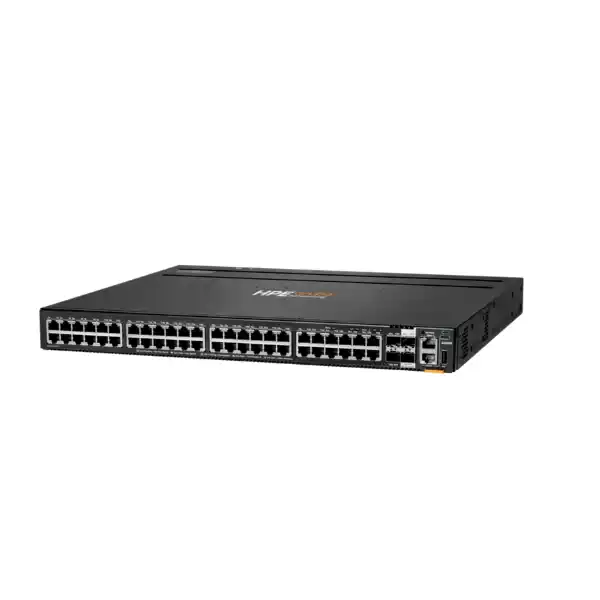
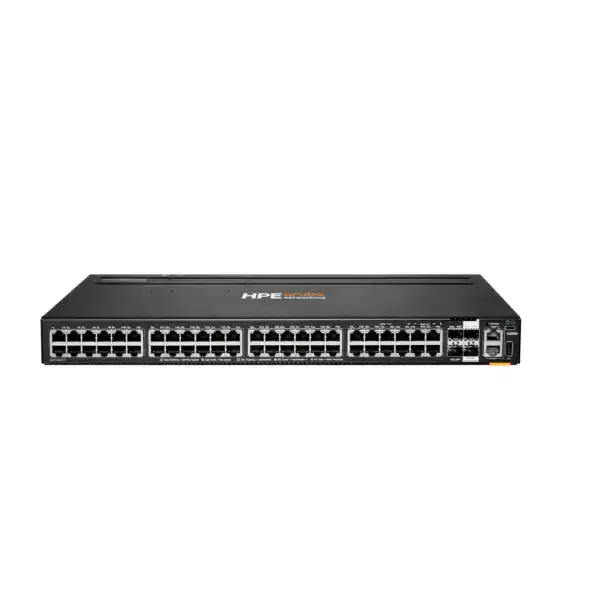
HPE Aruba Networking CX 6200M 48G Class4 PoE 4SFP+ Switch
R8Q70A is a 48-port modular CX 6200 access switch for organizations that need Gigabit edge connectivity, Class 4 PoE for powered endpoints, four 1/10G SFP+ uplinks and a serviceable power design. The most important purchase decision is not simply the port count: the final bill of materials must match the required PoE budget, power redundancy, uplink media, stacking design and management approach.
Direct answer: what is the CX 6200M 48G PoE switch?
The HPE Aruba Networking CX 6200M 48G Class4 PoE 4SFP+ Switch is product R8Q70A, a stackable Layer 2/Layer 3 access switch with 48 Gigabit PoE ports and four 1/10G SFP+ uplinks. It is mainly used to connect and power business edge devices such as wireless access points, IP phones, cameras and other Ethernet endpoints while linking the access layer to upstream switching. It suits branches, campuses and medium-sized enterprise networks that need serviceable power modules and higher PoE flexibility than a fixed-power design. Before proceeding, confirm the total PoE budget and PSU combination. FourTeck can help validate the model, power design, optics, stacking plan, licenses and deployment scope.
What R8Q70A does in an enterprise access network
The CX 6200M 48G Class4 PoE 4SFP+ is designed for the access layer, where user devices, phones, cameras, wireless access points, building systems and other Ethernet endpoints enter the wired network. Its forty-eight copper ports operate at 10/100/1000 Mbps and support IEEE 802.3af and 802.3at Class 4 PoE, allowing network data and electrical power to reach supported endpoints over the same structured cabling. For a buyer, that combination means the switch can consolidate connectivity for a dense floor, branch, department or equipment zone without requiring a separate local power adapter for every PoE-capable endpoint.
R8Q70A is not simply a forty-eight-port patch-panel replacement. The choice matters because it combines edge connectivity with a programmable AOS-CX operating environment, access-layer routing capabilities, policy functions, telemetry, network analytics, stacking and multiple management methods. The switch can be administered locally through the CLI or web interface, integrated with automation workflows, or managed through HPE Aruba Networking Central when the appropriate Central subscription and operational design are selected. Organizations can therefore deploy the same hardware in a conventionally managed environment or include it in a broader Aruba-managed network strategy.
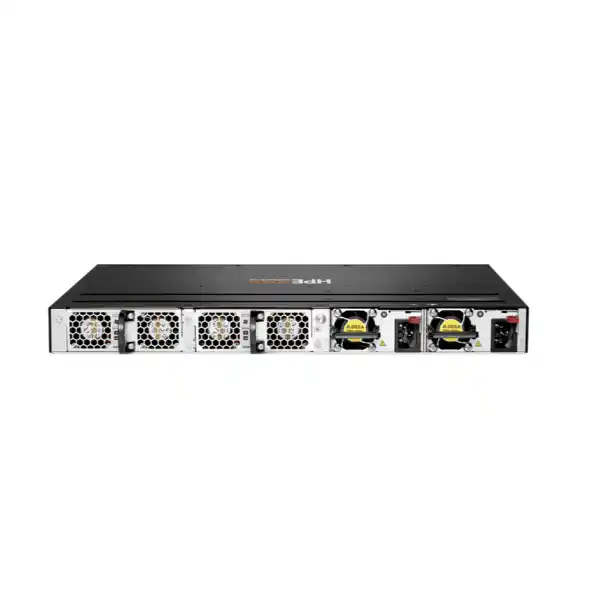
The model is particularly differentiated by its modular hardware approach. CX 6200M models use field-replaceable, hot-swappable power supplies, and R8Q70A provides two PSU slots. One power supply is the minimum requirement and it is ordered separately. A second supported PSU can be used where the design calls for additional PoE capacity, power-supply redundancy or both, depending on the selected PSU and power budget. The switch also has two fan-tray positions. One fan tray is included and required; a second field-replaceable fan tray can be added. This matters for organizations that consider serviceability and hardware resilience part of the access-layer design rather than treating an access switch as an entirely fixed appliance.
The four integrated SFP+ interfaces serve as 1G/10G uplinks and can also be used in supported VSF stacking designs. In a typical building network, these ports can connect R8Q70A to distribution or core switches over fiber. The correct transceiver, fiber type, link distance and upstream interface must be confirmed because an SFP+ slot alone does not determine the optical bill of materials. The same principle applies to stacking: the CX 6200 family can form VSF stacks of up to eight supported 24-port and 48-port CX 6200F and CX 6200M members, but the cabling, port allocation, software level and topology should be designed before installation.
Who should consider the CX 6200M 48G Class4 PoE model?
Branch and office networks
A branch with dozens of desktops, phones, access points and cameras can use the forty-eight access ports as a consolidated edge platform. It is a stronger fit when the branch needs managed routing, segmentation, policy controls, centralized monitoring or stack expansion rather than an unmanaged or lightly managed switch.
Campus access closets
The model can suit wiring closets where multiple user and IoT ports terminate and 10G uplinks connect toward aggregation. VSF allows several compatible CX 6200 switches to be operated as a stack, which can simplify growth and management when port density must expand beyond one chassis.
PoE-heavy edge deployments
Security cameras, IP phones, sensors and access points often create a power budget that is more important than the nominal port count. R8Q70A can deliver up to 30 W per access port and can reach a total PoE capability of up to 1,440 W with the appropriate supported PSU configuration.
Organizations should also consider what the model does not provide. Its forty-eight access ports are standard Gigabit Ethernet Class 4 PoE ports; they are not the 2.5G/5G Smart Rate Class 6 ports found on the CX 6200M 36G 12SR5 Class6 PoE model. A deployment built around multigigabit wireless access points, higher per-port PoE classes or other endpoints that need more than 1 Gbps at the access edge should compare a Smart Rate model rather than selecting R8Q70A solely because it has forty-eight PoE-capable ports.
PoE planning: the most important sizing decision
Every one of the forty-eight access interfaces can provide Class 4 PoE to a compatible powered device, but the switch chassis does not automatically provide a full 1,440 W budget in every order. The available power depends on the installed power-supply configuration. This distinction is essential when quoting R8Q70A because the minimum switch purchase requires a compatible PSU ordered separately, and the chosen PSU directly affects the amount of power that can be reserved for endpoints as well as the resilience strategy.
HPE lists the X372 JL086A 680 W power supply and the X372 JL087A 1050 W power supply as supported for this model. In HPE configuration guidance, one JL086A can provide up to 370 W of PoE budget and two can provide up to 740 W. One JL087A can provide up to 740 W of PoE budget, while a two-JL087A configuration can provide a maximum system PoE budget of up to 1,440 W. Power-supply combinations and regional power-cord requirements should be validated in the final bill of materials; buyers should not assume that two different PSU types can be mixed or that every power design is appropriate for every site.
A useful sizing exercise starts with the endpoints rather than with the headline maximum. Record the number and maximum power requirement of each wireless access point, IP phone, security camera, door controller, sensor, badge reader or other powered device. Add the expected simultaneous power demand, include a reasonable growth margin, and determine whether the target is basic operation or resilient operation after a PSU failure. For example, a design that normally uses 600 W across endpoints may run with a power configuration capable of that load, but if the requirement is to preserve all powered endpoints after one PSU is removed or fails, the redundancy calculation is different from the normal-state budget.
Per-port requirements also matter. R8Q70A is a Class 4 PoE model supporting up to 30 W on an access port. A device that requires a higher PoE class or more than 30 W cannot be made compatible simply by installing a larger switch power supply. The larger PSU increases the total available system budget; it does not change the Class 4 per-port limit of these forty-eight Gigabit interfaces. This is why endpoint model numbers should be included in a serious PoE review. If the access design includes high-power wireless APs, advanced cameras with heaters or illuminators, specialized displays or other higher-wattage devices, compare their requirements against the switch’s per-port capability before ordering.
For procurement teams in Dubai and the UAE, FourTeck can help turn a device list into a practical PoE worksheet covering quantity, endpoint wattage, expected growth, PSU selection and redundancy preference. This is especially useful when a switch is being installed as part of a new office, wireless refresh, CCTV expansion or converged access project where several powered device categories share the same access layer.
Uplink design and the four 1G/10G SFP+ ports
The four SFP+ ports give R8Q70A a practical path to upstream distribution or core switching without consuming the forty-eight copper access ports. Each can operate at supported 1G or 10G speeds with compatible transceivers or cabling. The official model specification also distinguishes two uplinks with LRM capability and two with LRM/MACsec 256 capability. Buyers planning encrypted Ethernet links should therefore verify which physical uplink ports and software configuration are appropriate rather than assuming identical MACsec capability across all four slots.
Transceivers are not a one-size-fits-all accessory. The correct choice depends on link speed, fiber type, wavelength, connector type, distance and the interface available on the device at the far end. A building backbone using multimode fiber over a short distance has a different optical requirement from a long-distance single-mode connection. Stacking links may use the front-panel interfaces as well, which means the number of ports left for ordinary uplinks can depend on the VSF design. If the switch is intended to use two 10G links for upstream resiliency and two additional links for stacking, that port allocation should be established before optics are purchased.
For projects that reuse existing structured fiber, record the current fiber type and patch-panel presentation. For greenfield projects, define the expected distance and pathway before ordering optics. FourTeck can assist with the switch-side bill of materials, but the final design should also account for the far-end switch model, supported optic matrix and any vendor-specific compatibility rules. An SFP+ slot is a capability boundary, not a guarantee that an arbitrary transceiver will be supported.
Modular power and fan serviceability
The letter “M” in CX 6200M matters to buyers who want field-replaceable power and cooling components. R8Q70A has two power-supply slots and two fan-tray slots. At least one compatible PSU is required, and HPE specifies that the PSU is ordered separately. One fan tray is included with the switch and is the minimum required cooling configuration; the second fan tray is optional. Both power supplies and fan trays are designed to be field replaceable and hot swappable, giving the platform more service flexibility than a fixed-power access switch.
Hot-swappable hardware should still be designed with operational policy in mind. A second PSU may be deployed for additional power capacity, for redundancy, or to help satisfy both goals depending on the actual load. If the PoE consumption is close to the capability of both installed supplies together, the system may not be able to maintain the same endpoint power after one PSU is removed. Consequently, “dual PSU” and “PoE redundancy” are not automatically the same statement. The resilient operating target must be checked against the endpoint load.
The same principle applies to cooling. An optional second fan tray can improve serviceability, but rack airflow, ambient temperature and cabinet design remain relevant. HPE specifies an operating range of 0°C to 45°C up to 5,000 feet, with altitude derating above that level and documented short-duration excursions. In UAE installations, a communications room should be treated as an actively cooled equipment space rather than assuming the switch’s published environmental range compensates for poor cabinet ventilation or air-conditioning failure.
Rack planning is straightforward but should not be skipped. The chassis is approximately 4.4 cm high, 44.2 cm wide and 38.5 cm deep and is intended for an EIA-standard 19-inch rack or cabinet. HPE documentation specifies horizontal mounting and includes a two-post rack kit. Confirm usable rack depth, cable-management clearance, the direction and condition of airflow, available power circuits and PDU outlets. If the deployment requires separate electrical feeds for redundant PSUs, this requirement should be included in the site preparation plan rather than discovered at installation.
VSF stacking for growth and operational simplicity
HPE Aruba Networking Virtual Switching Framework, or VSF, allows supported CX 6200 switches to operate as a stack. The CX 6200 platform supports up to eight members. For the 24-port and 48-port range, supported CX 6200F and CX 6200M members can be combined according to current HPE VSF rules, while the 12-port CX 6200F has separate stacking restrictions and should not be assumed to mix with the larger models. A VSF design can therefore let an organization start with one or two switches and expand the logical access stack as port requirements grow.
From an operations perspective, stacking can reduce the number of independently managed devices and give the access layer a clearer logical structure. A VSF stack has a conductor and can have a standby member. Configuration, monitoring and change control can be handled at the stack level rather than as a collection of unrelated switches. This can be particularly useful in a campus closet with several switches serving the same floor, where consistent VLAN, access policy and uplink configuration is important.
However, stacking consumes physical interfaces and requires topology planning. CX 6200 VSF uses front-plane links, so the design must reserve appropriate ports for inter-member connectivity. HPE supports chain or ring topologies, and the choice affects resilience. Long-distance stacking is possible with suitable optics, but the transceiver type, fiber path and supported distance must be validated. All intended members should also be checked for software compatibility and prepared according to the selected deployment workflow.
Buyers should decide whether they truly need stacking before treating it as mandatory. In some branches, two independent access switches with upstream redundancy may be operationally simpler. In larger closets, a VSF stack can be preferable because it centralizes the logical system and provides a clear scaling path. FourTeck can help map the required access-port count, stack member count, uplink count and fiber availability so that the switching design does not run short of SFP+ interfaces after stacking links are allocated.
AOS-CX management, automation and visibility
R8Q70A runs HPE Aruba Networking CX Switch Operating System, commonly referred to as AOS-CX. The platform is built around a modern database-driven and microservices-oriented architecture designed to expose network state consistently to management and automation tools. For network teams, the practical consequence is that the switch is not limited to manual command-line configuration. It supports a CLI and web GUI for direct administration, REST APIs and programmability for automation, telemetry-driven operational workflows, Switch Multi-Edit for multi-device configuration activities, and integration with HPE Aruba Networking Central.
HPE’s Network Analytics Engine is part of the CX operating approach and can use switch telemetry to monitor conditions and help operators investigate events that affect network health. This can be useful at the access layer, where user complaints may originate from interface changes, utilization, errors, policy behavior or endpoint connectivity. Rather than relying only on periodic polling, a modern telemetry model can provide more detailed operational context. The precise analytics deployed should match the team’s monitoring practices; owning a capable switch does not remove the need to define thresholds, alert handling and troubleshooting procedures.
HPE Aruba Networking Central can provide centralized management across supported wired, wireless and WAN infrastructure. For an organization already using Aruba wireless or planning a unified management strategy, bringing CX 6200 switches into Central can reduce tool fragmentation and provide a shared operational view. Central is a subscription service, so the appropriate switch license class and term should be included in the commercial plan when cloud management is required. A buyer that intends to manage R8Q70A locally does not need to assume that a Central subscription is a prerequisite for the switch to perform basic standalone switching functions.
There is also an optional term-based HPE Aruba Networking CX Advanced Feature Pack for CX switches. HPE describes this as unlocking additional visibility and advanced security use cases beyond native AOS-CX capabilities. For R8Q70A, which falls within the 62XX family licensing structure, the exact advanced pack and subscription term should be selected only if the required feature set justifies it. Procurement teams should avoid buying an advanced subscription merely because it appears in an accessory list; first identify the operational or security feature that requires it.
Automation value depends on operational maturity. REST APIs and Python-oriented workflows can be useful for organizations that manage many switches, standardize access policies across sites or integrate network changes with provisioning systems. Smaller organizations may prefer Central, Multi-Edit or direct GUI/CLI management. The switch supports several approaches, but the best method is the one the IT team can operate consistently, audit properly and support over the equipment lifecycle.
Layer 2/Layer 3 access, segmentation and network policy
The CX 6200 series is positioned as a Layer 2/Layer 3 access platform rather than a basic Layer 2-only edge switch. HPE documents enterprise access functions including access control lists, quality of service, static routing and access OSPF routing. Those capabilities can allow R8Q70A to participate in routed access or structured branch designs where selected network boundaries and routes are handled closer to the edge. Whether routing should be enabled on the access switch is an architecture decision: some environments centralize Layer 3 boundaries on distribution switches or firewalls, while others use routed access to reduce Layer 2 fault domains.
Segmentation is equally important. Forty-eight physical ports can represent very different trust levels: employee workstations, voice devices, cameras, printers, access points, controllers and building systems should not automatically share one broadcast or security domain. VLAN design, authentication, access policies and ACLs should reflect the business roles of those endpoints. HPE’s Dynamic Segmentation capabilities can support policy-oriented access designs across the Aruba networking environment, but the exact architecture and license dependencies should be checked against the selected solution.
Quality of service can matter when real-time applications such as voice or video share links with bulk data. The switch provides the control mechanisms, but good QoS depends on consistent classification and trust boundaries across the path. A switch cannot compensate for an upstream WAN or firewall policy that ignores the same traffic classes. For this reason, FourTeck can scope switching configuration as part of the wider network rather than treating each R8Q70A unit in isolation.
The two uplink interfaces identified with MACsec 256 capability can be relevant where link-layer encryption is required on supported connections. This is a specific interface capability and should be planned carefully with the far-end equipment and required configuration. It should not be interpreted as automatic encryption of every copper access port or every SFP+ interface. Security requirements need to be mapped to the interfaces and technologies that actually enforce them.
Product-fit matrix: when R8Q70A is a good match
| Requirement | Suitable when | Confirm before ordering |
|---|---|---|
| 48-port wired access | The site needs up to forty-eight standard Gigabit copper endpoints per switch. | Expected port growth, patching layout and whether a 24-port or stacked design is more appropriate. |
| Class 4 PoE | Powered devices require IEEE 802.3af/at and no more than 30 W per access port. | Per-device wattage, total PoE load and desired failure-state reserve. |
| 10G uplinks | Four integrated SFP+ ports are enough for upstream and stacking requirements. | Optics, fiber type, far-end interfaces and ports consumed by VSF. |
| Serviceable power | The project values hot-swappable power supplies and optional power redundancy. | JL086A vs JL087A, PSU quantity, power cords, PDU feeds and PoE budget. |
| Stack expansion | Several compatible CX 6200 switches may operate as one VSF stack. | Stack topology, software, interconnect media and member compatibility. |
| Aruba operations | The IT team uses AOS-CX, Aruba Central or wants a consistent Aruba wired/wireless management strategy. | Central subscription term, advanced feature requirements and operational ownership. |
Compatibility and integration checks
Switch selection should be validated against the surrounding environment. On the access side, confirm copper cabling category, patch-panel condition, endpoint speed and endpoint PoE requirements. R8Q70A supports Gigabit Ethernet on its forty-eight access ports. A connected 100 Mbps or 10 Mbps device can negotiate a lower speed, but a multigigabit device that needs 2.5G or 5G will not receive those rates from these access interfaces. This is an important distinction for modern high-performance wireless access points and specialized edge equipment.
On the uplink side, verify the distribution or core switch interfaces, supported optics and required link speeds. If the upstream switch has 10G SFP+ ports, a compatible fiber or direct-attach design can be created. If the upstream layer requires 25G or 40G links, R8Q70A may not be the correct access platform without accepting a 10G uplink boundary. Link aggregation can increase logical resilience and capacity where supported, but the topology must be designed consistently at both ends.
Power integration requires the exact supported PSU, appropriate regional power cord and sufficient circuit capacity. The switch’s modular PSU bays should not be treated as universal AC supply slots. The final bill of materials should specify the HPE-supported PSU model and confirm electrical requirements for the project site. Where dual PSUs are used, decide whether they will connect to separate PDUs or electrical sources and whether the expected endpoint load remains within the available PoE budget after a single-supply event.
Management compatibility is another layer. If the site uses HPE Aruba Networking Central, include the appropriate 62XX switch subscription and verify the desired management workflow. If the organization uses third-party monitoring, identify required standards, telemetry methods, SNMP practices or API integrations. AOS-CX supports modern programmable workflows, but operational integration should be tested against the organization’s chosen tools rather than assumed from a generic “managed switch” label.
Finally, check the intended CX 6200 stack membership. Up to eight supported members can be used, and 24-port and 48-port CX 6200F/CX 6200M models have flexible stacking options. The 12-port CX 6200F has different stack compatibility rules. Mixed-model stacks should therefore be mapped by exact product number, software release and port plan before equipment is installed.
Deployment and installation considerations for UAE sites
A reliable deployment begins before the switch is powered on. Identify the rack or cabinet, rack-unit position, patch panels, horizontal and vertical cable management, power source, grounding practice, environmental conditions and uplink path. R8Q70A fits a standard 19-inch rack and is approximately one rack unit high. Its 38.5 cm chassis depth is manageable in most enterprise cabinets, but allowance is still needed for connectors, cable bends and airflow.
Because the switch can power many endpoints, UPS and PDU planning should include both the switch system load and the downstream PoE load. The network may continue forwarding traffic during a utility disturbance if the switch is connected to a UPS, but the runtime will be much shorter if hundreds of watts of PoE endpoints are also drawing power through it. For CCTV, voice or wireless infrastructure where uptime matters, calculate UPS capacity using realistic switch-plus-PoE demand rather than the chassis consumption figure alone.
Configuration preparation can be handled in several ways. A small site may configure the switch locally through console, web GUI or CLI. A standardized enterprise deployment may use templates, automation, Central or Multi-Edit. Regardless of method, create the intended VLANs, management IP addressing, authentication policy, uplink configuration, spanning-tree or routed-access design, PoE policy, NTP, logging, monitoring and administrator access controls before user traffic is migrated. If VSF is used, establish member roles and interconnect links in accordance with the chosen topology.
Migration from an existing switch should include a port-by-port mapping. Record the old port, endpoint, VLAN, voice settings, PoE requirement, port security, authentication, link aggregation and any special QoS treatment. A forty-eight-port migration can look simple until a few critical devices depend on undocumented settings. A structured mapping reduces surprises and makes rollback planning clearer. Where network access control or dynamic policy is used, test representative user, phone, camera and access-point scenarios before migrating the entire closet.
For a new deployment, label switch ports and patch-panel positions consistently and preserve a copy of the as-built configuration. If FourTeck is assisting with installation or configuration, the quotation should define whether the scope includes rack mounting, power-up, software preparation, base configuration, VLANs, uplinks, stacking, optics installation, endpoint migration, testing, documentation and post-change support. These are separate project activities and should not be assumed to be included with hardware supply unless they are explicitly quoted.
Where R8Q70A fits in the CX 6200 family
The CX 6200 family includes fixed CX 6200F and modular CX 6200M variants. R8Q70A occupies a specific place in that range: it combines forty-eight standard Gigabit Class 4 PoE access ports with four 1/10G SFP+ uplinks and modular power. That makes it attractive when a site needs dense PoE access but does not require Smart Rate multigigabit access ports or Class 6 PoE on selected interfaces.
A nearby non-PoE option is R8Q69A, the CX 6200M 48G 4SFP+ switch. It retains forty-eight Gigabit access ports, four SFP+ uplinks and modular power architecture but does not provide the Class 4 PoE access capability of R8Q70A. It can be more appropriate where endpoints have local power or where PoE is not part of the site design. Choosing R8Q70A for a completely non-PoE environment may add unnecessary cost and power complexity.
R8Q68A is the CX 6200M 24G Class4 PoE 4SFP+ model. It can suit a smaller branch or closet where twenty-four PoE access ports are enough. The same four-uplink count can make the 24-port model attractive when uplink flexibility is more important than access density. Conversely, if expected growth could push the site rapidly beyond twenty-four ports, beginning with a forty-eight-port R8Q70A may reduce early expansion pressure.
R8Q71A is the CX 6200M 36G 12SR5 Class6 PoE 4SFP+ model. It mixes standard Gigabit ports with twelve Smart Rate ports and supports higher PoE class capability on the relevant interfaces. It should be evaluated when the access layer must support multigigabit endpoints such as advanced wireless access points or equipment that needs more than the Class 4 per-port limit. The decision is not that R8Q71A is universally “better”; it is better aligned to deployments whose edge requirements exceed 1G/30 W on selected ports.
The CX 6200F range uses fixed hardware configurations and can be suitable where a simpler fixed-power design meets the availability and PoE requirements. The CX 6200M platform is more compelling when field-replaceable PSU and fan architecture is part of the operational requirement. Buyers should compare the total BOM, not just the switch SKU, because R8Q70A requires the separate PSU decision and may require additional fan, optics and subscriptions depending on the design.
When another model should be evaluated
Consider a Smart Rate or higher-PoE model when key endpoints need 2.5G/5G access or more than 30 W per port. R8Q70A’s larger total PoE budget does not change its per-port Class 4 limit or the 1G speed of its forty-eight copper access interfaces. A higher-capability CX 6200M variant may be a more accurate fit for modern high-performance wireless access points.
Consider a 24-port model when the site has a modest endpoint count and limited growth. Buying forty-eight ports can be sensible for expansion, but it can also create unnecessary hardware and power cost in a stable small branch. Count current ports, planned devices and spare capacity rather than choosing the largest familiar configuration.
Consider a non-PoE model when nearly all connected equipment has independent power. PoE is valuable when it eliminates local adapters or centralizes power protection, but a PoE chassis may be unnecessary for a server, lab or wired-user environment with no powered edge devices.
Consider a higher-tier switching family when the architecture needs uplink speeds, routing scale, advanced campus features or redundancy characteristics beyond the CX 6200 access role. R8Q70A provides a strong enterprise access feature set, but it should not be stretched into a core or aggregation role solely because it supports Layer 3 functions. The switch family should match the architectural layer and expected traffic growth.
Practical use cases
Wireless access layer with centrally powered APs
A business can use R8Q70A to connect standard Gigabit PoE wireless access points while carrying AP traffic toward the upstream network over 10G SFP+ links. The design should confirm each AP’s negotiated Ethernet speed and maximum PoE requirement. If new AP models require multigigabit access or higher PoE classes, the Smart Rate CX 6200M model should be compared before standardizing on R8Q70A.
IP telephony and user access
The switch can provide PoE to IP phones while connecting user computers either directly to separate ports or through supported phone pass-through designs. Voice VLAN, QoS and network access policies should be documented. A voice deployment usually has modest per-device wattage, so the total PoE budget may allow substantial headroom for other endpoint categories, but the actual phone models and quantities should be included in the calculation.
CCTV and physical-security networks
Forty-eight PoE access ports can make R8Q70A suitable for a camera-dense access cabinet. Camera wattage varies substantially, particularly where pan-tilt-zoom mechanisms, heaters, infrared illumination or accessories are involved. Network design must also consider continuous video bandwidth toward recorders. A switch with adequate PoE power can still become poorly sized if uplink utilization, multicast behavior or recorder connectivity is ignored.
Converged branch infrastructure
A branch may connect employee devices, phones, cameras, printers and access points through the same physical switch while separating traffic logically with VLANs, policy and routing. The benefit is infrastructure consolidation, but the configuration must preserve security boundaries and operational clarity. Centralized management can be useful for organizations with many branches, particularly where a consistent AOS-CX template and monitoring model is preferred.
Licensing and subscription questions
Does R8Q70A need a subscription to switch network traffic? The hardware supports standalone AOS-CX operation and local management; a cloud subscription should not be treated as a prerequisite for ordinary switching simply because Aruba Central is supported. If the organization wants HPE Aruba Networking Central cloud management, the appropriate Central switch subscription and term must be included.
What about advanced CX features? HPE offers optional term-based CX Advanced Feature Packs for the 62XX family. These packs extend native capabilities for selected advanced visibility and security use cases. The correct approach is requirement-led licensing: first identify the feature that the project needs, then confirm whether native AOS-CX functionality is sufficient or whether an Advanced Feature Pack is required.
Can the license term be chosen? HPE lists multiple subscription durations for Central and CX Advanced Feature Packs. Commercial availability and current SKU naming can change, so the requested term should be confirmed during quotation. Procurement teams should align the term with internal renewal cycles and operating budgets rather than accepting a default period without review.
Does every switch in a stack need management licensing? Licensing is generally associated with managed devices and the selected service model, but the exact entitlement rules should be confirmed for the current Central or feature-pack offering. When quoting a multi-member VSF deployment, provide the total switch count so the licensing requirement can be calculated correctly instead of quoting only the conductor.
Buyer questions to answer before ordering
How many powered endpoints will connect?
List device quantities and maximum wattage. The total determines whether a 370 W, 740 W or higher available PoE design is appropriate and whether power should remain available after a PSU event.
Do any endpoints need more than 1G or 30 W?
If yes, identify those devices separately. R8Q70A is a 1G Class 4 access model, so Smart Rate or Class 6 requirements can make a different CX 6200M variant more suitable.
Which PSU configuration is required?
At least one PSU is mandatory and ordered separately. Choose JL086A or JL087A and the required quantity according to PoE budget, resilience target, electrical feed and regional power requirements.
How will the switch uplink?
Record speed, fiber type, distance, connector, far-end model and whether multiple uplinks are required. This information determines the correct transceivers and port allocation.
Will VSF stacking be used?
If stacking is planned, confirm member models, topology, reserved ports, optics or cables and software. Up to eight supported CX 6200 members can be included.
Is Aruba Central required?
Central provides unified cloud management but uses subscription licensing. Confirm whether the organization wants Central, local administration, Multi-Edit or another operational model.
Additional questions include whether an optional second fan tray is required, whether MACsec is needed on an uplink, which VLAN and routing model will be used, whether the site has redundant electrical feeds, what UPS runtime is required, whether installation and configuration are part of the purchase, and what support service level the organization expects. Addressing these points before quotation produces a more accurate bill of materials and reduces the chance of receiving a switch without a required PSU, transceiver, license or project service.
Procurement checklist for the HPE Aruba CX 6200M R8Q70A
- Confirm exact product number R8Q70A and required quantity.
- Document active copper-port count and expected growth.
- List every PoE endpoint type, quantity and maximum wattage.
- Select supported PSU model JL086A or JL087A and required quantity.
- Define whether PSU redundancy must preserve the full endpoint PoE load.
- Confirm regional power cords, PDU outlets and separate-feed requirements.
- Specify SFP/SFP+ transceivers or cables for every uplink and VSF link.
- Confirm fiber type, distance and upstream switch compatibility.
- Decide whether the optional second fan tray is required.
- Identify Aruba Central and Advanced Feature Pack licensing needs.
- Confirm rack space, cabinet depth, airflow and environmental conditions.
- Define configuration, migration, testing and documentation scope.
- Confirm support-service and warranty expectations during quotation.
- Confirm current UAE availability and vendor lead time before scheduling installation.
Performance figures in context
HPE specifies a switching capacity of 176 Gbps and throughput up to 130.9 million packets per second for R8Q70A. These figures describe the forwarding capability of the switch platform; they should not be confused with Internet speed, WAN throughput or application performance. End-to-end performance still depends on endpoint link rates, uplink design, traffic patterns, routing architecture, security devices and upstream capacity.
The forty-eight access ports are each limited to Gigabit Ethernet, while the four SFP+ interfaces can operate at 10G. A common access design therefore aggregates many 1G endpoints onto one or more 10G uplinks. Oversubscription is normal in many office networks because user devices rarely transmit at line rate simultaneously, but environments with high-volume backup, media, video surveillance or storage traffic require more careful traffic modeling. A switch with sufficient internal forwarding capacity can still experience a congested uplink when many active access ports compete for a smaller aggregate path.
HPE also specifies 8 GB of DDR4 memory, 16 GB eMMC flash and a current QuickSpecs packet-buffer figure of 6 MB. These platform resources support the AOS-CX control and forwarding environment but are not application memory in the same sense as a server. Buyers should use the published scale and feature limits relevant to their design rather than attempting to infer routing or table capacity purely from processor or memory values.
Latency specifications are measured under defined laboratory packet conditions and are useful for comparing switch behavior, but they should not be used as a promise of application latency across a production network. Cabling, endpoint stacks, queueing, upstream devices, WAN links and security inspection can contribute far more delay than the switching fabric itself. For procurement, the more important question is whether the model’s access speeds, uplink speeds and architecture match the traffic profile.
Management network and out-of-band access
R8Q70A includes a dedicated out-of-band management interface in addition to the ordinary data ports. A dedicated management network can give administrators a separate path to the switch when production VLANs or uplinks are being changed. Whether that port is used depends on the organization’s operations model, but it should be considered during IP address planning rather than left as an afterthought.
The switch also provides RJ-45 and USB-C console connectivity, giving deployment teams options for local serial access during initial setup or recovery activities. A USB Type-A host port is available for supported operational uses. Before a remote-site deployment, confirm who will have physical access to the cabinet and how emergency console access will be performed. Cloud management can simplify day-to-day administration, but an out-of-band or local recovery plan remains useful when a site has lost normal data-plane connectivity.
Administrator access should follow least-privilege principles. Define local or centralized authentication, role assignments, secure management protocols, logging destinations, time synchronization and configuration backup processes. If automation credentials or API accounts are used, store and rotate them according to organizational security policy. These practices are part of deploying a manageable switch, not optional extras that only apply to large data centers.
Support, warranty and lifecycle considerations
Current HPE data sheets list a limited lifetime warranty for the CX 6200M 48G Class4 PoE 4SFP+ Switch, with the detailed warranty terms governed by HPE’s applicable warranty documentation. Buyers should review the current regional warranty conditions rather than assuming a particular replacement time, onsite response or service entitlement from the phrase “limited lifetime.” Hardware warranty and paid support services are different commercial concepts.
Organizations with strict restoration targets may require a support service that adds defined technical assistance or hardware service levels beyond the base warranty. The appropriate choice depends on business impact, availability of spare equipment, number of deployed switches and site accessibility. A branch with one access switch and no spare may have a different risk profile from a campus with multiple VSF members and on-site replacement stock.
Software lifecycle is also relevant. AOS-CX receives ongoing updates, and features, security fixes, supported optics and management compatibility can change across releases. Network teams should maintain an approved software version, review release notes before upgrades, back up configurations and plan stack upgrades carefully. When integrating with Central or another management platform, verify that the intended software release is supported by that management environment.
R8Q70A continues to appear in current 2026 HPE CX 6200 QuickSpecs and product documentation. Availability in the UAE, however, can still vary by vendor lead time, quantity, channel and regional ordering conditions. A product being present in current documentation is not the same as confirmed local stock. FourTeck can coordinate a current quotation and availability check once the exact BOM is defined.
How FourTeck can help with selection and deployment
FourTeck can assist with the parts of an R8Q70A purchase that require more than choosing the chassis SKU. The first step is requirement clarification: number of access ports, powered devices, per-device PoE, uplink topology, expected growth, rack environment, management platform and resilience target. From that information, the switch can be validated against nearby CX 6200 alternatives rather than automatically assuming that the forty-eight-port Class 4 model is correct.
For bill-of-material planning, FourTeck can help identify the required PSU quantity and supported PSU type, expected PoE budget, fan-tray requirement, SFP/SFP+ optics or interconnect cables, management subscriptions and project services. Compatibility review can include the upstream switch interfaces, fiber type, access-point or camera power needs and intended VSF members. The objective is to prevent common ordering gaps such as receiving a modular switch without the required PSU or buying optics that do not match the installed fiber.
Where services are required, the scope can be structured around installation preparation, base AOS-CX configuration, VLANs, uplinks, VSF, management onboarding, migration planning, testing and documentation. Service scope varies by project and should be agreed in the quotation. Visit FourTeck network services for broader implementation assistance, review business technology products, or contact FourTeck for product sizing.
UAE availability and quotation guidance
Contact FourTeck to confirm current UAE availability for HPE Aruba Networking R8Q70A. Availability can depend on the exact switch SKU, PSU selection, transceivers, subscription licenses, quantity and vendor lead time. FourTeck does not need to assume local stock to prepare a technically accurate requirement; the first goal is to establish the correct bill of materials, then confirm commercial availability against that BOM.
For the most useful quotation, provide the required quantity, location in the UAE, expected powered endpoints, desired PSU redundancy, uplink media and distance, stack design, Aruba Central requirement and whether installation or configuration support is needed. Delivery and project coordination can be discussed once those details are confirmed. Installation dates, lead times and service coverage should be agreed as part of the specific quotation rather than inferred from a general product page.
Related CX 6200 options worth comparing
Frequently asked questions
Is R8Q70A a 48-port PoE+ switch?
Yes. HPE specifies forty-eight 10/100/1000BASE-T Class 4 PoE ports supporting IEEE 802.3af and 802.3at, with up to 30 W per compatible access port. The total available PoE budget depends on the installed supported PSU configuration.
Does the R8Q70A switch include a power supply?
No PSU should be assumed as part of the base switch chassis. HPE specifies that at least one power supply is required and ordered separately. Supported PSU options include JL086A and JL087A. The correct choice depends on PoE demand and resilience requirements.
What is the maximum PoE budget?
The maximum system PoE capability is up to 1,440 W with the appropriate supported power configuration. A smaller PSU arrangement provides a lower available budget, so endpoint demand should be calculated before the PSU BOM is finalized.
Can it stack with other CX 6200 switches?
The CX 6200 platform supports VSF stacks of up to eight members. Supported 24-port and 48-port CX 6200F and CX 6200M models can be combined under current HPE VSF rules. The 12-port CX 6200F has separate compatibility restrictions.
Does the switch support 10G uplinks?
Yes. R8Q70A has four integrated 1G/10G SFP+ ports. Transceivers, fiber type and far-end compatibility must be selected separately. If VSF uses some of these ports, fewer may remain available for ordinary upstream links.
Is Aruba Central mandatory?
No. The switch can be administered locally through supported AOS-CX methods. Aruba Central is an optional centralized management service that requires the appropriate subscription when selected. Confirm licensing if cloud management is part of the project.
Is R8Q70A suitable for multigigabit Wi-Fi access points?
It is suitable when the access point’s wired requirement is 1G and its power requirement fits within Class 4 PoE. If an AP requires 2.5G or 5G Ethernet, or more than 30 W per port, compare the CX 6200M Smart Rate/Class 6 model.
What information does FourTeck need for a quote?
Provide quantity, UAE project location, endpoint and PoE requirements, PSU redundancy preference, uplink fiber details, optics, VSF plan, management licensing needs and required installation or configuration scope. This allows a complete BOM rather than a chassis-only quote.
Decision recap for R8Q70A
What FourTeck needs to prepare the right BOM
Powered-device list
Total PoE target
PSU redundancy requirement
Uplink speed and fiber
VSF member plan
Aruba Central requirement
Installation/configuration scope
UAE project location
With these inputs, FourTeck can distinguish the required chassis, power supplies, optics, licenses and services from optional components. This keeps the quotation aligned with the intended deployment and makes it easier to compare R8Q70A with a 24-port, non-PoE or Smart Rate alternative where the requirement indicates a better fit.
Confirm the R8Q70A power, uplink and licensing design before you order
FourTeck can review whether the HPE Aruba Networking CX 6200M 48G Class4 PoE 4SFP+ Switch matches your endpoint density, PoE load, fiber uplinks, VSF plan and management model. The same review can define compatible power supplies, optics, subscriptions and implementation scope so the quotation reflects the actual UAE project rather than only the base chassis.

Reviews
There are no reviews yet.