
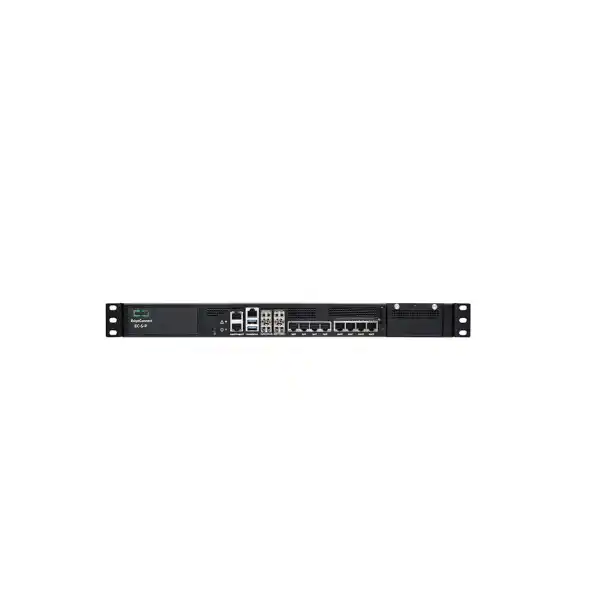
HPE Aruba Networking EdgeConnect EC-S-P SD-WAN Gateway
A resilient physical EdgeConnect appliance for larger branch environments that need multi-link WAN control, centralized orchestration, application-aware path selection and room to scale toward multi-gigabit WAN designs.
Direct answer: what is the EC-S-P and when does it fit?
Where EC-S-P sits in the EdgeConnect family
HPE positions the EC-S-P as a large-branch appliance. That family position matters because appliance selection should not be based only on the fastest circuit installed today. A branch may have two or more WAN paths, encrypted overlay traffic, application classes with different service objectives, optional security inspection, and future circuit upgrades. The EC-S-P is intended for sites that need more headroom than smaller branch platforms while not necessarily requiring a head-office or data-center class gateway.
In HPE reference designs, smaller EdgeConnect models target small and medium branches, while the EC-S-P is associated with large-branch use and typical WAN bandwidth reaching 3 Gbps. Above it, head-office and data-center platforms provide higher bandwidth and much larger connection scale. This makes the EC-S-P a practical comparison point when a branch is moving from sub-gigabit WAN designs toward multiple gigabit circuits, when 10GbE optical attachment is required, or when hardware redundancy has become a procurement requirement.
What the appliance changes operationally
Traditional branch WAN designs often bind applications to static routes, individual circuits or device-by-device configurations. EdgeConnect changes the operating model by applying centrally defined intent across an SD-WAN fabric. Business Intent Overlays can separate traffic classes and define how applications should use available transports. This can reduce the dependency on one WAN service and make policy behavior more consistent between locations.
The value is therefore not just the EC-S-P chassis. The result depends on the EdgeConnect software subscription, Orchestrator design, underlay quality, routing integration, segmentation policy and monitoring process. Buyers should evaluate the appliance as part of an architecture rather than as a direct replacement for a router based only on port count.
Verified EC-S-P hardware and capacity profile
The following values reflect HPE’s current EdgeConnect SD-WAN QuickSpecs and hardware reference information for the EC-S-P platform. Orderable variants and regional bundles can change over time, so the quotation should still identify the exact manufacturer part number rather than assuming that every EC-S-P shipment contains the same power, rail, optical or licensing items.
| Area | EC-S-P specification | Buyer relevance |
|---|---|---|
| Typical WAN bandwidth | 10 Mbps to 3 Gbps | Size against aggregate WAN-side demand and selected software bandwidth tier. |
| Simultaneous connections | 256,000 | Useful for checking session scale at busy branch sites. |
| WAN optimization recommendation | Up to 500 Mbps | Optimization licensing and workload should be treated separately from raw WAN capacity. |
| Copper data interfaces | 8 × 10/100/1000 RJ45 | Supports flexible LAN/WAN attachment without requiring optics for every circuit. |
| Optical data interfaces | 4 × 1/10GbE SFP+ | Provides fiber and 10GbE attachment options; compatible transceivers must be selected for the actual link. |
| Management connectivity | 2 × 10/100/1000 plus console | Allows separation of management access from data interfaces where the design requires it. |
| Storage | Dual SSD | Provides built-in storage redundancy compared with single-drive branch models. |
| Power | Single or dual redundant options; AC and DC variants | Power-feed design must be confirmed before ordering, especially where A/B feeds are required. |
| Form factor | 1U, approximately 44 × 438 × 420 mm | Check rack depth, airflow, cable bend radius and rail requirements. |
| Weight | Approximately 8.23 kg | Relevant to rack planning and installation handling. |
Capabilities that matter in a real branch design
Multi-transport SD-WAN
EdgeConnect can operate across internet, MPLS and cellular-backed WAN designs. The practical benefit is transport independence: policy can decide how traffic uses available paths instead of forcing every application onto one carrier. Circuit diversity still depends on how the underlays are sourced, terminated and physically routed.
Business Intent Overlays
Overlay policy is used to classify application traffic and apply service objectives, path preferences and segmentation. The number of available overlays and VRFs depends on the subscription tier, so topology and segmentation requirements should be defined before the license is selected.
Zero Touch Provisioning
For distributed deployments, Zero Touch Provisioning can reduce the amount of manual CLI work needed at each branch. It does not remove deployment planning: serial assignment, cloud reachability, addressing, circuit handoff and activation workflow still need to be coordinated.
Routing and LAN protection
EdgeConnect supports routing integration including BGP and OSPF, while LAN-side resilience options include VRRP. This is important when the appliance must fit into an existing routed branch rather than replacing every adjacent network function.
Encrypted fabric
HPE specifies IPsec with AES-256 for network encryption on the platform. Encryption is part of the throughput context, which is why buyers should use HPE’s documented WAN-capacity guidance instead of estimating performance from interface speeds alone.
Centralized management
EdgeConnect SD-WAN Orchestrator provides centralized configuration, monitoring and management across multiple appliances. The EC-S-P also supports local web UI, CLI, REST-based integration, secure syslog, SNMPv3, RADIUS and TACACS+ options for operational integration.
Licensing is a design input, not an afterthought
The EC-S-P hardware does not by itself define the usable SD-WAN feature set. HPE sells EdgeConnect SD-WAN as term-based software subscriptions, and licensing is applied on a per-gateway basis. Current HPE reference material describes Foundation and Advanced cloud-Orchestrator tiers, along with an on-premises Orchestrator option for environments that need to operate their own management instance. Subscription terms are commonly available in one-, three-, five- and seven-year periods.
Bandwidth licensing must also match the branch requirement. Advanced licensing provides a broader range of bandwidth tiers, while Foundation uses a smaller set of tiers. In a multi-site EdgeConnect fabric, HPE guidance states that subscription-tier mixing is not supported: the environment should be designed around a consistent tier. This matters when the EC-S-P is being added to an existing deployment because the new appliance cannot be licensed in isolation without considering the rest of the fabric.
Optional capabilities can introduce additional licensing decisions. WAN Optimization is licensed separately and is useful when latency mitigation or data reduction is required for selected application flows. Advanced security functions such as IDS/IPS and related threat-defense capabilities are also entitlement-sensitive. A quotation should therefore identify the desired SD-WAN tier, licensed bandwidth, term, Orchestrator model and any optimization or advanced-security requirements. Buying only the chassis can leave the project commercially incomplete.
Sizing the WAN correctly
Start with aggregate WAN-side bandwidth, not just the speed of one circuit. A branch with a 2 Gbps internet circuit and a second high-speed link can generate more total traffic than the nominal speed of either individual service. HPE’s design guidance also recommends using the higher value when asymmetric circuits are involved. Growth, backup-path behavior and the likelihood of simultaneous use should be included in the estimate.
The next question is feature load. Security inspection, encryption, WAN optimization and traffic statistics may affect how the site should be sized. The EC-S-P’s typical WAN range reaches 3 Gbps, but that does not mean every possible feature combination should be assumed to deliver the maximum number in every topology. Use HPE’s documented capacity guidance and validate the selected software release and license tier for critical performance requirements.
Finally, size the connection count and future WAN architecture. EC-S-P supports 256,000 simultaneous connections. If a location is really functioning as a regional hub, concentration point or data-center edge with substantially larger session scale, a higher EdgeConnect model may be the better choice even if the current circuit total appears to fit.
Ports, optics and physical handoffs
The EC-S-P provides a useful mixture of eight 1GbE RJ45 and four 1/10GbE SFP+ data interfaces. That does not automatically make every ISP or LAN handoff plug-and-play. Copper circuits may terminate on carrier equipment that presents Ethernet directly, while fiber services can require specific single-mode or multimode optics, supported wavelengths, connector types and link distances. SFP/SFP+ transceivers should be chosen against the actual service and HPE compatibility requirements.
A 10GbE SFP+ cage also does not imply that the EC-S-P should be treated as a 10Gbps WAN appliance. Interface line rate and platform WAN capacity are different specifications. The optical ports are valuable for high-speed attachment, fiber demarcation and flexible LAN/WAN mapping, but appliance sizing remains governed by the documented EC-S-P performance profile and software licensing.
Before quotation, document each expected connection: provider, media, speed, VLAN requirement, optical type if any, and whether it is WAN, LAN or management. This prevents last-minute accessory gaps and makes the installation plan far more predictable.
Resiliency: what the EC-S-P provides and what the site must still provide
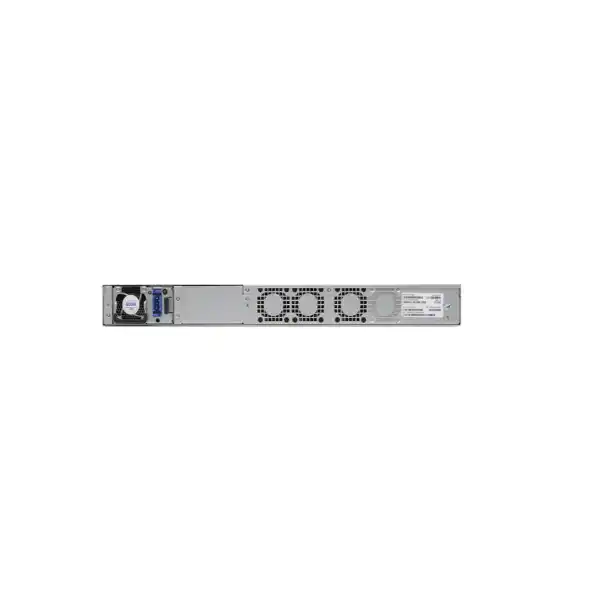
Compared with smaller branch platforms, EC-S-P offers stronger hardware-resilience options. HPE documents dual SSDs and single or dual redundant power-supply configurations, with AC and DC variants. For sites where appliance uptime is important, a redundant PSU arrangement can reduce exposure to one power-supply failure. It is most valuable when the two supplies are connected to appropriately independent power sources such as separate UPS-backed feeds rather than the same unprotected outlet strip.
Hardware redundancy inside one appliance is only one layer. WAN resilience requires separate underlay paths, and true carrier diversity may require different service providers, building entries or last-mile routes. LAN resilience can involve VRRP, dynamic routing and redundant switching. For branches that cannot accept the failure of a single EC-S-P chassis, the design may need two EdgeConnect appliances and a high-availability topology rather than relying only on redundant internal components.
The correct design therefore depends on the business impact of downtime. A retail or office branch with acceptable recovery windows may use one resilient appliance with multiple WAN circuits. A critical regional site may justify dual appliances, dual switches, independent power and diverse carriers. These are architecture choices that should be agreed before the bill of materials is finalized.
Common EC-S-P deployment scenarios in the UAE
Large corporate branch
A large office with multiple internet or MPLS services can use EC-S-P to create policy-driven overlays, prioritize real-time applications and standardize branch configuration under Orchestrator. The interface mix is useful where one provider hands off copper and another uses fiber.
Regional operations site
A logistics, manufacturing or service location with a large user and device population may need more branch headroom than entry-level appliances. EC-S-P can fit when the site remains branch-like in architecture but needs multi-gigabit WAN planning and resilient hardware options.
Cloud-first enterprise branch
Organizations moving collaboration, ERP and line-of-business applications toward SaaS and public cloud can use application-aware path steering so cloud-bound traffic is not forced through a legacy centralized WAN path. Security and internet breakout policy still need to be designed explicitly.
WAN modernization project
EC-S-P can be part of a phased migration from MPLS-heavy networking to hybrid WAN. Existing circuits can coexist while internet links are introduced and application policies are tested. The migration plan should define routing coexistence, cutover sequence and rollback rather than treating SD-WAN as a one-step replacement.
Deployment and migration considerations
When EC-S-P is a strong fit
- The site is a large branch rather than a small office or very high-scale data-center hub.
- Aggregate WAN demand is within the EC-S-P design range and may grow toward multi-gigabit levels.
- A mix of 1GbE copper and 1/10GbE optical interfaces is useful for provider and LAN handoffs.
- The business values centralized SD-WAN policy, multi-link path control and Zero Touch Provisioning.
- Dual SSDs and optional redundant power are appropriate for the site’s availability target.
- There is an EdgeConnect licensing and Orchestrator strategy for the wider deployment.
When another model should be evaluated
- A smaller branch needs far less bandwidth and interface density, making EC-S-P unnecessary for the requirement.
- The location will exceed the EC-S-P WAN or connection scale and is effectively becoming a regional hub or data-center edge.
- The design requires interface types, port counts or integrated functions that are not provided by the selected EC-S-P variant.
- The resilience requirement calls for dual appliances rather than only redundant components inside one chassis.
- Licensing cost and feature requirements make a different EdgeConnect platform or architecture commercially more suitable.
- The project primarily needs a conventional routing or security function and does not benefit from an EdgeConnect SD-WAN fabric.
Orderable variants, accessories and quotation accuracy
The label EC-S-P describes the platform, but the manufacturer has used multiple orderable variants and part numbers over time. HPE QuickSpecs list the EC-S-P 8×RJ45/4×SFP+ AC appliance as one orderable configuration and also identify a DC version. HPE’s newer catalog includes Small-P variants with updated orderable SKUs. This is why a UAE quotation should not rely on a model name alone. The exact current HPE SKU should be checked against the required power type, region, bundle status and lifecycle position.
Accessories may include rack-mount or sliding-rail items, redundant power supplies and optical transceivers. A 1/10GbE SFP+ port is a transceiver cage, not the optical module itself. The correct module depends on whether the link is 1GbE or 10GbE, multimode or single-mode, the optical reach, wavelength and the far-end interface. Power cords can also be localization-dependent. Buyers should therefore provide rack, power and carrier-handoff information with the request rather than expecting a generic accessory bundle to suit every installation.
Lifecycle status should be checked at the time of ordering, particularly for projects standardizing hardware across many branches. If the objective is a new multi-year rollout, it may be appropriate to compare EC-S-P with the latest currently orderable Small-P generation so that hardware availability, support horizon and software compatibility align with the expected deployment period.
Operational management after go-live
Orchestrator visibility
Centralized monitoring makes it easier to compare tunnel status, traffic patterns and appliance health across sites. Operational teams should define who owns policy changes, license administration and software upgrades rather than leaving these responsibilities implicit.
Logging and integration
Secure syslog, SNMPv3, NetFlow/IPFIX-related visibility, REST integration, RADIUS and TACACS+ support can tie EdgeConnect into existing NOC and security operations. The target log collector, authentication servers and monitoring platform should be included in the implementation checklist.
Software lifecycle
Feature availability, security behavior and supported integrations can change between ECOS and Orchestrator releases. Production upgrades should follow an approved maintenance process with release-note review, compatibility checking, backups and a defined rollback path.
Capacity review
A branch that initially fits EC-S-P may grow. Periodic reviews of WAN utilization, session count, security load and new circuits can show whether the platform remains correctly sized or whether a larger model should be introduced at the next refresh.
Buyer questions to resolve before purchase
Frequently asked questions
Is EC-S-P suitable for a 3 Gbps branch?
HPE positions EC-S-P for typical WAN bandwidth up to 3 Gbps. A design at the upper end should still be validated against the exact traffic pattern, enabled features, software release, license bandwidth and growth expectation. If sustained demand is expected to exceed that envelope, compare a larger platform.
Does the EC-S-P include 10GbE?
Yes. HPE documents four 1/10GbE SFP+ data interfaces in addition to eight 1GbE RJ45 data interfaces. The correct transceivers must be selected separately where optical connectivity is needed.
Can the appliance use internet and MPLS together?
Yes. Hybrid WAN using multiple transport types is a core EdgeConnect use case. The actual value depends on business-intent policy, route integration and the independence and quality of the available underlays.
Is Orchestrator required?
Centralized Orchestrator is fundamental to the intended multi-appliance EdgeConnect operating model. HPE subscription tiers can include cloud-hosted Orchestrator, while on-premises management is available through a different licensing approach. The preferred management model should be selected as part of the architecture.
Does EC-S-P have redundant power?
The platform supports single or dual redundant power-supply options, with AC and DC variants. The exact shipment contents and second-PSU requirement depend on the selected orderable SKU and should be stated on the bill of materials.
Is WAN Optimization automatically included?
No assumption should be made that the required WAN Optimization entitlement is included. HPE treats WAN Optimization as an optional licensed capability. The EC-S-P is recommended for optimization up to 500 Mbps, but the commercial license and workload requirement must be confirmed.
Decision recap for an EC-S-P purchase
What FourTeck needs for an accurate Dubai/UAE quotation
A useful quotation should describe the complete deployment requirement, not only the chassis name. Providing the information below helps separate mandatory items from optional accessories and reduces the risk of licensing, optics or power changes after the purchase request has already been approved.
Plan the EC-S-P around the branch, not just the box
For a Dubai or UAE deployment, the strongest EC-S-P bill of materials is the one that matches real aggregate bandwidth, carrier handoffs, subscription tier, Orchestrator model, resilience target, optics and migration scope. FourTeck can help translate those requirements into a practical HPE Aruba Networking EdgeConnect configuration and quotation.

Reviews
There are no reviews yet.