
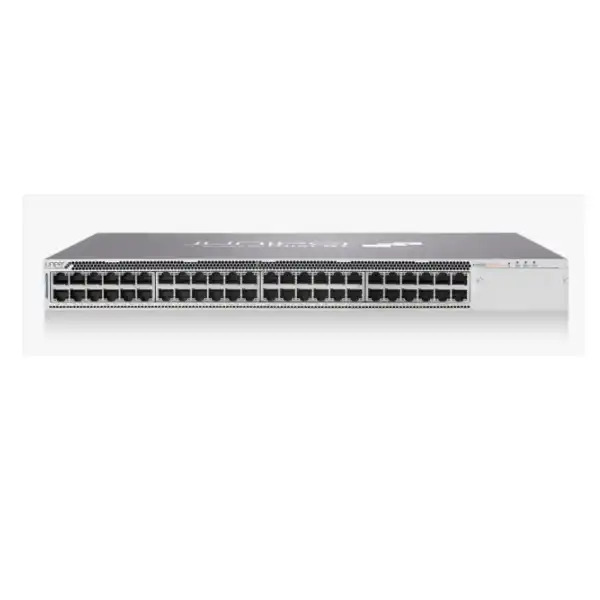
Juniper EX5200 Ethernet Switch Dubai
A high-performance 1U access switching family for enterprise campuses and branches that need dense 10GbE-capable copper access, Wi-Fi 7 power, resilient stacking, strong Layer 2 security and cloud-native operations through HPE Mist Wired Assurance.
Direct answer: what is the Juniper EX5200?
The Juniper EX5200, now presented in current HPE Networking material as the HPE Networking EX5200 Switch Series, is a premium fixed-form-factor enterprise access switch family. It is designed primarily for campus and branch access networks that require unusually high copper edge speed, strong security, resilient stacking and cloud-led operations. Its defining design point is that every access port in the four base models is multigigabit-capable from 100 Mbps through 1, 2.5, 5 and 10 Gigabit Ethernet, rather than limiting 10GbE to only a small subset of access interfaces.
The family is mainly used to connect demanding wired users, Wi-Fi 7 access points, IP communications, cameras, smart-building systems, IoT gateways and other edge devices where conventional 1GbE access can become a bottleneck. It should be considered by large offices, headquarters, universities, hospitality campuses, high-density workplaces, modern smart buildings and branch environments where the network design needs both higher edge bandwidth and an operational model that can be managed through HPE Mist Wired Assurance.
The most important factor to confirm before ordering is the exact EX5200 variant and the complete licensing/power design. The 24MP and 48MP models provide PoE++ while the 24T and 48T are non-PoE. Port count, required PoE load, 100GbE uplink or Virtual Chassis use, feature licensing, Mist subscriptions, transceivers, power feeds and resilience objectives all affect the bill of materials. FourTeck can help map those requirements into a precise Dubai/UAE quotation rather than treating “EX5200” as one universal SKU.
Why the EX5200 is different from a conventional campus access switch
Many enterprise access switches are built around a familiar model: large quantities of 1GbE user ports, a limited number of multigigabit interfaces for wireless access points, and several 10GbE or 25GbE uplinks. That architecture remains appropriate for many offices, but it can become restrictive when an organization is refreshing a campus around Wi-Fi 7, high-performance workstations, media production, large local data transfers, advanced building systems or edge devices that can actually use multi-gigabit rates. The EX5200 is positioned above that conventional pattern. Its access interfaces are designed for 100M/1G/2.5G/5G/10GbE operation across the full 24- or 48-port copper access count, which changes how an architect can plan bandwidth at the edge.
That does not mean every endpoint needs 10GbE. In practice, the value is flexibility. A floor may have a mixture of ordinary 1GbE printers, 2.5GbE wireless access points, 5GbE building or media devices and a smaller number of 10GbE workstations. A switch that supports the full speed range across all access ports reduces the need to predict exactly which desk or ceiling position will need the faster interface several years in advance. This can simplify moves, additions and changes, especially in offices where collaboration areas, wireless density and connected-building systems evolve after the first network design.
The EX5200 also combines this access density with dedicated high-speed connectivity for Virtual Chassis and uplink roles. HPE describes two dedicated 100GbE ports that can provide 400Gbps full-duplex Virtual Chassis bandwidth per switch when both are used for stacking. Up to ten EX5200 switches can operate as one logical system. For an operations team, the practical importance is not just a headline stacking number. A larger closet can be managed with a common configuration and operational view, while routing-engine switchover, nonstop bridging and nonstop active routing features are available to support resilient designs.
The platform is also explicitly built around telemetry and cloud operations. HPE Mist Wired Assurance can onboard, provision and monitor EX5200 switches, while Marvis-related workflows can surface issues such as missing VLANs, DHCP failures, wired authentication problems, bad cables, negotiation mismatches and Layer 2 loops. Buyers comparing the EX5200 with a purely CLI-managed switch should therefore evaluate both hardware and operating model. The strongest business case often appears when high-capacity access and operational automation are required together, not when the purchase decision is based on port speed alone.
EX5200 model selection: 24MP, 48MP, 24T or 48T
EX5200-24MP
24 multigigabit PoE access ports supporting 100M/1G/2.5G/5G/10GbE. The model supports IEEE 802.3bt PoE++ up to 90W per port and an aggregate PoE budget up to 2160W when configured with two power supplies.
A strong fit for premium access closets where device count is moderate but wireless, cameras or smart-building endpoints need high power and high bandwidth.
EX5200-48MP
48 multigigabit PoE access ports with the same 100M to 10GbE speed range. It supports up to 90W per PoE port and up to 3400W aggregate PoE budget with two power supplies.
Best suited to dense access environments where a single 1U unit must serve many high-power Wi-Fi 7, camera, sensor or building endpoints.
EX5200-24T
24 non-PoE multigigabit copper access ports supporting 100M/1G/2.5G/5G/10GbE. It retains the family’s high-speed access and enterprise switching capabilities without allocating hardware and power budget to PoE delivery.
Appropriate where endpoints are locally powered or where the switch is used for high-speed user, server-edge or specialized wired connectivity.
EX5200-48T
48 non-PoE multigigabit access ports from 100M through 10GbE. It offers maximum copper data-port density in the non-PoE branch of the EX5200 family.
A useful choice for dense high-performance wired environments that do not need switch-delivered endpoint power.
Key EX5200 specifications buyers should understand
| Area | Verified family capability | Buyer relevance |
|---|---|---|
| Form factor | Four fixed 1U access switch models | High access density without a modular chassis; rack power and cooling still require proper planning. |
| Access speed | 100M/1G/2.5G/5G/10GbE copper on 24 or 48 access ports | Supports mixed endpoint generations and high-speed Wi-Fi or workstation requirements without reserving only a few multi-gig ports. |
| PoE | MP models support IEEE 802.3bt PoE++ Class 8, up to 90W per port | Relevant for Wi-Fi 7, smart lighting, cameras and building automation; the total PoE budget must be sized, not just the per-port maximum. |
| PoE budget | Up to 2160W on 24MP and 3400W on 48MP with two power supplies | High power delivery can affect circuit sizing, UPS design, rack heat and power-supply selection. |
| Virtual Chassis | Up to 10 switches; 400Gbps full-duplex stacking bandwidth per switch using two dedicated 100GbE ports | Useful for resilient closet stacks and simplified management, but cabling topology and uplink use must be designed intentionally. |
| Security | IEEE 802.1AE MACsec with AES-256 on user-facing and uplink interfaces | Helps protect Layer 2 traffic, but licensing and peer compatibility should be confirmed for the intended encrypted links. |
| Telemetry | Hardware-accelerated flow-based telemetry, up to 256K concurrent flows, IPFIX export | Useful for operational visibility and anomaly investigation; associated feature licensing should be included where required. |
| Operating model | Junos OS with HPE Mist Wired Assurance cloud management support | Allows familiar Junos workflows while enabling cloud onboarding, templates, service-level insights and AI-assisted troubleshooting. |
Planning 10GbE access correctly
The most visible EX5200 feature is the ability to run the copper access ports at up to 10GbE, but designing a useful 10GbE edge is more than selecting a fast switch. The endpoint must support the target speed, the cabling plant must be capable of carrying that speed over the installed distance and environmental conditions, and the upstream network must have enough bandwidth to make the additional access capacity meaningful. A switch with dozens of 10GbE-capable edge ports can create a very different oversubscription profile from a traditional 1GbE closet, particularly when many of those ports serve high-throughput wireless access points or production users.
A practical survey should therefore classify endpoints by realistic throughput rather than simply assigning 10GbE everywhere. Office phones, printers and many IoT devices may remain at 100M or 1GbE. Modern access points may negotiate at 2.5GbE, 5GbE or higher depending on radio configuration and aggregate traffic. Workstations handling video, CAD, large data sets, backups or local storage can benefit from 10GbE if the server side and uplinks are designed accordingly. This mixed-speed reality is precisely where a full multigigabit port set provides operational flexibility.
Cabling deserves particular attention in brownfield buildings. Existing copper may have been installed years before multigigabit access was considered. Before a large EX5200 rollout, the design team should document cable category, link length, patching, pathway quality, grounding practices and any known certification results. It is usually cheaper to discover weak links during survey and test stages than after the switch has been installed and users begin reporting unstable negotiation or unexpectedly low port speed.
Upstream design is equally important. A 48-port EX5200 should not automatically be treated like a 48-port 1GbE switch merely because the port count is familiar. Calculate likely aggregate traffic, local east-west flows, internet and WAN limits, wireless backhaul demand, server paths and redundancy requirements. The dedicated 100GbE connectivity gives the designer substantial headroom, but using those ports for Virtual Chassis, uplinks or both must be planned around the actual topology. FourTeck can turn an endpoint inventory and closet diagram into a more defensible uplink and stacking recommendation before hardware is ordered.
PoE++ sizing for Wi-Fi 7 and smart-building deployments
The EX5200-24MP and EX5200-48MP are the PoE models in the family. They support IEEE 802.3bt PoE++ Class 8 with up to 90W available on a port. That figure matters for high-power endpoints, but it should not be interpreted as meaning every port can always draw 90W simultaneously. The critical design value is the aggregate power budget for the switch configuration: HPE states up to 2160W for the 24MP and up to 3400W for the 48MP when two power supplies are installed.
For procurement, create a PoE worksheet rather than estimating by port count. List each powered device, its expected operating draw, its maximum negotiated power class and whether there are future devices planned for the same closet. Wi-Fi 7 access points can consume significantly more power than older wireless generations depending on radios, USB attachments, IoT modules and enabled features. Cameras with heaters, PTZ motors or infrared illumination can also have peaks well above their average draw. Building controllers, sensors and lighting gateways introduce another category of load. The correct switch choice depends on the sum of those requirements plus design margin.
Power budget planning should continue beyond the switch itself. High aggregate PoE means energy enters the rack through the switch power supplies and leaves over copper cabling as endpoint power. Electrical circuits, PDUs, UPS capacity, rack thermal design and room cooling must all be checked. A 48MP configured for a large PoE budget can represent a materially different power and heat profile from a conventional access switch. In a Dubai equipment room, where ambient conditions and cooling reliability can be important operational considerations, this should be treated as part of infrastructure design rather than an afterthought.
The EX5200 also supports fast PoE and perpetual PoE behavior on PoE models. Fast PoE is intended to provide endpoint power shortly after switch power is applied, while perpetual PoE helps maintain endpoint power through switch software restarts or upgrades. These capabilities are valuable for cameras, access points and building systems that should avoid unnecessary power interruptions. They do not replace resilient electrical design, but they can reduce service disruption caused by routine software operations.
Virtual Chassis: when a ten-member stack makes sense
Operational benefit
Up to ten EX5200 switches can operate as one logical system. This can reduce the number of separately managed devices in a large closet and provide a common configuration and operational view.
Virtual Chassis is particularly attractive where a floor or building needs more ports than one switch provides but the network team still wants stack-like management and coordinated high availability.
Bandwidth and resiliency
The platform provides 400Gbps full-duplex stacking bandwidth per switch when two dedicated 100GbE ports are used for Virtual Chassis. HPE also describes graceful routing-engine switchover, nonstop bridging and nonstop active routing for resilient operations.
The physical stack topology, member roles, uplink placement and failure domains should be designed before installation rather than assembled ad hoc.
Virtual Chassis should not be selected simply because it exists. A ten-member logical system can simplify operations, but it also creates a shared administrative and upgrade domain. The right number of members depends on port density, closet layout, maintenance policy, failure containment, uplink architecture and the organization’s standard operating procedures. Some businesses prefer smaller stacks to limit the blast radius of a fault or change. Others value a larger logical system because it simplifies configuration and provides flexible cross-member uplink placement.
Licensing has another practical consequence. Juniper’s EX licensing guidance states that Virtual Chassis capability itself does not require a license. However, where an EX Virtual Chassis uses Advanced or Premium licensed features, each member switch needs the same Advanced or Premium licensing. A four-member stack therefore cannot be quoted accurately by purchasing one feature license and assuming it covers the logical system. This is a common procurement detail that should be captured in the bill of materials from the beginning.
The two dedicated 100GbE ports also create an architectural question because HPE notes that they can be used for Virtual Chassis or high-speed uplink connectivity where supported. A design that consumes both ports for stacking may have different uplink options from a standalone design. Confirm the exact uplink module choices, supported optics and intended physical topology for the selected model and Junos release before finalizing cabling.
Mist Wired Assurance and AI-assisted operations
The EX5200 is built to participate in HPE Mist Wired Assurance rather than treating cloud management as an optional afterthought. The platform can be claimed and onboarded through cloud workflows, configured using templates and monitored with service-level insights. This can matter significantly in a UAE organization operating multiple offices because the value of a switch estate is influenced by how quickly teams can standardize configuration, detect failures and troubleshoot remote users, not only by raw port performance.
Day 0 workflows focus on onboarding. Greenfield devices can be claimed through activation processes, while brownfield adoption workflows are available for existing environments. Day 1 operations can use templates to standardize standalone, Virtual Chassis and campus fabric deployments while retaining site-level attributes. Dynamic Port Profiles can automate port configuration based on endpoint or policy context. This helps reduce manual port-by-port configuration and makes it easier to keep distributed access switches aligned with a common design standard.
Day 2 and later operations are where the telemetry becomes valuable. Mist Wired Assurance can expose switch health, successful client connections, throughput, bandwidth and client-experience metrics. Marvis-related actions can identify issues that frequently consume network engineering time: missing VLANs, DHCP failure scopes, authentication problems, bad cables, speed negotiation mismatches, persistently failing clients, Layer 2 loops and misconfigured ports. Cloud-based packet capture and remote troubleshooting can reduce the need to dispatch staff to a closet simply to gather evidence.
This operational model does not remove the need for sound network engineering. Templates can reproduce a bad design just as efficiently as a good one. Before onboarding a large EX5200 estate, define naming, site hierarchy, VLAN and VRF structure, authentication policy, upgrade rings, maintenance windows, logging destinations, administrator roles and escalation processes. Cloud operations work best when those standards are agreed before the switches arrive.
Licensing must also be included in the comparison. HPE states that EX5200 supports Standard, Advanced and Premium Flex tiers, and that Advanced and Premium subscription licenses include HPE Mist Wired Assurance. Subscription terms are available for three and five years, while the platform also supports perpetual Flex licenses. The correct commercial model therefore depends on whether the buyer needs cloud assurance, advanced routing, EVPN-VXLAN or other premium functions. A hardware-only price comparison can be misleading if one proposal omits subscriptions required by the desired operating model.
Security: MACsec, access control and segmentation
The EX5200 supports IEEE 802.1AE MACsec with AES-256 encryption on user-facing and uplink interfaces. MACsec operates at Layer 2 and is designed to help protect traffic on Ethernet links against risks such as passive wiretapping, replay and man-in-the-middle interception. This is particularly useful where an organization wants encrypted switch-to-switch links or selected switch-to-host connections without pushing all of that protection to higher-layer tunnels.
MACsec is not a checkbox that should be enabled without design work. The peer device must support a compatible MACsec mode, keys or authentication must be managed, and the performance, operational and licensing expectations must be validated. Juniper’s EX licensing documentation lists separate MACsec license SKUs for EX devices, with class-based licensing associated with 24-port and 48-port platforms. Buyers who specifically require MACsec should make it an explicit quotation line item instead of assuming the hardware capability automatically means unrestricted licensed use in every configuration.
At the access layer, the EX5200 also supports 802.1X, MAC authentication and captive-portal workflows, together with dynamic policy assignment. IPv4 and IPv6 access-control lists can enforce network policy, while DHCP snooping, dynamic ARP inspection, IP source guard and IPv6 neighbor-discovery protections address common local-network attack paths. Secure management options include role-based administrator access, syslog, SNMPv3 and secure APIs.
For organizations moving beyond VLAN-only segmentation, EVPN-VXLAN and group-based policy can extend macro- and microsegmentation across wired and wireless environments. The important caveat is licensing: Juniper’s current EX licensing table places BGP, EVPN, EVPN-VXLAN, VXLAN, IS-IS and several related fabric functions in the Premium tier rather than Advanced. A proposal built around end-to-end campus fabric should therefore be costed as a fabric solution, not as a basic Layer 2 access-switch purchase.
Security architecture should connect the switch capabilities to identity, NAC, firewall policy and logging. An EX5200 can enforce policy at the edge, but the organization still needs a defined source of identity, RADIUS design, certificate strategy where applicable, incident workflow, logging retention and segmentation policy. FourTeck can help identify which of these dependencies belong in the switching scope and which need coordination with existing security infrastructure.
EVPN-VXLAN campus fabric: capability, license and architecture
EX5200 supports standards-based EVPN-VXLAN campus fabric architectures. In simple terms, the physical campus can use a Layer 3 IP underlay while logical Layer 2 and Layer 3 services are carried through a VXLAN overlay with EVPN as the control plane. This decouples logical segmentation from the exact physical topology and can reduce dependence on large Spanning Tree domains. It also allows the organization to scale campus services more systematically as buildings, floors and access blocks are added.
HPE describes several validated campus fabric approaches. EVPN multihoming can be used in collapsed-core or distribution designs, combining resilient link aggregation with a standards-based control plane. Campus fabric core-distribution introduces EVPN-VXLAN across the upper campus layers while allowing an organization to retain conventional access switching during a staged migration. Campus Fabric IP Clos extends the overlay all the way to the access layer so that VXLAN termination and policy enforcement can occur closer to endpoints.
The migration path is strategically useful. A business does not necessarily have to replace every access switch in one project simply because it wants to start using EVPN-VXLAN. A core-distribution fabric can provide an intermediate step, and access-layer fabric capability can be introduced in selected buildings or closets where segmentation and automation benefits justify it. That reduces the pressure for a full forklift upgrade and lets teams build operational experience with the new architecture.
Microsegmentation is one of the strongest reasons to consider access-layer fabric. Group-Based Policy can attach policy tags to clients and apply consistent controls across wired and wireless environments. HPE describes dynamic assignment of GBP tags through RADIUS transactions with HPE Mist Access Assurance. For a business trying to reduce broad VLAN trust zones, this can move enforcement closer to the source and make policy less dependent on physical port or subnet location.
There are, however, more design decisions than the switch alone can answer. The architect must define route-reflector or control-plane roles, IP addressing, underlay routing, anycast gateways, VRFs, VLAN/VNI mapping, multihoming, border connectivity, security-policy ownership and how existing firewalls or WAN edges connect to the fabric. Operational teams need monitoring and troubleshooting methods for both underlay and overlay. Training requirements may be as important as hardware cost for organizations moving from traditional Layer 2 campus networks.
Finally, treat EVPN-VXLAN as a licensed capability. Current Juniper EX Flex licensing documentation places EVPN, EVPN-VXLAN, VXLAN, BGP, ESI-LAG and related fabric functions in the Premium tier. If the business case for EX5200 depends on campus fabric, make the Premium feature requirement explicit in the quotation so that the hardware and software entitlement arrive aligned with the architecture.
Flow-based telemetry and troubleshooting value
High flow scale
The EX5200 supports hardware-accelerated flow-based telemetry and HPE states support for monitoring up to 256K concurrent flows. That scale helps observe large access environments without relying only on sampled interface counters.
IPFIX export
Flow records and alerts can be exported using IPFIX to external collectors. This enables integration with broader operational or security analytics when the organization already has flow-analysis tooling.
Investigation workflows
Traffic visibility can support automated investigation or quarantine workflows for abnormal endpoints, but the process should be integrated with the organization’s security and change-control practices.
Flow telemetry provides a different lens from simple port statistics. An interface counter can show that a port is busy, but flow records can help identify which endpoints and conversations are responsible. In an environment with large numbers of IoT systems, cameras, wireless clients and application servers, that context can shorten the time needed to determine whether a traffic spike is expected, misconfigured or suspicious.
The feature also has a security dimension. Abnormal traffic patterns, unusual communication relationships and policy violations can become inputs to investigation. However, a switch is not a replacement for a security analytics platform. Decide where IPFIX will be collected, how long records will be retained, what alerts matter, which team owns triage and how any automated quarantine action will be authorized. Without those operational decisions, enabling telemetry can create data without creating useful response capability.
Juniper’s EX licensing guidance lists a dedicated flow-based telemetry license SKU for EX5200. Include this requirement in procurement if the project depends on the feature. It is better to identify telemetry as a planned service with a collector and workflow than to discover after installation that the hardware supports a function the project did not license or operationalize.
High availability and maintenance behavior
The EX5200 is designed for access environments where a switch failure can affect large numbers of users, access points or building devices. HPE lists redundant hot-swappable power supplies and field-replaceable fan modules, which allows power and cooling components to be serviced with less disruption when the switch is correctly configured for redundancy. Resilience features also include graceful routing-engine switchover in Virtual Chassis, nonstop bridging and nonstop active routing.
These features are valuable only when the surrounding design is equally resilient. Two power supplies connected to the same single PDU or circuit do not provide the same protection as supplies fed from independent power paths. Dual uplinks terminating on one upstream failure domain do not provide true path diversity. A Virtual Chassis ring or resilient topology should be cabled according to design rather than convenience. Maintenance plans should also define how software upgrades are staged and which endpoints can tolerate brief link events.
PoE endpoint continuity deserves special attention in buildings that depend on network power for cameras, access control, lighting controllers or wireless coverage. Fast PoE and perpetual PoE can reduce interruptions associated with switch boot or software operations. Still, if the complete switch loses electrical power, connected devices will lose power unless another mechanism exists. UPS sizing and electrical redundancy therefore remain critical for safety, physical-security and operational systems.
At the network layer, EX5200 supports link aggregation, VRRP, BFD, ERPS and other resiliency mechanisms. The appropriate combination depends on topology. A simple branch may need redundant uplinks and a small Virtual Chassis; a large campus may use an EVPN-VXLAN fabric with multihoming; a specialized metro-edge deployment may have different routing and convergence requirements. Do not enable every redundancy feature simply because it is available. Select the mechanisms that match the failure scenarios the business actually needs to survive.
Junos OS, automation and operational consistency
EX5200 runs Junos OS, giving organizations that already operate Juniper routers, switches or security platforms a familiar command-line and automation model. A common operating system can reduce variation in configuration syntax, software processes and troubleshooting approach across parts of the network. This is particularly relevant for engineering teams that want access switching to fit into existing Junos operational standards rather than creating a separate management silo.
Junos supports CLI and API workflows, telemetry and a broad set of Layer 2 and Layer 3 services. In an EX5200 deployment managed by Mist, this does not disappear; cloud workflows and Junos capabilities complement one another. The operational decision is to define which settings are authoritative in templates, which are allowed as site-specific variables and how out-of-band or emergency changes are reconciled with cloud configuration.
Automation should be built around repeatable intent. Examples include standardized interface profiles for access points, phones, cameras and user devices; common management services; approved routing and VLAN templates; logging destinations; authentication policy; and software-version standards. The value is not “automation” as a slogan but the reduction of configuration drift and the ability to deploy a new site with known controls.
Software lifecycle also needs governance. Define how releases are tested, which sites form the pilot ring, how rollback is handled, which changes require maintenance windows and how version compatibility is checked with Mist features, Virtual Chassis and licensed functions. A high-performance switch becomes easier to operate when these processes are documented before the first major upgrade rather than invented during an incident.
EX5200 Flex licensing: Standard, Advanced and Premium
Licensing is one of the most important EX5200 procurement areas because the same hardware can be used in very different network architectures. HPE Juniper Flex licensing is structured around Standard, Advanced and Premium tiers. Standard capabilities are delivered with the Junos OS image. Advanced and Premium add feature entitlements, and subscription options can bundle HPE Mist Wired Assurance. A buyer should therefore begin with required functions and operating model, not with the assumption that the lowest software tier is automatically sufficient.
| Decision area | Advanced tier relevance | Premium tier relevance |
|---|---|---|
| Dynamic routing | Includes OSPF and a range of enterprise routing and multicast capabilities. | Adds BGP, IS-IS and other functions needed by many EVPN fabric designs. |
| Campus fabric | Suitable for many advanced non-EVPN access deployments. | EVPN, EVPN-VXLAN, VXLAN and ESI-LAG are listed as Premium functions in current EX licensing guidance. |
| Mist Wired Assurance | Included with Advanced subscription licenses according to the EX5200 data sheet. | Included with Premium subscription licenses and paired with the broader Premium feature set. |
| Port-count class | 24-port EX5200 models are class C2. | 48-port EX5200 models are class C3; class affects license SKU and pricing. |
EX5200 supports subscription and perpetual Flex licenses. HPE states that subscription licenses are offered for three- and five-year terms. The appropriate commercial choice depends on budget model, cloud-management strategy and lifecycle horizon. Subscription licensing can align feature and assurance entitlement to a defined refresh term, while perpetual licensing may suit organizations that want long-lived feature rights and separately planned operations services. The final choice should be based on the specific quote and current entitlement terms.
Do not overlook class-based licensing. The 24-port models are C2 and the 48-port models are C3. If an organization has mixed 24- and 48-port stacks, the software bill of materials must reflect both classes. In a Virtual Chassis using Advanced or Premium features, all members require matching tier entitlements. This can materially change total project cost compared with pricing one license per closet.
MACsec and flow-based telemetry are listed with dedicated EX license SKUs, so buyers relying on those features should request explicit confirmation in the quotation. Licensing documents and feature support can evolve across Junos releases, which is why FourTeck should verify the current SKU set against the exact hardware, software release and required feature list at the time of order.
Use cases where EX5200 can be a strong fit
Wi-Fi 7 access layer
Access points can require multi-gigabit Ethernet and high PoE budgets. EX5200 MP models combine 10GbE-capable copper with up to 90W per PoE port, making them appropriate where wireless design is constrained by the access layer rather than the radio.
Large enterprise campus
Headquarters and large sites can benefit from dense multigigabit access, ten-member Virtual Chassis, high forwarding scale and EVPN-VXLAN options for resilient segmentation and growth.
Smart buildings
PoE lighting, cameras, access-control devices, sensors and building automation can share a managed switching platform when power budgets, VLANs, security policy and failure impact are engineered carefully.
Higher education
Universities often combine dense Wi-Fi, labs, media traffic, IoT and distributed buildings. EX5200 can support the access bandwidth and fabric segmentation needed for those mixed populations.
Branch consolidation
A premium branch with high device density can use a 1U EX5200 where resilient, AI-managed access and high-speed local connectivity justify more capability than a basic branch switch.
Specialized cloud or metro edge
HPE also positions the platform for demanding cloud access and service-provider metro-edge cases where high routing, MAC, ARP/ND, VRF and policy scale in 1U is useful. Exact protocol and scale requirements should be validated against the intended Junos release.
When EX5200 may be more switch than you need
A balanced product recommendation also needs to identify where the EX5200 may not be the most economical choice. If the access layer is predominantly 1GbE, the wireless design uses only a modest number of 2.5GbE ports, PoE demand is conventional and there is no requirement for high-density 10GbE copper, the business may gain little from paying for the EX5200’s premium edge capability. A lower-tier EX family member can provide Junos and Mist integration with a cost structure better aligned to ordinary office access.
Similarly, the EX5200 is primarily positioned as a high-performance access platform. If the requirement is campus distribution, aggregation or a dense 25/100GbE fiber role, a platform such as EX4650 or another distribution-oriented model may be more appropriate. Using an access switch as a distribution switch simply because it has fast ports can create limitations around interface type, scale, architecture or future growth.
The PoE versions also deserve scrutiny. If very few endpoints require switch power, or if local power is already standardized, an MP model can introduce unnecessary cost and electrical complexity. Conversely, choosing a T model for a site expected to add large numbers of access points or cameras may force external injectors or an early switch replacement. The right decision comes from the endpoint and power forecast, not from assuming PoE is always better.
Finally, do not select EX5200 solely because EVPN-VXLAN is on the feature list. A fabric project requires Premium licensing, IP design, routing skills, policy planning and operational readiness. Organizations that do not need segmentation at that scale may be better served by a simpler routed access or traditional design. FourTeck can compare the intended architecture with nearby Juniper options so the switch is sized to the business rather than to the maximum available specification.
EX5200 compared with nearby Juniper choices
| Platform position | Why evaluate it | When EX5200 has the stronger case |
|---|---|---|
| EX4100 family | Suitable for many branch and campus access deployments with Mist integration and modern enterprise features. | Choose EX5200 where full-port-density access up to 10GbE, higher premium access scale or greater high-power endpoint density is central to the requirement. |
| EX4400 family | A mature high-performance access option with PoE, EVPN-VXLAN, MACsec and Mist integration across multiple variants. | EX5200 becomes compelling when the design needs higher-density 10GbE-capable copper access across all ports and the associated new-generation power/scale profile. |
| EX4650 family | Designed for midsize to large campus distribution and higher-speed 10/25/100GbE roles. | EX5200 is usually the better fit when the requirement is copper endpoint access, including PoE++ and 100M-to-10GbE edge connectivity, rather than fiber-centric distribution. |
This comparison should be treated as architectural guidance rather than a substitute for a detailed bill of materials. Juniper families include many submodels with different port layouts, PoE capabilities, uplinks and lifecycle positions. A project that needs only a handful of 10GbE copper ports can often be served by a smaller platform with selected multigigabit interfaces. A project that needs 25GbE or 100GbE server-facing density may point away from the EX5200 even though its overall switching capacity is high.
The useful question is therefore not “Which switch is newer?” but “Which port mix, power profile, feature tier and operating model matches the next five years of this site?” That framing usually produces a more economical and supportable design than selecting the highest specification in the portfolio.
Migration from an existing campus access layer
An EX5200 refresh can be straightforward when replacing standalone switches one closet at a time, but larger migrations require discipline. Start with discovery. Record current switch models, port counts, link speeds, VLANs, trunks, routing adjacencies, PoE draw, access-control methods, voice settings, spanning-tree roles, uplinks, transceivers, management addresses and any unusual static configurations. Do not rely only on configuration exports; physical cabling and live port usage often reveal exceptions that documentation missed.
Next, classify what should be preserved and what should be redesigned. A migration is an opportunity to remove obsolete VLANs, standardize port profiles, improve authentication, rationalize uplinks and adopt a more consistent addressing plan. Copying every legacy behavior into a high-performance switch can preserve years of technical debt. At the same time, avoid redesigning too many layers in one change window unless rollback is clear. A phased approach can separate hardware replacement from later fabric or NAC transformation.
PoE migrations need special scheduling because endpoint power is tied to the switch cutover. Identify cameras, access-control systems, phones, wireless access points and building devices that cannot tolerate an unexpected outage. Confirm whether endpoints will preserve configuration after a power cycle and whether building or security teams need to be present. If a closet supports life-safety-adjacent systems, follow the organization’s formal change and risk process rather than treating the move as a normal office network task.
For Mist-managed deployments, pre-stage organization, sites, templates, VLAN structures, port profiles, switch claims and software standards before the physical installation. A controlled pilot closet should validate authentication, DHCP, routing, monitoring, PoE behavior, user experience and support workflows. Use the pilot to refine automation rather than assuming the first template is final.
If EVPN-VXLAN is part of the destination architecture, decide whether it will be introduced during the switch replacement or in a second phase. HPE’s supported campus-fabric models allow staged adoption, including core-distribution fabric before full access-layer IP Clos. For many enterprises, this separation lowers risk: first establish stable EX5200 access under the existing design, then move selected sites into the new fabric once routing, policy and operations teams are ready.
Installation and site-readiness checklist
Rack and airflow
Confirm available 1U rack space, rail or mounting requirements, cable clearance, front/rear access and the airflow orientation appropriate to the room and adjacent equipment.
Electrical capacity
Size power circuits, PDUs and UPS capacity for the selected switch, power supplies and realistic PoE draw. High-density 48MP deployments can create a substantial rack power requirement.
Cooling
Verify the telecom-room temperature and cooling load under worst-case power conditions. Avoid assuming an old closet designed for low-power 1GbE switches will automatically support a high-PoE refresh.
Copper cabling
Certify or sample-test existing cabling for the intended multigigabit rate. Document patch-panel and horizontal-cable condition, especially in older or frequently reworked closets.
Uplink optics and fiber
Confirm exact optic/DAC compatibility, fiber type, connector, distance and the intended use of dedicated 100GbE ports before ordering transceivers.
Management readiness
Prepare DHCP, DNS, NTP, management reachability, Mist organization/site assignment, administrator roles, logging, AAA and software-release policy before installation day.
Optics, uplinks and accessories that can change the quotation
A switch-only quotation is rarely a complete EX5200 deployment. Uplink optics or direct-attach cables, power supplies, power cords, mounting hardware, licenses, Mist subscriptions and support may all be required. The exact accessory set depends on model, distance, fiber plant, desired resilience and how the two dedicated 100GbE ports are used. Buyers should avoid assuming existing optics from an older switch will be compatible simply because the nominal Ethernet speed is the same.
For fiber, identify whether the existing plant is single-mode or multimode, connector type, patching path and measured distance. For short intra-rack or adjacent-rack links, supported DAC or active cable options may reduce cost and complexity. For longer runs, supported transceivers must match both ends. The safest practice is to validate each optic and cable against the current hardware compatibility tool for the exact EX5200 model and intended Junos release.
Power supplies are not only redundancy accessories on the MP models; they also influence available PoE budget. A buyer planning a high-power wireless deployment must quote the power configuration that enables the required aggregate budget. Power-cord type and local electrical standard should be specified for UAE installation, and redundant supplies should ideally terminate on independent power paths when the site infrastructure supports it.
Sparing is another commercial decision. A large campus may justify holding one spare switch, power supply or fan module locally to reduce recovery time, especially if the cost of downtime is high. Smaller sites may prefer enhanced support with rapid replacement instead. The right balance depends on installed quantity, business criticality, local support coverage and the organization’s tolerance for waiting on logistics.
Support, warranty and lifecycle planning
Current HPE EX5200 documentation describes an enhanced limited lifetime hardware warranty for the original purchaser, including return-to-factory replacement while the original purchaser owns the product, lifetime software updates, advanced shipping of spares within one business day and 24×7 Juniper Technical Assistance Center support for 90 days after purchase. Power supplies and fan trays are described as covered for five years. Exact warranty terms, geography, eligibility and service conditions should still be verified in the formal warranty policy and sales quotation.
For production networks, many enterprises purchase support beyond the included warranty because they need defined response, software assistance, escalation and replacement service levels. The appropriate support tier should be based on failure impact. A small branch with redundant connectivity and local spares has a different requirement from a headquarters closet supporting hundreds of users and Wi-Fi access points.
Lifecycle planning should begin at purchase. Record serial numbers, support entitlements, subscription terms, license keys, software versions, activation codes and renewal dates in the asset-management system. Assign ownership for Mist subscription renewal and ensure procurement receives enough notice before three- or five-year terms expire. Losing a cloud entitlement unexpectedly because no one tracked renewal creates avoidable operational risk.
Also plan the eventual refresh path. High-density 10GbE copper and 100GbE stacking provide substantial headroom, but endpoint and wireless requirements will continue to evolve. A five-year architecture review should consider whether uplink bandwidth, PoE budget, fabric scale and building cabling remain aligned with business use. Buying EX5200 with clear growth assumptions is more valuable than buying maximum capability without a lifecycle plan.
Buying Juniper EX5200 in Dubai and the UAE
For UAE buyers, the commercial objective should be a complete, supportable bill of materials rather than the lowest headline switch price. The EX5200 family contains four base SKUs, and those hardware choices interact with power supplies, PoE budget, feature licensing, Mist subscription, optics, cables and support. Two quotations that both say “EX5200” may therefore represent very different capabilities and total project cost.
A useful request for quotation should identify the exact model, quantity, port use, expected PoE load, uplink speed and distance, Virtual Chassis size, routing or EVPN requirements, MACsec need, telemetry requirement, Mist subscription term, support level and installation scope. If those items are unknown, provide the business requirements instead: number of users, access points, cameras, high-speed workstations, buildings and current switch topology. FourTeck can use those inputs to determine which EX5200 variant and software tier should be priced.
Lead time and availability can vary, particularly for a newly introduced enterprise platform and for high-power components or specific optics. Procurement teams should therefore separate technical approval from delivery planning. Confirm the required-by date, whether partial delivery is acceptable, whether staging can begin with a pilot quantity and whether subscriptions should start at shipment, activation or another agreed milestone under the relevant commercial terms.
Installation in Dubai should also account for local site realities: telecom-room cooling, UPS capacity, rack condition, structured cabling quality, fiber availability and access scheduling. A switch can be technically correct on paper but still create delays if the room cannot support the power load or if legacy cabling will not carry the desired multigigabit speeds. Early site validation is a procurement risk-control measure, not merely an installation task.
Practical buyer questions before ordering
Do we really need 10GbE on every access port?
If only a few endpoints need multigigabit service, another EX model may be more economical. EX5200 is strongest where broad multigigabit flexibility or high-speed endpoint density is a real design requirement.
Which PoE model should we choose?
Use 24MP or 48MP when endpoint power is required. Select based on both port count and aggregate wattage, not only the 90W per-port maximum.
Is Premium licensing necessary?
It is important when the design needs BGP, EVPN, EVPN-VXLAN, VXLAN, ESI-LAG or related fabric capabilities listed in the Premium tier. Basic or OSPF-centric access designs may not require it.
Does Virtual Chassis need a separate license?
Virtual Chassis itself does not require a license, but every member using Advanced or Premium features must carry the matching tier entitlement.
Can existing copper cabling support the planned speeds?
That must be validated. Cable category, length, patching and installation quality affect whether endpoints can negotiate and sustain the intended multigigabit rate.
Should we use Mist management?
Mist Wired Assurance is a major part of the EX5200 operating model and can simplify onboarding, templates and troubleshooting. The subscription and process impact should be evaluated as part of the design.
Quality of service and application traffic
EX5200 provides eight hardware queues for traffic prioritization, with classification and marking based on Layer 2, Layer 3 and Layer 4 fields. Strict-priority and weighted scheduling options, ingress and egress rate limiting, shaping and jumbo frames up to 9216 bytes are also documented. These functions matter in converged access networks where voice, collaboration, wireless, cameras, building systems and high-throughput data share the same switching infrastructure.
QoS should be based on an end-to-end policy. Marking a packet on the access switch is useful only if upstream switches, routers, firewalls and WAN services interpret the marking consistently. Define traffic classes, trust boundaries, remarking policy, queue behavior and congestion objectives. For voice and interactive applications, the goal is predictable latency and loss under congestion, not simply assigning the highest priority to a large number of applications.
High-speed access can actually make QoS design more important rather than less. A 10GbE user or access point can generate bursts that reach a slower WAN, internet firewall or application path. The bottleneck moves but does not disappear. Rate limiting and shaping may be useful at specific boundaries, particularly where an endpoint or tenant should not consume disproportionate bandwidth.
Jumbo frames can improve efficiency for selected storage or data workloads when the complete path supports them, but inconsistent MTU settings create difficult troubleshooting problems. Enable larger MTUs only where there is a defined application need and validate every hop in the path. Ordinary campus user traffic does not benefit merely because the switch can support a larger frame size.
What FourTeck needs for an accurate EX5200 quotation
The fastest way to obtain a useful quotation is to provide enough information to choose the exact hardware and software configuration. An EX5200 quote should not stop at “24 or 48 ports.” The project team should describe device count, power load, uplinks, stack design, licensing and operational requirements. Where some values are unknown, estimates are acceptable as long as they are identified as estimates and validated before final order.
24MP, 48MP, 24T, 48T or permission for FourTeck to recommend the model from requirements.
Number of switches, closets, buildings and whether the rollout is one phase or staged.
Counts of users, Wi-Fi APs, cameras, phones, IoT and 10GbE workstations.
Expected watts per device, high-power endpoints and desired growth margin.
Target speed, fiber type, distance, redundancy and Virtual Chassis topology.
OSPF, BGP, EVPN-VXLAN, MACsec, telemetry, Mist and subscription term.
Required response/replacement level, local sparing and lifecycle expectations.
Supply only, staging, installation, migration, configuration, testing or managed operations.
Decision recap for EX5200 buyers
Model fit
Select 24 or 48 ports, then decide whether PoE++ is required. The MP models deliver power; the T models are non-PoE.
Capacity
Validate real endpoint speeds, aggregate traffic and uplink design. Full 10GbE capability at the edge can change oversubscription assumptions.
Power
For MP models, calculate total endpoint watts and confirm power supplies, circuits, UPS, PDU capacity and cooling.
Licensing
Match Standard, Advanced or Premium to required routing, fabric and cloud-management functions. Account for every Virtual Chassis member.
Compatibility
Verify copper cabling, supported optics, peer MACsec capability, existing NAC/RADIUS, routing architecture and management integrations.
Operations
Decide how Mist templates, software upgrades, logging, monitoring, change control and support escalation will work before mass rollout.
Buyer inputs FourTeck will use to finalize the design
For a technically clean quotation, send the information you already have. FourTeck can help fill the remaining gaps during consultation.
Plan the right Juniper EX5200 configuration for your Dubai network
The EX5200 is most valuable when its high-density 10GbE access, PoE++, 100GbE stacking, security, telemetry and Mist operations are matched to a real campus requirement. FourTeck can review your endpoint mix, PoE load, cabling, uplink topology, Virtual Chassis plan and Flex licensing needs, then prepare a bill of materials that distinguishes required components from optional growth items.

Reviews
There are no reviews yet.