
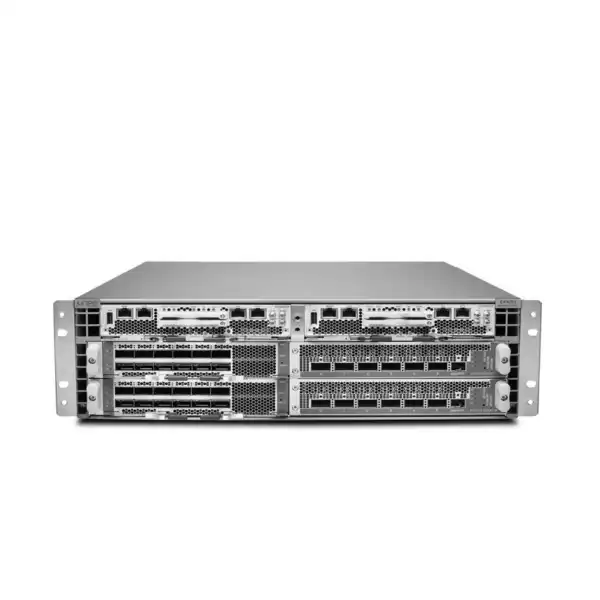
Juniper EX9250 Ethernet Switch Dubai
A compact Junos-based switching family built for enterprise core and aggregation, EVPN-VXLAN fabrics, high-density 10GbE/40GbE/100GbE connectivity and resilient Layer 2/Layer 3 designs. In 2026, EX9250 evaluation must also include a clear lifecycle and migration decision because the family has reached end-of-life status.
EX9253 modular 3U
Up to 100GbE
EVPN-VXLAN
Juniper lists the relevant EX9251 and EX9253 hardware SKUs as EOL. The family’s last-order milestone was 31 March 2022, while the published end-of-support milestone is 31 March 2027. That makes installed-base continuity, spare strategy and migration planning central to any 2026 procurement discussion.
Direct answer: what is the Juniper EX9250 and who should consider it?
Lifecycle notice for EX9250 procurement in 2026
The EX9250 family should not be assessed like a current greenfield core-switch purchase. Juniper’s published EX Series hardware milestone table lists the EX9251 chassis and options, the EX9253 chassis, routing engine, line cards and related EX9250 license SKUs in an end-of-life group announced on 15 October 2021. The last-order date shown for that group is 31 March 2022, and the published end-of-support date is 31 March 2027. Juniper product documentation also labels EX9251 and EX9253 as EOL and points users toward newer EX Series choices.
For a Dubai business that already operates EX9250 hardware, this does not automatically make every transaction wrong. There can be a defensible requirement for a matching replacement unit, a controlled spare, a temporary capacity addition during a migration, or a device required to preserve a certified design. The commercial question changes, however: availability, provenance, software entitlement, support status, matching power and airflow, optics compatibility, and the date by which the platform must be retired become as important as raw throughput. For a brand-new campus core expected to remain in service for many years, a current-generation alternative deserves strong consideration before any EX9250 commitment.
Where the EX9250 fits in an enterprise network
Juniper positioned the EX9250 as a compact but high-capacity distribution and core platform rather than as a user-access switch. It is particularly relevant where many access-layer links converge and where the aggregation layer needs high-speed 40GbE or 100GbE connectivity toward the core, servers, firewalls or another campus block. The platform can also participate in Layer 3 fabrics and EVPN-VXLAN overlays, allowing network architects to move away from broad Layer 2 failure domains and toward routed underlays with controlled overlay connectivity.
That architectural role matters when evaluating an existing EX9250 deployment. A core or aggregation switch normally sits on many critical traffic paths at once. Replacing it is therefore not the same as replacing an isolated edge switch. The design has to account for uplink speed, port breakout, VLAN and VRF structures, routing protocols, multicast, policy filters, QoS, link aggregation, peer redundancy, optics, cabling, maintenance windows and the operational tooling used by the network team. If the EX9250 is part of an EVPN multihoming pair or an MC-LAG design, the migration sequence should preserve endpoint connectivity while peers are upgraded or replaced.
The family’s original value proposition was to deliver high feature density in relatively compact 1U and 3U packages. That remains technically relevant for installed environments, but lifecycle status changes the buying priority. Instead of asking only whether EX9250 can carry today’s traffic, a 2026 buyer should ask whether the proposed unit can be supported through the remaining service period, whether the network can be migrated before support expiry, and whether investing in legacy optics, licenses or line cards will complicate the eventual transition.
EX9251 and EX9253: two different chassis decisions
EX9251 fixed 1U
The EX9251 is the compact fixed-configuration member of the family. Juniper documentation identifies eight 1GbE/10GbE ports together with four 40GbE/100GbE ports. Its 1U form factor and comparatively shallow depth suit deployments where rack space is tight and the required port mix is already understood. It uses a single integrated Routing Engine, so it does not provide the same control-plane hardware redundancy as the larger modular EX9253.
The EX9251 is therefore best interpreted as a dense fixed appliance for a known aggregation requirement rather than a modular growth platform. For an installed-base replacement, the fixed port map can simplify like-for-like restoration. For a new design, however, the inability to add line cards means future port-density changes must be addressed through additional devices or a platform change.
EX9253 modular 3U
The EX9253 is a two-slot modular 3U chassis designed for higher density and deeper resiliency. It accepts EX9253-6Q12C line cards, and the EX9253-6Q12C-M variant adds MACsec capability. Each line card combines twelve QSFP28 ports for 40GbE/100GbE with six QSFP+ 40GbE ports. A fully configured chassis can reach high 10GbE density through supported breakout arrangements, while the architecture provides separate data, control and management planes.
The EX9253 also supports primary and backup Routing Engines and a larger power and cooling subsystem. That makes it a better fit than EX9251 where chassis-level redundancy and modular growth were core design requirements. In 2026, the key caution is that chassis, routing engines and line cards all sit within the same EOL lifecycle family, so a modular spare strategy should be tied directly to a retirement plan rather than treated as indefinite expansion capacity.
Verified EX9250 technical specifications
The figures below reflect Juniper’s published EX9250 specifications. Exact supported combinations can depend on chassis type, line cards, software release, licensing, optics and port mode, so model-level validation is still required before ordering.
| Specification | EX9251 | EX9253 |
|---|---|---|
| Form factor | Fixed 1U | Modular 3U, two line-card slots |
| Dimensions | 44.2 × 4.4 × 45.7 cm | 44.2 × 13.3 × 76.2 cm |
| Maximum throughput | Up to 800 Gbps | Up to 4.8 Tbps |
| Data rate / system capacity | 400 Gbps data rate; 800 Gbps backplane | 2.4 Tbps data rate; 4.8 Tbps system capacity |
| Published family port density | Up to 24 × 100GbE, 36 × 40GbE or 144 × 10GbE across the EX9250 family, depending on chassis and configuration. | |
| MAC addresses | Up to 1,000,000 | |
| ARP entries | Up to 512,000 with the mid-scale license; 256,000 without it | |
| Jumbo frame | 9192 bytes maximum | |
| VLAN scale | Up to 32,000 VLANs | |
| IPv4 / IPv6 RIB | Up to 1 million IPv4 RIB and 1 million IPv6 RIB entries | |
| QoS queues | 8 egress queues per port | |
| Traffic monitoring | sFlow and Junos telemetry capabilities | |
| Operating system | Junos OS | |
What the architecture means in practice
Programmable forwarding
EX9250 uses Juniper programmable forwarding silicon. The practical benefit is not merely speed; the packet-forwarding pipeline supports a broad mix of campus, data-center and service-provider-derived functions such as filtering, sampling, rate limiting, load balancing, tunneling and overlay forwarding. In an installed environment, this capability can reduce the need for separate specialist appliances, but configuration complexity should be controlled through disciplined templates and change management.
Separated control and forwarding
The platform follows Juniper’s routing-oriented architecture in which the control plane maintains protocol state while forwarding hardware handles traffic. On EX9253, dedicated data, control and management planes plus redundant Routing Engines provide stronger chassis-level resilience. This matters when evaluating a migration because failure domains, graceful switchover behaviour and routing-protocol convergence should be tested rather than assumed.
Large forwarding scale
The EX9250 family was designed for large enterprise tables, including up to one million MAC addresses and high ARP/FIB scale with the appropriate license. That can be valuable in dense multi-tenant, aggregation or fabric environments. The buyer should still validate the actual table profile, because the number of routes, next hops, ARP entries, multicast groups, policies and tunnel endpoints can stress different hardware resources in different ways.
EVPN-VXLAN and campus fabric relevance
A major reason enterprises selected EX9250 was its ability to combine conventional Layer 2 and Layer 3 switching with EVPN and VXLAN. VXLAN provides an overlay mechanism that can extend logical Layer 2 segments across a Layer 3 underlay, while EVPN supplies a control plane for advertising endpoint and reachability information. Used together, the technologies allow architects to build routed fabrics while still providing the logical connectivity that applications or business segments require.
The practical benefit is containment of the physical network. Rather than expanding spanning-tree domains across multiple buildings or distribution blocks, the underlay can remain routed, with overlay services created only where required. EVPN multihoming can also provide active/active attachment to endpoints or access domains, allowing both distribution peers to carry traffic instead of leaving one path idle. The EX9250 documentation describes both EVPN multihoming and MC-LAG as deployment choices for collapsed core/distribution designs.
For an existing EX9250 fabric in Dubai, migration planning must preserve more than VLAN IDs. Engineers should capture EVPN route targets, route distinguishers, VNI mappings, IRB interfaces, anycast gateway behaviour, BGP policies, underlay IGP design, MTU settings, LAG identifiers, multihoming Ethernet segment identifiers, loopback addressing and route-reflector dependencies. A replacement platform can support the same broad architecture but may implement defaults, scale limits or operational tooling differently.
A buyer should therefore avoid treating EVPN-VXLAN support as a single checkbox. The correct question is whether the exact EX9250 software and license combination in use supports the required feature set, and whether the intended successor can reproduce that feature set with an acceptable migration sequence. Configuration extraction, state-table review and a lab validation may be more valuable than another capacity estimate when the environment already uses advanced overlay functions.
Six practical deployment scenarios
Campus distribution pair
Two EX9250 switches can aggregate multiple access closets and provide resilient uplinks toward a routed core. This design can use MC-LAG or EVPN multihoming, depending on the validated architecture. The strongest 2026 use case is maintenance of an already-deployed pair while preparing a controlled replacement.
Collapsed core
A medium or large campus may combine core and distribution functions into a resilient pair. EX9250’s routing scale, 100GbE capability and high-density aggregation made it suitable for this role. Replacement planning should model north-south traffic, east-west traffic, failure-state load and inter-switch-link utilisation.
On-premises data center aggregation
The family can aggregate server or top-of-rack domains with 10/40/100GbE links and advanced Layer 3 functions. In modern data centers, current alternatives may offer better automation and lifecycle runway, but an EX9250 can still be relevant where the existing network has operational dependencies that cannot be migrated immediately.
Data-center interconnect edge
MPLS, VPLS and EVPN capabilities can support DCI designs. This is a specialised use case where license entitlement, optics, MTU, routing scale and failure convergence must be reviewed carefully. A DCI migration also requires alignment with the remote site, not just the local chassis.
Legacy capacity bridge
An additional compatible line card or replacement chassis can sometimes provide temporary capacity while a wider network refresh is being designed. Because EOL support ends in March 2027, this should be a time-bounded bridge with a named retirement date, not an open-ended expansion strategy.
Spares for a validated estate
Organizations with strict maintenance procedures may require a known-good spare that exactly matches deployed hardware. In that case, serial history, hardware revision, software compatibility, included components, power type and support eligibility matter more than headline specification. Provenance becomes a core procurement requirement.
High availability: design for the failure state, not only normal load
Core-switch resilience is meaningful only if the network remains stable when a component fails. The EX9251 can use dual power supplies, but it has a single integrated Routing Engine. The EX9253 supports primary and backup Routing Engines with 1+1 redundancy and provides features such as graceful Routing Engine switchover, nonstop active routing and nonstop bridging. Those capabilities can reduce disruption during certain control-plane events, but they do not eliminate the need for a redundant network design.
A proper capacity review should therefore test the N-1 case. If two EX9250 devices share campus traffic, one chassis may need to carry the full load during maintenance or failure. Link utilisation, routing convergence, LAG member distribution, buffer behaviour and upstream firewall capacity should be checked under that condition. Redundancy can fail operationally even when the protocol state is correct if the surviving links do not have enough bandwidth.
For EX9253, internal component redundancy also needs operational attention. A redundant Routing Engine is useful only when software versions, configuration synchronisation and failover procedures are understood. Redundant power supplies require correct power feeds, and a 3+1 design is strongest when feeds are genuinely independent. In a Dubai data-center environment, the power and cooling plan should be reviewed together with rack depth and front-to-back airflow so the chassis can operate as intended.
Resilience questions worth testing
- Can either peer carry the full production load?
- Are power feeds actually independent?
- What happens when a Routing Engine fails over?
- How fast do BGP, OSPF, EVPN and LAG paths reconverge?
- Are firewalls, servers and access switches dual-attached correctly?
- Does the replacement plan preserve redundancy during each migration stage?
- Has failover been tested at production-like traffic levels?
Licensing can change what the hardware can do
EX9250 capabilities are not determined by hardware alone. Juniper’s legacy EX licensing documentation associates the Advanced Feature License with protocols and functions such as BGP, IS-IS, MPLS and EVPN/VXLAN-related capabilities. The family also uses a mid-scale license to raise certain forwarding-table capacities; Juniper documentation identifies up to 512,000 ARP and FIB entries with the mid-scale license, compared with 256,000 without it.
This makes license discovery an essential part of any replacement, spare or migration project. A chassis that powers on and has the correct port count is not necessarily functionally equivalent to the unit it replaces. Engineers should capture installed license keys or entitlements, active feature usage, configured routing protocols, current forwarding-table scale and any historically purchased add-ons. Where the intended transaction involves used or secondary-market hardware, entitlement transferability and software-download rights should be confirmed rather than assumed.
The same principle applies to MACsec. The EX9253-6Q12C-M line card is specifically the MACsec-capable version. If encrypted Ethernet links are part of the deployed design, substituting a non-M variant may remove a security function even though port counts look similar. Conversely, paying for a MACsec-specific card provides little value if the environment does not use the feature.
For quotation accuracy, FourTeck needs the exact chassis and option SKUs where possible, not only the family name EX9250. A photograph of the hardware labels, a redacted chassis inventory, current Junos version and output showing installed licenses can prevent mismatched recommendations and reduce delays during a maintenance window.
Optics, breakout and cabling: the hidden part of an EX9250 order
The EX9250 family exposes high-speed SFP+, QSFP+ and QSFP28 connectivity, but the chassis does not determine the optical design by itself. Every live link depends on a compatible transceiver or cable, the chosen speed, fiber type, reach, connector, breakout mode and the capability of the device at the far end. A 100GbE port can be a straightforward 100GbE uplink, or it can participate in a breakout design where the supported hardware and software combination divides capacity into lower-speed channels. The exact mode must be validated for the specific chassis, line card, transceiver and Junos release.
For short distances inside a rack or adjacent racks, direct-attach copper or active optical cables may be practical, subject to supported length and port compatibility. For structured cabling, multimode and single-mode optics serve different reaches and budgets. Existing data-center fiber should be documented before optics are quoted; simply requesting a 40G or 100G transceiver does not establish whether the link requires SR, LR or another optic class.
Breakout plans deserve particular care during migration. A single failed parent port can affect several child interfaces, and interface naming may differ across platforms. Monitoring systems, LAG configurations and server-facing descriptions should be updated accordingly. If a successor switch has different breakout constraints or requires different optics, the project may need new patching and spare inventory even when the logical topology remains unchanged.
A useful bill of materials therefore includes more than the switch. It should identify every required optic or cable, quantity, speed, distance, fiber type, connector, breakout harness, spare ratio and remote-end platform. For an EOL platform, this also prevents an unnecessary investment in legacy optics that cannot be reused on the replacement architecture.
Power, rack space and physical deployment
Physical planning is materially different between EX9251 and EX9253. The EX9251 is approximately 44.2 cm wide, 4.4 cm high and 45.7 cm deep, while the EX9253 is approximately 44.2 cm wide, 13.3 cm high and 76.2 cm deep. That depth difference matters in shallower telecom cabinets. The EX9253 can weigh about 54.4 kg fully loaded, so rack loading, lifting method and installation staffing should be planned rather than improvised.
| Physical factor | EX9251 | EX9253 | Buyer implication |
|---|---|---|---|
| Power supplies | Up to two | Up to six | Confirm redundant feed design and spare PSU strategy. |
| Published maximum power draw | 300 W AC / 312 W DC | 2692 W AC or DC | Size PDU outlets, circuits and UPS capacity for worst-case conditions. |
| Airflow | Front to back | Front to back | Align hot/cold aisle layout and do not obstruct intake or exhaust. |
| AC/DC mixing | AC and DC supplies are not mixed in the same chassis. | Match the required power type to the site and installed chassis. | |
For UAE deployments, the switch room should also be evaluated for sustained cooling, dust control, power quality and maintenance access. Environmental risk is not solved by specifying redundant hardware. If the cabinet runs close to thermal limits, a high-capacity core switch can become less reliable regardless of protocol design. During a migration, temporary cable routes and side-by-side chassis placement may also increase airflow restrictions, so the installation method should be reviewed before the maintenance window.
Routing, switching, multicast and policy capabilities
At Layer 2, EX9250 supports enterprise functions such as VLANs, LACP, spanning-tree variants, large MAC tables and jumbo frames. At Layer 3, Juniper lists static routing, RIP, OSPF, OSPFv3, VRRP, IPv6, BFD and virtual routers, with advanced licensed functions including BGP and IS-IS. MPLS capabilities, VPLS and EVPN broaden the platform beyond a conventional campus switch and explain why some organizations used it in complex aggregation or DCI designs.
Multicast support includes IGMP, MLD, PIM and related functions. That can be important in enterprise video, market-data, imaging or specialised application environments. A migration should capture multicast routing and snooping state, rendezvous-point design, source-specific multicast requirements and any ACLs that protect multicast boundaries. A replacement that matches unicast throughput but misses multicast scale or policy details can create application issues that are difficult to diagnose after cutover.
The platform also provides ingress and egress filtering, Layer 2 through Layer 4 ACLs, control-plane protection and QoS features. Juniper specifies 16,000 policers per chassis and eight egress queues per port, alongside weighted and strict-priority scheduling options. These details matter when the switch carries voice, video, storage or other traffic classes that depend on defined queuing behaviour.
Before replacing an EX9250, export more than the interface configuration. Policy terms, policers, CoS classifiers, rewrite rules, scheduler maps, firewall filters and counters can contain years of operational knowledge. A clean migration distinguishes intentional policy from historical residue, but it should not discard controls simply because the new platform uses different configuration syntax.
Automation, telemetry and operations
Juniper designed the EX9250 for programmatic operation as well as CLI-based administration. Documentation highlights Juniper Extension Toolkit capabilities, integration with automation frameworks and Junos Telemetry Interface for streaming operational data. The practical value is visibility and repeatability: configuration workflows can be automated, and telemetry can provide more timely state information than periodic polling alone.
In a mature environment, operational tooling can become as tightly coupled to a platform as routing protocols are. Configuration backup systems, inventory collectors, monitoring templates, syslog parsers, SNMP object mappings, telemetry subscriptions, authentication policies and ticketing integrations may all expect EX9250-specific commands or data paths. A successor project should inventory these dependencies before the switch is removed.
The same applies to staff knowledge. Engineers familiar with Junos operational commands, commit behaviour, rollback, configuration groups and routing-policy syntax can operate an EX9250 efficiently. Moving to a different architecture or management model can bring lifecycle benefits, but training and runbook updates should be included in the migration plan. A technically successful cutover is incomplete if the operations team cannot diagnose the new platform under pressure.
For an EX9250 that remains in service until a replacement project is complete, monitoring should become more—not less—disciplined as support expiry approaches. Track hardware alarms, fan and power status, interface errors, optical levels, routing churn, CPU and memory trends, forwarding-table utilisation and log anomalies. That provides evidence for proactive replacement and reduces the chance that a legacy platform fails before the migration window is ready.
A disciplined EX9250 migration journey
Capture the real estate
Collect chassis and line-card SKUs, serials, Junos versions, licenses, interface utilisation, optics, routing tables, MAC and ARP scale, LAGs, EVPN parameters, power feeds, rack position and operational integrations. The goal is to understand what the switch actually does, not what the original design document says it was intended to do.
Separate required from obsolete
Identify production-critical features and distinguish them from configuration that exists only because of historical changes. This step prevents the migration from carrying unnecessary complexity into the successor platform while still protecting dependencies such as multicast, QoS, BGP policy or EVPN multihoming.
Design for growth and N-1
Use measured peak traffic, failure-state traffic, table growth, uplink requirements and port forecasts. A replacement sized only for today’s normal state can become undersized as soon as a peer fails or new 25/100GbE workloads are introduced.
Test the target design
Validate routing adjacencies, EVPN behaviour, LAGs, optics, MTU, ACLs, QoS, monitoring and management access in a lab or controlled staging environment. Configuration conversion tools can accelerate work, but high-impact policy should still be reviewed by an engineer.
Migrate in reversible stages
Where architecture permits, move links or services in groups and verify state after each step. Preserve a documented rollback path until traffic, routing, monitoring and application checks are complete. A staged method can contain the blast radius of unexpected behaviour.
Close the lifecycle cleanly
After stability is proven, remove the EX9250 from monitoring, inventory and support records, securely clear configuration and credentials, record disposition, and decide whether selected units remain as short-term spares. Retirement should have a firm endpoint because support for the family is scheduled to end in March 2027.
When the EX9250 may still make sense
An end-of-life platform can still have a narrow, rational procurement case. The strongest example is an installed production network that cannot be migrated immediately and needs an exact spare to reduce outage exposure. If the alternative is to accept weeks of risk while waiting for a full redesign, a compatible unit with verified provenance can act as a bridge. Another reasonable case is a planned migration where an additional matching component is required temporarily to create capacity or redundancy during staged cutover.
A third case is a controlled environment with a validated software image, known application dependencies and a fixed retirement date before support expiry. Here, changing platform early could create more near-term risk than maintaining the existing design for a short period. That decision should be documented as a lifecycle exception with an owner and migration milestone.
What does not make sense is treating EX9250 as a normal long-term greenfield default simply because the technical specifications still appear competitive. Core infrastructure is typically expected to operate for years, and a platform reaching end of support in March 2027 provides very limited runway for a new deployment initiated in late 2026. Current alternatives should be evaluated on lifecycle, support, management, automation, interface mix and total migration cost, not only switch price.
When another Juniper platform should be evaluated
Current-generation campus distribution
If the requirement is a fresh distribution design with a multi-year support horizon, newer EX Series platforms should be considered. Current models can offer more modern operational integration and a lifecycle aligned with a new deployment. The exact choice depends on port speeds, PoE requirements, fabric architecture, management model and scale.
Higher-density modular core
Where the organization needs more slots, larger long-term capacity or a modular platform with a current support path, a larger chassis family may be more appropriate than investing further in EX9253 hardware. The right comparison should include rack, power, optics and operational migration costs.
Different interface mix
Networks moving from 10GbE toward 25GbE server and distribution connectivity may benefit from a platform designed natively around that interface mix. Buying legacy 10/40GbE capacity can postpone rather than solve the transition, especially where new servers and firewalls already use 25/100GbE.
The EX4650 is one useful historical comparison because it is a compact distribution/core switch with 10/25/40/100GbE capabilities, but Juniper also announced EX4600 EOL milestones in 2026 and buyers should verify the lifecycle of any candidate rather than assuming that a nearby model is automatically current. For a greenfield project, FourTeck can review the presently supported Juniper portfolio against the required architecture instead of limiting the shortlist to the EX9250 generation.
Sizing the replacement: what should actually be measured
Switch sizing is often reduced to port count and aggregate bandwidth, but core and distribution platforms need a broader model. Start with physical interfaces: current active ports, reserved ports, optic types, breakout groups and expected growth. Then measure real traffic at daily and monthly peaks. Averages are poor sizing data because they hide backup windows, application bursts and failure-state concentration.
Next, review control-plane and forwarding scale. Record MAC table size, ARP and neighbor entries, IPv4 and IPv6 routes, multicast groups, BGP peers, OSPF adjacencies, EVPN routes, VNIs and VRFs. The successor should have enough headroom for normal growth and failure events. If the current EX9250 uses the mid-scale license, that is a strong signal that table capacity was already a material design requirement.
Third, model redundancy. In a dual-chassis design, each new switch should be checked against the load it may carry when the other device is unavailable. This affects uplink count, port-channel sizing and sometimes line-card placement. For modular systems, spreading critical links across line cards can reduce the impact of a single module failure; for fixed systems, the design may rely more heavily on chassis diversity.
Finally, include the operational horizon. A platform sized with 20% free capacity may be adequate for a one-year bridge but weak for a five-year deployment. Growth assumptions should be tied to business plans such as new buildings, Wi-Fi upgrades, server refreshes, internet-capacity expansion, security segmentation and 25/100GbE adoption. The best replacement is not always the model with the highest specification; it is the one with enough verified capacity, the right interfaces and a support horizon that matches the organization’s lifecycle policy.
Security and segmentation considerations
Although the EX9250 is an Ethernet switch rather than a next-generation firewall, it can enforce important network controls. ACLs can restrict traffic at Layer 2 through Layer 4, control-plane protections can limit unwanted traffic toward the Routing Engine, and VRFs or virtual routers can separate routing domains. EVPN-VXLAN can also support segmentation architectures that keep business groups logically separated while sharing a routed underlay.
MACsec is especially relevant to EX9253 because the EX9253-6Q12C-M line card is specifically identified as the MACsec-capable variant. MACsec can protect Ethernet links against interception and tampering at Layer 2, but it must be supported and configured at both ends. If an existing link relies on MACsec, the replacement design must preserve cryptographic compatibility, key-management method, performance and operational monitoring.
Lifecycle also becomes a security consideration. As a platform approaches end of support, the organization has less future access to vendor fixes and engineering assistance. That does not mean the switch becomes insecure on a specific date, but it does mean the risk-management posture changes. Security teams should know the retirement date, approved compensating controls and the last supported software path.
A migration is an opportunity to review segmentation rather than blindly duplicate it. Legacy VLANs, permissive ACLs and old inter-VRF exceptions may no longer reflect current business requirements. The safest approach is to preserve required connectivity during cutover while separately identifying policies that should be tightened through a controlled change process.
Procurement guidance for Dubai and the UAE
Because the EX9250 family is EOL, procurement quality matters more than it would for a routine current-product order. An enquiry should state whether the required item must be factory-new old stock, refurbished, tested used hardware or simply functionally compatible equipment. These categories carry different cost, availability and risk profiles. The buyer should also define whether vendor support eligibility is mandatory or whether the hardware will be maintained under an alternative support arrangement during a short migration period.
Exact SKU matching is important. EX9251 AC and DC variants differ. EX9253 requires the correct chassis, Routing Engines, line cards, fan and power configuration. The MACsec line card is not interchangeable in capability with the standard line card. Transceivers and cables may be separate from the chassis. Rack kits, power cords, blanks and other mechanical items should be confirmed explicitly because secondary-market equipment may not include every accessory that was present in the original factory bundle.
FourTeck can prepare a more accurate Dubai quotation when the buyer provides the current device inventory and intended use. If the request is for a failed chassis replacement, that should be stated. If the requirement is for a new project, the expected deployment life should be stated so that current alternatives can be considered. If the request is for a migration bridge, include the target retirement date and the minimum support period required.
Logistics should also account for installation timing. A 3U EX9253 chassis can be heavy when populated, and a live-core replacement may need coordinated delivery, staging and pre-configuration. Receiving hardware days before the maintenance window without validating the exact software, licenses, optics and power components creates avoidable risk. A staged acceptance process—inventory, visual inspection, boot test, software validation, interface test and configuration load—gives the deployment team time to resolve mismatches before production is affected.
Buyer questions that should be answered before a quotation
Which exact chassis?
EX9251 and EX9253 are not equivalent purchases. State the exact model, power type and whether the requirement is for chassis-only, a populated system or a replacement for an existing serialised asset.
Which line cards?
For EX9253, specify required EX9253-6Q12C or MACsec-capable EX9253-6Q12C-M cards, quantity and existing slot layout. Do not assume any available EX9253 chassis includes the necessary cards.
Which licenses?
Document advanced routing, EVPN/VXLAN, MPLS and mid-scale requirements. A replacement without equivalent entitlement may boot normally yet fail to reproduce required production functionality.
Which optics?
Provide speed, fiber type, distance, connector, far-end device and breakout details for each link. This determines whether existing optics can be reused and prevents incompatible transceiver purchases.
What is the support objective?
State whether the platform must remain supported to a specific date, whether third-party support is acceptable, and whether the organization has an approved migration deadline before March 2027.
Is this a legacy repair or new design?
This single answer changes the recommendation. A legacy repair can justify exact EX9250 compatibility; a new design should compare presently supported Juniper platforms with a longer lifecycle.
Frequently asked questions about the Juniper EX9250
Is the Juniper EX9250 still a current product?
No. Juniper lists the principal EX9251 and EX9253 hardware and related options as end-of-life. The published last-order milestone for the group was 31 March 2022, and the end-of-support milestone is 31 March 2027. Buyers in 2026 should treat the platform as legacy infrastructure and plan procurement around continuity or migration rather than a long greenfield lifecycle.
What is the difference between EX9251 and EX9253?
EX9251 is a fixed 1U switch with eight 1/10GbE ports and four 40/100GbE ports. EX9253 is a two-slot modular 3U chassis that accepts high-density 40/100GbE line cards and can provide redundant Routing Engines. EX9253 is larger and supports much greater aggregate throughput and modularity.
Does EX9250 support EVPN-VXLAN?
Yes, Juniper positions EVPN and VXLAN as key EX9250 capabilities for evolved enterprise core and campus fabric designs. The exact software release and license entitlement must be checked. Existing deployments should document VNIs, route targets, BGP design and multihoming behaviour before migration.
How much throughput does the EX9250 provide?
Juniper specifies up to 800 Gbps maximum throughput for EX9251 and up to 4.8 Tbps for EX9253. Published EX9253 capacity is 2.4 Tbps per slot. Real design capacity still depends on port modes, traffic pattern, oversubscription objectives and the failure-state architecture.
Can EX9250 be used in a data center?
Yes. Juniper describes EX9250 as suitable for on-premises data-center aggregation as well as campus core and distribution roles. However, a new data-center project should compare current platforms, particularly where 25GbE server connectivity, newer automation models or a longer support horizon are priorities.
Does EX9250 support 100GbE?
Yes. EX9251 includes 40/100GbE-capable ports, and EX9253 line cards provide QSFP28 40/100GbE ports. The optics, breakout mode and remote endpoint must be compatible. A 100GbE-capable port does not guarantee that every optic or breakout combination is supported.
Does EX9253 support MACsec?
The EX9253-6Q12C-M line card is the MACsec-capable version. If MACsec is required, the exact line-card SKU and far-end support must be checked. A standard EX9253-6Q12C card should not be assumed to provide the same capability.
What should replace an EX9250?
There is no universal drop-in answer because EX9250 deployments vary from compact collapsed cores to modular high-density EVPN fabrics. A replacement should be selected from the currently supported Juniper portfolio based on interface mix, throughput, table scale, EVPN and routing features, redundancy, management model, optics and expected service life.
Can FourTeck quote EX9250 hardware in Dubai?
FourTeck can review EX9250 requirements for UAE customers and determine what information is needed for an accurate quotation. Because the family is EOL, availability and condition can vary. Exact SKU, quantity, power type, line cards, optics, licensing and required support status should be provided before a commercial commitment.
What is the most important thing to do now?
If EX9250 remains production-critical, establish a retirement plan before the March 2027 end-of-support milestone. At the same time, verify spares, backups, configuration archives, licenses, software images, optics and failover procedures so the network can remain stable while migration work is completed.
Decision recap: six points that should drive an EX9250 purchase
What FourTeck needs from the buyer
Providing the items below allows the consultation to move from a generic EX9250 discussion to an accurate bill of materials, compatibility review or migration recommendation.
Plan the right next step for your EX9250 environment
If you need an EX9250 for an existing Dubai network, the fastest route to a reliable answer is to share the exact chassis, options, licenses, optics and support objective. If the requirement is for a new core or distribution project, FourTeck can also help compare current alternatives so the design has the capacity, interfaces and lifecycle runway the business actually needs.

Reviews
There are no reviews yet.