
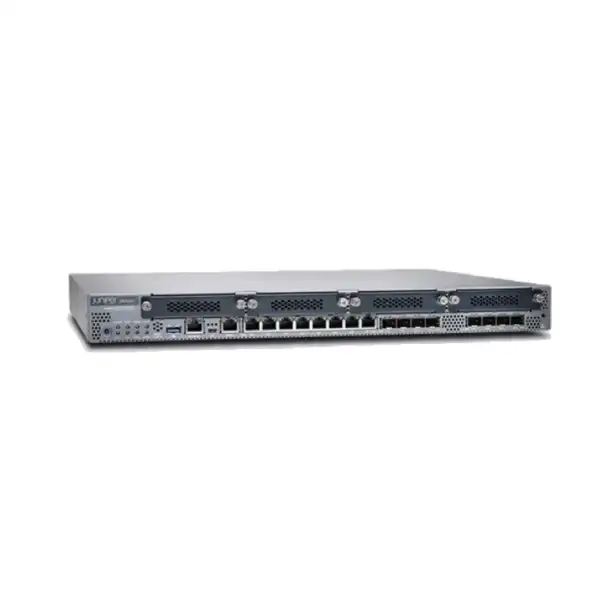
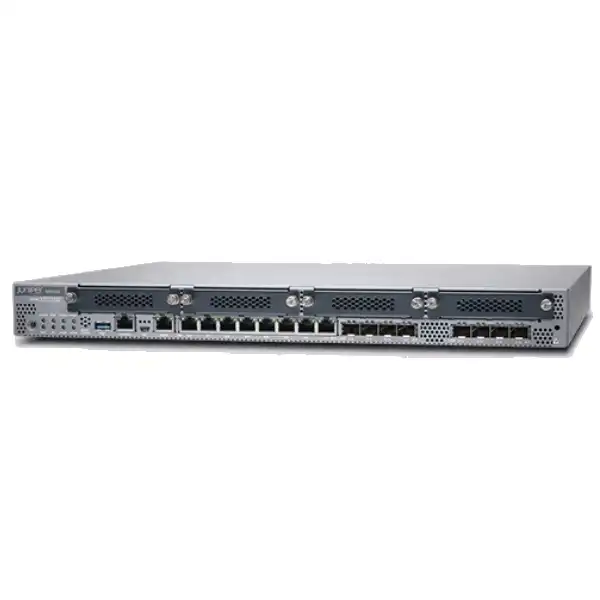
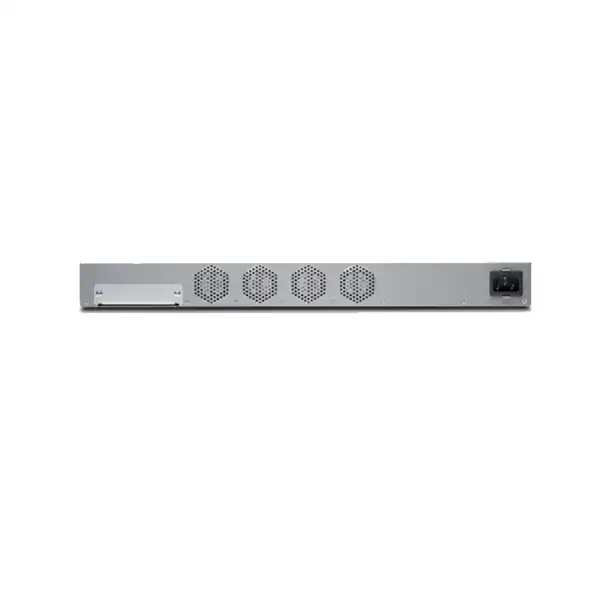
Juniper SRX345 Firewall Dubai
A 1U Junos-powered branch services gateway for organizations that need security, routing, switching, VPN and flexible WAN connectivity in one platform. The SRX345 is best evaluated against real traffic mix, enabled security services, interface requirements, redundancy design and current licensing rather than headline throughput alone.
Direct answer: what is the Juniper SRX345 and who should consider it?
The Juniper SRX345 Firewall is a 1U services gateway in Juniper’s SRX300 branch family. It combines security enforcement with routing, switching and WAN functions, and it runs Junos OS. The platform is mainly used at midsize to larger distributed enterprise branches where a single appliance must secure Internet access, connect private or public WAN links, terminate site-to-site VPNs and participate in enterprise routing.
It is worth considering when a branch needs more interface density and performance than a very small office firewall, especially where copper and SFP connectivity must coexist or where supported Mini-PIM options are needed. It can also be relevant to organizations already standardized on Junos operations, SRX security policy syntax, Juniper routing features or centralized Juniper management.
The most important factor to confirm is the real security-enabled traffic requirement. A 5 Gbps large-packet stateful firewall figure does not mean every deployment will deliver 5 Gbps while IPS, application control, URL filtering, threat intelligence and other services are active. Juniper publishes materially lower figures for IMIX traffic and security-service combinations, so sizing must match the intended feature set and traffic profile.
FourTeck can help determine whether the SRX345 has the right capacity, port mix, power configuration, subscriptions, optics, Mini-PIMs, high-availability design and migration scope for a Dubai or UAE site. That assessment is particularly useful when the appliance will replace an existing firewall with active VPNs, dynamic routing, NAT rules and business-critical security policies.
Where the SRX345 fits in a branch architecture
The SRX345 sits in a useful middle ground: it is not a tiny desktop security appliance, and it is not a data-center firewall designed for very high multi-gigabit inspection loads. Its 1U form factor, broad set of built-in 1GbE interfaces and four Mini-PIM slots make it a branch platform that can consolidate several edge functions without requiring a collection of separate routing and firewall devices. In a distributed organization, that can simplify branch design because the same operating system and security policy model can be used for Internet edge control, WAN routing, VLAN segmentation and encrypted connectivity to headquarters or cloud environments.
The hardware provides eight 1GbE RJ-45 ports and eight 1GbE SFP ports. For a buyer, that means the platform can accommodate a combination of copper Ethernet handoffs and fibre-based or optical connections, subject to supported transceivers. The physical interface density is often more important than a single headline speed figure. A branch may need separate WAN circuits, internal routed links, a DMZ, management connectivity, switch uplinks, dedicated voice or guest segments and failover paths. The SRX345 offers more flexibility for those designs than an appliance with only a handful of fixed copper ports.
The four Mini-PIM slots are another reason this model has remained relevant in mixed-WAN environments. Juniper documents supported Mini-PIM options including serial, T1/E1, VDSL2, LTE and Wi-Fi variants, depending on module and regional applicability. These modules are not hot-swappable, so expansion planning has an operational consequence: the device must be powered off to install or remove a Mini-PIM. For a live branch, module changes should therefore be treated as planned maintenance rather than a no-impact field modification.
For Dubai buyers, the right architectural question is not simply whether the SRX345 can route and firewall traffic. It is whether its combination of 1GbE interfaces, inspection performance, VPN capacity, module support and Junos operational model matches the branch’s current and expected requirements. Sites planning sustained multi-gigabit Internet access with a heavy set of threat-prevention services may need to compare a newer or higher-capacity SRX model rather than selecting the SRX345 solely because its large-packet firewall figure reaches 5 Gbps.
Key SRX345 hardware and capacity specifications
| Specification | SRX345 buyer-relevant detail |
|---|---|
| Form factor | 1U rack-mount platform for standard 19-inch rack environments. |
| Built-in copper ports | 8 × 1GbE RJ-45 ports. |
| Built-in SFP ports | 8 × 1GbE SFP ports; transceiver compatibility should be checked against Juniper’s current Hardware Compatibility Tool. |
| Expansion | 4 Mini-PIM slots for supported interface modules. Mini-PIMs are not hot-swappable. |
| Management | Dedicated management port plus serial RJ-45 and Mini-USB console connectivity documented by Juniper. |
| Memory / flash | 4 GB DRAM and 8 GB flash according to Juniper hardware documentation. |
| Stateful firewall | Up to 5,000 Mbps at 1518-byte packets; Juniper’s current hardware specifications also list 1,500 Mbps for IMIX firewall traffic. |
| IPsec VPN | Juniper’s hardware specifications list 0.977 Gbps with 1400-byte packets and 0.325 Gbps with IMIX traffic. |
| IPS performance | Juniper lists recommended IPS performance at 0.6 Gbps. |
| Concurrent sessions | 375,000 maximum concurrent IPv4/IPv6 sessions. |
| IPsec tunnels | Up to 2,048 IPsec VPN tunnels in Juniper’s current hardware specification listing. |
| Security zones / policies | Up to 64 security zones and 4,000 security policies in Juniper’s hardware specifications. |
| Power variants | Single AC, dual AC and single DC platform variants are documented; exact SKU and power requirements must be matched to the site. |
| Operating system | Junos OS; feature availability and behavior can depend on the selected Junos release and licensing. |
Performance values are laboratory platform specifications and should be treated as sizing inputs, not guarantees for every deployment. Packet size, traffic direction, security services, encryption, logging, application mix, rule complexity and software release can change real-world throughput.
Understanding SRX345 performance before you buy
Firewall sizing is one of the most common areas where procurement decisions go wrong. The SRX345’s 5 Gbps stateful firewall number is measured with large packets. Juniper’s current hardware specification page separately lists 1.5 Gbps for stateful firewall IMIX traffic, illustrating why packet distribution matters. Mixed Internet traffic contains packets of many sizes, and smaller packets create more per-packet processing work. A buyer who expects a 1 Gbps Internet circuit to run with substantial inspection should therefore evaluate the security-enabled figures and expected utilization rather than assuming a 5 Gbps firewall rating automatically provides five times the required capacity.
VPN traffic introduces another workload. Juniper lists approximately 0.977 Gbps of IPsec throughput using 1400-byte packets and approximately 0.325 Gbps with IMIX traffic. A branch with several large site-to-site tunnels, frequent cloud backups, replication traffic or centralized Internet breakout can place a different load on the firewall than a branch using VPN mostly for transactional applications. Encryption algorithm choices, tunnel count, packet size and bidirectional traffic patterns all affect practical headroom.
Threat-prevention services require further care. Juniper lists 600 Mbps recommended IPS performance for the SRX345, while application visibility and control is listed at 1.7 Gbps. These are not interchangeable metrics. If the security policy will enable intrusion prevention on most outbound and inbound user traffic, sizing should use the service combination closest to the intended deployment. A buyer who only needs stateful firewalling and routing has a very different performance profile from an organization enabling IPS, application security, security intelligence, URL filtering and malware-related services on the same flows.
Concurrency also matters. The platform supports up to 375,000 concurrent sessions, which is substantial for a branch, but session behavior varies by application. Modern browsers and collaboration tools can generate many short-lived connections. Guest networks, large Wi-Fi estates, contact centers and branches with IoT devices may create a higher session count than the employee headcount suggests. Conversely, a site with a small number of users but a large amount of bulk traffic may be constrained by inspected bandwidth long before session capacity becomes a concern.
A practical sizing exercise therefore starts with Internet and private-WAN circuit speeds, peak utilization, expected three-year growth, number of active users and devices, encrypted traffic share, VPN demand and the exact security services that must inspect traffic. Once those inputs are known, the SRX345 can be evaluated with sensible headroom. If the resulting workload sits close to its security-enabled limits, a larger platform is usually a safer design than operating a branch firewall continuously near its maximum tested capacity.
Security capabilities and what they mean operationally
Stateful security policies
SRX security zones and policies provide the fundamental control plane for deciding which traffic can cross network boundaries. For a branch, this supports segmentation between trusted users, servers, guest networks, WAN links, DMZs and other zones. Policy design should be migrated intentionally rather than copied blindly from a legacy firewall because object structures, service definitions and rule behavior may differ.
Intrusion prevention
Juniper documents IDP/IPS support on the SRX345. Enabling IPS changes both the security posture and the performance envelope, so it should be applied according to traffic risk and subscription entitlement. Signature updates, policy tuning and exception handling require ongoing operational ownership; an IPS service that is enabled but never monitored can produce avoidable false positives or miss opportunities for policy improvement.
Application visibility and control
AppSecure capabilities can identify and control applications beyond simple port-based firewalling. This helps when multiple applications share HTTPS or dynamically selected ports. The buyer should confirm the required feature entitlement and decide how application control integrates with acceptable-use policies, SaaS access, remote work and business-critical exceptions.
Content and threat services
Juniper’s SRX portfolio supports content-security and threat-prevention functions such as URL filtering and advanced threat services, subject to software, subscriptions and service availability. These functions add processing load and recurring commercial dependencies. A quotation should therefore separate hardware from the security subscriptions required to deliver the intended protection level.
IPsec VPN
The SRX345 can terminate site-to-site IPsec VPNs for branch-to-headquarters, branch-to-cloud and inter-branch connectivity. Design work must cover peer compatibility, IKE and IPsec parameters, route exchange, NAT exemptions, tunnel monitoring, failover behavior and the amount of encrypted traffic expected during peak periods.
MACsec and link security
Juniper documents MACsec support on the SRX345’s built-in network ports from supported Junos releases. MACsec can protect suitable Ethernet links at Layer 2, but the complete design depends on peer capability, key management, software support and interface context. It should be validated as a link-security feature rather than assumed to replace IPsec or application-level encryption.
Licensing and subscriptions: the hardware alone may not equal the required security outcome
The SRX345 can perform core firewalling, routing and VPN functions, but advanced security capabilities can depend on licenses or subscriptions. Juniper’s licensing documentation identifies features such as enhanced Web filtering, intrusion detection and prevention, Juniper Advanced Threat Prevention Cloud and security intelligence within the licensing framework for supported SRX platforms. This means a procurement list that contains only an appliance SKU may be incomplete if the design expects active threat-prevention services.
Licensing should be tied to the actual security policy. If the organization requires IPS, URL categorization, threat intelligence or cloud-based malware analysis, the quotation should state the relevant entitlement, subscription duration and renewal expectation. Buyers should also consider whether the organization already has enterprise agreements or existing Juniper subscriptions that alter what must be purchased for a new branch.
High availability introduces an additional commercial check. Juniper’s licensing guidance states that a chassis cluster does not require a separate cluster license, but licensed software features used in the cluster need valid, matching feature licenses on both devices. That is important because two hardware units without equivalent security entitlements can create feature inconsistency after failover or during configuration synchronization.
Because licensing programs and bundles can evolve, the safest approach is to quote the required outcome rather than rely on an old bundle name. Specify whether the branch needs base firewalling only, IPS, application control, Web filtering, threat intelligence, advanced threat protection, centralized management or other services, and then map those needs to the currently orderable license structure.
Interfaces, optics and Mini-PIM planning
The SRX345’s sixteen built-in 1GbE network interfaces are split evenly between RJ-45 and SFP connectivity. This is valuable when a branch receives different carrier handoffs or uses fibre links to distribution switches. It also creates a procurement responsibility: SFP ports require compatible transceivers or direct-attach media where supported. Buyers should not assume that every generic optical module will be supported. Juniper maintains a Hardware Compatibility Tool for supported transceivers, and the exact optic should match speed, fibre type, wavelength, connector type and link distance.
The dedicated management interface is useful for separating device administration from production traffic. Depending on the organization’s operational model, it may connect to a management VLAN, an out-of-band network or a dedicated management switch. Console access remains important during commissioning, recovery and certain maintenance scenarios. Juniper documents both an RJ-45 serial console and a Mini-USB Type-B console; when both console types are connected, Juniper states that the Mini-USB console has priority.
The four Mini-PIM slots support specific field-replaceable interface modules. Juniper’s hardware guide lists serial, T1/E1, VDSL2, LTE and Wi-Fi Mini-PIM options for the SRX345, with different model identifiers and regional considerations. These modules can extend a branch design beyond conventional Ethernet WAN connectivity. LTE, for example, may be used as a backup path where supported radio bands, carrier service, SIM provisioning and antenna conditions are suitable. Legacy serial or T1/E1 modules may be relevant for organizations that still have specialized carrier or industrial connectivity.
Mini-PIMs are not hot-swappable. That detail affects both initial installation and later changes. If a branch may add an LTE or legacy WAN module in the future, it is sensible to document the planned slot use during the original build and keep a maintenance procedure for the required shutdown. The module itself can also introduce licensing, cabling, antenna, carrier or environmental requirements not covered by the base chassis.
Port planning should therefore be done as a map, not a count. List every expected WAN, LAN, HA, management, DMZ and special-purpose connection; identify whether each uses copper, fibre or a Mini-PIM; note the required transceiver or cable; and leave reasonable spare capacity for changes. This prevents the common situation where an appliance has enough aggregate ports on paper but not enough of the right media type in the desired physical layout.
Common Dubai and UAE deployment scenarios
Regional branch Internet edge
A branch with a primary business Internet circuit can use the SRX345 for stateful policies, NAT, application-aware controls and secure connectivity to other sites. This use case fits best when the chosen security services and peak Internet utilization remain comfortably inside the platform’s inspection capacity.
Dual-WAN branch
Organizations can design primary and secondary WAN connectivity using suitable Ethernet or supported Mini-PIM options. The design must define route preference, health monitoring, NAT behavior, inbound-service implications and what happens to active sessions when a path changes.
Site-to-site VPN hub or spoke
With IPsec capability and significant tunnel scale, the SRX345 can connect a branch to headquarters, cloud gateways or other branches. Effective sizing still depends on encrypted throughput and traffic patterns, not tunnel count alone.
Segmented corporate site
The combination of routing, switching, VLAN support, security zones and policies can separate corporate users, servers, voice, guest access, building systems and other networks. Segmentation design should reflect trust boundaries and application dependencies rather than simply duplicating VLANs as firewall zones.
Junos-standardized estate
For an organization already using Junos, the SRX345 can reduce operational variation because engineers can work with familiar routing, policy and management concepts. This benefit depends on internal skill sets and the selected management architecture.
Resilient branch pair
Two SRX345 appliances can be considered for chassis-cluster high availability where the business requires device-level resilience. The complete design must include matching licenses, interface mapping, heartbeat/control connectivity, failure behavior and upstream/downstream network redundancy.
High availability: what a second SRX345 does and does not solve
A high-availability pair can protect against a single firewall hardware failure and can provide controlled failover, but it does not automatically make the entire branch resilient. A useful HA design considers the complete path from carrier handoff to switches, power sources and application dependencies. If both firewalls connect to one upstream modem, one access switch or one power circuit, those components can remain single points of failure even when two SRX appliances are present.
Chassis clustering also changes the bill of materials and implementation effort. The two units should be compatible, software levels must be planned, and licensed features should be present on both members. Interface mapping and redundancy groups need to reflect the physical topology. If the design uses redundant Ethernet interfaces, the downstream and upstream switching architecture must be able to support the chosen failover method without introducing loops or unexpected convergence behavior.
Operationally, the organization should decide what constitutes a failover trigger. Hardware failure is only one scenario. Some branches need path monitoring so that loss of an upstream route or service can cause traffic to move to an alternate path. Others prefer to keep device failover separate from WAN routing decisions. The correct model depends on how many carrier circuits exist, whether routing protocols are used, whether NAT must remain stable and how sensitive applications are to session interruption.
For critical Dubai sites, the question is therefore not simply whether to buy two firewalls. It is whether the branch requires device redundancy, WAN redundancy, switch redundancy and power redundancy, and how those layers interact. A well-designed pair can materially improve availability, but only when the surrounding network is engineered to avoid hidden single points of failure.
Junos OS management and operational considerations
The SRX345 runs Junos OS, which is one of the platform’s defining characteristics. Organizations familiar with Juniper routing and switching often value the consistent command-line structure, configuration hierarchy and operational commands. The firewall can be configured and managed through Junos interfaces such as the CLI, and Juniper documentation also references J-Web and centralized management options. Current Juniper documentation additionally provides onboarding guidance for Mist and Security Director Cloud, so management choices should be reviewed against the software release and the organization’s desired operating model.
Change control is important because the SRX may combine several network roles. A single configuration change can affect security policy, routing, VPN, switching or NAT behavior. Enterprises should use documented configuration standards, peer review for high-risk changes and configuration backups. For a migration, it is useful to build a mapping between the old firewall’s object groups, services, rules, NAT entries, VPN definitions and routes and the corresponding Junos constructs rather than performing ad-hoc translation during a maintenance window.
Software release selection also deserves attention. Features, defaults and behavior can evolve across Junos releases. Juniper’s hardware documentation notes, for example, a change in the factory-default configuration beginning with Junos OS 25.2R1 concerning the netconf SSH statement. That is a reminder that installation instructions written for an older release should not be treated as timeless. The release selected for deployment should be compatible with required features, organizational standards and the applicable Juniper support guidance.
Logging design should be intentional. Firewall logs are most useful when they are retained, searchable and correlated with other security events. The SRX345 can forward logs to external systems, and the organization should decide what events need to be logged, where logs will be stored, how long they are retained and who reviews them. Excessive logging can create storage and processing overhead, while insufficient logging can make incident investigation difficult.
Management access itself should be treated as a security zone. Restrict administrative protocols to designated interfaces or management networks, use strong authentication practices, limit administrator privileges and avoid exposing management services directly to untrusted networks. During handover, document device access, backup locations, monitoring integrations, software version and support references so operations staff can maintain the firewall without relying on undocumented installer knowledge.
Important fit limitation: 1GbE interface architecture and security-enabled throughput
The SRX345 has a large number of built-in interfaces, but they are 1GbE ports. That is an important architectural constraint for branches moving toward multi-gigabit carrier handoffs or high-speed LAN uplinks. Aggregate firewall throughput can exceed the speed of any one 1GbE interface, yet a single physical link cannot deliver more than its interface rate. Designs that require 2.5GbE, 5GbE, 10GbE or faster native interfaces should compare a different platform rather than trying to force the SRX345 into a role its physical port architecture does not match.
The same caution applies to inspected throughput. A 5 Gbps large-packet firewall figure is not a suitable sizing basis for a branch that expects full threat inspection on a 1 Gbps Internet circuit. Juniper’s published IPS and security-service metrics are lower. If the business requires high sustained inspected throughput with meaningful future growth, the better purchase can be a larger firewall even when the SRX345 has enough ports and sessions today.
This does not make the SRX345 unsuitable in general. It simply defines where it fits best: substantial 1GbE branch environments with a feature set and traffic profile aligned to its security-processing capacity. Correct sizing is about the workload the firewall must process, not the highest number shown in a specification table.
SRX345 versus nearby branch choices
Within the SRX300 family, the SRX345 has historically occupied a higher branch tier than compact SRX300 and SRX320 models and provides more capacity and interface flexibility than lower members of the family. Juniper’s current product materials also position the SRX380 above the SRX345 in performance. A buyer should use these family differences to shortlist a model rather than assume the supplied model is automatically the best option.
Consider a smaller branch model when…
The site has modest bandwidth, few WAN interfaces, limited VPN demand and a smaller session load. Buying excess hardware capacity can be unnecessary if the branch has no realistic growth or resilience requirement. The smaller model still needs to be checked against enabled security services.
Consider the SRX345 when…
A 1U branch needs substantial 1GbE copper and SFP density, flexible Mini-PIM expansion, Junos routing capabilities, IPsec VPN, segmentation and a performance envelope suitable for a midsize to larger branch after security-service sizing.
Consider a larger or newer model when…
The branch needs native interfaces faster than 1GbE, higher security-enabled throughput, greater growth margin or a different lifecycle and support profile. A larger model can also make sense when future WAN upgrades would otherwise require replacing the firewall soon after deployment.
A proper comparison should use the same workload assumptions for every candidate: packet mix, inspection services, VPN encryption, session count, interface media, high availability and projected growth. Comparing one model’s large-packet firewall number with another model’s security-enabled throughput can lead to an invalid conclusion.
Migration planning from an existing firewall
Replacing a firewall is not a simple appliance swap because the existing device usually contains years of accumulated policy decisions. A migration should begin with discovery. Export or document interface assignments, VLANs, IP addressing, routes, NAT rules, address objects, service objects, security policies, VPNs, authentication dependencies, DHCP functions, management access, logging destinations and monitoring configuration. This inventory helps distinguish active requirements from obsolete entries that no longer need to move.
Policy cleanup is often the highest-value part of the project. Legacy firewalls can contain duplicate objects, temporary rules that became permanent, unused VPN definitions and broad source or destination ranges created to solve past incidents. Moving those entries unchanged into the SRX345 carries old risk into the new platform. Each critical rule should have an owner or business purpose where possible, and high-risk any-to-any rules should be reviewed before conversion.
NAT migration deserves separate validation. Source NAT, destination NAT, static NAT and policy interactions can differ between vendors. Applications published to the Internet may also depend on DNS, certificates, load balancers or upstream carrier routing. During cutover planning, list every public IP address and map it to the intended SRX behavior. If a WAN circuit is changing at the same time, keep carrier and DNS dependencies visible rather than treating the firewall as the only moving component.
VPN migration requires coordination with remote peers. Site-to-site tunnels may connect to other firewalls, cloud VPN gateways, partner networks or service-provider equipment. Confirm IKE versions, proposals, authentication, interesting traffic or routing, dead-peer detection and failover behavior. If the remote side is controlled by another team or partner, schedule their validation during the maintenance window so a mismatch does not remain unresolved after the local firewall has been replaced.
Routing should also be reviewed as a design, not merely copied. The SRX345 supports enterprise routing functions, but the correct protocol, metrics, route filters and failover logic depend on the branch architecture. If the old environment uses static routes because it had only one WAN link, a dual-WAN migration may be an opportunity to implement more resilient routing. Conversely, adding a routing protocol without operational need can make a simple branch unnecessarily complex.
A good cutover plan includes a tested rollback path. Keep the old device configuration and physical connection map available, define success criteria for Internet, internal applications and VPNs, and identify which tests must pass before the maintenance window is considered complete. A firewall migration is successful when business traffic and security controls work as intended, not merely when the new appliance responds to management access.
Installation and rack-readiness in a UAE environment
The SRX345 is a rack-mount platform, so physical planning should be completed before site attendance. Confirm available rack units, cabinet depth, front and rear access, power outlets, grounding and cable routing. Juniper documentation states that the chassis can be installed in standard 800 mm or larger enclosed cabinets, 19-inch equipment racks or telecommunications open-frame racks. The selected power model must match the site’s electrical design and redundancy requirements.
Thermal conditions are especially relevant in the UAE because telecom rooms can be exposed to elevated ambient temperatures if cooling is inadequate. The firewall should be installed within the environmental limits specified by the manufacturer and with unobstructed airflow. Do not treat a network cabinet in a storeroom as equivalent to a properly ventilated communications environment. Heat-related instability can affect far more than the firewall if switches, UPS systems and carrier equipment share the same enclosure.
Power resilience should be matched to business impact. A dual-AC variant can provide device power-supply redundancy only when it is connected to appropriately independent power sources. Plugging both supplies into the same single UPS or power strip reduces the value of dual inputs. Sites with generator-backed UPS infrastructure should document which circuits feed the rack and how long network services are expected to remain available during a building power event.
Cabling should be labeled before production traffic is connected. For sixteen built-in network ports plus management, console and potential Mini-PIM connections, a clear port schedule prevents accidental swaps during maintenance. Fibre links should include exact optic identifiers and patch types. Copper links should identify switch port, VLAN or routed purpose, and carrier handoffs should be visibly separated from internal connections.
Installation completion should include grounding where required, physical inspection, software and license verification, configuration backup, monitoring checks and a basic failover test if redundant WAN or HA functions are included. These steps make the device supportable after the installer leaves and reduce the chance that a future incident begins with uncertainty about how the firewall is connected.
Procurement details that should be confirmed before an SRX345 quotation
Exact chassis and power variant
Confirm whether the requirement is single AC, dual AC or DC, and whether power redundancy is part of the architecture. The base model name alone does not fully describe the hardware configuration.
Security subscription scope
List required advanced services such as IPS, Web filtering, threat intelligence or advanced threat protection. Confirm term length and whether subscriptions must be duplicated for an HA pair.
Optics and cabling
For every SFP link, specify fibre type, distance, connector and peer interface. Supported optics should be selected rather than treating SFP modules as generic accessories.
Mini-PIM requirements
If LTE, VDSL2, T1/E1, serial or another supported module is required, include the exact module and any antenna, carrier or cabling dependencies.
Support entitlement
Confirm the desired support level, access to software updates, replacement expectations and internal escalation model. Support is part of operational risk, not merely an after-sale add-on.
Installation and migration scope
State whether the requirement includes rack installation, configuration, policy conversion, VPN migration, HA setup, testing, documentation and post-cutover support.
Sizing worksheet for a serious SRX345 evaluation
A useful quotation begins with a short technical workload statement. The following inputs let an engineer determine whether the SRX345 is comfortably sized or whether a different model should be evaluated.
- Internet circuits: current and planned bandwidth, symmetric or asymmetric service, primary and backup links, and expected peak utilization.
- Private WAN: MPLS, Ethernet, SD-WAN, leased line or other connectivity, including routing and handoff media.
- User and device population: employees, guests, phones, servers, cameras, IoT devices and other endpoints that create sessions.
- Security services: stateful firewall only or IPS, application control, URL filtering, threat intelligence and other inspection functions.
- VPN demand: number of site-to-site peers, expected encrypted traffic, tunnel redundancy and cloud VPN requirements.
- Interfaces: required copper, fibre, management and Mini-PIM connections, plus spare-port expectations.
- Routing: static routes, BGP, OSPF or other protocols, route scale and any policy-based routing requirements.
- Availability: standalone appliance or chassis cluster, dual WAN, upstream switch redundancy and power design.
- Growth horizon: planned circuit upgrades, branch expansion, new SaaS usage, additional VPNs and changes in security policy.
- Operations: management platform, logging destination, software standard, support requirements and internal Junos skill level.
Buyer questions about the Juniper SRX345
Is 5 Gbps the real throughput with all security features enabled?
No. The 5 Gbps figure is the published large-packet stateful firewall throughput. Juniper separately publishes 1.5 Gbps stateful firewall IMIX, 600 Mbps recommended IPS performance and other security-service metrics. Real capacity depends on the traffic mix, security services, encryption, logging and software configuration. Size the appliance against the closest security-enabled workload, not the largest number in the table.
How many physical Ethernet ports are built in?
The SRX345 provides eight 1GbE RJ-45 ports and eight 1GbE SFP ports, plus a dedicated management port. The SFP interfaces require compatible optics or supported media appropriate to the link. Port planning should include WAN, LAN, management, HA and future spare requirements.
Can the SRX345 use LTE?
Juniper documents LTE Mini-PIM support on the SRX345 from supported Junos releases. LTE deployment still requires the correct regional module, compatible carrier service, SIM provisioning, antenna placement and an appropriate configuration. Treat LTE as a complete WAN design rather than assuming the module alone provides automatic failover.
Are Mini-PIM modules hot-swappable?
No. Juniper states that SRX345 Mini-PIMs are not hot-swappable. The appliance must be powered off before a Mini-PIM is installed or removed. Future module changes should therefore be planned as maintenance events.
Can two SRX345 units be used for high availability?
The platform supports high-availability clustering. A practical HA design requires two suitably matched devices, correct cluster and interface configuration, compatible surrounding switching, and matching licenses for licensed features used on both nodes. The design should also remove upstream power and WAN single points of failure where the business requires end-to-end resilience.
Does the SRX345 support site-to-site IPsec VPN?
Yes. Juniper lists up to 2,048 IPsec tunnels and approximately 0.977 Gbps large-packet IPsec throughput for the SRX345, with a lower IMIX VPN figure. Tunnel scale and throughput are different sizing dimensions, so a design with many lightly used tunnels may behave differently from a small number of high-volume encrypted links.
Do advanced threat services require subscriptions?
Many advanced security capabilities are tied to Juniper licensing or subscription entitlements. The exact current bundle should be confirmed when quoting. Define the required outcome—such as IPS, Web filtering, threat intelligence or advanced threat prevention—then select the matching current entitlement and term.
Can I use any SFP transceiver?
Do not assume generic compatibility. Juniper provides a Hardware Compatibility Tool listing transceivers supported on the SRX345. The chosen optic must also match the peer equipment, fibre type, wavelength, connector and required distance. Optics should be included explicitly in the bill of materials.
Is the SRX345 suitable for a new multi-gigabit Internet circuit?
It should be evaluated carefully. The built-in production interfaces are 1GbE, and security-enabled throughput is lower than the 5 Gbps large-packet stateful firewall rating. A site requiring a native interface faster than 1GbE or sustained multi-gigabit inspected traffic should compare a larger or newer SRX platform.
What information is needed for an accurate Dubai quote?
Provide quantity, exact power preference, Internet and WAN speeds, security-service requirements, VPN use, user/device count, copper and fibre port needs, optics, Mini-PIMs, HA requirement, subscription term, support level and whether installation or migration is included. Those inputs reduce the risk of receiving a hardware-only quote that does not match the actual project.
Operational lifecycle and support considerations
A firewall purchase should be evaluated over its operational life, not only at the date of installation. The SRX345 remains documented on Juniper’s current product and documentation sites, but orderability, support milestones, recommended Junos releases and subscription programs can change. For that reason, every quotation should verify the specific SKU’s current commercial status and the support term available at the time of purchase rather than relying on an old reseller listing.
Software support matters because security appliances need updates for more than features. Organizations require access to appropriate Junos releases, security fixes, signature updates for subscribed services and technical support when faults arise. The desired support response should reflect branch criticality. A small non-critical office may tolerate a different replacement process than a regional operational site where firewall failure stops customer service or business applications.
Spares strategy should be considered for distributed estates. For a single critical branch, an HA pair may provide sufficient device resilience. For many branches, an organization may instead maintain centralized spare hardware or a standardized replacement process. The right choice depends on how quickly a failed device can be replaced, whether configurations are centrally backed up and whether local staff can assist with physical swaps.
The software lifecycle must also fit the organization’s change process. Very old releases can leave support or security gaps, while aggressive upgrades without testing can introduce operational risk. Maintain a schedule for release review, lab or pilot validation where appropriate, configuration backups and post-upgrade health checks. Features such as VPN, dynamic routing and security inspection should be included in upgrade testing because a successful reboot alone does not prove the branch is functioning correctly.
Finally, plan the eventual replacement before capacity becomes a crisis. Track WAN utilization, inspected throughput, session usage, port consumption and subscription renewals. If the branch begins approaching the SRX345’s security-enabled limits or needs faster physical interfaces, a planned migration to a higher-capacity platform is preferable to an emergency replacement triggered by performance problems.
Implementation journey: from requirement to stable production
Discover the workload
Collect circuit speeds, traffic patterns, users, devices, VPNs, security services, routing and interface requirements. This creates the sizing basis and exposes dependencies before hardware is ordered.
Validate the model fit
Compare the SRX345’s interface architecture and security-enabled performance with the workload, including growth. If the branch needs faster interfaces or more inspected capacity, change the platform before procurement.
Build the complete bill of materials
Select the chassis power variant, subscriptions, optics, Mini-PIMs, support and second appliance if HA is required. Include installation and migration services when they are part of the project.
Prepare configuration and migration
Translate objects, security policies, NAT, VPN and routing in advance. Remove obsolete rules where possible and document test criteria, peer coordination and rollback actions.
Install and validate
Rack, ground, cable and power the device correctly, then validate interfaces, routes, Internet access, published services, VPNs, logging and monitoring. HA or WAN failover should be tested where included.
Hando over for operations
Provide configuration backups, software details, license records, port maps, monitoring information and change notes. A clean handover turns a successful cutover into a supportable production service.
Why exact requirements matter more than a generic “SRX345 price”
Firewall pricing is rarely meaningful without scope. Two SRX345 projects can use the same chassis and still have different total costs because one needs an advanced security subscription, several optical transceivers, LTE expansion, dual appliances for high availability, installation and migration, while another needs only a single base appliance for a lab or simple branch. A quote that omits those dependencies may look attractive but can delay deployment when missing licenses or accessories are discovered later.
The quantity also matters. A single-site replacement can be engineered around one branch’s topology. A multi-site rollout needs standardization: repeatable configurations, site templates, staged logistics, serial-number tracking, license activation, change windows, remote-hands procedures and acceptance testing. For larger deployments, operational consistency can be more valuable than optimizing each site independently.
Availability and support terms should be checked at quotation time. Product lifecycle and distribution inventory are not static, particularly for established network platforms. Buyers should request the exact orderable SKU, warranty or support entitlement and expected delivery basis rather than purchasing from an ambiguous listing that only says “SRX345” without identifying the power variant or included subscriptions.
The best commercial request is therefore an outcome statement: what the branch must connect, secure and sustain. Once bandwidth, interfaces, licenses, resilience and service scope are clear, the price becomes comparable because competing quotations are based on the same technical result rather than incomplete hardware descriptions.
Decision recap for the Juniper SRX345
Model fit
Best considered for a substantial 1GbE branch where security, routing, switching, VPN and mixed interface connectivity need to coexist in a 1U appliance.
Capacity
Use security-enabled and IMIX figures for sizing. The 5 Gbps large-packet firewall rating is not equivalent to 5 Gbps of fully inspected application traffic.
Licensing
Advanced threat functions can require subscriptions. HA pairs need matching entitlements for licensed features used on both nodes.
Compatibility
Confirm SFP transceivers, Mini-PIM modules, Junos release, peer VPN parameters and management integrations before ordering.
Installation
Plan rack depth, cooling, grounding, power, cabling, migration testing and rollback. Mini-PIM changes require a device shutdown.
Growth
If the branch will need native multi-gigabit interfaces or materially higher inspected throughput, evaluate a larger or newer SRX platform before committing.
What FourTeck needs from you for an accurate SRX345 quotation
A short requirements note is enough to start. Include as many of the following details as are known; unknown items can be resolved during the technical discussion.
One branch, HA pair or multi-site rollout.
Current, peak and planned circuit bandwidth.
Firewall, IPS, AppSecure, filtering and threat services required.
Site-to-site peers, encrypted traffic and cloud connectivity.
Copper, fibre, transceiver and Mini-PIM requirements.
Standalone device or clustered pair with path redundancy.
Required licensed features and preferred term length.
Supply only, installation, configuration, migration and support.
Confirm whether the SRX345 is the right firewall for your Dubai branch
FourTeck can help turn the SRX345 specification into a complete branch design by checking inspected throughput, interface media, VPN load, subscriptions, HA requirements, optics, Mini-PIMs, software considerations and migration scope. The goal is a quotation that matches the actual network requirement and makes clear when another SRX model would provide a safer capacity or interface fit.

Reviews
There are no reviews yet.