
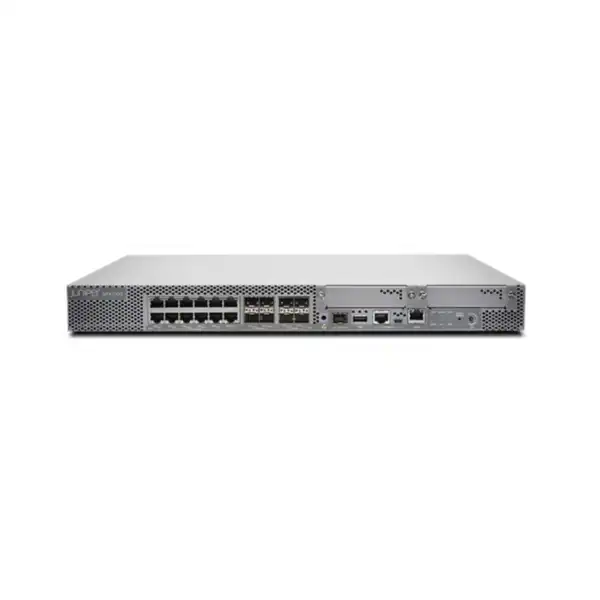
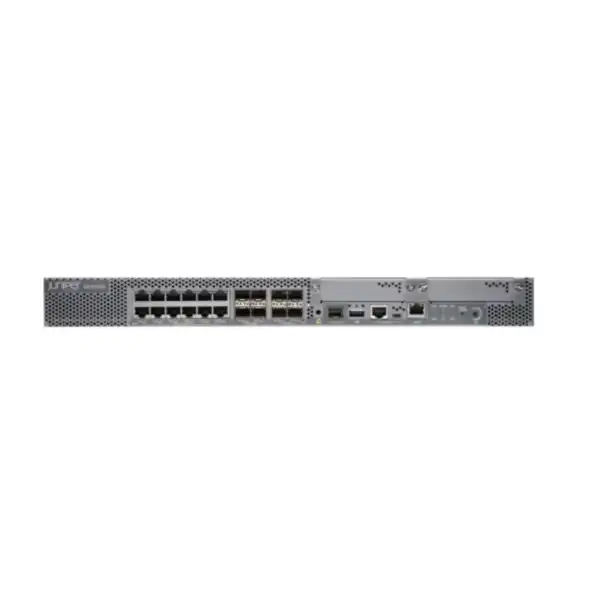
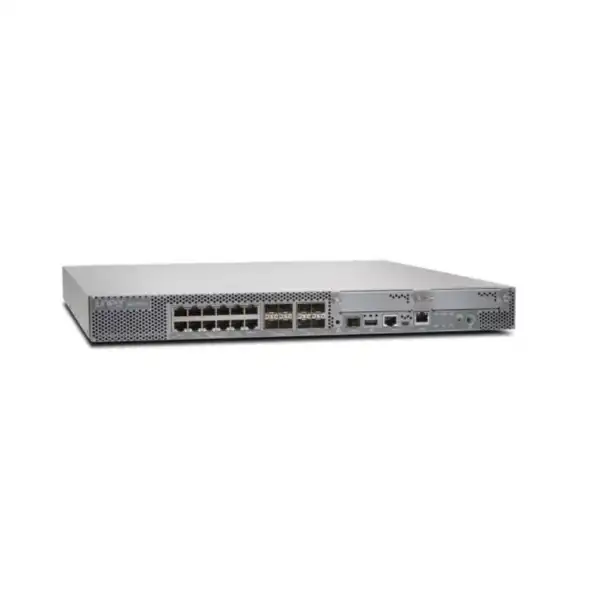
Juniper SRX1500 Firewall Dubai
The Juniper SRX1500 is a 1U next-generation firewall and security services gateway positioned for enterprise campuses, regional headquarters, larger branches and small-to-midsize data-center perimeter deployments. It combines high-density 1GbE access, 10GbE uplinks, Junos OS networking, VPN, application-aware controls, intrusion prevention and optional advanced threat services in a single hardware platform.
For a Dubai or UAE deployment, the important question is not simply whether the SRX1500 can pass traffic. The decision should be based on the throughput required with the security services you will actually enable, the number and type of interfaces, IPsec load, session scale, resiliency design, subscriptions, optics, power arrangement and the expected growth horizon. Those factors determine whether SRX1500 is a sensible fit or whether a newer or higher-capacity SRX platform should be evaluated.
Direct answer: what the SRX1500 is and what to confirm first
What exactly is it?
The Juniper Networks SRX1500 is a physical next-generation firewall and security services gateway running Junos OS. It brings firewalling, NAT, VPN, routing, application-aware security and supported threat-prevention functions into a compact 1U appliance. Juniper positions it for enterprise campus, regional headquarters, large branch and small-to-midsize data-center edge roles.
What is it mainly used for?
Typical roles include Internet perimeter security, campus edge enforcement, segmentation between trusted and untrusted zones, site-to-site IPsec aggregation, security for regional offices, application visibility, intrusion prevention and the consolidation of routing and security functions where a single Junos-based platform is desirable.
Who should consider it?
Organizations with established Juniper skills, 1GbE access requirements, 10GbE uplink needs and security traffic that remains inside the SRX1500’s real-world service envelope can consider it. It is especially relevant where Junos operational consistency, routing depth, VPN scale or chassis-cluster deployment is important.
What matters most before ordering?
Confirm the required throughput with the actual security stack enabled. A headline firewall figure is not the same as application-security, next-generation-firewall, secure-web-access or advanced-threat performance. Packet size, connection rate, TLS inspection, IPS, URL filtering, malware analysis, VPN and logging choices can materially change the sizing decision.
What can FourTeck help determine?
FourTeck can help map bandwidth, applications, user and device counts, VPN requirements, port types, fibre optics, licensing tier, support term, redundancy, migration tasks and installation constraints to an accurate UAE quotation. Where the requirement exceeds the SRX1500’s practical envelope, the same assessment can identify a more suitable SRX model rather than forcing an undersized design.
Where the Juniper SRX1500 fits in an enterprise security design
The SRX1500 is not simply a router with a basic access-control list and it is not merely a high-speed packet filter. Its value comes from combining stateful security policy, application-aware controls, routing, NAT, VPN and threat-security services on a single Junos OS platform. That combination matters when a business wants a consistent network operating model across switching, routing and security teams, or where the firewall must participate in more sophisticated routing and segmentation designs than a simple branch appliance.
Juniper’s current product information describes the SRX1500 as a high-performance, low-latency firewall for distributed enterprise campuses and small-to-medium data centers, while the product overview also highlights regional headquarters and large branch offices. In practical terms, that means the platform sits above small branch security appliances and below current high-capacity data-center firewalls. It is a compact appliance with meaningful session scale and a useful mix of copper, SFP and SFP+ interfaces, but it does not provide the 25GbE or 100GbE interface options found on newer higher-end models. That physical distinction is important because network upgrades increasingly move from 10GbE to 25GbE at the server and aggregation layers.
For an existing Juniper estate, SRX1500 can be attractive because operations teams can reuse Junos skills, familiar routing concepts, security zones, policy structures, CLI workflows and automation practices. For a greenfield project, the decision requires a broader comparison. The buyer should assess not only acquisition cost but also licensing, central management, required subscriptions, support coverage, staff familiarity, migration effort and the likely interface and throughput demand during the expected service life.
Good fit signal
You need a Junos-based enterprise firewall with 1GbE access ports, several 10GbE interfaces, substantial session capacity, IPsec VPN, routing flexibility and optional next-generation security services.
Sizing caution
Your Internet circuit may be below the headline firewall rating but above the throughput available when IPS, web filtering, threat prevention or heavy encrypted traffic inspection is enabled.
Upgrade signal
You expect 25GbE or 100GbE interfaces, materially higher NGFW throughput, greater encrypted-traffic inspection load, faster connection rates or a longer growth horizon that exceeds the SRX1500’s platform envelope.
Performance: read the figures in context
Juniper publishes several different performance figures for the SRX1500 because different security functions and traffic methods produce different results. The current model specification page lists a maximum firewall performance figure of 9.2 Gbps, IPS performance of 3.3 Gbps and VPN performance of 4.5 Gbps. The detailed SRX1500 datasheet provides a more granular test table that lists 9.0 Gbps firewall throughput with 1,518-byte packets and 4.5 Gbps for IMIX firewall traffic. It also lists 4.0 Gbps IPsec throughput with 1,400-byte packets and 1.0 Gbps for IMIX IPsec traffic. These numbers should not be treated as interchangeable.
| Published metric | SRX1500 figure | Buyer interpretation |
|---|---|---|
| Firewall throughput, 1,518-byte packets | 9.0 Gbps in datasheet test table | Useful as a large-packet forwarding reference, not a proxy for every production workload. |
| Firewall throughput, IMIX | 4.5 Gbps | A more conservative mixed-packet reference for conventional firewall traffic. |
| IPsec VPN, 1,400-byte packets | 4.0 Gbps | Relevant to large-packet encrypted tunnels under Juniper’s documented test conditions. |
| IPsec VPN, IMIX | 1.0 Gbps | Shows why mixed packets and security processing can create a very different sizing outcome. |
| Application security | 7.5 / 4.0 Gbps TPS/CPS | Two methodology values are published; understand whether the tested workload resembles your application mix. |
| Next-generation firewall | 7.0 / 2.0 Gbps TPS/CPS | Juniper measures this with firewall, application security and IPS enabled. |
| Secure Web Access firewall | 2.0 Gbps CPS | Measured with a broader service stack including firewall, application security, IPS, SecIntel and URL filtering. |
| Advanced Threat | 1.0 Gbps CPS | Measured with an even broader security stack that includes malware protection. |
The practical lesson is straightforward: size to the services you intend to run, not to the largest number on a brochure. A business with a 2 Gbps Internet circuit that expects continuous IPS, URL filtering, malware protection, detailed application control and substantial TLS inspection has a different requirement from a business carrying mostly trusted site-to-site traffic through a basic firewall policy. The appliance may still be suitable, but the headroom calculation needs to use the relevant security profile rather than raw firewall forwarding alone.
Connection behavior matters too. Juniper publishes a maximum of 2 million concurrent IPv4 or IPv6 sessions, 90,000 connections per second for 64-byte traffic and 1,600 SSL connections per second in the detailed datasheet. A network with many short-lived web connections, API calls, IoT devices or proxy-style flows can stress connection creation long before the aggregate bandwidth looks exceptional. Likewise, a heavily encrypted environment can place more pressure on inspection resources than a traditional network carrying a larger volume of clear-text or trusted east-west traffic.
Interfaces, expansion and physical design
The SRX1500 provides a useful onboard port mix for organizations that still have significant 1GbE requirements but need 10GbE uplinks or high-speed firewall zones. Juniper lists 16 onboard 1GbE ports and four onboard 10GbE ports. The 1GbE set is divided into twelve copper RJ-45 interfaces and four 1GbE SFP interfaces, while the 10GbE connectivity is provided through four SFP+ ports. There is also a separate 1GbE out-of-band management port, a dedicated 1GbE SFP high-availability port, one console interface using RJ-45 plus miniUSB and one USB 2.0 Type-A port.
Two PIM slots provide expansion capability, but buyers should treat expansion as a design item rather than assume every desired interface can be added after purchase. Exact PIM options, supported transceivers, Junos release compatibility and available slot use should be checked against the intended hardware configuration. The SRX1500’s onboard SFP and SFP+ ports also require the correct optics or direct-attach solution for the surrounding network. An appliance quotation without the required optical transceivers, patch leads or compatible modules can be technically correct yet operationally incomplete.
Copper access
Twelve onboard 1GbE RJ-45 ports can support conventional copper connections for LAN, WAN, DMZ or service segments. Port assignment should follow the security-zone and redundancy design rather than simply mirror existing switch cabling.
Fibre at 1GbE
Four onboard 1GbE SFP interfaces allow fibre or supported transceiver-based connectivity. Confirm fibre type, distance, connector standard and approved optic before ordering because the physical port does not include the entire optical path.
10GbE uplinks
Four SFP+ ports provide 10GbE connectivity for higher-speed WAN handoffs, campus cores, server or data-center zones. If the network roadmap requires native 25GbE or 100GbE, compare a newer SRX platform rather than designing around an interface bottleneck.
HA and management
Dedicated management and HA interfaces help separate operational traffic from production forwarding. A resilient pair still needs an intentional cluster design, correct cabling, redundant upstream paths and a failover plan tested against real applications.
Physically, the appliance is 1U high and approximately 43.9 cm wide, 4.44 cm high and 46.22 cm deep. Juniper lists a weight of about 7.30 kg with a power supply. The published average power consumption is 150 W and average heat dissipation is 512 BTU per hour. Airflow is front to back. Those figures make the chassis easy to accommodate in many standard racks, but facilities planning still matters: the rack must have appropriate depth and front/rear clearance, the airflow direction must match the cabinet strategy, and UPS capacity should be assessed for the complete security pair rather than one chassis in isolation.
The SRX1500 supports 1+1 redundant power supply configuration with AC or DC options. Power choice should match the data-room standard and the way A/B feeds are provided. In an HA deployment, the strongest design normally avoids having both chassis and all power supplies dependent on the same PDU, UPS or circuit. Hardware redundancy is only useful when the rest of the power and network path does not reintroduce a single point of failure.
Security capabilities: what the platform can enforce
At its foundation, SRX1500 provides stateful firewall inspection and a zone-based security model. Security policies can be used to control traffic between zones, while screens and protocol-anomaly protections provide additional safeguards against malformed or undesirable traffic patterns. NAT functions include source NAT with port address translation, bidirectional static NAT, destination NAT with PAT, persistent NAT and IPv6 address translation. This makes the appliance appropriate for traditional Internet perimeter designs, segmented campus networks, multi-zone DMZ environments and migration projects where existing public address translations need to be preserved carefully.
Application security adds a different layer of control. Instead of making every decision from source address, destination address and transport port alone, application-aware policy can identify and classify traffic so that business applications can receive different treatment from unsanctioned or risky applications. Juniper also lists application quality-of-service functions and advanced application policy-based routing capabilities. For organizations using multiple WAN paths or building SD-WAN-style traffic steering, application context can therefore influence both security and path selection. The exact feature set available to the planned software release and licence tier should be validated during design.
Intrusion prevention is central to next-generation firewall use. The SRX1500 supports IPS signatures and can be combined with application security, threat intelligence, URL filtering, antivirus and other services depending on licensing. The difference between owning the hardware and having active subscriptions is important: the chassis provides a capable security platform, but regularly updated signatures, cloud-based threat intelligence and advanced threat functions depend on the selected software and service entitlement. A buyer should therefore compare complete three- or five-year security cost rather than hardware price alone.
Encrypted traffic and TLS inspection
Encrypted applications are now the norm, which means security teams must decide how much traffic will be decrypted, inspected and re-encrypted. TLS inspection has architectural consequences: certificate deployment, privacy policy, excluded categories, application breakage testing and throughput impact all need attention. Juniper also describes Encrypted Traffic Insights as part of its broader advanced threat portfolio, intended to restore some visibility into encrypted traffic without relying exclusively on full decryption. Treat this as one component of an encrypted-traffic strategy, not a reason to skip sizing and governance.
Advanced Threat Prevention
Juniper ATP Cloud and related threat services can extend the firewall beyond local signature enforcement with cloud-assisted analysis, threat feeds and malware protection. Premium licensing is relevant where ATP Cloud capabilities are required. The project must also account for cloud connectivity, entitlement activation, policy design and any inspection path dependencies. These services should be selected because they address a defined threat model, not merely because they appear in a feature list.
Identity and role-aware policy
The SRX platform supports user and role-oriented security concepts in addition to conventional network policy. When identity integration is required, confirm the authentication source, directory design, expected user mapping, failover behavior and operational ownership. Identity-aware controls can improve policy clarity, but they also introduce dependencies that must be monitored and documented.
Segmentation and secure transit
Security zones, routing instances, policy enforcement and supported L1/L2/L3 deployment modes allow the SRX1500 to be used in more than a simple Internet edge. In data-center or campus designs, the firewall can enforce boundaries between application, user, partner and service networks. The design should avoid unnecessary hairpin traffic that consumes capacity without adding meaningful control.
Juniper also documents EVPN-VXLAN Type 5 route support for embedding security into data-center fabric designs, including inspection of VXLAN-encapsulated traffic with Layer 4 to Layer 7 services. This is a specialized capability rather than a default requirement for every customer. If the SRX1500 is being introduced into an EVPN-VXLAN environment, the architecture should be validated against the exact Junos release, control-plane design, route types, security insertion method and failure behavior. Fabric integration can remove unnecessary topology complexity when done correctly, but it should never be treated as a checkbox feature without testing.
VPN, routing and network services
The SRX1500 is notably strong when the firewall is also expected to perform substantial networking functions. Juniper lists site-to-site, hub-and-spoke, dynamic endpoint, AutoVPN, ADVPN and Group VPN capabilities, together with IPv4, IPv6 and dual-stack use cases. The platform supports IKEv1 and IKEv2, certificate-based authentication through PKI, pre-shared keys, perfect forward secrecy and standard monitoring mechanisms such as dead-peer detection. Juniper’s detailed datasheet publishes support for up to 2,000 IPsec VPN tunnels, but tunnel count should never be the sole scaling metric because throughput, packet size, encryption suite, route scale, latency and the number of active peers can be equally important.
For remote access, Juniper Secure Connect provides the SSL VPN capability referenced in the SRX1500 documentation. Remote-access projects require separate planning for identity, endpoint platform support, MFA strategy, certificate use, split-tunneling policy, DNS behavior and concurrent user requirements. Hardware capability alone does not define the final user experience. In hybrid-work environments, organizations should also compare firewall-hosted remote access with broader SSE or ZTNA approaches, especially where users primarily access SaaS and cloud applications rather than internal data-center services.
On the routing side, the SRX1500 inherits a wide range of Junos services. Juniper documents dynamic routing and service-provider-grade features including BGP, OSPF, multicast, MPLS capabilities, DHCP services, DNS proxy, real-time performance monitoring, J-Flow, BFD and additional network operations tools. This breadth is valuable when the firewall must sit at a sophisticated campus or data-center boundary and exchange routes dynamically with upstream routers, WAN providers or core switches. It can also simplify architectures that would otherwise require a dedicated edge router plus a separate firewall.
That consolidation has to be intentional. Combining routing and security reduces device count, but it also concentrates operational responsibility. Change control must account for the fact that a routing modification can affect security zones and a policy change can affect traffic-engineering behavior. Mature teams usually separate configuration ownership logically even when the physical device is shared, use versioned configuration management and test changes against a clear rollback plan.
High availability, management and operations
For critical perimeter roles, SRX1500 can be deployed as a chassis cluster with stateful high availability. Juniper documents active/passive and active/active scenarios, configuration synchronization, firewall session synchronization, device and link detection and in-service software upgrade capabilities. VRRP and route/interface monitoring are also part of the broader high-availability toolkit. The design implication is that resilience can be built at multiple layers, but those layers need a consistent failure model.
A pair of firewalls does not create end-to-end high availability by itself. Upstream switches, ISP handoffs, cross-connects, downstream cores, power feeds and routing protocols all need redundant paths. Stateful failover is most valuable when applications can continue without renegotiating every session, yet failover behavior should still be tested for business-critical systems. Some applications are sensitive to even a short path change, and dynamic routing convergence may take longer than the firewall’s own state transition.
Management can be performed locally through Junos tools and on-box interfaces, while Juniper also positions Security Director and Security Director Cloud for centralized administration. Centralized management is relevant when an organization operates multiple SRX devices or wants consistent policy, NAT and VPN deployment across sites. Security Director Cloud provides a broader policy and visibility layer that can span on-premises and cloud-oriented security architectures. The right management approach depends on estate size, operational model, cloud policy and licence requirements.
Automation is another reason organizations choose Junos-based firewalls. Juniper documents Zero Touch Provisioning, Python support, event scripts, commit scripts and operational scripts. For one appliance in a single data room, automation may mainly improve consistency and auditability. For dozens of sites, it can become a substantial operational advantage by reducing repeated manual configuration. The same capability increases the importance of source control, testing and credential governance; automation can reproduce a good configuration quickly, but it can also reproduce a bad change quickly.
Logging and monitoring should be designed at procurement time. Decide which events must be retained, where logs will be stored, whether a SIEM will receive them, the expected event volume, how NTP is controlled and who owns alert triage. Security appliances are most valuable when their telemetry is usable during an incident. A technically successful deployment that produces unreviewed or poorly synchronized logs leaves a major operational gap.
Licensing: the hardware is only one part of the SRX1500 purchase
SRX1500 licensing deserves careful attention because the platform can operate as a standard firewall and router, but many next-generation security functions rely on subscriptions. Juniper’s current licensing documentation describes a Standard base that includes Junos Base functionality such as routing, firewall, switching, NAT, VPN and MPLS. It also documents Advanced and Premium tiers for security services, with terms that can be ordered for multiple years. The exact licensing catalogue changes over time, so the quotation should use the currently orderable Juniper SKU rather than an old bundle name copied from an earlier proposal.
| License direction | Typical capability emphasis | Procurement question |
|---|---|---|
| Standard / base | Core Junos routing, firewalling, switching, NAT, VPN and MPLS functions. | Is the requirement primarily stateful firewall and networking, or does it include continuously updated threat controls? |
| Advanced tiers | Juniper documents combinations including IDP/IPS, application security, SecIntel and, in selected tiers, URL filtering and antivirus/antispam functions. | Which controls must remain effective with current signature and reputation updates throughout the support term? |
| Premium tiers | Adds ATP Cloud capability to advanced security combinations, with tier details varying by bundle generation. | Is cloud-assisted malware analysis, advanced threat intelligence or related ATP functionality part of the stated security requirement? |
| Remote access and other feature licences | Specific remote-access, security or management functions can have separate entitlement considerations. | How many users, what access method, what term and what management platform are required? |
A useful way to choose a licence is to start from the policy outcome. If the firewall will be used mainly for routing, NAT, site-to-site VPN and conventional stateful security between well-defined zones, a base configuration may cover a large part of the requirement. If the security policy explicitly calls for IPS, application identification and regularly updated signatures, an advanced subscription should be evaluated. If malware sandboxing, ATP Cloud, advanced threat feeds or related cloud-assisted services are required, premium options become relevant. This outcome-led approach is safer than choosing a bundle because its name sounds comprehensive.
The subscription term should also reflect the planned ownership cycle. A one-year licence can appear cheaper at purchase time but creates an early renewal event and potentially a different total cost over three years. A multi-year entitlement may simplify budgeting and reduce renewal administration, but it only makes sense if the appliance is expected to remain in service for the term. When a product is being purchased for an upgrade project with a short migration horizon, tying a long subscription to hardware that may be replaced early can be wasteful.
Licensing also affects performance planning. If advanced services are not enabled today but are expected next year, the firewall should be sized for the future service stack now. Turning on IPS, URL filtering and malware protection after the Internet circuit has already grown can expose a capacity shortfall that did not exist under basic firewalling. The correct design therefore models both day-one and expected end-of-term traffic.
For ATP Cloud, Juniper documents entitlement workflows tied to the firewall platform and serial number. Cloud security services also require network reachability to Juniper infrastructure and should be incorporated into outbound firewall, DNS and certificate planning. This is a reminder that a licence is not merely a code on an invoice; it enables an operational service that may have dependencies on cloud connectivity, account access and device registration.
For a Dubai procurement, ask for hardware, licences and support to be shown as separate line items. That makes it easier to compare alternative terms, distinguish one-time from recurring cost and verify that the security features specified by the security team are actually covered. It also prevents a common problem in firewall quotations where the chassis is priced clearly but the feature subscription or support entitlement is ambiguous.
Sizing the SRX1500 for a Dubai or UAE environment
Sizing should begin with traffic and policy, not user count alone. Juniper’s product page notes that the SRX1500 can protect enterprise campus networks with up to around 2,000 users, but that statement is a positioning guide rather than a universal sizing formula. Two organizations with 1,000 users can have radically different firewall loads. A software company with heavy cloud development, video collaboration, public APIs and encrypted SaaS may consume far more connections and inspection capacity than an office with mostly transactional business applications and centrally cached content.
Start with Internet and WAN bandwidth. Record current contracted capacity, typical busy-hour use, 95th-percentile demand if available, expected growth, backup circuit capacity and any planned move to 10GbE handoffs. Then separate traffic that will pass only through basic stateful policies from traffic that will use IPS, application control, URL filtering, malware protection or decryption. The SRX1500’s published performance table shows why this separation is necessary: mixed-packet firewall forwarding, NGFW processing and advanced-threat processing have different throughput envelopes.
Next, examine connections rather than bandwidth. Retail applications, public portals, mobile clients, DNS-heavy services, IoT estates, call centers and API platforms can create large numbers of short-lived sessions. Published concurrent-session capacity provides one ceiling, while new connections per second and SSL connection rates describe different pressure points. During sizing, gather connection-rate data from the current firewall where possible. If the old device is already constrained, raw statistics may understate true demand because dropped or delayed sessions never become visible as successful flows.
Encrypted traffic needs its own estimate. Decide what percentage of outbound web traffic will be decrypted, what inbound applications use TLS termination elsewhere, which categories are excluded for privacy or technical compatibility and how certificate distribution will be handled. Decryption projects often begin with a narrow policy and expand over time, so reserve capacity for growth. If the business expects broad TLS inspection at multi-gigabit rates, compare the SRX1500 with newer platforms whose security and SSL performance provide more headroom.
1. Measure
Collect real peak bandwidth, packet mix, concurrent sessions, connection rates, VPN load and security-service use from the existing environment.
2. Model
Map each traffic class to the planned policy stack. Basic firewalling, NGFW, secure web access, ATP and IPsec should not share one generic throughput assumption.
3. Add headroom
Allow for traffic growth, signature complexity, failover conditions, future decryption, new SaaS usage and the possibility that one HA node must carry the whole load.
4. Validate interfaces
Confirm that the physical port speeds and media types support the end-state topology. A throughput-capable firewall can still be the wrong choice if the network needs 25GbE or 100GbE ports.
5. Test failure mode
In a cluster, size each node to survive the loss of its peer. Do not depend on aggregate capacity that disappears during maintenance or failure.
6. Check lifecycle
Compare the expected three-to-five-year growth path with newer SRX models before finalizing. A slightly larger platform can be cheaper than an early replacement.
For dual-ISP designs, do not simply add both circuit speeds and assume that is the target throughput. Determine whether both links are active simultaneously, which applications use each path, what happens when one carrier fails and whether encrypted site-to-site traffic shares the same interfaces. In a failover scenario, the surviving ISP may carry a traffic profile different from normal operation. Policy-based routing or application-based routing can further change which flows are present on each path.
For data-center perimeter use, north-south bandwidth may be only part of the load. Partner connections, private cloud links, backup traffic, replication, management networks and inter-zone application flows can all cross the firewall. If a segmentation design forces high-volume east-west traffic through the SRX1500, the capacity requirement can grow rapidly. Sometimes the right answer is not a larger firewall but a different segmentation architecture that places enforcement closer to the workload and avoids unnecessary transit.
Finally, size the operational model. A firewall with sufficient packet-processing capability can still be a poor fit if the team lacks Junos expertise, if the central management requirement points strongly to another platform already standardized across the organization, or if the required subscription and support structure does not match procurement policy. Security architecture is both technical and operational; the appliance should fit the people and processes that will run it.
Deployment planning for UAE data rooms, campuses and regional offices
A successful SRX1500 deployment starts before the appliance reaches the rack. Create a physical and logical build sheet that defines rack position, power feeds, interface labels, transceiver type, patching destination, VLAN or routed-interface role, security zone, IP address, routing protocol, HA link and management network. This document becomes the bridge between the security configuration and the cabling team. It is especially useful in shared data centers where remote hands may install equipment without knowing the intended security topology.
Environmental specifications need practical interpretation in the Gulf region. Juniper publishes an operating range of 0°C to 40°C and 10% to 90% non-condensing humidity for the SRX1500. The appliance should operate in a properly conditioned IT environment, not a general electrical room where ambient temperature can rise during summer or cooling faults. Front-to-back airflow means rack orientation and hot/cold aisle design should be consistent. For high-availability pairs, place the units so that maintenance is straightforward while avoiding unnecessary shared dependencies.
The management plane should be secured separately from production traffic where possible. Use the dedicated management interface within an administrative network, restrict access to approved sources, integrate with centralized authentication where appropriate and ensure configuration backups are retained. Out-of-band management is most valuable during outages, so it should not depend entirely on the same switching and routing path that the firewall protects.
Software version planning matters as much as hardware. The exact Junos release should be selected according to supported features, organization standards, security advisories and compatibility with management systems. Do not assume that the version used for an old SRX or the version shown in a performance test is automatically the best production release. The migration plan should include backup, recovery image, rollback procedure and a tested path for future upgrades.
If the appliance will integrate with an ISP handoff, MPLS network, SD-WAN design, cloud connection or partner network, obtain the peer details early. ASN, BGP timers, route filters, VLAN tags, MTU, public IP allocation, VPN parameters and failover requirements can all delay a cutover when they are discovered late. The firewall may be physically installed in a few hours, but a robust perimeter migration is a coordination project involving carriers, application owners, network teams and security administrators.
Migration from an existing firewall to SRX1500
Firewall migration should not be treated as a direct syntax conversion. Start by inventorying the existing zones, interfaces, static routes, dynamic-routing neighbors, NAT rules, VPNs, address objects, service objects, security policies, certificates, authentication dependencies, URL categories, IPS profiles and logging destinations. Then classify each item as required, obsolete, duplicated or uncertain. Many legacy firewall policies accumulate exceptions that no longer serve a business purpose; blindly translating them reproduces risk and complexity.
Policy order and default behavior deserve special attention. Different firewall platforms can evaluate rules, NAT and application identification in different ways. A migration document should therefore express the intended access outcome in plain language before implementing Junos syntax. For example, a rule should state which user or subnet can reach which application, over what service, through which NAT behavior and with which inspection profile. That intent can then be tested on SRX1500 rather than inferred from a long historical rulebase.
VPN migration requires coordination with every remote peer. Capture encryption algorithms, IKE version, authentication method, peer addresses, traffic selectors, routing, lifetimes and monitoring behavior. Where older algorithms are still in use, a firewall refresh is an opportunity to move toward stronger settings, but only after compatibility is confirmed with the opposite endpoint. Changing cryptography during the same maintenance window as a platform migration increases variables, so high-risk links may be better migrated in controlled stages.
A staged cutover is preferable where topology allows it. Build and validate the SRX1500 management plane, base routing, objects, security zones and non-disruptive services before production traffic moves. Pre-stage certificates and subscriptions, verify DNS and NTP, confirm logging, test backup and rollback and check every physical interface. During the cutover, monitor session creation, route tables, CPU/resource indicators, VPN status and application reachability rather than relying only on ping tests.
After migration, keep a defined observation period. Application owners should validate critical services, the security team should review denied traffic and threat logs, and the network team should confirm routing stability and interface errors. Remove temporary broad rules created for troubleshooting once the intended policy is understood. A clean migration finishes with documentation updated to match the new state, not with a collection of emergency exceptions left behind.
Practical SRX1500 use cases
Enterprise campus Internet edge
SRX1500 can secure a campus Internet boundary where 1GbE access, 10GbE uplinks, IPS, application control, NAT and VPN are required. The design should use realistic mixed-traffic and NGFW performance, not only the maximum firewall number. If Internet growth or TLS inspection is expected to move materially beyond the SRX1500 service envelope, compare SRX1600 or a higher model before standardizing.
Regional headquarters
A regional office often combines Internet breakout, interoffice VPN, partner connectivity and access to cloud services. SRX1500 is well aligned with this mixed routing-and-security role when the port and throughput requirements fit. Chassis clustering can provide resilience, while dynamic routing simplifies integration with multiple WAN paths.
VPN aggregation hub
With published support for up to 2,000 IPsec tunnels and Juniper features such as AutoVPN and ADVPN, SRX1500 can serve as a regional VPN hub. The project should model encrypted throughput and failure behavior, because a hub may experience sudden load increases when a secondary path becomes active or many branches reconnect together.
Small or midsize data-center perimeter
The SRX1500 can protect north-south traffic for a modest data-center environment and offers routing depth plus EVPN-VXLAN-related capabilities. It becomes less attractive where the physical network has already moved to 25GbE or 100GbE, or where inspection demand is substantially above its NGFW and advanced-threat performance range.
Segmentation gateway
Security zones and routing flexibility make SRX1500 useful for separating user, server, partner, management and service networks. Segmentation should be selective: placing every high-volume internal flow through the firewall can consume capacity quickly. Focus enforcement on meaningful trust boundaries and confirm that inspection adds proportional risk reduction.
Junos standardization
Organizations already operating Juniper routing and switching may value a common operational language, automation model and support ecosystem. Standardization can reduce training and change-control friction, but the firewall should still be selected on security performance, licensing and interface needs rather than vendor consistency alone.
When the SRX1500 may not be the right choice
A balanced product assessment includes reasons not to buy. The SRX1500’s onboard high-speed interfaces top out at 10GbE. If the surrounding network requires native 25GbE server or aggregation links, 40GbE uplinks or 100GbE connectivity, using media converters or an extra switching layer merely to preserve the firewall choice can create unnecessary complexity. Newer SRX models offer higher-speed interfaces and substantially more security throughput.
The SRX1500 may also be unsuitable for high-volume encrypted inspection or advanced-threat processing. Juniper’s detailed datasheet shows that the throughput envelope changes as more security services are enabled, with advanced-threat CPS methodology significantly below raw firewall throughput. A buyer expecting multi-gigabit secure web inspection should not assume that a 9 Gbps-class firewall figure translates directly into the same rate for every security feature.
A very small branch may have the opposite problem: SRX1500 could provide more ports, session capacity and operational complexity than needed. Smaller SRX appliances may offer a better cost and power profile for modest circuits and limited VPN requirements. Oversizing is not automatically safer when it increases licence cost, spare strategy and administrative burden without a clear growth need.
Platform lifecycle is another procurement consideration. The SRX1500 remains documented and listed by Juniper, but buyers planning a new five-year deployment should compare it with current-generation models such as SRX1600 and SRX2300. A newer platform may offer better performance per rack unit, faster interfaces, stronger headroom or a more future-oriented feature baseline. The correct comparison depends on price, support horizon, software standard, migration impact and the organization’s actual capacity needs.
Finally, an SRX1500 may be technically capable but operationally mismatched if the organization has standardized deeply on another firewall management and policy ecosystem. Changing vendors can be worthwhile, especially for routing integration or Junos standardization, but the project should include training, monitoring integration, policy conversion and support process changes. Hardware comparison alone does not capture those costs.
SRX1500 vs newer Juniper options
For buyers considering a new deployment rather than replacing an identical unit, the SRX1600 and SRX2300 are useful reference points. Juniper’s current published specifications place the SRX1600 at up to 24 Gbps firewall performance, 21 Gbps IPS performance and 18 Gbps VPN performance. It provides four 1/10GbE SFP+ ports and two 1/10/25GbE SFP28 ports in addition to sixteen 1GbE copper ports. The SRX2300 moves much further upward, with published maximum firewall performance of 39 Gbps, IPS performance of 35 Gbps, VPN performance of 36 Gbps, five million concurrent sessions and interface options that include 25GbE and 100GbE.
| Decision area | SRX1500 | SRX1600 | SRX2300 |
|---|---|---|---|
| Published max firewall performance | 9.2 Gbps on current spec page | 24 Gbps | 39 Gbps |
| Published IPS performance | 3.3 Gbps | 21 Gbps | 35 Gbps |
| Published max VPN performance | 4.5 Gbps on current spec page | 18 Gbps | 36 Gbps |
| High-speed interface direction | Up to 10GbE onboard | Includes 25GbE SFP28 | Includes 25GbE and 100GbE |
| Best comparison reason | Existing SRX1500 standard, suitable current load or targeted replacement | Higher NGFW/VPN headroom and 25GbE requirement | Much higher performance, connection scale and 100GbE-facing design |
The SRX1600 is the most natural comparison when the SRX1500 is close to meeting the requirement but lacks enough security throughput or interface headroom. It retains a compact 1U format and two million concurrent sessions while materially increasing the throughput published for firewall, IPS and VPN workloads. Its 25GbE ports can also avoid a redesign when a campus core or data-center aggregation layer is already moving beyond 10GbE.
The SRX2300 is more appropriate when the project needs a larger step. It adds substantially higher throughput, five million concurrent sessions, 200,000 sustained new sessions per second on the current spec page and support for 100GbE interfaces. That does not mean every SRX1500 buyer should move to SRX2300; buying excessive capacity can increase cost. The point is to compare the expected end-of-term requirement, not only day-one traffic.
For an existing SRX1500 replacement where configuration compatibility and minimal change are priorities, like-for-like hardware may still be commercially rational if supportability and availability meet the project requirements. For a net-new deployment, however, it is worth pricing SRX1500 and at least one current higher-performance alternative side by side. The delta in acquisition cost can then be weighed against interface longevity, security-service headroom and the risk of needing another refresh sooner.
Procurement checklist for an accurate SRX1500 quotation
A firewall quote becomes much more accurate when the request contains the design inputs instead of only the model number. If you already know that SRX1500 is required, provide the exact quantity and whether the units are standalone, a new HA pair, expansion units for an existing cluster or spares. If the model is not fixed, share the current and target traffic figures so the platform can be validated before the commercial offer is finalized.
Hardware inputs
- Required quantity and standalone or HA design
- AC or DC power requirement and redundant PSU expectation
- Rack and airflow environment
- Onboard port plan and any PIM requirement
- 1GbE SFP and 10GbE SFP+ optic types, distances and quantities
- Console, management and HA cabling requirements
Capacity inputs
- Internet and WAN bandwidth today and expected growth
- Peak and average throughput
- Concurrent sessions and new connections per second where available
- Site-to-site VPN tunnel count and encrypted bandwidth
- Remote-access user requirement
- Expected TLS inspection percentage
Security and licence inputs
- Stateful firewall only or full NGFW requirement
- IPS and application-control requirement
- URL filtering, antivirus, antispam or ATP Cloud needs
- Security subscription term
- Central management requirement
- Support entitlement and response expectation
Project inputs
- Deployment location in Dubai or elsewhere in the UAE
- Existing firewall platform and migration scope
- Number of rules, NAT entries and VPNs to migrate
- Carrier or BGP integration
- Cutover window and rollback requirement
- Installation, configuration, testing and documentation needs
Separating these inputs also helps identify optional components. For example, a buyer may need the chassis but already own compatible optics and a valid support strategy, while another project may require a complete HA pair with transceivers, subscriptions, professional configuration, migration assistance and post-cutover support. A line-by-line quotation makes those differences visible and easier to approve.
Key SRX1500 hardware and scale specifications
| Specification | Published SRX1500 detail |
|---|---|
| Form factor | 1U rack-mount appliance |
| Onboard 1GbE | 12 x 1GbE RJ-45 plus 4 x 1GbE SFP |
| Onboard 10GbE | 4 x 10GbE SFP+ |
| PIM slots | 2 |
| Out-of-band management | 1 x 1GbE |
| Dedicated HA port | 1 x 1GbE SFP |
| System memory | 16 GB RAM |
| Primary boot storage | 16 GB mSATA |
| Secondary storage | 100 GB SSD |
| Maximum concurrent sessions | 2,000,000 IPv4 or IPv6 sessions |
| Connections per second | 90,000 for the datasheet’s 64-byte test case |
| SSL connections per second | 1,600 |
| IPsec VPN tunnels | 2,000 |
| Average power consumption | 150 W |
| Average heat dissipation | 512 BTU/hour |
| Operating temperature | 0°C to 40°C |
| Airflow | Front to back |
Published specifications are reference values under Juniper’s documented test methods. Production sizing should account for enabled services, packet distribution, software release, configuration, traffic pattern, TLS inspection, VPN usage and failover headroom.
Buyer questions about Juniper SRX1500
Is the SRX1500 suitable for a 1 Gbps Internet connection?
Potentially yes, but the correct answer depends on the inspection stack and traffic pattern. Juniper publishes mixed-packet firewall throughput of 4.5 Gbps and different values for NGFW, secure-web-access and advanced-threat workloads. A 1 Gbps circuit can therefore fit comfortably in some designs while becoming much closer to the platform envelope in others, especially with broad TLS inspection, intensive threat services, bursty traffic or significant VPN use. Size from observed production metrics and include failover and growth headroom.
Does the SRX1500 support 10GbE?
Yes. Juniper lists four onboard 10GbE SFP+ ports. The appliance also provides twelve 1GbE RJ-45 ports and four 1GbE SFP ports. The exact optical modules or direct-attach cables must be selected for the connected equipment. If the design requires 25GbE or 100GbE, evaluate newer SRX platforms because SRX1500’s onboard high-speed interface ceiling is 10GbE.
Can two SRX1500 firewalls be used in high availability?
Yes. Juniper documents chassis clustering with state synchronization and active/passive or active/active deployment scenarios. The physical pair should be supported by redundant power, upstream and downstream links, correctly designed routing and tested failover behavior. The architecture should assume that one node may need to carry the full production load during maintenance or failure.
Does the firewall include IPS and advanced threat protection automatically?
The platform supports IPS, application security and advanced threat capabilities, but active subscriptions and entitlements are important. Juniper licensing separates base functionality from advanced and premium security bundles. The correct order depends on whether you need updated IPS signatures, application security, URL filtering, antivirus, SecIntel, ATP Cloud and related services. Ask for the licence term and included functions to be explicit on the quotation.
How many IPsec VPN tunnels does SRX1500 support?
Juniper’s detailed datasheet lists up to 2,000 IPsec VPN tunnels. Tunnel count is only one dimension of a VPN-hub design. Also confirm aggregate encrypted bandwidth, packet size, encryption algorithms, route scale, peer reconnect behavior, WAN latency and failover demand. A hub with many low-bandwidth branches is a different workload from a smaller number of high-volume data-center tunnels.
Can SRX1500 be centrally managed?
Yes. Juniper documents centralized management through Security Director and Security Director Cloud in addition to local Junos management. Central management is valuable for policy consistency, visibility, NAT and VPN operations across multiple devices. Confirm the version, licensing, connectivity and operational model before assuming the management platform is included in a hardware-only purchase.
Is SRX1500 still a sensible choice for a new project?
It can be, particularly where an existing SRX1500 estate, 10GbE topology, Junos standardization or replacement requirement makes the model a natural fit. For a new multi-year deployment, compare it with SRX1600 and SRX2300. The newer models provide materially higher published security throughput and faster interface options. The decision should consider price, availability, support, licence term, migration effort and the capacity needed over the full planned lifecycle.
What information should I send FourTeck for a quotation?
Provide the quantity, required power option, standalone or HA design, Internet and WAN bandwidth, expected security services, VPN tunnel count, remote-access requirement, port and optic needs, subscription term, support preference, deployment location and whether migration or configuration services are needed. If you are replacing an existing firewall, include the current model and any available traffic statistics. This allows the quotation to address the full deployment rather than only the chassis.
Decision recap
What FourTeck needs from you
For the most useful Dubai/UAE quotation, send the details you already have. A complete design is not required; even partial information helps distinguish a simple hardware replacement from a new firewall architecture.
Plan the SRX1500 around your real traffic, not a brochure headline
The Juniper SRX1500 remains a capable 1U firewall for enterprise campus, regional office, VPN aggregation and selected data-center perimeter roles when its 10GbE connectivity and security-service performance match the project. The strongest buying decision combines measured traffic, realistic inspection requirements, the right software entitlement, complete interface planning and a resilient deployment design.
FourTeck can prepare a Dubai/UAE quotation for a like-for-like SRX1500 requirement or help compare SRX1500 with a higher-capacity Juniper option when the design needs more inspection headroom, faster interfaces or a longer growth horizon. Include your bandwidth, HA, licence and port requirements so the commercial offer reflects the whole deployment.

Reviews
There are no reviews yet.