
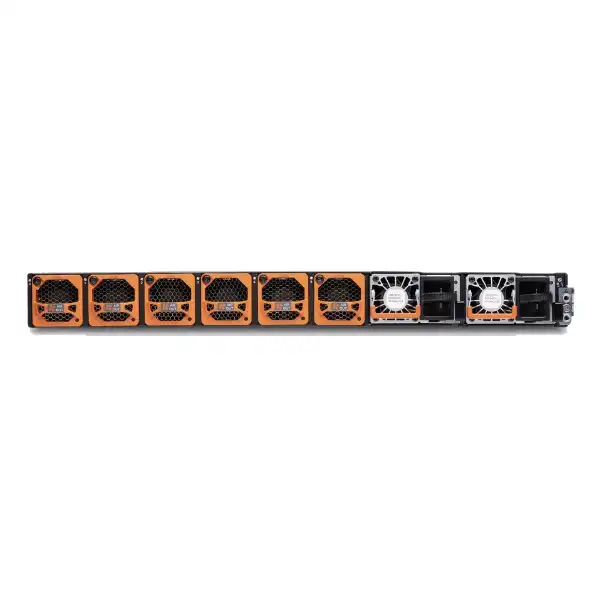
Juniper SRX4700 Firewall Dubai
The Juniper SRX4700 is a compact 1U next-generation firewall built for environments where ordinary enterprise edge appliances no longer provide enough throughput, interface density or scale. It combines up to 1.4 Tbps of published firewall throughput with 400GbE, 100GbE and 50GbE interfaces, Junos OS networking, advanced security services and data-centre fabric integration. For Dubai and UAE projects, the important buying task is not simply selecting the chassis: it is matching the security-service load, software throughput tier, optics, power, high availability and management design to the real traffic pattern.
Direct answer: what is the Juniper SRX4700 and who is it for?
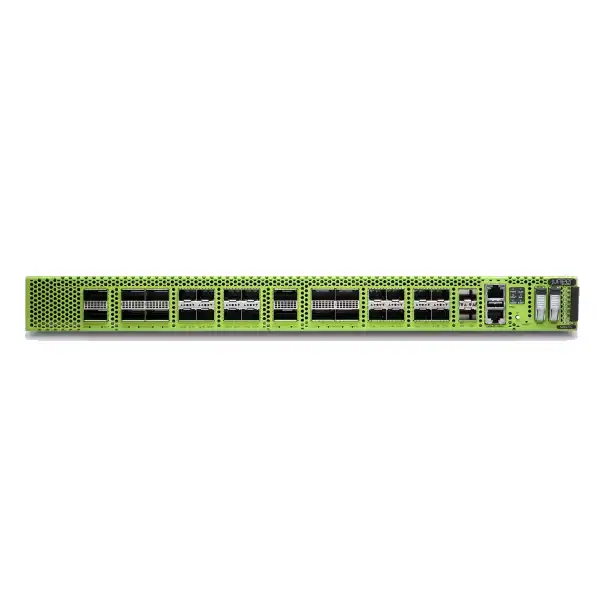
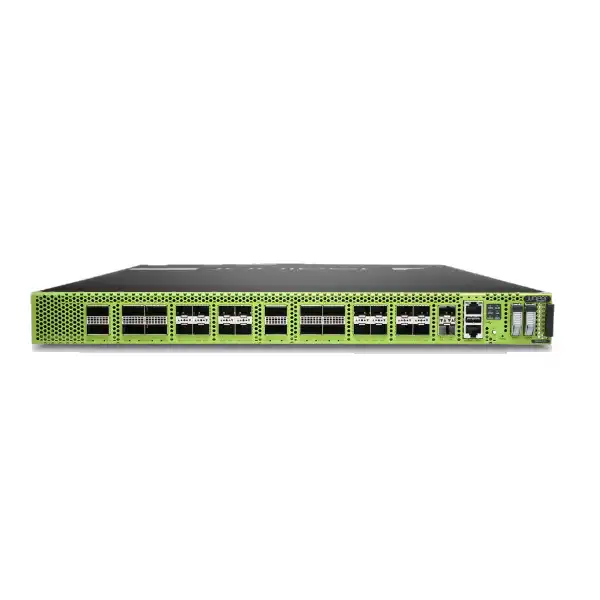
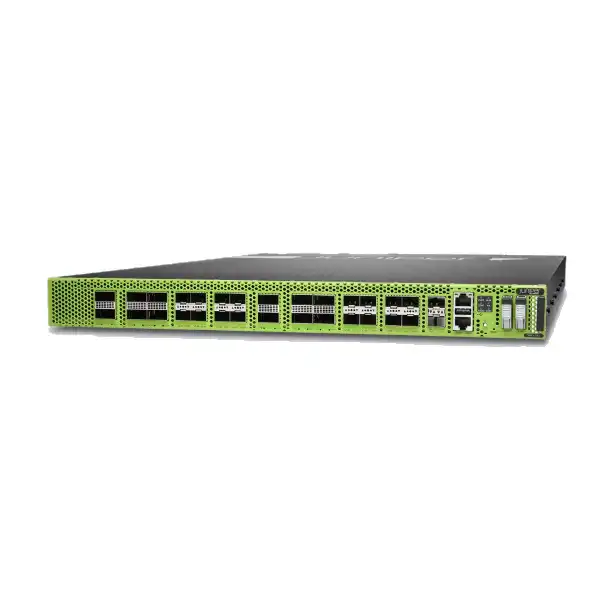
The Juniper SRX4700 is a high-performance next-generation firewall for service providers, cloud providers and large enterprises. Juniper positions it for data-centre core and edge security, enterprise campus and regional headquarters use, secure SD-WAN hub roles, and service-provider security functions. The appliance is based on Junos OS and uses a compact 1U fixed chassis with two 400GbE ports, ten 100GbE ports and sixteen 50GbE ports, plus dedicated management and high-availability connectivity.
Its main value is the ability to handle very high aggregate forwarding rates while still supporting advanced security services, routing, MACsec, VPN, NAT and modern data-centre integration. However, the headline 1.4 Tbps firewall figure is not the same as the throughput delivered when every security feature is enabled. Juniper publishes 100 Gbps NGFW throughput, 110 Gbps IPS throughput, 90 Gbps IPsec VPN throughput and 150 Gbps firewall throughput with application security. Those service-specific numbers are much more important for sizing an inspection-heavy deployment.
The most important factor to confirm is therefore the real workload: traffic volume, packet sizes, encrypted traffic, security profiles, session rate, interfaces, redundancy model and expected growth. FourTeck can help translate those inputs into the required SRX4700 throughput tier, license package, optics or DACs, AC or DC power choice, rack and cooling requirements, high-availability architecture and implementation scope for a Dubai or wider UAE deployment.
SRX4700 at a glance: the numbers that influence a buying decision
The SRX4700 is unusual because its raw forwarding capacity and its advanced security-service capacity are both high, but they are not interchangeable. A data-centre architect planning mostly stateful filtering and routing will size the system differently from a security team expecting sustained IPS, application security, TLS-related inspection workflows, VPN encryption or rich threat prevention. The table below separates the key figures so procurement discussions start from the correct performance envelope.
| Published specification | SRX4700 figure | Why it matters |
|---|---|---|
| Firewall throughput, IMIX / 1518-byte | 1.4 Tbps / 1.4 Tbps | Shows the maximum published stateful forwarding class under Juniper test conditions, not the expected rate for every inspection profile. |
| Firewall throughput with application security | 150 Gbps | Useful for deployments where application-aware policy is central to the design. |
| NGFW throughput | 100 Gbps | A more relevant reference than raw firewall throughput for full next-generation inspection workloads. |
| IPS throughput | 110 Gbps | Important when intrusion prevention will be applied to large east-west or north-south flows. |
| IPsec VPN throughput, IMIX PowerMode IPsec | 90 Gbps | Sets a practical reference for encrypted site-to-site or hub workloads; tunnel count and cryptographic policy still matter. |
| New connections per second | 600,000 | Relevant for public services, large NAT deployments, cloud edges and environments with bursty connection creation. |
| Maximum concurrent sessions | 60 million | Helps validate state scale for dense user, server, carrier or cloud workloads. |
| Maximum security policies | 100,000 | Useful when consolidating many zones, tenants or policy domains, though policy governance and management design remain critical. |
Published performance and capacity are measured under controlled test conditions. Actual throughput varies with Junos OS release, packet mix, enabled services, security policy, traffic composition, encryption and deployment design. A production sizing exercise should use expected sustained and peak service loads rather than a single headline number.
Why the SRX4700 is different from a conventional enterprise firewall
Terabit-class stateful forwarding
The SRX4700 is built for network points where stateful firewall traffic can reach hundreds of gigabits or more. That makes it relevant to data-centre aggregation, cloud interconnect, high-volume internet edges and service-provider infrastructures. It is not a typical branch appliance and should not be selected merely because higher throughput sounds desirable; its economics and operational profile make sense when dense high-speed connectivity and substantial traffic scale are genuinely required.
Dense 400/100/50GbE connectivity
Two 400GbE QSFP56-DD ports, ten 100GbE QSFP28 ports and sixteen 50GbE SFP56 ports create unusually dense front-panel capacity in 1U. This is useful when the firewall must connect directly into high-speed leaf-spine fabrics, data-centre routers, internet edge systems or carrier networks. The advantage only materialises when the optical plan, breakout requirements, cabling and peer interfaces are confirmed before purchase.
Security plus routing and fabric awareness
Because the platform runs Junos OS, it participates in network architectures that need more than firewalling. Juniper documents advanced routing, EVPN Type 5 and VXLAN integration, NAT and carrier-grade NAT functions, IPsec, QoS and centralized policy management. For architects already operating Juniper routing and switching, this can reduce the boundary between network and security operations, although feature compatibility still depends on the exact Junos release and licenses.
Designed for resilient large-scale deployments
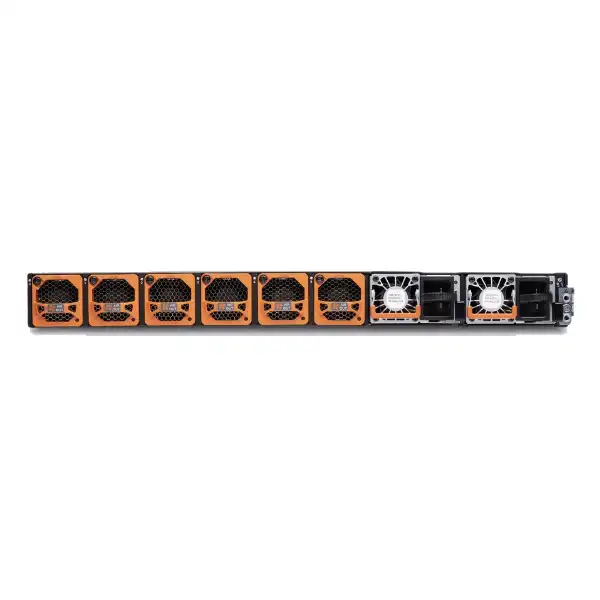
The chassis includes redundant power and fans and has dedicated high-availability ports. Juniper also documents Multinode High Availability for designs that require resilient forwarding and inspection across multiple nodes. High availability is not simply a checkbox: interface symmetry, licensing parity, session state, routing convergence, failure domains and maintenance workflows all need to be designed together.
High-speed interfaces: plan optics and topology before ordering
The SRX4700 front-panel design can remove the need for external media conversion or intermediate switching in some high-capacity architectures, but the port count alone does not define a usable deployment. The correct transceiver type, fibre standard, reach, breakout method, peer capability and supported optic must be validated against Juniper’s current hardware compatibility information. A quotation that lists only the chassis can be incomplete for a real production rollout.
| Interface group | Quantity | Buyer planning point |
|---|---|---|
| 400GbE QSFP56-DD | 2 | Confirm exact 400G optic, fibre type, distance and whether the peer uses a directly supported 400G mode or a breakout architecture. |
| 100GbE QSFP28 | 10 | Useful for fabric, core and router interconnects. Validate optic reach and the operational policy for spare transceivers and cleaning. |
| 50GbE SFP56 | 16 | Provides dense server, switch or service insertion connectivity where 50G is appropriate. Confirm whether any adjacent system requires lower-speed compatibility or breakout behavior. |
| Dedicated HA | 1 x 1GbE SFP control + 1 x 1GbE SFP data | These ports are part of the HA design and should be cabled and documented as resilient infrastructure rather than treated as spare data ports. |
| Management and console | 1GbE RJ-45 OOB, RJ-45 console, USB 3.0 Type A | Plan a separate management network, console access method and operational recovery path. Out-of-band access is especially important in a high-capacity core or edge deployment. |
Juniper states that all onboard data ports are MACsec-capable. MACsec can be valuable for protecting Ethernet links between trusted facilities or data-centre systems, but it must be designed end-to-end with compatible peers, keys, policy and operational monitoring. Do not assume that simply installing a MACsec-capable optic automatically creates encrypted links.
Security architecture and inspection services
At the platform level, the SRX4700 combines Junos OS with hardware acceleration and Juniper security services. Juniper describes the appliance as using its Trio ASIC architecture to provide predictable high-performance processing and to offload eligible flows through Express Path+. That architecture matters because a large firewall should not be evaluated solely as a collection of interfaces. Its useful capacity depends on how policy, application identification, intrusion prevention, VPN, threat intelligence and other services are processed under the expected traffic mix.
Stateful firewall and zone policy
The SRX platform supports stateful and zone-based firewall services, allowing security policy to be built around trusted, untrusted, application, data-centre and service segments. At SRX4700 scale, policy structure becomes an operational concern. A design with thousands of rules, objects and exceptions should include ownership, naming, review and cleanup standards so the 100,000-policy platform limit does not become a substitute for good governance.
Application visibility and control
Application-aware policy can identify and control traffic beyond simple IP addresses and ports. This is useful in cloud-connected and SaaS-heavy environments where applications may share transport protocols. The published 150 Gbps firewall-with-application-security and 100 Gbps NGFW figures are therefore more meaningful than the 1.4 Tbps stateful number when application inspection is expected across a large proportion of traffic.
Intrusion prevention
Juniper publishes up to 110 Gbps IPS throughput. IPS capacity is relevant when the firewall is expected to inspect server, internet, cloud or inter-zone traffic for exploit patterns. Rule scope, signature selection, traffic direction, encrypted content and false-positive handling all affect operational outcomes. Buyers should size for the security policy actually planned, not for a laboratory profile that differs from production.
Threat prevention and cloud intelligence
Juniper ATP Cloud and related threat-intelligence capabilities can extend protection beyond local signature matching, including sandboxing and security intelligence services depending on the purchased subscription. These are licensed capabilities, so a buyer who needs advanced malware analysis or cloud-delivered threat intelligence should not assume those functions are included with a base chassis. The entitlement, term and service tier need to be explicit on the bill of materials.
VPN and encrypted connectivity
The SRX4700 includes hardware-based cryptographic acceleration and Juniper publishes up to 90 Gbps IPsec VPN throughput under its specified PowerMode IPsec IMIX test. Real deployments depend on cipher suites, tunnel topology, packet size, rekey behavior and whether the firewall also performs other inspection on the same flows. For a large hub, migration from an existing VPN concentrator should include tunnel inventory and peak encrypted traffic measurement.
Device trust and secure provisioning
Juniper documents TPM 2.0-based device trust features, a cryptographically signed device identity and RFC-compliant secure zero-touch provisioning. These capabilities can strengthen supply-chain and onboarding controls when they are incorporated into the operational process. They are most useful when the receiving, staging, authentication and automation workflows are designed to validate device identity rather than treating the firewall as manually configured hardware.
Data-centre fabric integration: EVPN-VXLAN is a real architectural differentiator
A conventional firewall inserted into an EVPN-VXLAN fabric can create design friction if overlay traffic must be decapsulated or steered through a separate security tier. Juniper positions the SRX4700 for modern data-centre fabrics and documents support for EVPN Type 5 routes and VXLAN-related security workflows. This allows the platform to participate more directly in routed overlay environments and apply Layer 4-7 security services to relevant traffic without forcing every design to look like a traditional perimeter firewall.
That does not mean every EVPN-VXLAN network should automatically use the SRX4700. The value depends on the fabric control plane, the way tenants or VRFs are separated, where policy enforcement is intended to occur, how route leaking is handled, whether service insertion is centralized or distributed, and which Junos release supports the exact features being designed. A network team should map the existing leaf-spine routing and overlay model before deciding whether the firewall will behave as a secure fabric-aware node, a traditional routed security boundary or part of a broader distributed services architecture.
For Dubai data centres, this integration can be especially useful when organisations are consolidating security and high-speed switching/routing boundaries in space-constrained racks. The SRX4700’s 1U footprint and 400GbE interfaces support dense interconnects, but rack efficiency only becomes an advantage if the power, airflow, optic reach and operational resilience are planned at the same time.
Where the Juniper SRX4700 can fit
The SRX4700 is a specialist high-capacity platform. Its strongest use cases are environments where a smaller firewall creates a throughput, session, interface or resiliency constraint. The examples below are not automatic recommendations; they show where the model’s architecture aligns with common requirements and what should be checked before selection.
Data-centre internet edge
Large organisations can place the SRX4700 at high-speed internet or external connectivity edges where 100G or 400G interfaces are needed and traffic must be filtered before reaching core services. Sizing should distinguish inbound and outbound peaks, protected public-service traffic, application inspection, DDoS architecture, NAT state, routing scale and whether upstream scrubbing or other controls are already present.
East-west data-centre segmentation
High-volume inter-zone traffic can justify a firewall with very large session and forwarding capacity. The SRX4700 can enforce segmentation between application, database, shared-service or tenant zones, but the design should avoid turning one firewall pair into an unnecessary choke point. EVPN-VXLAN integration and distributed-services options may be relevant when security must scale with the fabric.
Service-provider security gateway
Juniper documents service-provider uses including security gateway, Gi/N6 firewall, CGNAT and roaming firewall scenarios. These deployments have very different session, subscriber, NAT, routing and logging demands from an enterprise perimeter. Capacity planning should use subscriber behavior, connection rates, state tables and service chaining requirements rather than enterprise user counts.
High-capacity secure SD-WAN hub
Juniper lists secure SD-WAN hub deployment among SRX4700 use cases. A large hub may terminate substantial IPsec traffic and centralize policy for many remote sites. The 90 Gbps published IPsec figure becomes more relevant than the 1.4 Tbps raw firewall number, and the design should account for tunnel counts, failover, hub redundancy, encryption settings, internet circuits and management integration.
Cloud and colocation interconnect security
Where private cloud, public cloud on-ramps or colocation fabrics deliver tens or hundreds of gigabits, the SRX4700 can provide a policy boundary without forcing traffic through low-speed interfaces. The firewall still needs compatible routing, BGP policy, VRF design, optics and high-availability connectivity. If only a small fraction of the 100G/400G fabric requires inspection, a different architecture may be more economical.
Sizing the SRX4700 correctly: use the service workload, not the port speed
A firewall with two 400GbE ports can be connected to extremely high-capacity infrastructure, but physical interface speed is not the same as sustainable inspected throughput. The starting point for an SRX4700 design is a traffic model that describes what the firewall will actually process. For a data-centre edge, collect at least 30-day and preferably 90-day traffic peaks, packet-size distribution, connection rates, session counts, protocol mix, encrypted traffic share and growth expectations. For a service-provider role, add subscriber counts, NAT behavior, roaming or mobile traffic patterns and any policy requirements that create additional state.
Next, separate traffic by service depth. Pure stateful flows sit closer to the platform’s raw firewall capacity. Flows requiring application visibility, IPS, advanced threat prevention, VPN cryptography or other next-generation services use different processing paths and should be compared with the corresponding published service figure. If most of a proposed 300 Gbps link will require NGFW inspection, the 1.4 Tbps headline is not the right sizing reference because Juniper publishes 100 Gbps NGFW throughput for the platform. That does not automatically make the SRX4700 unsuitable; traffic may be split, services may be selectively applied, or the architecture may use multiple nodes. It does mean the design needs to be explicit.
Session rate can be as important as bandwidth. Web farms, carrier NAT, DNS, API gateways and cloud workloads may establish huge numbers of short-lived connections. Juniper publishes 600,000 new connections per second and 60 million maximum concurrent sessions. A network with only 40 Gbps of traffic can still stress a security device if connection churn is extreme. Conversely, a storage or backup flow can consume large bandwidth with relatively few sessions. Both dimensions should be measured.
Capacity planning should also preserve failover headroom. If two appliances are configured so either one must carry the full production load during maintenance or failure, the normal steady-state load should not consume the capacity needed for that event. The same principle applies to routing convergence, logging, policy updates, signature updates and burst traffic. Production firewall sizing should be based on a resilient operating envelope rather than the highest achievable lab result.
Finally, map growth to a time horizon. A platform purchased for a five-year lifecycle may see 100G links become 400G links, more east-west traffic, greater encrypted content and additional security controls. Where the current load is far below the SRX4700 range, a smaller SRX platform may offer better cost efficiency. Where projected inspected traffic approaches one appliance’s security-service limits, a distributed or multi-node architecture should be evaluated from the beginning.
Licensing: the chassis does not define the complete security capability
SRX4700 procurement needs a deliberate software-license decision. Juniper’s current SRX licensing documentation identifies SRX4700 Flex tiers with 700G and 1400G software throughput capacity designations and security bundles identified as A1, A2, P1 and P2. Standard subscription terms are listed for one, three and five years, and Juniper also documents next-generation seven-year options. The exact SKU should be validated against the intended throughput entitlement, required security services and current Juniper price list at quotation time.
Throughput entitlement
Juniper’s licensing nomenclature includes 700G and 1400G SRX4700 software throughput capacity options. That means a buyer should not assume every appliance quote activates the full headline firewall capacity. The desired throughput tier should be written into the bill of materials and linked to the design assumptions used during sizing.
Security feature tier
A1, A2, P1 and P2 tiers package security capabilities differently. Juniper’s published tables distinguish functions such as IDP signatures, web filtering, antivirus and ATP Cloud entitlement. The best tier depends on the required policy and threat-prevention services, not on the chassis model alone.
Management licensing
Centralized management can introduce separate software entitlements. Juniper documents Security Director Cloud subscriptions for SRX4700-class devices with one-, three- and five-year terms. Organisations should decide whether they will manage the platform through Security Director Cloud, Security Director on premises, Junos CLI, J-Web or another supported operational workflow.
A practical licensing workshop should begin with feature requirements rather than SKU codes. List the services the security team expects to use on day one and during the planned lifecycle: intrusion prevention, antivirus, web filtering, ATP Cloud, application controls, remote access, centralized management and any other licensed capability. Then map those requirements to the current Juniper bundle. This avoids both under-licensing, where a needed feature is missing after installation, and over-licensing, where the project pays for a bundle that is unlikely to be used.
High-availability deployments require special attention. Juniper’s SRX4700 configuration guidance states that each device in a Multinode High Availability setup must have identical licenses to ensure feature functionality and configuration synchronization. Therefore, the BOM for a multi-device design should be checked for entitlement symmetry, subscription start and end dates, support coverage and any future expansion node. Licensing should be treated as part of the HA architecture, not as a purchasing detail added after technical design.
Because vendors update packaging over time, buyers should validate the exact SRX4700 license SKU against Juniper’s current licensing guide and quotation. FourTeck can help convert a feature list into a model-and-license BOM, but the final commercial proposal should show the throughput tier, security tier, term, management entitlement and support line items separately enough for the customer to understand what will expire or renew.
High availability and resilience
The SRX4700 provides redundant power supplies and fans and includes dedicated high-availability control and data ports. Juniper also documents Multinode High Availability with active/active and active/backup approaches and state synchronization capabilities. These functions support resilient designs, but the target architecture should be chosen from business recovery objectives rather than from the availability of an HA feature.
For a conventional pair, confirm whether either node must sustain the complete traffic and security-service load after failure. The calculation should include the most demanding inspection profile, not only average stateful bandwidth. Interface wiring should avoid a single upstream or downstream switch becoming the real failure point. Power feeds should be separated where the facility supports independent A/B distribution. Management and console paths should remain reachable during partial network failures.
In larger data-centre or provider environments, Multinode HA can change how forwarding and inspection scale. Juniper describes Layer 2, hybrid and Layer 3 deployments, including geographically separated designs. The value is greater resilience and scale, but the design is also more complex. Routing, session synchronization, state ownership, node roles, failure detection, link topology and operational procedures all need to be documented. The team should test not only hard failures but also maintenance, partial link loss, routing withdrawal, software upgrade and node rejoin behavior.
HA should also be considered during licensing and lifecycle planning. Matched entitlements are required for consistent feature operation in multi-node designs. A spare or expansion unit that is not licensed or staged correctly can prolong recovery rather than shorten it. A strong project therefore treats chassis, software, optics, configuration, subscriptions, support contracts, spares and runbooks as one resilience package.
Physical deployment in Dubai and UAE data centres
High-density network appliances can be easy to underestimate during procurement because a 1U device looks small on a rack elevation. The SRX4700 is 1.7 inches high and 17.4 inches wide, but chassis depth and power-supply depth must be checked carefully. Juniper lists a base chassis depth of about 26.5 inches, with an AC configuration extending to roughly 27.29 inches and a DC configuration to about 29.20 inches. That can matter in shallow cabinets, rear-door heat-exchanger environments or racks with dense cable-management hardware.
| Physical item | Published SRX4700 detail | Deployment implication |
|---|---|---|
| Form factor | 1U, standard 19-inch rack | Efficient rack density, but reserve adjacent space according to facility cabling, service and thermal practices. |
| Dimensions | 17.4 x 1.7 x 26.5 in base; up to 27.29 in with AC PEMs and 29.20 in with DC PEMs | Check usable rack depth including rear cabling, bend radius and door clearance. |
| Weight | About 40 lb / 18.2 kg with AC supplies; 42 lb / 19.1 kg with DC supplies | Use the correct rack kit and safe installation process; treat it as dense data-centre equipment rather than a lightweight branch appliance. |
| Power supplies | 2 x 2200W AC or 2 x 2200W DC, redundant 1+1 | Confirm facility feed type, connector/cable requirements, PDU capacity and A/B power design before delivery. |
| Airflow | Front to back | Match the rack’s hot-aisle/cold-aisle layout and avoid reversing surrounding equipment in a way that recirculates heat. |
| Operating temperature | 0°C to 40°C at the stated altitude conditions | Use a conditioned data-centre environment; do not treat UAE ambient outdoor temperature as the operating design point. |
The published acoustic level is also significant: Juniper lists approximately 78 dBA at normal fan speed and 92 dBA at full fan speed. This reinforces that the SRX4700 belongs in a data-centre or equipment-room environment, not an occupied office or quiet communications closet. Facility teams should include cooling, power and access requirements in the implementation plan rather than leaving them to the network engineer on installation day.
Management, automation and day-two operations
A high-capacity firewall creates operational value only when the security team can manage policy, changes, logging and upgrades predictably. Juniper provides multiple management paths for SRX4700 environments, including Junos OS CLI, J-Web, Security Director and Security Director Cloud, with current product documentation also providing onboarding guidance for Juniper’s broader cloud management ecosystem. The right method depends on the number of firewalls, policy workflow, administrator model, automation maturity and compliance requirements.
For a single or small number of appliances, direct Junos operations may remain familiar to network teams. In a larger estate, centralized policy management can improve visibility, rule consistency and change control. If the organisation already uses Juniper Security Director for other SRX devices, adding SRX4700 may support a more consistent operating model. If a cloud management strategy is preferred, the required Security Director Cloud subscription and connectivity should be included in design and procurement.
Automation should be used carefully. Secure zero-touch provisioning can accelerate deployment, and Junos provides mature programmatic and configuration-management capabilities, but automation is only as reliable as the source of truth, validation and rollback process behind it. For a firewall carrying hundreds of gigabits, an incorrect automated policy or routing change can create a large outage very quickly. Mature teams use staged changes, pre-checks, post-checks and version-controlled templates rather than treating automation as a shortcut around engineering review.
Software lifecycle management should be planned before production. Juniper publishes release notes, hardware support information and suggested software guidance. The SRX4700 hardware explorer identifies 24.4R1-S2 as the first supported Junos OS release, while current deployments may run later supported releases. A maintenance policy should therefore define approved versions, upgrade test criteria, backup procedures, rollback methods and coordination with the HA design. Do not assume that the newest software version is automatically the best production choice without checking feature support and known issues.
NAT, CGNAT and service-provider considerations
Juniper documents a broad set of NAT functions for SRX4700, including standard source and destination NAT as well as carrier-grade NAT capabilities. For enterprise deployments, this supports familiar internet-edge translation, published services and overlapping-address use cases. For providers, the scale and feature set can extend to subscriber-oriented architectures, but NAT should be sized as a stateful service rather than treated as a simple configuration feature.
CGNAT designs can create extremely large state tables and logging requirements. The 60 million maximum session figure and 600,000 connections-per-second figure are therefore valuable, but they are only part of the design. Subscriber behavior, port-block strategy, endpoint mapping, logging retention, lawful or regulatory requirements, IPv4 address conservation policy and failure recovery all affect the architecture. A project should also consider whether NAT is performed on the same nodes that provide deep security inspection, because resource and operational requirements can overlap.
Juniper’s SRX software documentation includes IPv4 and IPv6 translation methods such as NAT44, NAPT44, NAT64 and NAT46, along with deterministic NAT and port-block allocation options. Which functions are appropriate depends on the service. A carrier migration toward IPv6 may require a transition strategy rather than a permanent expansion of IPv4 translation. An enterprise may need only conventional source NAT and destination publishing. The SRX4700 can accommodate multiple patterns, but a clean requirements document prevents the platform from accumulating unnecessary complexity.
Logging is often the overlooked cost. High connection churn can generate large volumes of NAT and security logs, which may stress SIEM ingestion, storage and retention systems even when the firewall itself has sufficient session capacity. FourTeck can scope the firewall and implementation, but customers should involve their logging and security-operations teams early enough to confirm event destinations, retention periods, time synchronization, source identification and failure behavior.
Migration to SRX4700: what should be discovered before cutover
Replacing a high-capacity firewall is rarely a simple configuration-copy exercise. The target SRX4700 may support the required throughput and interfaces, yet a migration can still fail if routing adjacencies, NAT behavior, policy objects, VPNs, asymmetric flows or application dependencies are not fully discovered. A strong migration begins with an inventory of what the existing platform is doing, including features that may have been configured years ago and are no longer well documented.
1. Capture traffic and state
Collect bandwidth peaks, sessions, connections per second, protocol distribution, asymmetric flows and packet-size behavior. This validates sizing and helps identify traffic that may bypass expected security paths.
2. Inventory policy and objects
Export firewall rules, address groups, applications, services, schedules, user mappings, exceptions and disabled rules. Decide what should be migrated, simplified or retired rather than reproducing technical debt.
3. Map routing and overlays
Document static routes, BGP or other dynamic protocols, VRFs, route policies, EVPN-VXLAN dependencies and upstream/downstream peers. Security cutover and routing cutover should be planned together.
4. Inventory NAT and VPN
Record every source, destination and static NAT rule plus IPsec peer, tunnel parameters, authentication method, routing behavior and ownership. VPN migration often depends on third parties, so coordination time can exceed configuration time.
5. Validate logging and operations
Confirm SIEM destinations, syslog formats, authentication, NTP, SNMP or telemetry, backup, administrator roles and monitoring. A technically successful cutover is incomplete if the SOC loses visibility.
6. Build and test rollback
Define objective acceptance tests, failure triggers and the point at which the old path will be restored. For a core firewall, rollback cabling and routing should be as carefully engineered as the forward migration.
Where possible, stage the SRX4700 with management, licenses, software version, base security policy and interface configuration before the maintenance window. Validate optics with the real peer devices. Test HA synchronization and failure behavior. Pre-create monitoring dashboards and logging integrations. These steps reduce the amount of first-time activity performed during a high-risk cutover and create a clearer line between hardware installation, configuration verification and traffic migration.
When the SRX4700 may be too large—or not large enough
A balanced recommendation is important because the SRX4700 sits at the high end of fixed 1U firewall capacity. If an organisation has a modest internet edge, relatively low session rate and only 10G or 25G interfaces, the SRX4700 may provide far more raw capacity and interface density than the project can use. A smaller SRX platform can reduce acquisition cost, licensing cost, power, noise and operational complexity while still meeting security requirements. The correct comparison should use measured workload and growth, not the assumption that a larger model is always safer.
The opposite problem can occur in inspection-heavy environments. A design expecting several hundred gigabits of full NGFW or IPS service should not treat 1.4 Tbps of raw firewall throughput as proof that one SRX4700 will meet the workload. Juniper publishes much lower service-specific figures. If the required inspection rate approaches or exceeds those figures after headroom, the architecture may need multiple nodes, traffic distribution, service separation or a different class of platform. The decision should be made during architecture, not discovered after purchase.
Interface fit can also justify another option. The SRX4700 is rich in 50/100/400GbE connectivity, but a project dominated by many lower-speed copper links, PoE requirements or branch-style WAN ports may need a different firewall or adjacent switching. The SRX4700 has no PoE+ ports and no mini-PIM slots. In other words, it is optimized for high-speed data-centre connectivity rather than flexible branch-interface expansion.
Procurement checklist for an accurate SRX4700 quotation
A useful quote should describe a deployable solution rather than a single chassis line. The following inputs materially change the bill of materials, license selection or implementation effort. Providing them early reduces revision cycles and helps separate mandatory components from optional services.
Technical specification summary
The specification table below brings together the principal published hardware and capacity details that typically appear in an SRX4700 evaluation. It is a selection reference, not a substitute for validating the current Juniper hardware guide, supported optics and Junos release documentation for the exact order.
| Platform | Juniper Networks SRX4700 Firewall |
| Operating system | Junos OS; hardware explorer lists first supported release 24.4R1-S2 |
| Firewall throughput | Up to 1.4 Tbps IMIX / 1518-byte under published test conditions |
| Application-security firewall throughput | 150 Gbps |
| NGFW throughput | 100 Gbps |
| IPS throughput | 110 Gbps |
| IPsec VPN throughput | 90 Gbps, IMIX PowerMode IPsec reference |
| Concurrent sessions | Up to 60 million |
| Connections per second | Up to 600,000 sustained TCP three-way sessions per second |
| Maximum security policies | 100,000 |
| 400GbE ports | 2 x QSFP56-DD |
| 100GbE ports | 10 x QSFP28 |
| 50GbE ports | 16 x SFP56 |
| MACsec | Supported on all onboard data ports according to Juniper hardware specifications |
| HA ports | 1 x 1GbE SFP control and 1 x 1GbE SFP data |
| Management | 1 x 1GbE RJ-45 out-of-band management, 1 x RJ-45 console, 1 x USB 3.0 Type A |
| Storage | M.2 SSD configurations listed by Juniper include 2 x 1TB or 1 x 1TB plus 1 x 2TB |
| Power | 2 x 2200W AC or 2 x 2200W DC redundant power supplies |
| Airflow | Front to back |
| Operating environment | 0°C to 40°C operating temperature; 5% to 85% non-condensing humidity under published conditions |
Buyer questions about the Juniper SRX4700
Is 1.4 Tbps the throughput I will get with every security feature enabled?
No. Juniper publishes separate performance figures for different workloads. The 1.4 Tbps value is the firewall throughput reference for IMIX / 1518-byte traffic under published conditions. The same datasheet lists 150 Gbps with application security, 110 Gbps IPS, 100 Gbps NGFW and 90 Gbps IPsec VPN. A production design should compare its actual feature mix with the relevant service-specific figure and include headroom.
Does the SRX4700 support 400GbE?
Yes. Juniper lists two onboard 400GbE QSFP56-DD ports, along with ten 100GbE QSFP28 ports and sixteen 50GbE SFP56 ports. The exact optical module, cable, reach and supported configuration still need to be selected for the peer device and fibre plant. The fact that a port is present does not mean every third-party optic is supported.
Is the SRX4700 suitable for a normal branch office?
Usually not. It is a 1U high-capacity platform aimed at service providers, cloud operators and large enterprises. Its port mix is 50/100/400GbE, it uses 2200W-class redundant power supplies and Juniper publishes significant acoustic levels. A branch with modest traffic and lower-speed interfaces will usually be better served by a smaller SRX model with a more appropriate cost, power and interface profile.
What licenses should I buy?
The answer depends on throughput entitlement and required security services. Juniper documents SRX4700 700G and 1400G throughput-capacity tiers and A1/A2/P1/P2 security bundles, with several subscription terms. A buyer should list required IPS, antivirus, web filtering, ATP Cloud and other functions, then map them to the current Juniper bundle. Management software may also have a separate subscription.
Can I deploy the SRX4700 as a VPN hub?
Yes, Juniper positions it for secure SD-WAN hub and high-capacity IPsec use cases and publishes up to 90 Gbps IPsec VPN throughput under its stated test. The real design should include tunnel count, cipher suite, routing, failover, authentication and peak encrypted traffic. For very large hub architectures, redundancy and regional traffic distribution can matter as much as appliance throughput.
Does the SRX4700 support high availability?
Yes. The platform has redundant hardware components, dedicated HA ports and Juniper documentation for Multinode High Availability. The required design can be active/backup, active/active or a more advanced multi-node architecture depending on the supported topology. Licenses must be aligned across nodes, and the traffic plan should account for failure-state capacity.
Can the SRX4700 integrate with EVPN-VXLAN fabrics?
Juniper specifically documents EVPN Type 5 and VXLAN integration for the SRX4700. That can make the platform suitable for modern routed overlay data centres. The final architecture should still validate the exact Junos release, routing policy, VRF or tenant design, traffic steering and desired point of enforcement. Fabric awareness is a capability, not a complete design by itself.
Does it support MACsec?
Juniper hardware specifications indicate MACsec capability on all onboard data ports. MACsec can encrypt Ethernet links, which is useful for protected data-centre or inter-facility connections when both ends support compatible modes. Buyers should confirm peer support, keys, policy, optic and Junos requirements rather than assuming the function is automatically active.
Can the SRX4700 be centrally managed?
Yes. Juniper documents centralized management through Security Director and Security Director Cloud, in addition to on-box and Junos management options. A larger SRX estate usually benefits from consistent centralized policy and visibility. The management architecture should be included in the license and connectivity plan and integrated with administrator authentication, change control and logging.
What rack and power checks are important?
Confirm 19-inch rack compatibility, usable depth, front-to-back airflow, AC or DC feed, PDU capacity and redundant power paths. The chassis is about 26.5 inches deep before power-supply extensions and can reach around 29.2 inches with DC power components. The device is also loud enough that it should be installed in a proper equipment or data-centre environment.
What information does FourTeck need for a quote?
The most useful inputs are quantity, current and projected traffic, required inspection services, interfaces and optic distances, HA design, AC or DC power, licensing term, management preference, migration scope and support requirements. For a replacement project, existing firewall configuration details and a traffic baseline make the quotation more accurate and reduce the risk of selecting the wrong throughput or subscription tier.
Should I compare the SRX4700 with another model?
Yes, whenever measured requirements leave a large gap between what is needed and what the SRX4700 provides, or when the required service-specific throughput approaches its published limits. Smaller SRX platforms may be more economical for lower traffic and simpler interfaces, while multi-node or larger-scale designs may be appropriate for inspection loads beyond one SRX4700. The comparison should be based on workload, ports, resilience, licensing and lifecycle cost.
Decision recap: six items to settle before approving the SRX4700
What FourTeck needs from you for a precise Dubai/UAE quotation
A short requirement summary is enough to begin. For complex projects, the most accurate quotation follows a technical discovery that separates mandatory components from optional security services and implementation work.
Plan the Juniper SRX4700 as a complete security platform, not just a chassis
For a Dubai or UAE SRX4700 project, the right result comes from matching performance, inspection services, licensing, interfaces, optics, power, high availability and migration design in one bill of materials. Share your expected traffic, port requirements and security services with FourTeck, and the quotation can be structured around a deployable architecture rather than a headline throughput number.

Reviews
There are no reviews yet.