
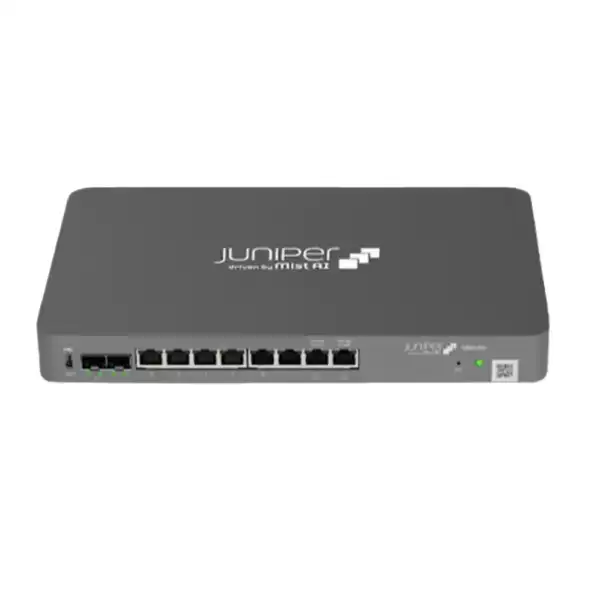
Juniper SSR400 Session Smart Router Dubai
A compact, fanless Session Smart Router designed for small retail and branch locations that need secure routing, SD-WAN policy, application-aware traffic handling and Juniper Mist management without treating a 1GbE port label as a 1Gbps performance promise.
Direct answer: what is the Juniper SSR400?
The Juniper SSR400 Session Smart Router is a fixed-configuration branch edge appliance running Juniper Session Smart Router software. Juniper positions it for small branch and small retail deployments. Its role is broader than a conventional Internet router: it combines application-aware Session Smart networking, SD-WAN functions, IP routing, policy enforcement, traffic engineering and next-generation firewall capabilities in a compact platform that can be managed through Juniper Mist or through Session Smart management workflows.
It is mainly used where a business wants controlled access to Internet, private WAN or cloud applications at a smaller site and wants centralized policy rather than an assortment of independent branch devices. Buyers who should consider it include retailers, small offices, service counters, clinics, hospitality outlets, managed service deployments and distributed enterprises whose site bandwidth and resilience requirements fall within the platform envelope.
The most important factor to confirm is capacity. The physical network ports are 1GbE, but Juniper lists the SSR400 throughput at 100 Mbps. A 1GbE connector therefore must not be interpreted as a 1Gbps routing or SD-WAN throughput commitment. The intended WAN speed, traffic mix, security features, encryption requirements, user count and expected growth should be reviewed before the model is selected.
FourTeck can help determine whether the SSR400 is the correct member of the Session Smart family, whether the base SSR400 or a cellular-capable SSR400-C is more appropriate, which optics and cabling are needed, how the two PoE+ ports will be used, what Juniper Mist WAN Assurance entitlement is required, and whether a larger platform should be quoted instead.
Why the SSR400 deserves a model-specific evaluation
Branch routing purchases often look simple because the front panel lists familiar Ethernet interfaces. The SSR400 is a good example of why a buyer should go beyond port count. It combines a particular hardware envelope with Juniper Session Smart software and a cloud-operational model. The useful question is not only whether ten 1GbE data ports are enough. The useful question is whether the complete combination of listed throughput, routing features, secure SD-WAN architecture, management subscriptions, power design, PoE budget, environmental conditions and site resilience matches the exact branch.
Juniper describes the SSR400 as part of its AI-native SD-WAN portfolio and positions it for small retail and small branch use. That positioning matters because it sets a sensible starting point for design. A modest branch with a 50 Mbps or 100 Mbps access circuit, a limited number of local devices and a need for centrally orchestrated application policy may be a very different fit from a branch that has dual 500 Mbps or 1Gbps circuits and expects all traffic to be inspected and routed at those rates. The same physical RJ-45 connectors could exist in both scenarios, yet the platform decision should not be the same.
The SSR400 is also different from a traditional tunnel-centric SD-WAN appliance. Session Smart networking uses a service-aware approach and Juniper’s Secure Vector Routing technology to create policy-driven connectivity based on sessions and services. For a buyer, this can mean a design discussion centered on who or what is reaching an application, which path should carry the session, what segmentation and firewall policy should apply, and how the network should react if a path degrades. That is more useful than buying hardware first and trying to make the architecture fit afterward.
For a Dubai deployment, the model-specific review should include practical local realities as well: the speed of the Etisalat by e& or du business connection being handed to the site, whether a provider hands off copper or fibre, whether a separately supplied SFP is required, whether an LTE or 5G backup requirement means the SSR400-C should be evaluated, whether the equipment location stays within the published operating temperature range, and whether a non-redundant external power supply is acceptable for the branch continuity target.
Verified SSR400 hardware at a glance
| Item | SSR400 | Buyer relevance |
|---|---|---|
| Platform role | Session Smart Router for small branch / small retail | Start sizing from a small-site requirement rather than assuming it is a general-purpose 1Gbps edge. |
| Listed throughput | 100 Mbps | Compare with the intended aggregate traffic, enabled services and growth plan. |
| Copper data ports | 8 × 10/100/1000BASE-T RJ-45 | Suitable for multiple WAN/LAN roles, subject to the logical design and throughput envelope. |
| Fibre-capable ports | 2 × 1GbE SFP | Optics are selected to match fibre type, wavelength, distance and peer equipment; do not assume the required transceiver is automatically included. |
| PoE | 2 × PoE+ ports, 30 W per supported port, 60 W maximum PoE power | Can power suitable edge devices without a separate injector, but the endpoint power class and total budget must be checked. |
| Memory | 8 GB DDR4 | A fixed platform characteristic; sizing should follow Juniper’s supported role rather than trying to upgrade the appliance like a server. |
| Console / USB | USB Type-C console plus USB Type-C storage interface | Useful for local initialization, maintenance and supported recovery workflows. |
| Cooling | Fanless | Helpful for quiet branch spaces, but adequate passive airflow and environmental control still matter. |
| Power | External AC adapter; no redundant PSU on SSR400 | UPS strategy and acceptable power-failure risk should be considered at sites with strict availability targets. |
| Dimensions | Approx. 30.0 × 3.3 × 19.1 cm | Compact enough for many branch cabinets or shelves, subject to clearance and cabling. |
| Operating temperature | 0°C to 50°C for base SSR400 | Indoor UAE deployments should still use a controlled equipment environment; the rating is not a reason to install the router in an unsuitable hot enclosure. |
| Integrated cellular | No on base SSR400 | If built-in WCDMA/LTE/5G is required, compare the SSR400-C rather than assuming the base model contains a modem. |
Port design: ten 1GbE interfaces do not remove the need for architecture
The base SSR400 provides eight 10/100/1000BASE-T RJ-45 interfaces and two 1GbE SFP interfaces. This is a flexible physical layout for a small branch because a design can allocate interfaces to Internet circuits, a private WAN, local LAN segments, management reachability or service handoffs. The important qualification is that physical interface quantity and interface line rate are not the same as platform forwarding capacity. The published 100 Mbps throughput figure remains the anchor for performance discussions.
Two of the copper ports support PoE PSE at up to 30 W per port, with a published maximum PoE budget of 60 W. This can be useful when a branch wants to power a compatible access point, phone, small camera or another supported powered device without adding a separate injector. That convenience should not be treated as an automatic compatibility promise. The powered endpoint’s IEEE PoE requirement, requested wattage, cabling and placement should be checked. If both PoE ports are populated, the combined draw should stay within the platform budget.
The two SFP interfaces are valuable where the site uses fibre handoff or where fibre is preferred for an internal connection. SFP is a form factor, not a complete optical specification. The correct transceiver depends on the peer port, fibre mode, wavelength, connector type, distance and Juniper support information. Buyers should identify whether the carrier or building network presents single-mode or multimode fibre and whether the handoff is 1000BASE-SX, 1000BASE-LX or another supported 1GbE optic before the quote is finalized.
Juniper hardware information also references a high-availability port in the SSR400 platform description. The role of any HA topology should be designed with the broader site architecture rather than treated as a checkbox. A redundant router design needs more than a port: it needs power diversity, upstream and downstream path planning, addressing, session behavior, failure detection, software design and operational testing. Because the base SSR400 itself does not provide a redundant PSU, the physical resilience model deserves specific attention if two-device availability is being considered.
One further operational detail matters during onboarding: the SSR400 does not have a dedicated out-of-band management Ethernet port. Juniper documents that ports 0, 1 and 2 can be used to contact Mist for zero-touch provisioning and for Conductor remote management. This makes Day 0 cabling and addressing part of the deployment plan. The team staging the router should know which interface will have reachability to the required management service and how that choice fits the final WAN/LAN assignment.
Session Smart routing: what the software changes at the branch
The value of the SSR400 is tied to Session Smart Router software. Juniper’s Session Smart approach is service-centric: policy can be expressed around applications, services, tenants and network intent rather than requiring every branch decision to be represented only as conventional interface-based routing. Secure Vector Routing is central to that design. It establishes session-aware connectivity without relying on the same tunnel-heavy model used by many earlier SD-WAN systems. For distributed networks, the goal is to make the WAN aware of the service being delivered and the policy that should govern it.
That architecture matters most when a business has more than one path or more than one type of application. A point-of-sale session, guest traffic, corporate SaaS, voice, management traffic and a branch-to-data-center application do not necessarily deserve identical treatment. The SSR platform provides a policy engine, service-based routing and traffic-engineering capabilities so the design can identify and handle traffic according to business intent. This is more powerful than simply configuring a static default route toward an Internet connection.
The SSR400 software feature set includes static routing, BGPv4, BGP route reflector functions, BGP graceful restart, BGP over Secure Vector Routing, BGP route maps and prefix lists, OSPFv2, and VRF-related BGP and OSPF functions. This gives the small appliance integration options that are useful in more sophisticated branch designs. A branch may need to exchange routes with a provider, maintain separate routing domains, advertise local services or participate in a larger enterprise routing policy. Whether those features should be used is an architecture decision; their presence does not mean every small site needs a complex dynamic-routing configuration.
The platform also includes common network services such as source and destination NAT, destination NAPT, shared NAT pools, IPv4 and IPv6 support, DHCP client, DHCP relay, DHCP server functions, DHCPv6 prefix delegation, DNS client, PPPoE, proxy ARP, NAT traversal, BFD, path-MTU discovery and MSS adjustment. These are practical building blocks for real branch integrations. They help the router sit between carrier services, local VLANs, cloud destinations and enterprise networks without forcing auxiliary devices into every simple role.
Traffic engineering includes scheduling and shaping, flow policing and shaping, packet marking based on DiffServ and service rate limiting. In buyer terms, that means the router can be part of an application-experience design rather than acting only as a pass-through gateway. The network team can make deliberate choices about which traffic gets priority or bandwidth protection. The effectiveness of those policies still depends on correct classification, realistic bandwidth settings, upstream behavior and the actual bottleneck in the path.
For Dubai businesses with several small branches, this capability can simplify standardization. A common branch template can describe WAN services, segmentation, application policy and security intent. The hardware can then be staged and onboarded consistently across sites. The operational advantage comes from repeatability: a new site should not require engineers to reinvent every NAT, routing and failover decision from scratch. That repeatability is one of the strongest reasons to evaluate an SSR platform rather than treating the purchase as a stand-alone router transaction.
Security: integrated controls, but policy quality still determines the outcome
Stateful firewalling
Juniper lists a distributed stateful firewall among Session Smart capabilities. Stateful inspection is useful for enforcing branch policy around established sessions rather than treating packets as unrelated events. The rulebase should be based on required business flows, not permissive defaults carried forward from an older router.
Segmentation and access control
Fine-grained segmentation and distributed access control can separate business services, guest access, IoT-style devices and administrative traffic. The real value appears when segmentation is mapped to identities, applications and business intent rather than simply creating more VLANs without a policy model.
Zero Trust SD-WAN approach
Juniper markets the SSR400 around a Zero Trust SD-WAN architecture with deny-by-default controls and encrypted Session Smart connectivity. The buyer should translate that into explicit permitted services, path policies, administrative access controls and a documented exception process.
Application awareness
The SSR400 platform is designed to identify applications and use application context in policy and operational insight. Classification quality, software release, subscription features and encrypted application behavior should all be considered when the design depends on a specific application-control outcome.
Integrated security can reduce the number of separate branch devices, but it does not eliminate security architecture. A business that currently uses a dedicated enterprise firewall should compare required functions carefully before deciding whether consolidation is appropriate. Requirements such as advanced threat prevention, URL or content controls, security inspection scale, remote-access VPN, compliance logging, segmentation depth, threat-intelligence services and centralized security operations can affect whether the SSR400 alone is sufficient or should work beside another security platform.
The most defensible approach is to list required security outcomes before ordering. Identify which inbound services must be published, which outbound services must be permitted, which branch zones must remain isolated, which cloud or data-center destinations are trusted, how administrator access is controlled, what logs must be retained and what incident response team needs to see. Then map those requirements to the supported software and subscription entitlement. This prevents the phrase “next-generation firewall” from becoming a substitute for a design review.
The 100 Mbps throughput figure: the buying decision that should come first
Juniper’s hardware specification for the SSR400 lists throughput at 100 Mbps. This is the most consequential number on the page because it determines whether the appliance belongs in the shortlist at all. The ten onboard data ports are 1GbE interfaces, but interface line rate does not override the published platform throughput. A branch ordering a 500 Mbps Internet service because “the router has gigabit ports” could create an immediate mismatch between access-circuit spend and edge capacity.
Sizing should begin with the traffic the router must actually process. If a site has one 100 Mbps circuit but typically uses only 25 to 40 Mbps, the platform may have a different risk profile from a site that regularly needs close to 100 Mbps in both normal and failover conditions. Dual-WAN designs need particular attention. If two circuits are present, the planner should decide whether they are active/standby, active/active, application-steered or used for different services. Aggregate demand can exceed the capacity implied by either circuit individually.
Security and encryption also matter. Published throughput labels are often measured under defined conditions, while a production branch may use encryption, firewall policy, segmentation, application identification, analytics, dynamic routing and traffic shaping simultaneously. FourTeck should therefore collect the intended service mix rather than quote the router from WAN bandwidth alone. Where performance is business-critical, the design should use Juniper’s current sizing and release guidance for the exact enabled functions.
Growth is another consideration. A 60 Mbps branch today may be scheduled for additional cameras, cloud backup, new SaaS workloads, guest Wi-Fi, higher-resolution video calls or local edge devices next year. A router that works comfortably at launch can become the constraint later. The right answer is not always to buy a larger platform immediately, but the growth margin should be deliberate. If expected demand approaches or exceeds the SSR400’s published capacity, another Juniper Session Smart model should be evaluated before purchase.
This is also why a like-for-like replacement exercise can be misleading. An older router may have been connected to a 100 Mbps circuit but could have passed less traffic because of prior usage patterns. A new SD-WAN rollout may intentionally shift cloud traffic directly to the Internet, increasing branch edge load. Capacity should reflect the future architecture, not just the speed printed on an old telecom invoice.
Juniper Mist WAN Assurance and management choices
The SSR400 is cloud-ready and can be onboarded into the Juniper Mist environment for WAN operations. Juniper’s current onboarding documentation states that a Mist WAN Assurance subscription and Mist organization credentials are needed for the cloud onboarding workflow. WAN Assurance brings lifecycle management, visibility and operational tools around the WAN edge, including onboarding, configuration, monitoring and troubleshooting functions. For distributed branches, this centralized operating model can be more important than any single hardware specification.
A typical cloud-led rollout starts before the router reaches the site. The organization and site objects are prepared, subscriptions are activated, the device is claimed, configuration templates or site-specific settings are reviewed, and the deployment team confirms which physical interface will have network reachability during onboarding. Because the SSR400 has no dedicated out-of-band management port, the Day 0 interface plan needs to be deliberate. Juniper documents ports 0, 1 and 2 as options for contacting Mist for zero-touch provisioning and for Conductor remote management.
The SSR400 can also be initialized and managed through Session Smart workflows rather than relying exclusively on Mist. Juniper documents the SSR Web Interface, CLI and Conductor-managed operation. This gives organizations architectural choice, but it also makes licensing and management scope a procurement question. A quote should reflect the desired operating model: cloud-managed WAN Assurance, existing Session Smart orchestration, or another supported design. The exact software release and subscription term should be aligned with the customer’s support policy.
Cloud management does not remove change control. Templates make it possible to standardize policy across many branches, but a bad template can standardize a mistake just as efficiently. The rollout process should define who can modify organization-wide settings, who can change a single site, how configuration revisions are reviewed, how emergency changes are handled and how a known-good baseline is documented. A small edge router can still be a critical business dependency if it connects payment, booking, inventory or customer-service systems.
For companies already using Juniper Mist for wireless or switching, adding WAN Assurance may create a more unified operational view. For companies with no existing Mist footprint, the management decision should include onboarding effort, subscription cost, administrator training, access governance and how alerts integrate with current IT support. FourTeck can structure the quote around the intended operational model rather than supplying hardware with an unspecified management assumption.
Physical design, power and environmental planning in the UAE
The SSR400 is compact, approximately 30.0 cm wide, 3.3 cm high and 19.1 cm deep. Juniper’s hardware data lists the shipped weight at about 1.6 kg for the base SSR400. Its fanless design is valuable in a quiet office or retail environment because there is no normal fan noise and there are fewer moving cooling components. Fanless, however, does not mean ventilation can be ignored. The router still needs the clearance and ambient conditions specified by Juniper, especially when installed in a cabinet with switches, power supplies, UPS equipment and other heat sources.
The published operating range for the base SSR400 is 0°C to 50°C, with non-condensing operating humidity of 10% to 90%. UAE indoor sites should aim for a properly controlled equipment area rather than treating 50°C as a normal operating target. Small retail cabinets near ceilings, glass storefronts, back rooms without continuous air-conditioning and enclosed cupboards can become significantly hotter than occupied office space. Temperature should be assessed where the device actually sits, not from the room thermostat several metres away.
Power is provided by an external AC adapter, and the base SSR400 does not have a redundant power supply. This is important for continuity design. A router can have dual WAN links and still fail if its single power source is interrupted. Branches that require better availability should consider a properly sized UPS, protected power distribution, and the consequences of adapter failure. If true equipment-level power redundancy is mandatory, a different hardware variant or platform may be more appropriate than trying to solve the requirement only with external power accessories.
The maximum PoE power is 60 W across the two PoE+ ports, with up to 30 W per supported port. PoE load contributes to the power and thermal plan. If both ports power devices near their maximum draw, the branch should account for the router plus endpoint load when sizing the UPS and evaluating cabinet temperature. Cabling quality matters as well; poor copper cabling can create intermittent link or PoE behavior that looks like a router problem.
Juniper hardware information lists maintenance clearance of 24 inches / 60.96 cm. In a compact deployment, the installation team should provide practical access for cables, power adapter, console connection and replacement. A shelf filled edge-to-edge with other equipment can make a simple troubleshooting visit unnecessarily disruptive. Good physical deployment is part of network reliability, not merely an aesthetic choice.
SSR400, SSR400-C or SSR440: which direction should a buyer examine?
SSR400
Best starting point: small branch or retail site where the published 100 Mbps throughput is adequate and integrated cellular is not required.
It provides 8×1GbE RJ-45, 2×1GbE SFP, two PoE+ ports, fanless cooling and a single external AC power design. It is the model covered by this page.
SSR400-C
Compare when: the branch needs an integrated cellular option rather than only wired WAN interfaces.
Juniper lists WCDMA/LTE/5G support on SSR400-C. Its cellular radio, regional model, carrier/SIM requirements, antenna placement and subscription plan should be confirmed for the intended UAE deployment.
SSR440 family
Compare when: the site is closer to a medium-branch profile, has stronger resilience requirements, or needs a different platform envelope.
Juniper positions SSR440 for medium branches and offers variants including dual external AC power supplies and cellular models. Exact performance and entitlement should be sized from the current datasheet rather than inferred from the model number.
The choice between these models should follow requirements, not a preference for the newest or largest unit. If the small branch uses a stable wired Internet service, has modest bandwidth and a UPS-backed equipment location, the base SSR400 may avoid paying for cellular hardware that will never be used. If the branch must stay reachable when the wired circuit is cut, integrated cellular can make the SSR400-C worth evaluating, subject to mobile coverage and carrier design.
If the branch already consumes close to the SSR400’s listed capacity, expects rapid growth, or has a resilience requirement that the base unit’s single power design does not meet, the correct response is not to stretch the SSR400 beyond its intended role. A larger Session Smart platform should be compared. FourTeck can build the comparison around bandwidth, path count, interface type, cellular need, power resilience, site count and subscription model.
Seven buyer-fit signals for the Juniper SSR400
Where the SSR400 can fit well in Dubai and UAE networks
Small retail branch
A retail outlet may need point-of-sale connectivity, cloud inventory, staff access, guest or customer services, IP telephony and perhaps a small number of powered endpoints. The SSR400 can provide the branch edge, policy framework and WAN path control when the traffic profile fits. The network should separate payment-related, corporate, guest and operational traffic according to security policy, and the WAN should be sized for both normal sales activity and business peaks. If the retailer relies on cellular backup at each store, the SSR400-C should be evaluated rather than assuming the base model contains a mobile modem.
Professional office or service branch
A small office running Microsoft 365, cloud CRM, voice, printing, secure remote application access and business Internet may benefit from centrally managed SD-WAN, especially when the company operates many similar offices. Application-aware policy can prioritize business-critical services, and branch templates can reduce configuration variation. Video conferencing and cloud backup can create bursts that materially change bandwidth requirements, so utilization data should be reviewed rather than sizing only by headcount.
Clinic or appointment-based location
A small clinic may use cloud scheduling, voice, payment, patient administration and secure connectivity to central systems. The router can support segmented services and controlled access, but the security and availability requirements should be documented carefully. If clinical systems have strict continuity, logging or regulatory requirements, the network designer should confirm whether the SSR400’s capacity and power model meet the risk profile and whether a separate security service remains necessary.
Restaurant, café or hospitality outlet
Hospitality branches frequently mix business systems with guest connectivity. POS terminals, ordering tablets, delivery-platform devices, voice and back-office systems should not be treated like guest traffic. Session Smart policy and segmentation can help enforce separation and path intent. PoE+ ports may be useful for a limited number of compatible devices, but larger wireless deployments usually depend on dedicated access switching or PoE infrastructure rather than the router’s two-port PoE budget alone.
Managed service standardized branch
The SSR400 is particularly interesting when an MSP or enterprise team wants a repeatable small-branch design. A standard bill of materials, standard WAN handoff, standard Mist organization/site structure, standard security template and standard acceptance test can reduce deployment variation. The platform is not automatically correct for every branch in a nationwide rollout; exceptional sites with larger circuits, cellular requirements or stricter resilience should be identified early and assigned a more appropriate model.
When the SSR400 may be the wrong choice
A strong product page should identify limits as clearly as benefits. The SSR400 should not be selected only because it is compact or because it belongs to a modern SD-WAN family. If a site requires sustained routed or secured traffic above the published 100 Mbps capacity, a larger platform deserves evaluation. This is especially important when the site pays for a high-speed fibre circuit, carries substantial cloud backup, hosts many users or expects multiple high-bandwidth application classes.
It may also be the wrong base model if the project requires integrated WCDMA/LTE/5G. The standard SSR400 does not provide the cellular capability that Juniper lists for SSR400-C variants. An external cellular router could be designed separately, but that changes the architecture, management and failure behavior. If integrated cellular is a core requirement, it is cleaner to compare the relevant cellular-capable Juniper model from the beginning.
The lack of a redundant PSU on the base SSR400 is another boundary. Many small branches are comfortable with a single power input protected by a UPS. Other businesses require dual power feeds all the way to the network edge. In those environments, an SSR440-2AC-class variant or another platform with redundant power capability may align better. A dual-WAN link design does not compensate for a single appliance power failure.
The SSR400 is fixed configuration. If a branch requires higher-speed interfaces, a larger number of fibre ports, modular interface cards, or a very different physical architecture, it is better to shortlist a platform designed for those needs. Attempting to solve a fundamental interface mismatch with media converters and extra unmanaged devices can increase fault points and make support harder.
Finally, some organizations have security requirements that justify a dedicated next-generation firewall platform regardless of the router’s integrated security functions. If the security team requires specific threat-prevention subscriptions, sandboxing, remote-access capabilities, advanced inspection scale or a mandated firewall vendor architecture, the SSR400 can still serve as the SD-WAN edge but may not replace the existing firewall. The correct design follows the security policy, not a consolidation slogan.
Licensing and subscription points to settle before quotation
Juniper SSR devices are delivered with Session Smart software, but the desired management and assurance experience affects subscription requirements. Current Juniper onboarding documentation for the SSR400 states that a Mist WAN Assurance subscription is needed to onboard the device into the Mist cloud workflow. Buyers should therefore treat licensing as part of the product design rather than an optional administrative detail added after the hardware arrives.
The quotation should identify the intended management model, the subscription term, the organization or tenant where devices will be claimed, and any support entitlement needed by the customer. A one-year deployment and a multi-year standardized branch rollout can have different commercial structures. Renewals should also be planned because a cloud-managed network becomes operationally dependent on its subscribed management functions even though the physical router remains installed at the site.
Software release matters as well. Juniper’s hardware compatibility information lists Session Smart Router 7.1.0-r1 as the first supported SSR software release for SSR400 hardware. That is a compatibility floor, not a recommendation to deploy the earliest release. The operating team should use a currently supported release appropriate to its environment, after reviewing Juniper release notes, interoperability requirements and change policy. When WAN Assurance support is required, the device software should meet the versions supported for that service.
FourTeck can prepare the bill of materials so the router, subscription, optics, power requirements, installation scope and support expectations are visible in one commercial view. That makes it easier for procurement to compare complete deployment cost instead of comparing only the appliance price while leaving cloud entitlement and accessories outside the decision.
A practical SSR400 deployment journey
Capture branch requirements
Record WAN speeds, expected utilization, user/device count, application classes, routing protocols, segmentation, security policy, fibre/copper handoffs, PoE endpoints, resilience target, management model and growth expectations.
Validate platform fit
Compare the requirement with the SSR400’s 100 Mbps listed throughput, ten 1GbE data ports, two PoE+ interfaces, base-model non-cellular design and single external AC power supply. Escalate to another model when a boundary is crossed.
Build the bill of materials
Include the exact router, correct WAN Assurance entitlement when Mist cloud management is required, supported SFPs, patch leads, rack or shelf considerations, UPS/power accessories and any installation services.
Prepare management
Create or verify the Mist organization and site, activate subscriptions, claim devices and define configuration templates, or prepare the appropriate Session Smart Conductor / SSR management workflow.
Stage and cable
Confirm power, environmental conditions, carrier handoff, management reachability, interface assignment and optics. Label cables and record the physical port map so remote operations match the installed reality.
Migrate services
Move WAN and LAN services in a controlled sequence. Validate DHCP, DNS reachability, NAT, routing adjacencies, segmentation, firewall policy, cloud applications, branch-to-data-center access and any prioritized traffic.
Test failure behavior
If multiple WAN paths are configured, test real path loss, not only configuration status. Confirm which sessions move, how quickly they recover, whether critical applications remain usable and whether alerts reach operations.
Baseline operations
Record normal utilization, application experience, path health, software version, configuration state and support contacts. A baseline turns later troubleshooting into a comparison against known-good behavior rather than guesswork.
Migration considerations from a conventional branch router
Replacing a traditional router with an SSR400 is not only a hardware swap. Existing devices may contain static routes, BGP neighbors, OSPF areas, NAT rules, DHCP scopes, VPN definitions, access lists, traffic shaping, policy-based routing, monitoring destinations and administrative access settings accumulated over years. Some of those settings represent real business requirements; others may be obsolete. A good migration translates required outcomes into the Session Smart model rather than mechanically reproducing every historical command.
Start with traffic flows. Identify what originates at the branch, what enters from outside, what must reach data-center services, what uses direct Internet access, what must remain isolated and what needs priority. Then map routes, NAT and firewall policy to those flows. This approach catches stale rules and hidden dependencies that are easy to miss when engineers compare command lines instead of services.
IP addressing deserves special attention. Changing a default gateway affects every device or VLAN that points to it. DHCP may distribute the gateway dynamically, while printers, cameras, servers or building systems may use static addresses. If the new router uses the same gateway address, the cutover still requires ARP convergence and careful sequencing. If addressing changes, the migration becomes a broader LAN project and should be scheduled accordingly.
Routing neighbors must also be coordinated. BGP or OSPF migration can involve authentication, timers, route filtering, prefixes, redistribution and provider-side changes. The SSR400 supports relevant dynamic routing features, but the peer must agree with the new configuration. If a telecom provider manages part of the routing, obtain their change window and technical contact before the cutover.
For Internet-facing branches, public IP dependencies may be hidden in cloud allowlists, SaaS security policies, third-party payment systems or partner firewalls. A new WAN circuit or NAT design can change the observed public source address. Those dependencies should be captured in advance. Otherwise a migration that appears successful from the router console may still break a business application that only accepts the previous public IP.
Finally, preserve a rollback plan. Keep the previous configuration export, document cable positions, label carrier handoffs and define the point at which the team will return to the old router if critical services fail. Session Smart deployment tools can make modern rollout efficient, but disciplined change management remains essential at revenue-generating branch locations.
WAN design questions that change the SSR400 configuration
Is there one WAN circuit or more than one? A single Internet circuit produces a simpler design but offers no carrier-path redundancy. Two circuits introduce choices around active/active use, preferred paths, failover thresholds and whether both links are sized to carry the full critical load. A secondary circuit that is much smaller than the primary may keep basic applications alive but not sustain every service during failure.
What type of handoff does each provider deliver? The SSR400 supports copper 1GbE and SFP 1GbE interfaces. A fibre presentation may require a compatible SFP and the correct patch lead. A provider-supplied CPE may instead present copper Ethernet. The demarcation should be known before installation so the correct interface is staged and tested.
Does the branch use PPPoE, DHCP or static addressing? The Session Smart feature set includes PPPoE and DHCP-client capabilities as well as conventional IP configuration. The exact ISP handoff determines authentication, addressing, DNS behavior and troubleshooting. A residential-style assumption should never be applied automatically to a business circuit.
Are routes learned dynamically? The SSR400 supports BGP and OSPF functions, but route policy has to be designed. A private WAN or enterprise backbone may require filters, route maps, prefix control, VRFs or graceful-restart behavior. The router can support these features; the site design decides which are appropriate.
Is Internet breakout local? Many SD-WAN architectures send SaaS and public-cloud traffic directly from the branch rather than backhauling it to a data center. Local breakout can improve path efficiency but moves NAT, security and Internet capacity considerations to the branch. That may increase traffic through the SSR400 compared with an older MPLS-centric design.
Which applications must survive path failure? Some sessions tolerate a brief interruption; others do not. Payment traffic, voice and real-time sessions may have stricter expectations than software updates. Failure testing should evaluate real user experience. Juniper describes intelligent rapid rerouting as part of the SSR400’s value proposition, but the result in a specific network depends on path detection, policy, application behavior and alternate-link quality.
LAN, VLAN and segmentation planning
A small branch can still have several security zones. Corporate users, voice, guest Wi-Fi, point-of-sale systems, cameras, building controls and administrative management traffic may all need different access. The SSR400’s routing and segmentation capabilities let the designer define separate services and policies, but physical port count is only one part of the layout. A managed access switch may carry many VLANs to the router over a trunk, while dedicated interfaces may be reserved for WAN circuits or isolated devices.
Segmentation should be based on trust and business function. Creating a VLAN called “Cameras” is useful only if policy actually limits where cameras can connect and which systems can initiate access to them. Guest traffic should normally have no route to corporate services. Administrative management interfaces should not be exposed to general user segments. Payment or other sensitive systems may need particularly restrictive paths. These rules should be documented as allowed flows so they can be tested after deployment.
The two PoE+ ports can simplify very small layouts, but they do not turn the SSR400 into a high-density PoE access switch. A branch with multiple access points, cameras or phones should plan a proper managed switch with enough PoE budget and uplink capacity. The router’s PoE ports are best viewed as useful integrated edge connectivity for a limited number of endpoints, not a substitute for an access-layer design.
DHCP services can be delivered locally by the router or relayed to another server, depending on the architecture. Local DHCP may improve branch independence, while centralized services may simplify address governance. The right choice depends on whether the branch must continue basic LAN operation when the WAN is unavailable, how DNS is provided, and whether enterprise IP address management must remain authoritative.
IPv6 should be considered even if the immediate branch is mainly IPv4. The Session Smart software supports IPv4/IPv6 functions and IPv6 Secure Vector Routing. UAE service providers and cloud platforms continue to expand IPv6 capability, so a new branch design should avoid choices that make future dual-stack adoption unnecessarily difficult. The project does not need to enable every IPv6 function on day one, but addressing, firewall policy and monitoring practices should be future-aware.
Operations after installation: what Day 2 should look like
A branch router is successful when operations can understand and support it months after the installer leaves. Day 2 planning should therefore be part of the purchase. With Mist WAN Assurance, the organization can operate the SSR400 from a centralized cloud context and use WAN-focused visibility and troubleshooting functions. That can shorten the path from “the branch is slow” to a more specific question about application experience, path health or device state.
Operational ownership must still be defined. Someone needs responsibility for subscription renewals, software upgrades, configuration changes, alerts and site inventory. If a managed service provider operates the router, the customer should know which incidents are handled remotely, which require on-site access and which depend on the telecom carrier. Clear boundaries reduce delays when a site loses connectivity.
Software lifecycle management is particularly important on a cloud-connected security and routing platform. The team should track Juniper’s supported SSR releases, security notices and feature changes. Upgrades should be tested against the organization’s routing, application and management requirements. A multi-site estate may use staged rollout rings so a new release is validated at representative branches before deployment everywhere.
Configuration backup and audit are equally important. Central orchestration makes configuration easier to distribute, but it also makes governance important. Maintain a record of who changed policy, why it changed, which sites inherited it and what rollback exists. For regulated or business-critical environments, this change history can be as important as the device’s packet-forwarding capability.
Physical inventory should include serial information, installed location, power source, WAN provider, circuit identifier, SFP model, connected switch ports and local contact. When an outage occurs at 2 a.m., those details save time. The SSR400’s compact size may make it easy to deploy, but professional asset documentation is what makes a distributed fleet manageable.
Procurement details that improve quotation accuracy
An accurate Juniper SSR400 quotation requires more than a model name and quantity. The first commercial input is the exact deployment variant. The base SSR400 is not the same purchase as SSR400-C, and cellular or region-specific variants should not be substituted casually. If the request simply says “SSR400,” the quote should state clearly that it refers to the non-cellular base model unless otherwise agreed.
The second input is quantity and rollout pattern. One replacement router for a Dubai office can be handled differently from fifty devices for stores across the UAE. Larger rollouts may require staged delivery, serial-number capture, pre-claiming into Mist, template preparation, preconfiguration, labeling, site kits and deployment scheduling. The hardware quantity may be the same, but the service scope is very different.
Third, provide WAN details. State circuit speed, number of circuits, copper or fibre handoff, IP method, dynamic-routing requirements and whether cellular backup is desired. This information determines whether the SSR400 capacity is sensible and whether SFP optics or another model should be included. If an SFP is needed, specify the carrier or peer optic information rather than ordering a transceiver by guesswork.
Fourth, define licensing and management. If Juniper Mist WAN Assurance will be used, state the required term and whether a Mist organization already exists. If the device will be managed through an existing Session Smart environment, provide the relevant architecture and software expectations. Licensing uncertainty is a common cause of incomplete network quotations.
Fifth, define support and installation scope. Hardware-only supply is different from staging, remote configuration, on-site installation, migration, testing and post-cutover support. The quote should also say whether the customer supplies rack/shelf space, UPS, LAN switching, structured cabling, carrier service and change-window coordination.
Finally, confirm lifecycle and warranty expectations at the time of purchase. Product availability, regional stock, lead time, entitlement options and support policies can change. Those commercial facts should be verified in the live quotation rather than hard-coded into a product page. This keeps the page technically useful without making an unsupported promise about stock or delivery.
Frequently asked buyer questions about the Juniper SSR400
Is the SSR400 a 1Gbps router because it has 1GbE ports?
No. The interfaces are 1GbE, but Juniper’s published hardware specification lists SSR400 throughput at 100 Mbps. Port line rate and platform throughput are different specifications. Size the router from the published throughput and intended feature set, not from the connector speed alone.
Does the base SSR400 include 5G?
No. Juniper lists WCDMA/LTE/5G capability for SSR400-C variants. If integrated cellular is required for a UAE branch, compare the correct SSR400-C regional model and verify carrier, SIM and radio requirements before ordering.
How many normal Ethernet ports does it provide?
The SSR400 provides eight 10/100/1000BASE-T RJ-45 data ports plus two 1GbE SFP data ports. The SFP ports require compatible transceivers when used for optical connections. Interface assignment to WAN or LAN roles is configuration-dependent.
Can the SSR400 power access points or phones?
Two supported ports provide PoE+ PSE capability up to 30 W per port, with a 60 W maximum PoE budget. A specific endpoint should be checked for PoE standard and power draw. Larger PoE deployments should use an appropriately sized access switch.
Is Juniper Mist required?
Mist is a supported and important management option, and Juniper documents a WAN Assurance subscription for cloud onboarding. The router can also be initialized and managed through Session Smart workflows including the SSR Web Interface, CLI and Conductor-managed operation. The intended management architecture should be decided before licensing is quoted.
Does it support BGP and OSPF?
Yes. Juniper lists BGPv4 features, BGP route maps and prefix lists, BGP graceful restart, BGP over Secure Vector Routing, OSPFv2 and VRF-related BGP/OSPF capabilities. The exact routing design should be coordinated with peers and provider requirements.
Can it replace a branch firewall?
The SSR400 includes integrated firewall and segmentation capabilities, and Juniper positions it with next-generation firewall functions. Whether it should replace an existing firewall depends on the organization’s required security services, inspection scale, subscriptions, compliance controls, remote-access needs and security operating model.
Does the SSR400 have redundant power?
The base SSR400 uses an external AC adapter and Juniper lists redundant PSU as “No.” A UPS can protect against some site power events, but it is not the same as dual internal or dual external power paths. Compare other variants if power redundancy is a mandatory requirement.
Is it suitable for a 500 Mbps Dubai business Internet circuit?
The SSR400’s listed throughput is 100 Mbps, so a 500 Mbps access circuit requires a careful platform review and normally points toward evaluating a higher-capacity router. Buying a fast carrier circuit does not make a lower-throughput edge appliance process traffic at the carrier rate.
Which SFP should I order?
That depends on the fibre type, wavelength, distance, connector and peer equipment. The correct choice should be checked against Juniper’s current hardware compatibility information and the carrier or LAN handoff. “1GbE SFP” alone is not enough information to choose an optic responsibly.
Technical purchasing checklist for an SSR400 deployment
Detailed buyer guidance: translating features into business outcomes
The strongest reason to deploy the SSR400 is not that it has many features. It is that its features can be combined into a repeatable branch architecture. Consider a business with twenty small outlets. Each outlet may have an Internet circuit, a payment system, staff devices, guest access and central cloud applications. Without standardization, each site can develop unique NAT rules, local firewall exceptions and ad-hoc failover behavior. Support becomes dependent on tribal knowledge. With a Session Smart design, the organization can define services and policy centrally, then deploy a consistent intent to the branch fleet.
Service-based routing changes the conversation from “which interface does this subnet use?” to “how should this business service reach its destination?” That can make multi-path policy easier to understand. Voice might prefer a low-latency circuit, cloud backup might be rate-limited, guest access might use direct Internet only, and management traffic might be restricted to specific destinations. These are examples of design intent, not promises that every network will use the same policy. The network team should map actual applications and business priorities before configuration.
BFD support is useful when failure detection needs to be faster and more deterministic than simply waiting for a route to age out. Dynamic routing with BGP or OSPF can then interact with path availability according to the chosen architecture. The important buyer insight is that resilience depends on detection, alternate path capacity and application behavior together. A second circuit adds little value if it cannot carry critical traffic, if DNS or authentication remains dependent on the failed path, or if a downstream switch creates a single point of failure.
Traffic shaping and policing are valuable when a branch has constrained bandwidth. A 100 Mbps-class edge may serve several competing applications, and uncontrolled bulk transfer can affect interactive services. Scheduling and service rate limits allow the design to reserve resources or prevent a lower-priority flow from consuming all available capacity. The policy should still be based on measured application needs. Excessively strict shaping can create its own performance problem.
NAT features provide flexibility for Internet breakout and overlapping address scenarios, but NAT should not be used as a substitute for proper IP planning. Overlapping private address spaces are common after mergers, managed-service onboarding or rapid branch expansion. Session Smart segmentation and NAT capabilities can help connect those environments, but the long-term architecture should document which overlaps are intentional and how routes remain unambiguous.
IPv6 readiness can add information gain even for an IPv4-focused project. The router supports IPv6 functions and Secure Vector Routing for IPv6, which means a business does not need to treat a later IPv6 phase as a complete platform replacement. The migration still requires address planning, DNS, firewall policy, ISP support and monitoring. A buyer can therefore ask the supplier whether the planned software version and WAN services support the organization’s future dual-stack roadmap.
The fanless design can be a real deployment benefit in customer-facing spaces. A small branch may not have a dedicated data room, and a noisy fan can be undesirable in a consultation room, reception area or retail back office. The tradeoff is that passive cooling depends on airflow around the chassis. The router should not be buried under paperwork, packed tightly among hot power supplies or installed in a sealed box because the enclosure looks tidy.
The two PoE+ ports can reduce small-site equipment count. If an outlet needs one suitable access point and one phone, for example, the router may power both without a separate PoE switch, provided each endpoint fits the power limits and the network design makes sense. But if the site has six access points and eight cameras, a dedicated managed PoE switch is the correct access-layer solution. The buyer should use integrated PoE where it simplifies a genuinely small topology, not to force the router into a role it was not designed to fill.
Cloud onboarding can reduce deployment effort when the prerequisites are prepared. A field technician can install a cloud-ready device while centralized engineers apply approved policy. This model is especially useful in distributed estates where network specialists cannot visit every site. The benefit depends on process maturity: serials must be claimed to the correct organization, subscriptions must be active, site assignment must be correct, and the onboarding interface must reach the cloud. A missing upstream DHCP service or incorrect carrier VLAN can still prevent zero-touch deployment.
Juniper Mist operational insight can also change support workflows. Instead of asking a branch employee to describe blinking LEDs, the network team can use centralized health and experience data to narrow the fault domain. That does not eliminate the carrier, cabling, power or endpoint troubleshooting that every WAN still requires. It gives operations better context so the first question can be more precise.
For procurement, the central outcome is reduced ambiguity. A well-designed SSR400 quote specifies exactly what problem the router is solving, the capacity envelope, the management model, required subscriptions, optics, PoE use, installation scope and acceptance criteria. This is a stronger commercial document than a one-line hardware quote because it makes hidden dependencies visible before purchase.
For executives or non-network buyers, the decision can be summarized simply: choose the SSR400 when the branch is genuinely small, the 100 Mbps platform rating matches expected traffic, its interface and power design meet the site, and the organization values Session Smart SD-WAN and Juniper Mist operations. Evaluate another model when bandwidth, cellular, interface, power redundancy or broader security requirements exceed that profile.
Decision recap before you order
What FourTeck needs for an accurate SSR400 quotation
Confirm the SSR400 against your real branch requirement
The Juniper SSR400 can be a strong fit for a small Dubai or UAE branch when its 100 Mbps capacity, ten 1GbE interfaces, two PoE+ ports, fanless design, single external power model and Session Smart management architecture line up with the site. The fastest way to avoid an undersized or incomplete order is to quote the router together with the WAN design, required subscription, optics, power plan and migration scope.

Reviews
There are no reviews yet.