
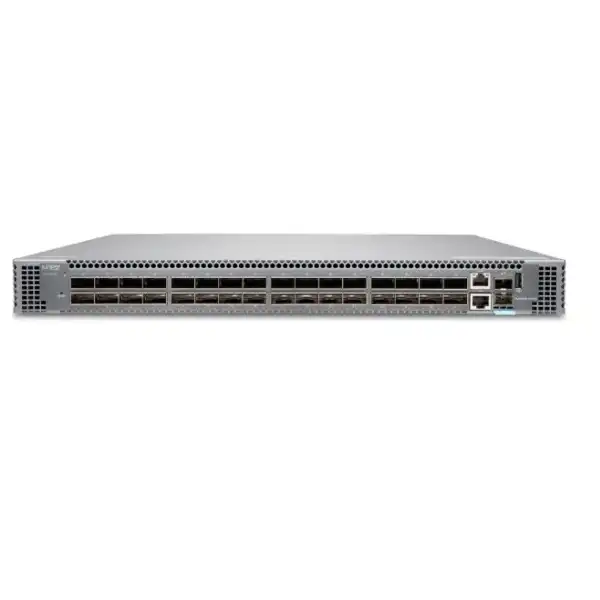
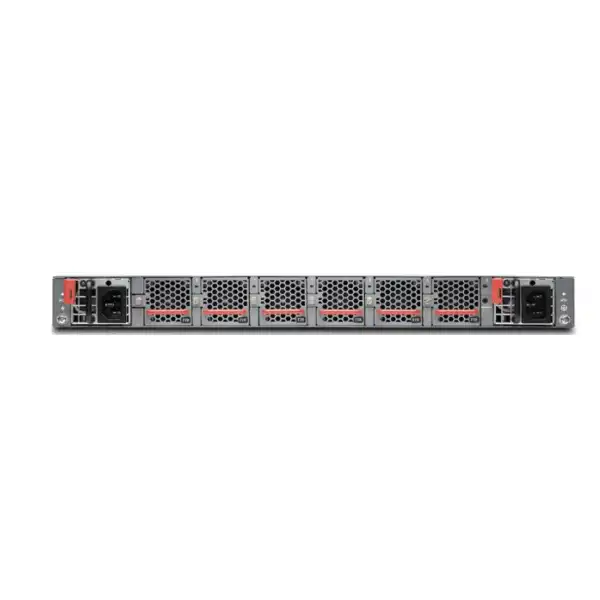
Juniper QFX5120-32C Data Center Switch Dubai
The Juniper QFX5120-32C is a dense 100GbE fixed switch for data-center leaf-and-spine fabrics, high-speed aggregation and channelized server connectivity. Its real value is not simply the count of front-panel ports; it is the combination of 32 40/100GbE QSFP28 interfaces, breakout flexibility, 3.2 Tbps unidirectional switching capacity, Junos OS, EVPN-VXLAN capabilities and a compact 1U footprint. For a Dubai deployment, the commercial decision should also cover airflow, AC or DC power, supported optics, breakout cabling, software entitlements, fabric design and support scope.
Direct answer: what the QFX5120-32C is and when it fits
Why the QFX5120-32C is different from an ordinary 48-port data-center switch
The QFX5120-32C is built around high-speed QSFP28 density rather than a large bank of native SFP28 or copper access ports. That distinction matters because it changes how the switch is used. In a spine role, each QSFP28 can remain a native 100GbE interface, producing a compact device with 32 high-speed fabric-facing links. In a leaf or server-aggregation role, many of those interfaces can be divided into multiple lower-speed lanes using supported breakout cables and the correct Junos configuration. The same physical platform can therefore support very different logical port maps, but only when the cabling plan, transceiver selection and port-specific channelization rules have been designed in advance.
Juniper publishes up to 3.2 Tbps of unidirectional and 6.4 Tbps of bidirectional Layer 2 and Layer 3 switching performance for this model, together with a forwarding capacity of 2 billion packets per second. Those figures help explain its position in the QFX5120 family: this is the model intended for the highest native 100GbE density in that family. It should not be confused with the QFX5120-48Y, which is better aligned to deployments needing many native 1/10/25GbE SFP28 server-facing ports, or the QFX5120-48T, which serves environments needing native 1/10GbE BASE-T copper. A design that chooses the 32C only because “100G is faster” can easily become more expensive or operationally awkward if most endpoints actually need individual 10GbE or 25GbE ports and the required breakout components were not included.
The switch runs Junos OS and supports a broad data-center feature set. Juniper positions the QFX5120 family for modern overlay and underlay architectures, including EVPN-VXLAN. That makes the QFX5120-32C relevant when the network design is moving beyond traditional Layer 2 aggregation into routed leaf-spine fabrics, distributed or centrally routed overlays, automation and streaming telemetry. At the same time, feature availability can depend on the Junos software release and software licensing tier. The correct procurement approach is to treat hardware, software entitlement and operations tooling as one design rather than assuming every capability mentioned at a family level is automatically licensed and ready for every deployment.
For Dubai buyers, this difference is commercially important. A useful quotation is not simply “one QFX5120-32C.” It should identify the exact airflow and power variant, the optic or cable type for every port class, any breakout harnesses, software licenses needed for the planned features, power cords suitable for the site, support coverage and any implementation work. A network switch can be technically correct but still fail the installation plan because air direction opposes the data-center cold-aisle/hot-aisle scheme, optics are mismatched to fibre type, or a desired EVPN-VXLAN function was never included in the software entitlement discussion.
QFX5120-32C core hardware specifications
| Specification | QFX5120-32C detail | Buyer relevance |
|---|---|---|
| Form factor | 1U fixed configuration | High port density in a compact rack footprint; confirm rack depth and airflow plan. |
| High-speed ports | 32 × QSFP28, operating at 100GbE or 40GbE | Suitable for dense spine links or breakout-based server and appliance connectivity. |
| Additional ports | 2 × SFP+ supporting 1GbE or 10GbE, plus dedicated management, console and USB interfaces | Useful for selected auxiliary connectivity and out-of-band administration; do not count the management interface as a production data port. |
| Switching performance | 3.2 Tbps unidirectional / 6.4 Tbps bidirectional | Matches the native 32 × 100GbE port-density objective of the platform. |
| Forwarding capacity | 2 Bpps | Relevant for packet-heavy workloads where packet rate matters as much as aggregate bandwidth. |
| Processor / memory / storage | 2.2 GHz quad-core Intel CPU, 16 GB memory, 64 GB SSD | Supports the control-plane and local software environment; it is not a substitute for evaluating route and table scale for the intended design. |
| Dimensions | Approximately 1.7 × 17.26 × 20.27 in (4.32 × 43.84 × 51.5 cm), excluding protruding FRU handles | Check rack rail compatibility, rear clearance, cable bend radius and service access. |
| Weight | Approximately 21.12 lb / 9.58 kg fully populated with power supplies and fans | Useful for rack loading, handling and installation planning. |
| Power supplies | Two 650 W AC or DC power supplies, depending on ordered variant | Confirm AC versus DC before quotation; do not mix power types or opposing airflow components in one chassis. |
| Cooling | Six hot-swappable fan modules; front-to-back or back-to-front variants | Airflow direction must match rack and aisle design. Mixed airflow FRUs are not a valid configuration. |
Specifications should be matched to the exact orderable variant and current Juniper hardware compatibility information before purchase. Optics, DACs, AOCs and breakout assemblies are deployment-specific items and should be selected against the intended reach, fibre plant and endpoint interfaces.
Port architecture and channelization: the most important design detail
A QFX5120-32C can look simple on a front-panel diagram because the main data plane consists of 32 QSFP28 cages. The network plan becomes more detailed once channelization is introduced. On ports 0 through 30, a native 100GbE QSFP28 interface can be broken into four 25GbE interfaces with the correct breakout media, and a 40GbE configuration can be broken into four 10GbE interfaces. Juniper also documents 2 × 50GbE channelization for the 100GbE ports. This flexibility can turn the switch into a dense server-facing device, but the theoretical count and the practical cabling plan are not the same thing. Every breakout consumes a physical QSFP interface and creates several logical links whose cable reach, connector type and remote endpoint compatibility must be designed.
Port 31 deserves special attention. Juniper documents that the final QSFP28 port does not support the 4 × 10GbE or 4 × 25GbE breakout modes available on ports 0 through 30 because its lanes are shared with the adjacent SFP+ resources. Port 31 can operate natively at 100GbE or 40GbE and supports 2 × 50GbE channelization. This is the kind of model-specific limitation that can cause a deployment issue if a design spreadsheet simply multiplies 32 ports by four. For 25GbE channelization, Juniper lists a maximum of 124 25GbE interfaces from ports 0 through 30. For 10GbE, those 31 QSFP ports can provide 124 10GbE channels and the two SFP+ interfaces increase the platform total to 126 10GbE interfaces, subject to the precise configuration and supported media.
When planning a leaf switch for racks containing 25GbE servers, decide how many QSFP ports are reserved for uplinks before calculating server density. A design might, for example, retain several native 100GbE ports for the fabric while channelizing the rest to 4 × 25GbE. The resulting ratio of server-facing capacity to fabric uplink capacity should be checked against expected traffic patterns, oversubscription tolerance, east-west workload behavior and failure scenarios. The switch can provide the physical interfaces, but it does not decide the correct oversubscription ratio for the business application. That is an architecture decision.
For a spine deployment, the calculation is usually different. Native 100GbE links can connect many leaf switches directly, making the 32C a straightforward choice where 100GbE is the established fabric speed. However, the number of usable spine-facing links must account for redundancy, multi-spine topology, growth, maintenance headroom and any ports assigned to DCI, services, border-leaf connections or other roles. A spine should not be sized solely for day-one leaf count. It is generally better to reserve credible expansion capacity than to create a topology that requires disruptive spine replacement after the next server-rack expansion.
The quotation stage should therefore include a port map rather than only a port count. For each link, identify local port speed, remote endpoint speed, media type, approximate reach, connector/fibre requirement, redundancy path and whether breakout is required. That port map becomes the basis for choosing QSFP28 optics, QSFP+ optics, SFP28 or SFP+ breakouts, DACs, AOCs and patching. It also exposes whether the QFX5120-32C is actually the right model or whether a platform with more native SFP28 access ports would reduce cabling complexity.
Six capabilities that matter in a modern data-center fabric
1. Dense 100GbE switching
Thirty-two 100GbE-capable QSFP28 ports in 1U make the 32C naturally suited to spine and high-speed aggregation designs. Dense native 100GbE also reduces the need to consume multiple lower-speed interfaces for each fabric path.
2. Flexible breakouts
Supported 4 × 25GbE, 4 × 10GbE and 2 × 50GbE breakout modes let a QSFP-focused chassis serve mixed-speed requirements. This is valuable when a data center is migrating from 10GbE to 25GbE or needs a combination of native fabric links and server links.
3. EVPN-VXLAN architecture
The QFX5120 family supports EVPN-VXLAN functions used to build scalable overlay networks on an IP underlay. Buyers should map the desired EVPN-VXLAN functions to the selected Junos release and software license rather than treating the feature name as a single binary capability.
4. Automation and provisioning
Juniper documents automation capabilities including zero-touch provisioning and programmatic management options. These are useful when dozens of switches must be deployed consistently, but the operational value depends on having templates, source-of-truth data, change controls and a tested rollback process.
5. Telemetry and visibility
Streaming telemetry can provide high-frequency operational data for capacity planning and troubleshooting. The monitoring platform, sensor configuration and any advanced telemetry licensing need to be considered as part of the operations design, not after the network is already in production.
6. Redundant field-replaceable power and cooling
The platform is supplied with redundant power and multiple hot-swappable fan modules. That improves serviceability, but only when both power feeds are connected appropriately and replacement FRUs match the chassis airflow direction and power type.
EVPN-VXLAN: where the switch adds architectural value
Traditional data-center networks often relied on large Layer 2 domains, spanning-tree behavior and chassis-centric aggregation. Modern leaf-spine designs commonly use an IP underlay with an EVPN control plane and VXLAN data-plane encapsulation to extend logical network segments across the fabric. The QFX5120 family is designed for this style of deployment, including Layer 2 and Layer 3 gateway capabilities. The architectural benefit is the ability to separate physical connectivity from logical tenant or application segmentation while keeping the underlay routed and predictable.
For a buyer, “supports EVPN-VXLAN” is only the beginning of the conversation. The design still needs to decide where routing occurs, how endpoints are multihomed, what route types are used, whether any-to-any host mobility is required, how external connectivity is attached, and how failure domains are controlled. A centrally routed overlay, for example, places routing responsibility differently from an edge-routed design. The correct choice depends on traffic patterns, operational preferences, existing network integration and the skill set of the engineering team.
Software licensing must be tied to this architecture. Juniper currently groups QFX software capabilities into license tiers, and the QFX5120-32C is listed in the applicable QFX licensing class for which higher tiers add functions including EVPN-VXLAN and other advanced features. License naming and feature entitlements can evolve between software generations, so a commercial quotation should state the intended feature set and license term explicitly. If the business needs only standard switching and selected routing features, buying the highest tier automatically may be unnecessary. If the design relies on EVPN-VXLAN, advanced routing or other premium functions, the hardware price alone is not a complete project cost.
The same principle applies to fabric automation. Juniper Apstra can be used to design and operate IP/EVPN fabrics with intent-based workflows and assurance. Whether Apstra is part of the project should be decided based on fabric scale, operational model and desired automation outcomes. A small environment with experienced Junos engineers may choose direct Junos management or other automation. A larger multi-rack fabric may place greater value on lifecycle automation, validation and closed-loop assurance. The switch supports the network foundation; the management method is a separate design decision.
When FourTeck scopes an EVPN-VXLAN deployment around QFX5120-32C switches, useful inputs include leaf and spine counts, expected endpoint density, VLAN or tenant scale, routing boundaries, external connectivity, redundancy objectives, desired automation tooling, existing Junos expertise and migration constraints. These inputs allow the quotation to reflect the actual fabric rather than presenting the switch as a standalone box.
Software licensing: avoid treating features as automatically included
QFX licensing is a procurement item that deserves the same attention as optics. Juniper supports subscription and perpetual software license options for QFX platforms, with feature tiers that can affect routing, EVPN-VXLAN, MPLS and other advanced functionality. The QFX5120-32C is categorized in Juniper’s QFX licensing framework, and current documentation maps feature entitlements to Advanced and Premium tiers. That means a feature listed in the platform family documentation may still require the corresponding software entitlement for compliant use.
The first licensing question should be functional: what protocols and operational capabilities does the network design actually require? A simple Layer 2 or basic routed deployment may have different needs from an EVPN-VXLAN leaf-spine fabric. A data-center border role using advanced routing or MPLS can have another set of requirements. Writing these requirements down before requesting pricing helps prevent two common problems: buying licenses that add no useful capability to the planned design, or omitting licenses until implementation and then discovering an unplanned commercial dependency.
License term also matters. A perpetual entitlement may be preferred in some capital-expenditure models, while a one-, three- or five-year subscription may fit organizations that align network software with recurring service budgets. The selection should also account for support strategy and expected hardware lifecycle. The cheapest first-year line item does not necessarily provide the best total-cost fit if the environment is expected to run for several years and requires continuous feature entitlement.
Virtual Chassis is another point to validate if the intended design uses it. Juniper’s current QFX licensing documentation notes model-specific member limits and license consistency requirements. The QFX5120-32C supports a limited Virtual Chassis member count compared with some other platforms, so it should not be assumed to behave like a large modular or multi-member access-switch stack. In many data-center architectures, independent routed leafs with EVPN multihoming may be operationally more appropriate than building a switching stack, but the correct design depends on the use case.
For quotation accuracy, provide FourTeck with the intended protocols, fabric architecture, management platform and desired license term. The result can then distinguish chassis hardware, software entitlements, subscriptions and support instead of hiding them inside an ambiguous “switch price.”
Power, airflow and rack engineering for Dubai data centers
AC power option
Juniper specifies 650 W AC power supplies for the QFX5120-32C AC variants, with an operating input range of 100–240 VAC at 50–60 Hz. Juniper publishes typical AC power consumption around 173 W and a maximum around 365 W under its stated test assumptions. Site design should still allow appropriate circuit capacity and redundancy.
DC power option
DC variants are available for facilities using telecom-style DC power. Juniper specifies a rated operating range around –48 to –60 VDC, with a wider operating range documented for the supply. The DC model should be ordered intentionally; AC and DC power supplies must not be mixed in one chassis.
Airflow direction
QFX5120-32C variants are offered with front-to-back or back-to-front airflow. Power supplies and fan modules must match the selected direction. This should be aligned with the rack’s cold-aisle and hot-aisle arrangement before the SKU is finalized.
In a UAE data center, thermal planning is especially important because the external climate places a high overall burden on cooling infrastructure even though the switch itself operates inside a controlled facility. The relevant question is not outdoor temperature; it is whether the rack inlet conditions, airflow path, room cooling, blanking-panel strategy and cable management maintain the equipment within Juniper’s supported environmental envelope. A switch installed backwards relative to the aisle airflow can recirculate heated exhaust and undermine otherwise adequate cooling capacity.
Redundant power only improves availability when the feeds are genuinely independent. Connecting both power supplies to the same PDU and upstream circuit protects against a single power-supply failure but not against the common power path. Where the facility offers A and B power feeds, the design should normally distribute the switch power supplies accordingly and verify circuit type, connector requirements and local power cords. If a rack uses intelligent PDUs, the expected steady-state and maximum load should be included in capacity calculations alongside the rest of the rack equipment.
Optical modules also contribute heat and power. Juniper’s published maximum switch consumption assumptions include a stated allowance per 100G optical module, but real deployments can use different optics with different power characteristics. Long-reach optical modules can consume more power than short-reach modules or passive DACs. The safest engineering approach is to use the consumption figures for the exact supported transceivers included in the final bill of materials instead of assuming that every fully populated 100GbE configuration has identical thermal behavior.
Rack depth is usually straightforward because the QFX5120-32C chassis is around 20.27 inches deep before protruding handles, but rear service clearance, cable bend radius, rail installation and PDU positioning can add practical constraints. The installation plan should make sure that power-supply and fan modules can be removed without dismantling cable bundles and that high-density QSFP breakout harnesses do not block airflow or service access.
Optics, DACs, AOCs and fibre compatibility
The switch chassis does not determine link reach by itself. Every high-speed connection needs media that is compatible with both endpoints and with the physical cabling environment. For short in-rack or adjacent-rack connections, passive direct-attach copper cables can be attractive because they are simple and power-efficient when supported at the required speed and length. Active optical cables can provide a pre-terminated optical option for longer intra-row connections. Pluggable optical transceivers are more suitable when the facility uses structured fibre cabling or when links must extend across a data hall or between locations within the reach of the chosen optical standard.
At 100GbE, the exact QSFP28 optic depends on distance, fibre type and connector arrangement. Multimode links can use short-reach optical technologies where the existing fibre plant supports them. Single-mode links may require LR-class or other supported optics for longer reach. Parallel optical variants can use different connector structures from duplex optics, so it is not enough to specify “100G multimode.” The patch panels, MPO/MTP polarity, duplex LC requirements, fibre grade and endpoint optic must all match.
Breakout connections introduce another layer. A QSFP28-to-4×SFP28 assembly is appropriate only when the parent port is configured for the supported 4×25GbE mode and the remote endpoints accept 25GbE SFP28 interfaces. A 40GbE-to-4×10GbE breakout has analogous requirements. A 2×50GbE breakout needs remote 50GbE support and the correct cable or optical architecture. Port 31’s channelization limitation should be reflected in cable assignment before hardware is installed, not discovered while patching the final server.
Supported-transceiver status should be verified against Juniper’s current hardware compatibility information. Data-center networks are long-lived, while optical part numbers, qualified firmware and support matrices can change. Using an unverified third-party optic might appear to reduce acquisition cost, but it can introduce operational and support risk. Some organizations intentionally standardize on approved third-party optics after validation; others require vendor-supported optics for every production link. The important point is to make that policy explicit and test it rather than mixing components opportunistically.
For a FourTeck quotation, the most useful optic schedule lists each link class, quantity, speed, approximate distance, fibre type, connector type and remote device. That information allows the switch, optics, breakout cables and patching to be quoted as a working connectivity design rather than independent part numbers.
Routing and switching scale: bandwidth is not the only sizing variable
A common mistake in data-center switch selection is to compare only aggregate terabits per second. The QFX5120-32C has substantial bandwidth, but a production design must also fit within the route, MAC, ARP/neighbor, VLAN, multicast and other forwarding-resource limits of the platform and software release. Juniper’s current hardware specifications publish substantial IPv4 and IPv6 table capacities, MAC address scale, VLAN support and other limits, but those limits are not interchangeable. Hardware tables often share underlying resources, and feature combinations can affect practical scale.
A straightforward enterprise leaf-spine fabric with a few hundred or thousand endpoints may be well within the platform’s capabilities. A service-provider or large multi-tenant environment with very large routing tables, extensive EVPN state, dense multicast, many virtual routing instances or unusually high MAC mobility can require a more detailed scale review. The number of physical ports may remain modest while control-plane and forwarding state grow rapidly. That is why the business requirement should include logical scale as well as link speeds.
Route scale matters particularly if the QFX5120-32C is considered for border or data-center interconnect roles. Receiving a full Internet routing table, carrying multiple VRFs or redistributing large route sets can impose a very different requirement from a leaf switch that only holds summarized internal prefixes and locally attached endpoints. The design should document expected IPv4 and IPv6 prefixes, ECMP path requirements, neighbor counts and routing protocol use. It should also preserve growth headroom rather than planning at the published maximum.
Packet size and traffic profile also affect real-world performance. Aggregate throughput figures are useful, but applications can generate microbursts, many small packets or highly asymmetric traffic. Telemetry and queue monitoring are therefore valuable after deployment. They help show whether congestion is caused by a sustained bandwidth shortfall, transient burst behavior, oversubscription or a downstream bottleneck. Buying a faster switch does not automatically eliminate congestion if the traffic is funneled into a smaller uplink, firewall, load balancer or storage interface.
For environments close to platform scale limits, FourTeck should be given the architecture and expected table sizes so that the QFX5120-32C can be checked against a larger QFX alternative if necessary. Selecting a switch with comfortable scale headroom is usually less disruptive than redesigning the fabric after endpoint or routing growth consumes an unexpected resource.
Where the QFX5120-32C fits best
100GbE spine
This is one of the clearest roles for the 32C. Native 100GbE density allows many leaf switches to connect without consuming breakout assemblies. The design should reserve ports for growth and account for dual-spine or multi-spine redundancy rather than allocating every port on day one.
High-density 25GbE leaf
Ports 0–30 can be channelized to 4 × 25GbE, enabling a dense server-facing design while keeping selected native 100GbE ports for fabric uplinks. This can be effective when cabling is planned deliberately and the rack contains many 25GbE servers or appliances.
Aggregation layer
The model can aggregate multiple 40GbE or 100GbE downstream systems and forward traffic toward core, border or service devices. Validate routing scale and service insertion requirements if the aggregation layer also acts as a policy or routing boundary.
Migration bridge between speeds
A mix of native and channelized interfaces can support staged migration from 10GbE or 25GbE server connectivity toward 100GbE fabric links. The cabling design should avoid creating a permanent patching complexity that outlives the migration benefit.
Campus distribution or core
Juniper also positions QFX5120 platforms for campus distribution/core use. The 32C can make sense where the campus backbone is fibre-based and requires high-density 40/100GbE rather than large quantities of native access-facing ports.
When another QFX model may be the better choice
A balanced product page should make clear when the QFX5120-32C is not the most efficient option. Its strength is QSFP28 density. If the requirement is dominated by native 25GbE server ports, the QFX5120-48Y can be easier to cable because it provides many native SFP28 interfaces plus high-speed uplinks. If the rack contains equipment with 10GBASE-T copper interfaces, the QFX5120-48T may align better because it provides native copper access ports. If the requirement calls for a newer generation with higher port speeds, larger scale or a different feature set, QFX5130 or other current QFX platforms may deserve comparison.
| Requirement pattern | Model direction to evaluate | Reason |
|---|---|---|
| Maximum native 40/100GbE density in the QFX5120 family | QFX5120-32C | 32 QSFP28 ports suit spine, aggregation and breakout-heavy designs. |
| Many native 1/10/25GbE SFP28 server links | QFX5120-48Y | Native SFP28 access ports can reduce breakout-cabling complexity. |
| Many 1/10GbE copper server or appliance links | QFX5120-48T | Native BASE-T ports are usually simpler than converting a fibre-focused 32C design. |
| Higher-speed next-generation fabric, larger scale or different silicon requirements | Evaluate newer QFX platforms | A current-generation comparison can be prudent when the project is a greenfield build with a long expected lifecycle. |
The correct comparison should be based on the port map, expected network lifetime, software feature requirements, operational tooling and total bill of materials. A switch that looks more expensive per chassis can be cheaper overall if it removes dozens of breakout assemblies or avoids an early platform upgrade.
Deployment planning from rack to production
A reliable deployment separates physical installation, base configuration, fabric configuration, validation and migration into controlled stages. The QFX5120-32C supports zero-touch provisioning and automation, but automated deployment is only as dependable as the templates and source data behind it. For a first installation or a network migration, a staged process reduces the chance that a cabling, software or routing mistake affects production services.
Migration considerations for an existing data center
Introducing a QFX5120-32C into an existing network is often more complex than installing it in a greenfield rack. Existing networks may have spanning-tree dependencies, legacy LAGs, static routing, older optic standards, mixed MTU settings, non-uniform VLAN conventions and applications that assume Layer 2 adjacency. A successful migration starts by discovering these dependencies instead of copying the current configuration line by line to a new switch.
If the project moves from a traditional three-tier network to EVPN-VXLAN, the migration plan must define an interworking stage. Old and new networks may need temporary Layer 2 or Layer 3 interconnection while workloads move. Default gateways might remain on the legacy core initially and then shift to leaf switches later, or the project may adopt a different routing boundary. The order matters because moving a gateway changes traffic paths, failure domains and sometimes security-policy enforcement.
Cabling migration can be equally significant. A rack moving from 10GbE SFP+ to 25GbE SFP28 may need new server NICs, new DACs or optics, updated patch panels and different breakout assemblies. A switch that is ready for 25GbE does not make a 10GbE-only server run at 25GbE. Endpoint capability, transceiver compatibility and driver or firmware support must be considered. Where mixed speeds will coexist, the QFX5120-32C breakout flexibility can help, but only if the port allocation remains understandable and supportable.
Operational migration is another dependency. Network teams accustomed to a small number of chassis switches may need new processes for a fabric containing many independent leaf devices. Configuration templates, routing troubleshooting, EVPN route inspection, telemetry and automation workflows become part of normal operations. If Juniper Apstra or Mist management is introduced, it should be incorporated into training and change-control processes rather than treated as a dashboard that will automatically solve design problems.
A rollback plan should be defined for every major migration step. That includes the physical patching required to revert, configuration checkpoints, change windows, application validation and responsible owners. The QFX5120-32C can enable a modern architecture, but the migration method determines whether the transition is controlled or disruptive.
Operations, telemetry and troubleshooting after go-live
The switch should enter production with an operations plan already in place. At minimum, administrators need secure management access, configuration backup, time synchronization, syslog, alarms, interface monitoring and a method to track software and hardware changes. In a high-speed fabric, simple five-minute interface polling can miss microbursts or short-lived congestion. Juniper Telemetry Interface capabilities can provide more granular data to a compatible monitoring system, while advanced telemetry functions may have separate licensing requirements.
Useful telemetry is tied to questions. Link utilization helps identify sustained capacity pressure. Queue depth and drops can indicate congestion. Optical receive and transmit levels can help isolate degrading fibre paths when the chosen transceivers expose the relevant diagnostics. CPU and memory trends can flag control-plane stress. Routing adjacency and EVPN state provide insight into underlay or overlay health. Collecting every available counter without a retention and alerting strategy can create an expensive data lake with little operational value, so monitoring should focus on actionable signals.
Configuration management also matters. Zero-touch provisioning can bootstrap a device, while Python, Ansible and other automation approaches can standardize later changes. The goal is not automation for its own sake. The goal is repeatability, reviewability and reduced configuration drift. A change should ideally be traceable to a source-of-truth record or approved template and be testable before broad rollout. Manual emergency changes need a process for reconciliation so that the actual switch does not remain different from the intended configuration.
Software maintenance should be planned rather than reactive. Junos release selection can affect available features, resolved issues, interoperability and lifecycle support. The most recent release is not always the correct production release for every organization; many enterprises standardize on releases that have passed internal validation. Before an upgrade, review the specific release notes, validate the required feature set, confirm configuration compatibility, back up the current state and test the maintenance procedure on a representative device where possible.
Troubleshooting in an EVPN-VXLAN fabric benefits from a layered approach: verify physical link and optics first, then underlay IP reachability and routing, then overlay EVPN control-plane state, then VXLAN forwarding and endpoint learning. This sequence prevents engineers from spending time on overlay symptoms caused by a simple physical or underlay fault. The QFX5120-32C provides the platform capabilities, but clear operational runbooks turn those capabilities into reliable service.
High availability: design beyond redundant power supplies
The QFX5120-32C includes hardware serviceability features such as dual power supplies and six fan modules. Those components reduce the impact of individual FRU failures, but high availability is a system property, not a checkbox on the chassis. A production fabric should also remove single points of failure in topology, upstream routing, cabling, power feeds, management access and critical services.
In a leaf-spine architecture, a server or appliance can be dual-homed to two separate leaf switches where the endpoint and design support it. The leaves can connect to multiple spines, giving traffic alternate equal-cost paths. This architecture differs from relying on one large aggregation chassis. It can provide strong failure isolation, but only if routing convergence, multihoming, link aggregation and application behavior are tested. A nominally redundant topology can still fail poorly if both links share the same patch panel, power source or upstream service dependency.
Maintenance is part of availability. The ability to replace a fan or power supply while the switch remains running is useful, yet an entire switch still needs planned software upgrades and occasional replacement. A fabric should be sized so that the loss of one leaf or one spine does not overload remaining paths. If every link normally operates near saturation, redundancy may exist on paper but fail to provide acceptable performance during maintenance.
Power redundancy should include separate upstream circuits where the facility supports them. Management redundancy should ensure that engineers can reach a device when the production network is impaired. Configuration and image files should be backed up in systems that are not dependent on the same switch for access. Monitoring should alert on loss of one redundant component before a second failure turns the condition into an outage.
The procurement impact is straightforward: high availability may require more than two power cords. It can require two switches per logical leaf pair, additional optics, duplicate fibre paths, separate PDUs, support coverage and enough spare capacity across the remaining fabric. These costs should be included when comparing architectures.
Procurement guidance for Dubai and UAE buyers
A technically correct QFX5120-32C order should start with the exact variant, not the family name. The hardware is available in combinations of AC or DC power and front-to-back or back-to-front airflow. These are not cosmetic options. They determine compatibility with the site power system and rack cooling direction. A quotation that does not state them clearly is incomplete.
The next step is to separate chassis quantity from connectivity quantity. Count how many native 100GbE and 40GbE links are needed, how many 25GbE, 10GbE or 50GbE links will be created through breakout, and which ports must be reserved for uplinks or future expansion. Convert that plan into optics, DACs, AOCs and breakout assemblies. Include spares according to the organization’s maintenance policy. For large deployments, spare optics can be operationally more valuable than a spare chassis if optics are the more frequent field replacement item, but the correct spare strategy depends on deployment size and business criticality.
Licensing should be quoted on its own line with tier and term. The business should know whether the price includes standard software only, an Advanced entitlement, a Premium entitlement, telemetry licensing or a management subscription. Support should also be explicit: support term, service level and start date should match the project timeline. Hardware that sits in storage for months before deployment can consume support period depending on contract structure, so implementation schedule and coverage dates should be coordinated.
For UAE installations, delivery logistics can include data-center access procedures, site receiving hours, security approvals, rack readiness and change-window scheduling. These project details are separate from the hardware specification but can determine whether an installation succeeds on the planned date. If FourTeck is providing installation or migration, the scope should state who supplies racks, power, patching, remote-end optics, IP addressing, configuration data, maintenance windows and application validation.
Pricing and availability should be confirmed by current quotation because enterprise networking hardware supply, support options and license programs can change. Avoid treating an old online price as a complete deployment cost. The most useful commercial comparison includes hardware, optics, licenses, support, implementation and the operational consequences of each design choice.
Common buyer questions about the Juniper QFX5120-32C
Does the QFX5120-32C have 32 native 100GbE ports?
Yes. Its 32 QSFP28 data ports can operate at 100GbE or 40GbE. The design can also channelize supported ports into lower-speed interfaces. The exact logical port count therefore depends on the selected speed and breakout configuration rather than the number of physical cages alone.
Can every QSFP28 port break out to four 25GbE links?
No. Ports 0 through 30 support 4 × 25GbE channelization. Port 31 has a specific limitation and does not support 4 × 25GbE or 4 × 10GbE breakout; it supports native 100/40GbE and 2 × 50GbE channelization. Port allocation should reflect this before cabling is ordered.
Can it be used as a 25GbE server-access switch?
Yes, when supported QSFP28 ports are channelized into 4 × 25GbE interfaces. This can provide very high 25GbE density. Compare the resulting breakout-cabling complexity with a switch that offers native SFP28 ports, especially if most server links will remain 25GbE for the full lifecycle.
Does it support EVPN-VXLAN?
The QFX5120 family supports EVPN-VXLAN data-center architectures, including Layer 2 and Layer 3 gateway functions. The required software entitlement and Junos release should be checked against the exact feature set planned for the deployment.
Are optics included with the switch?
Do not assume they are. The switch chassis and the required transceivers, DACs, AOCs or breakout cables should be treated as separate bill-of-material items unless a quotation explicitly bundles them. Media must be selected for speed, reach, fibre type and endpoint compatibility.
Does the QFX5120-32C support redundant power?
Yes. The platform uses two power supplies and supports redundant, load-sharing operation when both are correctly installed and powered. Availability is improved further when the two supplies are connected to independent upstream feeds rather than the same circuit.
Can AC and DC power supplies be mixed?
No. The chassis should use the correct matching power-supply type and airflow direction. Juniper explicitly warns against mixing AC and DC power supplies or mismatching airflow directions between power supplies and fan modules.
How much power does it consume?
Juniper publishes typical and maximum figures that vary between AC and DC configurations and depend on its stated optical-module assumptions. For AC, published typical consumption is about 173 W and maximum about 365 W. The actual rack calculation should use the final optic population and site conditions.
Is the switch appropriate for a small office LAN?
Usually not. Its port type, performance and feature set are intended for data-center, aggregation and high-speed distribution roles. A normal office access network generally needs many 1GbE/2.5GbE edge ports, PoE and different access-layer features, making another Juniper EX or related platform more appropriate.
Can it be managed through Juniper cloud or fabric tools?
Juniper currently documents QFX5120 support in its management ecosystem, including Mist-supported hardware listings and Apstra for data-center fabrics. Management subscription, software release and feature compatibility should be checked as part of the project design.
What should be supplied for an accurate Dubai quotation?
Provide quantity, intended role, native and breakout port counts, optical distances, AC or DC preference, airflow direction, feature and licensing requirements, support term, rack location and whether FourTeck should include configuration, migration or installation services.
Technical decision notes for architects and network engineers
The QFX5120-32C uses a Broadcom Trident3 switching architecture. For most buyers, the practical consequence is not the silicon name itself but the balance of port speeds, table resources, latency behavior and supported Junos features built around the platform. Engineers should validate any feature that depends on specific forwarding-chip capabilities against the intended Junos release, especially when a design relies on advanced telemetry, uncommon encapsulations, high scale or exact quality-of-service behavior.
Latency is another specification that is easy to oversimplify. Juniper publishes low-latency performance for the QFX5120 family, but application experience depends on the entire path. Serialization delay, congestion, queueing, optics, fibre length, intermediate devices and endpoint processing can dominate end-to-end latency. A low switch latency is beneficial in storage, compute and high-performance environments, yet it should be treated as one component of the latency budget rather than a guarantee of application response time.
Jumbo frames are supported, and Juniper’s current hardware specifications list a 9216-byte jumbo frame capability for the QFX5120-32C. If a storage or overlay network uses a larger MTU, configure it consistently across the path and account for encapsulation overhead. VXLAN adds headers to the original packet; an underlay MTU that only accommodates the endpoint frame size without the overlay overhead can cause fragmentation or packet loss. MTU validation should be part of pre-production testing.
ECMP is fundamental to leaf-spine design because traffic can be distributed across multiple equal-cost spine paths. The switch supports substantial ECMP capability, but the traffic distribution of real flows depends on hashing inputs and flow sizes. A small number of very large flows can create imbalance even when many equal-cost links exist. Where this matters, validate hashing behavior and use telemetry to identify persistent hot links rather than assuming that aggregate fabric capacity is perfectly shared.
Link aggregation and multihoming decisions should similarly follow the architecture. LAG can combine multiple physical interfaces to one logical link, while EVPN multihoming can provide redundancy across separate leaf devices. These mechanisms solve different problems. Combining them without a clear failure-domain model can make troubleshooting harder. The design should state whether redundancy is within one switch, across two independent switches, or across a broader routed fabric.
Finally, route policy and security boundaries should be deliberate. A data-center switch can forward at very high rates, but that does not make it the replacement for a firewall. Segmentation through VLANs, VRFs, EVPN and routing policy can constrain reachability, while stateful security inspection is typically handled by dedicated security platforms or appropriately designed distributed security controls. The network architecture should identify where security policy is enforced so that high-speed east-west routing does not inadvertently bypass required controls.
Sizing examples: turning a requirement into a port plan
Consider a rack with 48 dual-homed servers, each using one 25GbE link to each of two leaf switches. Each leaf therefore needs 48 server-facing 25GbE interfaces. Twelve QSFP28 ports channelized as 4 × 25GbE provide those 48 interfaces on each leaf. The remaining QSFP ports can be used for 100GbE fabric uplinks, services or growth, subject to the final design. This illustrates why the 32C can be effective as a dense 25GbE leaf even though it has no bank of native SFP28 cages. It also illustrates the cabling consequence: every set of four server links is tied to a breakout from one QSFP port, so cable labeling and physical routing must be organized.
Now consider a spine for 24 leaf switches, each connecting to the spine at 100GbE. Twenty-four native QSFP28 interfaces can serve those leaf links, leaving eight physical high-speed ports for growth or other fabric roles. In a dual-spine architecture, every leaf can connect to both spines, so two QFX5120-32C units would provide path diversity. The usable headroom should be assessed against future leaf additions and any non-leaf ports. If the design is expected to grow beyond 32 leaves per spine, a higher-port-density or higher-speed spine platform may be more appropriate from the start.
A mixed-speed migration might allocate several ports to native 100GbE uplinks, several to 40GbE legacy devices, and a group of ports to 4 × 10GbE or 4 × 25GbE breakout. This can avoid an immediate forklift replacement of all endpoints. The tradeoff is configuration and patching complexity. Every speed group should be documented in the rack elevation and port database, and the project should include a target-state plan. Temporary mixed-speed arrangements tend to become permanent when no migration milestone is assigned.
These examples are not universal reference architectures. They show how to translate endpoint counts into physical QSFP usage. Real designs must account for redundant links, server NIC teaming, fabric topology, oversubscription, route scale, failure capacity and application traffic. A data-center switch should be sized for the failure case as well as the normal case. If losing one uplink causes the remaining links to exceed safe utilization, the design is under-provisioned even if day-to-day graphs look comfortable.
FourTeck can use a simple endpoint and uplink worksheet to check these calculations before pricing. That reduces the chance of ordering the correct chassis but the wrong quantity of breakout assemblies, optics or licenses.
Support and lifecycle considerations
Enterprise switching is normally purchased for a multi-year service life, so lifecycle planning should begin at acquisition. The relevant questions include the current hardware availability status, Junos software support policy, chosen service contract, access to replacement hardware, software update rights and the organization’s own standardization window. These items can change over time, so they should be confirmed at quotation rather than copied from an old project.
Support coverage should reflect business criticality. A lab or non-critical environment may tolerate a longer replacement window. A core production fabric supporting revenue systems may justify more stringent service levels and local spare strategy. The right answer can vary even within the same company. A small number of strategic spare units can sometimes reduce outage exposure more effectively than relying entirely on courier replacement, especially where data-center access procedures or maintenance windows add delay.
Software planning should include an upgrade cadence. Running a single Junos release indefinitely can eventually create support or security issues, while frequent untested upgrades can introduce change risk. Mature operations usually select approved releases, test upgrades in a representative environment, maintain configuration backups and schedule maintenance windows with explicit rollback criteria. EVPN-VXLAN and automation environments benefit from additional regression testing because a software change can affect both forwarding behavior and the management tooling that interacts with the switches.
Hardware standardization can simplify lifecycle operations. If many racks use the same airflow direction, optics, power system and software release, spares are easier to manage and engineers encounter fewer one-off conditions. Conversely, a rushed purchase that introduces a different airflow variant or unsupported optic type can create years of operational friction. Standardization should therefore be part of the request for quotation when the QFX5120-32C is joining an existing Juniper estate.
When evaluating the QFX5120-32C for a greenfield project, compare its expected service horizon with newer platform options. An established platform can be attractive because its behavior and software are well understood, while a newer generation can offer more future bandwidth or scale. The right choice depends on requirements, budget, software maturity preferences and how long the design is expected to remain in service.
Security and management practices around the switch
A high-performance data-center switch should be deployed with a hardened management plane. Administrative access should use secure protocols, strong authentication and role separation appropriate to the organization. The dedicated management interface can be placed on an out-of-band network so engineers retain access when production routing is impaired. Console access should be physically controlled, and default or temporary credentials should not remain in service.
Centralized authentication and accounting can improve traceability by associating changes with named administrators rather than shared local accounts. Local break-glass access may still be required for emergencies, but it should be protected and audited. Configuration commits, software upgrades and interface changes should feed the organization’s change-management process, especially in fabrics where one template can affect many switches at once.
Control-plane protection is another consideration. Routing protocols should use appropriate authentication or peer restrictions where supported and required. Unnecessary management services should be disabled. Infrastructure ACLs or firewall filters can limit who reaches control-plane services. Logging should be sent to centralized systems so that events remain available if the switch itself is replaced or fails.
The network design should distinguish segmentation from inspection. VRFs, VLANs and EVPN can provide logical separation and routing boundaries, but a compliance requirement for stateful firewalling, intrusion prevention or application inspection typically calls for security controls beyond the switching platform. The architecture may steer traffic through firewalls at defined boundaries or use distributed security mechanisms depending on the application model. This decision affects switch port allocation and routing policy, so it belongs in the early design.
For procurement, security requirements can add dedicated management switches, console servers, authentication integration work, logging collectors or high-speed firewall interfaces to the project. Including these dependencies early avoids treating network security as a post-installation configuration task.
What makes a QFX5120-32C quotation complete
A complete quotation maps each commercial line item to a technical requirement. The switch chassis should state its exact AC or DC and airflow variant. Power cords should match the deployment location and PDU connector type. The optics schedule should show part number, speed, reach and quantity. Breakout assemblies should be tied to the planned channelized ports. Software licenses should identify tier and term. Support should identify the service period. Installation or configuration services should define deliverables and exclusions.
This level of detail is especially valuable when comparing offers from multiple suppliers. One quote may appear cheaper because it includes only the switch, while another includes optics, licenses and support. Comparing the final working bill of materials avoids a false price comparison. It also makes project approval easier because finance and technical teams can see what is being purchased and why.
For large rollouts, include deployment spares and staging requirements. Staging can cover hardware inspection, software standardization, configuration loading, serial-number capture, labeling and basic port tests before units reach the data center. This can reduce on-site change-window risk. If the customer has an internal automation pipeline, FourTeck can instead supply hardware ready for the customer’s own provisioning process and focus services on design validation or migration.
Documentation should be part of the implementation outcome. Useful deliverables include rack elevations, port maps, IP address plans, software versions, configuration backups, optic schedules, licensing records and support contract details. These documents become operational assets after the installers leave. Without them, routine replacement or troubleshooting can depend on individual memory.
The procurement objective is therefore not “obtain the lowest QFX5120-32C price.” It is “obtain the correct, supportable QFX5120-32C deployment at a transparent total cost.” That distinction protects both budget and service reliability.
Decision recap: six points to settle before ordering
What FourTeck needs from you for an accurate QFX5120-32C proposal
The following inputs allow the quotation to be built around the actual network rather than an assumed configuration. You do not need to have every answer finalized; the missing items simply become design questions to resolve during consultation.
Number of switches and whether each acts as leaf, spine, aggregation, distribution, border or another role.
Counts for native 100/40GbE and breakout 50/25/10GbE interfaces, including expected growth.
Approximate cable lengths, multimode or single-mode fibre, patch-panel arrangement and remote endpoint types.
AC or DC power, rack PDU connector type and required front-to-back or back-to-front airflow direction.
EVPN-VXLAN, routing protocols, telemetry, MPLS or other functions that may affect licensing and software selection.
Direct Junos administration, automation framework, Juniper Apstra, Mist management or another operational model.
Required service duration, replacement expectations and whether local spares are part of the availability strategy.
Supply only, staging, rack installation, configuration, migration, testing, documentation or full implementation assistance.
Build the QFX5120-32C around your actual fabric, not a generic parts list
The Juniper QFX5120-32C is a strong fit when a Dubai or UAE data center needs dense 100GbE connectivity, Junos-based fabric operations and flexible 25GbE, 10GbE or 50GbE breakouts. The final result depends on details outside the chassis: port allocation, optics, fibre reach, EVPN-VXLAN design, licensing, airflow, power redundancy, monitoring and migration planning. FourTeck can turn those requirements into a clear bill of materials and implementation scope so the quoted switch arrives with the components and entitlements needed for the intended role.

Reviews
There are no reviews yet.