
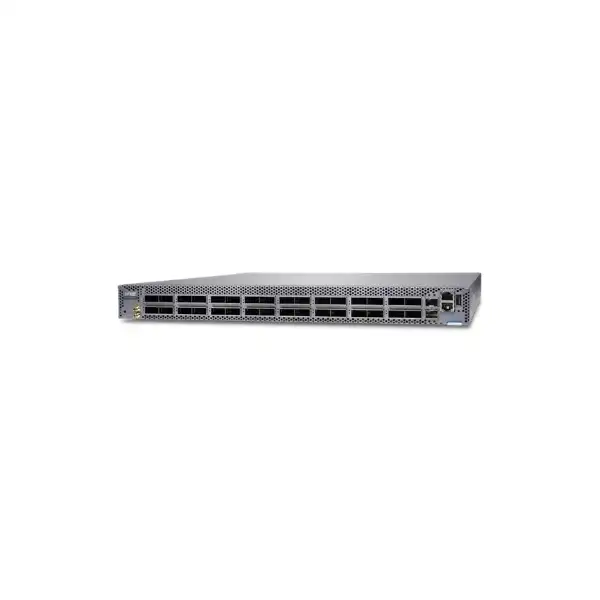
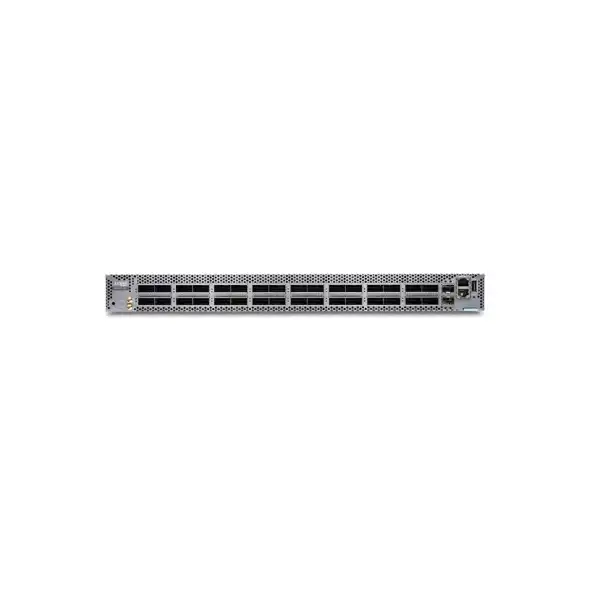
Juniper QFX5130E-32CD Data Center Switch
A high-density 1U switch with 32 QSFP-DD 400GbE ports for modern spine-and-leaf fabrics, EVPN-VXLAN networks, high-performance server connectivity, storage traffic and selected data-center interconnect designs. The buying decision is not only the chassis: airflow, AC or DC power, optics, breakout strategy, Junos OS Evolved release planning and software entitlements must match the intended fabric.
Direct answer for buyers evaluating the QFX5130E-32CD
Why the QFX5130E-32CD exists in a modern data center
The QFX5130E-32CD is built for the part of the network where port density and fabric bandwidth become architectural decisions rather than simple access-switch specifications. A server access layer moving from 10GbE toward 25GbE, 50GbE or 100GbE can quickly create an uplink requirement that is difficult to satisfy with older 100GbE-only spine designs. By offering 32 front-panel QSFP-DD positions capable of 400GbE operation in a single rack unit, the QFX5130E-32CD can aggregate substantial east-west traffic without requiring a large modular chassis. The same hardware can also be used in designs where each high-speed port is channelized into multiple lower-speed links, allowing the switch to support a wider range of attachment patterns.
Juniper positions the QFX5130 family for leaf, border-leaf and spine roles in IP fabrics, including EVPN-VXLAN designs. That flexibility is important because the same physical switch can serve very different purposes depending on the topology. In a spine role, the emphasis is normally on uniform high-speed connections to many leaf switches and sufficient route or forwarding scale for the intended fabric. In a leaf role, breakout flexibility can become more important because the device may connect directly to servers, storage nodes, security appliances or other endpoints at several Ethernet rates. In a border-leaf role, routing scale, external connectivity, policy, optics and convergence requirements deserve closer examination because the switch sits between the internal fabric and other networks.
The “E” model should not be treated as a naming variation of the QFX5130-32CD without checking its current specifications. The two share the 1U form factor, 32 QSFP-DD high-speed ports, 132 MB shared packet buffer, 160,000 MAC-address scale and the same broad fabric positioning, but Juniper’s current public specifications list different IPv4 and IPv6 route capacities for the QFX5130E-32CD. For this model, Juniper lists up to 720,000 IPv4 unicast/multicast routes and 428,000 IPv6 unicast/multicast routes, while the related QFX5130-32CD is listed with higher route figures. This distinction can matter for large routed fabrics, internet-facing edge designs or environments that expect significant future route growth.
That is why a sound procurement process starts with the intended role rather than with the port count alone. A 32-port 400GbE switch may look oversized for a small leaf, yet it can be economically sensible when breakouts reduce the number of physical devices needed. Conversely, the same model may be inappropriate for a design that demands much deeper buffering, integrated port-level encryption on specific links, a different route scale, or a different mix of native 100GbE server ports. The value of the QFX5130E-32CD comes from matching its density, software, forwarding resources and deployment characteristics to a fabric design that can use them.
Verified QFX5130E-32CD hardware and platform specifications
The values below are based on Juniper’s current product specifications, hardware documentation and QFX5130 line datasheet. Exact supported behavior can depend on the Junos OS Evolved release, transceiver type and port configuration, so feature-level validation remains part of a production design.
| Specification | QFX5130E-32CD detail |
|---|---|
| Form factor | Fixed 1U spine/leaf platform |
| High-speed network ports | 32 × QSFP-DD ports, natively supporting high-speed 400/200/100/40GbE modes subject to optics and configuration |
| Dedicated 10GbE ports | 2 × 10GbE SFP+ ports; Juniper notes these dedicated ports do not support 1GbE modules |
| System throughput | Up to 12.8 Tbps unidirectional / 25.6 Tbps bidirectional |
| Forwarding capacity | Up to approximately 5.3 billion packets per second in the current line datasheet |
| Maximum breakout examples | 64 × 200GbE + 2 × 10GbE; or up to 128 × 100/50/25/10GbE + 2 × 10GbE; or 32 × 40GbE + 2 × 10GbE, subject to supported optics/cables and software configuration |
| Shared packet buffer | 132 MB |
| MAC addresses | Up to 160,000 |
| IPv4 route scale | Up to 720,000 IPv4 unicast/multicast routes in Juniper’s current QFX5130 specification page |
| IPv6 route scale | Up to 428,000 IPv6 unicast/multicast routes in Juniper’s current QFX5130 specification page |
| ARP entries | 32,000 |
| VLAN scale | 4,000 VLANs listed in the current product specifications |
| Operating system | Junos OS Evolved; QFX5130E-32CD support begins with 23.4R2-EVO |
| Dimensions | 17.26 × 1.72 × 21.1 in. (43.8 × 4.3 × 53.59 cm) |
| Fully loaded weight | Approximately 24.5 lb (11.1 kg) |
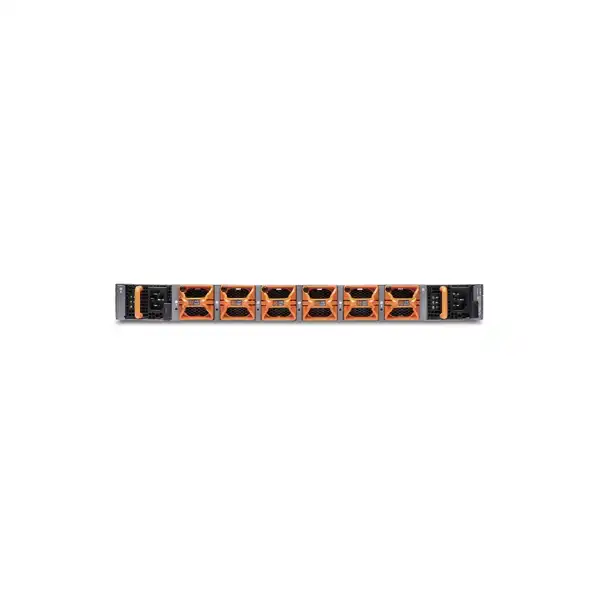
| Power and cooling | Redundant 1+1 hot-pluggable power supplies and six fan trays with 5+1 redundancy at the fan-rotor level; AC and DC chassis variants are available |
| Management and service interfaces | RJ-45 management port supporting 100 Mbps/1Gbps/10Gbps, RJ-45 console, USB, status indicators, timing outputs and dedicated 10GbE ports |
A specification table is useful for qualification, but it does not replace a port map. For a real deployment, list every intended connection with speed, media, reach and redundancy. That exercise exposes whether 400GbE ports will remain native, be converted to 200GbE, or be channelized into 100/50/25/10GbE links, and it prevents a quote from overlooking optics or breakout assemblies that are essential to the final design.
32 × 400GbE ports: what the density means in practice
The headline specification is 32 QSFP-DD ports, but the practical value is the ability to allocate those ports according to the fabric. A pure 400GbE spine can use the ports as high-capacity links to leaf switches. A mixed-speed leaf can use supported breakout arrangements to connect a much larger set of 100GbE, 50GbE, 25GbE or 10GbE endpoints. This is particularly relevant during staged server migrations: a data center may not move every rack from 25GbE to 100GbE at once, yet the switching platform can still be selected around the bandwidth profile expected over the next hardware cycle.
Port channelization must be designed rather than assumed. Juniper documents that ports 0 through 31 default to 400Gbps. A QSFP-DD optic can link in that default state, while a lower-speed transceiver may require the port to be configured for the appropriate speed or channelization. This matters during installation because a correctly inserted QSFP28 or QSFP+ module is not enough if the physical interface remains configured for 400GbE. Implementation plans should therefore include both the physical cabling schedule and the Junos interface configuration required to bring each link up at the expected speed.
The two dedicated SFP+ ports provide 10GbE connectivity that can be useful for selected network designs, but Juniper specifically states that these ports support 10GbE modules and not 1GbE modules. Buyers replacing an older switch sometimes assume that an SFP+ cage will accept an existing 1GbE optic, which can lead to an avoidable compatibility problem. If 1GbE is required for a connected appliance, management system or legacy endpoint, treat that requirement separately rather than assigning it to these two dedicated ports without validation.
The port plan should also consider failure domains. Breakout can make one physical QSFP-DD interface represent several logical server or appliance links. That saves front-panel space but ties those channels to a common physical port and cable assembly. Where independent failure separation is important, distribute critical connections across different physical ports, switches and, where appropriate, separate leaf devices. In a dual-homed server design, the topology should preserve the required redundancy even if each leaf has more than enough logical port count on paper.
Fabric roles: spine, leaf, border leaf and DCI
Spine
In a spine role, the 32 high-speed ports can create a compact high-radix fabric core. The key planning questions are the number of leaf switches, desired oversubscription ratio, required ECMP width, failure-domain design and future growth. Route scale and telemetry needs should also be evaluated if the spine participates in a large routed underlay.
Leaf / top of rack
As a leaf, breakout flexibility can turn a small number of QSFP-DD interfaces into many server-facing links while retaining 400GbE uplinks. This is useful where racks contain mixed generations of servers or storage. Cable type, endpoint NIC support and the way breakout lanes are grouped become central to the bill of materials.
Border leaf
Border leaf use brings external routing, policy and operational boundaries into the decision. The QFX5130E-32CD can support this role, but route scale, external peer count, VRF and policy requirements, optics reach and any encryption requirement should be checked against the exact design rather than inferred from the family name.
Edge / data-center interconnect
Juniper documents support for high-power 400G-ZR and 400G-ZR-M optics in the QFX5130 line for edge and DCI use cases. Optical reach, power draw, thermal envelope, airflow direction and supported Junos release must all be validated because long-reach coherent optics change the physical and thermal assumptions of a rack design.
A switch that can technically operate in several roles should not be forced into all of them. For example, a network that requires a large internet routing table plus significant policy scale may favor a different border architecture even if the QFX5130E-32CD is an excellent internal spine. Likewise, a leaf whose server population is predominantly native 100GbE may be compared with a QFX5130-48C or QFX5130-48CM because those models provide a different native port mix. Role clarity is therefore the fastest way to determine whether the QFX5130E-32CD is the correct model rather than simply a powerful model.
EVPN-VXLAN and Layer 3 fabric design
The QFX5130E-32CD supports EVPN-VXLAN, allowing data-center architects to build an IP underlay with an overlay that carries tenant or application segmentation. In a common design, BGP distributes reachability information while VXLAN provides the data-plane encapsulation needed to extend logical networks across a routed fabric. The switch can participate in Layer 2 and Layer 3 gateway functions, and Juniper describes support for both edge-routed-bridging and bridged-overlay approaches within the QFX5130 line.
For a buyer, the important point is not simply that “EVPN-VXLAN is supported.” The design has to define where VXLAN tunnels terminate, where anycast gateways live, how routing is exchanged between tenants or VRFs, how external connectivity enters the fabric and which system holds the source of truth for configuration. Those choices determine which features must be licensed, how many routes and MAC entries are consumed, how the underlay is sized and what telemetry is needed to troubleshoot overlay and underlay problems together.
The model’s route scale deserves specific attention in larger deployments. Juniper’s current QFX5130 product specifications list 720,000 IPv4 unicast/multicast routes and 428,000 IPv6 unicast/multicast routes for the QFX5130E-32CD. Those are substantial capacities for many enterprise and service-provider fabrics, but they are not identical to the figures shown for the QFX5130-32CD. If an architecture document or older bill of materials references only “QFX5130-32CD family,” verify which exact chassis was used for the scale calculation.
A well-designed EVPN fabric also plans failure handling before installation. Underlay addressing, BGP policy, ECMP paths, multihoming or redundant server attachment, maintenance behavior and rollback procedures should be specified. Hardware density can reduce the number of devices needed, but operational simplicity comes from consistent templates, validated configurations and observability. The switch provides the platform capabilities; the architecture determines whether those capabilities produce a resilient fabric.
RoCEv2, storage traffic and the 132 MB shared packet buffer
The QFX5130 line is designed to carry conventional Ethernet data and storage-oriented traffic, including Remote Direct Memory Access over Converged Ethernet version 2 (RoCEv2). Juniper describes a data-center-bridging implementation with mechanisms such as priority-based flow control and explicit congestion notification. These capabilities can be valuable for low-latency storage or distributed-compute environments, but they require disciplined end-to-end configuration. A switch cannot make an unreliable RoCE design reliable by itself.
The QFX5130E-32CD has a 132 MB shared packet buffer that is dynamically available to congested ports. Juniper explicitly positions the family around congestion-management techniques rather than deep-buffer switching. This is a meaningful architectural characteristic. Workloads with sustained speed mismatches, long-distance burst absorption requirements or assumptions based on very large per-port buffers should be modeled carefully. For many high-speed leaf-spine fabrics, a shared buffer combined with ECN and appropriate queueing can be effective, but the outcome depends on traffic patterns, oversubscription and endpoint behavior.
For RoCEv2 deployments, collect more than a list of switch models. Identify server NIC vendors and firmware, storage platforms, link speeds, maximum transmission unit, PFC priorities, DSCP plan, ECN behavior, expected congestion points and monitoring method. Determine whether the fabric will carry only storage traffic or a mixture of storage and general application traffic. These inputs influence queue configuration and can expose interoperability or operational issues before a production change window.
If the requirement is simply “high throughput,” do not automatically enable lossless features. PFC can change failure behavior if it is configured too broadly, and poor congestion design can create pause propagation or other undesirable effects. The better approach is to design the QoS and congestion model around the actual application, then confirm the Junos OS Evolved release supports the required feature set on this exact hardware.
Junos OS Evolved, automation and operations
The QFX5130E-32CD runs Junos OS Evolved, and Juniper lists 23.4R2-EVO as the first supported software release for this model. That starting point is important in brownfield networks. A company may already operate QFX switches running classic Junos OS or earlier Junos OS Evolved releases, but software images, feature availability and upgrade procedures cannot be assumed to be identical across platforms. A migration plan should identify the target release family, validate each required feature in Juniper’s feature documentation and align the new model with the organization’s normal software lifecycle.
Junos OS Evolved retains the familiar Junos CLI while using a modular Linux-based architecture. Juniper highlights the ability to localize component failures, support independent component updates in appropriate cases and retain operational or configuration state in a distributed data store. For network teams, the practical benefit is that automation and operational workflows can remain Junos-oriented while the underlying platform supports a more modular software model.
Automation options include NETCONF, the Juniper Extension Toolkit, telemetry interfaces, Python scripting, zero-touch provisioning and integration with common infrastructure-automation tools. Juniper also positions Apstra Data Center Director for Day 0 through Day 2+ data-center fabric automation and intent-based assurance. The choice between direct Junos automation and an intent-based fabric manager is not only technical; it affects operating procedures, skill requirements, source-of-truth ownership, change approval and troubleshooting responsibilities.
For a small environment, templates plus NETCONF or automation scripts may be entirely adequate. For a larger EVPN-VXLAN estate with many switches and frequent change, an intent-based platform may reduce configuration inconsistency and improve assurance. Buyers should therefore separate the hardware decision from the operations decision while ensuring the two remain compatible. The switch can participate in a highly automated fabric, but the organization still needs to choose how configurations are generated, validated, committed, monitored and rolled back.
Licensing and software entitlement: confirm this before final pricing
QFX software licensing is not a detail to leave until after the hardware arrives. Juniper’s current licensing documentation places both the QFX5130-32CD and QFX5130E-32CD in QFX Class 3 for Flex licensing. Current QFX licensing includes multiple software tiers and can be offered in subscription or perpetual forms depending on the entitlement and commercial option. Juniper’s QFX5130 ordering information also lists Class 3 software subscription SKUs for base Layer 3 and advanced software packages in multi-year terms.
The correct license depends on features, not on the fact that the switch will be used in a data center. A buyer should provide the planned routing protocols, EVPN-VXLAN functions, telemetry requirements, automation platform, advanced feature needs and any other licensed capability expected in production. The inclusion of a feature in a general license tier does not by itself prove that the feature is supported on every QFX hardware model or every Junos release, so hardware support and entitlement should be validated together.
This is especially important when a project is copied from an older design. A previous QFX model may have been purchased under a different commercial bundle, or the organization may have existing entitlements that are not automatically transferable to a new platform. Support services are also a separate procurement decision. Define the required response level, replacement expectations, software support and contract term rather than treating “support included” as an assumption.
For quotation accuracy in Dubai and the UAE, specify whether the request is hardware only, hardware plus the required software entitlement, or a complete bundle including optics, cables, licenses, support and installation services. A quote that only lists the switch chassis can appear attractive while omitting items that are essential for production use. FourTeck can build the bill of materials around the intended feature set so that commercial comparisons are made on equivalent scope.
Optics, DAC, AOC and breakout planning
High-speed data-center switches are often purchased before the cabling plan is fully resolved, yet transceivers and cable assemblies can represent a large part of the final project cost. The QFX5130E-32CD supports QSFP-DD 400GbE connectivity and a range of lower-speed modes using compatible optics or breakout options. Juniper documents support for 400GbE direct-attach copper and active optical cable options, 100GbE QSFP28 transceivers and channelized configurations that can create multiple 25GbE or 10GbE interfaces, subject to the exact media type and Junos release.
Start with reach. Connections within the same rack may favor DAC where distance, bend radius and cable management permit. Links between racks may use AOC or optical transceivers depending on distance and infrastructure. Longer data-center or campus links may need single-mode optics, and DCI designs can introduce coherent 400G-ZR or 400G-ZR-M modules. Each choice changes power, thermal load, fiber type, patching and cost. The most expensive mistake is often not choosing the wrong switch; it is ordering a correct switch with the wrong media.
Next define breakout direction and connector presentation. A 400GbE QSFP-DD port broken into four 100GbE links must terminate in endpoint interfaces and cables that match the required lane arrangement. Cabling should be documented by switch port, breakout lane, destination device, destination port, media type and length. For dual-fabric designs, label A and B paths so that redundant endpoints do not accidentally terminate on the same physical switch or same failure domain.
Transceiver support also depends on platform and software compatibility. Do not infer compatibility from connector shape alone. A QSFP form factor can represent different speeds, electrical interfaces and optical standards. The final bill of materials should use supported Juniper part numbers or explicitly validated compatible alternatives where the organization permits them. If third-party optics are contemplated, define the support policy and operational expectations before procurement.
Finally, consider growth. It may be preferable to leave some 400GbE ports native and unused for future spine expansion rather than consuming all ports through breakout on day one. Conversely, if the near-term requirement is a very high count of 25GbE or 100GbE servers, a leaf model with a different native port mix may simplify cabling. The optimal port strategy is the one that fits both the present rack and the next refresh cycle.
Power, airflow and rack integration for UAE data centers
The QFX5130E-32CD is available in AC and DC variants and in two airflow directions. Juniper’s ordering information identifies QFX5130E-32CD-AFI and QFX5130E-32CD-AFO for AC deployments, plus QFX5130E-32CD-D-AI and QFX5130E-32CD-D-AO for DC. AFI is described as back-to-front airflow, while AFO is front-to-back airflow. This is not an interchangeable preference after purchase: fans and power components must align with the chassis airflow and with the data center’s hot-aisle/cold-aisle design.
Juniper lists redundant 1+1 hot-pluggable power supplies and six fan trays with 5+1 redundancy at the rotor level for the 32CD platforms. The current datasheet shows maximum power draw around 839 W for AC and 871 W for DC under the stated test conditions, with typical values around 323 W for AC and 341 W for DC. Actual consumption varies with operating conditions and installed optics. High-power coherent optics can materially affect thermal planning, so do not size rack power and cooling from a chassis-only typical figure if the intended ports will use long-reach modules.
The chassis measures approximately 43.8 cm wide, 4.3 cm high and 53.59 cm deep, with a fully loaded weight of about 11.1 kg. Although 1U makes the switch compact, cable depth and bend radius matter in dense racks. QSFP-DD connections, breakouts and fiber management can occupy more physical space than the chassis faceplate suggests. Confirm rack rail compatibility, rear clearance, airflow orientation, cable-management method and power-feed location before shipment to the installation site.
For Dubai and UAE facilities, ambient conditions are normally controlled by the data center, but local climate increases the importance of reliable cooling design during maintenance or abnormal conditions. Juniper publishes operating limits that vary by airflow system and optic conditions. Rather than relying on a generic room-temperature assumption, validate the chosen chassis variant and transceiver combination against the actual rack inlet temperature and facility standards. Correct airflow is a procurement requirement, not an installation afterthought.
Management, telemetry and troubleshooting readiness
A 400GbE fabric can fail in ways that are difficult to diagnose if monitoring is designed after go-live. The QFX5130 line supports Junos telemetry capabilities intended for high-frequency visibility into interface and system behavior. Streaming telemetry can help identify utilization trends, congestion, latency-related symptoms and microbursts more effectively than relying only on periodic polling. In an EVPN-VXLAN environment, monitoring should correlate the physical underlay with overlay state so that an application path can be traced across both layers.
The QFX5130E-32CD also provides a dedicated RJ-45 management interface supporting 100 Mbps, 1Gbps and 10Gbps operation, plus a console port and USB interface. Plan a physically or logically separate out-of-band management path so that a fabric failure does not remove access to the switch at the moment it is needed most. Console-server connectivity is particularly valuable in remote or colocation racks where local hands may not be immediately available.
Operations teams should define a standard telemetry and logging baseline before deployment. Useful elements include interface counters, optical diagnostics, BGP and EVPN state, queue and drop statistics, environmental sensors, power-supply and fan status, configuration-change logs and synchronization with the organization’s time source. Juniper also documents IEEE 1588 PTP transparent and boundary clock support with hardware timestamping on the QFX5130-32CD/QFX5130E-32CD, which can be relevant to environments that require precise timing.
A practical acceptance test therefore includes more than successful pings. It should verify management access, telemetry export, syslog or event integration, configuration backup, authentication, time synchronization, optical levels, port error counters, routing adjacency, EVPN state and failover behavior. These checks establish an operational baseline that becomes valuable when future upgrades or workload changes introduce new symptoms.
QFX5130E-32CD ordering variants
| Ordering model | Power | Airflow | Buyer check |
|---|---|---|---|
| QFX5130E-32CD-AFI | AC | AFI, back-to-front | Confirm rack cold-aisle orientation, power-cord requirements and optic thermal profile. |
| QFX5130E-32CD-AFO | AC | AFO, front-to-back | Confirm airflow matches adjacent network devices and facility containment. |
| QFX5130E-32CD-D-AI | DC | AFI, back-to-front | Confirm -48V to -60V DC plant design, feeds, grounding and airflow. |
| QFX5130E-32CD-D-AO | DC | AFO, front-to-back | Confirm DC power engineering, facility connector requirements and airflow direction. |
The exact product code should appear on the purchase order rather than only “QFX5130E-32CD.” A generic model description leaves power and airflow unresolved and can result in a unit that is unsuitable for the rack. The same discipline should be applied to rail kits, power cords, optics and software subscriptions: each item should have an explicit quantity and role in the deployment.
Migration from 10/25/100GbE networks to a 400GbE fabric
Many QFX5130E-32CD projects are not greenfield installations. They are capacity upgrades where existing servers, firewalls, load balancers and storage systems remain at 10GbE, 25GbE or 100GbE while the spine or aggregation layer moves to 400GbE. Breakout support makes that transition possible, but a migration succeeds only when the current port inventory is translated into a new physical and logical map.
Begin by documenting every existing uplink and endpoint connection: speed, transceiver, fiber or copper type, VLAN or routed-interface role, LAG membership, MTU, routing protocol and redundancy partner. Then classify each connection as retained, upgraded, consolidated through breakout or removed. This prevents a new high-density switch from inheriting years of undocumented dependencies. It also reveals whether any legacy 1GbE requirement exists, which is relevant because the QFX5130E-32CD’s dedicated SFP+ ports are 10GbE only.
Software migration deserves equal attention. If the existing estate runs Junos OS rather than Junos OS Evolved, reuse the organization’s design intent rather than copying configurations line for line. Confirm command syntax, feature support, automation API behavior, telemetry paths and operational scripts on the target release. Build a lab or staging configuration where the business impact justifies it, especially for EVPN multihoming, routing policy, QoS or RoCEv2 behavior.
A phased cutover can reduce risk. Install the new pair or fabric alongside the old network, establish controlled interconnects, validate routing and reachability, migrate a small workload group, observe telemetry and then proceed in batches. Define rollback conditions before the maintenance window. The most important rollback question is not “can we put the old cables back?” but whether routing, overlay state and endpoint configuration can return to a known-good state without ambiguity.
When the migration objective is primarily higher bandwidth, also check whether the server estate can actually use it. A 400GbE spine may remove network bottlenecks while leaving application, storage or NIC limitations unchanged. Capacity planning should therefore correlate switch uplinks with server NIC rates, expected east-west traffic, storage behavior and oversubscription targets rather than assuming that the largest port speed automatically produces proportional application improvement.
When the QFX5130E-32CD is a strong fit — and when to compare another model
Strong fit
- A compact 1U platform is required for a high-radix 400GbE leaf or spine.
- The network needs a flexible mix of 400/200/100/50/40/25/10GbE through supported native modes or breakouts.
- EVPN-VXLAN, L2/L3 fabric functions and Junos OS Evolved align with the architecture.
- RoCEv2 or storage traffic will use congestion-management features rather than a deep-buffer design.
- Automation, telemetry and Junos operational consistency are important to the network team.
Compare alternatives when
- A larger native 100GbE server-facing port count would reduce breakout complexity.
- The design requires MACsec on specific high-speed ports; evaluate models such as the QFX5130-48CM and validate the exact encrypted-port requirement.
- Route or policy scale exceeds the QFX5130E-32CD’s published limits.
- The workload specifically needs substantially deeper buffering than this architecture provides.
- The rack requires a different form factor, power profile, native port mix or longer-term expansion model.
Within the QFX5130 family, the QFX5130-48C and QFX5130-48CM use a different combination of native 100GbE and 400GbE ports. The 48CM adds MACsec capability on a defined subset of ports. Those models may make more sense when the leaf layer is dominated by native 100GbE attachments rather than 400GbE spine density. The original QFX5130-32CD, meanwhile, is closely related to the E model but has different published route-scale figures. A side-by-side selection should therefore compare the exact model, not only the QFX5130 family label.
Security, segmentation and control-plane considerations
Data-center security on a high-performance switch is primarily about enforcing the architecture consistently. EVPN-VXLAN can provide tenant or application segmentation, routing policy can control reachability, and firewall filters can enforce selected traffic conditions. The exact scale and feature behavior depend on hardware resources and software release, so security policy should be translated into measurable requirements such as number of filters, terms, prefixes, VRFs and external peers.
Management security deserves separate treatment from data-plane policy. Use the dedicated management path where possible, restrict administrative access to approved sources, integrate authentication with organizational controls, maintain role separation and log configuration changes. Automated configuration systems should use controlled credentials and change workflows rather than permanent broad administrative access. If zero-touch provisioning is used, secure the bootstrap process and validate the image and configuration source.
For encrypted data-center interconnects, do not assume that a high-speed Ethernet port inherently provides link encryption. The QFX5130E-32CD should be evaluated against the specific encryption requirement. If MACsec is a mandatory function on selected links, compare a model designed with MACsec support or use an architecture that provides encryption elsewhere. The QFX5130-48CM exists in the same broader family with MACsec capabilities, but it also has a different native port layout and performance characteristics, so substitution is not a one-line change.
Security reviews should also include software lifecycle. Choose a supported Junos OS Evolved release, follow the organization’s patch and vulnerability-management process, maintain configuration backups and test upgrade behavior. The best security posture is not produced by enabling the maximum number of features; it comes from a clear, minimal, supportable design with known ownership and reliable monitoring.
Deployment journey: from requirement to production fabric
A disciplined sequence reduces the most common high-speed switching risks: wrong airflow, missing optics, incorrect breakout configuration, unlicensed features, unsupported software assumptions and incomplete operational visibility. The hardware itself is highly capable; deployment quality determines whether those capabilities translate into a predictable production environment.
Practical use cases in enterprise and service-provider networks
High-density spine for 100/400GbE leaf switches. A pair or set of QFX5130E-32CD devices can provide a compact spine layer where leaf switches require multiple 400GbE uplinks. The design should calculate uplink utilization and ECMP behavior under both normal and failure conditions so that losing a spine or link does not create an unacceptable oversubscription ratio.
Leaf for mixed-generation servers. Breakout support allows 400GbE ports to serve multiple lower-speed endpoints. This can be useful during a transition from 25GbE servers to 100GbE systems, especially when the new leaf must support both generations. The cable bill and lane map become significant, so endpoint NIC compatibility and physical patching should be planned before final quantities are ordered.
Storage or GPU-oriented Ethernet fabric. RoCEv2 and data-center-bridging functions can support low-latency storage and compute traffic. These deployments require end-to-end QoS and congestion design, not only switch configuration. Server NICs, storage systems, ECN thresholds, PFC priorities, MTU and telemetry should be considered part of one system.
Border or service leaf. The switch can terminate high-speed routed connections between the internal fabric and external services, but route scale and policy requirements should be measured. If the border must hold unusually large tables, provide substantial ACL scale or encrypt links, compare other QFX options before standardizing.
Selected DCI and edge links. Juniper documents support for high-power 400G-ZR and 400G-ZR-M optics in the family, making the platform relevant to certain coherent optical applications. Reach, fiber plant, optical power budget, thermals and interoperability must be validated for the exact module and software release. DCI should be engineered as an optical and routing problem together rather than as a simple transceiver choice.
Procurement checklist for Dubai and UAE projects
An accurate quote for the Juniper QFX5130E-32CD should describe the complete deployment rather than only the base chassis. The following checklist helps prevent commercial gaps between competing quotations.
State AC or DC and AFI or AFO airflow. Do not accept a generic QFX5130E-32CD line item if the variant is not defined.
List each transceiver, DAC, AOC or breakout cable by speed, reach and quantity, including spares if required.
Specify the feature tier and term needed for the planned routing, fabric and operational functions.
Define support term, service level and replacement expectations for the site.
Confirm mounting kit, power cords or DC-feed requirements, grounding and rack depth.
State whether staging, configuration, EVPN design, migration, installation, testing or post-cutover support is required.
Also identify delivery location, quantity and required project date. High-speed optics, support contracts and specific airflow variants can have different commercial lead times, so a project schedule is more reliable when all critical components are tracked as one bill of materials. If the switch is part of a redundant fabric, quote the complete pair or set rather than evaluating a single chassis in isolation.
Questions buyers frequently ask about the QFX5130E-32CD
Does the QFX5130E-32CD have 32 native 400GbE ports?
Yes. Juniper specifies 32 QSFP-DD high-speed ports for the QFX5130E-32CD. Those ports can operate at several supported Ethernet speeds and can be channelized for lower-speed connections, subject to the selected optics or cable and the software configuration.
Can it provide 128 × 100GbE connections?
Juniper lists a maximum breakout option of up to 128 × 100/50/25/10GbE plus two dedicated 10GbE ports. Whether a particular project can use that maximum depends on the chosen breakout media, endpoint interfaces and port configuration. A lane-level port map should be built before ordering.
Is it the same as the QFX5130-32CD?
No. They are closely related and share many hardware characteristics, but Juniper’s current specifications show different IPv4 and IPv6 route-scale figures. The E model also has a later first supported Junos OS Evolved release. Any architecture that depends on scale or software release should use the exact model designation.
Does it support EVPN-VXLAN?
Yes. The QFX5130 family supports EVPN-VXLAN and can be used in routed underlay/overlay data-center fabrics. The final design still has to define tunnel termination, gateway placement, routing scale, multihoming and the control or automation model.
Does it support RoCEv2?
Yes. Juniper positions the QFX5130 line for RoCEv2 and IP storage use with data-center-bridging and congestion-management functions. Successful deployment depends on coordinated switch, NIC and application settings, including QoS, ECN, PFC and MTU choices where applicable.
Can the two SFP+ ports run at 1GbE?
No. Juniper’s hardware documentation states that the last two SFP+ ports are dedicated to 10GbE and do not support 1GbE modules. Legacy 1GbE connectivity therefore needs a different interface or design.
What Junos release supports the E model?
Juniper’s current hardware information lists Junos OS Evolved 23.4R2-EVO as the first supported release for QFX5130E-32CD. Production deployments should use a release selected according to Juniper support guidance and the exact feature requirements of the fabric.
Is software licensing required?
Licensing depends on the required feature set. Juniper classifies the QFX5130E-32CD as a Class 3 QFX platform in its current Flex licensing documentation. Provide the planned routing and fabric features so the appropriate entitlement and term can be included in the quote.
Which airflow option should I buy?
Choose the airflow that matches the rack’s cold-aisle/hot-aisle direction and adjacent equipment. AFI and AFO are different ordering variants. The choice should be confirmed from the facility rack design before the purchase order is placed.
Can it be used for DCI?
Juniper documents support for high-power 400G-ZR and 400G-ZR-M optics in the QFX5130 line for edge and DCI use cases. The exact optic, reach, thermal conditions, software support, fiber path and routing design must be validated before treating the switch as a DCI endpoint.
Lifecycle, spares and support planning
A production data-center fabric should be purchased with a lifecycle plan, not only a deployment plan. Determine how failed hardware will be replaced, whether on-site spares are justified, how power supplies and fan modules are handled, and what support response the business requires. The cost of a spare can be compared with the operational cost of waiting for replacement hardware, particularly in a small fabric where each device carries a large share of the total capacity.
Software lifecycle is equally important. Maintain an approved Junos OS Evolved release policy, record the feature dependencies that prevent or require certain upgrades, and test configuration automation against new releases before rolling them into production. If the fabric is managed by Apstra Data Center Director or another orchestration platform, confirm the management platform’s compatibility with the target switch release as part of the same change plan.
Optics deserve lifecycle attention because data-center links may be upgraded independently from the chassis. Keep an inventory of transceiver types, cable lengths, fiber standards and spare quantities. If the network relies on breakout assemblies, a spare strategy should account for the fact that a single failed cable assembly can affect multiple logical interfaces. For long-reach coherent optics, document module-specific thermal and optical requirements as well as software compatibility.
Finally, record the exact installed SKU, serial numbers, airflow direction, power type, license entitlement and support contract for each unit. That information shortens troubleshooting and prevents the next expansion from accidentally mixing incompatible airflow or software assumptions. Good lifecycle documentation turns the QFX5130E-32CD from an isolated piece of hardware into a manageable part of a repeatable network standard.
How to size a QFX5130E-32CD fabric without relying on port count alone
Sizing begins with traffic, not with the number 32. Count the leaf switches or endpoints that need to connect, but also estimate how much of each link will be used at peak, what happens during a failure and how quickly demand is expected to grow. A spine with enough physical ports can still be undersized if losing one path pushes the surviving links beyond the organization’s acceptable utilization threshold. Conversely, a fabric does not need one 400GbE link per server rack if the workloads do not create that traffic pattern.
For a leaf role, calculate downlink bandwidth and uplink bandwidth separately. A rack with many 25GbE servers may never drive every server at line rate simultaneously, so some oversubscription may be appropriate. A GPU cluster, storage fabric or latency-sensitive analytics environment can have very different east-west behavior. Use application data, existing interface utilization and growth plans to choose an oversubscription ratio rather than adopting a generic industry number.
Next test the forwarding tables. Estimate IPv4 and IPv6 routes, MAC addresses, ARP or neighbor entries, VRFs, VLANs and policy scale. The QFX5130E-32CD’s published capacities are sufficient for many fabrics, but designs with large external route tables or unusual segmentation density should be checked carefully. Leave headroom so that normal growth, temporary convergence state and maintenance do not run the platform at its practical limit.
Then size operations. A 32-port 400GbE switch can carry a large amount of business traffic, which raises the importance of redundancy and maintenance planning. Determine how many switches are needed to keep the fabric within performance targets while one link, one device or one maintenance domain is unavailable. Include out-of-band management and console access so that failures remain recoverable without depending on the same fabric being repaired.
Finally, translate the capacity model into a three-year or five-year port plan. Mark ports needed on day one, ports expected for approved projects and a realistic reserve for growth. This provides a much better procurement answer than simply asking whether the switch “has enough ports.” It also makes it easier to compare the QFX5130E-32CD with a model that has a different native port mix.
Decision recap before approving a QFX5130E-32CD purchase
What FourTeck needs for an accurate Dubai/UAE quotation
A useful request for quotation can be concise, but it should resolve the decisions that materially change the bill of materials. Provide the following where known; FourTeck can help work through any item that is still open.
Plan the QFX5130E-32CD as a complete fabric component, not just a switch
The Juniper QFX5130E-32CD combines dense 400GbE connectivity, flexible breakout, EVPN-VXLAN, Junos OS Evolved automation and storage-ready congestion features in a compact 1U platform. The strongest deployments are the ones that verify the exact route scale, airflow, power, optics, licensing and software requirements before procurement. Share your port map or project requirement with FourTeck to build a Dubai/UAE bill of materials that reflects the actual fabric rather than a chassis-only estimate.

Reviews
There are no reviews yet.