
Juniper QFX5130-48CM Data Center Switch Dubai
A high-density 1U fixed switch for modern leaf, border-leaf and selected spine roles where 100GbE server connectivity, 400GbE fabric uplinks, Junos OS Evolved and optional MACsec link encryption need to be combined in a compact platform.
Direct answer: what the QFX5130-48CM is and when it makes sense
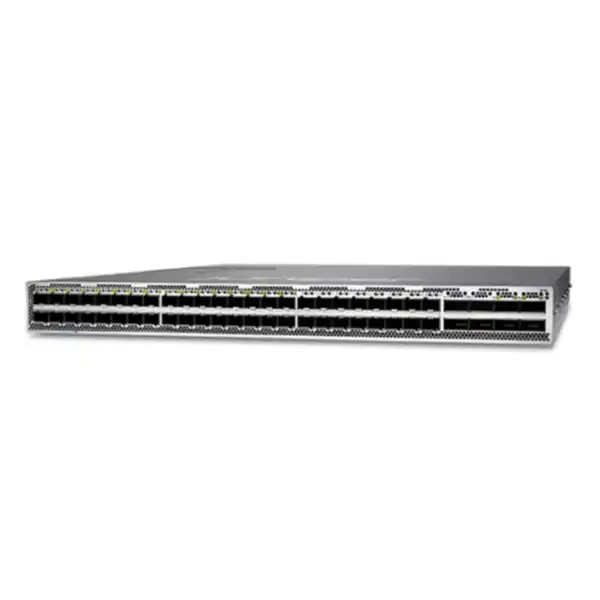
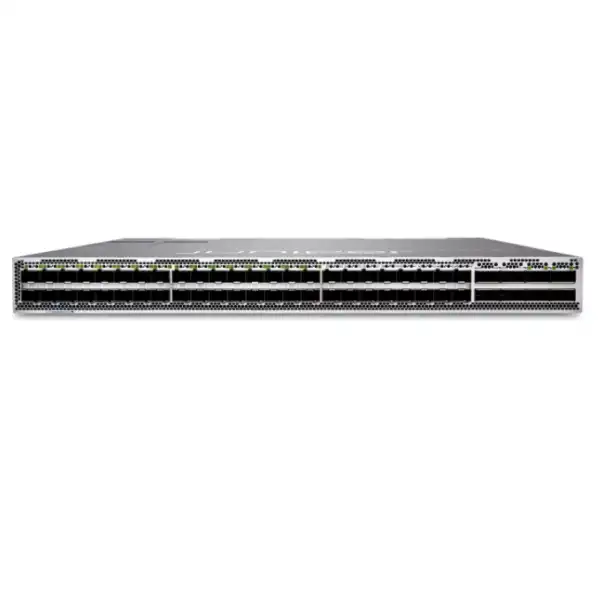
The Juniper QFX5130-48CM is a fixed-configuration, 1U data center Ethernet switch built around high-density 100GbE access and 400GbE uplinks. It has 48 SFP56-DD ports intended primarily for server or downstream connectivity and eight QSFP-DD ports intended primarily for high-speed fabric uplinks. It runs Junos OS Evolved and is the MACsec-capable member of the QFX5130-48C/48CM pair.
Its main use is as a top-of-rack or leaf switch in modern IP and EVPN-VXLAN fabrics, especially where a rack contains servers, storage nodes, appliances or accelerators that need 25GbE, 50GbE or 100GbE connectivity while the rack uplinks toward a spine at 100GbE, 200GbE or 400GbE. It can also serve selected border-leaf, aggregation or interconnect roles where its port geometry, feature set and scale match the design.
Organizations that should consider it include enterprise data centers, cloud environments, high-performance computing clusters, research networks, service-provider infrastructure and storage-focused networks that need a dense 100G/400G fixed platform. The most important factor to confirm is not simply whether the chassis has enough ports. Buyers should validate the exact port-speed plan, transceiver and cable compatibility, breakout requirements, airflow direction, AC or DC power, software entitlement, MACsec license requirement, feature support in the intended Junos OS Evolved release and the scale required by the proposed fabric.
FourTeck can help translate a Dubai or UAE project requirement into an exact bill of materials: chassis variant, compatible optics or DAC/AOC cables, rack kit, licensing, support, deployment services and migration scope. That prevents a common procurement problem with high-speed switching projects: ordering the correct base chassis but discovering later that airflow, optics, software or interface combinations do not match the rack design.
Why the QFX5130-48CM is different from a generic 48-port switch
The model name can make the QFX5130-48CM sound like a conventional 48-port data center switch, but its design intent is substantially different from a 1GbE, 10GbE or even typical 25GbE top-of-rack platform. The 48 server-facing interfaces use the SFP56-DD form factor and are designed around native 100GbE density. Above those access ports, eight QSFP-DD interfaces provide native 400GbE capacity for spine or fabric connectivity. That combination gives network architects a compact way to build racks with very high east-west bandwidth without consuming multiple rack units or relying on large modular chassis at the top of each rack.
Juniper positions the QFX5130 family for leaf, border-leaf and spine roles in IP and EVPN-VXLAN designs. Within that family, the QFX5130-48CM is most easily understood as the dense 100GbE server-access variant with MACsec capability. The nearby QFX5130-48C uses the same broad 48-port-plus-eight-uplink physical concept but does not provide the QFX5130-48CM MACsec capability. The QFX5130-32CD and QFX5130E-32CD, in contrast, put greater emphasis on 400GbE port density and are therefore a different fit when the requirement is a 400G-heavy spine rather than a 100G-heavy leaf.
This distinction matters in practical sizing. A rack containing many dual-port 100GbE servers can quickly exhaust the 100GbE density of platforms built around a smaller number of QSFP interfaces. The QFX5130-48CM concentrates 48 native SFP56-DD positions into 1U while retaining eight 400GbE uplink ports, reducing the need to consume 400G ports solely to fan them out into lower-speed server links. Conversely, a design that needs dozens of native 400GbE interfaces per device would normally compare the 32CD family member or a higher-capacity platform rather than forcing the 48CM into a role its front-panel geometry was not optimized to serve.
Strong fit
Racks with a high concentration of 25/50/100GbE server links, 400GbE fabric uplinks, EVPN-VXLAN requirements, high east-west traffic and a need for compact 1U density. It is particularly relevant when MACsec is part of the security design for selected high-speed links.
Compare another model when
The design is dominated by native 400GbE interfaces, requires substantially different route or MAC scale, depends on a feature not supported in the selected Junos OS Evolved release, needs a different buffer architecture, or has a lower-speed access requirement that can be met more economically with another QFX platform.
Verified QFX5130-48CM hardware specifications
The following values are based on Juniper’s QFX5130 documentation and hardware compatibility information. Exact capabilities can vary by software release, interface mode, installed optic and licensing, so the table should be treated as the hardware baseline for quotation and design rather than a substitute for a final compatibility check.
| Specification | QFX5130-48CM |
|---|---|
| Form factor | Fixed 1U chassis |
| Server/access port density | 48 × SFP56-DD ports, with native 100GbE support and supported lower-speed operation depending on interface configuration and transceiver or cable selection |
| High-speed uplinks | 8 × QSFP-DD 400GbE ports; supported channelization allows alternative high-speed port combinations |
| Additional interfaces | Two 10GbE SFP+ ports are supported by the platform in addition to the primary SFP56-DD and QSFP-DD interfaces |
| System throughput | Up to 8 Tbps unidirectional / 16 Tbps bidirectional without MACsec |
| Forwarding capacity | Up to 2.7 billion packets per second |
| MACsec capacity | Up to 9.6 Tbps bidirectional MACsec encryption support, with MACsec support on up to 32 × 100G SFP56-DD ports and 4 × 400G QSFP-DD ports according to Juniper’s current product documentation |
| Operating system | Junos OS Evolved |
| Switch silicon | Broadcom Trident4 |
| System memory | 32 GB DDR4 |
| Storage | 2 × 100 GB |
| Packet buffer | 82 MB shared packet buffer |
| Dimensions | Approximately 17.28 × 1.72 × 20.5 in. (43.9 × 4.3 × 52.1 cm) |
| Weight | Approximately 27 lb / 12.24 kg as shipped with power supplies and fans |
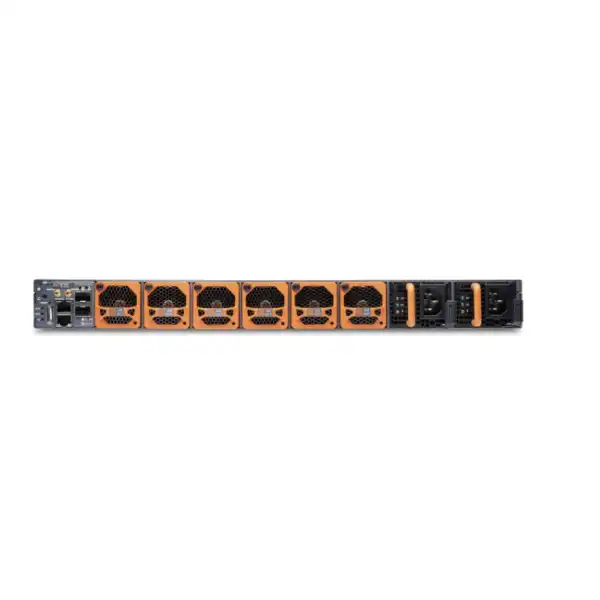
| Power architecture | Redundant 1+1 hot-pluggable 1600 W AC or DC power supplies, depending on ordered variant |
| Cooling | Front-to-back AFO or back-to-front AFI airflow variants with redundant hot-pluggable fan modules |
| Jumbo frames | Up to 9216 bytes according to Juniper hardware specifications |
Port architecture: planning 100GbE access and 400GbE uplinks correctly
The front-panel port count is only the starting point for a QFX5130-48CM design. The switch supports several interface speeds and breakout modes, but a deployable bill of materials depends on exactly how each port group will be used. Juniper documents 48 SFP-DD ports that can operate at 100GbE, 50GbE, 25GbE or 10GbE in supported configurations. The eight QSFP-DD ports support 400GbE and can also be used at lower speeds such as 200GbE, 100GbE or 40GbE, with supported channelization including 4 × 100GbE and 2 × 200GbE modes. The SFP-DD ports also support 2 × 50G channelization where the required cabling and software support are present.
That flexibility is useful during server refresh projects. A data center may begin with a mixture of 25GbE and 100GbE host adapters, then increase the proportion of 100GbE servers over time. The same physical platform can support a heterogeneous speed plan, but the assumption that every port can accept every optic or cable in every mode is unsafe. Transceiver support is model-, port-, speed- and software-dependent. Juniper explicitly directs customers to the Hardware Compatibility Tool for supported optics, DACs, AOCs and breakout cables. This should be checked against the planned Junos OS Evolved release before purchase, not after the switches arrive.
The uplink plan deserves equal attention. Eight 400GbE interfaces create substantial potential fabric bandwidth, but oversubscription should still be calculated from expected server traffic rather than from port counts alone. Forty-eight 100GbE downlinks represent 4.8 Tbps of theoretical server-facing bandwidth before considering any lower-speed operation. A design with eight 400GbE uplinks provides 3.2 Tbps of nominal uplink bandwidth if all eight are used as native 400G fabric links. Whether that ratio is appropriate depends on workload behavior, east-west traffic, storage traffic, redundancy and whether all server ports are actually populated and simultaneously active at line rate.
For many enterprise fabrics, the preferred design is not to fill every uplink automatically. Uplinks may be divided across multiple spine switches or allocated to different services, DCI connectivity, border functions or spare capacity. The correct topology is determined by failure-domain goals as much as by throughput. A leaf connected to two or four spines, for example, should be assessed for the effect of a single uplink or spine failure on remaining bandwidth. If the network carries storage, AI/HPC or latency-sensitive flows, the failure-state oversubscription ratio can be more important than the normal-state ratio.
Breakout is also a procurement item. A 400GbE QSFP-DD port that is intended to become four 100GbE connections requires a compatible breakout assembly and a supported optical or copper architecture. Similarly, channelizing an SFP-DD interface for 2 × 50G is not equivalent to simply inserting any 50G optic. The port map, optic part numbers, cable length, connector type and remote device interface must be engineered as one end-to-end link.
MACsec on the QFX5130-48CM: important capability, specific limits
The letter “M” in QFX5130-48CM is commercially significant because this model is the MACsec-capable alternative to the QFX5130-48C. MACsec, standardized in IEEE 802.1AE, protects Ethernet links between directly connected devices by encrypting Layer 2 traffic. It can be valuable when high-speed links cross areas where physical interception is a concern, when regulated traffic requires link-level encryption, or when an organization wants to reduce exposure on data center interconnect or critical fabric segments without moving encryption responsibility to every application.
The platform should not be purchased on the assumption that MACsec applies at full unencrypted system throughput to every front-panel port. Juniper specifies up to 9.6 Tbps bidirectional MACsec encryption capacity and identifies MACsec support on up to 32 of the 100G SFP56-DD ports and four of the 400G QSFP-DD ports. That is a major design constraint for environments planning to encrypt a large proportion of links. A requirement for all 48 access ports and all eight uplinks to be encrypted simultaneously should therefore be validated carefully rather than inferred from the physical port count.
Licensing is another dependency. Juniper’s QFX licensing documentation identifies the MACsec feature for QFX5130-48CM as a hard-enforced licensed capability, using the S-QFX5KC3-MACSEC family of licenses. Available terms include multi-year and perpetual options according to current Juniper ordering information. The exact license SKU and term should be included in the quotation whenever MACsec is part of the design; buying only the MACsec-capable hardware does not by itself complete the entitlement requirement.
Operationally, MACsec also requires the peer device, interface mode and software release to support the intended configuration. In a leaf-spine fabric, this means both ends of an encrypted link must be checked. If the peer is a different QFX model, a router, an optical transport device or third-party equipment, compatibility should be validated on the actual interface type and speed. Encryption planning also needs to include key management and operational procedures, not simply the forwarding capability of the silicon.
For a Dubai data center project, the practical decision is therefore straightforward: choose QFX5130-48CM when MACsec is a real design requirement or a likely near-term requirement, and size the encrypted port count explicitly. If link encryption is not required and is not expected to be required, the QFX5130-48C may be worth comparing because the “M” capability does not automatically make the 48CM the best-value choice for every network.
Data center fabric roles and EVPN-VXLAN design
Leaf / top of rack
This is the most natural role for the 48CM. The SFP56-DD density aligns with server-facing connectivity while the eight QSFP-DD interfaces provide high-capacity paths toward the spine layer.
Border leaf
The platform can participate in EVPN-VXLAN designs where external connectivity is attached through a border-leaf role, subject to route scale, interface requirements and feature support.
Selected spine use
It can operate in spine functions when its port geometry and scale fit, but 400G-heavy designs should also compare the QFX5130-32CD or other platforms with more native 400G interfaces.
Junos OS Evolved provides the QFX5130 line with the L2/L3 and overlay features expected in contemporary data center fabrics. Juniper documents EVPN-VXLAN support, L2 and L3 gateway services, BGP capabilities, multicast, ECMP, dynamic load balancing, telemetry and data center bridging functions. The architectural benefit of EVPN-VXLAN is that the physical underlay can remain an IP routed fabric while VXLAN provides the overlay segmentation and EVPN distributes endpoint and reachability information through a control plane rather than depending on traditional flood-and-learn behavior for every service.
For buyers, the important point is that “supports EVPN-VXLAN” does not define a finished fabric. Design choices still include routed versus bridged attachment, the location of default gateways, multihoming strategy, underlay routing protocol, BGP policy, route-target design, MTU, anycast gateway behavior, failure-domain boundaries and operational tooling. A data center with ten racks and a few hundred endpoints may be able to use a relatively simple EVPN architecture, while a large multi-pod environment can require much more deliberate route-scale and interconnect planning.
The QFX5130 line supports all-active multihoming and other EVPN functions in supported software releases, which can help attach servers, appliances or downstream switches redundantly to two leaf devices. This architecture is often preferable to older multi-chassis Layer 2 designs because EVPN gives the control plane explicit information about Ethernet segments and remote reachability. The exact implementation should still be tested with the host bonding mode, LACP behavior and the specific server or appliance involved.
For an existing Juniper environment, Junos OS Evolved can preserve familiar operational concepts such as CLI workflows, NETCONF, automation scripts, telemetry and rollback while using a newer modular architecture. For organizations migrating from another vendor, the right comparison should focus on operational model and feature parity as well as port price. A fabric switch is a long-lived operational platform, and the team responsible for Day 2 changes, troubleshooting and upgrades will live with the software architecture long after the initial installation.
RoCEv2, storage traffic and congestion management
The QFX5130 family is designed to carry more than ordinary application traffic. Juniper documents support for RoCEv2-related data center bridging capabilities, including priority-based flow control and congestion-management mechanisms. This is relevant for environments using RDMA over Converged Ethernet between servers and high-performance or disaggregated storage systems, and increasingly for compute clusters where predictable east-west behavior is important.
The QFX5130-48CM uses an 82 MB shared packet buffer. That is a meaningful specification because workload behavior, oversubscription and congestion response need to be considered together. A shared-buffer architecture can allocate buffer capacity dynamically to congested ports, but it should not be confused with a deep-buffer switch designed for long-lived speed mismatches or unusually large bursts. Juniper’s positioning emphasizes congestion-control mechanisms such as PFC and ECN rather than simply absorbing every burst in a very large buffer.
For a storage or HPC project, the design conversation should therefore include more than “does the switch support RoCEv2?” Engineers should confirm NIC capabilities, PFC priorities, ECN marking behavior, queue design, MTU, hashing, oversubscription, link symmetry and telemetry. Misconfigured lossless Ethernet can create head-of-line blocking or pause propagation, while insufficient congestion signaling can allow queue growth and packet loss. The switch provides the mechanisms, but fabric-wide behavior depends on consistent configuration across hosts, leafs, spines and storage endpoints.
A buyer comparing this platform with a deep-buffer alternative should start from traffic evidence. If the workload consists of short, distributed east-west flows with well-engineered congestion management, the QFX5130 architecture can be a strong fit. If the network regularly experiences sustained many-to-one bursts, major speed transitions or WAN-like latency effects, buffer requirements should be modeled explicitly and a different platform may be appropriate. Selecting by headline port speed without understanding queue behavior is a common cause of disappointing application performance.
Junos OS Evolved, automation and operational visibility
The QFX5130-48CM runs Junos OS Evolved rather than classic Junos OS. Junos OS Evolved uses a modular, Linux-based architecture in which system functions operate as independent components. For network teams, the important outcome is not the underlying Linux label itself but the operational model: familiar Junos-style configuration, APIs and automation are combined with a software architecture designed for component isolation and modern platform operation.
Juniper documents automation mechanisms including zero-touch provisioning, NETCONF, Python scripting, event and operation scripts, configuration rollback and Junos telemetry interfaces. These capabilities matter most when switches are deployed in groups. Manually configuring a single device is manageable; manually maintaining dozens or hundreds of nearly identical leaf switches creates configuration drift, inconsistent change control and avoidable troubleshooting overhead. A QFX5130 deployment should therefore be evaluated together with the organization’s intended source of truth, templating workflow and monitoring platform.
Apstra Data Center Director is one management and assurance option for Juniper data center fabrics. It can provide intent-based design, deployment, validation and analytics across the fabric. It is not mandatory for every QFX5130-48CM installation, and organizations with established automation stacks may use Ansible, Terraform, NETCONF or in-house tooling instead. The procurement question is whether the project needs device-level management only or a fabric-level system that validates intent across many switches.
Streaming telemetry is especially useful in high-speed networks because traditional polling can miss brief congestion events. The QFX5130 line supports Junos Telemetry Interface functions that can feed operational data to external monitoring systems. For capacity planning, this can help identify link utilization patterns, microbursts and hot spots before they become chronic application issues. For incident response, correlated underlay and overlay telemetry can reduce the time required to distinguish a server problem from a fabric problem.
Before standardizing on an automation workflow, verify the exact YANG models, API functions, telemetry sensors and software release supported by the planned production image. Automation compatibility can change by release, and a successful proof of concept should test the same configuration and observability features that will be used in production rather than only proving basic Layer 3 forwarding.
Scale, resilience and performance considerations
Scale figures should be read as engineering limits, not as design targets. If a planned EVPN fabric expects route, MAC, ARP/ND, ACL, multicast or tunnel scale close to a hardware ceiling, headroom needs to be reserved for growth, convergence and operational events. A switch that technically supports a number of entries may not be the right choice if the normal steady state already consumes most of the available resource. The same principle applies to forwarding bandwidth: average utilization can look comfortable while a link failure pushes the remaining paths into congestion.
Resilience begins with redundant power supplies and fan modules, but device-level redundancy is only one layer. In a leaf-spine fabric, servers that require high availability are often dual-attached to separate leaf switches, and each leaf connects to multiple spines. The design should consider what happens during a leaf reboot, spine failure, optic failure, software upgrade and control-plane reconvergence. Features such as BFD, ECMP and EVPN multihoming can shorten or localize failure impact when correctly designed, but application behavior and host teaming must also be compatible.
A useful acceptance test is to measure the network under failure, not just in a healthy steady state. During commissioning, engineers can disable an uplink, restart a routing process or withdraw an EVPN path while observing packet loss, convergence and available bandwidth. This verifies the architecture that users will depend on during real maintenance or faults and exposes oversubscription problems that a simple throughput test may miss.
Optics, DACs, AOCs and breakout cables: build the link, not just the chassis
High-speed switches are frequently misquoted because the chassis is specified correctly but the physical links are not. The QFX5130-48CM supports multiple speeds across SFP56-DD and QSFP-DD interfaces, and Juniper provides a Hardware Compatibility Tool for supported transceivers, direct-attach copper cables, active optical cables and breakout assemblies. Compatibility must be checked for the exact switch model and software release because a connector that physically fits is not proof that the optic is supported or that the desired speed and channelization are available.
For short intra-rack connections, DACs can offer a simple, low-power option when the server NIC and switch port both support the cable type and required distance. AOCs may be useful when a longer lightweight cable is preferred without deploying separate transceivers and fiber patch leads. For structured cabling, multimode or single-mode optics are selected according to distance, fiber plant and connector design. Longer data center interconnect links may involve 400G coherent or ZR-class optics in supported ports, but power, thermal and port-specific restrictions must be reviewed.
Breakout design requires particular care. A single 400GbE port can be channelized into lower-speed links, but the remote endpoints, breakout cable and software configuration must all agree. If one QSFP-DD port is planned as four 100GbE links, the purchase list should identify the exact breakout assembly, fiber polarity or copper type, and the four remote ports. A diagram that numbers each switch port and destination is far safer than a generic statement such as “include 100G breakouts.”
Transceiver power also affects thermal planning. Juniper’s product documentation notes specific considerations for high-power 400G-ZR and 400G-ZR-M optics, including environmental conditions on certain airflow configurations. This is why a bill of materials should be validated as a complete system. The same switch with passive DACs can have a very different heat profile from one populated with many high-power coherent optical modules.
For quotation accuracy, provide link speed, distance, media type, connector type and peer device for every distinct connection class. FourTeck can then separate the bill of materials into server links, fabric uplinks, inter-switch links, DCI links, management links and spare optics rather than applying one transceiver assumption across the entire switch.
Power, airflow and rack planning for UAE data centers
The QFX5130-48CM is available in AC and DC power configurations and in both front-to-back and back-to-front airflow variants. Current Juniper ordering information includes QFX5130-48CM-AFO and QFX5130-48CM-AFI AC models, plus QFX5130-48CM-D-AFO and QFX5130-48CM-D-AFI DC models. AFO corresponds to ports-to-FRUs airflow, while AFI corresponds to FRUs-to-ports airflow. This choice must match the hot-aisle/cold-aisle orientation of the rack. Installing a switch with the opposite airflow direction can cause the device to ingest hot exhaust air even when the room itself is correctly cooled.
The chassis uses redundant 1+1 hot-pluggable 1600 W power supplies, but the power-supply rating is not the same as normal switch consumption. Juniper lists typical power draw for the QFX5130-48C/48CM class at approximately 219 W AC or 238 W DC under its stated test conditions, and maximum draw at approximately 609 W AC or 587 W DC under the documented higher-load test conditions. Actual consumption varies with traffic, temperature, transceivers and unit variation, so facility planning should include installed optics and realistic operating conditions rather than using only a chassis figure.
In Dubai and the wider UAE, data center ambient temperature is normally controlled, but cooling-system faults or high-density rack conditions can produce local hotspots. Juniper documents operating ranges that differ by airflow configuration and notes restrictions associated with certain high-power optics. The rack design should therefore include front and rear clearance, cable management that does not obstruct fans, compatible airflow direction across neighboring devices and power feeds sized for failure conditions.
Power redundancy also needs an upstream design. Two hot-pluggable power supplies only provide meaningful resilience when they are connected to independent PDUs or power paths where the facility design supports that separation. Connecting both supplies to the same PDU protects against a PSU failure but not against that PDU or its upstream circuit. For critical racks, the equipment schedule should record which PSU connects to which power feed so installation follows the intended A/B architecture.
The chassis is approximately 43.9 cm wide, 4.3 cm high and 52.1 cm deep, with a shipped weight around 12.24 kg with power supplies and fans. Rack depth, rail clearance and rear cable bend radius should be checked before delivery. Juniper lists a four-post tool-less rack mounting kit for the QFX5130-48C/48CM family, which may need to be included depending on the ordered bundle and site standards.
Software licensing and entitlement decisions
A QFX5130-48CM quotation should separate hardware capability from software entitlement. Juniper classifies the QFX5130-48CM in its QFX Class 3 licensing structure. Current ordering information identifies Base L3, Advanced and Premium software subscription options for the QFX5130-48C/48CM class, with subscription and perpetual choices depending on the SKU. The correct tier depends on the features the organization intends to use, and the inclusion of a feature in a license tier does not necessarily mean that feature is supported on every platform or every software release.
This is especially important during procurement because a design document may use broad terms such as EVPN, telemetry, advanced routing or automation without mapping those functions to licensing. The safer process is to create a feature matrix. For each required function, record whether it is needed on day one, whether it is included in standard software or a selected license tier, the minimum Junos OS Evolved release, and whether it has been validated on the QFX5130-48CM specifically. That turns licensing from a generic line item into an engineering requirement.
MACsec must be treated separately. Juniper’s license documentation identifies MACsec on the QFX5130-48CM as hard-enforced and uses the S-QFX5KC3-MACSEC family. If MACsec is planned, include that feature license with the appropriate term. A purchase order that includes the 48CM hardware but omits the required MACsec entitlement can delay deployment even though the physical switch is the correct model.
Support entitlement is another decision. Hardware and software support requirements depend on the organization’s maintenance model, business criticality and whether the switch is part of a standardized fleet. Buyers may want manufacturer support aligned to an internal replacement SLA, software update policy and lifecycle plan. The support term should also align with the software license strategy; a five-year infrastructure plan is easier to manage when license, support and hardware lifecycle dates are visible together.
Because Juniper can update licensing names, bundles and feature support, final quoting should use current official ordering data rather than copying an old bill of materials. FourTeck can help map the required functions to the current commercial SKUs and flag items that need additional validation before an order is approved.
Deployment and migration journey
1. Define the traffic model
Record server NIC speeds, storage traffic, east-west traffic, north-south traffic, growth assumptions and the expected behavior during a link or spine failure. This determines whether the port density and uplink capacity fit the workload.
2. Create the exact port map
Assign every SFP56-DD and QSFP-DD interface a role, speed and peer. Mark native ports, breakout ports, spare ports and encrypted ports. This port map drives optics, cable and licensing requirements.
3. Validate software and features
Choose a supported Junos OS Evolved release and verify EVPN, routing, telemetry, MACsec, RoCEv2 or other required features on that release. Align the required software tier and support entitlement.
4. Confirm physical deployment
Select AC or DC power, AFO or AFI airflow, rack kit, PDU feeds, cable routing and any environmental constraints created by high-power optics. Confirm that the rack can support the depth and service clearances.
5. Stage and test
Load the target software, apply base configuration, test optics and breakout modes, validate routing and EVPN adjacencies, exercise failure scenarios, verify telemetry and confirm that the automation workflow can reproduce the intended state.
6. Migrate with rollback criteria
Move workloads in controlled groups, observe congestion and convergence, and keep a defined rollback threshold. The migration is complete only when monitoring, backups, documentation and operational ownership are in place.
A migration from 10GbE or 25GbE top-of-rack switching to the QFX5130-48CM often changes more than the switch. Server NICs may be upgraded, optics and cabling may change, MTU may increase, routing may move closer to the rack and an EVPN-VXLAN overlay may replace older VLAN extension methods. Treating the project as a like-for-like switch replacement can overlook those architectural changes.
Brownfield networks need special attention to interoperability. During transition, a new QFX5130 leaf may connect to existing spines, routers, firewalls or servers that use different vendors and software generations. Standard protocols reduce risk but do not remove it. LACP timers, BGP policy, MTU, VLAN tagging, optical FEC, autonegotiation, breakout mappings and EVPN behavior can create subtle interoperability issues. A lab or staging test with representative peers is valuable when the migration path is complex.
Operational documentation should be considered a deliverable. The final record should include rack location, serial numbers, management addressing, software release, license status, port map, optic part numbers, cable IDs, underlay and overlay addressing, routing policy, support contracts and recovery procedures. A well-documented high-speed fabric is easier to troubleshoot and expand than one whose knowledge exists only in the installer’s notes.
Practical QFX5130-48CM use cases
100GbE server racks
Dense virtualization, private cloud or compute racks can use the 48 native 100GbE-capable SFP56-DD positions to avoid consuming multiple 400G ports solely for fan-out. The eight 400G ports can then be preserved for fabric uplinks.
HPC and research clusters
Clusters with high east-west traffic can use 100G access, 400G uplinks, ECMP and RoCEv2-related congestion controls, subject to careful queue, oversubscription and host-NIC design.
Storage and NVMe fabrics
The platform can carry converged Ethernet storage traffic with data center bridging and RoCEv2 support. The design should validate PFC, ECN, MTU and burst behavior across every hop.
Secure interconnects
MACsec-capable 100G and 400G links can protect selected point-to-point Ethernet connections. Encrypted port limits, license entitlement and peer compatibility must be included in the design.
EVPN-VXLAN leaf
The switch can terminate server-facing VLANs and participate in an EVPN-VXLAN fabric, supporting routed underlay and overlay designs with distributed gateway and multihoming options in supported releases.
Cloud and service-provider edge
High port density, routing, telemetry and automation can suit cloud and service-provider environments when the required route scale, optics and border functions fit the QFX5130-48CM resource profile.
QFX5130-48CM versus nearby choices
The best comparison is based on interface mix and security requirement rather than model number alone. The following matrix highlights the decision logic; final selection should still be checked against current Juniper specifications and the required software release.
| Option | Best reason to evaluate it | Key decision point |
|---|---|---|
| QFX5130-48CM | Dense 100GbE access plus 400GbE uplinks with MACsec capability | Confirm encrypted-port requirement, MACsec license, optics and 82 MB shared-buffer suitability |
| QFX5130-48C | Similar 48 × 100G plus 8 × 400G physical design when MACsec is not required | Compare commercial value against the need for link encryption now or later |
| QFX5130-32CD / 32CD family | Higher native 400GbE port density for spine-heavy or 400G-centric designs | A stronger choice when native 400G radix matters more than 48 native SFP56-DD positions |
| Another QFX family platform | Different buffer depth, route scale, access speed, form factor or feature set | Do not overbuy 100G/400G density if the actual requirement is lower-speed access or a specialized feature |
The 48CM becomes compelling when the design genuinely needs a large number of server-facing 100G-capable ports in 1U and also benefits from MACsec. It is less compelling when most hosts are 10GbE, when the rack has only a small number of 100GbE endpoints, or when the network’s defining requirement is something other than port density—such as unusually deep buffering, extremely large routing tables, a specialized timing feature or a much larger number of native 400GbE ports.
A balanced shortlist should therefore compare the 48CM against at least one lower-cost or lower-density option and one higher-capacity or differently optimized option. This makes the trade-off visible and helps ensure the final decision is driven by workload and lifecycle requirements rather than by the attractiveness of a headline specification.
Buying the Juniper QFX5130-48CM in Dubai and the UAE
Enterprise switching projects in the UAE are commonly quoted as a combination of hardware, optics, licenses, support and professional services. For the QFX5130-48CM, a useful request for quotation should identify more than “one switch.” The exact hardware variant needs to state AC or DC input and AFO or AFI airflow. The port schedule should state the required speeds and media. The software list should identify the necessary tier and MACsec entitlement. Support duration, spare strategy, installation requirements and delivery location should also be explicit.
There are multiple QFX5130-48CM hardware order variants. The AC front-to-back model is QFX5130-48CM-AFO, while the AC back-to-front model is QFX5130-48CM-AFI. DC equivalents use the QFX5130-48CM-D-AFO and QFX5130-48CM-D-AFI identifiers. Juniper also lists a chassis-only spare variant without power supplies and fans. These distinctions are important because a generic “QFX5130-48CM” line on a purchase request does not fully define the physical unit required at the site.
Delivery planning should allow time for the complete bill of materials, not just the chassis. High-speed optics, breakout cables and specific airflow or power variants may have different lead times. For a scheduled migration, reserve time for staging, software loading, configuration generation, rack preparation and interoperability testing. A switch arriving on the target cutover date is not the same as a switch being ready for production on that date.
Warranty and support expectations should also be clear. Juniper documentation lists a standard one-year warranty for the platform class, while operational support services and replacement commitments are commercial choices that should be aligned to business criticality. A production data center may require faster replacement and software support than a lab or noncritical environment. Spare switches or spare optics can also be justified where the cost of downtime exceeds the cost of holding inventory.
FourTeck can prepare a project-specific UAE quotation based on the target topology, switch quantity, interface speeds, optics, cable distances, power, airflow, software, MACsec use, support period and implementation scope. This approach avoids treating a high-density data center switch as a single generic SKU and gives the technical team a bill of materials that can be reviewed before purchase approval.
Frequently asked buyer questions
Is the QFX5130-48CM mainly a leaf or a spine switch?
Its 48 native SFP56-DD server-facing ports and eight QSFP-DD uplinks make it especially natural as a high-density leaf or top-of-rack switch. Juniper also positions the QFX5130 family for border-leaf and spine roles, so the 48CM can be used elsewhere when its interface mix and scale fit. If the design needs a very large number of native 400GbE spine ports, compare the QFX5130-32CD family or another higher-400G-density platform.
Does every SFP56-DD port have to run at 100GbE?
No. Juniper documents supported 100GbE, 50GbE, 25GbE and 10GbE operation on the SFP-DD port group, with 2 × 50G channelization also supported in defined configurations. The exact transceiver, cable, software release and remote endpoint must support the selected mode. A complete port schedule should be created before ordering optics.
Can the 400GbE ports be broken out?
Yes. Juniper documents channelization options on the QSFP-DD interfaces, including 4 × 100GbE and 2 × 200GbE modes as well as other supported lower-speed combinations. Breakout operation requires the correct cable or optic assembly and a compatible remote endpoint. Port numbering and FEC behavior should be validated in the target Junos OS Evolved release.
Is MACsec included just because the model is QFX5130-48CM?
The hardware is MACsec-capable, but Juniper identifies MACsec as a hard-enforced licensed feature on this platform. The appropriate S-QFX5KC3-MACSEC entitlement must be included for the required term. The encrypted port count and throughput are also lower than the full unencrypted physical-port capacity, so the security design should specify which links actually require MACsec.
What is the difference between AFO and AFI?
AFO is front-to-back airflow from the port side toward the field-replaceable-unit side, while AFI is back-to-front airflow from the FRU side toward the ports. The choice should match the rack’s cold-aisle and hot-aisle orientation. Airflow is not a cosmetic SKU distinction; the wrong direction can cause the switch to draw hot exhaust air from the rack.
Does the QFX5130-48CM support EVPN-VXLAN?
Yes, Juniper documents EVPN-VXLAN support across the QFX5130 line, including L2/L3 gateway and multihoming functions in supported releases. An EVPN-VXLAN project still requires an underlay and overlay design, routing policy, gateway model, MTU plan, addressing, route-target strategy and validation of the specific features required by the chosen software release.
Is the 82 MB packet buffer enough for storage or AI traffic?
There is no universal answer. The platform is designed to use a shared buffer together with congestion-management mechanisms such as PFC and ECN, and Juniper positions the family for RoCEv2 and storage workloads. Suitability depends on burst profile, oversubscription, NIC behavior, queue design and traffic pattern. Workloads with sustained many-to-one congestion or large speed mismatches should be modeled carefully and may justify comparison with a deeper-buffer architecture.
What should be included in a QFX5130-48CM quotation?
At minimum: the exact AC/DC and AFO/AFI chassis variant, quantity, rack kit requirements, software tier, MACsec license if needed, manufacturer support, all server and fabric optics or cables, breakout assemblies, spare optics, power cords where applicable, installation scope, migration services and a port map showing speeds and link distances. For EVPN or RoCE deployments, design and validation services may also be required.
When should a buyer choose the QFX5130-48C instead?
The 48C is worth comparing when the same general 48 × SFP56-DD plus 8 × QSFP-DD port geometry is attractive but MACsec is not required. The correct choice depends on commercial pricing, security roadmap and feature requirements. If future compliance or interconnect policy may require link encryption, the 48CM can protect that option; if not, buying MACsec-capable hardware may not add useful value.
Can FourTeck supply only the hardware?
A hardware-only request can be quoted, but high-speed data center switching is safer when the optics, software and physical deployment are reviewed at the same time. FourTeck can scope a complete bill of materials or work from an existing validated design. The most useful input is an interface schedule showing how many links are required at each speed, their distances and the devices at the far end.
Decision recap before you shortlist the QFX5130-48CM
What FourTeck needs for an accurate Dubai/UAE quotation
A precise bill of materials can usually be prepared quickly when the following project inputs are available. If some are not known, they can become design questions rather than assumptions hidden inside the quotation.
Number of switches, data halls, racks and whether redundant leaf pairs are required.
Counts for 10G, 25G, 50G, 100G, 200G and 400G links, including expected growth.
DAC, AOC, multimode fiber, single-mode fiber or DCI requirements and connector standards.
AC or DC, required AFO or AFI direction, PDU standards and A/B feed arrangement.
EVPN-VXLAN, routing, automation, telemetry, RoCEv2, MACsec and any other mandatory feature.
Required support term, replacement expectations, staging, installation, migration and documentation scope.
Build the QFX5130-48CM bill of materials around your actual fabric
For a reliable quotation, send FourTeck the number of racks, server-link speeds, uplink design, optic distances, airflow direction, power preference, MACsec requirement and software features. We can use those inputs to identify the correct QFX5130-48CM variant and the supporting optics, cables, licenses, support and implementation items required for a deployable Dubai or UAE solution.

Reviews
There are no reviews yet.