
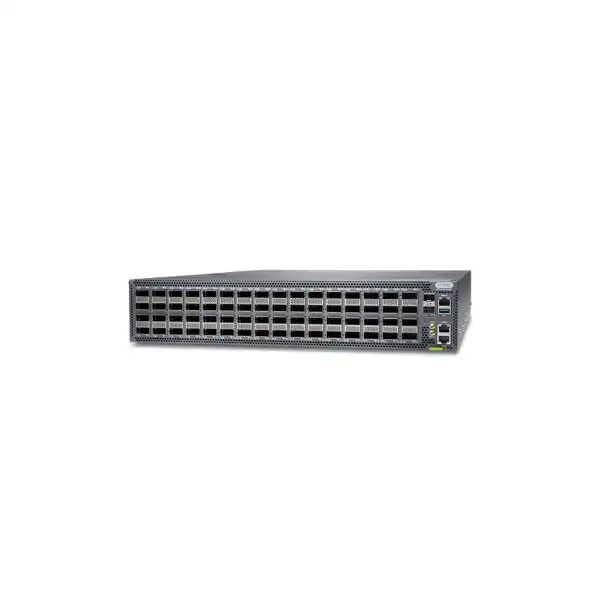
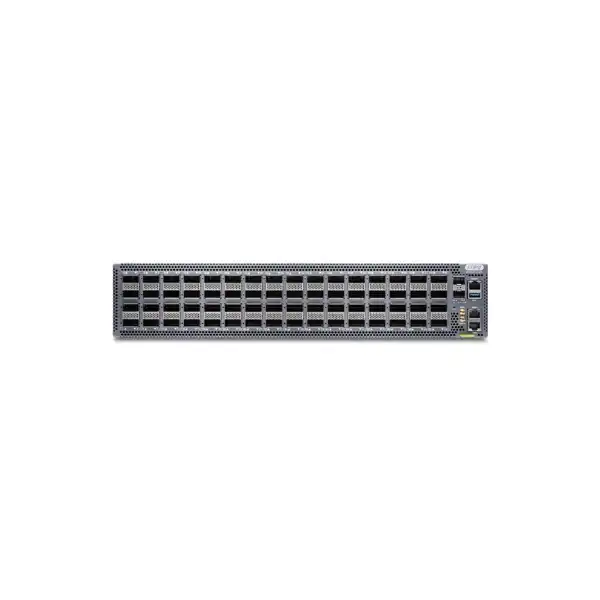
Juniper QFX5240-64QD Data Center Switch Dubai
The Juniper QFX5240-64QD is a 2U fixed-configuration switch designed for high-density 800GbE data center fabrics. With 64 QSFP-DD 800GbE ports, 51.2 Tbps unidirectional system throughput, Junos OS Evolved and traffic-management capabilities suited to large AI/ML clusters, it is intended for leaf, spine, super-spine and high-radix IP fabric roles where port density, deterministic operations and rapid east-west connectivity are central design requirements.
Direct answer: what is the QFX5240-64QD and who should consider it?
The Juniper QFX5240-64QD is the QSFP-DD variant of Juniper’s QFX5240 800GbE data center switching platform. It provides 64 high-speed QSFP-DD ports capable of 800GbE operation, plus two 10GbE SFP+ ports, in a 2U fixed chassis. Juniper positions the platform for high-density leaf, spine and end-of-row roles in IP fabrics, including data center networks supporting AI and machine-learning clusters.
It is mainly used where a fabric requires very high east-west bandwidth, dense 800GbE connectivity, large-scale ECMP, EVPN-VXLAN or routed IP fabric functions, and congestion-management features appropriate for traffic patterns such as RoCEv2. Organizations building GPU clusters, high-performance compute environments, large private clouds, service-provider infrastructure or high-bandwidth storage and analytics fabrics are the most natural candidates.
The most important factor to confirm before ordering is not simply whether 800GbE is required. Buyers should validate the complete physical and logical design: exact optics and cable types, breakout speeds, supported mixed-speed port combinations, rack depth, front-to-back airflow, dual power feeds, software release requirements, automation tooling, support entitlement and the expected traffic pattern. A 51.2 Tbps shallow-buffer switch can be an excellent spine or AI-fabric component, but its suitability depends on topology and congestion design rather than headline throughput alone.
FourTeck can help translate the intended rack, GPU, server, storage and uplink design into a practical bill of materials for Dubai or other UAE deployments. That includes confirming the correct QFX5240-64QD hardware variant, supported transceivers and breakouts, rack and power prerequisites, required Junos OS Evolved feature support, Apstra requirements where applicable, installation scope and service coverage.
Why the QFX5240-64QD is a distinct data center switching choice
The QFX5240-64QD is not simply a faster top-of-rack switch. Its defining design point is high radix at 800GbE: a single fixed 2U chassis exposes 64 QSFP-DD ports and a 51.2 Tbps switching system. That density changes how architects can build a fabric. A spine can aggregate many high-speed leaf links without moving immediately to a modular chassis, and an AI network can use fewer physical switching nodes for a given amount of 400GbE or 800GbE connectivity. Fewer nodes can simplify cabling and reduce the number of independent devices that must be operated, although the final architecture must still satisfy fault-domain, oversubscription and availability objectives.
The QSFP-DD front panel is particularly relevant to buyers whose current or planned optics ecosystem is based on QSFP-family form factors. The sister QFX5240-64OD uses OSFP instead. That distinction is procurement-critical because 800GbE optics, cable assemblies, thermal characteristics and connector choices can have a material effect on cost and deployment readiness. Choosing the correct chassis interface at the beginning reduces the risk of buying a switch that later requires an unexpected optics transition strategy.
The platform runs Junos OS Evolved rather than traditional Junos OS. This matters for operational planning, release validation, automation and feature checks. Teams with established Juniper data center processes can retain familiar Junos concepts while still treating software qualification as a specific workstream for the QFX5240. In production AI fabrics, feature support must be reviewed against the intended Junos OS Evolved release because congestion management, telemetry and forwarding behavior are often as important as port speed.
The QFX5240 family is also a shallow-buffer design. Its 165 MB packet buffer is appropriate to architectures that rely on high bandwidth, carefully engineered traffic management, ECMP and modern congestion controls rather than large shared buffers to absorb prolonged bursts. That makes design discipline important: the switch is strongest when it is placed in a topology whose traffic behavior and queueing policy have been understood in advance.
Juniper QFX5240-64QD verified hardware specifications
| Specification | QFX5240-64QD detail | Buyer relevance |
|---|---|---|
| Orderable airflow model | QFX5240-64QD-AO | AO indicates airflow-out, matching front-to-back port-to-FRU cooling. |
| Form factor | 2U fixed chassis | Provides very high port density without a modular chassis. |
| High-speed network ports | 64 × QSFP-DD 800GbE | Suitable for dense 800G, 400G, 200G, 100G and selected 50G breakout designs. |
| Additional ports | 2 × 10GbE SFP+ | Useful for specific network or operational connectivity; final use should match the validated design. |
| System throughput | 51.2 Tbps unidirectional / 102.4 Tbps bidirectional | Supports high-radix leaf and spine designs with large aggregate bandwidth. |
| Maximum forwarding rate | 21.2 billion packets per second | Important for fabrics with very high packet-rate workloads, not only large flows. |
| Packet buffer | 165 MB | Confirms the platform is a shallow-buffer architecture; congestion design matters. |
| MAC scale | 136,000 addresses | Relevant to EVPN-VXLAN and large Layer 2/overlay environments. |
| IPv4 unicast routes | Up to 2,000,000 routes; 880,000 host routes | Supports large routed fabrics subject to the complete scale profile and software release. |
| IPv6 unicast routes | Up to 2,000,000 routes; 875,000 host routes | Useful for modern dual-stack and IPv6-forward data center designs. |
| CPU and memory | Intel 4-core 2.2 GHz Ice Lake CPU; 32 GB DRAM | Supports the control plane for Junos OS Evolved and operational services. |
| Internal storage | 960 GB total SSD, implemented as two 480 GB drives | Supports system software and platform operations. |
| Power supplies | 2 AC hot-removable/hot-insertable PSUs with 1+1 redundancy | Plan two dedicated power feeds if full power redundancy is required. |
| Cooling | 4 hot-removable fan modules, front-to-back airflow | Rack hot-aisle/cold-aisle orientation must match airflow direction. |
| Approximate chassis size | 17.26 × 3.46 × 25.51 in (W × H × D) | Check usable rack depth, cable bend radius and service clearance. |
| Weight | Approximately 22 kg without optics | Plan safe rack installation and suitable rail support. |
| Operating temperature | 0°C to 40°C | Data hall cooling must maintain the chassis within the documented environmental range. |
Specifications should be revalidated against the exact orderable part number, current Junos OS Evolved release, Juniper Hardware Compatibility Tool and selected optics before purchase, because supported combinations and software behavior can evolve over the product lifecycle.
Port architecture, breakout strategy and why QSFP-DD matters
The QFX5240-64QD front panel is built around 64 QSFP-DD interfaces capable of 800GbE. That headline density is valuable, but the practical design advantage is flexibility. Juniper documents support for configurations that can provide 64 × 800GbE, 128 × 400GbE, 256 × 200GbE, as many as 320 × 100GbE, or 256 × 50GbE, depending on the breakout arrangement and supported combination. Mixed-speed designs should be checked with Juniper’s port validation resources rather than assumed from raw lane arithmetic. The maximum number of physical endpoints does not mean every arbitrary mixture of speeds is supported on every port in every software release.
For a buyer, this creates several architecture choices. An AI spine may consume the ports predominantly as 800GbE or 400GbE fabric links. A cloud spine may use a mixture of 400GbE and 100GbE breakouts to connect successive generations of leaf switches. A lab or migration environment may deliberately preserve 100GbE connectivity while reserving native 800GbE ports for future expansion. In each case, the switch remains the same, but the bill of materials changes substantially because breakout cables, optical modules, fiber type, patching and connector density determine the installed result.
QSFP-DD should be treated as a system decision rather than a connector label. At 800GbE, optics can differ in reach, fiber type, wavelength plan, electrical power, heat generation and operational requirements. Direct-attach copper may be practical for very short in-rack or adjacent-rack connections, while active optical cables or pluggable optical transceivers may be required for longer runs. Structured cabling choices then influence patch panels, polarity, cleaning practices and spare strategy. A buyer that orders switches before defining links can easily create avoidable cost or compatibility work later.
The two additional 10GbE SFP+ interfaces should not be confused with the dedicated RJ-45 management interface. They are network-facing interfaces with their own intended roles. The chassis also includes an RJ-45 console port, RJ-45 management port and USB Type-A interface, plus timing-related connections including 10 MHz, pulse-per-second and Time of Day. These operational interfaces are useful when the data center has defined out-of-band management and timing standards.
The most reliable procurement method is to map every required logical link to a physical port, speed, media type, transceiver or cable, connector, reach and redundancy role before finalizing the switch quantity. That mapping makes it possible to validate whether native 800GbE, 2 × 400GbE, 4 × 200GbE or higher-density breakout is the best use of each port group and prevents a late-stage discovery that the planned cable plant does not match the selected interface format.
51.2 Tbps switching capacity in practical terms
Juniper specifies 51.2 Tbps of unidirectional throughput and 102.4 Tbps bidirectional aggregate capacity for the 64-port QFX5240 platform. This aligns with a high-radix 800GbE architecture: 64 ports multiplied by 800 Gb/s equals 51.2 Tb/s of one-way port bandwidth. The platform is designed so architects can build large fabrics without concentrating excessive uplink demand on a small number of interfaces.
Throughput alone does not guarantee application performance. Real fabrics are affected by packet-size distribution, traffic locality, ECMP entropy, congestion, oversubscription, server NIC behavior, link failures and queue configuration. For AI training clusters, the difference between average utilization and tail latency can be significant. For cloud fabrics, traffic matrices can change rapidly as workloads move. Capacity planning therefore needs both aggregate bandwidth calculations and a view of how flows arrive at individual ports and queues.
The QFX5240-64QD is best understood as a platform that gives the architect substantial raw bandwidth and a modern traffic-management toolset. It does not remove the need for a sound Clos design, consistent link speeds, appropriate ECMP width and disciplined failure-domain planning.
21.2 Bpps forwarding and small-packet workloads
The specified forwarding rate of 21.2 billion packets per second matters when the network carries huge numbers of smaller packets, not only large elephant flows. AI, storage and service-provider environments can contain a mixture of large data transfers, control traffic and shorter flows. A fabric therefore needs to sustain both bandwidth and packet processing demands.
When comparing alternatives, buyers should avoid selecting only by Tbps. A platform’s forwarding scale, table capacity, buffering, supported routing features, queue behavior and telemetry all affect the quality of the deployment. The right switch is one whose complete profile matches the traffic model and operational plan.
For very specialized workloads, FourTeck can help turn estimated server or GPU traffic into a port and topology model before hardware is quoted. That exercise is particularly useful when the organization is deciding between fewer high-radix spines and a larger number of lower-density switching devices.
AI and machine-learning fabric capabilities: RoCEv2, ECN, PFC and load balancing
The QFX5240 line is explicitly positioned for AI data center networking. That positioning is not just a reference to 800GbE port speed. Distributed training traffic can create synchronization-sensitive communication patterns in which delayed flows slow the completion of an entire job. Large GPU clusters also generate concentrated east-west flows, incast and traffic shifts that make queueing, congestion signaling and path utilization important design variables.
Juniper documents Priority-based Flow Control, Explicit Congestion Notification, Weighted Random Early Drop and related class-of-service capabilities on the QFX5240. It also supports mechanisms used in RoCEv2-oriented designs. RoCEv2 carries RDMA over an IP network, so the switching fabric must be engineered to avoid harmful congestion while maintaining predictable behavior. PFC can be valuable for protecting selected loss-sensitive traffic classes, but it should be configured carefully because poorly designed PFC domains can propagate congestion. ECN and appropriate endpoint congestion control are therefore part of the broader architecture, not optional afterthoughts.
Dynamic Load Balancing is another significant feature for modern data center traffic. Conventional hash-based ECMP can place several heavy flows on the same path while leaving another equal-cost path lightly used. DLB can respond to changing path conditions for supported configurations and can improve utilization when the flow mix has limited entropy. Juniper documents DLB for port speeds above 50 Gbps, but also documents restrictions involving link aggregation groups. That limitation needs to be considered before an architect assumes that every aggregated uplink design can use the same load-balancing behavior.
The practical implementation question is whether the planned AI fabric uses rail-optimized connectivity, how many GPUs or accelerators sit behind each leaf, which NIC speeds are used, whether links are 400GbE or 800GbE, and what oversubscription is acceptable. The answers determine leaf count, spine count, cable count, ECMP width and failure behavior. An 800GbE switch can reduce the number of spine ports required, but it may also concentrate more bandwidth in each failure domain. That tradeoff should be modeled rather than assumed.
Organizations should validate the exact Junos OS Evolved release against required RoCEv2, PFC, ECN, telemetry and DLB functions before production rollout. A controlled staging environment is especially valuable for AI clusters because the network should be tuned using representative traffic patterns rather than only interface-up tests.
EVPN-VXLAN and IP fabric roles
Beyond AI-specific deployments, the QFX5240-64QD is designed for high-scale data center fabrics. Juniper positions the family for leaf, spine and super-spine use in IP and EVPN-VXLAN architectures. In a routed underlay, the switch can participate in large IPv4 or IPv6 fabrics with ECMP providing path diversity. In an EVPN-VXLAN design, the control plane can distribute reachability while VXLAN provides overlay segmentation and mobility across the physical fabric.
The appropriate role depends on the surrounding port speeds. A QFX5240-64QD can be a spine above 100GbE, 200GbE or 400GbE leaves, or it can operate in an 800GbE leaf/spine hierarchy for next-generation servers and accelerators. In a large multi-stage Clos fabric, the high-radix 64-port design can also be used above lower tiers to reduce the number of inter-stage links and switches. The architecture should be chosen from endpoint scale, required oversubscription, failure-domain size and cabling feasibility.
The platform’s published route and MAC scales are useful planning anchors. Juniper lists up to two million IPv4 and two million IPv6 unicast routes, hundreds of thousands of host routes and 136,000 MAC addresses. Those numbers are substantial, but they should never be treated as universally simultaneous maxima. Real platform scale depends on feature combinations, forwarding profile and software release. A production design should therefore validate the actual mix of routes, hosts, MAC addresses, next hops, VXLAN endpoints and policies rather than relying on a single table value.
For buyers migrating from a traditional Layer 2 aggregation architecture, the biggest change is usually operational, not physical. Moving to an IP underlay and EVPN overlay requires consistent addressing, BGP policy, route-target planning, fabric automation and failure testing. The QFX5240 provides the hardware foundation, but successful migration depends on a design and operational model that the network team can sustain after handover.
Shallow-buffer architecture
The 165 MB packet buffer means the QFX5240 should be deployed with intentional congestion management. It is designed for high-bandwidth, modern data center fabrics rather than as a deep-buffer appliance intended to absorb sustained bursts for long periods.
Eight unicast queues per port
Juniper’s hardware specifications list eight unicast QoS queues per port and two multicast queues. Queue design should reflect the traffic classes that actually need differentiated treatment rather than creating unnecessary complexity.
Telemetry for operations
Streaming telemetry and queue-level visibility are especially important in AI and cloud fabrics because transient congestion may not be obvious from periodic interface polling. Monitoring should include queue occupancy, drops, ECN/PFC behavior and path utilization where supported.
Apstra Data Center Director and intent-based operations
Juniper positions the QFX5240 for use with Apstra Data Center Director, its intent-based data center automation platform. The operational value is broader than initial configuration generation. A large Clos fabric can contain hundreds or thousands of interfaces, repetitive BGP relationships, cabling expectations and policy dependencies. Manual workflows become difficult to validate consistently as the fabric grows.
With an intent-based approach, the operator defines the desired design and uses automation to deploy and continuously validate that state. In practice, this can help with fabric blueprinting, device onboarding, configuration consistency, telemetry, anomaly detection and change assurance. For AI networks, where cabling mistakes or a single misconfigured link can have disproportionate performance impact, closed-loop validation can be particularly valuable.
Apstra is not automatically synonymous with every QFX5240 purchase. Buyers should establish whether they intend to manage the switch through Junos OS Evolved directly, through existing network automation, through Data Center Director, or through a combination of tools. Subscription edition, scale and feature requirements should be confirmed separately. A switch bill of materials that omits the intended management and assurance platform can leave an important operational cost outside the initial procurement scope.
For a new fabric, FourTeck can scope hardware and automation together so the quotation reflects the actual operating model. For an established Juniper environment, the more important question may be compatibility with the current Apstra release, blueprint standards and supported Junos OS Evolved version.
Junos OS Evolved: software planning and release discipline
The QFX5240 runs Junos OS Evolved. That operating system shares familiar Junos configuration and operational concepts, but it is architected for newer platforms and should be treated as its own software lifecycle. Before rollout, the network team should identify the target release based on Juniper recommendations, feature requirements, optics support, automation compatibility and any platform-specific caveats.
Release qualification is especially important for a switch this capable because the design may depend on features that evolve over time. Breakout support, RoCEv2 behavior, DLB, telemetry sensors, EVPN functions and platform instrumentation should be checked against the intended software release. Production change control should also define how software upgrades are staged across the fabric so that redundant paths remain available during maintenance.
The switch provides dedicated out-of-band management and console access. A resilient deployment should place the management interface on a network that remains reachable when the data fabric is impaired. Console-server integration can provide an additional recovery path for remote data centers. AAA, role-based administration, configuration backups, syslog, NTP or PTP where required, telemetry collectors and monitoring should be integrated before the switch carries production traffic.
Buyers should also confirm the support contract and software entitlement that match their operational expectations. Hardware redundancy reduces the likelihood of a single component causing downtime, but it does not replace access to software updates, technical assistance and replacement logistics. In the UAE, the desired response time and sparing strategy should be discussed at quotation stage rather than after installation.
Power, cooling and Dubai data hall planning
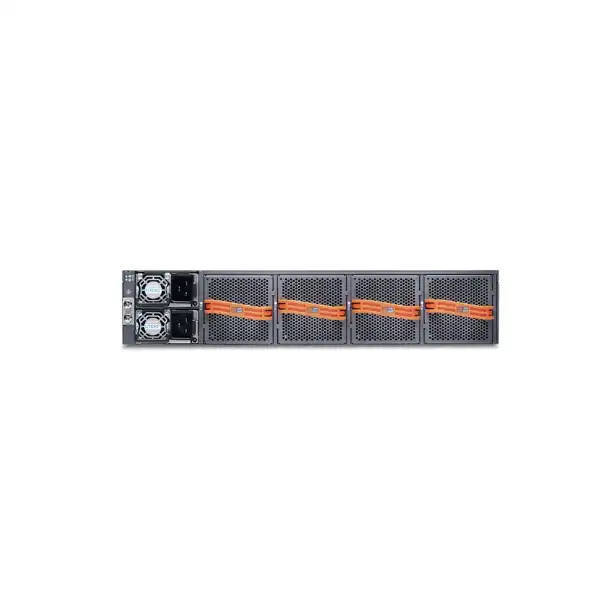
High-density 800GbE switching has meaningful power and thermal implications. Juniper equips the QFX5240 with two redundant AC power supplies and four hot-removable fan modules. The platform uses front-to-back airflow, also described as port-to-FRU airflow or airflow-out. Air enters at the port side and is exhausted through the rear field-replaceable-unit side. Rack orientation must therefore match the data hall’s cold-aisle and hot-aisle design.
Juniper documents typical QFX5240-64QD power consumption around 616 W under a specified 25°C, 50% load test using DACs and excluding transceivers, with maximum documented consumption around 2258 W under a 40°C, full-load test with SR optics. Those figures illustrate why power planning must include the actual optics population. An 800GbE optical module can consume materially more power than a passive DAC, and a fully populated chassis may have a noticeably different rack heat load from a switch used primarily with short copper interconnects.
The two power supplies are intended for redundancy and load sharing. Where full resilience is required, each PSU should be connected to a separate appropriate power feed so the switch can continue operating if one feed or PSU is lost. Juniper’s installation guidance calls for dedicated power sources and appropriate circuit protection, with grounding completed before the unit is energized. Local electrical requirements and the selected power cord should be validated for the UAE installation.
The published operating temperature range is 0°C to 40°C with 5% to 90% noncondensing relative humidity. Dubai’s outdoor climate is not directly relevant to a properly conditioned data hall, but it increases the importance of dependable facility cooling, especially during utility or chiller events. The rack should not depend on room-average temperature alone; inlet temperature at the switch matters. Exhaust from adjacent equipment should not be allowed to feed the QFX5240 intake.
For capacity planning, combine the switch’s expected load with every selected transceiver, adjacent server or GPU system and the rack’s total power-density limit. A high-performance fabric may be electrically feasible at the PDU level while still exceeding cooling capacity in a particular row. That is why a rack elevation and per-device heat estimate are useful inputs for the quotation and installation plan.
Rack installation, clearance, grounding and service access
The QFX5240-64QD occupies 2U and weighs approximately 22 kg without optics. Juniper provides a four-post tool-less rack-mount kit for the platform. Before delivery, buyers should confirm rack type, rail compatibility, usable depth, vertical space, front-door clearance and the bend radius required for dense high-speed cabling. The chassis depth is roughly 25.5 inches, but a practical rack design must allow more than the metal chassis dimension because power cords, fan service and front-panel fiber management require space.
Juniper’s site guidance calls for unobstructed airflow and significant service clearance. The vendor recommends leaving at least 24 inches in front of and behind the chassis and references 30 inches of front maintenance clearance under NEBS guidance. In a crowded data center, this can affect rack-row selection and maintenance procedures. A technically compatible rack is not automatically operationally convenient if technicians cannot replace a PSU, fan or cable without disturbing neighboring equipment.
Grounding is a mandatory installation consideration. Juniper instructs installers to connect the chassis to earth ground before applying power and specifies a two-hole protective grounding terminal. The site’s grounding cable and lug should meet the documented requirements and be installed by appropriately qualified personnel. This is not an accessory that should be improvised during commissioning.
Because the ports are on the intake side and the replaceable power and cooling modules are at the rear, labeling should cover both faces of the rack. Front labels should identify port, peer, speed and circuit or fabric role. Rear labels should identify power-feed source and field-replaceable-unit location. This simple discipline makes emergency maintenance faster, particularly in a high-density fabric where many identical links may be present.
For new Dubai installations, it is useful to review the rack elevation and power schedule before equipment is shipped. That allows rail kits, PDUs, cable managers, grounding materials and optics to arrive with the switch instead of becoming separate urgent purchases during commissioning.
Optics and cabling: the part of the QFX5240 purchase that deserves equal attention
A data center switch is only useful when every planned link has a supported physical implementation. For the QFX5240-64QD, that means selecting QSFP-DD optics, cable assemblies or breakout solutions that match the distance, fiber plant, connector type and target Ethernet rate. It is risky to treat optics as a generic commodity because 800GbE modules have different electrical and thermal profiles and not every transceiver is supported in every switch port or software release.
Start with reach. Very short connections within a rack or between adjacent racks may use direct-attach copper where supported and physically practical. Active electrical or active optical cables may simplify some short-reach designs. Longer data hall links generally use optical transceivers and fiber. Each link should therefore have a documented source device, destination device, distance, required redundancy, speed and fiber type. Once those facts are known, a supported optic can be chosen with far less ambiguity.
Breakout links add another layer. A single 800GbE port can be divided into lower-speed interfaces, but the resulting cable fan-out, connector presentation and switch port configuration must all align. For example, breaking 800GbE into multiple 100GbE endpoints can dramatically increase front-panel cable density. That may be electrically valid yet operationally poor if the rack has insufficient cable management or if maintenance requires tracing many individual legs through a congested bundle.
The best design does not automatically maximize breakout density. Native 400GbE or 800GbE links can be easier to operate and may provide a cleaner migration path. Breakout is most valuable when it solves a specific endpoint-speed requirement without creating excessive cabling complexity. In mixed-generation data centers, a deliberate breakout strategy can extend the usefulness of existing 100GbE or 400GbE devices while preserving spare native 800GbE capacity for future equipment.
Optical power budget, patch-panel loss, fiber polarity and cleanliness also matter. High-speed optical links can be sensitive to contamination and poor connector handling. Commissioning should include inspection and cleaning procedures, correct fiber polarity and link verification rather than only confirming that the interface eventually comes up. Spare optics should be selected from the same validated compatibility set so replacements do not introduce a new variable during an outage.
For quotation, FourTeck can work from a port schedule or fabric diagram and identify the number of native 800GbE modules, 400GbE or 100GbE breakouts, DAC/AOC assemblies, fiber patch leads and spares required. This approach is more accurate than quoting a bare switch and attempting to calculate connectivity after purchase.
Migration planning from 100GbE and 400GbE fabrics
Many organizations considering the QFX5240-64QD are not building a greenfield 800GbE fabric. They are expanding a 100GbE or 400GbE environment and want a spine layer with enough headroom for the next server or GPU generation. The QFX5240 can support that transition through breakout, but a good migration plan should define which links change speed in each phase and how old and new tiers coexist.
A common approach is to deploy the new switch first as a higher-speed spine while leaving existing leaves in place. The spine-facing ports can be broken out to 100GbE or 400GbE as required. Newer leaves can then be introduced with native 400GbE or 800GbE uplinks over time. This protects the investment in the spine while avoiding a disruptive simultaneous replacement of every rack switch.
However, migration is not only about port speed. The new fabric may also introduce Junos OS Evolved, new EVPN policies, different BGP timers, changed MTU, RoCEv2-specific class-of-service settings, a new automation platform or revised out-of-band management. Every one of those changes needs a test and rollback plan. When several changes are combined in one maintenance window, fault isolation becomes harder if something does not behave as expected.
A lower-risk sequence separates physical migration from control-plane or policy migration where possible. Bring the new chassis online, validate management and monitoring, verify optics and link stability, then introduce routing adjacencies and production traffic in controlled stages. If the topology supports parallel paths, traffic can be moved incrementally while counters and telemetry are observed. This provides evidence that the new fabric is healthy before legacy paths are removed.
For AI environments, migration testing should include representative traffic rather than basic ping and throughput checks. Collective communication patterns, incast and sustained east-west transfers can reveal congestion behavior that ordinary acceptance tests miss. The purpose of staging is to validate the intended operational outcome, not merely confirm that every port negotiates at the expected speed.
Redundant power
Two hot-removable AC PSUs provide 1+1 redundancy. Full value comes when the PSUs are connected to independent, correctly protected power sources and the failure of either feed is tested during commissioning.
Serviceable cooling
Four hot-removable fan modules support front-to-back cooling. Juniper documents redundancy at the rotor level, but facility cooling and unobstructed airflow remain prerequisites for reliable operation.
Fabric-level resilience
Hardware redundancy inside one switch does not replace topology redundancy. Critical fabrics should use multiple spines, diverse links and an ECMP design that continues to meet performance targets after a link or device failure.
Sizing the QFX5240-64QD for leaf, spine and super-spine roles
Sizing begins with endpoints, not switch count. List the number of servers, GPU nodes, storage systems or leaf switches, the speed of each connection, the desired oversubscription ratio and the amount of growth expected during the useful life of the fabric. Then determine how many ports a single QFX5240-64QD must dedicate to downlinks, uplinks, inter-stage links or spares. This produces a topology that can be evaluated mathematically rather than by rule of thumb.
As a spine, the 64 high-speed ports provide substantial radix. In a two-tier Clos fabric, each leaf typically connects to every spine. The number of spine devices therefore affects both ECMP width and how many uplinks each leaf needs. More spines can improve path diversity and reduce the impact of one spine failure, while fewer larger spines can simplify cabling and device count. The right balance depends on how much bandwidth must remain after a failure.
As a leaf, the QFX5240-64QD makes sense when the rack or cluster itself requires unusually high-speed connectivity. That may include GPU systems with multiple 400GbE or 800GbE NICs, high-performance storage or dense aggregation of faster leaf devices. For conventional enterprise server racks dominated by 10GbE, 25GbE or 100GbE host links, a lower-speed leaf may be more economical and operationally simpler, with the QFX5240 reserved for the spine tier.
As a super-spine or higher-stage device, the value is again high radix and 800GbE. Large fabrics can connect multiple pods through native high-speed links, but the routing scale, failure domains and inter-stage oversubscription must be checked. The platform’s large route tables are useful, yet the actual deployed scale should be validated against the complete feature set and software release.
A useful design target is not maximum port occupancy on day one. Reserve enough ports for link failures, future leaves, maintenance and growth. High-density switches are expensive assets, but filling every interface immediately can create an early redesign when the cluster expands. A small amount of planned headroom often improves the economics of the fabric over its full lifecycle.
When the QFX5240-64QD may not be the right choice
The QFX5240-64QD is a specialized high-capacity platform, so it should not be selected simply because it is faster than an existing switch. If the environment has mostly 10GbE, 25GbE or 100GbE endpoints and modest growth, a lower-density or lower-speed QFX model can reduce hardware, optics and power costs. A buyer should compare the total fabric bill of materials, not just the number of switch ports.
It may also be unsuitable where deep buffering is a primary requirement. The QFX5240 provides 165 MB of packet buffer and is designed around shallow-buffer, high-bandwidth fabrics with modern congestion management. Workloads with prolonged speed mismatch or specialized burst absorption requirements may need a different platform architecture.
Form factor and optics ecosystem can also point to another model. Buyers committed to OSFP-based 800GbE connectivity should compare the QFX5240-64OD rather than choosing the QSFP-DD QFX5240-64QD. If fewer high-speed ports are needed, a lower-radix model may produce better rack economics. Conversely, very large environments may need a multi-stage topology or different class of system rather than trying to stretch one fixed switch role beyond its design target.
A balanced quotation should therefore include at least one nearby alternative when the requirements are not yet fixed. The goal is not to maximize the switch specification; it is to choose the platform that meets capacity, resilience, cabling, management and lifecycle requirements with the least unnecessary complexity.
Licensing, support, subscriptions and lifecycle questions
Enterprise data center procurement should separate the physical switch from the complete software and support outcome. The QFX5240 runs Junos OS Evolved, and the exact software entitlement, support contract and optional automation platform should be confirmed for the intended deployment. A hardware-only price can be misleading if the project later requires additional subscriptions, premium support or automation licensing that was not included in the original budget.
If Apstra Data Center Director will be used, determine the required edition and managed-device scope. Different operational requirements can affect the appropriate subscription. Teams using their own automation stack should still verify API and telemetry expectations, supported Junos OS Evolved release and how configuration compliance will be maintained. The switch does not prescribe one operational model, but the procurement package should reflect the model the organization actually intends to use.
Support planning should define replacement expectations. The platform includes hot-serviceable PSUs and fans, but a field-replaceable component is only useful when a spare or replacement can be obtained within the required window. Critical UAE data centers may choose enhanced service levels, local sparing or both. The correct strategy depends on whether the fabric can tolerate a reduced redundancy state for hours, a day or longer.
Lifecycle planning also includes optics. A spare switch without compatible spare transceivers may not restore a failed path. Conversely, stocking many expensive optics without a compatibility and failure-rate strategy can tie up budget unnecessarily. A practical spare plan identifies which components are common across the fabric, which failures would create a capacity risk, and which items can be obtained quickly under support.
Before issuing a purchase order, buyers should request a quotation that clearly separates chassis, included power supplies and fans, rack kit, optics and cables, software or subscription items, support term, installation services and any migration work. That structure makes competing proposals easier to compare and reduces ambiguity during delivery.
Dubai and UAE deployment considerations
For customers in Dubai and the wider UAE, the switch’s technical specification is only one part of deployment readiness. Data center access procedures, rack allocation, power-feed availability, structured cabling standards, delivery scheduling and change windows can all affect the project. High-density 800GbE equipment is easiest to deploy when those facility details are captured before the hardware arrives.
The QFX5240’s front-to-back airflow should be matched to the facility aisle design. Its dual power supplies should be mapped to the available A and B feeds with the correct regional power cords. The chassis should be grounded according to Juniper’s installation requirements and local practice. If the site is a colocation facility, remote-hands procedures should include clear instructions for PSU, fan and cable replacement because the port density can make visual identification difficult.
Importantly, the UAE climate increases the consequence of facility cooling problems even though the switch itself operates inside a controlled data hall. A rack containing GPU servers and 800GbE switching can have high heat density. Inlet temperature monitoring, adequate airflow and rack-level power capacity are therefore part of network reliability, not separate facilities concerns.
FourTeck can coordinate the product quotation with optics selection, rack and power checks, installation scope, software planning and support requirements. For a multi-rack fabric, providing the intended topology and port schedule at the start produces a more accurate UAE bill of materials than requesting a quantity of bare switches alone.
Practical implementation journey for a QFX5240-64QD fabric
Define traffic and topology
Document endpoint count, NIC speeds, GPU or server grouping, storage flows, oversubscription objectives, failure tolerance and growth. Decide whether the switch will act as leaf, spine or a higher-stage fabric node. This is the foundation for every later port and optics decision.
Create a port schedule
Assign every planned connection to a port role and speed. Identify which interfaces remain native 800GbE and which need 400GbE, 200GbE, 100GbE or 50GbE breakout. Reserve ports for expansion and maintenance so the design is not at maximum occupancy on day one.
Validate optics and cabling
For each link, confirm reach, fiber or copper medium, connector, breakout type and supported transceiver. Check the latest Juniper compatibility resources and the required Junos OS Evolved release. Include spare optics based on operational criticality.
Confirm rack, power and cooling
Check 2U rack space, chassis depth, rail support, service clearance, grounding, dual power feeds and airflow direction. Estimate thermal load using the expected optics population rather than a bare-chassis assumption.
Build the software design
Select the target Junos OS Evolved release, underlay and overlay model, BGP policy, ECMP behavior, MTU, QoS classes, PFC/ECN settings where required, management addressing, logging, AAA, NTP or timing services and automation integration.
Stage and test
Validate management access, software image, optics, breakout, routing adjacencies, redundancy, telemetry and failure behavior before production. AI fabrics should be tested with traffic patterns that approximate real collective communications and congestion scenarios.
Migrate in controlled phases
Introduce new links or racks gradually, observe counters and telemetry, and keep a rollback path. Avoid combining more physical, routing, QoS and automation changes in a single window than the team can troubleshoot safely.
Operationalize the fabric
Create monitoring thresholds, configuration backup, software-upgrade procedures, spare strategy and support escalation paths. A successful deployment ends when the operations team can maintain the fabric confidently, not when the final cable is connected.
Where the QFX5240-64QD commonly fits
AI training clusters
High-density 400GbE and 800GbE leaf-spine connectivity, RoCEv2-oriented congestion controls, telemetry and load-balancing functions make the platform relevant to large GPU clusters where network performance contributes directly to job completion time.
Private cloud spine
A 64-port high-radix spine can aggregate many 100GbE, 200GbE or 400GbE leaves while retaining native 800GbE capability for future growth. EVPN-VXLAN and large IP route scale support modern cloud fabric designs.
High-performance storage
Storage and analytics fabrics can benefit from high east-west bandwidth, but the exact fit depends on transport, burst profile and congestion requirements. Shallow-buffer behavior should be evaluated against the application’s traffic characteristics.
Multi-stage Clos fabrics
The 64-port 800GbE radix can be valuable as a higher-stage node between pods or clusters. Designers should calculate inter-stage oversubscription, failure impact and cabling requirements before selecting the number of devices.
100G/400G migration backbone
Breakout support allows the switch to aggregate existing lower-speed equipment while preserving a route to 800GbE. This can reduce the need to replace an entire fabric in one project phase.
Automation-led data centers
Organizations using Apstra Data Center Director can combine the hardware with intent-based design, deployment validation and telemetry workflows. The subscription and software release should be included in the project plan.
Buyer questions and detailed answers
Is the QFX5240-64QD a 64-port 800GbE switch?
Yes. Juniper specifies 64 QSFP-DD high-speed ports capable of 800GbE on the QFX5240-64QD, plus two 10GbE SFP+ interfaces. The 64 high-speed ports can also be used in supported breakout configurations for lower Ethernet rates. Buyers should validate mixed-speed arrangements against Juniper’s current port and compatibility tools because not every theoretical lane combination should be assumed to be supported.
What is the difference between QFX5240-64QD and QFX5240-64OD?
The key front-panel difference is the 800GbE interface form factor. QFX5240-64QD uses QSFP-DD ports, while QFX5240-64OD uses OSFP ports. Both are high-density 64-port 800GbE models in the QFX5240 family. The correct choice should align with the planned optics ecosystem, cable strategy and interoperability requirements rather than being selected only by chassis performance.
Can the QFX5240-64QD be used as a spine switch?
Yes. Spine is one of the core roles Juniper identifies for the QFX5240 family. Its 64-port high radix and 51.2 Tbps unidirectional capacity allow a spine layer to aggregate many high-speed leaf links. The number of required spines should be determined from leaf count, uplink bandwidth, ECMP width, oversubscription and the minimum performance that must remain after a spine failure.
Is it suitable for AI and GPU networking?
It is designed with AI data center use cases in mind and supports high-speed 800GbE connectivity plus traffic-management functions such as PFC, ECN, WRED and dynamic load balancing in supported configurations. Suitability still depends on the GPU topology, NIC speeds, RoCEv2 design, oversubscription target, traffic pattern and software release. The network should be validated using representative AI traffic before production.
Does the QFX5240-64QD support EVPN-VXLAN?
Yes, the QFX5240 family supports EVPN-VXLAN use in data center fabrics as part of Juniper’s cloud-ready data center feature set. Buyers should define underlay routing, overlay segmentation, route-target policy, gateway placement and automation method before deployment. As with all advanced features, exact support should be checked against the planned Junos OS Evolved release.
How much power does it consume?
Juniper’s current QFX5240 power documentation lists approximately 616 W typical consumption for the QFX5240-64QD under its stated test conditions and approximately 2258 W maximum under a high-load, high-temperature test with SR optics. Actual consumption varies with traffic, fan speed, environmental temperature and the installed transceivers. Rack power planning should therefore use the intended optics population and redundancy design, not only the typical figure.
What airflow direction does the Dubai model require?
The QFX5240-64QD-AO uses front-to-back, port-to-FRU airflow. Air enters at the port side and exits through the rear where the power supplies and fan modules are installed. The rack should align with the facility cold-aisle and hot-aisle arrangement, and the exhaust from other equipment must not be directed into the switch intake.
Are the power supplies and fans replaceable without shutting down the switch?
Juniper describes both the power supplies and fan modules as hot-removable and hot-insertable field-replaceable units. The two PSUs provide 1+1 power redundancy when both are installed and operating. Maintenance procedures still need to follow vendor guidance, and replacement parts should be available before a failed cooling or power component is removed for an extended period.
Can one 800GbE port be broken into multiple lower-speed ports?
Yes. Juniper documents supported breakout options including 400GbE, 200GbE, 100GbE and 50GbE configurations on the QSFP-DD platform. The exact maximum density depends on the breakout mode and port combination. Buyers should validate the proposed mixed-speed layout before ordering cables because physical fan-out and logical port support must both match.
Does the switch include the transceivers?
A switch quotation should not assume that every required 800GbE, 400GbE or breakout optic is included unless the bill of materials explicitly lists it. Transceivers and cable assemblies are selected according to reach, media, connector, peer device and port mode. FourTeck can quote the chassis together with a validated connectivity set so the delivered equipment matches the deployment plan.
Is Apstra required to operate the QFX5240-64QD?
The switch can be managed through Junos OS Evolved and its management interfaces. Apstra Data Center Director is an automation and assurance option that can simplify fabric design, deployment and ongoing validation. Whether it should be included depends on the operational model, fabric size, desired closed-loop assurance and existing automation tools. Licensing should be scoped separately.
What should be checked before ordering the QFX5240-64QD in Dubai?
Confirm the exact QFX5240-64QD-AO model, quantity, switch role, port speeds, breakout map, optics and cable reach, target Junos OS Evolved release, EVPN or IP fabric design, AI/RoCEv2 requirements, rack depth, airflow, dual power feeds, grounding, support level, automation subscriptions and installation scope. Providing those details with the quotation request greatly reduces procurement and commissioning risk.
Procurement risks that are easy to miss
The first common risk is ordering the correct switch but the wrong optics ecosystem. The QFX5240 family includes both QSFP-DD and OSFP variants. Those chassis choices should follow the link design. If the buyer has already standardized on one transceiver form factor, confirming that standard before the purchase order avoids a costly mismatch.
The second risk is treating breakout as free flexibility. A port may support several breakout speeds, but the required cable assemblies, lane mapping and software configuration must still be correct. High-density 100GbE breakout can also create a large number of front-panel fibers and labels. A simple port-count spreadsheet should be translated into a physical cable plan before final approval.
The third risk is underestimating rack services. A 2U chassis can still require substantial rear and front service space, redundant high-capacity power feeds, grounding and careful airflow. The switch should not be delivered to a rack that has available U-space but no suitable power or cable-management capacity.
The fourth risk is software ambiguity. Junos OS Evolved feature support should be tied to a selected release. If the design depends on DLB, a particular telemetry sensor, EVPN behavior or RoCEv2-related QoS function, that requirement should be tested before the fabric is declared production ready.
The fifth risk is incomplete support planning. High availability inside the chassis does not answer how quickly a failed component or entire switch can be replaced in the UAE. Support level, local logistics and the need for onsite spares should be decided according to the business impact of running in a degraded state.
Decision recap: the six factors that determine QFX5240-64QD fit
What FourTeck needs for an accurate QFX5240-64QD quotation
The fastest route to an accurate quote is a short technical requirement rather than only a switch quantity. The following inputs allow the hardware, optics, services and support to be aligned in one bill of materials.
Plan the Juniper QFX5240-64QD as a complete fabric component, not a standalone box
For Dubai and UAE projects, FourTeck can prepare a QFX5240-64QD quotation that includes the correct chassis, validated optics and breakouts, rack and power assumptions, Junos OS Evolved requirements, support coverage and optional deployment assistance. Share the topology, port speeds and link distances and we can structure the bill of materials around the network you intend to operate.

Reviews
There are no reviews yet.