
High-density 800GbE switching for modern data center fabrics
Juniper QFX5241-32OD Data Center Switch Dubai
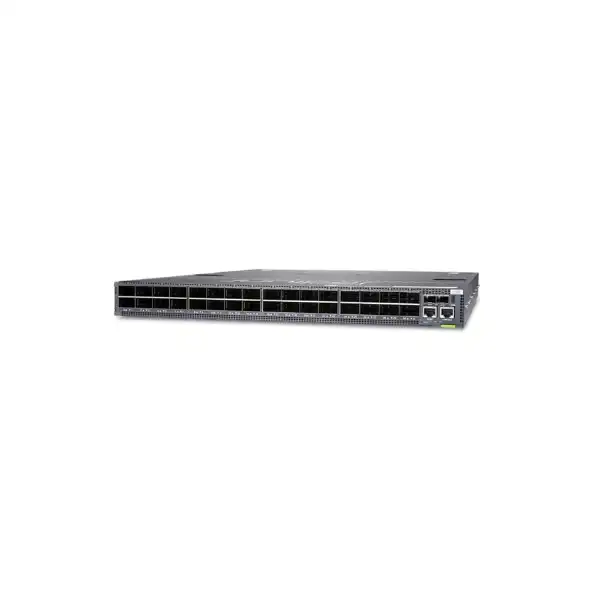
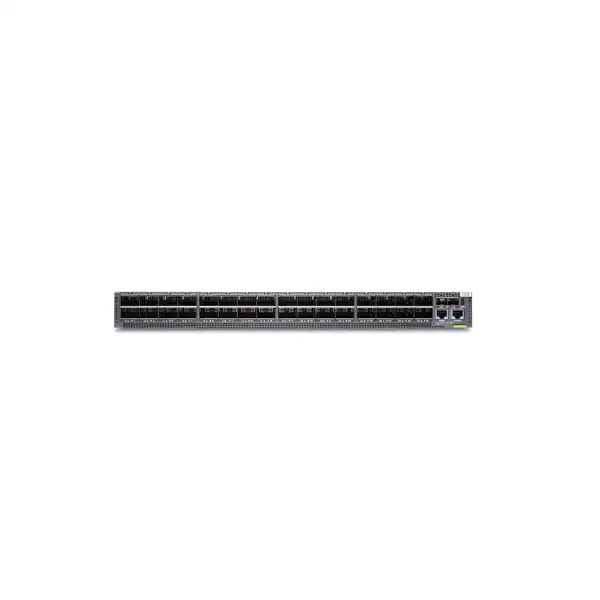
The QFX5241-32OD is a fixed 1U switch with 32 OSFP network ports supporting up to 800GbE per port. It is designed for high-speed leaf, spine, end-of-row and AI/ML fabric roles where density, deterministic operations and a modern Junos OS Evolved control plane matter. For UAE projects, the important purchasing question is not simply whether 800GbE is fast enough; it is whether the optics, breakout model, rack power, airflow, fabric architecture and software feature set are aligned with the workload.
Direct answer: what is the Juniper QFX5241-32OD?
The Juniper QFX5241-32OD is a fixed-configuration, one-rack-unit data center switch with 32 OSFP ports capable of operating at speeds up to 800 Gigabit Ethernet. Juniper positions the platform for high-density IP fabrics, including leaf, spine and end-of-row roles, with particular relevance to AI/ML clusters and other east-west traffic environments where very high interface bandwidth and low latency are important.
It is mainly used to build high-speed server, accelerator, storage and fabric interconnect layers. Organizations planning 400GbE or 800GbE uplinks, GPU clusters, high-performance computing, large cloud fabrics or rapid migration from 100GbE designs should consider it. The platform also supports lower-speed breakout scenarios, but the exact port-to-optic-to-cable combination must be checked against current Juniper hardware compatibility information and the Junos OS Evolved release selected for the deployment.
The most important factor to confirm before purchase is the complete deployment profile: required port speeds, number of 800G/400G/200G/100G links, transceiver form factor, fiber type and reach, breakout cable design, power-feed availability, airflow direction, rack depth and the intended fabric software architecture. Those dependencies determine whether the QFX5241-32OD is the correct model and what must be included in the bill of materials.
FourTeck can help UAE buyers translate those requirements into a practical quotation, including the exact switch variant, optics and cables, rack accessories, support coverage, software considerations and deployment services. The objective should be a complete, compatible fabric node rather than a chassis-only purchase that creates integration gaps later.
Where the QFX5241-32OD fits in a data center architecture
The QFX5241-32OD sits in the high-performance end of Juniper’s fixed data center switching portfolio. Its defining characteristic is 32 front-panel OSFP interfaces at up to 800GbE in only 1U. That combination is valuable when a design needs substantial bandwidth per rack unit without moving immediately to a larger 64-port chassis. It can therefore make sense as a spine in a moderate-scale Clos fabric, as a leaf for dense 400G or 800G server and accelerator attachment, or as an end-of-row aggregation device where many high-speed rack links converge.
For AI and machine-learning environments, the switch is relevant because fabric performance is not determined by raw port speed alone. GPU and accelerator clusters generate synchronized, bursty east-west traffic and can be sensitive to packet loss, queue behavior and uneven path utilization. Juniper documents support in the QFX5240 family for RoCEv2-oriented congestion functions such as priority flow control, explicit congestion notification and data-center quantized congestion notification. Dynamic load-balancing functions are also part of the platform story. These capabilities are important because a 25.6 Tbps forwarding system still needs disciplined traffic engineering to deliver useful application-level performance.
For cloud-ready enterprise fabrics, EVPN-VXLAN support gives the platform a role beyond pure Layer 3 IP routing. A business can use an EVPN control plane to create scalable segmentation, extend tenant networks through VXLAN overlays and reduce dependence on large Layer 2 failure domains. This makes the QFX5241-32OD relevant to organizations standardizing on Juniper fabrics, particularly where automation and repeatable configuration are part of the operating model.
The model is not automatically the correct choice for every data center. A 32-port 800GbE platform can be excessive for a site that still has predominantly 10/25/40GbE server connectivity and modest east-west traffic. Conversely, a very large AI fabric may benefit from a 64-port 800GbE platform because fewer spine devices and fabric links may be required. The right decision comes from endpoint count, oversubscription target, failure-domain design, optics cost, cable topology and projected growth rather than from the highest headline interface speed.
Verified QFX5241-32OD hardware profile
| Specification | QFX5241-32OD detail | Buyer relevance |
|---|---|---|
| Network interfaces | 32 OSFP ports, each supporting speeds up to 800GbE | Confirm exact optics and channelization before final BOM approval. |
| Additional interfaces | 2 SFP28 ports supporting 10GbE, plus RJ-45 management, RJ-45 console and USB Type-C | Useful for operations and management; do not assume the SFP28 pair is a general 25GbE expansion resource. |
| Switching capacity | 25.6 Tbps unidirectional, 51.2 Tbps bidirectional | Matches 32 × 800GbE line-rate port density in a compact fixed system. |
| Packet forwarding | Approximately 10.6 Bpps unidirectional in Juniper specifications | Relevant for high packet-rate fabrics, not only large sequential transfers. |
| Buffer | 83 MB | This is a shallow-buffer architecture; congestion design and traffic engineering matter. |
| Latency | Juniper lists approximately 700–750 ns | Appropriate for latency-sensitive east-west fabrics when the complete design is tuned correctly. |
| Form factor | 1U fixed chassis, roughly 43.8 cm wide × 4.3 cm high × 58.9 cm deep | Rack depth and rear service clearance must be checked, especially in dense UAE data halls. |
| Control plane | Intel 4-core 2.2 GHz Ice Lake-class processor with 32 GB DRAM | Supports the Junos OS Evolved control and management environment. |
| Internal storage | Two 480 GB NVMe SSDs, 960 GB total | Provides resilient local storage for the operating system environment. |
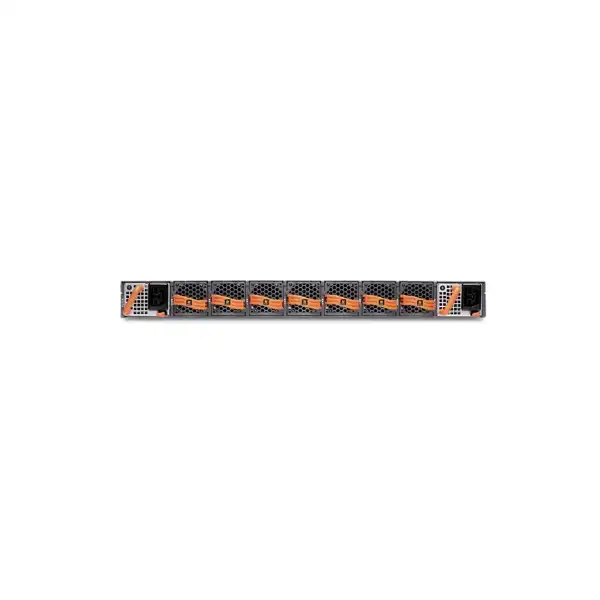
| Cooling | Airflow-out/front-to-back design with seven hot-serviceable fan modules and 6+1 fan redundancy | Rack hot-aisle/cold-aisle orientation must match the switch airflow. |
| Power supplies | Two hot-serviceable AC PSUs with 1+1 redundancy and load sharing | Use independent power feeds where the data center resilience design requires it. |
| Typical device power | Juniper lists about 543 W at 220–240 V under its stated test conditions, excluding transceivers | Real rack planning must include the selected optics and operational headroom. |
| Operating system | Junos OS Evolved | Release selection influences available features, optics support and lifecycle planning. |
Specifications can change with software releases, qualified optics and hardware revisions. Final design should be checked against current Juniper documentation and compatibility tools at the time of order.
Port architecture: 800GbE density is only the starting point
Native 800GbE
Each of the 32 OSFP network ports can support an 800GbE link when paired with a qualified optic or cable and a compatible peer. This is the cleanest configuration for new high-bandwidth fabrics, but it can carry substantial optical and power cost, so a port-count-only comparison is incomplete.
400G and 200G breakout
Juniper documents channelization of the OSFP interfaces, including two 400GbE channels or four 200GbE channels from supported port configurations. Breakout lets the switch serve mixed generations, but cabling geometry and peer-side form factor must be planned carefully.
100G and 50G channelization
The platform also supports lower-speed breakout modes on qualified combinations. Juniper publishes system-level breakout densities for the model, but buyers should not assume that every mathematical lane combination is simultaneously supported across all ports, optics and releases.
Management-plane interfaces
The separate RJ-45 management and console interfaces provide out-of-band access, while the two SFP28 positions operate at 10GbE according to Juniper documentation for this model. Treat them as specific platform interfaces rather than general-purpose substitutes for the 32 OSFP ports.
Optics govern real deployment cost
A chassis can appear attractive until 800G optics, fiber trunks, patching, spare modules and peer interfaces are added. Procurement should therefore compare a complete link budget and not only the switch price. In many deployments the optical bill of materials is a major share of total project cost.
How to plan OSFP optics and breakout cables correctly
OSFP is the physical module form factor used by the QFX5241-32OD’s 32 high-speed network interfaces. The form factor alone does not define reach, fiber type, wavelength plan or peer compatibility. An 800G direct-attach cable for a short in-rack connection is a different procurement item from an 800G multimode optic, a single-mode data-center-reach optic or a long-reach module. The port may be physically capable of 800GbE, but the network link works only when both endpoints, the optical standard, the fiber plant and the software release support the intended mode.
For short copper connections, DAC or active electrical cable options may reduce cost and power compared with optical transceivers, but allowable reach is limited and cable bulk can complicate dense racks. For optical links, buyers should record connector type, fiber category, distance, patch-panel count and any intermediate optical distribution frame. Link-loss budgets become more important as speeds rise because connector cleanliness, insertion loss, bends and fiber quality can determine whether a nominally compatible design operates with sufficient margin.
Breakout creates another layer of dependency. An OSFP port configured as two 400G channels needs a breakout assembly or optic that presents compatible lanes at the remote end. A 100G breakout may connect to multiple QSFP28-class peer ports, but the exact combination must be supported by Juniper’s Hardware Compatibility Tool and the remote vendor’s interface specification. A generic statement such as “800G breaks into eight 100G links” is not enough for procurement. The validated BOM must name the actual module or cable and the port mode expected on each side.
Juniper also notes support for linear pluggable optics on the QFX5241-32OD. LPO technology can reduce optical module power by simplifying parts of the digital signal-processing path, but it should not be treated as a universal drop-in replacement. The switch, module, fiber and peer must all be validated. Operational teams should also consider monitoring behavior, diagnostics and sparing policy when introducing a newer optical technology into a production fabric.
For a Dubai quotation, FourTeck can build the optics list from a port map rather than guessing quantities. A useful input is a simple table showing source device, destination device, link speed, approximate distance, cable medium, connector preference and whether the link must be breakable into lower-speed channels. That information usually prevents the most expensive errors in high-speed switching projects.
AI/ML fabrics: why congestion behavior matters as much as bandwidth
AI training clusters often exchange large volumes of synchronized traffic between accelerators. Collective communication patterns can cause many endpoints to transmit toward a smaller set of destinations at the same time, creating incast and transient congestion. A switch with very fast ports can still become a bottleneck if traffic distribution is uneven or if queues are not managed for the loss characteristics expected by the application. The QFX5241-32OD belongs to a platform family designed with these data-center traffic patterns in mind.
RoCEv2 is commonly used to carry RDMA traffic across Ethernet. Its value comes from low CPU overhead and efficient memory-to-memory transfers, but the network must be engineered carefully. Priority flow control can provide lossless treatment for selected traffic classes, while explicit congestion notification allows devices to signal congestion before queues overflow. Data Center Quantized Congestion Notification is part of the broader congestion-control toolkit. The correct configuration is not a matter of enabling every feature by default; it depends on NIC behavior, traffic classes, oversubscription, MTU, queue allocation and the application communication model.
Dynamic load balancing can help spread traffic when ordinary flow hashing produces hot paths. This matters in accelerator clusters because many flows may share similar header fields or because large “elephant” flows dominate fabric utilization. Juniper documents fine-grained and selective load-balancing capabilities in the QFX5240 family. Network architects should validate the exact functions supported by the chosen Junos OS Evolved release and ensure the design is consistent across all fabric tiers.
The platform’s 83 MB buffer is a useful specification to understand because the QFX5241-32OD is not a deep-buffer switch. Shallow-buffer systems can deliver excellent latency and throughput in well-engineered fabrics, but they are less forgiving of prolonged congestion. If the application profile involves substantial speed transitions, unpredictable bursts or long-distance buffering needs, a different architecture may be more appropriate. That is one reason the supplied model should be evaluated in the context of the entire topology rather than selected from interface speed alone.
A serious AI fabric review should therefore include GPU or accelerator count, NIC speed, rail design, number of fabric planes, acceptable oversubscription, expected collective workload, required fault tolerance and the behavior of the server networking stack. These inputs determine whether a 32-port 800GbE switch is the right building block and how many devices are needed at each tier.
EVPN-VXLAN, IP fabric and segmentation considerations
The QFX5241-32OD is not limited to specialized AI clusters. Junos OS Evolved supports the routing and switching capabilities needed for modern IP fabrics, and Juniper positions the QFX family for EVPN-VXLAN deployments. In a conventional three-stage Clos topology, each leaf connects northbound to multiple spines, and endpoint traffic can travel over equal-cost paths. This design increases path diversity, scales horizontally and avoids the operational fragility associated with very large Layer 2 domains.
EVPN provides a control-plane mechanism for distributing endpoint reachability, while VXLAN encapsulation creates overlay segments across the routed underlay. For multi-tenant or segmented enterprise environments, this architecture can separate application domains without forcing physical isolation. The value is architectural consistency: routing, segmentation and fabric automation can be standardized even as individual racks or services change.
A buyer should nevertheless avoid assuming that all EVPN-VXLAN designs are equivalent. Some use centralized routing, others distributed anycast gateways. Some connect only servers, while others extend to firewalls, load balancers or edge routers. Route-target design, anycast gateway behavior, multicast strategy, BGP policies and external connectivity all affect the required feature set. Hardware scale is also consumed differently depending on the number of MAC addresses, hosts, routes and VXLAN network identifiers.
Juniper publishes scale values for the platform family, including large MAC and routing capacities, but exact usable scale can depend on software release, feature combinations and forwarding profiles. If a project is approaching hundreds of thousands of routes, large tenant counts or unusually high policy scale, the design should be validated against the specific Junos OS Evolved release rather than relying on a generic product-page number.
For an organization already operating Juniper EVPN-VXLAN, introducing the QFX5241-32OD can preserve operational consistency while increasing bandwidth. For a greenfield project, the decision should include automation method, day-two troubleshooting workflows and staff familiarity. A technically capable switch still needs a supportable operating model.
Automation, telemetry and Junos OS Evolved operations
Junos OS Evolved
The platform runs Junos OS Evolved rather than classic Junos OS. Operations teams should align software standards, upgrade processes, configuration templates and feature validation with the Evolved software train. The distinction matters for release planning and support qualification.
Apstra Data Center Director
Juniper promotes intent-based automation and closed-loop validation through Apstra Data Center Director. It can be valuable where repeatable fabric design, automated deployment and state validation are more important than manual per-device configuration.
Open automation tooling
Juniper also describes support for common infrastructure automation approaches including Python, Ansible, Terraform, Puppet and zero-touch provisioning. The practical choice depends on the customer’s source-of-truth model and change-control process.
Automation should be treated as an operating discipline rather than a product add-on. A fabric managed by intent-based tooling needs authoritative device roles, IP addressing, cabling data and expected-state definitions. If those inputs are inaccurate, automation can reproduce errors faster. Teams therefore need clear responsibility for the source of truth, pre-change validation, rollback, software-image governance and exception handling.
Telemetry is equally important in high-speed fabrics. Traditional five-minute interface polling can miss microbursts and short congestion events that materially affect AI workloads. The platform family includes advanced telemetry capabilities, including congestion-related counters. Buyers should decide how those signals will be collected, stored and visualized before deployment. That may involve Juniper management tooling, an existing observability platform or a combination of both.
Power, cooling and UAE rack planning
High-speed data center switches must be planned as physical infrastructure, not just logical network equipment. The QFX5241-32OD uses two redundant AC power supplies and front-to-back airflow. Juniper’s hardware documentation states that each PSU can provide up to 2400 W output when supplied from 200–240 V AC, while lower-voltage 100–127 V operation provides reduced output capacity. In UAE facilities where 230 V-class distribution is common, the high-voltage operating range is usually the relevant planning case, but the actual rack PDU and circuit design should always be confirmed with the data center operator.
Do not interpret the 2400 W PSU rating as normal switch consumption. Juniper lists typical QFX5241-32OD power around 543 W under specified laboratory conditions at 220–240 V, 25°C, 50% load and with DACs, excluding transceivers. Production consumption varies with traffic, module type, ambient conditions and unit variation. High-power 800G optics can add a meaningful amount to rack load, so the complete optical configuration must be included in thermal and electrical calculations.
Cooling uses seven fan modules with 6+1 redundancy, and the documented airflow-out design moves air from the port side toward the field-replaceable-unit side. This must match the cold-aisle/hot-aisle orientation of the rack. Installing a switch with opposing airflow relative to neighboring equipment can create recirculation and localized hot spots, especially in dense AI racks where servers and accelerators already produce substantial heat.
The chassis is approximately 58.9 cm deep and occupies 1U. Juniper specifies a four-post rack-mount kit for installation. Buyers should verify usable rack depth, rail compatibility, cable-management space, rear clearance and access for power-supply and fan servicing. The hardware guide also calls for maintenance clearance, grounding and site preparation. These details become more important when racks are densely cabled with OSFP breakouts because cable bend radius and connector access can restrict serviceability.
For UAE deployments, environmental control should be evaluated against Juniper’s documented operating range of 0°C to 40°C and 5% to 90% non-condensing relative humidity. Modern data centers generally operate comfortably within these values, but edge facilities, industrial rooms and temporary installations can require closer inspection. Power and cooling assumptions should be documented before the equipment arrives, not discovered during rack-and-stack.
Resilience and maintainability
The QFX5241-32OD provides redundant, hot-serviceable AC power supplies and hot-serviceable fan modules. These features reduce the risk that a single PSU or fan failure will require immediate chassis shutdown. Juniper documents 1+1 power redundancy and 6+1 fan redundancy. In practice, redundancy only delivers its intended value when the installation uses separate power paths, adequate rack power and operational procedures that maintain replacement stock.
A redundant power supply connected to the same single PDU or upstream circuit does not protect against that shared failure point. For critical fabrics, each PSU should be connected according to the facility’s A/B power design. Likewise, teams should understand how long the switch can safely operate with a failed fan and what alarms or telemetry will be generated. The goal is not merely to own replaceable modules but to detect and replace failed components before the remaining redundancy is consumed.
At the network level, redundancy is broader than component duplication. A spine-leaf fabric normally uses multiple independent links and equal-cost paths so that a single link or switch failure does not isolate workloads. Fast failure detection, BFD where applicable, routing convergence and server-side bonding or multipathing all contribute. The QFX5241-32OD can be part of that resilient architecture, but it cannot compensate for a topology with single points of failure outside the chassis.
Sparing strategy deserves separate attention. A large deployment may justify keeping compatible optics, fan modules, power supplies or even a cold-spare chassis locally in the UAE. Juniper lists a QFX5241-32OD spare chassis that excludes PSUs and fans, which means a replacement plan must account for what can be transferred from the failed unit and what must be stocked separately. Support contract response time should be compared with the business impact of fabric degradation.
Security and management considerations
Data center switches are part of the security boundary because they carry management credentials, routing state and tenant traffic. Juniper identifies secure boot among the QFX5241-32OD benefits, helping protect software integrity during the boot process. Buyers should pair platform security with operational controls such as restricted management-plane access, centralized authentication, role-based permissions, configuration backups and controlled software-image distribution.
The dedicated RJ-45 management port supports out-of-band access, which is valuable during failures or routing changes that affect the production fabric. A proper out-of-band network should be independent enough to remain reachable when the data plane is impaired. Console access is also available for local recovery. Organizations should decide how console servers, management jump hosts and emergency access credentials will be handled before commissioning the device.
Software lifecycle is another security dependency. Junos OS Evolved releases introduce features, optic qualification and defect fixes over time. A production standard should define the preferred software train, patch cadence, lab validation method and rollback procedure. High-performance fabrics should avoid unplanned version drift because inconsistent behavior across leaf and spine layers can create difficult troubleshooting scenarios.
Security requirements may also influence architecture. If MACsec, specific encryption functions, detailed control-plane policing or compliance features are mandatory, verify them against the exact platform and selected software release before purchase. Product-family descriptions are not a substitute for a feature-by-release validation when the requirement is contractual or regulatory.
A practical deployment journey for QFX5241-32OD projects
Define traffic and endpoint needs
Document server or accelerator count, NIC speeds, oversubscription target, fabric tiers, required uplink capacity, failure tolerance and expected growth. This decides whether 32 ports per switch are sufficient and how many devices are required.
Assign every high-speed link
Create a source-to-destination port map showing speed, channelization and media. This prevents late discoveries that a planned breakout, connector or optic is not supported on one side of the link.
Validate rack, power and airflow
Check four-post rack geometry, A/B power feeds, PDU outlets, front-to-back cooling, cable bend radius, maintenance clearance and environmental conditions before shipment.
Select Junos OS Evolved release
Validate needed EVPN, RoCEv2, telemetry, optics and automation functions against the release chosen for production. Define standard image, configuration baseline and upgrade policy.
Test the fabric before cutover
Verify optics, link training, breakout modes, routing adjacencies, EVPN behavior, MTU, congestion policies, telemetry and failure recovery with representative servers or traffic generators.
Commission with measurable acceptance
Use a checklist that includes interface health, route and EVPN state, redundancy tests, power-feed verification, alarms, telemetry visibility, backup configuration and documented rollback procedures.
Migration from 100GbE or 400GbE fabrics
Many buyers considering the QFX5241-32OD are not building a completely new 800G environment. They are upgrading a fabric where server-facing links may remain at 25G, 100G or 400G for years. In that scenario, the ability to channelize 800G OSFP interfaces becomes strategically important because it allows the switch to participate in a mixed-speed architecture while preserving a path toward higher native bandwidth later.
The first migration decision is where to introduce 800GbE. Some organizations upgrade the spine layer first because this removes a fabric bottleneck while leaving existing leaf switches in place. Others deploy 800G-capable leaf switches for new GPU racks and connect them to an existing 400G spine through breakout. The correct sequence depends on port availability, oversubscription, optical reach, server refresh cycles and whether the old and new platforms can share the same routing and EVPN design.
A second issue is transceiver investment protection. Existing QSFP-DD or QSFP56-DD optics generally cannot simply be inserted into an OSFP cage without validated adapters or supported module strategies. Even when electrical lane rates are compatible, physical form factor, thermal behavior and firmware qualification can differ. The migration budget must therefore distinguish reusable fiber from reusable optics. Fiber plant may remain usable while endpoint modules are replaced.
Configuration migration also needs planning. Junos OS Evolved may resemble familiar Junos operational concepts, but platform behavior and feature implementation should be tested. Do not copy large legacy configurations blindly. Rebuild intent from the desired topology, addressing, policy, EVPN segmentation and QoS design, then generate clean platform-appropriate configuration. This approach is especially useful when introducing automation because it eliminates years of accumulated configuration exceptions.
Finally, migration should include a rollback boundary. A fabric change that upgrades the spine, optics and routing policy simultaneously can be difficult to reverse. Phased deployment with validated inter-generation links gives operators a safer path and makes performance changes measurable.
When QFX5241-32OD is a strong fit — and when to evaluate something else
Strong fit indicators
- You need 800GbE or dense 400GbE connectivity in a compact 1U fixed switch.
- The fabric is designed for low-latency east-west traffic, including AI/ML or HPC workloads.
- You want a Juniper leaf/spine platform running Junos OS Evolved.
- EVPN-VXLAN or routed IP fabric architecture is part of the target design.
- You have a clear optics, breakout and rack-power plan for high-speed interfaces.
- You value intent-based automation and telemetry integration across a Juniper data center environment.
Evaluate alternatives when
- Most endpoints are 10/25GbE and no high-speed aggregation requirement justifies 800G economics.
- You need deep buffering for sustained congestion or specialized long-haul traffic patterns.
- A 64-port 800GbE platform would materially reduce the number of fabric nodes required.
- Your optical standard is centered on a different pluggable form factor and adapter strategy would add risk.
- A specific security, timing or interface feature is mandatory but not validated for this model and release.
- The organization is not prepared to operate Junos OS Evolved or the required automation and observability stack.
Licensing, support and software planning
Enterprise switch quotations can be misleading when the hardware line item is considered in isolation. The QFX5241-32OD runs Junos OS Evolved, while broader automation, support and lifecycle services may be purchased separately depending on the customer’s architecture and commercial agreement. Feature entitlement, software subscription and support packaging can evolve, so a quotation should be based on the exact functions required and current Juniper commercial terms rather than assumptions from an older QFX purchase.
If Apstra Data Center Director is part of the design, the project should identify the number of managed devices, the intended subscription term, whether existing licenses can be extended and which support level is required. Automation licensing is not simply an administrative detail: it affects the operating model, who owns fabric intent and how compliance is validated after changes.
Hardware support should be selected according to business impact and local sparing. An AI training environment where one failed spine reduces cluster efficiency may justify a faster replacement SLA than a lab fabric with spare capacity. Buyers should also register hardware and maintain entitlement records because support validation and RMA processing depend on accurate serial and contract information.
Software lifecycle planning belongs in the commercial discussion as well. Determine whether the organization needs a specific long-lived release strategy, how frequently maintenance windows are available, and whether a lab switch is required for upgrade validation. A high-bandwidth fabric can be operationally fragile if each node is managed manually with inconsistent versions.
FourTeck can structure the quotation around the intended lifecycle rather than only day-one hardware. That may include switch hardware, qualified optics and cables, support, automation licensing, staging, rack installation, configuration, migration assistance and post-deployment validation. Not every customer needs every element, but each should be consciously included or excluded.
Dubai and UAE procurement considerations
Buying a QFX5241-32OD for a UAE data center involves more than confirming stock. The exact order should identify the airflow-out AC variant, required rack-mount components, support level, power-cord requirements and every optical or copper interconnect. Because the switch is designed around 800G OSFP interfaces, optics and cable availability can affect project timing more than the chassis itself. Lead times should therefore be checked for the complete BOM.
The power environment should be matched to the intended facility. The AC PSUs are designed to deliver their highest output capability on 200–240 V input, which aligns well with common UAE data-center distribution, but plug type and PDU receptacle must still be specified. Do not assume that a power cord supplied for another region will match a local high-density PDU. The electrical team should approve connector, current rating and redundancy path.
Shipping and staging practices matter for high-value optics. Transceivers should remain in protective packaging until needed, with ESD procedures and fiber-cleaning tools available. For large deployments, staging the switch with the intended software image and pre-labeled optics can reduce time spent in the data hall. Serial-number capture should be part of receiving so asset management and support registration are accurate from day one.
For projects spanning Dubai, Abu Dhabi or other Emirates, consistency of BOM is valuable. Mixing optic vendors, firmware variants or cable types can complicate troubleshooting even when each component is nominally compatible. A standardized approved parts list simplifies sparing and operations across sites.
Pricing for this class of switch is generally quotation-based because commercial terms depend on hardware, support, software, optics, quantities and project scope. A buyer asking only for “QFX5241-32OD price in Dubai” may receive an incomplete comparison. A more useful request describes the complete port plan and desired support term so suppliers can quote equivalent solutions.
Model comparison within the QFX5240 family
| Decision point | QFX5241-32OD | 64-port QFX5240-family options |
|---|---|---|
| Native 800G port count | 32 OSFP | Up to 64 800GbE ports, depending on model and form factor |
| Form factor | 1U | Typically larger 2U class for the 64-port line |
| Typical use | Compact leaf/spine or end-of-row role where 32 high-speed ports are sufficient | Larger spine/super-spine or dense leaf designs requiring more native 800G interfaces |
| Optic form factor | OSFP | Family includes OSFP and QSFP-DD variants depending on exact model |
| Selection logic | Prioritize rack efficiency and right-sized 32-port density | Prioritize maximum port consolidation and fabric scale |
The comparison is not simply “smaller versus bigger.” A 64-port switch can reduce device count, management points and spine-to-spine cabling, but it also concentrates more failure impact into one chassis and may require a different optical form factor. The 32-port QFX5241-32OD can make a topology more modular. Model choice should therefore be modeled at the fabric level, including the number of switches, links, optics, rack units and failure domains.
Representative use cases
GPU cluster leaf
Use high-speed OSFP ports to connect accelerator servers directly or through validated breakout. This design requires careful RoCEv2, PFC/ECN, MTU and rail planning. The switch may be especially useful when a rack or pod needs 400G/800G server attachment without consuming 2U.
Clos fabric spine
Deploy multiple QFX5241-32OD units as spine devices for high-bandwidth leaf uplinks. The 32-port count suits fabrics where path diversity and modular scale are preferred over the largest possible chassis. Calculate oversubscription and growth before finalizing quantity.
400G migration aggregation
Channelized 800G ports can aggregate existing 400G infrastructure while preserving a future move to native 800G. The migration is attractive when fiber can be retained and endpoint optics are available, but physical form-factor differences must be considered.
High-performance storage fabric
Large distributed storage systems can generate intense east-west traffic. The QFX5241-32OD can provide the bandwidth required for modern storage nodes, but queue behavior, flow distribution and storage protocol requirements should be validated under representative load.
EVPN-VXLAN cloud pod
Use the switch as part of a routed underlay and EVPN-VXLAN overlay supporting tenant segmentation. Automation becomes especially valuable as the number of leaves, VRFs and network segments grows across data-center pods.
Research and HPC environment
Scientific and engineering clusters may need high-throughput low-latency Ethernet without a proprietary fabric. The switch can be part of that architecture when Ethernet protocol, congestion control and application communication patterns are proven in testing.
Sizing the switch count for a real fabric
A 32-port switch does not necessarily support 32 endpoints in every architecture. In a leaf role, some ports are used for server connections and others for spine uplinks. If a design uses 16 server-facing 800G ports and 16 spine-facing 800G ports, one leaf serves 16 endpoints at a 1:1 raw bandwidth ratio. If server links are 400G breakouts while uplinks remain 800G, the endpoint count can increase, but the oversubscription calculation changes. The physical lane configuration and fabric policy must be modeled together.
In a spine role, each port typically connects to one leaf uplink or breakout group. A 32-port spine can therefore support a certain number of leaf connections per plane, but multi-link connections, dual-plane AI designs and planned spare capacity reduce the usable count. Designers should reserve ports for growth and maintenance rather than operating every chassis at 100% physical utilization from day one.
Bandwidth demand should also be expressed in both average and peak terms. An AI training cluster may run near line rate during collectives, whereas an enterprise cloud fabric can have lower average utilization but unpredictable bursts. Oversubscription that is acceptable for application servers may be unacceptable for synchronized accelerator traffic. The switch count therefore depends on workload behavior, not only aggregate NIC bandwidth.
Failure modeling is another sizing input. If losing one spine would cause all remaining links to exceed safe utilization, the fabric is under-provisioned for maintenance and faults. Capacity planning should test normal state, one-link-down state and one-device-down state. This is particularly important in AI environments where a temporary reduction in bisection bandwidth can slow the whole job even if connectivity remains technically available.
A useful sizing deliverable is a topology diagram paired with a port schedule and three bandwidth states: normal, single-link failure and single-switch failure. That makes the trade-off between 32-port and 64-port platforms much clearer than a simple product comparison.
Buyer questions and detailed answers
Does the QFX5241-32OD really provide 32 ports of 800GbE?
Yes. Juniper documents 32 OSFP network ports, numbered 0 through 31, with support for speeds up to 800GbE. The key qualification is that a port reaches its intended speed only with a compatible transceiver or cable, suitable software release and compatible remote endpoint. A purchase should therefore include exact link media rather than treating the chassis port count as a complete solution.
Can I use the 800G ports for 400G or 100G equipment?
The OSFP interfaces support channelization, and Juniper publishes breakout configurations for 400G, 200G, 100G and 50G modes. Exact usable breakout density varies by mode and qualified media. The remote device’s port type and supported breakout behavior must also match. Always validate the proposed optic or cable part number in the current compatibility tools before ordering.
Is this switch suitable for NVIDIA or other GPU clusters?
It can be suitable for Ethernet-based AI fabrics because the QFX5240 family supports 800GbE, RoCEv2-related congestion functions, dynamic load balancing and low-latency operation. Suitability still depends on the GPU NICs, rail architecture, cluster size, oversubscription, optics, lossless-network policy and software interoperability. A proof-of-design or vendor-validated reference architecture is advisable for large training clusters.
What does shallow buffer mean for this model?
Juniper lists an 83 MB buffer for the QFX5241-32OD. Shallow-buffer switches prioritize fast forwarding and low latency rather than storing large volumes of traffic during sustained congestion. They work very well in engineered data-center fabrics but require appropriate congestion control, capacity planning and traffic distribution. If a design depends on buffering long bursts or large speed mismatches, a deep-buffer platform may be a better fit.
What operating system does the switch use?
The QFX5241-32OD runs Junos OS Evolved. This is important for software lifecycle, automation tooling and feature verification. Customers migrating from older QFX models that run classic Junos should review operational differences, supported release trains and configuration compatibility. Standardizing a tested Junos OS Evolved image across the fabric reduces version drift and support complexity.
Does the QFX5241-32OD support EVPN-VXLAN?
Yes, Juniper positions the platform for EVPN-VXLAN and IP fabric deployments. The exact design still needs choices around underlay routing, EVPN signaling, gateway placement, segmentation and external connectivity. Feature support should be checked against the selected Junos OS Evolved release, particularly when a project uses advanced scale, multicast or policy functions.
How much power should I allocate?
Do not size the rack only from Juniper’s typical 543 W figure. That value is measured under defined conditions and excludes transceivers. The platform has redundant high-capacity PSUs, and the selected 800G optics can add significant load. Plan from the exact optic count, expected operating condition, PDU limits, facility redundancy and required engineering margin.
What airflow does the Dubai deployment need?
The documented QFX5241-32OD-AO configuration uses airflow out, also described as front-to-back or ports-to-FRUs airflow. The port side should face the cold aisle in the intended rack design so exhaust is directed toward the hot aisle. Verify the orientation of adjacent servers, blanking panels and containment before installation.
Are the power supplies and fans replaceable without shutting down?
Juniper documents the two AC power supplies and seven fan modules as hot-insertable and hot-removable field-replaceable units. The PSUs operate in 1+1 redundancy and the fan design provides 6+1 redundancy. Proper maintenance still requires attention to replacement time, safe handling and maintaining the remaining redundant path during service.
Does the switch include the rack kit?
Juniper’s current hardware guide identifies the QFX5241-1U-4PRMK four-post rack mount kit as the default rack kit for the QFX5241-32OD. Quotation details can vary by commercial bundle or region, so the order confirmation should still list included accessories explicitly. This avoids delays when equipment reaches the data center and the expected mounting hardware is not available.
Can I reuse existing 400G optics?
Possibly not directly. The QFX5241-32OD uses OSFP cages, while many installed 400G devices use QSFP-DD. Electrical speed compatibility does not guarantee physical compatibility. Some adapter approaches may exist, but they must be specifically supported for the switch, optic and peer. Reusing fiber is more likely than reusing every transceiver.
What should be included in a complete quotation?
A robust quotation should identify the exact QFX5241-32OD variant, quantity, rack kits, power cords, support coverage, software or automation subscriptions where required, every OSFP or breakout cable, spare optics if requested, installation scope, staging and migration services. For high-speed fabrics, the link media list is as important as the switch line item.
Procurement risks to eliminate before placing the order
Wrong optic form factor
Do not assume a 400G module from an older QSFP-DD switch can be reused in an OSFP port. Validate the exact module or supported adapter.
Incomplete breakout BOM
A breakout configuration requires compatible cable geometry, remote ports and software. Specify each end, not only the desired speed.
Underestimated rack power
Typical chassis power excludes optical modules. Include optics, redundancy and engineering margin when reserving PDU capacity.
Airflow mismatch
The airflow-out direction must align with the rack’s cold-aisle/hot-aisle design. Wrong orientation can create thermal problems.
Feature assumption
Validate mandatory EVPN, RoCEv2, security, telemetry and automation features against the intended Junos OS Evolved release.
Support not matched to impact
Choose SLA and local spares based on how a switch failure affects fabric capacity, not solely on purchase cost.
Operational acceptance tests after installation
A switch should not be considered deployed simply because all interfaces show link. Acceptance testing should prove that the physical, routing and operational design behaves correctly under normal and failure conditions. For the QFX5241-32OD, start with hardware inventory: confirm both PSUs are present and healthy, all fan modules are operational, the expected Junos OS Evolved release is installed and management connectivity is available through the out-of-band network.
Next, validate every OSFP and breakout interface against the port schedule. Confirm negotiated speed, lane grouping, error counters, optical transmit/receive levels where available and peer-side consistency. High-speed links may come up while still operating close to optical margin, so signal health should be recorded before production traffic begins. This creates a baseline for later troubleshooting.
Routing and EVPN tests should prove neighbor state, expected route counts, tenant reachability, anycast gateway behavior and external connectivity. In an AI fabric, acceptance should include end-to-end MTU, priority marking, PFC/ECN operation, congestion telemetry and representative traffic tests. It is better to discover queue or hashing problems during staging than after a large training job fails to meet performance targets.
Failure tests should include at least one spine or leaf uplink shutdown, one device isolation scenario and verification of management access while the data plane is degraded. Where safe and permitted, power-feed resilience can be tested one feed at a time to confirm A/B distribution. The objective is to demonstrate that the design survives the failures it was purchased to tolerate.
Finally, capture the as-built state: serial numbers, cable labels, optic part numbers, software version, configuration backup, rack position and support entitlement. This operational record is invaluable when the fabric expands months later.
Decision recap for the Juniper QFX5241-32OD
What FourTeck needs for an accurate UAE quotation
The fastest way to produce a useful QFX5241-32OD quotation is to provide deployment inputs rather than only the model name. The following information allows the hardware, optics and services to be aligned from the beginning.
Number of QFX5241-32OD units and any planned spare chassis.
Count of 800G, 400G, 200G, 100G and lower-speed breakout links.
Approximate cable length and whether links stay in-rack, cross-row or cross-hall.
Server NIC, switch or router model and port form factor at the opposite end.
Leaf, spine, end-of-row, AI rail or EVPN-VXLAN role for each device.
PDU voltage/connector, A/B feeds, rack depth and airflow orientation.
Required replacement SLA, support duration and any local-spares policy.
Whether staging, installation, configuration, migration or acceptance testing is required.
Build the QFX5241-32OD around your fabric, not around a chassis-only quote
For Dubai and UAE data center projects, FourTeck can help convert your topology into a complete Juniper QFX5241-32OD bill of materials covering switch quantity, OSFP optics, breakout cables, rack accessories, power considerations, support and deployment scope. Share the endpoint count, required speeds and link distances so the proposed design can be checked for compatibility and growth before purchase.

Reviews
There are no reviews yet.