
Juniper MX Series • Modular Edge Routing • Dubai & UAE
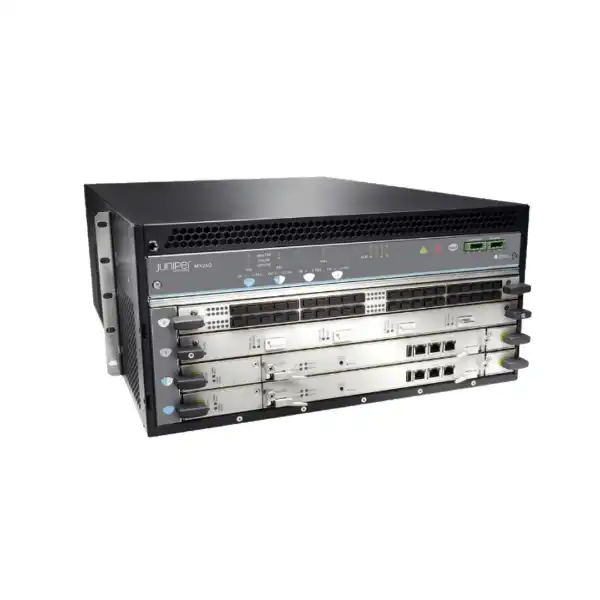
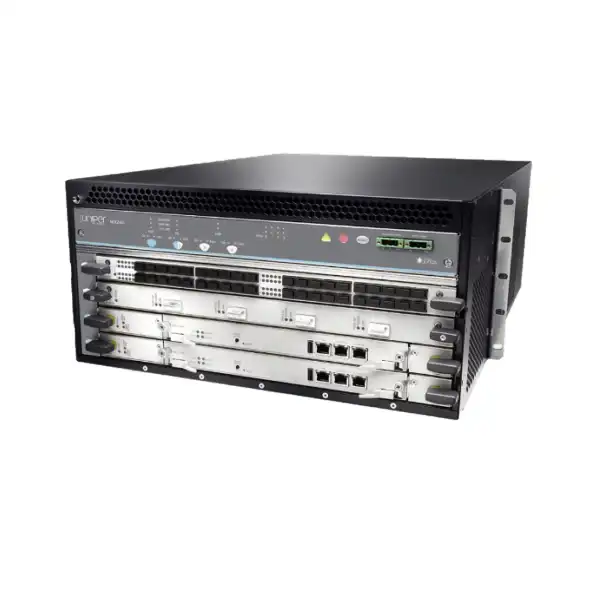
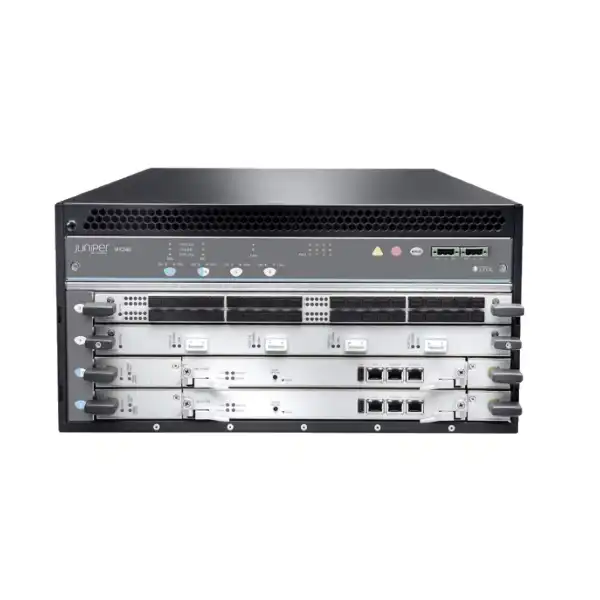
Juniper MX240 Universal Routing Platform in Dubai
A space-efficient 5 RU modular routing platform for organisations that need carrier-class routing, service edge scale, resilient control and flexible interface choices without committing to the larger MX480 or MX960 footprint. The important buying decision is not simply the chassis: the final capability depends on the exact Routing Engines, Switch Control Boards, MPCs, MICs where applicable, optics, power supplies, Junos software release, software entitlements and redundancy design selected for the deployment.
Direct answer: what is the Juniper MX240 and who should consider it?
The Juniper MX240 Universal Routing Platform is a modular member of the MX Series built for high-scale routing, switching and service-edge roles. Juniper currently positions it for service-provider and enterprise applications including business and residential multiservice edge, provider edge, broadband, mobile, data-centre, peering and other environments that benefit from high forwarding scale in a compact chassis. The platform is powered by Junos OS and uses Juniper Trio-based forwarding hardware through supported Modular Port Concentrators.
Its principal attraction is the combination of a 5 RU form factor and up to 3 Tbps of system capacity. In practical buying terms, this means the MX240 can suit a network that needs considerably more modularity, service depth and interface flexibility than a small branch or fixed appliance, while still avoiding the rack footprint of larger MX chassis. It should be considered by operators that need serious routing scale, resilient architecture, modular interfaces, traffic engineering, VPN services, broadband features, timing, telemetry or high-speed Ethernet in a platform designed for continuous network operation.
The single most important factor to confirm is the required hardware and software composition. An MX240 chassis by itself does not define port density, usable forwarding scale, encryption capability, subscriber scale, redundancy level or final licensing. Those depend on the installed MPC generation, control-plane components, transceivers, power arrangement, Junos release and relevant software licenses. A quotation therefore has to be built around the intended traffic profile and services rather than around the chassis name alone.
FourTeck can help determine whether MX240 is the correct chassis size, which supported line cards and optics match the required interfaces, how much redundancy is appropriate, what power and rack preparation is needed in the UAE site, and which licensing and support terms should be included in the bill of materials.
MX240 platform identity and where it fits in the MX family
The MX240 is best understood as a compact modular edge platform rather than as a conventional enterprise router with a fixed collection of Ethernet ports. Its chassis provides the physical foundation for control, switching fabric, forwarding hardware, cooling and power, while the installed modules determine much of the usable network personality. Juniper’s current MX material lists the MX240 at up to 3 Tbps of system capacity and up to 1.5 Tbps of switch-fabric capacity per forwarding slot. The chassis is commonly described as a three-slot design because of its physical slot arrangement, but current Juniper specifications identify two DPC/MPC forwarding positions; the control and switch-fabric subsystem occupies the remaining architectural space. This distinction matters when a buyer is translating a marketing statement into an actual line-card plan.
Within the traditional modular MX line, the MX240 sits below the MX480 and MX960 in chassis size and maximum system throughput. The MX480 is a larger 8 RU platform with higher aggregate capacity and more forwarding slots, while the MX960 occupies substantially more rack space but provides the greatest scale in that family. The MX240 is therefore compelling when the requirement is substantial service-edge capability but rack units, power density, deployment simplicity or site constraints make a larger chassis unattractive. Conversely, if the design needs many independent forwarding cards, very high interface density across numerous slots, or growth beyond the MX240’s aggregate system capacity, moving up the chassis family can be cleaner than engineering around a platform that is already close to its practical ceiling.
The comparison is not purely bigger versus smaller. Juniper also offers newer compact MX platforms such as the MX304, which can provide high capacity in a very small footprint using a different architecture and newer line-card format. That can make a newer compact platform attractive in greenfield high-speed Ethernet designs. The MX240 remains relevant when modular MX feature heritage, installed-base consistency, supported MPC choices, service requirements, operational familiarity or a particular migration path favour the established chassis architecture. Buyers should compare exact feature support, required interfaces, software release, scale and lifecycle rather than selecting solely from headline terabits.
Choose MX240 when
You need a modular, resilient MX edge chassis, up to 3 Tbps system scale, two forwarding-card positions, substantial 100GbE/400GbE possibilities with compatible hardware, and a 5 RU footprint that is easier to place than larger modular MX systems.
Evaluate a larger chassis when
The design needs more forwarding-card slots, higher aggregate capacity, denser service separation or a growth path that would consume most MX240 resources at launch. MX480 or MX960 may reduce future chassis expansion complexity.
Evaluate a newer compact MX when
A greenfield design prioritises the latest compact architecture, very high 100/400GbE density and minimal rack space. The correct decision depends on exact features, interfaces, resiliency and software compatibility rather than capacity alone.
Verified MX240 headline specifications
The following values reflect current Juniper published material for the MX240 platform. They are useful for early sizing, but they do not replace a configuration-specific check of the selected MPCs, optics, Routing Engines, Switch Control Boards, Junos version and feature licenses.
| Specification | Current published MX240 value | Why it matters to the buyer |
|---|---|---|
| System capacity | Up to 3 Tbps | Sets the chassis-level forwarding ceiling; usable design must still account for selected cards and traffic direction. |
| Per-slot switch fabric capacity | Up to 1.5 Tbps | Important when matching high-speed interfaces and line-card forwarding capability to the chassis fabric. |
| Forwarding-card positions | 2 DPCs and/or MPCs per chassis in current specification | Port density and service capacity must fit into two forwarding slots, so card selection is a central design task. |
| Rack height | Approximately 5 RU | Makes the platform attractive for sites that need modular resilience but cannot allocate the space of larger MX chassis. |
| Published dimensions | About 17.45 × 8.71 × 27.75 in including standard cable-manager depth reference | Depth and service clearance can be more important than rack-unit count when evaluating an existing cabinet. |
| Maximum published weight | Approximately 130 lb / 59 kg depending on configuration reference | Rack loading, lifting, installation method and cabinet stability should be planned before delivery. |
| Power options | AC and DC options; Juniper lists 100–240 VAC and -40 to -72 VDC ranges in current specifications | Exact power-supply bundle, feed design and redundancy depend on site voltage, load and selected modules. |
| Operating temperature reference | 0–40°C at 6,000 ft in current product specification | Data-room cooling and environmental monitoring matter in UAE deployments, especially where inlet temperatures can rise quickly after HVAC faults. |
| Humidity | 5–90% noncondensing | The equipment should be installed in controlled indoor conditions rather than exposed utility spaces or unconditioned rooms. |
Modular architecture: chassis, control plane, switch fabric and forwarding hardware
A useful way to size the MX240 is to separate the system into four purchasing layers: chassis and power, control plane, switch fabric, and forwarding/interface hardware. The chassis provides the physical enclosure, midplane, cooling and power distribution. Switch Control Boards connect the forwarding slots through the internal fabric and participate in system control. Routing Engines run the Junos control plane, execute routing protocols and management processes, and maintain the state needed for operation. MPCs provide packet forwarding and service functions, with interface presentation varying by MPC design and, on relevant generations, by installed Modular Interface Cards.
This modularity is one of the MX240’s strengths because a buyer can build the system around the actual network role. A provider-edge router carrying BGP, MPLS and EVPN does not necessarily require the same line-card mix as a broadband edge platform, a data-centre interconnect router or a multiservice aggregation node. The same chassis name can therefore describe markedly different systems. It is possible for two MX240 deployments to have different Ethernet speeds, port counts, software entitlements, control-plane resilience and power requirements even though both are correctly called MX240.
That modular flexibility also creates procurement risk if the bill of materials is incomplete. A chassis quotation that omits the intended Routing Engine generation, redundant control components, correct MPCs, optical transceivers, power supplies, cables or software licenses may appear attractive but will not represent a deployable design. Likewise, installing an older card because it physically fits is not sufficient evidence that the required feature, bandwidth or Junos release is supported. Juniper maintains hardware compatibility information and release-specific documentation precisely because support combinations evolve over the product lifecycle.
For a resilient design, control-plane architecture deserves explicit attention. Juniper documents support for redundant host subsystems when the system is fully configured with the appropriate Routing Engines and Switch Control Boards. A single control subsystem can be valid for a lab, noncritical role or cost-sensitive deployment, but it does not provide the same failure behaviour as a fully redundant production build. The desired availability target should be stated before the BOM is finalised so redundancy is designed, not added as an afterthought.
Forwarding hardware is equally decisive. Current Juniper MX literature describes Trio-based MPCs as the components responsible for routing, MPLS, switching, inline services, subscriber functions, hierarchical quality of service and telemetry capabilities, subject to the specific card and software support. The line-card generation chosen affects usable throughput, port combinations, feature scale and power draw. That is why FourTeck requests interface counts, speeds, service requirements and traffic expectations before locking the configuration.
Interface planning: 10GbE, 40GbE, 100GbE and 400GbE are configuration outcomes
Juniper’s current MX240 product information highlights support for high-speed Ethernet, including configurations that can reach up to six 400GbE interfaces or up to thirty 100GbE interfaces at the platform level with suitable supported hardware. These figures demonstrate the chassis potential, but they should not be interpreted as fixed ports built into every MX240. The actual interface count comes from the installed MPCs, supported breakout modes, optics, cabling and software combination.
An enterprise buyer connecting two data centres may need a small number of high-capacity 100GbE or 400GbE links plus lower-speed handoffs. A service provider may need substantially more 10GbE and 100GbE interfaces with precise QoS, MPLS and subscriber requirements. A peering deployment may care strongly about 100GbE density, route scale and telemetry, while a legacy multiservice network may need compatibility with an existing set of optical standards and operational processes. The MX240 can support a broad range of roles, but a sensible configuration begins with an interface matrix rather than with a generic maximum-density statement.
Speed and count
List every required access, uplink, core, peering and interconnect port by speed. Include planned breakout requirements and future ports, not only day-one active links.
Media and distance
Define whether each link is single-mode fibre, multimode fibre or direct-attach, and give the approximate reach. Optical power budget, connector type and counterpart compatibility can change the transceiver selection.
Encryption need
If MACsec is required, identify which links need it and at what aggregate bandwidth. Hardware support and relevant license entitlements must be checked against the exact card and software release.
Port growth
Reserve enough physical and forwarding headroom for the expected life of the chassis. Consuming both forwarding slots at launch can be reasonable, but it leaves future growth dependent on replacing cards rather than adding another card.
Peer compatibility
Confirm the optics and Ethernet mode at the far end. A theoretically supported port is not a complete link until wavelength, reach, FEC, breakout and interoperability requirements are aligned.
The most common quotation mistake in high-end routing is to treat optics as incidental accessories. They can represent a substantial portion of cost and they determine whether the planned physical links can actually come up. A proper MX240 BOM should therefore pair each required interface with the intended transceiver or cable family, supported reach and quantity, including sensible spares where service continuity justifies them.
Routing, MPLS, VPN and multiservice edge capabilities
The MX family is widely used because it combines high-speed forwarding with a broad service feature set under Junos OS. The MX240 can participate in sophisticated Layer 2 and Layer 3 network designs, including IP routing, MPLS-based services, VPNs, Ethernet services and service-edge architectures. Juniper’s product positioning specifically calls out Layer 2 and Layer 3 VPN services, broadband network gateway functions and integrated routing, switching and security use cases. The practical capability available in a particular deployment still depends on hardware, Junos release, scale targets and licensing.
For a provider-edge role, the buyer may need BGP for internet or customer routing, IS-IS or OSPF inside the provider core, MPLS label distribution and traffic engineering, EVPN for modern service delivery, L2 circuits, L3VPNs, fast failure detection and policy controls. The architecture should specify expected route counts, VRF counts, neighbour counts and convergence expectations. These values matter because a platform that has ample packet throughput can still be poorly matched if control-plane scale or service-table requirements exceed the selected hardware and software profile.
For business-edge and enterprise WAN roles, the MX240 can be attractive where the organisation wants carrier-style segmentation, deterministic routing policy, multi-homing and high interface capacity. It can sit at the edge of a large campus, data centre or private WAN and aggregate multiple upstreams while keeping services separated through routing instances and VPN technology. The selection should nevertheless be compared with smaller or newer MX options if the enterprise does not genuinely need the modular chassis, because operational complexity and capital cost should be justified by the service requirement.
For broadband and subscriber services, headline throughput is only one part of sizing. Subscriber scale, session behaviour, address management, QoS policies, lawful or operational requirements, redundancy and specific broadband feature licensing can all be relevant. Juniper publishes dedicated licensing options for wireline broadband feature packs in the MX ecosystem. Buyers planning BNG functions should provide projected subscriber counts, access architecture, session types, authentication design and growth assumptions rather than requesting a generic MX240 configuration.
The result is that MX240 is not a single-purpose router. Its value comes from combining forwarding scale with service depth. That flexibility is strongest when the intended role is documented precisely, because it allows line cards, licenses and resiliency to be matched to outcomes instead of being over-specified or under-specified.
MACsec, security services and encryption planning
Juniper currently highlights inline MACsec support on the MX240 for 10GbE, 40GbE and 100GbE interfaces with compatible hardware, and its licensing documentation identifies MACsec bandwidth licenses for MX240 and other MX platforms. For a buyer, the important interpretation is that encrypted links require an end-to-end design: the selected forwarding hardware must support the intended MACsec mode, the software release must support it, the license entitlement must be appropriate, and the peer device must also be configured compatibly.
MACsec can be useful for protecting Ethernet links between data centres, provider facilities or strategic network nodes where link-layer encryption is required without moving the security boundary to a separate appliance. It should not be added to a quotation merely because it appears in the feature list. The buyer should identify the number and speed of encrypted links, desired key-management approach, peer platform and operational ownership. That information allows the design to distinguish between links that need encryption and those that do not, which can materially affect the hardware and software bill.
The broader MX ecosystem also supports security service options, including IPsec capabilities with supported security processing hardware and licenses. These are configuration-specific and should be validated carefully before purchase. A requirement for large-scale IPsec, service chaining or integrated security processing can influence slot use and power, so it belongs in initial architecture discussions rather than in a late-stage accessory list.
FourTeck therefore treats security requirements as design inputs. State whether you need MACsec, IPsec, control-plane protection, encrypted inter-site transport, DDoS-related routing policy integration or another security function. The platform may be capable of the requested outcome, but the exact implementation must be mapped to current Juniper support rather than inferred from the MX240 name alone.
Junos OS, automation, telemetry and operations
The MX240 runs Junos OS, giving it the operational model used across Juniper routing platforms. This is significant for organisations that already operate Juniper because configuration conventions, routing policy concepts, monitoring practices and automation can be reused. Consistency does not remove the need for release planning, however. Hardware support, feature behaviour and recommended software trains vary over time, and a production deployment should use a release chosen for the installed cards, required services and support policy.
Automation becomes particularly valuable on an MX240 when the device carries many routing instances, policy objects, interfaces or customer services. Rather than treating the router as a box configured manually over a console, mature operations teams can integrate configuration management, telemetry and orchestration into the wider network workflow. Juniper positions the MX240 as SDN-enabled and references standards-based control integration, including its Paragon automation ecosystem. The right automation method depends on the customer’s existing NMS, source-of-truth model and change-control process.
Telemetry should be designed around operational questions. Useful signals can include interface utilisation, queue behaviour, errors, loss, delay, routing adjacency changes, control-plane health, temperature, fan status, power state and module alarms. Trio-based forwarding platforms expose rich operational data, but collecting everything without a retention and alerting strategy can overwhelm monitoring systems. Define which conditions must generate an incident, which trends inform capacity planning and which metrics are retained for post-event analysis.
Out-of-band management is another practical requirement. Production MX240 deployments should plan management addressing, secure administrative access, authentication, logging destinations, time synchronisation, configuration backup and emergency access. These are often small line items compared with the chassis cost, yet they directly affect how quickly an engineer can recover from an outage or diagnose a control-plane problem.
When migrating from an older router, operational parity is as important as feature parity. Existing scripts, SNMP polling, streaming telemetry, authentication methods, syslog parsing and change tooling should be reviewed against the target Junos release. A technically successful forwarding migration can still create operational pain if the monitoring and automation stack is left behind.
Software licensing: standard features, Flex tiers and bandwidth entitlements
Juniper’s current licensing documentation for MX Series routers supports both subscription and perpetual licensing models and defines Flex license structures for modular platforms including MX240. Enhanced capabilities are organised into tiers such as Advanced and Premium, while many standard software functions remain available without an enhanced tier. The presence of a feature in a license tier does not by itself guarantee that every MX240 hardware combination supports that feature; hardware and software compatibility still have to be checked.
For modular MX hardware, licensing can also relate to bandwidth associated with particular MPC families. Juniper publishes full-bandwidth and scale-on-demand structures for supported cards, as well as separate license identifiers for capabilities such as MACsec bandwidth. This makes the commercial configuration more nuanced than purchasing a chassis and assuming all installed forwarding capacity is automatically entitled in every scenario.
Feature tier
Identify which advanced routing, EVPN, scale, traffic-engineering, security or service functions are actually needed. Select a tier because of a requirement, not because the tier name sounds safer.
License term
Decide whether the organisation prefers subscription terms or perpetual licensing where available. Budgeting, asset policy and upgrade strategy can influence the better commercial model.
Bandwidth entitlement
Match supported MPC bandwidth and the required licensed throughput. A card’s physical capacity and the intended commercial entitlement should be treated as related but distinct BOM decisions.
Add-on services
MACsec, broadband feature packs and security processing can carry their own licensing considerations. These should be explicitly listed when the requirement depends on them.
A useful procurement practice is to create a feature-to-license worksheet. Each nonbasic requirement—such as EVPN scale, large L3VPN scale, broadband functions, encrypted links or security services—is mapped to the planned hardware and current Juniper entitlement. This avoids two opposite errors: buying expensive licensing that the deployment does not use, or discovering after installation that an important function requires an additional entitlement.
Licensing programmes change more frequently than chassis mechanics, so the exact SKUs should be confirmed at quotation time. The product page should guide the decision, but the purchase order needs the then-current Juniper license identifiers, term, quantity and support relationship appropriate to the selected configuration.
High availability: redundancy is a configuration, not a label
Juniper’s MX240 hardware documentation describes a fully configured router as capable of redundant power supplies, Routing Engines and Switch Control Boards, with redundancy in the cooling system as well. The critical phrase is fully configured. A chassis does not become fully redundant merely because the platform family supports redundancy. The required duplicate components must be included, installed and configured, and the power feeds must be arranged so a single upstream electrical failure does not defeat the intended design.
For control-plane redundancy, two host subsystems allow one Routing Engine and its associated switch-control function to act as primary while the other provides backup capability. The operational outcome depends on correct software configuration, compatible components and the services being run. Redundancy design should also consider planned maintenance: a system that can continue forwarding during a control-component replacement or software operation can reduce the number of maintenance events that require a total service outage.
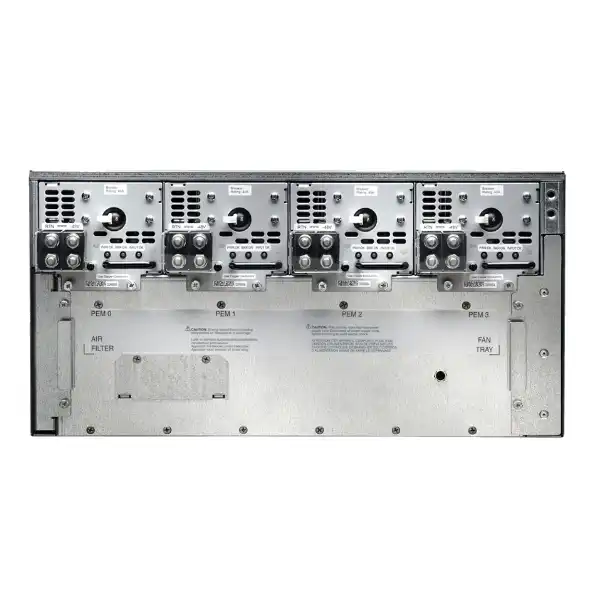
Power redundancy has additional detail. Juniper documents different supply counts and behaviour for high-line AC, low-line AC and DC arrangements. In a typical UAE data-centre environment using high-line AC, the relevant supply and feed design should be selected around the expected chassis load and redundancy target. Power budgeting must include the actual MPCs and control modules because line-card power can be a large share of the total. The correct question is not simply “Does MX240 support redundant power?” but “Can the selected power-supply configuration carry this exact system load after one supply or feed fails?”
Cooling redundancy also deserves attention. Juniper notes that the cooling system contains redundant components and can increase remaining fan speed after a fan failure. This protects against certain component failures, but it does not compensate for a badly ventilated cabinet or a failed room HVAC system. Airflow paths, rack doors, blanking panels, cable congestion and ambient temperature can all undermine a router that is otherwise internally healthy.
Finally, chassis redundancy should be separated from network redundancy. A highly redundant MX240 is still a single physical location. Critical services may require two routers, diverse power, separate racks or rooms, diverse fibres and routing protocols that can converge around an entire node failure. FourTeck can help distinguish component-level resilience from site- and network-level high availability so the design matches the business recovery requirement.
Power, cooling, rack depth and Dubai site preparation
A 5 RU chassis can look easy to place, but the MX240 is a substantial piece of infrastructure. Juniper publishes a chassis weight in the low-twenties kilograms before full population and a maximum configured weight around 59 kg depending on the reference. That affects lifting, rack strength, installation manpower and cabinet stability. The rack should be secured appropriately, and the selected mounting position must leave enough depth for the chassis, cable manager, fibre bends, power cords and service access.
Juniper’s site guidance calls for standard 19-inch rack accommodation and identifies important maintenance and airflow clearances. Its current documentation calls for at least 24 inches of working space in front of and behind the router for service activity, with a greater front clearance recommended in certain deployment standards. It also publishes side-clearance guidance for cooling and stresses that airflow must not be obstructed. A cabinet that technically has 5 RU available can still be unsuitable if it is too shallow, too congested or cannot provide the needed service clearance.
In Dubai and the wider UAE, environmental control should be treated as a core availability dependency. The published operating range assumes controlled conditions. Network rooms that experience air-conditioning interruptions, hot spots, blocked intake paths or recirculated exhaust can exceed safe inlet conditions quickly, particularly when dense line cards are installed. The facilities design should therefore include appropriate cooling capacity, temperature monitoring and a plan for HVAC failure notification. This is a site-engineering issue rather than a router feature.
Power planning should begin with the selected configuration. Juniper’s own examples show that individual MPCs and control components contribute materially to total output demand. The chassis base load is only a portion of the electrical picture. The BOM should identify the power-supply type, input voltage, number of supplies, desired redundancy and power cords. The facilities team should then confirm available feeds, breaker capacity, PDU connectors and whether A/B feeds are genuinely independent.
Grounding is another installation item that should not be deferred. Juniper’s site-preparation checklist includes planning the chassis grounding connection, checking external power distances, acquiring cables and connectors, verifying environmental factors and calculating fibre optical power budgets. These tasks are simple to overlook when procurement is driven by the logical network design, yet they determine whether the hardware can be installed cleanly on the planned date.
Sizing the MX240 for a real network
Sizing should begin with service demand and failure scenarios rather than with the largest published numbers. The 3 Tbps system capacity describes a maximum platform capability, but a production design needs to determine what traffic must be carried simultaneously, what happens during link or component failures, and how much growth should be absorbed without replacing the chassis. A router that runs at an acceptable average load can still be undersized if a failure forces traffic onto fewer links or if short bursts overwhelm a constrained queue.
Start with interface demand. Count each physical link, speed, media type and expected utilisation. Then identify oversubscription assumptions. If two 100GbE upstreams protect one another, the design must decide whether either single link is expected to carry the full traffic load after a failure. If multiple customer interfaces converge on a smaller set of core links, quantify the intended aggregation ratio. If 400GbE is being introduced, include expected migration from 100GbE and whether breakouts are part of the plan.
Next consider packet and service behaviour. Traffic made of very small packets can stress packet-processing resources differently from large bulk flows. Heavy QoS, large routing tables, many VPNs, substantial subscriber state, extensive filters or security services can change the practical sizing model. The exact platform limits for these functions should be checked against the selected MPC and Junos release rather than inferred from chassis throughput.
Control-plane scale should be documented independently. For BGP-heavy deployments, record expected IPv4 and IPv6 route counts, peer count, route-policy complexity and convergence expectations. For MPLS and EVPN networks, include instance, endpoint and label-scale requirements. For subscriber edge, define sessions and feature packs. These values make it possible to select the Routing Engine generation and software tier with evidence instead of preference.
Finally, reserve growth. A sensible headroom target depends on the organisation’s forecast confidence, procurement lead times and change windows. A network that can add capacity every quarter may run closer to its current limit than a remote or regulated site that can only be upgraded during a yearly outage. Because the MX240 has two forwarding-card positions, slot consumption is particularly important. If both are fully utilised on day one, future interface growth may require card replacement, link consolidation or another chassis.
FourTeck can turn this information into a sizing worksheet that maps traffic, ports, features and resilience to the selected MX240 hardware. The goal is not to maximise specification; it is to buy enough capacity and modularity for the expected life of the deployment without paying for hardware or licenses that have no credible use case.
Practical MX240 deployment scenarios
Provider edge
An ISP or carrier can use MX240 as a compact PE node where BGP, MPLS, L2/L3 VPNs, QoS and high-speed Ethernet are required but the site does not justify a larger chassis. The design should emphasise route and VPN scale, redundancy, uplink diversity, line-card selection and the operational consequence of using only two forwarding slots.
Internet peering
A network with multiple transit and exchange links may value MX routing policy, BGP scale and 100GbE/400GbE interface options. The architecture should quantify full-table requirements, peer counts, RPKI or routing-security workflow, telemetry, route-policy complexity and whether all external traffic can be carried after an uplink failure.
Data-centre edge / DCI
For data-centre edge or interconnect, the MX240 can aggregate large routed links, participate in EVPN/MPLS designs and support encrypted Ethernet where the selected hardware and licenses allow. Fibre reach, MACsec need, convergence, diverse paths and compatibility with the switching fabric on each side should be documented before ordering optics.
Business edge
Large enterprises, financial organisations and multi-site groups may use MX240 where they require many high-capacity WAN or partner links, strong segmentation, resilient routing and mature operational controls. A smaller platform may be more economical if traffic, port count and service scale remain modest, so the business case should reflect real capacity and resilience needs.
Broadband edge
For BNG use, subscriber counts, authentication, address assignment, hierarchical QoS, service profiles and license packs are central. A broadband design should be sized from projected session scale and failure behaviour, not just from aggregate Ethernet bandwidth.
Mobile and aggregation
The platform can serve transport and aggregation roles that need timing, MPLS, high availability and dense Ethernet. Confirm the exact timing interfaces, synchronisation requirements, service scale and resiliency model against current supported hardware and software before standardising the design.
Migration planning from an existing edge router
A successful migration to MX240 should preserve both traffic and operational behaviour. Begin by inventorying the current router: physical interfaces, VLANs, routing instances, BGP and IGP neighbours, MPLS services, QoS policies, filters, NAT or security dependencies, management addresses, AAA, logging, telemetry, timing, optical modules and cross-connects. This establishes the real migration scope and often reveals legacy functions that are no longer required.
Next classify configuration elements as direct equivalents, redesign candidates or unsupported legacy behaviour. A line-by-line configuration conversion is rarely the best architecture. Junos policy structure and service models may offer cleaner ways to implement the same intent, while some old platform-specific workarounds can be retired. The target should be functional equivalence where it matters and deliberate simplification where it does not.
Physical migration deserves a separate plan. Confirm rack position, power feeds, grounding, fibre lengths and patch-panel routes before the maintenance window. Label new transceivers and patch cords against a port schedule. If the old and new routers must run in parallel, ensure there is enough rack space and power for both during the transition. For high-speed links, verify optics on both ends in advance rather than discovering wavelength or FEC mismatches during cutover.
Routing migration should specify adjacency order and rollback criteria. For BGP, determine when sessions move, which routes are preferred during coexistence and how to prevent accidental transit. For MPLS or EVPN, confirm control-plane dependencies and service validation. For default-gateway or aggregation roles, test ARP/ND, LAG behaviour, MTU and VLAN tagging. The cutover checklist should include both protocol status and end-to-end application tests.
Operational handover completes the migration. Monitoring systems need the new device identity, interface map and alert thresholds. Backups and automation jobs should target the correct Junos device. Support contracts and serial-number records must be stored where the NOC can find them. Staff should know the emergency access method and rollback procedure. These tasks turn a technically working router into a maintainable production platform.
For critical migrations, staging the MX240 before site installation can reduce risk. The chassis can be assembled with the intended control and forwarding modules, upgraded to the target Junos release, baseline-configured and subjected to interface and protocol testing. This does not reproduce every production condition, but it catches many configuration, optics and compatibility issues before the change window begins.
Procurement: build a complete MX240 bill of materials
The MX240 should be quoted as a system. Juniper publishes multiple base bundles and power variants, and the correct bundle depends on the intended control plane, power source and redundancy. A professional quotation should make every major dependency visible so the buyer can compare like with like between proposals.
| BOM area | What must be specified |
|---|---|
| Chassis/base bundle | MX240 base variant appropriate to AC or DC power strategy and the planned control architecture. |
| Routing Engines | Supported RE generation, quantity, memory/storage profile where relevant, and whether redundant control is required. |
| Switch Control Boards | Compatible SCB generation and quantity aligned with forwarding capacity and redundancy requirements. |
| MPCs / interface modules | Exact supported card model, count, interface type, forwarding capacity, service features and power draw. |
| Optics and cables | Transceiver model, speed, reach, wavelength, connector type, breakout cables if used, patch cords and optional spares. |
| Power supplies | AC/DC supply type, quantity for the calculated load and redundancy, power cords and PDU compatibility. |
| Software licenses | Feature tier, bandwidth entitlement, term and add-ons such as MACsec, broadband or security functions where required. |
| Support | Required Juniper support level, coverage term, replacement expectations and local operational support scope. |
| Services | Staging, rack installation, migration, configuration, testing, documentation and handover if these are part of the project. |
The quotation should also make exclusions clear. If optics are customer-supplied, that should be stated. If the price includes one Routing Engine but the design discussion assumed two, the mismatch must be resolved before purchase. If support begins at shipment rather than commissioning, the buyer should understand the service-term impact. Clear commercial boundaries prevent the hardware from arriving with missing dependencies.
Availability and lead time can vary by module even when the chassis is obtainable. A project schedule should therefore be based on the longest-lead critical component, not just on the base unit. If a particular MPC or optic is constrained, FourTeck can help evaluate a supported alternative configuration while preserving the required interfaces and features.
MX240 versus nearby Juniper MX choices
A balanced selection process should test whether MX240 is truly the best fit. The following comparison uses current headline characteristics as a shortlist guide; detailed feature and hardware checks are still required for a final architecture.
| Platform | Headline position | When to consider it |
|---|---|---|
| MX240 | 5 RU modular chassis, up to 3 Tbps, two forwarding-card positions. | Best when established modular MX architecture, service depth, resilience and flexible MPC choices are valuable within a compact chassis. |
| MX304 | Newer compact 2 RU platform with up to 4.8 Tbps and LMIC architecture. | Worth evaluating for greenfield high-density 100/400GbE edge requirements where very small footprint and newer platform architecture are priorities. |
| MX480 | 8 RU modular chassis, up to 7.5 Tbps in current Juniper comparison material, six forwarding-card positions. | Use when more slots, higher aggregate capacity or broader line-card expansion justify the additional rack and power footprint. |
| MX960 | Large modular chassis, up to 12 Tbps in current Juniper comparison material, eleven forwarding-card positions. | Evaluate for major service-provider, core/edge or multiservice sites needing substantially more slots and aggregate scale than MX240 can provide. |
The MX304 comparison is particularly important because a newer compact platform can offer greater headline capacity in less rack space. MX240 can still be the better choice when a customer has an installed MX240/MX480/MX960 operational model, needs specific compatible MPC or service capabilities, values common sparing, or has a validated design based on the established chassis. Greenfield buyers should not assume that the older or newer form factor is automatically superior; the decision should be feature- and lifecycle-led.
The MX480 and MX960 comparisons are easier: they primarily expand modular scale. If a proposed MX240 would use both forwarding slots immediately and growth forecasts are strong, the larger chassis can offer a cleaner expansion path. If the deployment needs only a small number of high-capacity interfaces and rack space is constrained, the MX240 may provide the better balance.
Lifecycle, support and long-term operating considerations
A high-end routing platform is normally purchased for years of service, so lifecycle planning should be part of the initial decision. The MX240 has a long deployment history and a broad installed base, but individual modules and software releases have their own lifecycle status. A new project should confirm that every proposed Routing Engine, SCB, MPC, optic and license is appropriate for the intended support horizon.
Support coverage should match business criticality. A router carrying internet transit, customer VPNs or data-centre interconnect traffic may need rapid hardware replacement and access to vendor technical support. A lab or standby platform may justify a different service level. The support contract should be considered alongside the redundancy architecture: local spares, dual routers and vendor replacement commitments can all reduce restoration time, but they solve different failure scenarios.
Software lifecycle is equally important. Production networks should use a supported Junos release selected for stability, hardware compatibility and required features. Upgrade procedures need configuration backups, release-note review, maintenance planning and validation. In redundant deployments, the team should understand what forms of upgrade or switchover are supported for the chosen architecture rather than assuming every maintenance event can be hitless.
Spares strategy depends on the environment. Organisations with several MX240 systems may keep common optics, power supplies or critical modules on hand, while a single-site customer may rely more heavily on support replacement. The ideal mix is a business-continuity decision based on failure impact, lead time and cost, not simply on the price of the spare part.
Frequently asked buyer questions about Juniper MX240
Is the MX240 a 3 Tbps router in every configuration?
No. Three terabits per second is the current published maximum system capacity. Actual usable throughput depends on the installed forwarding cards, licensed bandwidth where applicable, interface mix and design. The BOM must be sized to the required traffic rather than assuming the chassis automatically provides the maximum figure.
How many MPCs can an MX240 use?
Juniper’s current platform specification lists two DPCs and/or MPCs per chassis. The physical architecture is often described as a three-slot chassis because the control/switch-fabric arrangement occupies part of the slot structure. Buyers should plan around two forwarding-card positions.
Does MX240 support 400GbE?
Current Juniper MX240 information identifies support for configurations scaling to six 400GbE interfaces with appropriate supported hardware. 400GbE is not a fixed chassis port; the exact MPC, optics, Junos release and feature requirements must be validated.
Can the MX240 be configured with redundant control?
Yes. Juniper documents redundant host subsystems using appropriate Routing Engines and Switch Control Boards. Complete resilience requires the redundant components to be included in the configuration, and network-level availability may still require a second router or site.
Does it support redundant power?
The platform supports redundant power configurations, but the exact number of supplies and failure behaviour depend on the AC high-line, AC low-line or DC arrangement and the system load. The power budget must be calculated for the selected modules.
Is MACsec included automatically?
No assumption should be made. Juniper supports MACsec on selected MX hardware and publishes specific MACsec bandwidth licensing. The intended interface speed, MPC, Junos release and entitlement should be confirmed for each encrypted-link requirement.
Can I buy only the chassis and add modules later?
A modular chassis can be expanded or changed over time, but a production router still needs a compatible set of control, switch-fabric, forwarding, power and software components. If future expansion is expected, the initial design should reserve slot, power and compatibility headroom rather than leaving those choices undefined.
What rack should be prepared?
Juniper specifies standard 19-inch rack compatibility and provides detailed depth, clearance and structural requirements. The 5 RU height alone is not enough to approve a cabinet; confirm depth, front/rear maintenance clearance, airflow, rack loading and cable space.
Which optics should I order?
Optics depend on line-card port type, Ethernet speed, fibre type, distance, wavelength, FEC and the far-end device. Provide a link schedule with distances and counterpart interfaces. That allows each transceiver to be selected deliberately instead of using a generic optic list.
Is MX240 suitable for enterprise use?
Yes when the enterprise needs the scale, modularity and service capabilities of a carrier-class edge platform—for example large internet edge, data-centre edge, WAN aggregation or high-capacity partner interconnect. It can be excessive for smaller networks where a compact fixed platform would meet all requirements more simply.
Should I compare MX240 with MX304?
For many greenfield projects, yes. MX304 is a newer compact platform with a different architecture and higher headline capacity in less rack space. MX240 may still be preferable for specific modular-MX compatibility, service needs, existing operations or validated designs. Compare exact requirements rather than only age or capacity.
What information produces an accurate Dubai quotation?
Provide required port speeds and quantities, optics distances, traffic and growth, routing/service features, redundancy target, power type, rack location, software-license preference, support term and whether staging, installation or migration services are needed. This prevents a chassis-only price from being mistaken for a complete deployable system.
Decision recap for MX240 buyers
The MX240 is a strong candidate when a network needs modular MX services and resilience in a compact 5 RU chassis, but the right purchase depends on much more than the chassis model. The following decisions should be settled before an order is placed.
What FourTeck needs for an accurate Juniper MX240 quotation
A short technical brief is usually enough to turn the platform into a concrete BOM. If some details are unknown, provide the business requirement and current-network information so the missing values can be determined during consultation.
Build the right Juniper MX240 configuration for your Dubai network
FourTeck can help you move from a product name to a complete deployment plan: chassis bundle, control-plane redundancy, MPC selection, 10/40/100/400GbE interfaces, optics, power supplies, Junos licensing, support coverage, rack readiness and migration services. Share your required ports, traffic, services and resilience target, and the quotation can be built around the network you actually need rather than a generic MX240 package.

Reviews
There are no reviews yet.