
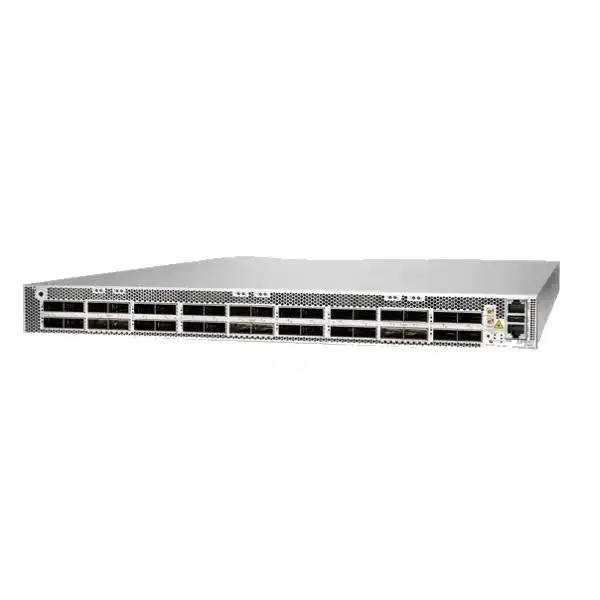
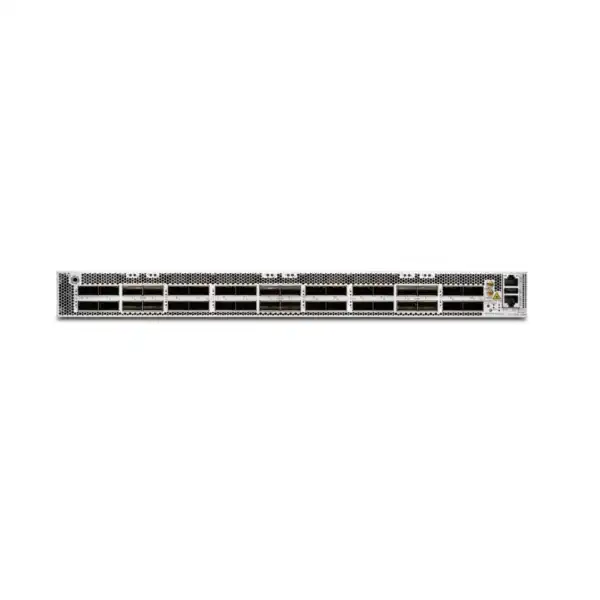
Juniper PTX10001-36MR Packet Transport Router in Dubai, UAE
A high-density 1U core and peering router for organisations that need a deliberate transition from 100GbE to 400GbE without moving immediately to a larger modular chassis. The PTX10001-36MR combines 24 QSFP56-DD ports, 12 QSFP28 ports, Junos OS Evolved, deep packet buffering and high-speed forwarding in a compact form factor.
Buyer signals at a glance
Exact usable interface density depends on port speed, breakout mode, optics, software release and the intended traffic profile.
Direct answer: what the PTX10001-36MR is and when it makes sense
The Juniper PTX10001-36MR is a fixed-configuration packet transport router designed primarily for high-capacity peering, core routing and infrastructure-edge positions in service-provider, cloud-provider and content-provider networks. It is not simply a 36-port Ethernet device. Its port architecture is built around 24 QSFP56-DD cages and 12 QSFP28 cages, with multi-rate operation that can be used to create different combinations of 10GbE, 25GbE, 40GbE, 100GbE, 200GbE and 400GbE connectivity depending on optics, breakout design and software support.
The platform should be considered by operators that require dense 100GbE and 400GbE in a 1U footprint, especially where rack space, power efficiency and migration from existing 100G links are central design constraints. It is also relevant to Internet exchange deployments, data-centre interconnect handoff points, remote core locations and embedded peering sites where a large modular chassis would be excessive.
The most important factor to confirm is not the headline 9.6 Tbps figure by itself. Buyers need to validate the intended port-speed mix, optics and breakout map, traffic distribution, power type, environmental limits, software release, feature requirements and redundancy model. Some maximum port-density figures assume breakout operation, and published documentation distinguishes between line-rate and oversubscribed 100GbE scenarios. A technically correct bill of materials therefore starts with the traffic and interface plan rather than with chassis quantity alone.
FourTeck can help a Dubai or UAE buyer turn those requirements into a quotation scope covering the exact hardware variant, compatible optics and cables, power feeds, rack preparation, Junos OS Evolved considerations, support coverage, migration services and installation requirements.
Why this model is distinctive
The PTX10001-36MR occupies a useful middle ground: it offers 400G-class density and a service-provider routing design in one rack unit, but without the slot-by-slot expansion model of a large chassis. That makes capacity planning more deterministic. The trade-off is equally clear: growth is achieved by adding additional fixed systems or moving to a larger PTX platform rather than inserting more line cards into the same chassis.
For buyers, that means the right question is whether the planned capacity envelope fits comfortably inside the fixed platform over the expected service life. If it does, the compact design can simplify space and power planning. If the architecture is likely to exceed 24 native 400GbE ports, require substantially larger packet buffers, or demand a different scaling model, a larger PTX option should be assessed at the design stage.
Where it is usually positioned
Juniper positions the PTX10001-36MR for peering, core routing and infrastructure-edge use. In practical network design, those roles can include high-capacity external BGP peering, aggregation of multiple 100G links into 400G core transport, compact core nodes at remote facilities, interconnection between metro or data-centre domains, and packet transport at sites where rack density is a decisive constraint.
It is less appropriate to treat it as a generic campus aggregation switch or to select it solely because a project needs many Ethernet ports. Its value comes from the combination of high-speed routing scale, packet processing, resilient hardware design, Junos OS Evolved operations and transport-oriented interfaces.
The main procurement risk
A router quote that lists only the chassis can be misleading. The production design usually depends on transceivers, fibre type and distance, breakout cables or adapters, power cords, rack accessories, software entitlement, support services, release compatibility and the exact topology. Coherent 400G optics can introduce additional thermal and software considerations that are different from ordinary short-reach or long-reach client optics.
For this platform, the optical bill of materials and port map are part of the architecture, not last-minute accessories. They should be designed at the same time as the chassis count.
PTX10001-36MR hardware and performance profile
The figures below describe the platform at a buyer-planning level. They are useful for shortlisting, but exact orderable SKU, software release, optics and environmental conditions should still be validated for the intended deployment.
| Specification | Published value | Buyer relevance |
|---|---|---|
| System capacity | 9.6 Tbps | Defines the fixed chassis throughput envelope; interface combinations still need traffic-engineering review. |
| Forwarding capacity | Up to 6 Bpps | Important for packet-rate-heavy workloads, not only large-packet bandwidth calculations. |
| Physical network cages | 24 QSFP56-DD + 12 QSFP28 | The two cage types have different default speeds and breakout possibilities. |
| Maximum port densities | 120 × 10GbE, 30 × 40GbE, 108 × 100GbE, 48 × 200GbE, 24 × 400GbE | Maximums are mode-dependent and can require breakout; they should not be read as simultaneous capacities. |
| Packet buffer | 24 GB | Useful for absorbing bursts, but traffic patterns and queue design still determine operational behaviour. |
| Form factor | 1U; approximately 17.3 × 1.75 × 25.5 in | Suited to space-constrained peering and core locations, subject to service clearances. |
| Maximum weight | About 39.7 lb / 18 kg | Relevant to rack loading and installation handling. |
| CPU / memory / storage | 2.1 GHz 12-core Intel CPU, 64 GB DRAM, 400 GB SSD total | Supports the control and management plane; feature scale should still be checked in the relevant software release. |
| Power architecture | Two 3000 W AC/HVDC or DC supplies, 1+1 redundancy | Power feed type, cable set, redundancy and site electrical design must match the selected orderable variant. |
Understanding the 36-port architecture and breakout choices
The physical front panel contains 36 network cages, but the useful design question is how those cages will be configured. Twenty-four are QSFP56-DD sockets and are configured as 400GbE ports by default. Twelve are QSFP28 sockets and are configured as 100GbE ports by default. The QSFP56-DD ports can support 10G, 25G, 40G, 100G and 400G rates, while the QSFP28 group supports 10G, 25G, 40G and 100G. That flexibility is one of the reasons the router is attractive for migration projects: a network does not have to move every adjacent device to 400G on day one.
However, maximum interface-density numbers are achieved through specific breakout combinations. Juniper publishes a platform maximum of 24 400GbE, 48 200GbE, 108 100GbE, 30 40GbE or 120 10GbE. These are separate planning ceilings, not capacities that can all be used at the same time. A 400G port can be broken into multiple lower-rate channels when the transceiver, cable, neighbouring equipment and Junos configuration support that mode. This lets operators reuse the same chassis while the surrounding network evolves, but it also makes the port map a formal engineering input.
400GbE design
Up to 24 native 400GbE interfaces are associated with the QSFP56-DD group. This is the cleanest way to view the platform for dense next-generation core or peering links.
100GbE migration
The platform can support large numbers of 100G interfaces through a mix of native QSFP28 and breakout from the double-density ports. Juniper distinguishes a 96-port line-rate scenario from a 108-port maximum oversubscribed scenario in its hardware documentation.
Lower-speed handoffs
10G, 25G and 40G remain possible through supported transceivers, adapters and breakout methods. That matters when a core upgrade must interoperate with older edge or peer equipment.
Port-level speed control
Current Junos OS Evolved guidance uses port-level speed configuration. Each physical interface should be mapped to its target optic and remote-side requirement before implementation.
A common design mistake is to start with a desired total bandwidth and then assume any mixture of ports can be enabled without restriction. On this router, the 36 cages are organised across three logical PICs, and the forwarding architecture has internal capacity rules that can matter when many ports are driven at their highest rates. Juniper describes the aggregate system as 9.6 Tbps and notes that some maximum 100G arrangements are oversubscribed. This does not make those configurations unusable; it means traffic engineering should reflect the actual east-west and north-south flows rather than assume every interface can simultaneously transmit at its nominal maximum without contention.
For a UAE deployment, a useful design worksheet should identify each physical port, intended speed, remote device, optic part number, fibre type, distance, breakout requirement, expected peak traffic, redundancy partner and future migration target. This simple discipline prevents a procurement list from mixing incompatible transceivers or using a breakout topology that cannot be supported by the far-end equipment.
The platform is therefore well suited to phased migration. An operator can connect existing 100G peers, introduce 400G uplinks where traffic and optical reach justify them, and use selected lower-speed breakouts for legacy interconnection. The design remains cleanest when breakout is used intentionally rather than as a way to postpone necessary architecture decisions indefinitely.
Routing scale, packet buffering and traffic behaviour
High-speed router selection should consider route scale and packet behaviour as well as port bandwidth. Juniper’s published material for the PTX10001-36MR cites up to four million IPv4 FIB entries, a 24 GB packet buffer and forwarding capacity up to 6 billion packets per second. Those figures help establish the class of deployment the device is intended to serve, particularly Internet core and peering environments where routing tables, convergence and bursts can be substantial.
The buffer should not be interpreted as a substitute for traffic engineering. Buffering helps absorb bursts and speed transitions, but the outcome depends on queue configuration, packet size distribution, interface oversubscription, congestion duration and service policy. A provider carrying many microbursts from data centres may need different queue and telemetry settings from a backbone carrying smoother long-haul flows. During design, traffic samples from the current platform can be more valuable than a theoretical average-utilisation figure.
The published maximum transmission unit guidance also deserves attention. Juniper documentation states that PTX10001-36MR WAN interfaces can support a maximum transit MTU of 16000 bytes, while traffic originating from or destined to the host has a lower limit. This distinction matters in MPLS, telemetry, control-plane and service environments where operators may use jumbo frames. An MTU plan should therefore cover the complete path and identify whether packets are transit traffic or must terminate on the router itself.
For BGP-heavy deployments, route-policy complexity, address families, convergence expectations and software release are part of sizing. The headline IPv4 FIB number does not automatically guarantee that every mix of IPv6, MPLS labels, services and control-plane features will scale to the same boundary. A production design should check the exact Junos OS Evolved release and feature scale required by the intended configuration.
MACsec and high-speed link security
The PTX10001-36MR includes inline MACsec capability across its network ports. This is valuable where operators need Layer 2 encryption on high-capacity Ethernet links without placing a separate encryption appliance in the path. Typical examples include protected inter-data-centre links, secure peering handoffs and regulated network segments where link confidentiality is required between trusted endpoints.
MACsec planning still requires more than confirming that the chassis supports the technology. The far-end device must support a compatible mode and key-management approach, and the software release must support the required operational feature set. Teams should also verify whether all necessary counters, telemetry, alarms and key rollover behaviour are available in the chosen release. Security policy may require separation of operational responsibilities between routing administrators and key-management personnel.
Encryption also changes troubleshooting practice. If a circuit experiences errors or flaps, engineers need visibility into the physical optic, Ethernet layer, MACsec state, routing adjacency and underlying optical path. Runbooks should make that layering explicit so that a cryptographic state problem is not misdiagnosed as an optical fault, or vice versa.
Ask whether encryption is required on every high-speed link, only selected inter-site links, or not at all. That decision affects software validation, peer compatibility, operational procedures and potentially the final licence/support scope.
Optics, breakouts and coherent 400G planning
Transceiver selection is one of the most consequential parts of a PTX10001-36MR project. The QSFP56-DD ports support multiple optic and cable families, including double-density transceivers, QSFP28-class optics, active optical cables, direct-attach copper and breakout assemblies where supported. The QSFP28 ports support their own range of transceivers and cabling. Compatibility should be verified against the current Juniper Hardware Compatibility Tool for the exact router variant and Junos release.
Distance alone is not enough to choose an optic. The design should account for fibre type, connector type, patch-panel losses, expected optical budget, forward-error-correction requirements, remote-side transceiver support, wavelength plan, environmental temperature and whether the link runs through passive optical infrastructure or an active DWDM system. For breakout applications, the far-end port must support the same lane mapping and speed combination.
Short-reach and data-centre links
For links within the same facility, the choice may involve DAC, AOC or short-reach optics. Cable routing, rack distance, patching practice and operational preference determine whether a passive copper or optical solution is more suitable.
Campus or metro fibre
Single-mode client optics may be appropriate when the optical budget and distance fit a standard Ethernet reach. Existing fibre cleanliness, connector loss and patch-panel count should be measured rather than assumed.
Coherent 400G transport
Supported 400ZR and related coherent options can simplify point-to-point DWDM designs, but wavelength, optical power, amplification, line system compatibility and software support become part of the router design.
Juniper software documentation specifically includes support for 400G ZR-family optics on the PTX10001-36MR in selected Junos OS Evolved releases, with later releases adding additional control and application options. This can be strategically important for operators that want to collapse packet and transport layers for suitable point-to-point links. It does not mean every dark-fibre path should automatically use coherent pluggables. A long or heavily engineered optical path may still require a dedicated optical line system, amplifiers, dispersion planning or provider-managed wavelengths.
Thermal restrictions also need attention. Juniper documents specific combinations of some 400G transceivers that have reduced supported temperature and altitude limits when placed in adjacent ports. In Dubai and the wider UAE, data-centre ambient temperature is normally controlled, but that does not eliminate the need to validate thermal conditions. Hot-aisle containment, rack inlet temperature, fan health, neighbouring equipment exhaust and any transient cooling event can affect available margin.
For this reason, optics should be listed by exact part number in the quotation. A generic line such as “400G optic” is insufficient for a production bill of materials. The quotation should state quantity, reach, connector type, fibre expectation, breakout requirement if any, and whether optical patch leads are included. Where coherent optics are used, the optical engineering responsibility should also be clear: the buyer, carrier, FourTeck, or another transport specialist may own different parts of the path.
A well-designed optic plan can also reduce migration risk. For example, a network may start with native 100G on existing links, reserve a subset of QSFP56-DD ports for 400G growth, and move high-volume peers first. This preserves investment while preventing the router from becoming fragmented by unplanned breakout use.
Junos OS Evolved, management and operational fit
The PTX10001-36MR runs Junos OS Evolved. For an organisation already operating Juniper routing, that provides familiar CLI concepts while using the newer Evolved software architecture. Juniper describes the platform as manageable through the CLI and through its automation and routing-management tools. The operational advantage depends on how well those capabilities fit the buyer’s existing network-management model.
Software release selection should be a formal deployment decision. A router may support the chassis and basic interfaces on one release while a specific optic, telemetry sensor, MPLS function or security enhancement requires a later version. Conversely, an operator may have an established long-lived release standard that prioritises stability and support policy over the newest feature. The correct release is therefore the one that satisfies required functions, optical support, security policy and vendor support lifecycle, not simply the newest image available.
Change management should include lab or staged validation when the router will carry critical core traffic. Configurations can be generated from templates, but the migration plan should verify routing adjacencies, policy behaviour, MTU, BFD timers, label stacks, QoS treatment, MACsec where used, telemetry exports and alarm integration. Operators should also confirm how configuration backups, software images and rollback procedures are handled in their management environment.
CLI and configuration discipline
Existing Junos-skilled teams can reuse familiar operational approaches, but should still review Evolved-specific software installation, release notes and platform feature support.
Automation and telemetry
Modern monitoring can use streaming telemetry and open models where supported. Sensor availability is release-dependent, so the observability design should be tested before cutover.
Routing and transport integration
The platform is intended for IP/MPLS and high-speed transport roles. The exact feature set required by the architecture should be checked in Juniper Feature Explorer for the selected release.
A buyer replacing equipment from another vendor should budget for more than syntax conversion. Routing policy semantics, default behaviours, monitoring identifiers, interface naming and operational workflows may all differ. A migration is most successful when the team translates the intended network behaviour, then expresses that behaviour cleanly in Junos, rather than copying line-by-line configuration from a different operating system.
Power, cooling and environmental planning for Dubai sites
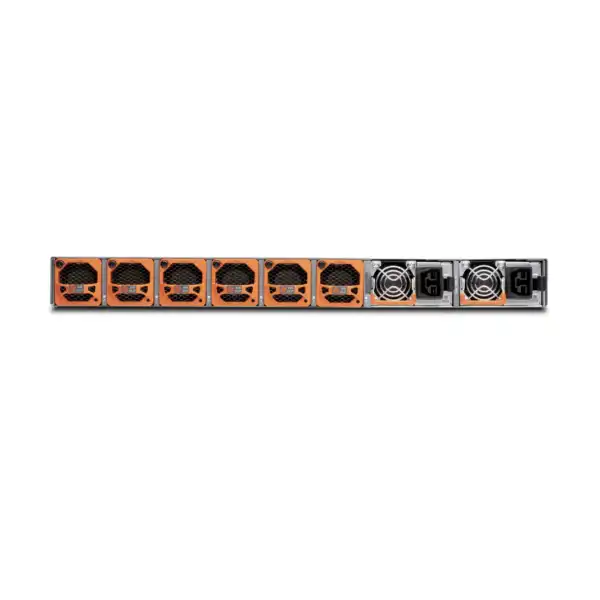
The PTX10001-36MR uses two 3000 W power supplies in a 1+1 redundant design. Orderable configurations include AC/HVDC and DC variants. Juniper publishes a maximum power figure of 2164 W and typical consumption around 1300 W in its fixed-platform datasheet, while hardware tools also provide operating data by power type. Those figures are planning references, not a substitute for site-specific electrical engineering.
For an AC deployment, Juniper documents an AC input range of 200–277 VAC. DC designs use a different input range and cabling. The chosen variant must match the facility power architecture, PDU connectors, redundancy arrangement and local electrical practice. Power supply redundancy only protects against a supply failure if the feeds themselves are independent enough to avoid a common upstream failure. A serious core deployment should identify which PDU, breaker and upstream source powers each supply.
Cooling is front-to-back, with six field-replaceable fan modules plus fans in the power supplies. This airflow direction needs to match the data-centre aisle design. If the router is installed backwards relative to neighbouring equipment, hot exhaust can be drawn into another device’s intake or into the PTX itself. Rack elevation drawings should therefore show both the physical U position and airflow direction.
Juniper hardware documentation lists normal environmental conditions around 0°C to 40°C and 5% to 90% relative humidity for the hardware tool, while a product specifications page publishes a broader upper temperature value. Because published limits can vary by document, software generation, optic population or qualification basis, FourTeck recommends validating the exact selected SKU and optical configuration against current Juniper hardware guidance at quotation time. This is especially important for coherent optics that may carry tighter thermal restrictions in specific adjacent-port combinations.
Dubai facilities are typically well controlled, but ambient outdoor climate still matters indirectly because cooling plant failures can raise room temperature rapidly. For a router carrying core traffic, monitoring should include inlet temperature, fan status, power-supply state and environmental alarms. Capacity planning for the room should use the router’s heat-dissipation figures together with neighbouring equipment, not just its electrical nameplate.
Grounding is also a design requirement. Juniper specifies chassis grounding provisions and installation in a restricted-access location. The rack, earth connection, cable lug, conductor size and local electrical code must be handled by qualified personnel. These are not cosmetic installation details: grounding and surge control affect safety, electromagnetic compatibility and service reliability.
Rack installation, cabling and service clearance
Although the chassis is only 1U high, installation should not be reduced to “find one free rack unit.” Juniper supports two-post and four-post rack mounting when the rack meets the required mechanical standards. The chassis depth, cable bend radius, front-to-back airflow and rear access all influence the chosen location.
Juniper’s site guidance calls for substantial working clearance in front of and behind the router for installation and maintenance. A dense rack can technically have enough U-space while still being unsuitable if fibre bundles, vertical PDUs or adjacent equipment prevent access to fan modules and power supplies. The rack survey should confirm usable depth, rail compatibility, cable managers, PDU location, grounding, airflow and clearance before delivery.
Fibre routing should protect connector cleanliness and maintain bend radius. High-density breakout designs can increase cable count quickly, so it is useful to reserve patch-panel capacity and label each lane consistently. A naming scheme that maps physical router port, breakout lane, patch-panel position and far-end device reduces troubleshooting time after cutover.
The front panel also includes out-of-band management, console access, USB and timing-related connectors. Those ports should be included in the installation drawing rather than treated as incidental. A separate management network is especially valuable for a core router because it provides access during routing failures. Console-server connectivity can provide another recovery path when IP management is unavailable.
Installation acceptance should include power redundancy checks, fan and alarm verification, management access, software version confirmation, optic diagnostics, interface error counters, routing-neighbour state, MTU testing and traffic validation. A physical installation is complete only when the router can be safely operated, monitored and recovered under fault conditions.
Hardware resiliency and field maintenance
The PTX10001-36MR is a fixed router, but it still includes serviceable components and hardware redundancy. The two power supplies are hot-removable and hot-insertable, and the fan modules are field-replaceable. Juniper’s hardware design is intended to allow replacement of these components without taking the routing function down when redundancy conditions are satisfied.
That capability does not eliminate operational procedure. Juniper documents specific time and fan-count constraints during fan replacement. Maintenance teams should therefore follow current hardware instructions rather than assuming any number of fans can be removed at once. Spare strategy should include the correct airflow fan model and the correct power-supply type for the installed variant.
True service resilience also extends beyond the chassis. A single fixed router is still a single network node. Where the service-level objective requires protection from full-node failure, software fault, fibre cut or maintenance event, the architecture should use dual routers, diverse paths and appropriate routing convergence. Chassis component redundancy and network-level redundancy solve different problems.
For critical UAE deployments, a practical support plan should define vendor support level, local spare availability, replacement logistics, escalation ownership and the maintenance window process. Hardware capability is most valuable when the organisation can obtain the right replacement part and qualified support quickly.
Use cases where the PTX10001-36MR can be a strong fit
Internet peering edge
An operator with several large peers can use native 100G and 400G connectivity in a compact footprint. The platform’s route scale, packet processing and MACsec options are relevant to peering, but the final design should verify BGP policy scale, route families, optics and traffic balance.
Regional core node
A 1U fixed system can suit a remote or embedded core site where rack space is expensive and traffic fits the 9.6 Tbps envelope. Dual-router architecture can provide node diversity while retaining relatively modest rack consumption.
100G-to-400G migration
The mixed QSFP28 and QSFP56-DD architecture provides a practical bridge between established 100G links and new 400G uplinks. Migration can be staged by traffic priority, peer capability and optical reach.
Cloud or content backbone
High packet rates, dense interfaces and automation support can fit private backbone designs. Capacity modelling should use actual flow patterns, especially when multiple high-speed links converge on a fixed system.
Data-centre interconnect packet layer
For appropriate distances, standard or coherent 400G optics can connect facilities at the packet layer. Optical engineering must confirm reach, loss budget and any line-system dependency.
Space-constrained exchange site
The 1U footprint is attractive where colocation rack units are limited. Power, airflow and service clearance still need to be reserved; compact height does not remove the facility requirements of a 400G-class router.
When this model is likely to fit
- The required throughput fits comfortably inside a 9.6 Tbps fixed system.
- The design needs dense 100G and/or up to 24 native 400G interfaces.
- Rack space is limited and a 1U system is operationally attractive.
- The network team is comfortable operating Junos OS Evolved or plans to build that capability.
- The topology can scale by adding fixed routers or by moving later to a larger platform.
- Optics, power and environmental conditions can be engineered to match the platform.
When another option should be evaluated
- Growth is likely to exceed the fixed capacity or native 400G port ceiling within the planning horizon.
- The architecture requires a larger packet buffer or a modular expansion model.
- The project needs a feature that is not supported on the required Junos OS Evolved release.
- A different airflow, power architecture or environmental rating is required.
- The buyer expects chassis-level line-card expansion rather than node-level scale-out.
- The application is ordinary enterprise access or campus switching where a PTX-class router would be unnecessary.
Comparing nearby Juniper PTX choices
A balanced shortlist should compare the PTX10001-36MR with alternatives based on capacity, buffer, interface density, rack space, security requirements and growth strategy. Two comparisons are particularly relevant: the larger PTX10003 fixed platform and the newer PTX10001-36MR-K hardware identity.
| Decision area | PTX10001-36MR | PTX10003 family | PTX10001-36MR-K |
|---|---|---|---|
| Form factor | 1U fixed | 3U fixed | 1U fixed |
| Published throughput | 9.6 Tbps | Models published at 8 Tbps and 16 Tbps | Same hardware/software capabilities as PTX10001-36MR per Juniper overview |
| 400GbE density | Up to 24 | Published up to 16 or 32 depending on model | Equivalent platform capability |
| Packet buffer | 24 GB | Published 64 GB or 128 GB depending on model | Equivalent to base 36MR platform |
| Identity/security distinction | Original 36MR platform | Different platform class | Juniper states the K SKU adds embedded digital cryptographic identity in TPM 2.0 for functions including secure zero-touch provisioning and filesystem encryption |
The larger PTX10003 should not automatically be considered “better.” It consumes more rack space and may provide capacity or buffer characteristics the project does not need. Conversely, the PTX10001-36MR should not be selected solely for compactness if projected growth means multiple units will quickly be required. Total rack, power, optics and operational cost over the planning horizon provide a better comparison than chassis price alone.
Migration planning: from existing 100G core to PTX10001-36MR
A migration should begin with the current network state rather than the new chassis. Document existing routers, software versions, routing adjacencies, policy sets, interface utilisation, optical reaches, MTUs, QoS policies, failure domains, maintenance windows and monitoring dependencies. This creates the reference against which the PTX design can be validated.
Next, classify links by migration path. Some 100G circuits may remain 100G for years because the far-end router or carrier handoff does not justify an upgrade. Others may be immediate 400G candidates because they already run near capacity. A third group may be better consolidated through breakout or redesign. Mapping those categories to the 24 QSFP56-DD and 12 QSFP28 cages produces a realistic port plan and preserves enough high-speed ports for growth.
Routing migration should focus on policy equivalence and convergence. For BGP peers, verify address families, authentication, maximum-prefix controls, community handling, import/export logic, graceful restart or non-stop behaviour where applicable, and expected failover timers. For MPLS environments, validate label depth, traffic-engineering requirements, MTU and OAM. If MACsec is introduced during the migration, test key establishment and failure behaviour separately before combining it with a major routing cutover.
Operational tools must move with the service. Add the router to monitoring, telemetry, configuration backup, AAA, logging, NTP or timing infrastructure, inventory and support systems before it becomes a production dependency. Alarm thresholds should be tuned for high-speed interfaces; a small percentage of errors on a 400G link can still represent significant traffic loss.
A staged cutover is generally easier to troubleshoot than moving every peer at once. Start with non-critical or lower-volume links, confirm routing and optics, then progress to more important connections. For redundant architectures, one side can often be migrated while the existing peer path remains available. The exact sequence depends on topology, but every stage should have measurable success criteria and a rollback point.
A practical seven-stage implementation journey
- Discovery: capture traffic, routes, ports, optics, services, dependencies and failure requirements.
- Design: define chassis count, port map, power variant, optics, software release, features and redundancy.
- Site readiness: validate rack, cooling, grounding, power feeds, management connectivity and fibre paths.
- Build: rack, power, upgrade software if required, apply base configuration and integrate management.
- Validation: test optics, MTU, routing, QoS, telemetry, security and failover in a controlled state.
- Migration: move traffic in planned stages with rollback checkpoints.
- Acceptance: compare post-cutover counters, utilisation, latency, alarms and route state against the agreed baseline.
The final implementation document should remain with the operations team. A high-capacity core router is not a one-time installation; it will be upgraded, monitored, expanded and maintained for years. Clear records of port mappings, optics, power feeds and design assumptions reduce future change risk.
Licensing, software entitlement, support and quotation scope
Juniper’s ordering material includes software right-to-use entries for PTX fixed platforms, and the exact software tier or entitlement required can depend on the features being deployed. Buyers should not assume that every advanced routing, automation or security capability is automatically included in the base chassis purchase. The correct approach is to map required features to the current Juniper licensing and support model at the time of quotation.
Support coverage is equally important. A production core router may justify a faster replacement and escalation service than lab or non-critical equipment. The support level should match business impact, available redundancy and local spares. If the architecture uses two routers with sufficient capacity to carry traffic after a single-node failure, the organisation may choose a different spare strategy from a site where one router is a critical bottleneck.
A complete quotation can therefore include several layers: the exact PTX10001-36MR hardware variant, power supplies and fans as included by the SKU, Juniper-supported optics, breakout assemblies, power cords, rack accessories where required, software entitlement, Juniper Care or other support, implementation services, migration assistance and post-installation validation. Not every buyer needs every layer, but omitting a required layer can produce a low initial quote that does not represent the deployable system.
FourTeck can structure the commercial scope around the technical design. If the buyer already has an approved optic standard, support contract or installation team, those items can be separated. If the requirement is a turnkey migration, the quote can include design verification, rack installation, configuration, cutover and acceptance tasks.
Frequently asked buyer questions
Is the PTX10001-36MR really a 9.6 Tbps router?
Yes. Juniper publishes 9.6 Tbps as the system capacity. Buyers should still distinguish system capacity from the sum of nominal front-panel rates. The physical WAN-side combinations can exceed the system figure in some breakout scenarios, and Juniper documentation distinguishes line-rate and oversubscribed 100G arrangements. Capacity planning should therefore model how traffic actually crosses the system rather than adding port labels alone.
How many 400G ports does it support?
The platform provides 24 QSFP56-DD cages that can operate as 400GbE interfaces, giving a published maximum of 24 400GbE ports. The remaining 12 physical network cages are QSFP28 and are oriented to 100G and lower rates. Exact optics, software support and thermal restrictions must be validated for the selected 400G transceiver.
Can the 400G ports be used for 100G?
Yes, the QSFP56-DD group is multi-rate and can support lower speeds with supported transceivers or breakout designs. That flexibility is useful during 100G-to-400G migrations. The exact method depends on optic type, adapter or breakout cable, lane mapping and far-end support. A port-by-port bill of materials is preferable to buying a generic pool of transceivers.
Does it support 200GbE?
Juniper publishes a maximum 200GbE density of 48 interfaces for the platform. Because the chassis has 36 physical network cages, that density necessarily depends on supported breakout or channelisation behaviour rather than 48 separate physical cages. Confirm the intended 200G optic and breakout scheme against current compatibility data.
Is MACsec available at 400G?
Yes. Juniper describes integrated MACsec support for the high-speed interfaces and states that the PTX10001-36MR supports MACsec across ports regardless of port speed. The operational design still needs compatible peer equipment, the required software feature support and a key-management approach.
Can it use 400ZR coherent optics?
Juniper documents support for 400ZR-family coherent optics in selected Junos OS Evolved releases, with later releases adding enhancements. Coherent operation should be treated as an optical-engineering project as well as a router feature. Fibre loss, wavelength plan, target power, line-system behaviour and remote transceiver compatibility all matter.
What is the difference between PTX10001-36MR and PTX10001-36MR-K?
Juniper introduced the PTX10001-36MR-K beginning with Junos OS Evolved 24.2R1 documentation. Juniper states that the K model has the same hardware and software capabilities as the base 36MR but adds a digital cryptographic identity embedded in TPM 2.0, enabling security functions including secure zero-touch provisioning and filesystem encryption. Buyers with a new procurement should ask which exact SKU is being quoted and why.
What power supply does the router use?
The router uses two 3000 W supplies in a 1+1 redundant architecture. Juniper offers AC/HVDC and DC orderable variants. The facility must provide the appropriate feeds, cords or DC cabling, grounding and redundancy arrangement. Power supply redundancy does not protect against an upstream PDU or circuit failure if both supplies share the same source.
How much power should a data centre reserve?
Juniper’s datasheet publishes maximum draw around 2164 W and typical draw around 1300 W, while the power supplies themselves are rated at 3000 W each for redundant operation. Facility planning should use the vendor’s current electrical guidance for the selected variant and apply the site’s engineering rules for breaker, PDU and thermal capacity. Optic population and operating conditions can also influence actual consumption.
What airflow direction does it use?
The PTX10001-36MR uses front-to-back airflow: cool air enters through the port-panel side and hot air exits through the fan and power-supply side. Rack orientation should align with the facility’s cold-aisle and hot-aisle design. Matching airflow is particularly important in dense racks with other high-power equipment.
Are the fans and power supplies hot-swappable?
Juniper documents the fan modules and power supplies as hot-removable and hot-insertable field-replaceable units. Maintenance procedures still need to follow Juniper’s timing and redundancy guidance. Removing multiple cooling components outside those limits can force a shutdown, so field staff should use the current hardware manual during service.
Can the router replace a modular core chassis?
Sometimes, but the decision depends on scale and growth model. If the required bandwidth, buffer and ports fit comfortably inside the 1U system, fixed routers can simplify space and deployment. If the network expects continual in-chassis expansion, much higher total 400G density or larger buffers, a bigger fixed or modular PTX architecture may be more suitable.
Is 24 GB of buffer enough?
There is no universal answer. Buffer requirements depend on burst size, traffic asymmetry, speed transitions, queue policy and service objectives. The 24 GB figure places the platform in a high-capacity transport class, but applications with extreme incast or longer congestion windows may benefit from comparing platforms with larger buffers. Traffic measurements from the existing network are the best sizing input.
What software version should be ordered?
The correct Junos OS Evolved release is determined by required optics, features, support policy and operational standard. Newer releases can add support for particular coherent optics, telemetry sensors or routing functions, but production networks may prefer a validated release train. The feature matrix should be checked before hardware shipment so that software is not discovered as a blocker during installation.
Does it support streaming telemetry?
Junos OS Evolved provides telemetry capabilities, and Juniper release notes show PTX10001-36MR support for multiple telemetry sensors and open-model updates across releases. The exact sensor set should be matched to the monitoring platform. A proof-of-concept can confirm counter names, collection intervals and dashboard expectations before production cutover.
What should be tested before traffic migration?
At minimum, test power redundancy, management reachability, software version, optics and light levels, interface errors, MTU, routing adjacencies, policy behaviour, QoS, BFD or equivalent failure detection, MACsec where used, telemetry, logging and failover. For a dual-router design, simulate loss of one node or path and confirm that the surviving infrastructure carries the expected load.
Can FourTeck supply only the router chassis?
A chassis-only commercial scope can be prepared when the buyer already owns compatible optics, support and deployment resources. The important point is to verify compatibility first. If the buyer needs a production-ready system, it is usually safer to quote the exact optics, power and support components together with the router so that the bill of materials represents the intended topology.
What information is needed for an accurate Dubai quotation?
Useful inputs include quantity, required chassis variant, current and future interface speeds, optic reaches, fibre type, breakout requirements, estimated traffic, software features, power type, deployment site, rack availability, redundancy approach, support SLA and whether installation or migration is required. Even a partial design is enough to start, but uncertainty should be visible in the quotation rather than hidden in generic part lines.
Decision recap for a PTX10001-36MR purchase
What FourTeck needs from the buyer for an accurate quotation
You do not need to have every answer before requesting a quote. The items below are the most useful inputs because they determine the correct chassis variant, optics and implementation scope.
Single router, redundant pair, multi-site rollout or spare requirement.
Required 10G, 25G, 40G, 100G, 200G and 400G links, including future growth.
In-rack, room, campus, metro, long-reach or coherent DWDM requirements.
AC/HVDC or DC, PDU details and desired feed diversity.
BGP, MPLS, traffic engineering, MACsec, telemetry, timing and automation needs.
Supply only, rack-and-stack, configuration, migration, cutover or managed implementation.
Target Juniper support level, replacement SLA and local spare strategy.
Dubai/UAE location, rack space, cooling, grounding, fibre paths and maintenance windows.
Plan the Juniper PTX10001-36MR around your real traffic, optics and site
The PTX10001-36MR is most valuable when its compact 1U design, 9.6 Tbps capacity and mixed 100G/400G interface architecture align with a clear network plan. FourTeck can help translate your port map, fibre distances, redundancy requirements, software features and UAE site conditions into a deployable bill of materials rather than a chassis-only estimate.

Reviews
There are no reviews yet.