
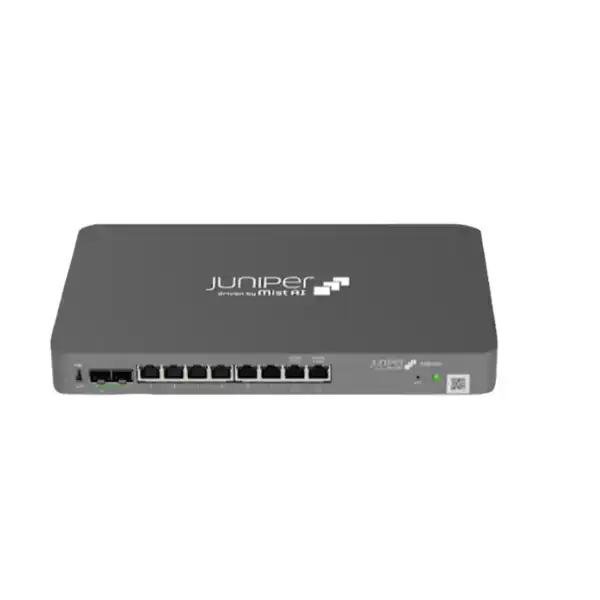
Juniper SSR440 Session Smart Router Dubai
A medium-branch Session Smart Router for organizations that want application-aware SD-WAN, service-centric routing, integrated security functions, and centralized operational visibility without relying on a conventional tunnel-heavy branch design.
Direct answer for buyers evaluating the SSR440
What exactly is it? The Juniper SSR440 is a fixed-configuration hardware appliance that runs Juniper Session Smart Router software and is positioned for medium-sized branch locations. It is part of the SSR400 line used as hardware for Juniper AI-native SD-WAN.
What is it mainly used for? It is primarily used as a secure branch WAN edge where the organization wants policy-aware routing, application-informed path selection, segmentation, stateful firewalling, resilient multi-link connectivity, and centralized or conductor-based management.
Who should consider it? Medium branches with Internet, MPLS, leased-line, or mixed WAN circuits should evaluate it when their expected encrypted traffic fits the 300–500 Mbps platform range and when its 1GbE interface mix is appropriate for local LAN and WAN connectivity.
What is the most important factor to confirm? Do not select the SSR440 from port count alone. Confirm real encrypted traffic demand, required security services, cloud-management entitlements, resiliency expectations, optical requirements, and whether cellular or dual-power variants are needed.
What can FourTeck help determine? FourTeck can translate branch traffic, circuit design, port requirements, licensing goals, installation environment, migration constraints, and support expectations into a specific SSR440-family quotation for Dubai and the wider UAE.
Where the Juniper SSR440 fits in a branch architecture
The SSR440 is not simply a small Ethernet router with an SD-WAN label. Juniper positions the SSR400 family as the hardware foundation for its Session Smart networking approach, and the SSR440 specifically as the model intended for medium-sized branches. That positioning matters because a branch-edge decision affects much more than how many copper ports are available. It influences how WAN paths are selected, how application sessions are treated, how branch segmentation is enforced, how operations staff troubleshoot user experience, and how the site participates in a larger multi-branch fabric.
Session Smart Router software uses a service-centric model and Juniper Secure Vector Routing rather than depending on the traditional design assumption that every branch path must be represented as a permanent overlay tunnel. For a buyer, the practical value is not the terminology by itself. The decision point is whether the organization wants a branch edge that can identify services and applications, apply policy to individual session behavior, steer traffic according to path conditions and business intent, and export operational telemetry that can be consumed through Juniper management platforms. This can be particularly useful in distributed companies where each branch may combine primary Internet, backup Internet, private WAN, or other circuits and where the quality of a cloud application matters more than the simple up/down state of a link.
The base SSR440 is a compact, fanless appliance with an external AC power supply, ten onboard 1GbE network ports in total, and no integrated cellular radio. The ten ports consist of eight 1GbE BASE-T RJ-45 ports and two 1GbE SFP ports. Two of the copper ports provide PoE+ capability, with Juniper specifying 30 W per supported port and a 60 W maximum PoE budget. This gives the appliance enough local connectivity to support many conventional medium-branch designs without requiring every WAN handoff to be converted through another device, but the exact port mapping still needs to be planned before purchase.
A branch that needs integrated WCDMA/LTE/5G should not assume that capability is present in the base SSR440. The cellular functions are associated with the SSR440-C and SSR440-C-2AC variants. Likewise, buyers who require power-supply redundancy should compare the SSR440-2AC or SSR440-C-2AC models, because the standard SSR440 is specified with a single external AC supply. These variant distinctions are important procurement details: they affect resilience, installation, and the bill of materials, and they are easier to correct at quotation stage than after a deployment schedule has been committed.
Verified SSR440 hardware specifications
| Specification | Juniper SSR440 | Buyer relevance |
|---|---|---|
| Target deployment | Medium-sized branch | Use this as a family-position guide, then size against measured traffic and service requirements. |
| Encrypted throughput | 300–500 Mbps | The most important sizing number for branches carrying encrypted SD-WAN traffic. Real design should keep growth and feature load in mind. |
| Network ports | 10 x 1GbE total | Confirms the appliance is a 1GbE-edge platform rather than a multi-gigabit branch chassis. |
| Copper ports | 8 x 10/100/1000BASE-T RJ-45 | Useful for Ethernet WAN handoffs, LAN uplinks, management, or other routed roles according to the final configuration. |
| SFP ports | 2 x 1GbE SFP | Optics and fibre media requirements should be quoted separately and matched to Juniper compatibility guidance. |
| PoE+ | 2 ports, 30 W each; 60 W maximum total | Potentially useful for a small number of powered devices, but not a replacement for a branch access switch where many PoE endpoints exist. |
| Console | 1 x USB Type-C console | Important for local installation and recovery workflows. |
| USB storage port | 1 x USB 2.0 Type-C | Supports documented software or maintenance workflows using USB storage where required. |
| Dedicated HA port | 1 x 1GbE RJ-45 HA port | Relevant when designing paired-router high-availability topologies; HA design still requires configuration and topology planning. |
| Memory | 8 GB DDR4 | Platform resource specification, useful when comparing the family but not a substitute for supported throughput and software-scale guidance. |
| Cooling | Fanless | Well suited to quiet branch spaces, provided site temperature and clearance limits are respected. |
| Size | 11.81 x 1.3 x 7.52 in. (30.00 x 3.30 x 19.10 cm) | Compact desktop format; two-post rack mounting uses a separately orderable rack-mount kit. |
| Power | External AC supply; no redundant PSU on base SSR440 | For power redundancy, compare the SSR440-2AC rather than assuming the base model can take a second PSU. |
| Operating environment | 0°C to 50°C | Important in UAE branches, cabinets, kiosks, and telecommunications rooms where local temperature can be substantially above normal office temperature. |
| Cellular | Not included on base SSR440 | Choose SSR440-C or SSR440-C-2AC if integrated WCDMA/LTE/5G is part of the design. |
These hardware values define the physical platform, but they do not by themselves answer whether the router is correctly sized. Branch design must also account for encryption, application mix, simultaneous sessions, firewall features, security subscriptions, expected WAN growth, high-availability architecture, and whether the branch is likely to exceed the intended medium-site role during the equipment lifecycle.
Interface planning: ten 1GbE ports do not mean ten interchangeable design decisions
Copper handoffs
Eight 1GbE RJ-45 ports give the SSR440 useful flexibility for Ethernet WAN circuits, LAN-facing routed links, or other branch connections. The correct allocation should be documented before implementation so that circuit handoffs, VLAN design, switch uplinks, and local management paths are clear. A port inventory built only from the number of sockets can miss requirements such as provider handoff type, failover topology, or the need for a physically separate management path.
Fibre handoffs
The two onboard SFP interfaces support 1GbE connectivity. Buyers should identify fibre type, wavelength, connector, distance, and provider handoff requirements before the quote is finalized. Juniper recommends supported Juniper optical modules and states that JTAC support applies to Juniper-supplied optics and cables rather than unqualified third-party modules. That support policy can matter during fault isolation, especially where a branch WAN outage involves both the router and the optical link.
PoE expectations
Ports 8 and 9 support PoE PSE at up to 30 W per port, with a 60 W maximum PoE budget. This can be useful for a limited number of endpoints, but a branch with several access points, phones, cameras, or IoT devices will usually still need a dedicated PoE access switch. Treat the SSR440 PoE capability as a specific design feature, not as evidence that the appliance replaces the branch switching layer.
The dedicated 1GbE RJ-45 HA interface at the rear of the appliance is another reason to draw the physical topology before ordering. In a resilient pair, interface assignments, upstream provider circuits, downstream switching, addressing, and failure domains all need to be planned together. A router pair does not automatically remove single points of failure if both appliances still depend on the same power outlet, single access switch, single Internet circuit, or an unmanaged optical converter. The hardware gives the building blocks; availability depends on the full site architecture.
Sizing the 300–500 Mbps encrypted-throughput platform correctly
Juniper specifies 300–500 Mbps encrypted throughput for the SSR440 family. That number is central to model selection because branch Internet circuits are often purchased with a much higher nominal line rate than the traffic the edge platform will sustainably process under the intended security and encryption design. The correct question is not only, “Is the ISP link 500 Mbps?” It is, “How much simultaneous business traffic must this router carry after encryption, policy, routing, application handling, security features, and resilience requirements are applied?”
A branch with a 500 Mbps primary Internet circuit and a 300 Mbps backup link can still be a reasonable candidate if normal encrypted demand is well within the platform range and the secondary link is primarily for failover. The same appliance may be a poor fit if both circuits are expected to be used actively, if users routinely transfer large datasets to cloud services, if backup windows create long periods of high utilization, or if the site is likely to be upgraded to gigabit encrypted traffic within the deployment term. The design should consider actual measured utilization, peak periods, application sensitivity, user count, session count, security services, and growth rather than treating the WAN service label as the only sizing input.
Encrypted throughput also needs to be interpreted in context. The SSR440 has 1GbE interfaces, so physical port speed is higher than the encrypted throughput figure. This is normal in network appliances: the presence of a 1GbE interface does not guarantee 1Gbps of every possible software workload. If a branch expects sustained encrypted demand above the supported platform envelope, a larger Session Smart platform should be evaluated instead of relying on optimistic assumptions. Headroom is especially valuable where the router will remain in service through several bandwidth upgrades.
For a quotation, FourTeck can work from a practical traffic profile: current WAN circuit speeds, average and peak utilization, number of users, critical applications, expected cloud traffic, security features, whether both WAN links will be active at the same time, growth over the planned support term, and whether high availability will be implemented. That produces a model decision based on workload rather than a simple model-name preference.
Session Smart routing and SD-WAN behavior
The SSR440 runs Juniper Session Smart Router software. The platform is built around a service-aware routing architecture that identifies the business service associated with a session and can apply routing, security, and path behavior accordingly. Juniper describes Secure Vector Routing as a tunnel-free architecture for its Session Smart solution. For operators familiar with traditional IPsec-overlay SD-WAN, this is a meaningful architectural difference: the design focus moves toward sessions, service policy, path state, and metadata rather than treating every site relationship as a collection of static tunnels.
From a branch operations perspective, the useful capabilities include path selection based on service-level attributes, traffic engineering, session migration, load balancing, service-route redundancy, and application identification. Juniper documentation also lists conventional network services such as IPv4/IPv6, DHCP functions, NAT functions, BFD, MTU handling, and policy controls, alongside routing functions that include static routing, BGP, route maps and prefix lists, and OSPF. This means the SSR440 can participate in existing routed environments rather than requiring the entire enterprise to be redesigned around a single proprietary routing model.
A good SD-WAN design starts by deciding which applications and services deserve which behavior. Voice and video may need low latency and stable quality. SaaS applications may need direct Internet breakout with security policy. Corporate applications may need specific private or secure paths. Bulk replication may tolerate a lower-priority path. Guest or IoT traffic may require different segmentation. The SSR policy model can support these kinds of decisions, but the quality of the outcome depends on the design inputs. Buying the hardware without defining service intent produces a router; designing the service model produces an SD-WAN implementation.
The branch also needs a clear control and management architecture. Session Smart deployments can be managed with Juniper Mist services, through Session Smart management interfaces, or in conductor-managed designs. Organizations should decide whether they are standardizing on Mist for cloud operations, retaining a conductor-based operational model, or using a combination permitted by their architecture. That choice affects licensing, onboarding, operations workflow, telemetry, administrator roles, and how future branches are provisioned.
Security capabilities and the licensing questions that should be explicit
Built-in routing and firewall foundation
Juniper lists a distributed stateful firewall, automated access control, fine-grained segmentation and tenancy, NAT services, and service-aware routing functions within the Session Smart feature set. These capabilities can consolidate important WAN-edge functions, but security policy still needs to be deliberately designed. Segments, zones, services, address objects, application intent, inbound rules, and administrative access should be documented rather than left to default assumptions.
Advanced Security Pack dependency
Juniper documentation states that IDS/IPS and URL filtering are available through the Advanced Security Pack. Buyers who require intrusion prevention or web-category controls should therefore confirm the correct subscription and term in the commercial proposal. A branch design should not assume every security feature is included simply because the hardware can run Session Smart software.
Encryption is another important part of the architecture. Juniper documents AES-256 and AES-128 session payload encryption, authentication options, adaptive encryption, rekeying, and FIPS 140-3 validation within the Session Smart software feature set. The purchasing implication is that the organization should define what traffic must be encrypted, how trust is established between sites, how segmentation maps to business services, and whether any compliance requirements impose specific configuration or operational controls. Hardware capability and compliant deployment are not the same thing; the latter depends on the selected software version, configured features, procedures, and the organization’s broader compliance program.
Secure-edge integrations should also be planned if the branch uses cloud-delivered security. Juniper lists connections to Juniper Secure Edge and third-party SSE as supported capabilities in the product family. The right approach depends on whether the SSR440 will perform local firewall enforcement, steer traffic to a cloud security service, combine both methods, or participate in a larger SASE design. This needs to be determined before license quantities and implementation scope are finalized because security architecture influences routing policy, failover behavior, DNS handling, user experience, and troubleshooting ownership.
For procurement, ask for licensing to be separated into clear line items with feature purpose, quantity, subscription term, renewal basis, and management dependency. That makes it easier to compare proposals and reduces the chance that an appliance is installed successfully but a required cloud-management or security function is unavailable because the relevant entitlement was not included.
Mist, WAN Assurance, conductor management, and operational workflow
Juniper supports onboarding and management workflows for the SSR440 through Mist and through Session Smart management methods. Juniper’s hardware documentation notes that the router can be claimed and onboarded using the Mist AI cloud portal when the appropriate assurance licensing is present, while conductor-managed routers can be initialized and administered through the Session Smart web interface or CLI. These are not merely different user interfaces; they represent operational choices that affect how the network team provisions sites, receives telemetry, investigates user experience, performs upgrades, and structures administrator access.
WAN Assurance adds cloud-based operational visibility for SSR deployments. Juniper describes it as a service that receives streaming telemetry from Session Smart routers and applies service-level measurements, anomaly detection, and AI-assisted troubleshooting through the Mist platform. In a multi-branch environment, this can reduce the need to inspect each edge device individually when a user reports that an application is slow. The value is strongest when the network team defines meaningful application and service objectives, because dashboards and automated insights are most useful when they map to real user experience.
For branches being added to an existing Juniper Mist estate, the SSR440 may fit naturally into the same cloud operations model as other Juniper network elements. For customers with a mature conductor-based Session Smart environment, preserving the established management pattern may be more important than changing tooling at the same time as the branch refresh. The correct choice depends on current licenses, operational skills, network standards, change-control requirements, and whether the organization wants one cloud view across WAN and other infrastructure.
Before ordering, identify who will own Day 0 provisioning, Day 1 configuration, and Day 2 operations. Decide who claims the device, who creates site templates, who owns routing policy, who approves security changes, who monitors service levels, and who controls software upgrades. A clear operating model prevents the common situation in which hardware is delivered on time but deployment pauses because no team has the required cloud organization access, conductor permissions, activation entitlement, or approved configuration template.
High availability: choose the topology and the power model together
The SSR440 family includes a dedicated HA interface, and Juniper Session Smart software provides high-availability capabilities. However, the base SSR440 itself is specified without a redundant power supply. This creates an important distinction between router-level redundancy and component-level redundancy. Two base SSR440 appliances can form part of a resilient branch design, but each still depends on its own single external AC supply. A dual-router topology should therefore consider independent power circuits or UPS outputs, switch redundancy, carrier diversity, and physical path separation rather than relying only on protocol failover.
If the requirement is specifically to have redundant AC supplies within each appliance, the SSR440-2AC is the closer variant to evaluate. If integrated cellular is also required, the SSR440-C-2AC combines the cellular variant with redundant AC. A buyer who chooses the standard SSR440 because it is the familiar model name may miss this distinction and later discover that the high-availability requirement was actually at the power-supply level rather than merely at the router-pair level.
WAN resilience also needs a failure matrix. What should happen if the primary ISP fails but the router is healthy? What if the access switch fails? What if the router loses power? What if an optical transceiver fails? What if the upstream provider handoff stays electrically up but stops forwarding traffic? Session Smart features such as path monitoring and service-route behavior can address network-path problems, but local hardware and cabling failures require appropriate physical redundancy. The design should map each business-critical application to the failures it must survive.
For a medium branch that can tolerate a short outage, a single SSR440 with dual WAN circuits may be a sensible cost and complexity balance. For a branch that hosts customer-facing operations, payment systems, manufacturing workflows, contact-center users, or other outage-sensitive services, a paired design may be justified. The right answer depends on business impact, not on whether high availability is technically possible.
Dubai and UAE installation considerations for a fanless branch router
The fanless SSR440 is attractive for branch offices because it reduces acoustic noise and removes fan maintenance from the local hardware profile. Fanless does not mean environment-independent. Juniper specifies an operating range of 0°C to 50°C for the base SSR440, and the installation documentation requires appropriate clearance and site preparation. In the UAE, this matters in retail back rooms, telecommunications closets, warehouses, temporary offices, remote branches, and cabinets located near exterior walls where ambient temperature can rise above the normal air-conditioned office environment.
A practical site survey should verify actual cabinet temperature, ventilation, dust exposure, power quality, rack depth, earthing, cable entry, and physical security. Do not assume the room is suitable because office space nearby is cool. Network closets can accumulate heat from switches, UPS systems, power adapters, and poor airflow. The SSR440 itself is fanless, so maintaining the surrounding environmental conditions is part of reliable operation rather than an optional facility detail.
Juniper documents both desktop placement and two-post rack mounting. The rack-mount option uses the separately orderable SSR400-RMK kit, so a rack deployment should include the correct kit in the bill of materials rather than assuming rack ears are part of the base appliance package. The installation guide also calls for supporting the rear of the chassis during rack mounting and for verifying that the rack or cabinet can safely support the equipment. These details are straightforward but can create avoidable installation delays when the branch rollout has a narrow access window.
Power design should include the external AC adapter location, available socket type, UPS capacity, cable routing, and whether the branch requires generator-backed service. Where two routers are deployed for resilience, placing both power adapters on the same single UPS output may preserve a common failure point. Where the branch uses an SSR440-2AC, the two redundant AC inputs only improve resilience if they are connected to appropriately independent sources.
For Dubai deployments that use fibre handoffs from a carrier or building backbone, confirm whether the handoff is single-mode or multimode, the required optic standard, connector type, and distance. Juniper’s support position on supported optics should be considered when selecting modules. For copper handoffs, Juniper instructs use of shielded cables on network ports. A complete installation quote should therefore include not only the router but also optics, patch leads, rack hardware, power accessories, labeling, and on-site work where required.
Migration planning: replacing a router is easier than replacing a branch-edge policy model
A migration to the SSR440 should start with discovery of the existing branch rather than with configuration of the new appliance. Capture current WAN circuits, public and private addressing, BGP or OSPF neighbors, static routes, NAT rules, DHCP roles, VLANs, firewall policies, VPN dependencies, cloud-security forwarding, QoS requirements, monitoring systems, syslog destinations, SNMP settings, management access, and any business application that depends on a specific source address or path. The Session Smart architecture may allow the design to be simplified, but the old environment must first be understood well enough to avoid accidental omissions.
For SD-WAN migrations, pay special attention to how the existing solution identifies applications and responds to path degradation. A rule that sends voice over MPLS and web traffic over Internet may not translate directly into the optimal Session Smart service policy. The goal should be to preserve business intent, not to mechanically reproduce every legacy configuration object. This is an opportunity to remove obsolete rules, consolidate duplicate policies, and map traffic to services that reflect current applications.
Addressing transitions need their own plan. If the new SSR440 will take over existing public IPs, provider handoffs, NAT behavior, or dynamic routing sessions, confirm the cutover sequence and rollback path. If the branch uses DHCP from the old router, consider lease timing and client impact. If the router participates in BGP, coordinate neighbor configuration and authentication. If the site uses OSPF or static routing toward the LAN, validate route preference and convergence during the change. A branch can appear reachable while a subset of applications still fails because a NAT, return path, or policy dependency was missed.
Where Mist onboarding is part of the target architecture, claim and organization access should be verified before the change window. Where a conductor is used, conductor reachability and appropriate configuration should be prepared in advance. Zero-touch provisioning can reduce manual branch work, but it only works smoothly when upstream connectivity, DNS, addressing, activation, and template assignments are ready. The cutover runbook should distinguish what can be staged before the visit from what must happen when the old router is disconnected.
A sensible acceptance test goes beyond ping. Validate Internet access, private applications, DNS, critical SaaS services, voice quality, branch-to-branch traffic, management visibility, failover between WAN circuits, recovery to the preferred path, security-policy enforcement, logging, and any locally hosted services. Document expected behavior before the maintenance window so the team knows what constitutes a successful migration and when rollback should be considered.
Practical branch use cases for the SSR440
Medium office with dual Internet
A professional-services, distribution, healthcare administration, or regional office using two broadband connections can use the SSR440 as the SD-WAN edge when its encrypted traffic profile fits the 300–500 Mbps range. Service policies can prioritize latency-sensitive applications and use both links according to business intent. The design should still verify failover objectives, security services, and whether the branch requires a second router for hardware resilience.
Branch with Internet plus private WAN
Organizations retaining MPLS, leased lines, or another private WAN can blend those circuits with Internet rather than treating the migration to SD-WAN as an immediate replacement of every service. Session-aware policy can make application-specific path decisions, while BGP, OSPF, and static-routing functions help integrate the branch with the existing routed environment. Circuit cost and criticality can be considered together.
Cloud-first branch
A branch whose users spend most of their day in Microsoft 365, collaboration platforms, SaaS applications, and cloud-hosted business systems may benefit from local Internet breakout and application-aware path decisions. The security architecture must define whether the SSR440 enforces local controls, steers traffic to a cloud security service, or does both. Mist/WAN Assurance can add operational visibility where the corresponding entitlements are included.
Quiet retail or customer-facing site
The fanless design and compact chassis are useful where a router is installed close to occupied space. For retail sites, showrooms, clinics, and smaller service locations, noise reduction can be valuable. If the branch is truly small and traffic is lower, the SSR400 should also be compared; if integrated cellular backup is required, the base SSR440 should be replaced in the shortlist by an SSR440-C family variant.
Branch requiring optical WAN handoff
Two onboard 1GbE SFP ports let the appliance connect directly to appropriate fibre links without automatically introducing a separate media converter. The benefit depends on selecting supported optics with the correct fibre type and distance. For operations teams that depend on vendor support during outages, the qualification status of the transceiver should be part of the procurement decision rather than an afterthought.
Choosing between SSR440 family variants
| Model | Cellular | Power redundancy | When to evaluate it |
|---|---|---|---|
| SSR440 | No integrated cellular | No redundant PSU | Medium branch where wired WAN connectivity and a single external AC supply match the resilience plan. |
| SSR440-2AC | No integrated cellular | Yes, dual redundant external AC | Medium branch that needs power-supply redundancy but does not need integrated WCDMA/LTE/5G. |
| SSR440-C | WCDMA/LTE/5G | No redundant PSU | Medium branch that wants integrated cellular as a WAN option or backup and can accept a single power supply. |
| SSR440-C-2AC | WCDMA/LTE/5G | Yes, dual redundant external AC | Medium branch that needs both integrated cellular capability and redundant AC power. |
The four models share the same fundamental SSR440 role and 300–500 Mbps encrypted-throughput specification, but they are not interchangeable from a site-design perspective. The cellular models have a lower published maximum operating temperature of 40°C, while the non-cellular SSR440 and SSR440-2AC are specified to 50°C. In UAE sites where communications equipment is installed in a warm cabinet or lightly conditioned utility area, that environmental difference should be taken into account during the site survey.
The choice between these variants should be driven by failure scenarios and connectivity needs. If cellular is only a future possibility, decide whether integrated radio capability is worth purchasing now or whether an external provider solution will be used later. If power redundancy is mandatory, select a 2AC variant and ensure the two supplies are connected to independent power sources where possible. If the branch is small and bandwidth demand is below the SSR440 range, also compare the SSR400; if encrypted traffic is expected to grow beyond the SSR440 envelope, evaluate a larger Session Smart platform rather than oversizing circuits around a constrained edge.
When the SSR440 may not be the right choice
The strongest product page is not the one that recommends the supplied model to everyone. The SSR440 should be reconsidered when the branch’s sustained encrypted traffic is likely to exceed the 300–500 Mbps platform range, when a design requires interfaces faster than 1GbE, when a large number of PoE endpoints must be powered directly, when the base model’s single external AC supply conflicts with the availability objective, or when integrated cellular is mandatory. Each of those conditions points either to a different SSR440 variant or to a different platform class.
The router can provide two PoE+ ports, but it is not a substitute for a full access switching system. A branch with multiple Wi-Fi access points, IP phones, cameras, and IoT devices should size a separate PoE switch according to port count and power budget. Likewise, two SFP ports are useful, but a branch that needs many fibre connections, 10GbE uplinks, or a more modular interface architecture should use appropriate switching or a larger edge platform instead of forcing the SSR440 into a role it was not designed to fill.
If a site is very small, the SSR400 may be a more economical family member to compare, particularly if its lower throughput is sufficient. If the branch is expected to move rapidly to higher encrypted bandwidth, comparing an SSR1000-series platform can reduce the risk of an early hardware replacement. The correct size is the smallest platform that meets present requirements with sensible growth and feature headroom, not the smallest model that can pass a one-time speed test.
Security requirements can also change the choice. If advanced IDS/IPS and URL filtering are mandatory, confirm the Advanced Security Pack and validate the expected performance under the intended policy set. If the organization’s security architecture is centered on a separate next-generation firewall or a cloud SSE service, define exactly which functions remain on the SSR and which are delegated. A clear division of responsibilities avoids duplicated controls, asymmetric routing, and troubleshooting ambiguity.
Procurement checklist for an accurate Juniper SSR440 quotation
A useful quotation should describe a deployable solution rather than list only an appliance SKU. Because the SSR440 can participate in different management, security, WAN, and high-availability architectures, the commercial scope changes significantly according to the branch design. The following decisions should be made or explicitly marked as pending before the final purchase order.
The quotation should also distinguish supply from services. Hardware staging, software upgrade, Mist or conductor onboarding, configuration template creation, WAN policy design, migration, on-site installation, after-hours cutover, testing, documentation, and post-change support are separate activities. Some customers have internal engineers who need only product supply; others need a complete migration. Defining that boundary early produces a more accurate commercial comparison.
For multi-site UAE deployments, standardization can reduce operational cost. A consistent interface map, naming convention, software train, license term, rack layout, configuration template, and acceptance test make repeated branches easier to deploy and support. Exceptions should be documented deliberately—for example, only warehouse sites receive cellular variants, while office sites use the base model. This keeps the fleet understandable over several years instead of allowing every location to become a unique project.
Lifecycle, software release, support, and operational governance
Juniper’s hardware compatibility information identifies Session Smart Router software as the supported operating system for the SSR440 family and lists 7.1.0-r1 as the first supported SSR release for these appliances. A new deployment should use a currently supported software train that is appropriate for the customer’s environment rather than automatically installing the first supported release or assuming the factory image is the desired production version. Release planning should consider the wider Session Smart estate, conductor compatibility where applicable, feature requirements, and the organization’s change policy.
Support planning should include more than the appliance warranty. Determine the Juniper support level, required response expectations, software entitlement, access to updates, and whether the customer or an implementation partner will open JTAC cases. Where SFP optics are used, Juniper’s documentation states that JTAC provides full support for Juniper-supplied optical modules and cables, while third-party modules that are not qualified or supplied by Juniper are not covered in the same way. That policy should be weighed against any savings from unsupported optics.
Operational governance should specify who approves software upgrades, how configuration is backed up or represented in templates, how emergency changes are recorded, how administrator roles are controlled, and where logs are retained. Juniper lists management options including GUI, CLI, REST, role-based access control, configuration templates, upgrade rollback, remote packet capture, syslog, SNMPv2, and audit logs. These are useful capabilities only when they are incorporated into an operating process.
Finally, review lifecycle status before a large procurement, especially for phased projects that may purchase hardware over several quarters. Confirm that the selected model, licenses, optics, and support terms remain orderable for the planned rollout and that the software release strategy aligns with Juniper support guidance. For projects with long deployment windows, lifecycle validation belongs in the sourcing process, not only in the technical design.
Frequently asked buyer questions
Is the Juniper SSR440 suitable for a 500 Mbps Internet circuit?
It can be, because Juniper specifies 300–500 Mbps encrypted throughput for the SSR440. Suitability depends on how much traffic is actually encrypted and processed at peak, whether multiple WAN links will be active simultaneously, what security features are enabled, and how much growth headroom is required. A branch that already sustains close to the upper end of the range should evaluate a larger platform instead of assuming a 500 Mbps circuit automatically equals a safe 500 Mbps appliance design.
Does the base SSR440 include 5G?
No. The base SSR440 has no integrated cellular capability. Juniper lists WCDMA/LTE/5G on the SSR440-C and SSR440-C-2AC variants. If cellular is part of the WAN resilience plan, specify a cellular variant or define the external cellular solution before ordering.
Does the SSR440 have redundant power supplies?
The standard SSR440 does not. It uses an external AC power supply and Juniper specifies no redundant PSU for this model. The SSR440-2AC adds two redundant external AC supplies. The SSR440-C-2AC provides the same redundant-power concept together with integrated cellular capability.
How many Ethernet ports are available?
The SSR440 provides ten onboard 1GbE network ports: eight 10/100/1000BASE-T RJ-45 ports and two 1GbE SFP ports. In addition, Juniper documents a dedicated 1GbE RJ-45 HA port. Port roles should be planned according to WAN, LAN, management, and HA requirements rather than assuming all interfaces will be used identically.
Can it power access points or phones?
Two of the RJ-45 ports support PoE+ PSE at up to 30 W per port, with a 60 W maximum PoE budget. That can power a limited number of compatible devices. A branch with many phones, cameras, or access points should use a dedicated PoE switch sized for the endpoint count and total power requirement.
Can the SSR440 be rack mounted?
Yes. Juniper documents desktop placement and two-post rack mounting. Rack installation uses the separately orderable SSR400-RMK rack-mount kit. Include that kit in the quote if the branch standard requires rack installation.
Does IDS/IPS come with the hardware automatically?
Juniper states that IDS/IPS and URL filtering are available through the Advanced Security Pack. Buyers who need those functions should include the appropriate subscription in the licensing design and verify the term, feature set, and performance expectations before purchase.
Can it use BGP or OSPF with an existing network?
Yes. Juniper documents BGPv4, BGP route-map and prefix-list functions, BGP VRF capabilities, OSPFv2, OSPF VRF, and static routing in the Session Smart feature set. The migration design should still verify the exact protocol behavior and feature requirements against the software release selected for production.
Do I need Juniper Mist?
Mist is a supported management and onboarding path, but Session Smart routers can also be operated through Session Smart management methods, including conductor-managed workflows. The right choice depends on the existing architecture and licensing. Organizations that want WAN Assurance, Mist cloud operations, and AI-driven visibility should confirm the required assurance entitlement; organizations with established conductor operations may choose to retain that model.
Is the fanless design suitable for hot UAE sites?
The base SSR440 is specified for operation from 0°C to 50°C, provided site and clearance requirements are met. The cellular SSR440-C variants are specified to 40°C. A Dubai or UAE site survey should measure or realistically estimate the equipment-cabinet environment rather than relying on the temperature of adjacent office space.
Should I buy Juniper SFP optics?
Juniper recommends Juniper optical transceivers and connectors for its routers and states that JTAC provides complete support for Juniper-supplied optical modules and cables. Third-party modules that are not qualified or supplied by Juniper do not receive the same support. For production WAN links, supportability should be considered alongside optic cost.
What information gives FourTeck the fastest route to an accurate quote?
Provide the number of branches, required router quantity per site, current and planned WAN speeds, copper or fibre handoffs, need for cellular, power-redundancy requirement, expected encrypted traffic, management preference, Advanced Security Pack requirement, support term, rack-mount requirement, optics, migration scope, and whether installation is required in Dubai or another UAE emirate. Existing network diagrams or a simple interface list can significantly reduce quotation ambiguity.
Decision recap before ordering the SSR440
Model fit
Use the SSR440 for medium-branch roles only after confirming that the 300–500 Mbps encrypted-throughput range, ten 1GbE interfaces, and expected feature load match the site. Compare SSR400 for smaller needs and a larger SSR platform where growth will exceed this envelope.
Resilience
Decide whether resilience means dual WAN only, a pair of routers, redundant AC supplies, or integrated cellular. The base SSR440 does not include redundant power or cellular, so those requirements may change the exact model.
Licensing and operations
Confirm the desired management path, WAN Assurance entitlement, Advanced Security Pack requirement, support term, and software release strategy. Hardware delivery alone does not define the finished operational capability.
Installation and compatibility
Specify rack or desktop installation, SSR400-RMK where required, supported SFP optics, shielded copper cabling, branch environmental conditions, power source, provider handoffs, and integration with existing routing and security systems.
What FourTeck needs from the buyer
For the most accurate Dubai or UAE quotation, send the practical inputs below. If some information is not yet known, identify it as pending so the design can show assumptions instead of hiding them.
Build the SSR440 quotation around the branch, not just the appliance
Share your WAN speeds, resiliency target, interface handoffs, licensing goals, security requirements, and migration scope. FourTeck can help translate those inputs into the appropriate Juniper SSR440 family model, supporting optics and accessories, subscription plan, deployment services, and UAE installation scope.

Reviews
There are no reviews yet.