

DrayTek Vigor2915 Dubai
The DrayTek Vigor2915 is a compact, wired dual-WAN business router designed for small offices that need more control than a basic ISP gateway. It combines Gigabit Ethernet routing, WAN failover and load balancing, VPN services, VLAN segmentation, bandwidth control, firewall policies, content controls and central-management compatibility in one appliance. For Dubai buyers, the most important question is not simply whether the router can connect two Internet services; it is whether its published throughput, VPN capacity, port arrangement and non-Wi-Fi design match the actual network.
16 VPN tunnels
8 SSL VPN tunnels
8 VLANs
Non-Wi-Fi base model
Direct answer: what is the DrayTek Vigor2915?
What exactly is it?
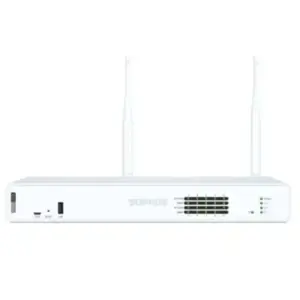
The Vigor2915 is the wired model in DrayTek’s Vigor2915 Series. It is an Ethernet security router rather than a DSL modem-router and it does not include integrated Wi-Fi. The front-panel layout provides a fixed Gigabit Ethernet WAN port, three fixed Gigabit Ethernet LAN ports, one Gigabit Ethernet port that can be assigned as WAN or LAN, and one USB 2.0 port.
What is it mainly used for?
Its main role is to sit between one or two Internet connections and a small-office LAN, applying routing, failover, firewall, VPN, VLAN and bandwidth policies. It is especially useful when a business wants a dedicated router behind an ONT, modem or provider handoff instead of relying on an ISP-supplied gateway for all policy control.
Who should consider it?
Small offices, retail locations, clinics, professional practices, satellite branches, workshops and other sites with roughly small-business scale are the natural audience. DrayTek positions the series for about 30 hosts and publishes a 30,000-session figure, so larger sites or networks with unusually high session counts should be sized more conservatively.
What must be confirmed first?
Confirm the expected WAN throughput with the actual features enabled. DrayTek lists NAT throughput up to 530 Mbps and higher accelerated figures under specific conditions, while encrypted VPN traffic has different limits. If a Dubai office is buying a 500 Mbps, 1 Gbps or faster service, the application mix matters as much as the nominal line rate.
What can FourTeck determine?
FourTeck can help map the Vigor2915 to the intended Internet circuits, WAN failover method, VPN users, site-to-site tunnels, VLAN plan, filtering requirements and installation scope. That sizing step helps avoid ordering a router that is technically compatible but too constrained for growth, encrypted traffic or a high-speed Internet subscription.
Exact model identity matters: Vigor2915 is not Vigor2915ac
A recurring procurement mistake with this family is treating the model names as interchangeable. The supplied model here is DrayTek Vigor2915, which is the non-wireless unit. DrayTek also offers the Vigor2915ac, which adds dual-band wireless functionality. The base Vigor2915 therefore makes most sense when the office already has dedicated access points, when Wi-Fi is provided by another managed platform, or when the router will be installed in a cabinet or communications room where wireless coverage from the router itself would be ineffective.
This distinction affects more than convenience. An office buying the wired model should plan access points separately and should not assume that the USB port or switchable Ethernet port substitutes for integrated wireless. Conversely, a business that already operates ceiling-mounted access points may prefer the wired Vigor2915 because routing and wireless coverage can then be sized independently. That can produce a cleaner architecture: the router handles Internet edge policy, while access points handle radio coverage, roaming and client capacity.
The Vigor2915 is also an Ethernet router, not an xDSL termination device. A Dubai fibre connection normally presents Ethernet from an optical network terminal or provider device; that can be connected to the fixed Gigabit WAN interface where the service parameters are compatible. If the Internet service requires a separate modem, ONT, special VLAN tagging, static addressing, PPPoE credentials or provider-specific handoff, those details need to be captured during deployment. The router supports common IPv4 and IPv6 WAN methods, but the service handoff remains a provider-side dependency.
Model verification should therefore be part of every quotation. The exact label on the requested unit, the presence or absence of Wi-Fi, the intended provider handoff and the desired secondary-WAN method should all be agreed before hardware is dispatched. That simple check prevents a common situation in which the router arrives technically functional but does not provide the wireless, modem or interface role the buyer expected.
Published Vigor2915 specifications buyers should use for sizing
The table below concentrates on the wired Vigor2915. Performance figures are vendor-published maximums under test conditions, not guaranteed application throughput. Real-world results depend on packet size, traffic direction, firewall rules, VPN encryption, QoS, filtering, hardware acceleration state and the behaviour of the connected services.
| Specification | DrayTek Vigor2915 | Buyer relevance |
|---|---|---|
| WAN/LAN Ethernet | 1 fixed GbE WAN, 3 fixed GbE LAN, 1 GbE WAN/LAN switchable port | Allows a second Ethernet WAN or an additional LAN port depending on design. |
| USB | 1 × USB 2.0 | Can support selected USB-based functions such as compatible mobile WAN or external storage use; exact device compatibility should be verified. |
| NAT sessions | 30,000 published session scale | Useful for estimating whether the router suits the number and behaviour of connected devices. |
| NAT throughput | Up to 530 Mbps; DrayTek also publishes up to 930 Mbps with hardware acceleration in its specification data | Do not equate the accelerated laboratory maximum with all-feature production throughput. |
| VPN tunnels | Up to 16 concurrent VPN tunnels | Relevant to branch connectivity and remote-access concurrency. |
| OpenVPN + SSL VPN | Up to 8 tunnels | Important when remote workers use SSL-based or OpenVPN-style access. |
| IPsec throughput | Up to 250 Mbps with AES-256 in DrayTek’s published data | Critical for site-to-site VPN sizing when business traffic traverses encrypted tunnels. |
| SSL VPN throughput | Up to 150 Mbps | Sets expectations for aggregate remote-access traffic rather than Internet speed alone. |
| VLANs | 802.1Q tag-based and port-based VLAN; up to 8 VLANs | Supports separation of staff, voice, guest, CCTV or other logical networks when paired with compatible switching. |
| Routing | Static routing, policy routing, inter-VLAN routing and RIP v1/v2 | Useful when traffic must follow different WANs or internal network paths. |
| Management | Web UI, HTTPS, SSH v2, TR-069, SNMP v1/v2c/v3, Syslog; VigorACS support from firmware 4.0.5 | Provides several options for local and managed administration. |
| Power | DC 12V @ 1A; published maximum power consumption 7.8 W | Low-power desktop deployment; UPS runtime can be planned separately. |
| Dimensions | 220 × 160 × 36 mm | Compact form factor, but rack placement needs a suitable shelf if used in a cabinet. |
| Operating environment | 0 to 45°C operating; 10% to 90% non-condensing humidity | In Dubai, communications cupboards should be ventilated or cooled so local temperature remains within the equipment rating. |
Where the Vigor2915 fits in a Dubai business network
The strongest use case for the Vigor2915 is a small site that needs dependable routing policy but does not require enterprise-scale firewall inspection or multi-gigabit throughput. Think of a branch office where the Internet edge must be more predictable than a basic ISP router: the business may have a primary fibre service, a secondary Ethernet or mobile backup path, a few VLANs, several remote workers, a site-to-site VPN to headquarters and a requirement to prioritise voice or business applications.
In this role, the Vigor2915 can centralise several network decisions. WAN failover logic lives at the edge, so a failed primary circuit can trigger traffic to a secondary path. Policy-based routing can direct selected traffic over a chosen WAN. VLAN-aware routing can keep different departments or device types logically separate. VPN services can connect users and sites without adding a separate VPN concentrator. Bandwidth limits and QoS policies can prevent non-critical traffic from overwhelming smaller Internet links.
The product is less suitable when the edge must inspect traffic at modern next-generation-firewall depth, when the site expects sustained near-gigabit or multi-gigabit application throughput with extensive security services, when there are many more than the recommended small-office host count, or when the WAN and VPN demands are likely to grow significantly. The Vigor2915 is a capable router with security controls, but it should not be confused with a large dedicated NGFW platform designed for advanced threat inspection, sandboxing, high port density or data-centre segmentation.
A particularly clean design is to pair the Vigor2915 with managed Gigabit switching and separate access points. In that architecture, the router controls Internet and inter-VLAN policy, the switch handles wired distribution and VLAN tagging, and the access points provide Wi-Fi. This modular approach lets a business replace or expand wireless coverage without changing the Internet router. It also avoids placing the router in an open office merely because Wi-Fi must radiate from it.
For a buyer comparing this model with a simple consumer router, the difference is therefore policy control and manageability rather than just raw Wi-Fi speed. For a buyer comparing it with a higher-end business firewall, the difference is the opposite: the Vigor2915 is compact and efficient for a modest branch, but a larger security appliance may offer more inspection capacity and richer security services. The correct shortlist depends on what the edge device is expected to do every day, not on a single headline throughput number.
Dual-WAN design: failover, load balancing and practical dependencies
DrayTek positions the Vigor2915 as an up-to-two-WAN router. The normal starting point is the fixed Gigabit Ethernet WAN interface. A second path can be created with the switchable Ethernet port, and DrayTek’s series documentation also discusses USB-based mobile WAN possibilities. The wireless-WAN option belongs to the Vigor2915ac model, so it should not be assumed for the wired Vigor2915.
For most Dubai offices, the cleanest resilient design is two independent services that fail differently. Two circuits delivered through the same building riser, provider core or ONT may not provide the level of resilience the buyer expects. A primary fixed-line service paired with a separately engineered secondary path can offer better fault diversity, but the exact arrangement depends on the building and telecom providers. The router can make path decisions only after the physical services have been delivered and configured correctly.
Failover and load balancing solve different problems. Failover keeps a secondary path available when the preferred route stops meeting health criteria. Load balancing can distribute sessions across available WANs, which may improve aggregate utilisation but does not automatically make one individual connection twice as fast. Many applications establish sessions that must remain on a consistent public IP path. Banking portals, remote-access services, SIP systems, cloud security policies and partner allowlists can be sensitive to public IP changes or session movement. A good design therefore uses policy rather than blindly balancing every connection.
The Vigor2915 supports connection detection and WAN policy options that can be used to determine whether a path is healthy. The practical question is what should count as failure. A physical Ethernet link can remain up even when the provider beyond it is unreachable. Health checks should therefore be designed around meaningful upstream reachability. At the same time, checks that are too aggressive can cause unnecessary path changes during brief Internet jitter. The failover policy needs to match the tolerance of the business applications.
Capacity planning is equally important. When the secondary circuit is slower than the primary service, a failover event changes the available bandwidth for the whole office. Voice, video meetings, cloud backup and large downloads may compete for a much smaller pipe. QoS and bandwidth rules should be prepared before an outage occurs, so critical services remain usable on backup. If the backup is metered mobile data, usage and data-budget policies may also matter.
For quotation accuracy, provide the access type of both WAN services, expected download and upload rates, addressing method, any PPPoE details, provider VLAN requirements, whether public static IPs are required, and which applications must stay on a specific public address. Those inputs decide whether the Vigor2915 can be configured as a straightforward dual-WAN gateway or whether a more specialised edge design is needed.
VPN capability: strong for a small office, but size encrypted traffic separately
The Vigor2915 can operate as a VPN endpoint for both branch connections and remote users. DrayTek publishes support for up to 16 VPN tunnels, with protocols including IPsec, L2TP over IPsec, SSL VPN, IKEv2, OpenVPN, PPTP, L2TP and GRE in the product specification. Legacy protocols may remain available for compatibility, but a modern deployment should favour current secure methods that match the remote peer and organisational policy rather than enabling older options simply because the router supports them.
For site-to-site connectivity, the usual sizing question is not the tunnel count alone. One branch may need only a single tunnel but push most of its business traffic through that encrypted path. DrayTek lists IPsec performance up to 250 Mbps with AES-256 under its test conditions. If a Dubai branch is expected to move hundreds of megabits per second continuously through a headquarters tunnel, that encrypted throughput figure becomes more relevant than the router’s headline NAT result. The exact peer configuration, encryption suite, packet size and traffic direction also influence real performance.
Remote access introduces a different pattern. DrayTek publishes up to 8 OpenVPN plus SSL VPN tunnels and SSL VPN throughput up to 150 Mbps. Eight concurrent sessions can be adequate for a small team that connects occasionally, but it is not the right capacity for a company expecting dozens of simultaneous remote users. In that case, a larger router or a separate remote-access platform should be evaluated before purchase.
Authentication and identity integration need the same attention. The Vigor2915 specification lists local RADIUS, LDAP and mOTP-related user authentication options, with pre-shared key and X.509 methods for IKE authentication. Which method is appropriate depends on the existing identity environment and security policy. A site using Microsoft identity infrastructure, an external RADIUS server or certificate-based authentication may require integration work beyond the physical router installation.
VPN failover deserves specific testing in a dual-WAN design. If the public IP changes when traffic moves to a backup link, tunnels may need to renegotiate. Remote peers may use static addressing, dynamic DNS or other matching methods. DrayTek provides VPN Matcher functionality to assist certain NAT situations, and DrayDDNS can provide a hostname for changing addresses, but the design should be agreed with the remote endpoint rather than assumed. Firewalls at the other end may also need rules for both public addresses.
A useful procurement brief therefore lists every required VPN relationship: branch-to-headquarters, branch-to-cloud, partner tunnels and remote users. Add the expected concurrent count, approximate bandwidth per tunnel, peer device type, authentication method and failover behaviour. That information makes it possible to decide whether the Vigor2915 is comfortably within capacity or whether the project is already close to the platform’s practical limits.
Firewall and content controls: know what is built in and what may require a subscription
The Vigor2915 includes stateful firewall functions and IP-based policy controls appropriate to a small-business router. DrayTek lists port redirection, open ports, port triggering, DMZ host, UPnP, application-layer gateway support for protocols such as SIP and FTP, VPN pass-through, denial-of-service defence and spoofing defence. These tools can enforce basic Internet-edge policy and publish selected internal services when required.
Content Security Management adds application, URL keyword, DNS keyword, web-feature and web-category controls. The important licensing distinction is that category-based web filtering is marked by DrayTek as subscription-required. A buyer should not assume that every filtering feature remains fully functional forever with the hardware purchase alone. If web-category control is part of the business requirement, the quotation should explicitly state the required service term and renewal expectations.
Keyword and DNS-based controls can still be useful for straightforward policy, but encrypted web traffic changes how filtering works. Modern browsing uses HTTPS, and applications increasingly use protocols such as QUIC. DrayTek’s own guidance explains that DNS filtering can help control access to encrypted destinations, while QUIC may need separate policy attention because it can bypass assumptions built around traditional TCP/443 filtering. This is a good example of why a router’s feature checklist does not automatically equal a complete acceptable-use policy.
The Vigor2915 should also be positioned correctly against dedicated next-generation firewalls. DrayTek’s specification for this model does not list features such as Suricata-based inspection or IP reputation in the same way higher-end security platforms may provide them. If the organisation requires advanced intrusion prevention, cloud sandboxing, malware inspection, TLS decryption at scale or a comprehensive security-subscription stack, the project should compare a specialised NGFW rather than stretching the Vigor2915 beyond its intended role.
For many small branches, however, strong configuration hygiene matters more than buying complexity. Unneeded inbound services should remain closed. Remote administration should use secure methods and restricted source addresses where possible. Default credentials must be changed. UPnP should be considered carefully in a business network. Firmware should be maintained. Logs should be sent to an appropriate destination if the business needs audit history. These operational controls often determine the real security outcome more than whether a router has a long list of menu options.
When requesting a Vigor2915 for firewall use, describe the actual policy: which internal networks may access the Internet, whether guest users must be isolated, which inbound services are published, whether web categories are required, whether application restrictions are required, and whether logs must be retained externally. That turns a generic router purchase into a deployable security requirement.
Bandwidth management and QoS: protecting business traffic when links are busy
Bandwidth management is one of the Vigor2915’s practical small-office strengths. DrayTek lists IP-based bandwidth limits, IP-based session limits, QoS classification using TOS, DSCP, 802.1p, IP address, port and application, plus voice prioritisation and application QoS. The business value is simple: the router can decide that not all traffic deserves equal treatment when the WAN becomes congested.
This matters most on asymmetrical or backup links. A cloud-sync application or large upload can consume upstream capacity and increase latency for VoIP or video meetings. Session-heavy devices can also create a disproportionate load. By limiting selected users, reserving priority for real-time traffic or controlling sessions, the router can keep essential services responsive even when the total Internet subscription is modest.
QoS is not a substitute for sufficient bandwidth, and it cannot create capacity that the provider does not deliver. It works by managing contention. The configuration should therefore be based on measured or contracted line rates, especially upload speed. If the router is told that a link is faster than it really is, scheduling may occur too late because the provider has already become the bottleneck. If configured too conservatively, usable capacity may be wasted.
Voice deployments require end-to-end thinking. The router can prioritise traffic it recognises or that carries the expected markings, but switches, phones, PBX systems and service-provider behaviour also affect call quality. A clean voice VLAN, correct DSCP treatment and adequate Internet latency are often more valuable than simply turning on a generic VoIP checkbox. Similar principles apply to video conferencing and cloud desktops.
A useful deployment step is to identify the three or four applications that truly must remain responsive during congestion and then design policies around them. That produces a simpler, more maintainable QoS policy than dozens of overlapping rules. If the site frequently operates at or near full line capacity even after sensible controls, the correct fix may be a faster Internet service or a higher-capacity edge router rather than increasingly complicated traffic shaping.
VLAN and LAN segmentation for staff, voice, guests and devices
The Vigor2915 supports both 802.1Q tag-based VLAN and port-based VLAN functions, with DrayTek listing up to eight VLANs. That is enough for many small offices to separate traffic into meaningful zones without introducing an additional routing appliance. Typical examples include corporate workstations, IP phones, guest access, CCTV, printers or building-management devices.
Segmentation is only effective when the full path understands the VLAN design. A managed switch must carry the correct tags between the router and downstream ports. Access points must map SSIDs to the intended VLANs. DHCP scopes need the right gateways and DNS settings. Inter-VLAN firewall or routing rules must then define which networks may communicate. If any part of that chain is unmanaged, a logical design on the router can fail to reach the endpoint.
The Vigor2915 also supports multiple IP subnets, custom DHCP options and bind-IP-to-MAC functionality. These can help with structured addressing, voice provisioning or devices that benefit from stable leases. Bindings should not be mistaken for strong endpoint authentication; they are an addressing control. Where user or device identity must be enforced, the wider LAN architecture may require 802.1X-capable switching or a dedicated NAC approach.
Inter-VLAN routing creates a deliberate policy point. A guest network may be allowed to reach the Internet but denied access to every internal subnet. CCTV cameras may be permitted to talk to an NVR but not to staff devices. Voice phones may need access to the PBX and selected Internet services. Printers may be reachable from user networks without initiating sessions back to them. The router’s firewall and routing rules should express those requirements explicitly instead of allowing broad any-to-any communication between VLANs.
Eight VLANs is a useful small-business ceiling, but it can become restrictive in more complex environments. A rapidly growing organisation might want separate zones for departments, servers, management, phones, cameras, access control, guests, IoT, contractors and test equipment. In that case, a larger firewall or Layer-3 switching design may be more appropriate. The number of VLANs is therefore a sizing parameter, not just a checkbox.
For a Dubai office rollout, provide the number of user groups, switch models, access-point platform, voice system and any devices that must remain isolated. A short logical network diagram is often enough to determine whether the Vigor2915’s VLAN capacity is comfortable and which switch ports need tagging or access-mode configuration.
USB port, mobile backup and file-sharing possibilities
The wired Vigor2915 includes one USB 2.0 port. DrayTek’s product information positions USB as one option for adding a secondary WAN through compatible cellular equipment, and the broader DrayOS platform can also use USB storage for SMB file sharing on supported configurations. These functions are useful, but buyers should avoid treating the USB connector as a universal peripheral port. Modem compatibility, file-system support, firmware behaviour and device power requirements must be checked for the exact accessory.
For backup Internet, a USB cellular modem can be attractive where a second fixed circuit is unavailable. The tradeoff is predictability. Mobile signal quality varies by building, modem placement and carrier conditions. Carrier-grade NAT may affect inbound services. Data plans may be metered. Public IP availability can differ from fixed-line services. A practical installation should therefore test signal, failover timing and application behaviour before the backup path is considered production-ready.
USB storage is best treated as a convenience or light-duty feature rather than a substitute for a business NAS. DrayTek documents SMB file-sharing capabilities on supported Vigor routers, allowing LAN users to access files on attached storage. A dedicated NAS or server still provides stronger storage features, redundancy options, performance, access control, backup integration and lifecycle management. The router’s primary job remains Internet edge routing and security policy.
If the USB port is part of the purchase requirement, state the exact intended function in the quotation request. That allows the accessory to be checked against the Vigor2915 firmware and avoids discovering after installation that a particular modem, storage format or operating mode is unsupported.
Management, monitoring and firmware lifecycle
The Vigor2915 provides several management paths. DrayTek lists HTTP and HTTPS administration, Telnet, SSH v2, FTP and TR-069, with SNMP v1, v2c and v3 plus Syslog support. In a business environment, secure protocols should be preferred and unnecessary legacy management services should be disabled or restricted. Remote management should be exposed only when required and then limited by source policy, VPN or another appropriate control.
Configuration backup and restore are supported, which is important for recovery. A router replacement is much faster when a current configuration backup exists and the firmware compatibility has been checked. Backups should be taken after meaningful changes and stored securely with basic documentation of WAN addressing, VLAN IDs, VPN peers and administrator access procedures.
For centralised management, DrayTek lists VigorACS support for the Vigor2915 from firmware 4.0.5. That can be relevant to organisations or service providers managing multiple DrayTek sites. Central management can simplify provisioning, monitoring and policy consistency, but it introduces its own server or subscription considerations. Whether it is justified depends on the number of routers and the operational model.
Firmware maintenance is not optional for an Internet-edge device. As of the latest DrayTek resource listing checked for this content, the Vigor2915 Series has firmware version 4.4.9 dated 5 August 2026. That date matters because it shows the family is still represented in DrayTek’s current resource centre at the time of writing. Future releases, support status and security advisories can change, so the installed firmware should be checked again during deployment rather than relying permanently on the version stated on this page.
Change management should be conservative. WAN, firewall, VPN and VLAN changes can affect the entire office. A small branch may not have redundant routers, so a failed update or policy error can cause a full outage. Good practice includes exporting a configuration backup, documenting the current version, confirming release notes, scheduling disruptive changes outside critical hours and having local console or physical access available if recovery is required.
Logging is equally useful when troubleshooting intermittent issues. Syslog can provide a longer record than relying only on the live interface, while SNMP can feed network-monitoring systems. Useful alerts include WAN changes, VPN status, resource conditions and authentication events where supported. The goal is not to collect every message forever; it is to retain enough evidence to explain outages, security events and repeated service degradation.
Performance sizing: why Internet speed alone is not enough
Router sizing often starts with the contracted WAN rate, but that is only the first variable. DrayTek lists the Vigor2915 at up to 530 Mbps NAT throughput and also publishes a higher hardware-accelerated maximum in its detailed specification data. The manufacturer explicitly notes that throughput figures are derived from internal testing under optimal conditions and that actual performance varies with network conditions and activated applications. This caveat should guide the buying decision.
A 500 Mbps Internet circuit is therefore not automatically a perfect match simply because a 530 Mbps figure appears on the page. The office may enable firewall policies, QoS, VPN, filtering, logging or other functions that consume processing resources. Traffic may be bidirectional. Packet sizes may be smaller than the test scenario. Multiple users may open thousands of sessions. Encrypted traffic has separate limits. A design that operates constantly at the edge of the published maximum leaves little room for feature overhead or growth.
The 30,000-session figure and DrayTek’s recommendation for around 30 hosts are another useful sizing signal. Thirty ordinary office users can behave very differently from thirty high-activity devices. Cloud applications, browsers, mobile phones, smart televisions, cameras, backup clients and collaboration platforms can create many simultaneous sessions. A retail location with a few staff but many guest devices may also generate a different session profile. Host count is therefore a guideline, not a guarantee.
VPN changes the calculation again. IPsec throughput is published up to 250 Mbps and SSL VPN up to 150 Mbps. If a branch routes all corporate traffic through a headquarters IPsec tunnel, the effective ceiling may be shaped by encrypted performance rather than ordinary NAT. If only a small subset of traffic crosses the VPN and the rest exits locally, the load looks different. Remote-access sessions are similarly dependent on encryption and concurrency.
Upload speed can be more important than download speed for interactive services. Many fibre packages have strong downstream rates but lower upstream capacity. Cloud backup, CCTV uploads, off-site replication and video meetings all consume upstream bandwidth. Once the upstream path saturates, latency can rise sharply and make the connection feel slow even though download capacity remains available. QoS can mitigate contention, but it cannot overcome a chronic capacity shortage.
The safest purchasing approach is to create a performance envelope rather than a single number. List contracted WAN rates, typical and peak utilisation, approximate user/device count, active VPN bandwidth, number of VLANs, filtering requirements, QoS needs and expected growth over the planned hardware life. If those figures place the Vigor2915 close to its limits on day one, a larger model is usually better value than replacing the router early.
This is also where a buyer should resist over-specifying unnecessary features. A small office with a 200 Mbps fibre circuit, modest VPN use, several VLANs and no advanced inspection requirement may be comfortably served by the Vigor2915. The objective is not to buy the biggest firewall available; it is to choose an edge device with sufficient headroom for the actual traffic and security policy.
When to choose Vigor2915 — and when to evaluate a larger router or firewall
Vigor2915 is a sensible fit when
The site is genuinely small, Internet rates are comfortably within the router’s practical performance envelope, and the main requirements are resilient Ethernet WAN, branch or remote-access VPN, VLANs, firewall policy and bandwidth management.
It is also attractive when the office already uses separate managed Wi-Fi and wants a compact wired router. A few well-defined VLANs, several VPN tunnels and straightforward content controls are aligned with the platform’s intended role.
Evaluate a larger platform when
The office needs sustained near-gigabit security throughput, many more users, more than eight VLANs, significantly more VPN concurrency, advanced threat inspection, higher port density, stronger high-availability options or major growth headroom.
A larger DrayTek model or a dedicated NGFW should also be considered when the edge is expected to perform security inspection that the Vigor2915 does not provide, rather than using the router mainly for routing, VPN and policy control.
DrayTek identifies the Vigor2927 Series as a related higher-capacity product family, with more sessions and more concurrent VPN capacity than the Vigor2915 series. That does not make it automatically better for every buyer, but it is a useful comparison when WAN speed, VPN load or growth makes the Vigor2915 look tight. The correct comparison should be based on the live requirements, not merely the price difference between two router models.
A practical Vigor2915 deployment journey
Confirm the circuits
Document primary and secondary WAN handoffs, speed, addressing, provider VLANs, PPPoE credentials, public IP needs and whether the backup is fixed-line, Ethernet or compatible mobile USB.
Build the LAN plan
Define subnets, VLAN IDs, DHCP scopes, switch trunks, access ports and SSID mappings. Decide which VLANs may communicate and which should remain isolated.
Define security policy
List allowed outbound access, published inbound services, guest restrictions, content rules and administrative-access sources. Avoid broad temporary rules that remain permanently enabled.
Create VPNs and identity
Configure branch tunnels and remote users with modern secure methods supported by both sides. Confirm certificate, RADIUS, LDAP or other authentication dependencies.
Tune QoS and failover
Set realistic WAN rates, prioritise essential traffic and test link detection. Verify that critical applications survive or recover acceptably when the preferred WAN fails.
Back up and monitor
Export the final configuration, record firmware and administrative details, configure logging or monitoring as required, and document how to restore service after hardware or configuration failure.
Testing should simulate real failure rather than only reviewing the configuration screen. Disconnect the primary service, observe the failover time, test DNS resolution, verify VPN recovery, make a voice or video call on the backup link and confirm that critical cloud services remain reachable. Then restore the primary WAN and observe failback. This exercise often reveals application dependencies that cannot be identified from the router configuration alone.
Dubai installation considerations
The Vigor2915 is physically compact at 220 × 160 × 36 mm and is designed as a low-power desktop-style appliance. In a professional installation it is often placed on a shelf inside a communications cabinet. Because it is not a standard rack-mount chassis, the cabinet should have a suitable shelf and enough clearance for the power adapter, Ethernet patch leads and airflow.
Temperature deserves particular attention in the UAE. DrayTek specifies an operating range of 0 to 45°C and non-condensing humidity of 10% to 90%. A closed cabinet in an unconditioned store room can exceed comfortable electronics temperatures even when the office itself is cool. The router should therefore be installed in a ventilated or air-conditioned location where heat from switches, UPS units and other equipment does not accumulate beyond the rating.
Power protection is another inexpensive resilience measure. The router’s maximum published consumption is only 7.8 W, but an Internet service is useful during a power disturbance only if the ONT, modem, switches and access points are also powered. A UPS plan should cover the whole critical connectivity chain, not just the router. If the secondary WAN uses mobile equipment, that device and any powered USB hardware should also be included in the runtime calculation.
Cabling should be labelled clearly. The switchable WAN/LAN port can create confusion during support if nobody knows whether it is currently acting as LAN or the second WAN. Patch-panel labels, a simple topology diagram and saved configuration notes reduce troubleshooting time. If a provider replaces an ONT or changes addressing, those records become especially useful.
FourTeck can combine router supply with wider UAE network services through FourTeck UAE and infrastructure support through FourTeck IT Services UAE. This is useful where the Vigor2915 is only one part of a branch project that also includes switching, cabling, access points, VPN migration or managed support.
Procurement questions that prevent costly mismatches
A router quotation is more accurate when it describes the desired outcome rather than only naming the model. The model may already be correct, but the supporting details determine whether extra services, subscriptions or accessories are required. They also reveal when the requested hardware is undersized.
Start with the WAN. State the current provider, service type, download and upload speed, public IP requirements and the desired backup method. If the connection uses PPPoE or provider VLAN tagging, note that. If there will be two fixed services, identify whether each arrives on independent provider equipment. If mobile backup is planned, provide the intended modem model and carrier so compatibility can be checked.
Next document the LAN. Count users and devices separately because phones, cameras, printers and IoT equipment may outnumber staff. List VLANs, managed switches and access points. If the network already has a Layer-3 switch, clarify whether inter-VLAN routing should remain there or move to the Vigor2915. If voice is in scope, provide the PBX or hosted-voice platform and any QoS requirements.
For VPN, state how many site-to-site peers and remote users are needed now and at peak. Include expected tunnel traffic, remote firewall/router brands and authentication requirements. A project with two tunnels carrying heavy replicated data can be more demanding than one with ten light remote-access users, so both count and throughput matter.
For security, clarify whether basic firewall and URL controls are enough or whether subscription-based web-category filtering is required. If advanced threat inspection, malware scanning, application risk scoring or intrusion prevention is mandatory, say so explicitly; that may shift the recommendation away from Vigor2915 toward a dedicated security appliance.
Finally, specify the service scope: hardware supply only, pre-configuration, on-site installation, migration from an existing router, after-hours cutover, remote support, documentation or ongoing management. Buyers outside the UAE can also review the broader FourTeck site for international technology coverage.
Common mistakes to avoid with the Vigor2915
Expecting built-in Wi-Fi
The Vigor2915 is the wired model. If integrated wireless is required, compare the Vigor2915ac or, more often in a business setting, use dedicated access points. Do not order the base model and assume Wi-Fi can simply be enabled later.
Sizing from accelerated NAT only
The highest laboratory figure does not represent every traffic mix with every feature enabled. Include VPN, filtering, QoS, session count and real packet behaviour when deciding whether the router has enough headroom.
Assuming failover is application-transparent
Public IP changes can break active sessions, VPNs or allowlists. Test business applications during WAN failure and restoration. Resilience requires both router policy and application-aware planning.
Forgetting filtering subscriptions
DrayTek marks web-category filtering as subscription-required. If category control is a compliance or HR requirement, include the service term and renewal plan rather than assuming it is permanently included with the router.
Treating eight VLANs as unlimited segmentation
Eight VLANs are enough for many small sites but can become restrictive in a complex office. Count the required security zones before purchase, including future guest, voice, CCTV, IoT and management networks.
Ignoring cabinet conditions
The 0 to 45°C operating range should be respected. A hot, enclosed Dubai communications cupboard can be a reliability risk even when the office room temperature is comfortable.
Detailed buyer FAQ for DrayTek Vigor2915 Dubai
Does the Vigor2915 include Wi-Fi?
No. The Vigor2915 is the non-wireless model. The Vigor2915ac is the wireless variant in the family. A wired Vigor2915 can still support a wireless office when it is connected to separate access points through a managed switch. That approach is often preferable when coverage, roaming or user density requires access points in several locations.
Can it use two Internet connections?
Yes. The series supports up to two WAN paths. The router has one fixed Gigabit WAN and one Gigabit Ethernet port that can be configured as WAN or LAN. A compatible USB mobile connection can also be relevant in some designs. The best secondary path depends on the required resilience, addressing and backup bandwidth.
Will dual WAN double the speed of one download?
Not necessarily. Load balancing typically distributes sessions or traffic according to policy across available links. A single application session often remains on one WAN. The main benefits are aggregate utilisation and resilience. Applications sensitive to public IP changes may need rules that keep them on a specific connection.
Is the Vigor2915 suitable for a 1 Gbps Internet service?
It can connect to Gigabit Ethernet, but that does not mean every security and routing workload will deliver 1 Gbps application throughput. DrayTek publishes up to 530 Mbps NAT and a higher hardware-accelerated maximum under specific test conditions. If sustained near-gigabit performance is a requirement, especially with VPN or filtering, evaluate a higher-capacity model.
How many VPN tunnels can it handle?
DrayTek publishes up to 16 VPN tunnels for the Vigor2915 Series. The combined OpenVPN plus SSL VPN limit is listed as 8. Tunnel count is only one dimension; encrypted throughput and the traffic profile of each tunnel should also be considered.
What VPN throughput should I expect?
DrayTek lists IPsec throughput up to 250 Mbps with AES-256 and SSL VPN throughput up to 150 Mbps under its published test conditions. Actual performance depends on configuration, packet size, traffic direction, peer settings and other features running on the router.
Does it support VLANs?
Yes. DrayTek lists 802.1Q tag-based VLAN and port-based VLAN support with up to eight VLANs. A managed switch and correctly configured access points are required if tagged VLANs need to extend beyond the router.
Can I separate guest Wi-Fi from staff traffic?
Yes, when the access points and switches support the required VLAN mapping. The router can route and firewall the guest VLAN separately from staff networks. Because the Vigor2915 itself has no Wi-Fi, wireless guest access must come from external access points.
Does web filtering need a license?
Some filtering functions are available as router features, while DrayTek marks category-based web filtering as subscription-required. If web categories are part of the purchase requirement, request the correct subscription term and confirm the renewal model.
Can it prioritise VoIP?
Yes. DrayTek lists voice prioritisation and QoS classification methods including DSCP, 802.1p, IP address, port and application. Good voice quality still depends on the WAN, switch and PBX design, so QoS should be configured end to end rather than only at the router.
Can the USB port be used for 4G backup?
A compatible USB cellular modem can be used in supported configurations. Compatibility should be checked for the exact modem and firmware before purchase. Mobile signal, carrier NAT, public IP availability and data-plan limits must also be considered.
Can I connect fibre directly to the Vigor2915?
The router has Gigabit Ethernet rather than an SFP fibre interface. A fibre service normally connects through the provider’s ONT or another Ethernet handoff device. If a direct optical SFP connection is mandatory, a different router interface design is required.
Does it support IPv6?
Yes. DrayTek’s specification includes IPv6 connection and routing capabilities. The exact deployment depends on what the ISP supplies, how prefixes are delegated and whether internal systems are prepared for IPv6 policy and addressing.
Can it be centrally managed?
DrayTek lists VigorACS management support for the Vigor2915 from firmware 4.0.5. Central management is useful when several sites need consistent provisioning and monitoring, but the required VigorACS service architecture should be included in the project scope.
What is the current firmware version?
At the time this page was prepared, DrayTek’s resource centre lists Vigor2915 Series firmware version 4.4.9 dated 5 August 2026. Firmware changes over time, so the deployed unit should be checked against DrayTek’s current release information during installation.
Is Vigor2915 a next-generation firewall?
It is better described as a business router with firewall, VPN and content-control functions. If the requirement includes advanced intrusion prevention, malware inspection, sandboxing or high-performance deep security inspection, compare a dedicated NGFW platform rather than assuming the Vigor2915 provides the same security stack.
How many users is it for?
DrayTek recommends the Vigor2915 Series for a network of about 30 hosts. Real suitability depends on session count, traffic type, VPN usage and enabled services. A small number of very active devices can create more load than a larger number of light users.
Can it replace an ISP router?
Often yes when the provider presents a compatible Ethernet handoff and supplies the necessary credentials or addressing. It cannot replace an optical ONT or unsupported modem function. Some services may also use provider-specific voice, IPTV or VLAN arrangements that need to remain on the original device or be migrated carefully.
Decision recap: the six checks that determine whether Vigor2915 is the right fit
What FourTeck needs from the buyer for an accurate quotation
Vigor2915 wired model, plus quantity required.
Provider, service type, upload/download rate and addressing.
Second Ethernet WAN or compatible mobile USB, including desired failover behaviour.
Current and expected growth, including phones, cameras and guest devices.
Site-to-site peers, remote users, authentication and approximate encrypted bandwidth.
VLAN count, managed-switch models, access points and inter-VLAN policy.
Basic firewall, web categories, application controls or any advanced inspection requirement.
Supply only, configuration, on-site installation, migration, testing, documentation or support.
Plan the DrayTek Vigor2915 around your real Dubai network
The Vigor2915 is most convincing when its compact dual-WAN, VPN, VLAN and bandwidth-management capabilities are matched to a genuinely small-business workload with enough performance headroom. Share your WAN speeds, VPN requirements, device count and VLAN plan so the model can be validated before purchase rather than after installation.

Reviews
There are no reviews yet.