
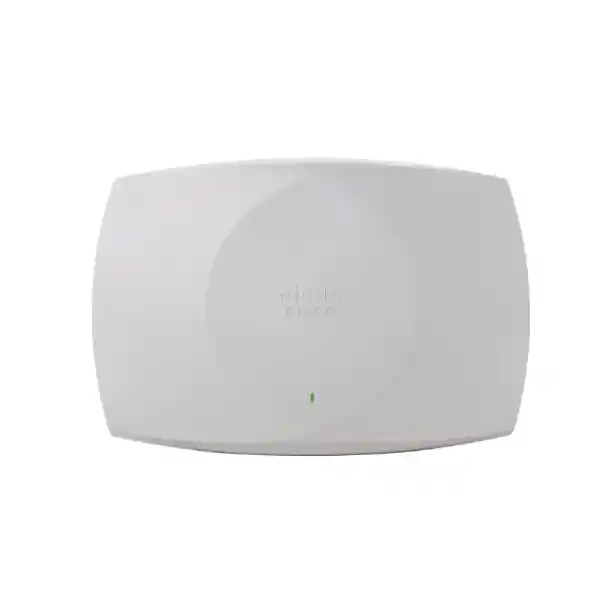
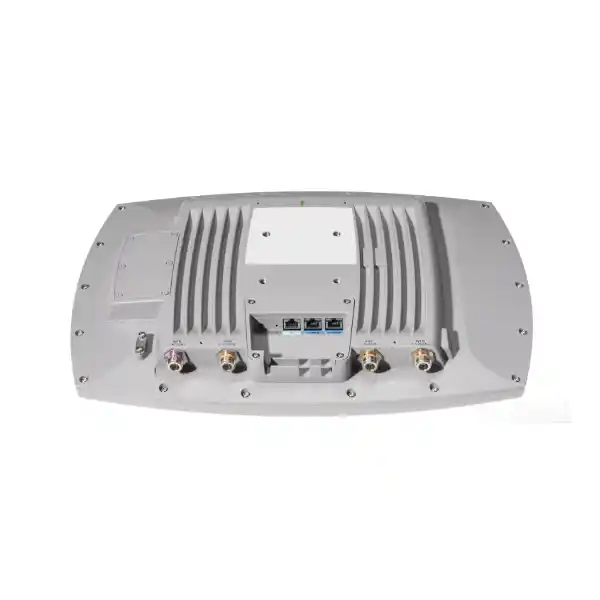
Cisco Wireless CW9179F Wi-Fi 7 Access Point
Purpose-built for stadiums, arenas, airports, exhibition halls, outdoor event zones and other exceptionally dense wireless environments, the CW9179F combines Wi-Fi 7 radio capacity, software-controlled directional coverage, dual 10 Gigabit uplinks and flexible cloud or controller-based operations in one integrated platform.
Direct answer for UAE buyers
Choose the CW9179F when the project requires engineered directional coverage rather than a conventional ceiling-mounted omnidirectional access point. Its strongest fit is a venue where thousands of devices can gather in defined seating, concourse, gate, queue, bowl, apron or event areas and where RF cells must be shaped deliberately.
For best performance, plan full 802.3bt Class 6 power, multigigabit/10G access switching, Cat 6A cabling where 10G is required, professional RF modelling and a verified UAE 6 GHz regulatory design. FourTeck can scope these dependencies before quotation.
4096-QAM, MLO, preamble puncturing, OFDMA, TWT and WPA3-ready enterprise operation.
4×4 operation across 2.4 GHz, two 5 GHz radio slots and 6 GHz when fully powered and permitted.
Dual RJ-45 ports support 100M, 1G, 2.5G, 5G and 10G rates for resilient high-capacity designs.
Quoted PHY capacity is a radio-layer figure and should not be confused with real application throughput.
Full 4×4 radio operation and dual 10G links are designed around Cisco UPOE/802.3bt power, with maximum PoE draw up to 47 W.
Wide, narrow/boresight and front-and-back patterns let RF engineers shape cells without physically replacing the integrated antenna assembly.
What the Cisco CW9179F is designed to solve
Large public venues are difficult wireless environments because user density changes dramatically by time and location. A stadium can move from nearly empty to tens of thousands of active clients within minutes. An airport gate may be lightly used for part of the day and then become a dense queue of passengers streaming media, downloading boarding passes, using airline applications and making calls. Exhibition halls can contain temporary stands, reflective structures, video walls and localized pockets of intense traffic. In these environments the problem is not simply achieving signal coverage. The real design problem is controlling cell size, interference, channel reuse, airtime utilization, client distribution and wired backhaul so that usable capacity exists where people actually gather.
The CW9179F addresses this problem with an integrated high-density architecture. Rather than attaching a general-purpose access point to a separate directional antenna, Cisco combines the access point electronics and configurable antenna system into one platform. The integrated antenna can operate with different software-selected beam states, allowing a design team to choose a narrower boresight pattern, a wider pattern, or a front-and-back mode for specialized venue geometries. This gives the RF engineer a repeatable way to modify coverage characteristics while keeping the core hardware consistent across many installation locations.
For UAE projects, this architecture is particularly useful in venues where physical access after installation is difficult. Access points mounted under stadium roofs, on high poles, on arena structures or above airport operational zones can be expensive to revisit. Software-controlled RF geometry does not eliminate the need for correct initial placement, but it can reduce the need to physically replace antenna assemblies when the intended cell shape changes. FourTeck positions the CW9179F as an engineered infrastructure component, not as a simple plug-and-play Wi-Fi device; successful deployments should begin with capacity objectives, floor plans, mounting heights, user density assumptions, switch and PoE budgets, cable paths and regulatory requirements.
Core hardware and radio architecture
At the radio layer, the CW9179F is substantially different from a normal three-radio enterprise access point. Its serving-radio design can operate with a 2.4 GHz radio, two separate 5 GHz radio slots and a 6 GHz radio. Under full-power conditions, these radio slots can operate as 4×4:4 MU-MIMO radios, giving a maximum of sixteen spatial streams across the four serving slots. Cisco also integrates additional capabilities for scanning, IoT connectivity and GNSS positioning, so the platform can participate in RF monitoring, location-aware workflows and connected-device use cases without sacrificing a serving radio solely for every auxiliary function.
Wi-Fi 7 support includes features that matter in high-density design. 4096-QAM can improve spectral efficiency when client signal quality is exceptionally strong. Multi-Link Operation is intended to let compatible clients use more than one link as Wi-Fi 7 ecosystems mature, which can improve throughput, reliability or latency depending on client and network behavior. Preamble puncturing can preserve portions of a wide channel when part of that channel is affected by interference. Uplink and downlink OFDMA help divide channel resources among multiple clients, while uplink and downlink MU-MIMO support concurrent transmissions to or from multiple capable clients. Target Wake Time helps power-sensitive endpoints coordinate sleep and wake behavior, and BSS coloring supports better spatial reuse where neighboring cells overlap.
The maximum published PHY data rate depends on radio mode. In quad-radio mode, Cisco specifies aggregate PHY rates up to approximately 24 Gbps when the 6 GHz radio uses 320 MHz channels, both 5 GHz radios use 160 MHz channels and the 2.4 GHz radio uses 20 MHz. In tri-radio arrangements, the aggregate can differ depending on whether the design prioritizes a single full-band 5 GHz radio or other radio combinations. These figures should be treated as theoretical radio-layer capacity, not as promised user throughput. Actual application performance is influenced by channel width, regulatory power limits, client capabilities, distance, interference, airtime contention, protocol overhead, security processing, roaming behavior, switch uplink capacity and internet or WAN bottlenecks.
A good large-venue design therefore starts with the question “how many active devices must each RF cell serve at the busiest interval?” rather than “what is the maximum speed of the access point?” The CW9179F gives the designer high radio capability, but its value is realized only when those radios are divided into appropriately sized cells with controlled reuse. FourTeck can incorporate the AP into an end-to-end capacity model that includes client mix, expected application traffic, airtime targets and switch uplink aggregation.
Wi-Fi 7 channel strategy: 2.4 GHz, dual 5 GHz and 6 GHz
2.4 GHz
The 2.4 GHz slot supports legacy reach and compatibility and is normally planned with 20 MHz channels. In a dense venue it should be used deliberately because the band has limited non-overlapping spectrum and can attract older clients that consume disproportionate airtime.
Dual 5 GHz
Two 5 GHz radio slots allow capacity to be spread across lower and higher portions of the 5 GHz band in supported regulatory domains. This is central to the CW9179F high-density concept and requires careful orientation and power balancing.
6 GHz
The 6 GHz slot enables Wi-Fi 6E and Wi-Fi 7 client operation with cleaner spectrum and, where locally permitted, channel widths up to 320 MHz. Regulatory mode, channel availability and outdoor permissions must be verified for the UAE deployment.
The dual-5-GHz design deserves particular attention. When dual-radio mode is enabled, the two 5 GHz slots are associated with different parts of the 5 GHz spectrum. This separation allows both radios to be active in the same physical AP while reducing self-interference, but it also means antenna orientation and channel planning affect which part of the intended seating or user area sees each radio most strongly. Cisco’s deployment guidance emphasizes that the two 5 GHz beams can be physically separated in wide mode, so installation orientation is not cosmetic: it can determine where high-band and low-band capacity lands.
In dense projects, channel width should be chosen for capacity reuse rather than headline speed. A 160 MHz or 320 MHz channel can deliver impressive peak rates to a small number of compatible clients, but it consumes more spectrum and reduces the number of distinct reuse channels available. Stadiums and exhibition environments often benefit from narrower channels to create more cells and improve spatial reuse. Conversely, airport premium lounges, media production zones or low-density areas may justify wider channels. The correct approach is to model the whole venue, not force one channel width everywhere.
The 6 GHz band is especially valuable because it introduces additional spectrum and a cleaner client population, but it must be treated as a design resource rather than a universal replacement for 5 GHz. Client penetration into 6 GHz varies by device generation. RF propagation and penetration differ from lower bands. UAE indoor 6 GHz operation exists within the local regulatory framework, while any outdoor 6 GHz design should be validated against the current TDRA rules and Cisco country approval/AFC status at the time of deployment. FourTeck can keep the bill of materials and configuration aligned with the permitted operating mode instead of assuming that every theoretical radio option is available in every location.
Software-selectable beam patterns for precision coverage
The CW9179F includes three primary selectable beam states: wide, narrow/boresight and front-and-back. These are not marketing labels; they materially change where radio energy is directed. In the published deployment guidance, the narrow boresight configuration creates a concentrated 35° × 35° pattern for the 5 GHz and 6 GHz directional slots, while the wide state steers the two 5 GHz beams away from each other and broadens the 6 GHz coverage geometry. The 2.4 GHz internal directional pattern is broader. The front-and-back state is designed for installations where the main beam serves one zone while external antennas serve a zone behind the access point.
| Beam state | 2.4 GHz | 5 GHz slot 1 | 5 GHz slot 2 | 6 GHz |
|---|---|---|---|---|
| Wide | 70° × 70° | 35° × 35° | 35° × 35° | 70° × 35° |
| Narrow / boresight | 70° × 70° | 35° × 35° | 35° × 35° | 35° × 35° |
| Front-and-back | External path used | 35° × 35° | External path used | 35° × 35° |
In wide mode, the two 5 GHz beams are steered approximately 15 degrees away from one another. This can spread capacity across adjacent seating blocks or queue zones, but it also means that installers must preserve the intended physical orientation. Rotating the AP without updating the RF plan can cause one 5 GHz sub-band to illuminate the wrong area. Narrow mode is useful when the objective is to concentrate capacity into a defined region and minimize unnecessary spill into neighboring cells. Front-and-back mode is more specialized: it redirects the 2.4 GHz and one 5 GHz path to rear external connectors, so compatible external antennas are required for those redirected radios.
Because the beam state is controlled in software, configuration governance becomes part of RF engineering. An accidental RF profile change can alter the physical coverage footprint even when nobody touches the AP. For that reason FourTeck recommends documenting beam state, mounting orientation, channel plan, power range and intended service area for every CW9179F location. Change-control procedures should treat RF profile modifications with the same care as switch VLAN or routing changes in a critical venue.
Dual 10 Gigabit multigigabit Ethernet: designing the wired edge correctly
A high-capacity Wi-Fi 7 access point can only perform as well as the wired network feeding it. The CW9179F includes two multigigabit RJ-45 Ethernet ports, each supporting 100 Mbps, 1 Gbps, 2.5 Gbps, 5 Gbps and 10 Gbps link rates. Cisco positions these ports for link and power resiliency, and the platform can use dual high-speed uplinks in appropriate configurations. For full 10 Gbps operation, the cabling system should be designed accordingly; Cisco notes Cat 6 or Cat 6A is required for 10 Gbps port speeds, while Cat 5e can support rates up to 5 Gbps under the documented platform guidance.
The access-switch selection must therefore be part of the access point quotation. A switch with only 1G PoE+ ports can physically power and connect the AP in reduced modes, but it cannot expose the hardware’s full radio or uplink potential. In a new build, FourTeck typically evaluates the number of CW9179F units per switch, the multigigabit speed required per AP, PoE class, switch power-supply redundancy, uplink oversubscription, switch-stack bandwidth and fiber aggregation. The objective is not simply to provide a 10G copper port; the upstream distribution and core must also carry the aggregate traffic generated when many APs are active during event peaks.
A useful sizing method starts with expected busy-hour client throughput per RF cell, multiplies that value across serving radios and then applies realistic concurrency assumptions. This is more useful than multiplying the published 24 Gbps PHY figure by the number of APs. Real Wi-Fi traffic includes management frames, contention, retransmissions, encryption overhead and half-duplex airtime behavior. The aggregate Ethernet requirement may be far below the headline PHY number, but large public venues can still exceed 1G or 2.5G during peaks. Dual 10G capability gives the design headroom and resilience needed for demanding locations.
Where link aggregation or redundant uplinks are used, cabling paths should be diverse if the venue architecture permits. If both AP cables share the same tray, conduit, patch panel and switch, a single physical incident can defeat the intended redundancy. Conversely, redundant paths increase switch-port and cabling costs. FourTeck can model the operational value of dual paths by venue zone so that critical bowls, gates or public-safety areas receive stronger redundancy while less critical locations can use a simpler single-uplink design.
PoE power modes and why 802.3bt matters
The CW9179F can accept several PoE standards, but the available radio and Ethernet capability changes significantly with the negotiated power level. Full 802.3bt Class 6 power is the preferred design point for a new high-density deployment. Under this mode, Cisco specifies 4×4 operation on the 2.4 GHz radio, both 5 GHz radios and the 6 GHz radio, with both Ethernet links capable of 10 Gbps. Maximum PoE power consumption is listed at 47 W, while typical consumption under Cisco’s documented test profile is lower. A switch power budget must be sized for worst-case supported draw rather than only the typical figure.
With 802.3at PoE+, the AP remains operational but enters reduced-capability modes. In quad-radio PoE+ operation, serving radios scale to 2×2 and the Ethernet links can be limited to 2.5G. In tri-radio PoE+ operation, a full-band 5 GHz radio can operate at 4×4 while other radios operate at 2×2 and Ethernet behavior is further constrained. Standard 802.3af PoE is not a normal production mode for this platform; Cisco documents it for staging or configuration with serving radios disabled and a 1G Ethernet link. This distinction is critical when an existing venue wants to reuse older PoE access switches.
Power negotiation also depends on LLDP or Cisco Discovery Protocol behavior between the AP and the switch. A valid PoE switch may still cause the AP to operate below the intended performance level if the negotiated power is insufficient or if power allocation policies are incorrect. During commissioning, FourTeck recommends verifying actual negotiated PoE class, switch port power allocation, radio chain state and Ethernet speed at every AP rather than assuming configuration from the switch model number.
In UAE venues, thermal design and PoE planning intersect. At high ambient temperatures the platform can reduce radio chain count to remain within operating limits. Outdoor locations exposed to direct sun should include environmental accessories and thermal considerations from the beginning, especially for temperatures above 40°C. A procurement list that includes only the AP and mount can therefore be incomplete. The correct bill of materials may need an outdoor environment pack, solar shield, appropriate gland system, grounding components, safety tether, cable accessories, high-power switching and potentially power injectors where switch replacement is not practical.
Indoor-to-outdoor conversion for UAE venue infrastructure
The CW9179F is designed as a convertible platform. Standard shipments use an indoor environment pack, while the separately ordered outdoor environment pack CW-ACC-9179-B-00 adds the sealing and physical protection needed for outdoor deployments and supports the platform’s outdoor operating mode. With the outdoor pack installed, Cisco rates the unit for IP65/IP67 ingress protection. This matters for stadium structures, outdoor hospitality zones, transportation facilities, festival grounds, queueing areas, open concourses and other locations where dust, rain or washing exposure would make an indoor enclosure unsuitable.
Environmental ratings do not remove the need for proper installation. Ethernet cable glands must be correctly assembled and sealed. Cisco’s installation guidance calls for dielectric grease in the outdoor cable sealing process, and unused gland positions must be plugged. The AP must be grounded, and a safety tether should be used where required by the mounting location and local safety procedures. The articulating mount supports pole or wall installation and allows the device to be aimed mechanically before fine RF behavior is adjusted through beam configuration.
Cisco specifies the CW9179F for temperatures down to -20°C and up to 60°C without solar load, and up to 50°C with solar load. When ambient temperature rises above 40°C, radio chains can reduce from 4×4 to 2×2. For hot outdoor deployments in the 45–50°C range, Cisco identifies the solar shield accessory as required. These figures are particularly important in Dubai and other UAE locations where shaded-air temperature and direct-sun surface temperature can be very different. A south- or west-facing installation on a metal structure may experience more thermal stress than a shaded indoor concourse even when the regional weather report shows the same ambient temperature.
The platform is also documented for high wind loads, with published resistance to sustained winds up to 100 mph (161 km/h) and gusts up to 165 mph (266 km/h) when properly installed. The mounting structure itself must be engineered for the static and dynamic load, not just the AP weight. The AP weighs about 4.54 kg, and the bracket adds roughly 1.72 kg, but the effective wind loading of the enclosure can dominate structural requirements on poles and elevated mounts.
Outdoor 6 GHz requires separate regulatory attention. Installing the outdoor environment pack does not by itself create legal permission to operate 6 GHz outdoors in every country. Cisco’s outdoor 6 GHz capability uses standard-power operation with Automated Frequency Coordination in markets where that mode is permitted and supported. In the UAE, indoor 6 GHz spectrum has been allocated for Wi-Fi, but an outdoor design should be validated against current TDRA regulations and Cisco’s country approval tools at project time. FourTeck will keep the quotation and configuration aligned with the approved operating mode instead of relying on assumptions that may change with regulation or software releases.
UAE 6 GHz planning: performance opportunity with regulatory discipline
The UAE has been an early regional adopter of 6 GHz Wi-Fi spectrum. The national regulator allocated the 5925–6425 MHz range for indoor Wi-Fi use under the applicable class-authorization framework. That spectrum can be extremely valuable in enterprise venue networks because it provides a cleaner operating environment than legacy bands and enables Wi-Fi 6E and Wi-Fi 7 clients to use wider channels without consuming 5 GHz reuse capacity. The CW9179F is technically capable of 20, 40, 80, 160 and 320 MHz channels in 6 GHz, subject to regulatory and software conditions.
A professional design does not simply enable the widest possible channel. In a stadium bowl, for example, the network may have dozens or hundreds of RF cells that must reuse spectrum. A 320 MHz channel can offer very high peak throughput, but it consumes a large portion of the available band. If every AP uses an ultra-wide channel, co-channel contention can offset the theoretical benefit. For dense seating, narrower 6 GHz channels may produce greater total venue capacity by increasing the number of independently reusable channels. Wider channels can be reserved for lower-density VIP, media or operations areas where fewer cells need to coexist.
Client support is another design input. Wi-Fi 7 smartphones, laptops and tablets can use 6 GHz where enabled, but a venue still contains Wi-Fi 6, Wi-Fi 5 and older clients. Some operational devices such as scanners, ticketing terminals, handheld POS systems and IoT endpoints may remain 2.4 or 5 GHz only. The RF plan should therefore distribute capacity across all bands without starving legacy clients or allowing 2.4 GHz beacons to dominate the airtime plan. SSID strategy, band steering, minimum data rates and client onboarding policies become part of the capacity design.
For any UAE quotation, FourTeck recommends recording whether each CW9179F location is indoor, covered outdoor, fully outdoor or exposed to direct sun; whether 6 GHz is required at that location; and whether the expected client population actually supports 6 GHz. This prevents the project from paying for complexity that does not produce a user benefit and helps the design team separate regulatory, thermal and RF requirements by zone.
Catalyst and Meraki management flexibility
One of the most important strategic changes in Cisco’s newer wireless portfolio is unified hardware that can be adopted into different management models. The CW9179F can participate in Cisco Catalyst controller-based networks or Cisco Meraki cloud-managed environments, subject to compatible software and subscription entitlements. This allows organizations to standardize physical AP hardware while retaining a choice of operational model.
In a Catalyst architecture, the CW9179F can be managed by Catalyst 9800 Series Wireless Controllers, including physical or virtual controller options, with Cisco IOS XE software support beginning with the required release family documented for the AP. This model suits enterprises that want detailed controller-centric policy, integration with existing Catalyst infrastructure, campus segmentation, RF profiles and established operational procedures. The beam state is part of RF configuration, so network teams can assign the required beam behavior through the platform’s wireless configuration workflow.
In a Meraki architecture, the same hardware can be onboarded into the cloud-managed stack, where RF profile settings expose antenna beam configuration. Cloud management can simplify multi-site operations, remote monitoring and lifecycle administration for organizations already standardized on Meraki. The choice should not be made only on interface preference. It should consider existing licensing, network policy requirements, controller investments, cloud governance, operational staffing, telemetry requirements and integration with the wider LAN.
Cisco’s current licensing direction uses Cisco Networking Subscription entitlements, with wireless subscription tiers such as Essentials or Advantage depending on required features. Licensing terms evolve, so FourTeck treats subscription validation as part of the quote rather than assuming that an older DNA or Meraki license is automatically correct for a new CW9179F deployment. The BOM should include the AP hardware, required subscription term, management platform dependencies and any support service needed by the customer’s procurement policy.
This flexibility also has migration value. An organization can adopt the CW9179F into its current management model without necessarily locking future hardware replacement to the same operational architecture. Migration still requires planning, software compatibility checks and change-control, but unified hardware reduces the need to maintain different country- or controller-specific physical AP variants across an estate.
Enterprise wireless security capabilities
High-density public connectivity and enterprise operational wireless have very different security requirements, yet both may share the same physical venue. The CW9179F supports modern enterprise Wi-Fi security features including WPA3, WPA2 compatibility, 802.1X authentication, Enhanced Open/OWE and strong AES-based encryption suites. Supported enterprise authentication methods include common EAP frameworks such as EAP-TLS, PEAP and EAP-TTLS, allowing the AP to participate in certificate-based or identity-driven access designs controlled by the wider Cisco wireless architecture.
For public guest networks, Enhanced Open can improve privacy compared with a completely open SSID by encrypting over-the-air traffic without requiring a shared password, where client support and the chosen architecture permit. For staff, operations, POS, ticketing and contractor networks, WPA2-Enterprise or WPA3-Enterprise with 802.1X can tie access to enterprise identity. The most sensitive operational devices should not share policy solely because they use the same physical AP. VLAN, SGT, firewall and application-policy segmentation should keep guest, corporate, IoT, production and venue-control traffic logically separated.
Wireless security also includes RF visibility. The platform incorporates scanning capabilities that can support wireless monitoring and optimization. In a large venue, dedicated scanning and telemetry improve the ability to detect interference, rogue activity and changing RF conditions without permanently sacrificing a main serving radio. However, the final capability depends on the management architecture, software release and subscription tier, so security feature requirements should be listed explicitly in the project scope.
FourTeck can integrate the wireless access layer with broader security architecture available through the Firewall Dubai practice, including segmentation gateways, secure internet breakout and policy enforcement. This is important for event venues where guest traffic volume is high and where a compromise on a public SSID must not create a path to corporate, payment, surveillance or building-management networks.
IoT, Bluetooth and GNSS integration
The CW9179F is more than a client-serving Wi-Fi radio platform. Cisco integrates an IoT radio supporting Bluetooth Low Energy capabilities and Zigbee-ready functionality, along with GNSS/GPS functionality. These features are valuable in modern venues where the wireless infrastructure is expected to support location-aware services, sensors, asset workflows and building or event systems in addition to phones and laptops.
The IoT radio can reduce the need to deploy a completely separate overlay solely for supported low-power connected-device use cases. Application hosting and container support can also bring selected edge functions closer to the access layer, depending on the validated Cisco software architecture. This can simplify data collection for IoT applications and reduce the number of standalone gateways distributed across a venue. It is still important to qualify each application rather than assume that every proprietary sensor ecosystem can run directly on the AP.
GNSS has a specific role in the global-use and 6 GHz story. Location awareness can help the platform determine regulatory context and participate in workflows such as Automated Frequency Coordination where supported. The unit includes integrated GNSS capability and can support an external GNSS antenna accessory through the documented connector when installation conditions make an external antenna preferable. This matters when an AP is installed below dense structural materials that reduce satellite visibility.
For venue design teams, these integrated radios should be included in cable, switch, segmentation and security planning from the beginning. IoT data may terminate in local applications, cloud platforms or security systems. GNSS and management traffic need secure reachability. Application-hosting workloads may have their own lifecycle. FourTeck can map these dependencies into the broader UAE network design instead of treating the AP as an isolated RF endpoint. For infrastructure integration, server, virtualization and local compute requirements can also be coordinated with the Server Dubai engineering portfolio.
RF design methodology for stadiums, arenas and major venues
The fastest way to create a poor high-density network is to place APs using a simple coverage heat map and then assume that stronger signal means better service. In a stadium, every AP can potentially “see” thousands of clients if it is mounted high enough. That is precisely the problem. High-density wireless design tries to reduce the number of clients contending for each radio by creating smaller, controlled RF cells and reusing channels across physical distance or structural boundaries.
Cisco has demonstrated basic client connectivity with the CW9179F narrow beam at distances up to roughly 60 metres under test conditions, but the deployment guidance also warns that long distance can create an excessively large coverage area. A narrow beam still expands with distance. At around 60 metres the illuminated area can exceed one thousand square metres, potentially containing far more users than a single radio should serve during an event. The correct target is therefore not maximum reach; it is the shortest practical distance that creates the required cell with appropriate signal quality and manageable client count.
FourTeck’s recommended design workflow begins with venue segmentation. Seating bowls are divided by section, tier and expected occupancy. Concourse areas are modelled separately because people move and congregate around concessions. Gates, immigration halls, ticketing zones and security queues are treated as transient high-density cells. VIP lounges, media areas and operations rooms have different application demands. Once zones are defined, the design team sets target client counts per radio, minimum RSSI or SNR objectives, expected channel widths and maximum airtime utilization. AP mounting positions and beam states are selected to satisfy those objectives.
Power balancing is especially important because the CW9179F can have different antenna gains across bands and beam states. If one 5 GHz radio transmits with substantially higher effective radiated power than the other, clients may prefer the stronger radio and create an uneven load. The same issue can appear between 5 GHz and 6 GHz as MLO clients become more common. RF power limits should therefore consider antenna gain and regulatory EIRP, not only the configured radio transmit power. In many high-density designs, deliberately reducing power improves capacity by shrinking cell overlap and encouraging clients to associate with the closest intended AP.
After predictive design, an on-site validation is essential. Construction materials, temporary event equipment, LED displays, metal structures, seating geometry, people and neighboring networks can change propagation. The AP includes a local site-survey mode that can help engineers validate beam state and RF behavior during commissioning. Final tuning should be based on measurements taken with realistic mounting positions and, where possible, conditions that represent actual venue occupancy.
The output of the RF design should be a documented matrix for every AP: installation ID, coordinates, height, azimuth, mechanical tilt, beam state, 2.4/5/6 GHz channel plan, power range, switch port, cable ID, PoE class, intended client zone and management profile. This document becomes the operational reference for troubleshooting after handover.
High-density capacity sizing: from client count to AP count
There is no responsible one-line formula that converts “number of people” directly into “number of CW9179F access points.” Two venues with the same attendance can require very different AP counts because client activity, seat geometry, application mix, mounting distance, available spectrum and channel reuse differ. A 40,000-seat stadium dominated by messaging and ticket applications has a different traffic profile from a 40,000-person esports event where visitors stream video, upload high-resolution content and use latency-sensitive applications simultaneously.
A useful starting point is to estimate the peak number of associated devices, then the percentage that will be active in the same short interval. Each active client is assigned a busy-hour throughput requirement based on the application mix. Multiplying active clients by per-client throughput provides an initial aggregate demand for the zone. That number is then converted into airtime demand using realistic Wi-Fi efficiency rather than raw PHY speed. The design must reserve margin for management overhead, retries, roaming, broadcast/multicast traffic and sudden event-driven spikes.
Client capability distribution matters because low-rate legacy devices consume more airtime for the same payload. A radio with fifty modern Wi-Fi 7 clients can behave very differently from a radio with fifty mixed clients that include older handheld scanners or low-power IoT endpoints. Minimum basic rates, SSID count and legacy band support therefore affect capacity. Every additional SSID also adds beacon overhead, especially at low basic rates, so venue networks should avoid creating unnecessary SSIDs for organizational convenience.
Once an airtime budget is established, the RF engineer divides the venue into cells that keep projected busy-hour airtime within the chosen target. The CW9179F’s multiple serving radios can increase capacity per physical mounting point, but the radios still need usable spectrum and appropriate spatial separation. In a dense bowl, dozens of APs can share the same channel plan only if cells are sufficiently isolated by distance, directional patterns, building geometry and controlled transmit power.
FourTeck uses this capacity-first approach to create a BOM that can be defended technically. It also helps explain why replacing an older directional Wi-Fi 5 or Wi-Fi 6 design one-for-one with Wi-Fi 7 may not be optimal. Some areas may need fewer physical APs because the CW9179F can serve multiple controlled radio cells; other areas may still need dense placement because the user population, not the AP maximum speed, determines the capacity requirement.
Switching, uplink and core network sizing
A CW9179F project frequently exposes weaknesses in an existing access layer. Older switches may provide PoE+ but not 802.3bt, or multigigabit ports may top out at 2.5G. Distribution links may be 10G even though a group of APs can generate more aggregate traffic than that during event peaks. The solution is not automatically to make every link faster; it is to model expected utilization and upgrade the specific layers that would become bottlenecks.
At the access switch, each AP port should support the intended negotiated data rate and PoE class. If both CW9179F Ethernet ports are used, switch architecture must support the chosen resilience or aggregation model. Switch power supplies should be sized for maximum allocated PoE, not just average measured draw. Where many high-power APs share a switch, dual power supplies or higher-capacity PSU options may be required. The UPS and generator design must also account for switch PoE load if the venue expects Wi-Fi to remain active during utility failure.
The access switch uplink is then sized from the aggregate expected traffic of attached APs. Oversubscription is normal in enterprise networks, but the oversubscription ratio should be chosen consciously. A 48-port switch filled with high-capacity APs can theoretically attach enormous radio capacity, yet actual venue traffic may be much lower. Busy-hour telemetry from an existing network, if available, is valuable for calibrating the model. New venues without history should use conservative assumptions and preserve expansion headroom.
Core and internet egress also need attention. Guest traffic from a major event can overwhelm NAT, firewall or internet circuits even when the Wi-Fi itself is healthy. Corporate and venue operations may require low latency and deterministic paths even when guest usage spikes. Traffic classes should therefore be segmented and, where appropriate, rate-limited or prioritized. Local content caching, venue applications and internet breakout architecture can reduce unnecessary WAN traversal.
FourTeck can coordinate access switching, firewall capacity, fiber uplinks, routing and local IT services through the FourTeck IT Services UAE practice. This avoids the common procurement mistake of purchasing premium Wi-Fi 7 APs while leaving the wired access layer undersized.
Installation engineering: mounting, aiming, grounding and cable preparation
The physical installation of a CW9179F should follow the RF design exactly. The device measures approximately 475 mm wide, 330 mm long and 73 mm high without the mounting bracket. The AP itself weighs about 4.54 kg, and the articulating bracket adds roughly 1.72 kg. Cisco specifies that the mounting structure should be capable of supporting at least 50 lb (22.7 kg) of static load. Engineers should also account for dynamic wind load and the characteristics of the supporting pole, wall, truss or venue steelwork.
The CW-MNT-ART3 articulating mount supports wall and pole deployments with significant adjustment range, allowing the installer to set azimuth and elevation. Mechanical aiming is still essential even though beam state can be changed in software. A software pattern cannot compensate for an AP that is mounted behind an obstruction, pointed at the wrong seating block or rotated such that the two 5 GHz beams land in unintended areas. Installation drawings should therefore include device orientation, not just a dot marking the mounting location.
Outdoor installations require additional sealing discipline. The outdoor environment pack uses cable glands, and cable outer diameter must fit the supported gland. Dielectric grease should be applied according to Cisco’s documented process, and any unused openings must remain properly sealed. Cabling should be routed to minimize water tracking toward connectors. A safety tether is strongly recommended for elevated installs and may be required by local site rules. The AP must be grounded before power is applied, and grounding must follow the relevant electrical and building codes.
For difficult high-level installations, Cisco offers a quick-connect cable accessory that allows more of the weatherized cable preparation to be completed at ground level. This can reduce work at height and simplify final Ethernet connection. The solar shield should be included where outdoor temperature and direct exposure require it. These accessories can appear small compared with the AP cost, but omitting them can delay commissioning or compromise weather protection.
FourTeck recommends staging every AP before it is lifted into a hard-to-reach location. Staging should verify serial inventory, firmware readiness, controller or cloud onboarding, license entitlement, switch negotiation, beam profile, LED state and baseline configuration. The installation team can then focus on mounting and cable integrity rather than troubleshooting software from a lift or roof structure.
Where the CW9179F fits best in the UAE
Stadium bowls
Directional cells can be aimed at seating blocks from roof, rail or under-seat-adjacent structures, with dual 5 GHz and 6 GHz capacity used to improve reuse and distribute dense client populations.
Arenas and event halls
Beam-state flexibility helps adapt to different floor layouts, seating configurations and event profiles without requiring a separate antenna type for every coverage geometry.
Airports and terminals
High-density gates, baggage areas, check-in halls and waiting zones benefit from deliberate cell shaping, strong backhaul and segmented guest, airline, retail and operational traffic.
Exhibition centres
Temporary stands and changing visitor density make flexible RF design valuable. Software-controlled beam configuration can support recurring layout changes while preserving consistent hardware.
Outdoor fan zones
With the correct environment pack, solar protection, mounting, grounding and locally permitted radio settings, the platform can serve exposed public gathering areas around major venues.
Transport and public spaces
Metro-adjacent halls, ferry terminals, public plazas and large queueing zones can use directional high-capacity cells where conventional omnidirectional APs create excessive overlap.
The AP is less compelling for a conventional office floor where ceiling-mounted omnidirectional Wi-Fi 7 APs can provide simpler coverage at lower installation complexity. The CW9179F earns its place when the venue geometry, client density or mounting restrictions justify directional high-density engineering. Matching the AP type to the environment is more important than selecting the highest-end model everywhere.
Operational monitoring and lifecycle management
A high-density venue network should be operated using measurable service objectives. Useful metrics include client association count per radio, channel utilization, retries, latency, packet loss, client SNR, roaming events, authentication delay, switch port errors, negotiated Ethernet rate and PoE state. Aggregate venue statistics alone can hide a failing cell, so dashboards should allow operations teams to drill down from building or event view to AP, radio and client.
Because the CW9179F’s beam state can be changed through configuration, the configuration itself becomes part of the physical network state. Backups, configuration templates and change approval are essential. A drifted RF profile can produce a coverage change that looks like interference or hardware failure. Operations teams should maintain a source-of-truth document that maps each AP to its intended beam state and orientation and should monitor for deviations after software upgrades or bulk policy changes.
The built-in accelerometer can support post-installation verification of device position. This is useful where maintenance work, venue refurbishment or accidental impact could alter an AP’s orientation. If RF performance changes unexpectedly, a physical-angle change should be considered alongside channel interference and software configuration. Front and rear status LEDs also simplify local installation checks from different viewing directions.
Software lifecycle planning matters because Wi-Fi 7 functionality, regulatory country support and client interoperability continue to evolve. The CW9179F requires supported Cisco software releases, and country enablement can depend on release version. FourTeck recommends maintaining a qualified software train for the venue, testing upgrades in a representative zone and verifying regulatory, controller, switch and subscription compatibility before broad rollout. Major events are not ideal windows for first-time firmware validation.
For customers without an internal wireless operations team, managed monitoring and support can be scoped through FourTeck UAE. The support design can include configuration backup, health monitoring, incident escalation, firmware planning and periodic RF reviews after venue changes.
Common design mistakes to avoid
Using distance as a design goal
The CW9179F can reach far, but a large distant cell can include too many users. In high density, shorter controlled cells usually produce better capacity and channel reuse.
Powering with legacy PoE
PoE+ or 802.3af can force radio-chain and Ethernet reductions. A premium AP on insufficient power may never deliver the architecture that justified its purchase.
Ignoring switch uplinks
Multigigabit AP ports are only useful when switch fabric and distribution uplinks have enough capacity. Model the complete path from radio to internet or application.
Maximizing channel width everywhere
Wider is not always better in a dense venue. Channel reuse and airtime efficiency can make narrower channels deliver greater total capacity across the whole building.
Treating beam state as cosmetic
Wide, narrow and front-and-back states change physical coverage. RF profile changes should be controlled because they can alter which user zone each radio serves.
Assuming outdoor 6 GHz is universally permitted
Weatherproofing and radio authorization are separate questions. Outdoor 6 GHz must follow current local rules, supported power mode and Cisco country approval.
Detailed specification reference for procurement teams
| Model | Cisco Wireless CW9179F |
|---|---|
| Wireless generation | IEEE 802.11be Wi-Fi 7, with backward support for applicable 802.11ax/ac/n/a/b/g capabilities by band and software configuration. |
| Serving radio architecture | 2.4 GHz, dual 5 GHz and 6 GHz radio slots; up to 4×4 MU-MIMO with four spatial streams per serving slot under full-power operating conditions. |
| Wi-Fi 7 features | 4096-QAM, Multi-Link Operation, preamble puncturing, uplink/downlink OFDMA, uplink/downlink MU-MIMO, Target Wake Time, BSS coloring, MRC, packet aggregation and WPA3 support. |
| Maximum channel widths | 20 MHz on 2.4 GHz; up to 160 MHz on 5 GHz; up to 320 MHz on 6 GHz where regulations and software allow. |
| Peak aggregate PHY | Up to approximately 24 Gbps in documented quad-radio Wi-Fi 7 configuration. Real user throughput is lower and deployment dependent. |
| Integrated antenna | Directional serving antennas with software-selectable wide, narrow/boresight and front-and-back operating states, plus IoT and GNSS antenna functions. |
| Peak antenna gains | Published peak gains include approximately 6 dBi for 2.4 GHz, 12 dBi for 5 GHz directional slots, and up to 12 dBi for 6 GHz boresight with lower gain in wide mode; exact values depend on beam state. |
| External antenna connectivity | Four color-coded rear antenna connectors support specialized external-antenna workflows, including front-and-back mode. Use only Cisco-supported antenna options and adapters. |
| Ethernet | 2 × RJ-45 multigigabit Ethernet ports supporting 100M/1G/2.5G/5G/10G. |
| Console | RJ-45 management console port, documented default speed 115200 bps. |
| Power input | 802.3bt / Cisco UPOE, 802.3at PoE+ and 802.3af for staging with radio limitations; Cisco CW-INJ-8 injector is an available power option. |
| Maximum PoE draw | Up to 47 W in full 802.3bt Class 6 mode according to Cisco’s product specification. |
| Dimensions | Approx. 475 × 330 × 73 mm without mounting bracket. |
| Weight | Approx. 4.54 kg AP; articulating bracket approximately 1.72 kg. |
| Environmental protection | IP65/IP67 when the outdoor environment pack is installed correctly. |
| Operating temperature | Approximately -20°C to 60°C without solar load and -20°C to 50°C including solar load; radio-chain reductions occur above 40°C under documented conditions. |
| Management | Cisco Catalyst controller-based or Cisco Meraki cloud-managed operating models, subject to supported software and subscription. |
| Licensing | Cisco Networking Subscription for wireless, with appropriate Essentials or Advantage entitlement based on required features and term. |
| Security | WPA3, WPA2, 802.1X, Enhanced Open/OWE, AES-based encryption and enterprise EAP authentication options through the supported wireless architecture. |
Specification and regulatory availability can vary by software release and country approval. FourTeck validates the proposed operating mode, license and accessories against the final UAE project requirements before order placement.
Accessory planning and bill-of-material considerations
A CW9179F BOM should be assembled by installation scenario rather than by model number alone. Indoor locations may require the AP, subscription, mounting bracket, appropriately rated copper cabling and a compatible 802.3bt multigigabit switch port. Outdoor locations add the environment pack, cable-sealing requirements, grounding, weather-rated supporting infrastructure and potentially the solar shield. High-level or difficult-access installations may benefit from the quick-connect cable. Specialized front-and-back deployments can require supported external antennas and the appropriate connector adapters.
The articulating mount CW-MNT-ART3 supports pole or wall installations and provides the adjustment required to aim the directional assembly. The outdoor environment pack CW-ACC-9179-B-00 changes the enclosure mode for weatherized operation. The solar shield CW-ACC-9179-CVR is relevant for direct-sun, high-temperature deployments and is specifically important in UAE summer conditions. The quick-connect cable CW-ACC-QCKCNCT1 can reduce complexity when final connections must be completed at height. Cisco also lists N-Type to RP-TNC adapter options for supported external-antenna scenarios.
Power injectors can solve isolated cases where an existing switch lacks the required PoE class, but they should not be used automatically across a large deployment. Hundreds of standalone injectors add power sockets, UPS dependencies, cable clutter and additional failure points. In a major venue, upgrading to centralized high-power access switches may provide cleaner operations and better monitoring. Injectors are more attractive for small numbers of APs, temporary deployments or zones where switch replacement is impractical.
FourTeck’s quotation process can separate mandatory items from conditional accessories so the customer understands why each component is present. That is especially useful for consultants and contractors who need to reconcile RF drawings, electrical drawings and IT bills of material before procurement.
When to choose CW9179F instead of a conventional indoor Wi-Fi 7 AP
The CW9179F is a specialized high-density platform. If the project is a normal office floor with 3 m ceilings, predictable room geometry and moderate device density, a standard indoor omnidirectional Wi-Fi 7 AP will usually be easier to install and more cost effective. The CW9179F becomes attractive when its directional and environmental capabilities solve a real engineering requirement.
Choose CW9179F when users gather in visible, defined zones that can be served with directional cells; when the access point must be mounted on walls, poles, roof structures or other non-standard surfaces; when indoor and outdoor variants should share common hardware; when high-density dual-5-GHz and 6-GHz capacity is valuable; or when the project needs software-selectable beam geometry for changing venue layouts. These characteristics are common in stadiums, airports, transport hubs, arenas and exhibition venues.
Do not choose it solely because “Wi-Fi 7 is faster.” Several Cisco Wi-Fi 7 access points can deliver modern features in conventional enterprise spaces. The value of the CW9179F lies in the combination of radio capacity, directional antenna integration, rugged outdoor conversion and high-capacity dual Ethernet. Those capabilities also increase design responsibility: mounting, thermal behavior, PoE class, cable category, beam state and RF zoning all need explicit decisions.
FourTeck can compare the CW9179F against other Cisco Wi-Fi 7 models during a design consultation and identify which locations genuinely require the large-public-venue platform. Mixed-AP designs are often the most efficient approach: specialized directional APs in bowls, concourses and outdoor zones, with standard ceiling APs in offices, lounges and back-of-house rooms.
Migration from Wi-Fi 5, Wi-Fi 6 or external-antenna venue designs
Many large venues already have a directional wireless system. A migration to the CW9179F is an opportunity to improve capacity and simplify antenna architecture, but it should not be implemented as a blind one-for-one replacement. Existing AP locations may have been chosen for an antenna with a different beamwidth, gain, cable loss and mounting orientation. The new integrated beam patterns can illuminate a different area even when installed at the same coordinates.
The first migration step is to export historical performance data from the current network. Busy-hour client count, channel utilization, throughput, interference and help-desk incidents identify where the old design is actually constrained. Next, the current RF plan should be compared with the CW9179F beam options. Some cells can be preserved, others can be split, and low-density areas can potentially be consolidated. This is also the time to revisit the 2.4 GHz strategy and reduce legacy coverage where modern clients no longer require it.
The wired network usually needs more change than expected. Older directional deployments may connect through 1G PoE+ access switches and Cat 5e cabling. The CW9179F can attach to those networks in reduced modes, but a full upgrade may require 802.3bt multigigabit switching and Cat 6A to selected locations. Rather than recable an entire venue automatically, FourTeck can categorize locations by expected traffic and determine where 10G is justified, where 5G is sufficient and where existing paths can be reused.
Licensing and management architecture should also be reviewed. Organizations running Catalyst can retain controller-based operations with compatible 9800 infrastructure, while those moving toward Meraki can evaluate the cloud management path. A migration window should include client testing with representative phones, laptops, scanners, POS terminals and operational devices because newer security defaults and 6 GHz behavior can expose client-side limitations.
The result should be a phased upgrade plan that improves the busiest zones first, preserves service during events and avoids mixing incompatible power or RF assumptions. A pilot section of the venue is often the safest place to validate mounting, heat behavior, beam selection, roaming and wired capacity before expanding to the full site.
Procurement guidance for Dubai and UAE projects
Enterprise wireless procurement should distinguish hardware availability from deployment readiness. The fact that CW9179F is a global-use product ID simplifies logistics, but the final project still needs supported country operation, compatible software, correct subscription licensing and accessories for the installation environment. FourTeck therefore treats the AP model as the beginning of the quote rather than the whole quote.
A complete request for quotation should include project location, venue type, indoor/outdoor status, quantity estimate, preferred management model, existing controller version, switch models, available PoE class, cabling category, ceiling or mounting height, expected client count and target go-live date. If drawings are available, they help identify whether directional mounting is practical and which zones may need outdoor environmental protection. If the project is consultant-led, sharing the wireless specification and approved-vendor requirements helps ensure licensing and support terms are included correctly.
Lead time can vary for specialized mounting and environment accessories even when the AP itself is available. It is therefore safer to approve the complete BOM together. Substituting an accessory during installation can alter weather rating, mounting geometry or antenna behavior. FourTeck can also align delivery batches with venue construction phases so that expensive wireless hardware is not stored on site for long periods before the mounting structure and cabling are ready.
For large deployments, spares should be planned explicitly. A small pool of pre-staged APs, mounts and environment components can reduce recovery time after physical damage. Spare units should be kept on compatible software and associated with the same operational documentation. The global-use hardware model simplifies replacement logistics, but country and configuration onboarding still need to be controlled.
FourTeck can supply Cisco wireless infrastructure as part of a wider enterprise solution covering switches, firewalls, servers, structured cabling, installation and managed IT support. This integrated approach reduces handoff gaps between the RF design, PoE switching and security architecture.
Commissioning and acceptance testing checklist
A CW9179F deployment should not be accepted based only on green LEDs. Commissioning must verify physical installation, RF operation, wired capacity, security, management and user experience. Every AP should be checked against the design matrix. The installer should confirm the correct device serial, switch port, cable label, negotiated Ethernet rate, PoE class, beam state, radio mode, channel, transmit power and environment mode. Outdoor units should be inspected for gland sealing, grounding, tether attachment and solar shield where required.
RF testing should measure signal strength, SNR and throughput in the intended service area and also inspect spill into neighboring cells. A directional AP can deliver excellent signal in the target zone while simultaneously creating excessive overlap behind or beside that zone if it is mis-aimed. The test should therefore include cell boundaries, roaming paths and adjacent seating sections. For front-and-back mode, both the integrated primary coverage and the external-antenna rear coverage must be validated.
Capacity tests should use multiple clients where possible. A single speed test can show that an AP is connected to 10G, but it does not prove that dozens or hundreds of users can share airtime efficiently. Event simulations can combine video streams, web transactions, voice calls and application traffic. Where a full load test is impractical, the acceptance plan can compare channel utilization, retries and latency under a controlled number of clients against the design model.
Security acceptance should verify each SSID and identity path, including guest onboarding, 802.1X certificate validation, VLAN or policy assignment, DNS, DHCP, firewall access and internet reachability. Operations acceptance should verify telemetry in the chosen Catalyst or Meraki management platform, alerting, inventory naming, configuration backup and escalation procedures.
Finally, the handover package should include as-built drawings, AP orientation, beam state, switch-port mapping, firmware version, license records, test results and photographs of outdoor sealing and grounding where relevant. This documentation turns the installation into an operable system rather than a collection of access points.
Why FourTeck for Cisco CW9179F deployment in the UAE
The CW9179F sits at the intersection of RF engineering, enterprise switching, power design, cybersecurity, structured cabling and venue operations. Buying the correct AP model is only one part of a successful project. FourTeck UAE can assist with the technical activities that determine whether the hardware performs as expected after installation.
Our project scope can begin with requirements discovery and design review: venue drawings, user density, application traffic, mounting restrictions, management preference, existing Cisco estate and regulatory constraints. From that baseline we can develop an RF and wired design, select the appropriate AP quantity, identify mounting and outdoor accessories, size PoE switches and uplinks, validate licensing and prepare a quotation that separates mandatory from optional components.
During implementation, services can include staging, configuration, controller or cloud onboarding, switch integration, installation coordination, RF profile assignment, acceptance testing and documentation. For existing sites, migration can be phased to preserve service while old APs are replaced. For new construction, FourTeck can coordinate with MEP, ELV and structured-cabling teams so that mounting points, cable routes, power budgets and rack capacity are ready before AP installation.
Customers planning a wider network modernization can also use FourTeck as a single technical point across campus switching, security, servers and IT operations. This reduces the risk that each infrastructure layer is sized independently. The CW9179F should be part of an architecture in which client capacity, AP uplinks, switch fabric, firewall throughput and internet bandwidth have been designed to work together.
Decision recap: is the Cisco CW9179F right for your venue?
Strong fit
Stadiums, arenas, airports, exhibition centres and public venues that need highly directional high-density cells, dual 5 GHz capacity, 6 GHz support, outdoor conversion and resilient multigigabit uplinks.
Design prerequisites
Professional RF planning, correct mounting orientation, 802.3bt power for full capability, multigigabit/10G switching, adequate cabling, software and subscription validation, and current UAE regulatory confirmation for the intended bands.
Do not over-specify
Conventional offices and small indoor spaces may be better served by simpler omnidirectional Wi-Fi 7 APs. Use the CW9179F where its directional and environmental engineering creates measurable value.
If your venue experiences congestion even though Wi-Fi signal strength appears high, the problem may be cell density, airtime contention, channel reuse or wired backhaul rather than basic coverage. The CW9179F can address these issues when incorporated into a capacity-first design. Its ability to shape beams, run multiple high-capacity serving radios and connect through dual 10G Ethernet provides the foundation, while the RF and switching design determines the outcome.
Quotation input checklist
To receive a technically accurate Cisco CW9179F UAE quotation, provide as many of the following details as possible. Missing information can be resolved during consultation, but each item helps FourTeck size the correct hardware, licensing and services.
Stadium, arena, airport, exhibition, outdoor event, transport hub or other large public venue.
Peak associated devices and expected active-user percentage during the busiest event period.
Identify fully indoor, covered, open-air and direct-sun mounting points.
PDF or CAD plans, seating layouts, pole positions and approximate AP-to-client distance.
Catalyst 9800 controller model/software or Meraki organization details and current licensing approach.
Access-switch models, available multigigabit ports, PoE class, power budget and uplink capacity.
Cat 5e, Cat 6 or Cat 6A routes, cable length and whether dual paths are available.
Guest, staff, operations, POS, IoT, contractor and event network segmentation expectations.
Plan a Cisco CW9179F design with FourTeck UAE
FourTeck can help determine whether the CW9179F should be used across the whole venue or only in high-density directional zones. The consultation can cover RF cell design, Catalyst or Meraki architecture, subscription licensing, outdoor accessories, 802.3bt switching, multigigabit uplinks, firewall capacity and commissioning.
For broader network and security sourcing, visit the FourTeck UAE and specialist infrastructure portals linked throughout this page. A coordinated design prevents wireless, switching and security decisions from becoming separate bottlenecks after installation.
Recommended next step
Send the venue type, city, approximate client count, indoor/outdoor mix and existing switch/controller details. FourTeck can then prepare the appropriate CW9179F BOM and identify any design questions that must be resolved before final pricing.
Technical specifications, regulatory availability and software features can change by release. Final procurement should use the currently approved Cisco and UAE operating conditions for the project date.

Reviews
There are no reviews yet.