
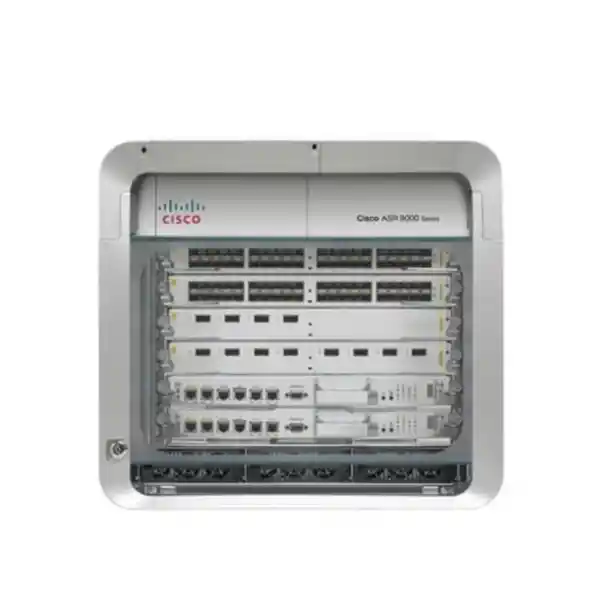
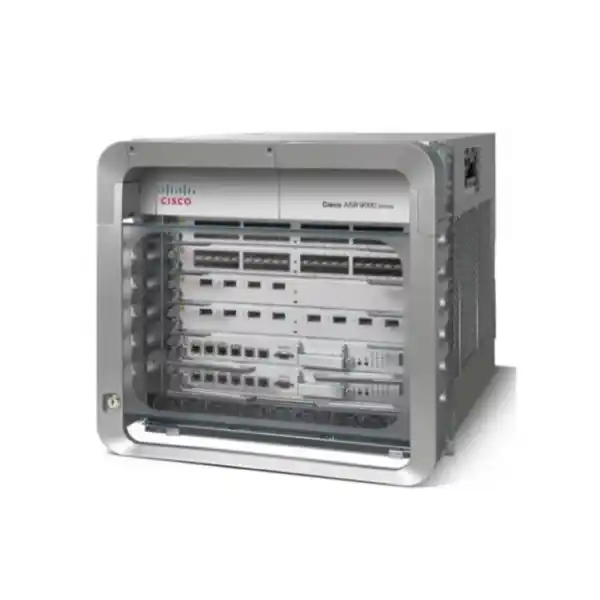
Cisco ASR 9006 Aggregation Services Router
A modular 10-RU aggregation and edge-routing platform for operators, carriers, government networks, utilities, data-center interconnect environments and large enterprises that require resilient IOS XR routing, scalable Ethernet services, MPLS, EVPN, Segment Routing and a chassis architecture that can be engineered around specific interface and service requirements.
Choose the ASR 9006 when you need a modular Cisco IOS XR platform with four line-card slots, redundant RSP positions, carrier-class routing and a compact footprint relative to larger ASR 9000 chassis. Do not size it by chassis name alone: the usable forwarding capacity, port density and feature scale depend on the exact RSP, line-card generation, optics, software train and licenses in the final BOM.
Designed for standard carrier and enterprise rack environments.
Modular interface capacity selected around the service role.
Supports redundant control-plane design when correctly configured.
Subject to the supported RSP and line-card combination.
Platform figure; real deployment capacity must be BOM-validated.
Service-provider routing, automation, MPLS and resiliency framework.
What the Cisco ASR 9006 is designed to do
The Cisco ASR 9006 is part of the ASR 9000 aggregation-services family, a routing architecture aimed at networks that must combine high-capacity forwarding with rich service-edge functions. In practical terms, that means the chassis is not simply a large Ethernet switch and it is not merely an Internet border router. It is intended for roles where routing scale, MPLS transport, service separation, quality of service, resiliency, operational consistency and interface flexibility must coexist. Typical deployments place the platform at a provider edge, metro aggregation layer, mobile transport hub, large-campus WAN edge, utility or government backbone, or as an interconnection point between data-center, transport and IP networks.
For a Dubai or wider UAE project, this distinction matters because buying the chassis is only one part of the design. The engineering decision begins with the service model. A carrier delivering business VPNs may prioritize L2VPN, L3VPN, EVPN, hierarchical QoS and deterministic convergence. A large enterprise may prioritize BGP edge scale, redundant uplinks, route-policy control, multi-VRF separation and DCI connectivity. A mobile operator may add synchronization requirements, strict latency objectives and highly resilient transport. A government or critical-infrastructure network may emphasize operational isolation, redundant control planes, auditability, standardized change procedures and a long hardware lifecycle. Each requirement changes the appropriate line-card mix, RSP choice, optics, licenses, power design and spare strategy.
The ASR 9006 should therefore be treated as a configurable routing system rather than a fixed appliance. Four line-card slots create a useful balance between modularity and rack footprint. Two RSP positions allow a redundant control-plane architecture when a pair of supported processors is installed and correctly configured. Cisco lists the platform at up to 2 Tbps of bandwidth per slot and up to 16 Tbps maximum capacity in its platform comparison information, but those figures are architectural ceilings rather than a promise that every historical card, RSP or software combination will deliver the same capacity. A production design should validate the exact hardware generation and release matrix before purchase, staging and change approval.
Chassis architecture: six slots, four for services and two for route-switch processors
The physical architecture of the ASR 9006 is centered on six principal card positions: four line-card slots and two Route Switch Processor positions. This separation is fundamental to understanding how the router is engineered. The RSP layer provides the control-plane processing, system management, route processing and fabric resources associated with the supported processor generation, while the line cards provide the physical network interfaces and packet-forwarding resources for customer, peer, transport, data-center or backbone connections. By separating control and interface functions, the chassis can be adapted as traffic patterns and service requirements change without replacing an entire fixed-format router.
The four service slots are particularly useful when a design needs a deliberately mixed interface profile. One slot could be allocated to high-density 10 Gigabit Ethernet access or aggregation, another to 100 Gigabit Ethernet uplinks, another to modular interfaces, and another retained for growth or a second uplink block. That is only an illustrative design pattern; the exact supported combinations depend on the selected hardware generations and software release. The important design principle is to map each line card to a traffic and failure-domain purpose. Doing this avoids consuming premium ports on low-bandwidth services, reduces unnecessary optic diversity and makes later expansion more predictable.
For high-availability designs, the two RSP positions are normally evaluated as a redundant pair. Redundancy is valuable not because hardware never fails, but because maintenance, software operations and component faults must be handled without turning a single control module into an avoidable outage point. Engineers should still validate the exact stateful-redundancy behavior of the intended IOS XR release, services and protocols. BGP, IS-IS, OSPF, MPLS, L2VPN, EVPN and other functions can have different convergence characteristics depending on topology and configuration. Proper resiliency therefore combines hardware redundancy with protocol design, diverse paths, fast convergence, tested maintenance procedures and realistic failure testing.
The chassis height is 17.5 inches, corresponding to 10 rack units. Cisco documentation lists a width of approximately 17.38 inches and a depth around 29.05 inches for the ASR 9006, although installation planning should account for rack-mount hardware, doors, cable-management structures and working clearance rather than using chassis dimensions alone. A UAE data-center design should also reserve front and rear service space, verify cabinet depth, ensure optical and copper bend radii, and confirm that the cabinet and floor loading are suitable for a fully configured system plus cabling and adjacent equipment.
RSP selection, forwarding fabric and why the exact BOM matters
A frequent procurement mistake is to treat every ASR 9006 as if it has identical performance. It does not. The chassis has been supported across multiple generations of Route Switch Processor and line-card technology, and those generations influence forwarding bandwidth, route scale, memory, feature support and software compatibility. Cisco documentation for IOS XR 64-bit software identifies ASR 9006 support with newer RSP families such as RSP5 and RSP880 variants, while older deployments may contain earlier RSP generations. When sourcing a new deployment, expansion, replacement or refurbished unit, the RSP part numbers must be captured explicitly rather than described only as “dual RSP.”
This is important because the forwarding fabric is not an abstract number on a datasheet. The fabric capacity available to a given line card depends on the processor and fabric architecture supporting it. If an organization buys a high-capacity line card but pairs it with an older processor generation, the result may be lower usable bandwidth than expected, unsupported combinations, or a constrained software path. Conversely, purchasing the most capable processor without validating actual interface demand can create unnecessary cost. A correct design starts with traffic and service requirements, then chooses a compatible RSP and line-card combination that meets those requirements with defined growth headroom.
For a greenfield UAE rollout, FourTeck normally recommends documenting the hardware baseline at part-number level: chassis revision, RSP product ID, line-card product IDs, fan-tray version, power-entry hardware, power-module version, optics, software image, license model, rack kit and spares. For an existing installed base, the same exercise should be performed through inventory commands and physical audit. This produces a compatibility matrix that procurement, engineering and operations can all use. It also reduces the chance of receiving a technically valid Cisco component that is nevertheless wrong for the installed chassis release or service objective.
Capacity planning should therefore use two numbers: theoretical platform capability and validated configuration capability. The theoretical number is useful for architecture comparison. The validated number is what belongs in a low-level design, change record and acceptance test. That validated figure should include expected packet sizes, traffic distribution across cards, oversubscription assumptions, link aggregation, protection behavior, service features and failover conditions. A network that appears comfortably sized in normal operation can become congested after losing an uplink, RSP, line card or remote path, so failure-state traffic is as important as steady-state traffic.
Line-card strategy: build the port map around services, not around empty slots
The ASR 9006 has supported a broad range of ASR 9000 line cards over its lifecycle. Cisco documentation includes examples ranging from 1/10 Gigabit Ethernet combinations to 100 Gigabit Ethernet cards and modular card families, with compatibility dependent on RSP generation and IOS XR release. The correct approach is not to list every historical card and assume universal interchangeability. Instead, define the port map required by the network, identify supported card families that satisfy it, and validate the exact hardware and software matrix before finalizing a bill of materials.
For metro aggregation, a common requirement is a large number of 10G handoffs combined with several 100G uplinks. A line-card plan should consider not only raw port count but also the service profile on those ports. Internet transit, peering, L3VPN customer access, mobile backhaul, wholesale Ethernet and data-center interconnect can have very different QoS, buffering, scale and operational requirements. Separating heavy services across cards can improve fault containment and maintenance flexibility. Where link bundles are used, member links should be distributed carefully so that a single card failure does not remove the entire logical path.
Optics are another part of the router design, not an afterthought. The engineering team should identify required reach, fiber type, connector, patch-panel path, optical budget, temperature rating and supported transceiver coding. Short-reach links inside a data center may use different optics from metro dark fiber or long-haul transport handoffs. 100G services can also use different optical formats and breakout arrangements depending on line card. Documenting these details before ordering prevents a common commissioning problem: the router arrives on time but the optics, patch cords or remote-side interfaces do not match.
A useful procurement deliverable is a port-allocation worksheet that maps every planned circuit to slot, card, port, speed, optic, remote device, service type, expected peak traffic and redundancy group. This worksheet should reserve sensible growth capacity and mark whether future expansion requires only additional optics, a new line card, a higher-capacity RSP or a separate chassis. FourTeck can align the ASR 9006 router design with wider UAE network infrastructure through FourTeck UAE, including switching, routing, optics, structured implementation and deployment planning.
Cisco IOS XR: operational architecture for service-provider routing
The ASR 9006 runs Cisco IOS XR, the network operating system used across Cisco service-provider routing platforms. IOS XR is designed around modular routing and operational processes, with features intended for large networks where protocol scale, controlled change, high availability and automation are central requirements. For engineering teams accustomed to enterprise IOS or IOS XE, the command structure and operational workflows require deliberate planning. The gain is an operating environment designed for carrier-grade routing, MPLS services and structured configuration management.
IOS XR supports mainstream service-provider routing protocols and service frameworks, including BGP, IS-IS, OSPF, IPv4, IPv6, MPLS, L2VPN and L3VPN capabilities. Across current ASR 9000 software documentation, Cisco also describes technologies such as EVPN, Segment Routing, SRv6 and VXLAN-related functions on the family. Feature availability on a specific ASR 9006 configuration must still be checked against the exact release, RSP and line-card set. This qualification is important because a platform family may support a feature while a particular older card or processor generation does not support every mode, scale or encapsulation.
The configuration model encourages controlled commits rather than immediate line-by-line activation. That allows engineers to review pending changes, detect conflicts and apply a consistent change set. In environments with strict maintenance governance, this model can simplify rollback planning and peer review. The operating team should build standard templates for routing policies, interface descriptions, logging, AAA, NTP, telemetry, SNMP, BGP policy, IGP, MPLS, QoS and service definitions. Consistent templates lower human error and make post-change validation repeatable.
Software strategy should be treated as part of hardware procurement. Before shipping a router to site, identify the target IOS XR train, verify hardware compatibility, read release notes, confirm required SMUs or maintenance updates, test configuration migration and capture a rollback path. The same discipline applies when integrating an existing ASR 9006 into an updated network. Do not assume that a configuration from an older RSP or IOS XR release can be moved unchanged to a newer software train. Feature syntax, defaults, hardware support and licensing can evolve.
MPLS, L3VPN and carrier service edge use
One of the strongest reasons to deploy an ASR 9006 is its suitability for IP/MPLS service-edge roles. MPLS enables an operator to build traffic-engineered transport and separated customer services over a shared infrastructure. In an L3VPN design, customer routes are placed in separate VRFs while MP-BGP distributes VPN reachability between provider-edge routers. The result is multi-tenant Layer 3 connectivity without requiring a physically separate core for each customer. For enterprises, the same concepts can be used internally to separate business units, security zones, subsidiaries, operational technology networks or managed customers.
The router can participate in an IGP such as IS-IS or OSPF for infrastructure reachability while BGP carries Internet, VPN and policy-controlled routes. In large networks, the engineering objective is not simply to make routes exchange; it is to define failure behavior. Route-policy language should be used to make import, export, local preference, communities, route targets and filtering explicit. Prefix-limit protections should be set according to expected route scale. BFD and fast-convergence mechanisms may be introduced where the design needs rapid failure detection, but timers should be validated against CPU, topology and downstream dependencies rather than aggressively reduced without testing.
For service providers in Dubai and the wider Gulf, the ASR 9006 can function as a provider-edge node aggregating enterprise circuits, mobile transport, wholesale links or data-center services. It can also sit between access aggregation and a higher-capacity core. The four-slot architecture is often attractive where a 21-RU or larger platform would be excessive but a fixed router would not provide enough modularity. A two-chassis design can provide node-level redundancy across racks, rooms or power feeds, which is generally more robust than relying solely on redundancy within one physical chassis.
When planning a VPN edge, the BOM should be sized for route scale, number of VRFs, number of BGP peers, interface count, QoS policies, multicast requirements, pseudowires, EVPN instances and the expected control-plane event rate during convergence. Those figures need to be tested against the selected processor and software release. A route table that looks modest during normal operation can create a much heavier convergence event after a major link failure or peer reset. Acceptance testing should therefore include controlled fault scenarios, not only ping and throughput tests.
L2VPN, EVPN and Ethernet service delivery
The ASR 9000 family is widely associated with Carrier Ethernet and Layer 2 VPN services. Point-to-point pseudowires can emulate an Ethernet circuit across an MPLS network, while multipoint services can create a broader Layer 2 domain between sites. Traditional VPLS remains relevant in many installed networks, and Cisco documentation for the platform also covers EVPN as a modern control-plane approach for Layer 2 and Layer 3 service delivery. EVPN uses BGP to distribute reachability information, reducing reliance on data-plane flood-and-learn behavior and providing stronger multi-homing options.
For a provider selling E-Line, E-LAN or managed data-center connectivity, the service design should define VLAN handling, MTU, MAC scale, storm control, QoS, OAM, redundancy, protection behavior and handoff standards. A customer may request a “10G Layer 2 circuit,” but the engineering definition needs far more detail: tagged or untagged handoff, single or double VLAN tags, allowed frame size, committed and excess information rates, policing, shaping, protection path, SLA measurement and demarcation responsibilities. These choices influence the router configuration and may influence which line-card resources are appropriate.
EVPN can be particularly valuable when multi-homing customer or data-center devices to redundant provider edges. Control-plane MAC learning and all-active or single-active redundancy models can improve convergence and traffic distribution compared with designs that depend heavily on spanning-tree behavior. However, feature support should be validated against the selected ASR 9006 hardware generation. Modern ASR 9000 software documentation may describe capabilities across the family that require specific line cards or processors, so the low-level design must tie each desired EVPN function to the exact target hardware and release.
For data-center interconnect, EVPN and VXLAN-related gateway functions can form part of a broader architecture connecting MPLS transport to EVPN-based fabrics. The ASR 9006 may be suitable where interfaces, feature support and scale align with the project. The design must account for MTU end to end, encapsulation overhead, failure domains, route-target policy, MAC mobility, split-horizon behavior and multi-homing state. A DCI should not extend Layer 2 simply because it is technically possible; operational failure domains and application requirements should determine where Layer 2 adjacency is truly necessary.
Segment Routing, traffic engineering and modernization paths
Segment Routing provides a method of steering traffic through a network using segment identifiers rather than maintaining the same type of per-tunnel state associated with traditional RSVP-TE designs. Cisco’s ASR 9000 software documentation covers Segment Routing and Segment Routing Traffic Engineering functions across supported hardware and releases. For operators modernizing an MPLS backbone, the technology can simplify traffic-engineering control, support policy-based paths and integrate with centralized controllers. The ASR 9006 can participate in such architectures when the selected hardware and software support the required feature set.
A migration from traditional MPLS traffic engineering to Segment Routing should not be treated as a protocol toggle. The design needs an IGP strategy, SID allocation plan, policy architecture, controller or distributed path-computation model, fast-reroute objectives, monitoring framework and a staged coexistence plan. During transition, operators may need both legacy and newer transport methods to coexist. Hardware forwarding behavior, label-stack depth, hashing and feature interactions should be tested with realistic services and packet sizes.
SRv6 is another modernization path described in newer ASR 9000 software documentation. It uses IPv6 segment-routing constructs and can enable different service and traffic-engineering models. Whether SRv6 is appropriate for a particular ASR 9006 deployment depends heavily on line-card and release compatibility. An existing chassis with older cards may be an excellent MPLS PE yet not the right target for every newer SRv6 function. The economic question is therefore not only “does ASR 9000 support it?” but “does this exact installed hardware support the feature, scale and performance we need, and is upgrading components more sensible than introducing a newer platform?”
FourTeck can support the infrastructure work around such transitions through FourTeck IT Services UAE, including discovery, configuration standardization, staging, migration-window planning, acceptance testing and operational documentation. The objective is to make the router a controlled component of a broader network transformation rather than an isolated hardware purchase.
QoS architecture: engineer the service contract into the forwarding path
Quality of Service is a critical differentiator in aggregation and service-edge routing. At high traffic volumes, congestion is inevitable somewhere in the network; the design objective is to decide how that congestion is handled. The ASR 9000 family supports hierarchical QoS capabilities on appropriate hardware, allowing service providers to classify, police, shape, mark and schedule traffic according to service policy. Exact queue counts, hierarchy levels and scale vary by line card and software, so QoS requirements should influence card selection from the beginning.
A good QoS design starts with a traffic model rather than a list of CLI commands. Identify real-time voice, signaling, interactive applications, transactional traffic, bulk data, backups, customer classes and control-plane traffic. Define what must be protected during congestion, which services can be shaped, which can be dropped first and how customer markings are trusted or rewritten. In a wholesale Ethernet environment, the provider may need per-customer policers and aggregate shaping. In a mobile transport network, timing and latency-sensitive classes may receive strict treatment. In a large enterprise, business-critical applications may need predictable behavior across WAN edges.
The second step is to map policy to the physical forwarding architecture. If many high-speed customer interfaces share a lower-capacity uplink, the design must model oversubscription. If redundant links carry full traffic after a failure, the surviving path must have enough capacity and appropriate queueing. Policers must be defined with an understanding of burst size and traffic behavior. Shapers should be placed where they actually control egress congestion. Classification rules should be simple enough to operate consistently and monitored through counters that can be tied back to the SLA.
Acceptance testing should deliberately create congestion and verify queue behavior rather than checking only line-rate forwarding. Measure loss, latency and jitter for protected classes, inspect policy counters and confirm behavior after link failures. This is especially important when the ASR 9006 is replacing another platform whose queueing model differs. A mathematically similar QoS policy can behave differently because of hardware scheduling and buffering implementation.
High availability: build redundancy across components, links and nodes
Carrier-class availability requires layers of redundancy. The ASR 9006 provides two RSP positions and supports redundant power configurations, but a resilient service cannot rely on chassis redundancy alone. The complete design should consider RSPs, power feeds, line cards, uplinks, downstream links, IGP paths, BGP sessions, MPLS label-switched paths, remote provider edges, fiber routes and even physical rack placement. The failure of any one component should have a defined and tested outcome.
At the hardware level, paired RSPs can remove the control processor as a single point of failure when supported and configured correctly. Power modules can be installed for redundancy according to the chassis power system. Link bundles can provide interface resilience, but bundle members should be distributed across cards where possible so a card failure does not remove all members. Two separate ASR 9006 chassis can provide node redundancy for services that cannot tolerate a chassis-level outage. Where possible, those routers should use independent power feeds and diverse upstream paths.
At the protocol layer, Nonstop Routing, Nonstop Forwarding and graceful-restart-related mechanisms may help preserve forwarding during specific control-plane events, depending on feature and release. Fast IGP convergence, BFD, MPLS fast reroute, EVPN multi-homing and ECMP can reduce traffic interruption for path failures. The engineering team should avoid stacking every fast-convergence feature without understanding interactions. Excessively aggressive timers can create instability, especially during maintenance or transient optical faults.
A proper resilience test plan includes RSP switchover, line-card removal where operationally safe, individual power-feed loss, member-link failure, full uplink failure, IGP adjacency loss, BGP session reset and remote-node failure. Measure packet loss and convergence for each service class. Capture expected alarms and verify that monitoring systems distinguish planned failover from unexpected faults. The goal is not zero events; it is predictable service behavior and fast diagnosis.
Power architecture for ASR 9006 deployments
The ASR 9006 uses a single power tray and supports different generations of AC or DC power systems. Cisco’s hardware documentation states that version 1 supports up to three power modules in the tray and version 2 supports up to four. The ASR 9006 does not support version 3 power modules. This is a key procurement detail: a power module that belongs to the broader ASR 9000 family is not automatically suitable for the ASR 9006 chassis.
Cisco documents both AC and DC input options, but the router must use one input type rather than a hybrid AC-plus-DC configuration. The correct choice depends on the facility. Many enterprise data centers in the UAE use redundant AC feeds backed by UPS and generators, while telecom facilities may provide -48V DC plants. The power design should account for the fully configured chassis, the selected RSPs, line cards, optics and redundancy target. Cisco provides power-calculation tools because actual consumption varies with hardware population; engineers should not size feeds based only on a chassis headline figure.
Power redundancy must be aligned with upstream electrical redundancy. Installing multiple power modules does not create full resilience if they all connect to the same PDU, UPS branch or utility feed. For dual-feed designs, map modules deliberately across independent A and B sources according to Cisco guidance and the target redundancy mode. Verify breaker ratings, cable specifications, connector types and local electrical standards. For DC installations, conductor sizing, polarity, grounding and protection devices require particular attention and should be implemented by qualified personnel.
Before commissioning, record normal power draw, module status and alarm behavior. Test one feed at a time to verify that the remaining source can support the load. Any future line-card expansion should trigger a power-capacity review because the additional card and optics may reduce redundancy margin. A capacity plan that reserves an empty chassis slot but ignores electrical headroom is incomplete.
Cooling, airflow and UAE environmental planning
Cisco specifies front-to-back airflow for the ASR 9006 power system, which should be aligned with the data-center hot-aisle/cold-aisle layout. Nominal operating temperature is documented at 5°C to 40°C, while the ASR 9006 has a short-term operating range extending from -5°C to 55°C under Cisco-defined short-term conditions. The higher short-term limit should not be interpreted as a target operating point. UAE deployments should be engineered around stable nominal conditions with sufficient cooling redundancy, clean airflow and early environmental alarms.
Dubai facilities often have excellent precision cooling, but the regional climate increases the operational importance of HVAC and power continuity. A building cooling problem, blocked filter, poorly managed cable bundle or incorrect rack airflow can raise inlet temperature rapidly. High-density routing cards and optics add localized heat. For this reason, temperature should be monitored at the device inlet and within the rack environment, not only at a room thermostat. Avoid placing equipment with reverse airflow in the same airflow zone unless the cabinet design accounts for it.
Cisco’s environmental documentation also defines humidity and altitude ranges. The nominal site should stay within supported humidity limits without condensation. Dust control is important in regional installations outside tightly controlled data centers, especially in telecom rooms or industrial buildings where filters and doors may be opened frequently. Preventive maintenance should include visual inspection, filter and fan checks according to Cisco guidance, verification of unobstructed intake and exhaust, and monitoring of fan alarms.
The rack itself must be assessed as a thermal system. Confirm perforated-door area, front clearance, rear clearance, cable density and neighboring heat loads. Deep chassis and large cable bundles can impede exhaust if rear space is insufficient. For new UAE data-center builds or equipment-room refreshes, FourTeck can coordinate rack, power and supporting infrastructure alongside network deployment through Server Dubai infrastructure services.
Physical installation and rack-readiness checklist
The ASR 9006 occupies 10 RU and is a substantial chassis, so installation should be planned rather than treated as a routine rack mount. Cisco documentation lists the chassis at roughly 17.5 inches high, 17.38 inches wide and around 29 inches deep, with weight varying significantly depending on installed components. The fully configured weight can exceed 100 kilograms in some hardware descriptions, so lifting methods, rack stability and site safety must be considered before the equipment arrives.
Start with rack compatibility. Verify the cabinet has enough usable depth for the chassis, doors, cable-management system, power connectors and optical bend radius. Confirm rail or mounting requirements and ensure the rack is securely anchored according to facility standards. Reserve vertical space around the system as required by Cisco guidance and by the chosen cable-management method. High-density fiber can become the dominant installation challenge; use structured patching and clear labels so line cards remain serviceable without disturbing unrelated circuits.
Grounding is a core part of installation. The equipment rack, chassis and electrical system should comply with local regulations and Cisco grounding instructions. In telecom environments, grounding and bonding practices may be more stringent than in typical enterprise server rooms. Never improvise DC power or grounding connections to meet a commissioning deadline. Electrical and physical infrastructure should be signed off before the router is energized.
A pre-install survey should capture rack ID, available RU position, front and rear photographs, power-feed type, breaker details, PDU sockets, grounding point, fiber paths, patch-panel ports, cable lengths, management-network availability and console access. The result becomes part of the method of procedure for installation. On commissioning day, engineers can then focus on verification and configuration rather than discovering basic infrastructure gaps.
Routing scale, control plane and sizing methodology
Routing scale should be sized from measured or forecast network state rather than from vague labels such as “full Internet table capable.” The ASR 9006 platform has existed across multiple processor generations, and route scale depends on the installed RSP, memory, software release, address family and enabled features. A BGP edge carrying IPv4 unicast, IPv6 unicast, VPNv4, VPNv6 and EVPN routes can have very different memory and control-plane demands from a router carrying only an IGP and a few internal prefixes.
A sound sizing exercise records current routes by address family, expected annual growth, number of peers, maximum prefixes per peer, route-policy complexity, update rate, convergence objectives and backup paths. For MPLS PE use, add number of VRFs, route targets, VPN routes, pseudowires, EVPN instances, MAC routes and multicast state where applicable. For Internet edge use, consider whether the router receives one full table, multiple full tables, partial routes plus default, or route-server feeds. More routes are not always operationally necessary; the routing policy should match the traffic-engineering objective.
Control-plane stress often appears during abnormal events. A major peer flap, route-reflector restart, IGP reconvergence or optical instability can generate bursts of updates far beyond the normal rate. The design should therefore include convergence testing and route-policy safeguards. Max-prefix limits, dampening strategies where appropriate, BGP session protection, infrastructure ACLs and control-plane policing can reduce risk. The exact protection mechanisms and syntax should be validated for the chosen IOS XR release.
Where the installed ASR 9006 is older, a hardware assessment is especially valuable. Upgrading RSPs or line cards may extend useful life, but the cost should be compared with the operational advantages of a newer platform. The right answer depends on existing spares, interface needs, software requirements, support status, staff familiarity and migration risk. A lifecycle decision is an engineering and financial calculation, not simply a benchmark comparison.
Security controls at the routing edge
The ASR 9006 is not a next-generation firewall, but a service-provider router still has major security responsibilities. It enforces routing policy, interface filters, infrastructure protection, management-plane controls, VRF separation and service boundaries. Security design should begin by separating traffic planes: management traffic, routing control traffic and customer data traffic should each have explicit policies. Remote administration should be limited to trusted management networks, use strong authentication and be logged centrally.
Routing protocols need protection from accidental and malicious misuse. BGP peers should have tightly defined neighbor addresses, prefix policies, maximum-prefix limits and appropriate authentication or session-security controls where supported. IGP adjacencies should exist only on intended infrastructure links. Route redistribution should be minimized and documented. Infrastructure prefixes should be filtered from customer-facing interfaces, and bogon or invalid source policies can be applied according to network role and operational policy.
Layer 2 services also need safeguards. Customer VLANs, bridge domains and pseudowires must be uniquely mapped to avoid cross-connection. MAC limits and storm-control-related mechanisms may be relevant depending on service type and hardware. EVPN route-target policy needs the same discipline as L3VPN route targets because an incorrect import/export rule can join domains that were intended to remain separate. In multi-tenant environments, configuration automation should include validation checks to reduce this class of error.
Where the router connects to Internet or untrusted networks, pair routing controls with dedicated security enforcement as required. FourTeck’s Firewall Dubai practice can align edge-routing design with firewall segmentation, DDoS strategy, secure remote access and logging architecture. The router and firewall should have distinct, intentional responsibilities rather than overlapping policies that are difficult to troubleshoot.
Management, telemetry and operational readiness
A router of this class should never be deployed with monitoring limited to interface up/down alarms. Operational readiness includes device health, RSP state, line-card state, fabric status, power modules, fans, temperatures, optical levels, routing sessions, route counts, MPLS state, service state, CPU, memory, packet drops, QoS counters and syslog. The exact telemetry stack can use SNMP, streaming telemetry, model-driven interfaces, CLI collection or a combination depending on the IOS XR release and the organization’s tools.
Monitoring thresholds should reflect normal baselines. A 70 percent CPU reading may be harmless during a known convergence event but concerning if sustained. Optical receive power can degrade gradually before a link fails. A growing output-drop counter may reveal a congestion problem long before users open tickets. Collecting time-series data allows operators to identify trends and capacity limits, while event correlation helps distinguish a primary fault from secondary alarms.
Configuration management is equally important. Store version-controlled backups, capture golden templates and record every production change. AAA should use centralized authentication where practical with a tested emergency-access process. NTP or another supported time source should be configured consistently so logs can be correlated across routers, firewalls, servers and monitoring platforms. Management access should be separated through a dedicated VRF or out-of-band network where the architecture allows it.
Operational handover should include a command reference for routine checks, alarm interpretation guide, backup procedure, software upgrade workflow, RSP switchover procedure, common fault isolation steps and vendor-escalation information. This documentation is especially valuable where the network operations center and implementation team are separate organizations. The goal is to ensure that knowledge about the ASR 9006 survives beyond the installation project.
Synchronization and mobile transport considerations
Mobile and converged transport networks often require timing as well as packet forwarding. Cisco has documented timing functions in ASR 9000 RSP families, including support for technologies such as Precision Time Protocol, BITS, GPS-related interfaces and Synchronous Ethernet depending on hardware. For a mobile backhaul or fronthaul-adjacent design, timing requirements should be specified separately from bandwidth because a router can meet throughput targets while still failing a synchronization objective.
The engineering team should identify whether the service needs frequency synchronization, phase/time synchronization or both. It should map primary and backup clock sources, define quality-level behavior, decide how clock selection operates during failure and verify support across the chosen line cards and RSP. Timing must be tested through the end-to-end path because intermediate optical transport, Ethernet devices and access equipment can affect performance.
Mobile traffic also places strict demands on QoS and convergence. Voice and signaling flows may require low latency, while user-plane traffic can be highly bursty. Aggregation links need capacity for peak demand and failover conditions. Segment Routing, MPLS TE or traditional IGP engineering may be used to control paths, but the design must remain operationally understandable. A theoretically optimal traffic-engineering policy that is difficult for the NOC to troubleshoot can increase real-world outage duration.
For UAE operators, the ASR 9006 can therefore be evaluated as part of a broader transport node that combines Ethernet aggregation, MPLS, routing, QoS and synchronization. The exact fit depends on interface speed requirements and future capacity. If the project is rapidly moving toward dense 400G or beyond, a newer chassis may be economically more appropriate. If the requirement is a mature mix of 10G/100G services with an established IOS XR operational model, the ASR 9006 may remain a practical fit when the required components and support lifecycle align.
Deployment scenario 1: Dubai Internet and enterprise WAN edge
A large enterprise, cloud provider or managed-service operator can use the ASR 9006 as a high-capacity routing edge connecting multiple carriers, private WANs and internal aggregation layers. In this role, the design may use BGP for Internet and partner connectivity, VRFs for service separation, high-speed Ethernet line cards for upstream circuits and redundant RSPs for control-plane resilience. Two ASR 9006 chassis can be deployed as separate edge nodes to remove the physical chassis as a single failure domain.
The architecture should determine whether full Internet routes are necessary on every edge node. Some enterprises prefer full routes from two or more carriers for granular outbound policy, while others use partial routes plus default to reduce complexity. Inbound traffic engineering can use BGP communities and provider-specific controls. Route filtering should reject unexpected prefixes, and default-only designs should still protect against accidental route leaks. The internal handoff can use OSPF, IS-IS or iBGP depending on the wider architecture.
Physical diversity is central in Dubai multi-carrier deployments. Two circuits from different providers are not truly diverse if they share the same building entry, riser, meet-me room or metro duct. The network design should capture provider demarcation, fiber path, cross-connect and power diversity. Router redundancy should be matched by carrier and facility redundancy; otherwise the most expensive component remains protected while a single fiber path determines availability.
The ASR 9006 can also provide a controlled boundary between enterprise routing and dedicated firewalls. A common architecture places Internet circuits on the router, uses BGP and route policy there, then hands selected networks to firewalls for security enforcement. This division keeps the routing function scalable while preserving deep security inspection on specialized platforms. The exact topology depends on whether public services, DDoS scrubbing, remote-access VPN and cloud connections are involved.
Deployment scenario 2: service-provider PE and metro aggregation
In a service-provider network, the ASR 9006 can operate as a Provider Edge router aggregating customer Ethernet and IP services. Access rings or aggregation switches feed the chassis over 10G or 100G interfaces, while core-facing links connect to P routers, route reflectors or upstream PE nodes. Customer services can be modeled as L3VPNs, pseudowires, VPLS or EVPN depending on product definition and network evolution.
The design should separate customer scale from transport scale. For each PE, record number of attachment circuits, VRFs, bridge domains, pseudowires, BGP VPN routes, EVPN MAC/IP routes, QoS policies and multicast state. Then model growth and a node-failure scenario in which a peer PE temporarily handles additional traffic. This avoids deploying a router that is adequate at day one but has no operational margin during expansion or maintenance.
Service assurance should be built into the architecture. Ethernet OAM, MPLS OAM, BFD, SLA probes and telemetry can provide visibility into different layers. The NOC should be able to distinguish a customer access fault from a pseudowire issue, core path problem, optic degradation or remote CE failure. Consistent naming and service identifiers across configuration, CRM and monitoring systems significantly improve fault restoration times.
For regional operators extending services beyond the UAE, a standardized ASR 9006 design can simplify spares and training across multiple markets. FourTeck’s broader regional presence at FourTeck Africa can support multi-country network programs where common engineering standards, hardware baselines and deployment documentation are required across sites.
Deployment scenario 3: government, utility and critical infrastructure backbone
Government and utility networks often combine geographically dispersed sites, strict segmentation and long equipment lifecycles. The ASR 9006 can serve as a regional backbone or aggregation router where modular interfaces and IOS XR services align with the requirement. VRFs can separate departments, operational technology, corporate IT, public services and third-party connectivity. MPLS or Segment Routing can provide controlled transport between sites, while redundant routing and power architectures support availability targets.
In these environments, lifecycle governance can be more important than maximum throughput. Every hardware part number should be recorded, spares should be held according to restoration targets and software releases should pass a controlled validation process before production rollout. Configuration changes may require peer review and formal approval. The router’s role in security architecture should be documented clearly so that routing ACLs, firewalls and segmentation policies do not conflict.
Out-of-band management is strongly recommended where practical. A separate management network allows engineers to reach the ASR 9006 during failures that affect production routing. Console-server access, redundant management switches and independent power can improve recoverability. Backup configurations, software images and device inventory should be stored in protected repositories accessible to authorized operations staff.
Environmental conditions may also differ from commercial data centers. Utility substations, industrial campuses or remote telecom rooms can face higher dust levels, temperature variation and limited hands-on support. The ASR 9006 should be installed only where environmental and power conditions meet Cisco requirements. Remote telemetry, environmental sensors and well-defined field-replacement procedures are particularly valuable when a site is difficult to access.
Capacity planning: convert traffic forecasts into a chassis design
Start capacity planning with traffic matrices, not port-count estimates. List each ingress and egress connection, current peak, 95th percentile, expected annual growth, service class and failure path. A 100G interface does not imply 100G of sustained load, but several lightly used links can converge onto the same uplink during an outage. The design must capture these relationships. For a three-year planning horizon, apply realistic growth assumptions rather than arbitrary 50 percent headroom everywhere.
Next, map traffic to line-card slots. The goal is to distribute high-volume services so that no card becomes an unnecessary bottleneck or single point for a complete service family. If a link bundle spans multiple line cards, calculate the remaining bundle capacity after losing one card. If two core uplinks sit on one card, ask what happens when that card is removed. If all customer access sits on another card, determine whether maintenance can be performed without a mass outage.
Then model packet-rate rather than only bit-rate demand. Small packets create a higher packets-per-second load than large packets for the same Gbps value. Security filtering, NetFlow-like functions, QoS classification and encapsulation can also affect hardware-resource consumption. Hardware forwarding is highly capable, but engineered networks validate worst-case service combinations instead of assuming every feature is free at every scale.
Finally, create thresholds for expansion. For example, define when average core-link utilization, route scale, port occupancy or power draw should trigger additional optics, a new card, RSP upgrade or second chassis. Thresholds turn capacity planning into an operational process. They also help finance teams forecast capital expenditure before an urgent capacity event forces an expedited purchase.
The listed ASR 9006 platform capacity of up to 16 Tbps provides substantial architectural headroom, but it should never replace this bottom-up sizing method. The system capacity that matters is the capacity of the validated BOM under the specific services and failure states of the production network.
ASR 9006 technical planning reference
| Planning item | ASR 9006 reference | Design implication |
|---|---|---|
| Rack height | 10 RU / 17.5 in. | Reserve rack, service and cable-management space. |
| Line-card slots | 4 modular slots | Map slots to service and failure domains. |
| RSP slots | 2 | Plan a compatible redundant pair where HA is required. |
| Bandwidth per slot | Up to 2 Tbps listed | Validate against exact RSP and line card. |
| Maximum system capacity | Up to 16 Tbps listed | Treat as platform ceiling, not guaranteed BOM throughput. |
| Power system | Version 1 or Version 2 AC/DC | Do not order Version 3 modules for this chassis. |
| Nominal temperature | 5°C to 40°C | Engineer UAE sites for stable nominal operation. |
| Short-term temperature | -5°C to 55°C under defined conditions | Not a recommended continuous operating target. |
| Airflow | Front to back | Align cabinet and aisle airflow accordingly. |
| Software | Cisco IOS XR | Validate release, feature and hardware compatibility. |
Licensing and software entitlement planning
Cisco licensing models have evolved across the lifetime of the ASR 9000 family. Some historical line cards and feature sets used capacity or service licenses, while current IOS XR offerings may use newer consumption and entitlement models. A procurement team should not assume that a used or spare card includes every required software right simply because the hardware is physically present. Likewise, a chassis moved from one network to another may require a licensing review before the target service is activated.
Build the license review from the feature list. Identify whether the deployment needs advanced routing, service-edge functions, capacity activation, telemetry, encryption-related capability or other licensed functions for the chosen software release. Then map those functions to Cisco’s current entitlement documentation and the specific hardware product IDs. This is especially important when mixing new and older components, because a historical hardware architecture may coexist with a newer software licensing framework.
Software support also has operational value beyond access to an image. Organizations may require entitlement for technical assistance, defect resolution, security updates and release guidance. For a mission-critical router, support strategy should match the business impact of failure. If a platform is being retained as part of an installed base, confirm that the desired software train and hardware components remain within the organization’s support policy and vendor lifecycle requirements.
The final quotation should therefore separate chassis hardware, RSPs, line cards, optics, power components, rack accessories, software entitlements, support services and professional implementation. This makes commercial comparison easier and exposes missing components before purchase approval.
Procurement in Dubai: what must be stated on the quotation
A reliable ASR 9006 quotation should be detailed enough that an engineer can understand exactly what will arrive. The description “Cisco ASR 9006 with dual RSP and 100G card” is not sufficient. It should identify product IDs, quantities and condition for the chassis, RSPs, line cards, fan trays, power tray, power modules, rack accessories, optics and licenses. If any component is refurbished, replacement, surplus or recertified, that status should be explicit. Serial-number and warranty requirements should be agreed before delivery.
Compatibility must be validated before commercial acceptance. A line card may fit mechanically but require a newer RSP or IOS XR release. A power module may belong to the ASR 9000 family but be unsupported in the ASR 9006. An optic may be electrically compatible yet unsupported for the intended card or reach. A software release may support the chassis but not an older interface module. Part-number validation is therefore a technical gate in the procurement process.
Lead time and spares should also be considered. In critical networks, a replacement RSP, fan tray or common optic can be more valuable than additional unused chassis capacity because it shortens mean time to repair. Spares should reflect actual failure impact and local availability. For regional networks, decide whether spares will be centralized in Dubai or distributed to country sites. Shipping time, customs processes and site access can turn a nominally redundant network into a long outage if a second failure occurs before the spare arrives.
FourTeck can prepare a quotation around a defined network role rather than a bare chassis request. Providing current topology, required ports, software features, power environment and availability target allows the BOM to be engineered more accurately and reduces revision cycles during procurement.
New deployment, expansion or lifecycle extension?
The ASR 9006 is a mature modular platform, so buyers should define whether the project is a greenfield deployment, an expansion of an existing ASR 9000 estate or a lifecycle-extension exercise. These cases have different economics. Existing operators may already own compatible line cards, spares, IOS XR automation and staff expertise, making an ASR 9006 expansion very efficient. A greenfield buyer should compare the platform with newer Cisco routing options based on interface roadmap, power efficiency, support horizon and required software functions.
For expansion, inventory the installed system first. Capture chassis PID, serial number, RSP type, line cards, power version, fan version, IOS XR release, licenses and free slots. Measure current traffic and route scale. Then determine whether the requirement can be met by adding optics, changing a line card, upgrading RSPs or installing a second chassis. This prevents unnecessary replacement and also reveals hidden constraints such as power capacity or software compatibility.
For lifecycle extension, define the business horizon. If the router only needs to support a stable 10G/100G aggregation role for several years, retaining the platform may be sensible when spares and vendor support are available. If the network roadmap includes dense 400G, major SRv6 expansion, significantly higher scale or a new automation architecture, migration planning may offer better long-term value. Running cost, rack space and power should be included in the comparison, not only chassis purchase price.
The migration path can be phased. A second-generation platform can be introduced in parallel, new services placed there, and existing circuits moved during controlled windows. BGP, MPLS and EVPN architectures can often support coexistence, but hardware and software feature interoperability must be tested. A phased approach reduces risk compared with a one-night replacement of a heavily loaded provider edge.
Implementation method for a production ASR 9006
A production rollout should begin with discovery and a low-level design. Discovery captures current topology, routing protocols, address plan, VLANs, VRFs, services, QoS, MTU, optics, monitoring, security policy and failure objectives. The low-level design converts those inputs into interface assignments, routing policies, protocol settings, redundancy behavior and migration steps. For a replacement project, the design should also identify behavioral differences between the old and new platforms.
The router should then be staged before site installation whenever possible. Staging verifies hardware inventory, RSP redundancy, line-card health, power-module state, software version, license status and base configuration. Management access, AAA, NTP, logging and monitoring can be tested in advance. Where a lab or peer device is available, engineers can validate BGP, IGP, MPLS, L2VPN, EVPN or QoS functions before the maintenance window.
The migration method of procedure should be written as a sequence with owners and checkpoints. It should state which links move first, which routes or services are expected at each step, how success is measured and when rollback is triggered. Pre-change captures should include interface state, neighbor state, route counts, service counts, CPU, memory and key traffic metrics. Post-change validation should compare against those baselines rather than relying on a few manual pings.
After cutover, keep heightened monitoring for a defined observation period. Check optical levels, interface errors, packet drops, routing stability, QoS counters and customer-service alarms. Update network diagrams, inventory, monitoring systems and spare records. The project is complete only when operations has accurate documentation and the old configuration or hardware has been handled according to the rollback and decommissioning plan.
Common ASR 9006 design mistakes to avoid
Buying by chassis name only
The ASR 9006 has multiple supported generations of processors, cards and power systems. Require exact product IDs and validate the complete combination.
Treating 16 Tbps as universal throughput
Platform capacity is an architectural ceiling. Real capacity depends on RSP, line cards, traffic profile, services and software.
Ignoring failure-state traffic
A network sized only for normal operation can congest after a core-link, card or node failure. Model N-1 and node-loss conditions.
Ordering unsupported power modules
The ASR 9006 supports version 1 and version 2 power systems and does not support version 3 power modules.
Leaving optics until installation
Reach, fiber, connector, remote-side interface and transceiver support should be engineered and quoted with the router.
Skipping software compatibility review
Feature support belongs to a hardware-and-release combination. Check release notes and compatibility before migration.
Frequently asked technical questions
How many line cards does the ASR 9006 support?
The chassis provides four line-card slots in addition to two RSP positions. The actual interfaces available depend on the installed line-card models.
Is the ASR 9006 a 10-RU chassis?
Yes. Cisco lists the ASR 9006 at 17.5 inches high, corresponding to 10 rack units.
Does it support redundant RSPs?
The chassis has two RSP slots and can be designed with a compatible redundant processor pair. Exact behavior depends on hardware and IOS XR release.
Can ASR 9006 run IOS XR 64-bit?
Cisco documents ASR 9006 support for IOS XR 64-bit beginning with supported hardware and releases. Verify the exact RSP, card and target release matrix.
Does it support MPLS L3VPN?
Yes, the ASR 9000 family is designed for MPLS service-edge roles including L3VPN. Scale and feature details must be matched to the selected configuration.
Does it support L2VPN and EVPN?
Cisco IOS XR documentation covers L2VPN and EVPN across the ASR 9000 family. Confirm specific EVPN functions against the exact ASR 9006 hardware and software release.
Can I install version 3 power modules?
No. Cisco documentation specifically notes that the ASR 9006 chassis does not support version 3 power modules.
Can the chassis mix AC and DC?
No. Cisco hardware guidance states that ASR 9000 routers use one input type; hybrid AC and DC operation is not supported.
What is the nominal operating temperature?
Cisco lists 5°C to 40°C nominal operation. The ASR 9006 also has a defined short-term range up to 55°C, which is not a continuous target.
How should I request a quotation?
Provide required port speeds and quantities, service features, RSP redundancy, AC/DC power, target IOS XR release, optics, support term, rack requirements and deployment location.
Decision recap: when the ASR 9006 is a strong fit
The Cisco ASR 9006 is a strong candidate when the network needs more modularity and service depth than a fixed router but does not require the rack footprint of a larger chassis. Four line-card slots make it practical for deliberate interface mixes, while two RSP positions support a resilient control-plane design. IOS XR provides the routing, MPLS and service-provider operating framework expected in large aggregation networks.
Choose it when
You need modular 10G/100G-class aggregation, MPLS PE services, L2VPN/L3VPN, EVPN functions, large-scale BGP, resilient routing and a mature IOS XR operations model.
Validate first when
The chassis contains older RSPs or cards, the project needs newer SRv6/EVPN functions, or a quotation combines hardware generations. Compatibility must be checked part by part.
Consider newer platforms when
The roadmap is centered on dense 400G interfaces, materially higher scale, improved power efficiency or features that are not economical on the installed ASR 9006 generation.
For Dubai procurement
Specify chassis, RSP, line cards, power version, optics, software, licenses, support, spares and installation scope in the same technical BOM.
Quotation input checklist for Cisco ASR 9006 Dubai
Sending the information below with your RFQ allows the technical and commercial team to build a more accurate ASR 9006 configuration on the first pass.
Internet edge, MPLS PE, metro aggregation, DCI, mobile transport, enterprise core or replacement.
Port count by 1G, 10G, 40G, 100G or modular interface type, including growth reserve.
Reach, single-mode or multimode, connector, remote interface, patching and dark-fiber details.
BGP peers, route counts, VRFs, VPN routes, EVPN routes, IGP size and multicast requirements.
MPLS, L2VPN, L3VPN, EVPN, Segment Routing, QoS, BFD, multicast, timing and telemetry.
Dual RSP, redundant power, dual chassis, link bundles, diverse paths and failover targets.
AC or DC, available feeds, PDU type, redundancy goal and existing chassis power-system version.
Current IOS XR version, desired release, licensing requirements and maintenance policy.
Dubai/UAE location, rack type, free RU, cabinet depth, airflow, grounding and delivery restrictions.
Hardware only, staging, configuration, migration, remote support, onsite support or managed operations.
FourTeck consultation for ASR 9006 architecture and procurement
For a production router, the correct question is not “what is the price of an ASR 9006 chassis?” but “which ASR 9006 configuration safely delivers the required services, scale, interfaces and failure behavior?” FourTeck can work from your current topology or service requirements to produce a configuration-oriented quotation and deployment scope for Dubai and the wider UAE.
Where required, the engagement can cover hardware inventory, compatibility validation, port mapping, optics, rack and power review, IOS XR baseline, routing policy, MPLS/EVPN design, migration procedure, test plan, monitoring integration and operational handover. This approach reduces procurement ambiguity and creates a system that is easier to operate after commissioning.
Include required interfaces, current router model, desired protocols, power type, redundancy target and installation location. If replacing an existing ASR 9006, include RSP and line-card product IDs from the installed chassis.
Final engineering note
The Cisco ASR 9006 remains a highly configurable routing chassis whose real value comes from matching its modular hardware to a clearly defined network role. Its four line-card slots, redundant RSP architecture, IOS XR software model and ASR 9000 service portfolio make it suitable for sophisticated aggregation and provider-edge environments. Because the platform spans several hardware generations, every serious quotation should be validated at product-ID level rather than relying on family-level capability statements.
For Dubai deployments, pay particular attention to chassis power generation, airflow, cooling redundancy, cabinet depth, fiber management and spare strategy. For network design, validate route scale, QoS, VPN services, EVPN or Segment Routing requirements against the exact RSP, line cards and IOS XR release. This disciplined approach turns the ASR 9006 from a collection of compatible parts into a predictable production routing system.

Reviews
There are no reviews yet.