
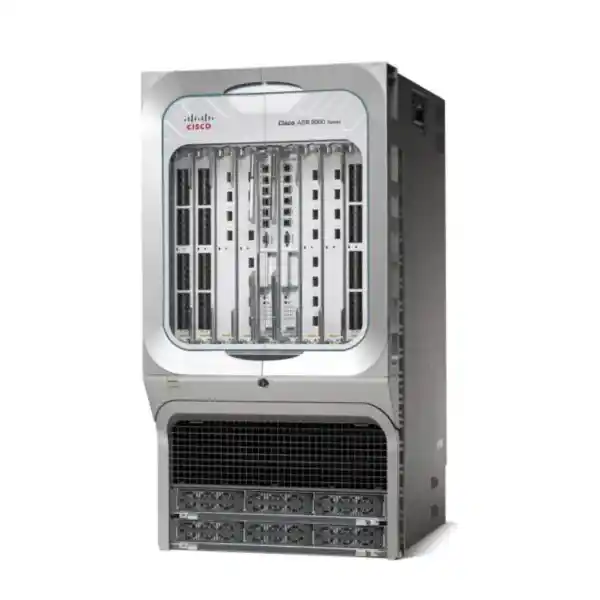
Cisco ASR 9010 Aggregation Services Router
A modular Cisco ASR 9000 Series platform for resilient provider-edge routing, Ethernet aggregation, broadband subscriber services, MPLS, transport convergence and high-density network growth. FourTeck supports UAE organizations with architecture validation, chassis and card selection, optics planning, power engineering, IOS XR implementation and lifecycle-aware deployment.
Direct answer: what is the Cisco ASR 9010 and where does it fit?
The Cisco ASR 9010 is a modular member of the Cisco ASR 9000 Series Aggregation Services Routers. It is built for networks where interface density, deterministic forwarding, protocol scale, operational continuity and service flexibility matter more than the compact footprint of a fixed router. The chassis provides two positions for Route Switch Processor cards and eight positions for service or Ethernet line cards. That architecture lets a network designer separate control-plane resilience, switch-fabric capacity and interface selection instead of purchasing a fixed port map that may become restrictive as traffic changes.
In practical UAE deployments, the ASR 9010 is most relevant at the provider edge, metro aggregation layer, broadband network gateway environment, large Internet edge, data-center interconnect aggregation layer, wholesale service edge or a high-scale enterprise WAN core. It is not a small branch router and should not be sized as one. The correct bill of materials depends on the exact generation of RSPs, line cards, optical modules, software release, feature licenses, redundancy target, rack conditions and expected traffic mix. FourTeck therefore treats the chassis as an engineering platform rather than a single fixed-throughput appliance.
Redundant route-switch processing with up to eight line-card slots for modular service and interface growth.
Packet-forwarding functions reside on line cards while the RSP provides system control, switch-fabric and timing functions.
Service-provider routing software designed for modularity, operational isolation, high availability and large routing environments.
Designed for networks that need redundant control, flexible Ethernet speeds and long-lived modular expansion.
ASR 9010 chassis architecture explained
The ASR 9010 is best understood as an integrated routing system composed of a chassis, redundant control and fabric resources, distributed line-card forwarding engines, power infrastructure and cooling subsystems. Cisco documentation describes the ASR 9000 family as fully distributed: traffic arrives on an interface implemented by a line card, packet lookup and forwarding actions are performed with resources on that line card, and the internal switch fabric carries traffic toward the egress line card when the destination interface is located in a different slot. This architecture reduces dependence on a centralized forwarding CPU and is one of the reasons the platform can scale across multiple interface generations.
Two chassis slots are reserved for Route Switch Processor functions. In a redundant deployment one RSP operates as the active control element while the second is available as standby. The RSP also provides switch-fabric resources and system timing. Cisco has released multiple generations of RSP hardware over the platform lifecycle, including later RSP families with higher fabric bandwidth, memory and processing capability. This means an ASR 9010 chassis name alone does not tell you the complete performance envelope. A production design must identify the actual RSP PIDs and their compatibility with the required line-card generation and IOS XR release.
The remaining eight positions can accept compatible ASR 9000 line cards according to the selected hardware and software matrix. Depending on generation, those cards can provide combinations of 1 Gigabit Ethernet, 10 Gigabit Ethernet, 25 Gigabit Ethernet, 40 Gigabit Ethernet, 100 Gigabit Ethernet and, in supported modern configurations, higher-speed capabilities associated with later ASR 9000 hardware families. The critical design discipline is to treat every chassis as a complete compatibility matrix. Interface type, fabric generation, software train, optical module, breakout mode and license state must agree before the bill of materials is approved.
Why throughput must be stated with context
Marketing summaries for modular routers can create confusion because a chassis may appear with different capacity figures in documentation written for different RSP, fabric and line-card generations. The ASR 9010 has existed across a long Cisco ASR 9000 hardware evolution. Earlier configurations and later RSP or line-card combinations do not represent the same per-slot bandwidth. A responsible UAE quotation should therefore avoid promising one universal chassis throughput without first defining the exact hardware population.
When FourTeck sizes an ASR 9010, the calculation begins with required ingress and egress bandwidth by slot, oversubscription policy, expected packet size distribution, service features, traffic directionality and failover state. We then compare those requirements with the fabric capacity available from the selected RSP generation and with each card’s supported throughput. A design that looks nonblocking in normal operation may still become oversubscribed during RSP, line-card, LAG-member or upstream-path failure if redundancy is not included in the math.
This contextual method is especially important for service providers carrying Internet transit, peering, mobile backhaul, business Ethernet, broadband subscribers, multicast video or mixed VPN services. Those traffic profiles can stress different resources. Small-packet forwarding may place a very different load on forwarding engines than large-packet bulk transfer, and subscriber or service features can introduce scale constraints unrelated to raw interface rate. Capacity planning should therefore combine bandwidth, packets per second, route scale, label scale, QoS policy scale and operational convergence requirements.
Cisco IOS XR: the operational foundation
Cisco IOS XR is central to the ASR 9000 operating model. It was designed for carrier-scale routing environments where software modularity, process isolation, high availability and controlled operational change are fundamental. Rather than treating the router as a monolithic branch device, IOS XR exposes a structured operational environment for routing protocols, interface services, MPLS functions, policy, management and lifecycle operations. For engineering teams in Dubai running critical WAN or provider-edge infrastructure, the practical value is the ability to design change procedures around redundancy and service continuity.
Typical control-plane responsibilities can include BGP for Internet, VPN and inter-domain routing; IS-IS or OSPF for an interior gateway protocol; MPLS label distribution and traffic-engineering functions; segment-routing functions on appropriate software and hardware combinations; multicast control protocols; Ethernet service signaling; and network management through CLI, SNMP and automation interfaces supported by the selected IOS XR release. Exact feature availability must always be validated against the release and hardware matrix because the ASR 9000 family spans many generations.
Operationally, software selection is as important as the physical chassis. A new deployment should identify a Cisco-recommended maintenance release or organization-approved software train, confirm that every RSP and line card is supported, review ROMMON or firmware prerequisites, validate required packages and licenses, and build a rollback path before production migration. Existing ASR 9010 estates may also require an interim upgrade sequence rather than a direct jump between widely separated releases.
FourTeck can align router staging with change-management requirements, including baseline configuration, management-plane access, AAA, NTP, logging, SNMP or telemetry, routing policy, interface naming, redundancy verification and pre-migration test cases. For customers that need broader implementation support, our UAE IT services team can coordinate rack, network, migration and operational handover activities around the routing project.
Routing and service roles for the ASR 9010
Provider edge and MPLS VPN
The ASR 9010 can be positioned as a provider-edge node where customer VLANs, routed links or access rings terminate into MPLS-enabled services. Depending on hardware and software, it can support Layer 3 VPN, Ethernet VPN or legacy Layer 2 service requirements, with routing policy and QoS applied at the service edge. The modular port architecture is useful when the same chassis must aggregate many lower-rate customer interfaces while also connecting to higher-speed core links.
Metro Ethernet aggregation
In metro networks, the router can consolidate traffic from access switches, rings or aggregation nodes. Ethernet services may include VLAN-based handoffs, QinQ or service-instance constructs, protected uplinks, link aggregation and routed aggregation. Engineers should size MAC, VLAN, pseudowire, bridge-domain and routing scales according to the intended service model rather than relying only on physical port count.
Broadband network gateway
Where a supported BNG architecture is required, the ASR 9000 family can be engineered for subscriber-aware broadband functions. That design requires careful attention to subscriber scale, session type, address assignment, authentication, policy, accounting, QoS hierarchy, redundancy and service-edge line-card capabilities. The correct configuration is workload specific and must be validated against the intended IOS XR release.
Internet and peering edge
The chassis can serve at an Internet edge where BGP scale, policy control, upstream diversity and high-speed interfaces are required. Route-table growth, RSP memory, convergence behavior, prefix filtering, RPKI integration architecture, DDoS operational strategy and telemetry all matter. The edge should be designed around both normal operation and failure scenarios such as loss of an upstream or a route processor.
Data-center interconnect
For organizations interconnecting facilities across Dubai, Abu Dhabi or other UAE locations, an ASR 9010 can provide high-capacity routed or service-provider style transport at the DCI edge. The design may incorporate dark fiber, wavelength services, carrier Ethernet or leased capacity. Optics, MTU, protection, latency, BFD timers and route convergence should be engineered end to end.
Large enterprise WAN core
Large enterprises, utilities, aviation, education, government and financial organizations can use carrier-class routing architecture when they operate many sites or multiple data centers. In these environments the ASR 9010 may aggregate diverse carrier circuits and internal MPLS or routed services. The modular chassis makes sense when operational continuity and interface growth justify its rack, power and cooling footprint.
Route Switch Processor planning: RSP generation matters
The RSP is not merely a management card. In the ASR 9010 architecture it combines major control-plane responsibilities with switch-fabric and timing functions. Cisco documentation describes redundant operation in which one RSP is active and the other can assume control functions after a failure. Because the fabric is also associated with the RSP design, choosing the correct RSP generation is fundamental to per-slot bandwidth and line-card compatibility.
Cisco has introduced multiple RSP generations over the life of the ASR 9000 platform. Later RSP variants provide increased bandwidth, memory and processing capability compared with earlier hardware. Some generations are available in different scale or feature-oriented variants. A procurement team should therefore record the exact PID rather than using a generic description such as “ASR 9010 dual supervisor.” The PID determines what line cards can be used, what software releases are supported and how much fabric capacity is available to each slot.
For a redundant production node, both RSPs should normally be planned as a matched and supported pair according to Cisco rules for the chosen release. The migration process should verify synchronization, standby readiness, configuration state, software parity and switchover behavior. If a customer is upgrading an installed chassis, line-card compatibility can become the deciding factor: replacing RSPs may enable newer cards but may also require software changes, power-system upgrades, optics replacement or removal of unsupported legacy components.
FourTeck’s quotation workflow therefore records chassis revision, existing RSP PID, target RSP PID, installed line-card PIDs, target IOS XR release, power-tray version and all optical interfaces. This prevents an apparently economical card purchase from creating a compatibility problem during the maintenance window.
Line cards, port density and interface strategy
The eight line-card positions are where the ASR 9010 becomes application specific. A metro aggregation router may need large quantities of 10 Gigabit Ethernet and 1 Gigabit Ethernet handoffs. An Internet edge may prioritize 100 Gigabit Ethernet or higher-speed uplinks with fewer physical customer-facing interfaces. A broadband edge can require line cards whose scale and service features match subscriber requirements. An installed base may include a mixture of card generations, provided the combination is supported by the selected RSP and IOS XR release.
Cisco’s ASR 9000 portfolio has supported a broad progression of Ethernet speeds. Modern data sheets list flexible options across 1, 10, 25, 40, 100 and 400 Gigabit Ethernet within the wider ASR 9000 family, but not every line card works in every chassis/RSP/software combination. That distinction is critical. A page describing the ASR 9010 should not imply that any ASR 9000 card can simply be inserted. Procurement must start with the exact supported hardware matrix.
Port density is also not synonymous with usable service capacity. Breakout modes can convert higher-rate physical ports into multiple lower-rate lanes on supported optics and cards, which can simplify migration from many 10G links toward 100G aggregation. However, breakout support, connector type, optical reach, FEC requirements and operational tooling vary. The fiber plant and patch-panel design must be reviewed alongside the router BOM.
For each intended interface, FourTeck recommends documenting speed, media type, connector, reach, wavelength, expected optical budget, transceiver PID, peer device, link aggregation membership, protection role and MTU. This interface-by-interface matrix prevents common deployment errors such as ordering short-reach optics for a cross-campus span, mixing unsupported optics with a line card, forgetting breakout harnesses or discovering that the peer requires a different FEC mode.
Optics and fiber engineering for Dubai deployments
High-speed routing projects often fail at the “last meter” because optical planning is left until after the chassis purchase. The ASR 9010 should be engineered together with the fiber environment. A link inside the same rack, across a data hall, between buildings, across a campus, through a carrier meet-me room or across a metro wavelength service can require very different optical modules. Even when two optics share the same nominal Ethernet rate, reach, fiber type, connector, wavelength and forward-error-correction expectations may differ.
For each path, engineers should confirm whether the physical plant is single-mode or multimode, the approximate route length, connector count, patch-panel loss, splice loss and any passive optical elements. The optical budget should include engineering margin rather than being calculated at the theoretical limit. Where dense wavelength services or third-party transport shelves are involved, the router’s client optic and the transport vendor’s line system must be matched carefully.
In Dubai facilities, cross-connect ordering can also determine the practical go-live date. Carrier-neutral data centers may require separately ordered internal cross-connects between the rack and meet-me room. A good implementation plan maps every ASR interface to the facility-side demarcation and assigns a label before the maintenance window. This becomes especially valuable in multi-carrier Internet edges where dozens of physically similar fibers may land on adjacent ports.
FourTeck can coordinate router optics with the broader security and network edge. Customers refreshing perimeter connectivity can also review related solutions through our Firewall Dubai platform, particularly when high-capacity routed handoffs must be aligned with firewall interface speed, LAG design, VLAN presentation and HA topology.
MPLS, Segment Routing and service convergence
The ASR 9000 family was designed for service-provider routing, and MPLS is a natural part of many ASR 9010 deployments. A provider can use MPLS to separate transport from customer services, establish Layer 3 VPNs, deliver point-to-point or multipoint Ethernet services, support traffic-engineering objectives and build resilient core or edge architectures. The exact feature set depends on IOS XR software and installed hardware, so designs should be validated against the intended release rather than copied from a different ASR 9000 generation.
Traditional MPLS designs may use an IGP plus label distribution and BGP VPN control planes. More recent architectures can use segment routing on supported software and hardware to reduce protocol complexity and provide explicit path-control capabilities. Whether migration to segment routing is appropriate depends on the rest of the network. A single ASR 9010 cannot create operational simplicity if surrounding nodes, management systems or engineering teams are not ready for the same control-plane model.
Service convergence also means understanding QoS. Business Ethernet, mobile backhaul, broadband traffic, voice, video, cloud connectivity and Internet access can have different latency, loss and bandwidth expectations. The router must classify traffic at an appropriate point, mark or trust packets according to policy, police ingress where required, queue egress traffic and preserve service-level objectives during congestion. Hierarchical QoS can become especially important where many customers share a high-speed uplink but each has a contractual rate.
An engineering workshop should therefore produce a service catalog before configuration begins. For every service class, define encapsulation, addressing, routing protocol, redundancy method, QoS treatment, MTU, OAM mechanism, monitoring target and expected scale. Once these are known, line-card and software selection becomes much more deterministic.
BGP scale, routing policy and Internet-edge discipline
When the ASR 9010 is used at the Internet edge, BGP design deserves as much attention as hardware throughput. Internet routing involves a large and continuously changing set of prefixes, path attributes, communities and policy decisions. The RSP generation, memory resources, IOS XR release and configured address families influence operational scale. Engineers must also plan for convergence after a peer reset or upstream failure, not only stable-state route count.
A clean policy architecture separates import and export intent. Inbound policies can enforce maximum-prefix thresholds, bogon or invalid route filters, customer-prefix rules, community handling and local-preference strategy. Outbound policies control which routes are advertised to transit providers, peers and customers. Prefix limits should be chosen with realistic growth headroom so that a normal increase in route count does not trigger unnecessary outage, while still protecting the control plane from a gross leak.
Large Internet edges should also include an RPKI validation strategy where appropriate, explicit route-leak prevention, control-plane policing, secure management access, logging and a documented incident procedure. DDoS handling may involve remote-triggered black hole communities, flowspec in supported architectures, upstream scrubbing services or dedicated mitigation appliances. The ASR 9010 can be part of that design, but DDoS resilience should never be described as a single-box feature.
For UAE organizations purchasing Internet transit from multiple carriers, FourTeck can help create a port and policy plan before equipment is ordered. The goal is to ensure the chassis has sufficient slots, high-speed interfaces, optics and failover bandwidth for the intended mix of full routes, defaults, peering, private interconnects and internal routing domains.
High availability: design beyond dual RSPs
Dual RSPs are only one layer of availability. A carrier-grade design considers every fault domain between the customer service and its destination. Within the chassis, engineers plan redundant control resources, adequate fabric capacity, resilient power feeds and healthy cooling. At the interface layer they can use link aggregation, multiple physical paths or routed equal-cost paths. At the network layer they can deploy fast IGP convergence, BFD, redundant BGP peers, MPLS protection or service-specific mechanisms.
Power redundancy is particularly important. The ASR 9010 uses modular power trays and Cisco has shipped multiple power-system versions over the platform lifecycle. A quotation must therefore identify the chassis power version and select compatible AC or DC power modules. Facility feeds should be distributed across independent circuits or DC plants where the site design permits. A router with redundant power modules connected to the same upstream breaker does not provide true power-path diversity.
Cooling redundancy also requires operational discipline. Fan assemblies, filters and airflow paths must remain clear, and rack layouts should avoid hot-air recirculation. In a UAE data center, ambient temperature may be controlled tightly, but localized inlet temperature can still rise when adjacent high-density equipment exhausts toward the router or when blanking panels are missing. Environmental alarms should be integrated with monitoring rather than waiting for a thermal event to become a service outage.
Finally, resilience must be tested. Maintenance procedures should include controlled RSP switchover, single-feed power tests where allowed, member-link failure, upstream-routing failure and restoration. The acceptance criterion is not simply that the router stays powered; key services must continue within agreed convergence and packet-loss objectives.
Power, rack and cooling requirements
The ASR 9010 is a substantial modular platform and must be treated as a data-center or telecom-room infrastructure project. Cisco publishes chassis dimensions of approximately 36.75 inches in height, about 17.5 inches chassis width and roughly 28.65 inches depth including cable-management and front-cover elements. Published chassis-only and fully configured weights differ significantly, with a fully populated system becoming a heavy rack load. Exact installation planning should use the current hardware guide for the specific chassis and power configuration.
Rack engineering should check usable rack units, front and rear clearance, cable-management space, rack depth, mounting pattern, floor loading and service access. The router should not be installed where front-side cabling obstructs card removal or where rear clearance prevents safe maintenance. Fiber management is especially important with high-density line cards; bend radius, patch-cord length and labeling must allow a card to be serviced without disturbing unrelated fibers.
Power consumption is configuration dependent. A minimally populated chassis and a system with high-density line cards, multiple optics and maximum fan demand do not draw the same power. Facility sizing should be based on the selected RSPs, line cards, power modules and redundancy model. The design should include upstream PDU or DC-plant capacity, breaker ratings, cable type, connector requirements and desired redundancy. Where A and B feeds are used, engineers should verify that the system remains within supported power capacity after loss of either feed.
Cooling calculations should use the expected electrical load and Cisco environmental specifications. The system’s airflow direction, rack containment strategy and neighboring equipment should be considered as a unit. FourTeck can incorporate these physical constraints into the BOM so that power cords, rack hardware, optics and cable-management requirements are not discovered after the chassis arrives.
Security architecture for a service-provider class router
A large routing platform is part of the security boundary even when its primary role is packet transport. Management-plane access should be restricted to dedicated networks or secure jump hosts. Authentication, authorization and accounting should be integrated with enterprise identity or TACACS+/RADIUS systems where appropriate. Local credentials should be tightly controlled for emergency use. SSH, API and management services should be enabled only when required and filtered at the infrastructure edge.
The control plane should be protected from avoidable traffic. Routing sessions can use authentication where supported, infrastructure ACLs can restrict who is permitted to reach router addresses, and control-plane policing can rate-limit classes that must terminate on the router. SNMP should use secure versions and scoped access where possible. Logs, configuration changes and authentication events should be exported to centralized monitoring or SIEM platforms so that a local compromise does not remove the audit trail.
Routing policy is another security control. Prefix filters, route-policy language, maximum-prefix settings, community handling and peer-specific export rules reduce the chance that a customer or peer accidentally influences routes it should not. Internet-facing environments should consider RPKI validation and route-origin policy. MPLS VPN environments need consistent route-target and route-distinguisher governance to prevent accidental cross-customer leakage.
The router should also be included in vulnerability and lifecycle processes. IOS XR software should follow an approved maintenance policy, Cisco security advisories should be evaluated against the deployed release and features, and upgrade windows should be planned before support deadlines become urgent. Network security teams can coordinate this work with FourTeck’s broader UAE networking and infrastructure portfolio.
QoS engineering: protect services during congestion
Capacity is valuable, but no production network should assume congestion will never occur. Failures, traffic bursts, attacks, maintenance events and asymmetric routing can all concentrate traffic onto fewer links. Quality of service should therefore be designed for the failure state. The ASR 9000 platform supports sophisticated classification, marking, policing, queueing and shaping concepts, with exact capabilities determined by line-card generation and software release.
The first design decision is where classification occurs. Customer-facing ports may classify by VLAN, DSCP, MPLS EXP/traffic-class bits, access interface or service context. Trust boundaries should be explicit; a customer should not automatically be allowed to mark all traffic as the highest priority. Policers can enforce contracted rates while hierarchical policies can preserve fairness between subscribers, customers or services sharing a common uplink.
Queue design should focus on business outcomes rather than the maximum number of queues supported. A typical model might reserve a strict-priority or low-latency class for delay-sensitive traffic, separate routing and control traffic, protect interactive business applications, provide an assured class for important data and leave best-effort traffic with remaining capacity. The exact percentages should reflect measured traffic and service agreements. Over-reserving priority traffic can starve other classes, while under-provisioning it can defeat the purpose of QoS.
During acceptance testing, traffic generators or production telemetry can verify that policies behave correctly under saturation. Tests should measure loss, latency, jitter and throughput for each class, then repeat them when a bundle member or uplink is failed. This is the point where theoretical QoS policy becomes an operational service guarantee.
BNG and subscriber aggregation considerations
The ASR 9000 family has long been associated with subscriber-aware broadband aggregation. In a BNG role, the design goes well beyond terminating Ethernet. The router may participate in subscriber session establishment, authentication, address assignment, policy application, accounting, QoS and routing toward service networks. Every one of these functions has scale implications, and the applicable limits vary with hardware, software and subscriber architecture.
A sizing worksheet should start with current and forecast subscriber counts, concurrent-session ratio, access technology, IPv4 and IPv6 model, PPPoE or IPoE use, DHCP functions, AAA design, per-subscriber policy requirements, accounting frequency and desired redundancy. Engineers should also define whether subscriber traffic is locally routed, placed into VRFs, handed to CGNAT infrastructure or transported toward a centralized service edge.
BNG resiliency is a service architecture rather than simply an RSP feature. The design may use multiple chassis, subscriber redundancy mechanisms, access-ring protection and routing convergence to avoid concentrating all subscribers on one failure domain. Operations teams need a clear model for session behavior during failover because subscriber reauthentication can create a large transient load on AAA, DHCP and routing systems.
Because subscriber features are among the most software- and line-card-sensitive functions in a router, FourTeck recommends formal compatibility validation before any BNG BOM is finalized. The quotation should state the intended subscriber architecture and required features rather than listing only chassis and ports.
IPv6 readiness and dual-stack transition
New aggregation platforms should be evaluated for IPv6 even if the immediate service is IPv4 dominated. Dual-stack changes route scale, addressing, ACL design, management, monitoring and customer provisioning. The ASR 9000 software family supports IPv6 routing capabilities, but the production design still needs to define which interfaces, VRFs and services will carry IPv6 and how security controls will be mirrored across protocol families.
At the Internet edge, IPv6 may require separate BGP sessions, route policies, maximum-prefix thresholds and monitoring. In MPLS VPN environments, IPv6 VPN services may introduce additional address families. In broadband deployments, prefix delegation, router advertisements, DHCPv6 and subscriber policy must be designed coherently. Management networks should also be considered so that operational access does not remain dependent on an undocumented IPv4-only island.
Security teams should avoid the common mistake of building comprehensive IPv4 infrastructure ACLs while leaving IPv6 permissive. Monitoring platforms must collect both families, and flow telemetry or interface counters should be able to distinguish them when troubleshooting. DNS, NTP, AAA and syslog destinations should be tested under the intended management stack.
A practical transition plan can activate IPv6 on a controlled subset of core links first, validate routing and observability, then extend it to services. Because the ASR 9010 is a long-lived modular platform, planning dual-stack capacity during the initial card and RSP selection can reduce disruptive hardware changes later.
Monitoring, telemetry and day-two operations
A router at the aggregation or provider edge should be observable before it carries production traffic. Basic interface monitoring is necessary but insufficient. Operations teams should collect interface utilization, errors, discards, optical levels, queue drops, routing-neighbor state, CPU and memory trends, RSP state, line-card health, temperature, fan status, power alarms and system logs. Thresholds should be set to identify degradation before a user reports an outage.
BGP and IGP monitoring should include session-state change, prefix-count deviation and convergence events. MPLS or VPN environments should track label and service state where the management platform supports it. Subscriber environments need session counts and AAA performance. QoS monitoring should include per-class drops and utilization because a link can show modest aggregate usage while one priority or shaped class is congested.
Configuration management is equally important. Golden templates, version control, automated backups and pre/post change snapshots reduce mean time to recovery. Large IOS XR configurations are easier to maintain when naming, route-policy construction, interface descriptions and service structures follow repeatable standards. Every port description should identify the remote device or customer, circuit reference and intended service so that operations personnel can understand the topology from the CLI during an incident.
FourTeck can incorporate monitoring handover into project acceptance: establish a baseline, confirm that alerts reach the right team, document expected normal readings and verify that a simulated failure creates the intended alarms. This converts installation from a hardware-delivery event into an operationally supportable network service.
Sizing methodology for a new ASR 9010 deployment
A defensible sizing exercise starts with services, not chassis slots. First list every current handoff: access rings, customer NNI links, upstream transit, peering, data-center interconnect, internal core connections, firewall handoffs and management interfaces. For each link record current utilization, peak utilization, contracted rate, interface speed and expected growth. Then model the 24- to 60-month target rather than simply reproducing today’s port map.
Second, calculate failure-state traffic. If two 100G uplinks normally share 120G of peak traffic, loss of one link cannot be tolerated even though average utilization might appear comfortable. The same principle applies to line-card failures and maintenance. Decide whether the network is designed for full traffic during any single failure, partial degradation, or controlled service shedding. That business decision determines required spare capacity.
Third, calculate scale beyond bandwidth: BGP prefixes, VPN routes, IGP routes, MPLS labels, MAC addresses, bridge domains, pseudowires, subscribers, ACL entries, QoS classes and telemetry load. Identify which numbers are hardware-dependent and confirm them against Cisco documentation for the exact RSP and line-card combination. Add growth headroom rather than buying a system already close to a scale ceiling.
Fourth, create a slot plan. Place critical uplinks across different cards where possible so that one card failure does not remove all paths. Keep expected per-slot bandwidth within the fabric and card envelope. Reserve slots for likely future expansion if that is part of the business case. Finally, map power draw, optics, rack space and cooling to the resulting configuration.
This process produces a BOM that can be defended technically and financially. It also helps determine whether an ASR 9010 is the right platform at all; in some environments a smaller or newer fixed platform may provide a better lifecycle fit, while in others the eight-slot modular design is exactly what long-term service growth requires.
Migration from an existing router or ASR 9000 chassis
Router migrations should be designed as controlled state transitions. The first step is discovery: export the existing configuration, routing table summaries, interface inventory, optics, software versions, service definitions, QoS policies, redundancy mechanisms and current alarm state. The migration team should identify configuration that is no longer required rather than blindly copying years of legacy syntax into the new platform.
Next, normalize the target architecture. Interface numbering will change if line cards are placed differently. Bundles, subinterfaces, bridge domains, VRFs and route policies should be mapped explicitly. If the migration also changes IOS XR generation, RSP hardware or service architecture, syntax and feature behavior should be lab validated. A configuration that parses successfully is not proof that traffic will follow the same forwarding path.
The cutover plan should define physical sequence, routing sequence and rollback triggers. For a dual-homed service, it may be possible to move one path at a time and verify traffic before moving the second. For an Internet edge, local preference and BGP advertisement can drain traffic before physical changes. For MPLS services, route or label convergence should be monitored. Every cutover should include checkpoints so that the team knows whether to proceed or return to the previous state.
Post-migration validation must compare against the pre-change baseline: route counts, neighbor states, interface errors, optical levels, QoS drops, application reachability, latency and traffic distribution. A maintenance window should not be declared successful merely because links are green. User services and redundancy must be verified.
For multi-country networks, FourTeck can also align UAE edge planning with regional connectivity requirements through our Africa infrastructure practice, useful where Dubai hubs connect to African branches, service-provider PoPs or data-center partners.
Upgrade planning for an installed ASR 9010
An installed ASR 9010 can often be modernized selectively, but upgrades should be approached as a dependency graph. A customer may want higher-speed line cards, yet those cards can require a newer RSP generation. The RSP may require a newer IOS XR release. The software change can impose prerequisites on other cards. New cards may increase power draw or require a different power-system revision. Higher-rate optics may require new fiber patching or peer-side hardware. Treating any one component independently can create a cascade of unexpected changes.
The first step is a chassis audit. Record serial and PID information for chassis, RSPs, line cards, power trays, power modules, fan assemblies and optics. Export software inventory and licensing state. Review all unsupported or end-of-life components in the proposed target release. Then build a compatibility matrix showing the existing state, intermediate state if required and final state.
Upgrade sequencing should preserve redundancy wherever possible. In some cases one RSP can be replaced or upgraded while the other maintains service, but exact procedures depend on Cisco guidance and the hardware combination. Line-card replacement can be staged slot by slot if traffic is rerouted first. The network topology should carry the load during each intermediate state; otherwise the change becomes a risky big-bang event.
A lifecycle review should accompany the technical plan. Because the ASR 9010 has been available for many years, individual PIDs can have different support timelines even when the chassis family remains listed. Procurement should verify support status for the exact components being quoted and compare the cost of modernization with alternative Cisco platforms where appropriate.
UAE procurement and logistics considerations
A production ASR 9010 order is not simply a chassis purchase. The final commercial package may include chassis, RSPs, line cards, modular port adapters where applicable, power trays or modules, fan components, optical transceivers, breakout accessories, rack hardware, power cords, software subscriptions or licenses, support and implementation services. Omitting a small accessory can delay an otherwise complete data-center project.
For Dubai and UAE sites, procurement teams should specify the facility power standard and whether AC or DC feeds are available. Telecom facilities may prefer DC plant integration while enterprise data centers commonly use AC PDUs. The power design must match the actual ASR 9010 power-system version. A pre-order rack survey can confirm depth, available rack units, cable path, grounding requirements, PDU sockets and airflow.
Optics should be listed by endpoint pair. If the ASR connects to a firewall, switch, optical transport shelf or carrier handoff, the peer-side optic and port capabilities must be known. Where carriers provide an optical demarcation, their required wavelength and connector should be confirmed before purchase. Spare optics and critical FRUs can be included according to the organization’s mean-time-to-repair objective.
Lead time can vary considerably across specific ASR 9000 components, especially older or specialized PIDs. A quotation should therefore state whether parts are new, Cisco-supported, refurbished or subject to availability, and customers should align support expectations with the exact source. FourTeck can structure the quote around a validated BOM rather than presenting a generic “ASR 9010 router” line item.
Organizations purchasing a broader technology stack can use FourTeck UAE as the main coordination point for routing, switching, security, server, cabling and implementation requirements, helping keep dependencies visible across teams.
Technical specification summary
| Product family | Cisco ASR 9000 Series Aggregation Services Routers |
| Chassis model | Cisco ASR 9010 |
| Modular slots | Two RSP positions and up to eight line-card positions |
| Forwarding architecture | Distributed line-card forwarding interconnected by switch-fabric resources |
| Control/fabric redundancy | Designed for redundant Route Switch Processor deployment |
| Operating system | Cisco IOS XR; release compatibility must be matched to installed hardware |
| Ethernet strategy | Multiple interface generations supported across the ASR 9000 family; exact speeds and densities depend on line card, RSP and IOS XR release |
| Approximate chassis height | 36.75 in / 93.35 cm; verify rack-unit and mounting details against current installation guide |
| Approximate chassis width | 17.50 in / 44.45 cm chassis width; overall width increases with rack-mount flanges/front door |
| Approximate chassis depth | 28.65 in / 72.72 cm including cable-management system and front cover |
| Power architecture | Modular AC or DC power systems with multiple chassis power-system versions across lifecycle |
| Typical roles | Provider edge, MPLS services, metro aggregation, broadband edge, Internet edge, DCI and large WAN core |
| Key sizing rule | Use exact RSP, line-card, software, optics, service scale and redundancy requirements; do not size from chassis name alone |
Comparison with fixed-form-factor routers
A fixed router can be the right choice when port requirements are predictable, rack space is constrained and the target capacity fits comfortably inside a compact appliance. The ASR 9010 takes a different approach. Its value lies in modularity: interface cards can be selected for a particular service mix, RSPs can provide redundant control and fabric resources, and the chassis can evolve through multiple hardware generations within supported limits.
That modularity comes with infrastructure cost. The chassis consumes considerably more rack space than a small fixed router, power draw is configuration dependent and cooling must be planned properly. Spare-part strategy is more complex because there are multiple field-replaceable units. Software and card compatibility also require tighter change control. Organizations should choose the ASR 9010 when these costs are justified by interface density, service scale, redundancy and operational lifespan.
Another factor is failure isolation. A fixed device failure can remove all ports on that device, while a modular chassis can distribute interfaces across line cards and maintain a redundant control plane. However, the chassis itself remains a shared physical failure domain. Critical networks often deploy two routers in separate racks, rooms or sites so that a single chassis fault, maintenance activity or power incident cannot remove the entire service.
The comparison is therefore architectural, not just financial. FourTeck can model a dual-fixed-router design, a dual-ASR 9010 design or a mixed approach and compare slot growth, port count, redundancy, software lifecycle, rack impact and total implementation cost.
Deployment blueprint: dual ASR 9010 provider edge
A common resilient pattern uses two ASR 9010 routers operating as independent network nodes. Each router has redundant RSPs and power. Customer or access aggregation links are dual-homed where feasible, and upstream core or transit links are divided across both chassis. Routing protocols select the preferred path in normal operation while retaining an alternate path through the peer router.
For MPLS networks, both routers can act as provider-edge nodes with redundant connectivity into the core. Customer routing can use eBGP, OSPF, static routing or other supported mechanisms according to service design. For Internet edge deployments, each router may connect to different transit providers or peering fabrics. Traffic engineering can use local preference, MED, communities and IGP metrics. For Layer 2 services, the architecture must carefully manage loops, multihoming and failure convergence.
Physical diversity should be real. Separate chassis can be installed in different racks with independent PDUs, fiber paths and upstream switches. If both routers share the same rack power strip, same cross-connect path and same aggregation switch, dual chassis do not deliver the expected resilience. The design should document common-mode failures and remove them where the business impact justifies the cost.
Management and telemetry should also be redundant. Both routers need reachable out-of-band access, synchronized time, consistent AAA, independent logging paths where practical and configuration backups. This blueprint provides a clear failure boundary: maintenance on one chassis should leave the second able to carry the required service load.
Common design mistakes to avoid
Assuming every ASR 9000 card is compatible
Card support depends on chassis, RSP generation, software release and sometimes feature mode. Always validate the exact PID combination.
Quoting a single universal throughput
The ASR 9010 spans multiple RSP and line-card generations. State capacity only for a defined hardware population and failure model.
Ignoring failure-state bandwidth
Normal-state utilization can look safe while one failed uplink or card creates severe oversubscription. Model N-1 operation explicitly.
Ordering optics after the router
Fiber type, reach, connector, peer optics, FEC and breakout requirements should be part of the original interface matrix.
Forgetting power-system revision
ASR 9010 power systems have evolved. AC/DC module compatibility and redundancy calculations must match the installed chassis power version.
Treating migration as config copy
A reliable migration validates service behavior, topology, routes, QoS and rollback. Syntax transfer alone is not sufficient.
Lifecycle-aware buying for the ASR 9010
The ASR 9010 has a long deployment history, and that creates both opportunity and responsibility. Many organizations already operate the chassis and may want compatible expansion rather than a complete network replacement. At the same time, individual RSPs, line cards, optics and software trains can have different lifecycle statuses. Buyers should evaluate each PID rather than assuming that the status of the chassis name applies uniformly to every component.
For an installed-base expansion, compatible spares can extend useful life where operational knowledge and network architecture are already built around IOS XR. The financial case may be strong if only a few interfaces are needed. For a greenfield project, however, the comparison should include newer Cisco platforms and the organization’s expected support horizon. Power efficiency, rack density, future interface speeds and software roadmap may outweigh the value of reusing an older architecture.
Support strategy matters as well. Production service providers often require manufacturer support with defined replacement and software entitlement. Other environments may accept carefully sourced spare hardware for a non-critical lab or migration bridge. The quotation should state the support model plainly so that price comparisons are like for like.
FourTeck’s approach is to map technical need to lifecycle risk: identify required services and ports, check supported hardware/software combinations, verify component status at quotation time, and provide an alternative architecture when the requested PID would create avoidable operational exposure.
Implementation and acceptance testing
A properly commissioned ASR 9010 should pass a repeatable acceptance plan before carrying live traffic. Physical checks include chassis mounting, grounding, airflow clearance, cable management, power-feed labeling, power-module status, fan status, RSP status, line-card state and optical receive/transmit levels. Every optic should be matched against the interface matrix and every fiber should be labeled at both ends.
Software checks start with the approved IOS XR release, package inventory, boot variables, RSP redundancy and configuration synchronization. Management services should be tested from the correct networks. AAA, NTP, DNS where used, logging, SNMP or telemetry, backup processes and out-of-band access must work before routing is activated. Baseline CPU, memory and environmental readings should be recorded.
Network checks validate L1, L2 and L3 independently. Confirm interface speed, duplex where applicable, FEC, MTU and error counters. Verify LAG membership and hashing behavior. Check IGP adjacencies, BGP neighbors, received and advertised prefixes, MPLS labels or VPN routes, multicast state and service-specific OAM. QoS policies should show expected counters and no unexpected drops under normal load.
Resilience testing is the final proof. Switchover one RSP in a controlled window, fail redundant links, remove or disable an upstream path and verify that traffic converges according to design. Confirm that monitoring generates the expected alarms. Where possible, test the failure mode before customer traffic is migrated, when corrective changes are least disruptive.
The handover package should include final configuration, software inventory, rack elevation, physical port map, optical matrix, IP plan, routing diagram, support contacts, recovery procedure and the acceptance results. This documentation is as important as the hardware when a future engineer has to diagnose an outage at 2 a.m.
Frequently asked technical questions
How many line cards does the Cisco ASR 9010 support?
The chassis provides up to eight line-card slots in addition to two RSP positions. The actual usable card types depend on the installed RSP generation, IOS XR release and Cisco compatibility rules. A slot count alone should therefore never be used as the BOM.
Does the ASR 9010 have redundant supervisors?
It supports a redundant pair of Route Switch Processor cards. One can act as the active control RSP while the other is available as standby. RSPs also provide fabric and timing functions, making generation and compatibility important to the overall design.
What operating system does it use?
The ASR 9000 family uses Cisco IOS XR. The selected release must be validated for the exact RSPs, line cards, optics and features in the router. Existing hardware may not support every current software train.
Can it be used for MPLS and provider-edge routing?
Yes, MPLS and provider-edge use cases are core design areas for the ASR 9000 family. Exact service features, scale and configuration depend on hardware and software. Network architects should define VPN, label, routing and QoS requirements before selecting cards.
Can the ASR 9010 be used as an Internet edge router?
It can be engineered for Internet edge and peering roles when the selected RSP, line cards and software meet route-scale and throughput requirements. The design should include BGP policy, prefix growth, RPKI strategy, security, telemetry and failure-state bandwidth.
Does it support 100 Gigabit Ethernet?
The ASR 9000 portfolio includes 100 Gigabit Ethernet line cards, and supported combinations can be used with the ASR 9010 subject to RSP, software and card compatibility. Always validate the exact PID and required optics before ordering.
What is the maximum throughput?
There is no responsible single number without defining the hardware generation. Published ASR 9010 capability has evolved with RSP and line-card generations. FourTeck sizes per-slot and total traffic against the exact proposed BOM and N-1 failure scenario.
Can existing older ASR 9010 chassis be upgraded?
Many installed systems can be upgraded selectively, but the answer depends on chassis power revision, RSPs, line cards and target IOS XR. An audit should be completed before buying replacement or higher-speed cards.
Is AC and DC power available?
The chassis family supports modular AC or DC power systems, with different power-system versions over its lifecycle. The exact installed version must be identified to determine compatible power modules and redundancy calculations.
What should be included in a Dubai quotation?
At minimum: chassis, dual RSP target, line cards, optics, power system/modules, rack accessories, software/license requirements, support, implementation scope and a compatibility statement. The quote should also specify whether hardware is new, refurbished or sourced for installed-base expansion.
Why FourTeck for Cisco ASR 9010 projects in the UAE?
FourTeck approaches modular routing projects as infrastructure engineering rather than box delivery. We begin with the service and port requirements, then map those needs to a compatible chassis configuration. This includes validating RSP generation, line-card selection, interface speeds, optics, power-system revision, rack conditions and software dependencies. The objective is a bill of materials that can actually be installed and supported.
For migration projects, we can help document the current environment and create a staged target. That is particularly useful when an existing ASR 9010 carries multiple legacy services. Instead of copying everything at once, the migration can be divided by upstream, access ring, customer group, VRF or service family. Each stage has defined pre-checks, cutover actions and rollback criteria.
For new deployments, FourTeck can coordinate routing with adjacent switching, firewall, server, carrier and data-center requirements. This reduces the risk of speed, optic, MTU or VLAN mismatches at system boundaries. A 100G router interface is useful only when the peer device, fiber plant and service provider handoff are engineered for the same parameters.
Regional projects can also be structured around a Dubai hub serving multiple countries. FourTeck’s global capability is available through FourTeck Global, while the UAE team can remain the technical and commercial coordination point for local deployment.
Detailed quotation sizing worksheet
Before requesting a final ASR 9010 configuration, prepare a worksheet that captures the following technical inputs. For current hardware, list whether the project is greenfield or an expansion, then record every known ASR 9010 chassis and power-system PID. If the router already exists, include show inventory output, current IOS XR release and installed license information. This immediately narrows the compatibility matrix.
For control and fabric requirements, state the desired RSP redundancy model and whether the project intends to reuse existing RSPs or migrate to a newer supported generation. Provide target route scale, BGP peers, VPN families, IGP topology size, MPLS or segment-routing requirements, multicast requirements and any subscriber features. If the router will accept full Internet routes from multiple peers, say so explicitly because this affects memory and policy planning.
For interfaces, create one row per link. Include current and target speed, local connector, remote device, remote port type, fiber mode, distance, optic preference, LAG ID, VLAN or routed service, MTU and redundancy role. Mark any link that will use breakout. High-speed migrations often require new patch panels or cassettes, so include the physical fiber route rather than only logical topology.
For service features, document VRF count, VLAN/bridge-domain scale, pseudowires if any, QoS hierarchy, policers, ACLs, NetFlow or telemetry requirements, BFD sessions and management protocols. Subscriber networks should add current and forecast sessions, authentication method, IPv4/IPv6 allocation and per-subscriber policy. The target should reflect forecast growth rather than only current counters.
For facilities, record rack type, available RU, rack depth, AC or DC power, feed redundancy, PDU connector type, grounding, cooling conditions and cable-entry direction. With this information FourTeck can produce a much more precise BOM and identify infrastructure changes before procurement.
Decision recap: when the ASR 9010 is the right choice
Choose it when
You need a modular chassis with eight line-card positions, redundant RSP architecture, Cisco IOS XR, service-provider routing functions, mixed Ethernet density and a design that can separate interface growth from chassis replacement. It is particularly relevant for MPLS provider edge, metro aggregation, Internet edge, broadband aggregation and large resilient WAN environments.
Re-evaluate when
You need only a few fixed ports, have severe rack or power constraints, require a greenfield lifecycle extending far beyond the support horizon of the selected ASR 9010 components, or can meet all requirements with a newer compact platform. A chassis should be selected because its modularity and service scale provide value, not because it is familiar.
Validate before purchase
Exact RSP PIDs, line-card PIDs, IOS XR release, license features, optic compatibility, chassis power-system revision, rack clearance, feed redundancy, failure-state bandwidth and support status. These variables determine whether the planned router is technically coherent.
Design for day two
Include out-of-band management, AAA, logging, telemetry, configuration backup, spares, software maintenance, alarm handling and tested failover procedures. A provider-edge router is successful only when operations teams can maintain it safely after deployment.
Quotation input checklist for Cisco ASR 9010 Dubai
Provider edge, MPLS PE, Internet edge, BNG, metro aggregation, DCI or enterprise WAN core.
Chassis PID, RSPs, line cards, power modules, optics, IOS XR release and support status.
Count by 1G/10G/25G/40G/100G or other supported target, plus breakout requirements.
Fiber type, connector, distance, wavelength constraints, cross-connects and peer-device optics.
BGP peers, route count, VRFs, IGP, MPLS labels, VPN families and forecast growth.
Peak Gbps, packets per second where known, N-1 failure load and expected annual growth.
QoS, ACLs, MPLS, BNG, multicast, BFD, telemetry, route policy and automation requirements.
Rack space, AC/DC feed, redundancy, grounding, cooling, cable path and maintenance access.
Build the ASR 9010 around your actual network, not a generic bundle
Send FourTeck your interface requirements, current chassis inventory if applicable, target traffic, routing scale, redundancy objectives and data-center power details. We can translate those inputs into a compatibility-aware ASR 9010 bill of materials for Dubai or wider UAE deployment.
A useful first submission is a simple spreadsheet containing each link, its required speed, peer device, fiber distance and service role. Add the expected BGP/VRF/MPLS/subscriber scale and whether the project must survive any single RSP, line-card, power-feed or uplink failure without capacity loss. These details allow fabric, line-card and slot placement to be designed correctly from the beginning.
For installed systems, include Cisco inventory output and the current IOS XR version. For greenfield projects, include the expected service life and upgrade horizon so that the recommendation can compare the ASR 9010 with alternative Cisco architectures where appropriate. The result is a technically defensible platform decision rather than a catalogue-based purchase.
Include these five essentials
✓ Current or target RSP PIDs
✓ Required line-card port map
✓ IOS XR and feature requirements
✓ Optics, fiber and peer details
✓ Power, rack and redundancy model

Reviews
There are no reviews yet.