
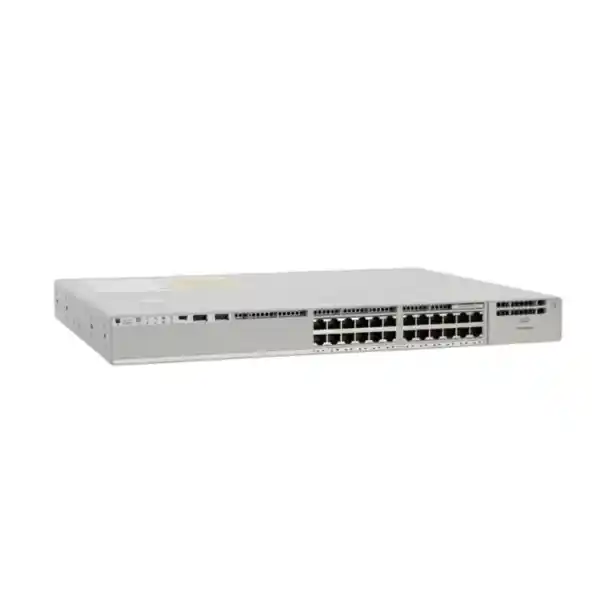
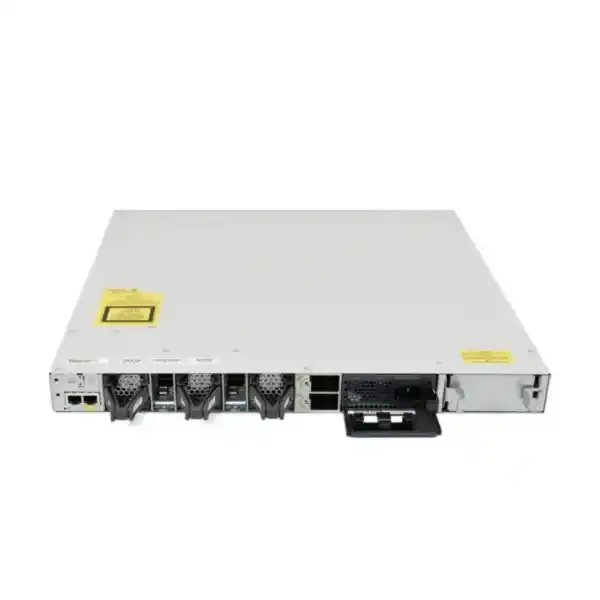
Cisco C9350-24P Smart Switch
A next-generation 24-port 1 Gigabit Ethernet PoE+ access switch built for secure campus connectivity, converged wired and wireless edge services, high-availability stacking, flexible uplinks and modern operational control.
Choose the C9350-24P when your access layer needs twenty-four 1G copper ports, PoE+ for phones, cameras and standard-power wireless devices, high-speed modular uplinks, enterprise stacking and Cisco’s current smart-switch management model without paying for multigigabit downlinks that the endpoint estate may not need.
What is the Cisco C9350-24P?
The Cisco C9350-24P is a stackable smart switch in Cisco’s C9350 Series, positioned primarily for enterprise campus access and also suitable for selected distribution or collapsed-core roles where its port mix and scale match the design. The model supplies 24 RJ-45 downlink interfaces operating at 10/100/1000 Mbps and provides IEEE-class PoE+ power of up to 30 watts per port. Cisco specifies a total available PoE budget of up to 720 watts for the model, making it a practical convergence platform for IP phones, surveillance cameras, room systems, badge readers, sensors, thin clients, wireless access points that fit within the power envelope, and other powered edge devices.
The switch is based on Cisco Silicon One A100/L architecture and belongs to the newer generation of Cisco smart switching platforms intended to unify hardware, software, management and support. Rather than treating access switching as a simple port-density purchase, the C9350 family is designed around policy enforcement, segmentation, telemetry, automation, lifecycle control and operational flexibility. Organizations can therefore deploy the C9350-24P as a conventional IOS XE enterprise access switch while also integrating management workflows with Cisco Catalyst Center or the Cisco Meraki dashboard according to the applicable licensing and operating model.
For Dubai and UAE networks, the C9350-24P is particularly relevant to offices, headquarters floors, schools, healthcare sites, hospitality properties, logistics facilities, retail environments and government campuses where twenty-four powered access ports align with room, floor or zone density. FourTeck can supply the switch as part of a complete access-layer project covering rack planning, fiber uplinks, PoE sizing, VLAN design, authentication, wireless convergence, firewall integration, UPS coordination, configuration standards and post-deployment support.
Access density
Twenty-four 10/100/1000 copper ports are a strong fit for controlled floor-by-floor designs, IDF cabinets, branch rooms and edge zones that do not require 48 user-facing ports.
PoE convergence
Up to 30W PoE+ per access port and up to 720W aggregate PoE provide a predictable basis for powering voice, video, physical-security and IoT endpoints.
High-speed uplinks
Modular uplinks support high-speed fiber choices so the access layer can be matched to the campus core, distribution design and growth plan rather than locked to a fixed uplink format.
Stackable operations
StackWise-1.6T support enables multiple switches to operate as a coordinated stack, simplifying management and improving design options for resilient access blocks.
Cisco C9350-24P key technical specifications
| Specification | C9350-24P detail |
|---|---|
| Primary role | Enterprise campus access; can also be positioned selectively in distribution or collapsed-core designs when requirements align |
| Downlink ports | 24 × copper RJ-45, 10/100/1000 Mbps |
| Power over Ethernet | PoE+ up to 30W per supported access port |
| Total PoE budget | Up to 720W, subject to power-supply configuration and operating design |
| Switching silicon | Cisco Silicon One A100/L; C9350-24P uses a single ASIC according to Cisco platform documentation |
| Stacking | StackWise-1.6T support |
| Uplink architecture | Modular; C9350 family options include dual-rate 100G/40G and multirate 50G/25G/10G/1G choices depending on selected network module |
| Memory | C9350 platform: 16 GB DRAM and 18 GB flash |
| Optional storage | Up to 240 GB SSD on the C9350 platform for supported use cases |
| Jumbo frames | Up to 9216 bytes on the C9350 platform |
| VLAN scale | Up to 4094 VLAN IDs; up to 4000 active VLANs on the C9350 platform |
| MAC scale | Up to 64,000 MAC addresses on the C9350 platform |
| Physical size | Approximately 1.73 × 17.5 × 15.1 in / 4.4 × 44.5 × 38.3 cm |
| Weight | Approximately 13.54 lb / 6.14 kg with the default power supply, per Cisco hardware specifications |
Performance and scale values published for the C9350 series are platform capabilities and can vary by exact SKU, software release, feature combination, license tier, forwarding mode and configuration. Final design validation should use the Cisco release-specific documentation and the ordered bill of materials.
Why the Silicon One A100/L architecture matters
Access switches are often evaluated only by port count and PoE wattage, but the forwarding architecture determines how well the platform can sustain policy, telemetry, segmentation and growth. The C9350 family uses Cisco Silicon One A100/L switching silicon. For the C9350-24P, Cisco documentation identifies a single A100/L ASIC. The design provides hardware-based packet forwarding for the 1G downlink model and is part of a platform that Cisco publishes with substantial system, forwarding and table scale.
At the family level, Cisco lists up to 500G system switching, ASIC capacity up to 1.3 Tbps when switching traffic and stack capacity are considered, and forwarding rates up to 3 billion packets per second on higher configurations using up to two ASICs. Those maximums should not be misread as guaranteed figures for every C9350 SKU. The more useful design point for the 24P is that it inherits an architecture intended for enterprise-scale policy and high-bandwidth uplink connectivity rather than being engineered as a low-end unmanaged or lightly managed access device.
That matters when a floor switch must simultaneously serve voice, wireless, surveillance and user traffic while enforcing QoS, access controls, segmentation and monitoring. A modern ASIC provides the hardware foundation for keeping these functions in the forwarding path with predictable performance. It also gives the platform room to support larger routing, MAC, VLAN and telemetry requirements than would normally be associated with a small branch-class switch.
Understanding the 24-port 1G access design
The C9350-24P is deliberately a 1 Gigabit Ethernet downlink model. Each of the 24 copper ports supports 10 Mbps, 100 Mbps and 1 Gbps Ethernet, allowing mixed endpoint estates to migrate cleanly while standardizing the switch hardware. This makes the model well suited to devices whose practical bandwidth requirements remain comfortably inside 1G, including office PCs, desk phones, printers, standard IP cameras, access-control panels, building-automation gateways and many embedded devices.
The choice between a 1G model such as the C9350-24P and a multigigabit C9350 variant should be made from endpoint requirements rather than from headline speed alone. If a new wireless deployment uses access points that can generate sustained traffic beyond 1G, or if high-performance workstations need 2.5G, 5G or 10G copper, a multigigabit model may be more appropriate. If the endpoints remain 1G and the real bottleneck is upstream aggregation, the 24P can be a more efficient bill-of-materials choice because high-speed capacity can be concentrated in the modular uplinks.
A 24-port form factor also helps with failure-domain control. Instead of loading a single 48-port switch with every device in a floor zone, some organizations prefer smaller access blocks where a switch outage affects fewer endpoints. The tradeoff is rack-unit consumption, stack design and cost per port. In projects with strict availability targets, twenty-four-port blocks can simplify mapping of redundant devices, dual-homed systems and power circuits, especially when combined with a resilient stack or paired access design.
Port allocation should include spare capacity. A switch installed with all 24 ports occupied on day one leaves no room for a temporary device, replacement endpoint, new camera or additional access point. FourTeck normally recommends sizing the physical port count, PoE consumption and uplink load separately. A site can have free Ethernet ports but no remaining PoE power, or ample PoE capacity but no rack patching positions. Treating those as independent constraints avoids late-stage redesign.
PoE+ engineering: 30W per port and up to 720W total
Power over Ethernet is one of the defining capabilities of the C9350-24P. The model supports up to 30W PoE+ on its access ports and Cisco specifies a total PoE budget of up to 720W. In simple arithmetic, 24 ports multiplied by 30W equals 720W, so the platform can be planned for a full set of 30W-class endpoints when the power-supply configuration and operating conditions are selected accordingly. In a real deployment, however, PoE design should never stop at multiplication.
First, engineers should use the endpoint’s negotiated or design power, not only the number printed on a marketing sheet. Some devices boot at a higher draw, enable radios or infrared illuminators later, or change consumption when USB accessories are attached. Wireless access points can have different behavior depending on radio configuration. Cameras may increase demand at night when IR lighting activates. Video phones and room systems may consume more when displays or peripherals are active. The switch therefore needs enough budget for worst-case simultaneous operation, not merely average daily load.
Second, power redundancy must be considered. A design can deliver a large PoE budget with multiple power supplies but lose part of that budget after a PSU or feed failure. If business requirements state that all powered endpoints must remain online during a single power-supply failure, the normal operating load must fit inside the surviving power capacity. This is especially important for access-control systems, emergency phones, security cameras and critical wireless coverage.
Third, upstream electrical planning matters. A switch that powers hundreds of watts of endpoint load is not just a network device; it is part of the electrical and UPS design. Rack PDUs, circuit capacity, UPS runtime, battery autonomy, generator strategy and thermal load all need to reflect the planned PoE consumption. In Dubai server rooms and telecom closets, heat management is particularly important because ambient temperature and airflow directly affect reliability. The switch is designed for enterprise operation, but blocked airflow, overloaded UPS systems and poorly ventilated cabinets can still undermine an otherwise strong network architecture.
For larger rollouts, build a PoE worksheet listing endpoint type, quantity, maximum draw, diversity factor, criticality and redundancy requirement. Then model normal operation, peak operation and single-failure operation. This turns the 720W headline into an engineering decision and helps determine whether the C9350-24P, the higher-power C9350-24U, or another model is the right fit.
PoE sizing example A
12 IP phones at 8W, 6 cameras at 14W and 4 access points at 22W produce a design load of 268W before contingency. This leaves substantial room for endpoint growth and failure-margin planning.
The correct conclusion is not simply that 268W is below 720W. Confirm boot peaks, future devices, PSU redundancy and UPS runtime before finalizing the configuration.
PoE sizing example B
24 endpoints designed at the full 30W class equal 720W. This is the edge of the published total PoE budget and leaves no design margin for unexpected draw or a reduced-budget failure state.
For a mission-critical site, select power components and endpoint allocation so the required service level remains achievable after the planned fault scenario.
Modular uplinks: design the access layer around the campus, not the other way around
The C9350 platform uses modular uplink options, which is one of its most important architectural advantages. Cisco lists network modules including C9350-NM-2C with two dual-rate 100G/40G interfaces, C9350-NM-4C with four dual-rate 100G/40G interfaces, and C9350-NM-8Y with multirate connectivity supporting combinations of 50G, 25G, 10G and 1G depending on configuration. The exact module should be chosen as part of the bill of materials rather than assumed to be included.
For a 24-port 1G access switch, a 10G uplink may be entirely adequate in a lightly utilized office, while a pair of 25G links can provide more headroom for dense wireless, video, east-west application traffic or future growth. A 40G or 100G interface may be useful when the access stack aggregates multiple switches and the upstream architecture is designed for very high throughput. The right answer depends on oversubscription, application behavior, failure-state bandwidth and how many physical switches share the uplink path.
Do not size uplinks using only the theoretical sum of 24 × 1G downlinks. Typical user access traffic is bursty and rarely drives every port at line rate simultaneously. Conversely, some environments have synchronized traffic patterns such as backup windows, imaging, software distribution, CCTV recording, VDI boot storms or large media transfers. Network telemetry from the existing environment is therefore more valuable than a generic ratio. Where telemetry is unavailable, use conservative assumptions and plan a modular uplink path that can be upgraded without replacing the base switch.
Fiber type, optic reach, transceiver compatibility and patch-panel design also belong in the same decision. For Dubai campuses, it is common to encounter a mix of multimode fiber within buildings and single-mode fiber between buildings or remote telecom rooms. The network module gives speed flexibility, but the final solution still requires compatible optics, clean fiber plant, proper polarity, labeled paths and redundant physical routes where resilience is required.
StackWise-1.6T and resilient access blocks
Cisco specifies StackWise-1.6T support for the C9350-24P. Stacking allows multiple physical switches to be operated as a coordinated logical system, simplifying configuration, management and uplink design while increasing port density. Cisco’s platform naming for StackWise-1.6T reflects the high-capacity stack architecture; implementation details, cabling rules, topology and supported scale should be validated against the software and hardware guide for the chosen release.
From a design perspective, stacking can reduce operational complexity because access policies, VLANs, uplinks and software maintenance can be handled across a single logical stack rather than as a collection of unrelated standalone switches. It also enables engineers to spread uplink connectivity and powered endpoints across stack members, which can improve resilience when combined with redundant power and physically diverse upstream paths.
A stack is not a substitute for a full high-availability strategy. A common management plane simplifies operations, but risk analysis must still cover stack cable failures, software defects, maintenance windows, power failures and physical incidents in the rack. For critical networks, decide whether a single stack failure domain is acceptable or whether independent access systems should be used. The correct architecture varies between a standard office floor, a hospital clinical zone, an industrial operation and a command center.
FourTeck can design stack member placement, stack link topology, uplink distribution, VLAN placement and power allocation so that the resilience objective is explicit. The goal is not merely to connect stack cables; it is to define which faults the network must survive and verify that endpoint power and upstream connectivity remain available during those faults.
Security at the wired edge
The access switch is where user devices, phones, cameras, printers, sensors and unmanaged equipment enter the enterprise network. Security therefore begins before traffic reaches a firewall. The C9350 platform is designed to participate in identity-aware access, segmentation, policy enforcement, traffic visibility and secure operations. Depending on software release and license tier, organizations can integrate the switch into broader Cisco security and network-management workflows rather than treating every access port as an implicitly trusted connection.
A secure deployment starts with port policy. User-facing ports should have a defined authentication and fallback strategy, such as 802.1X for managed endpoints with an approved method for devices that cannot perform 802.1X. Voice, cameras and IoT endpoints should not automatically share the same trust level as employee computers. Dynamic or static segmentation can place devices into the appropriate VLAN or policy domain, while access control lists and upstream security enforcement limit lateral movement.
Layer 2 protections are equally important. Features such as DHCP snooping, Dynamic ARP Inspection, IP source validation, storm control, spanning-tree protections and secure management-plane settings can reduce common edge attacks and accidental outages. The exact feature set and licensing should be checked against Cisco’s current Switching Licensing Feature Matrix, because capability may depend on software and subscription tier. The engineering principle is to enable controls that match the threat model without creating operational fragility.
The C9350 series also reflects Cisco’s direction toward future-facing cryptographic and threat-protection capabilities. Cisco positions the family with support for post-quantum cryptography-related capabilities and hardware readiness for inline threat-protection workflows. Those features are not a reason to skip conventional network controls; they are part of a broader platform strategy. Buyers should confirm software release, entitlement and deployment prerequisites for any advanced function that is mandatory to the project.
For UAE organizations subject to internal audit, industry requirements or contractual security controls, the strongest design is a documented access policy: who may connect, how identity is established, what segment is assigned, what traffic is permitted, how events are logged, how configuration changes are controlled, and how failed authentication is handled. The switch provides the enforcement foundation; governance determines whether that capability is used consistently.
Identity
Define employee, guest, contractor, voice, camera, IoT and infrastructure device classes. Map each class to authentication, VLAN or policy, and remediation behavior.
Segmentation
Keep high-risk or special-purpose endpoints out of broad user networks. Enforce least-privilege connectivity at the edge and upstream security layers.
Visibility
Collect operational telemetry, interface statistics, event logs and flow data appropriate to the monitoring architecture so anomalies are visible before users report them.
Control
Harden management access, centralize administrator identity, back up configurations, maintain approved images and track changes through a formal lifecycle process.
QoS for voice, video and business-critical applications
Converged access means traffic with very different performance requirements shares the same switch. A desktop software download can tolerate delay, but an IP voice call reacts immediately to jitter and packet loss. Interactive video requires consistent service. Surveillance traffic can be continuous and high volume. Business applications may need priority during congestion even if their average bandwidth is modest.
A C9350-24P deployment should therefore include an explicit Quality of Service model rather than relying on defaults. The first task is to define trust boundaries. A switch should not blindly trust every endpoint marking, because a misconfigured or malicious device could mark ordinary traffic as high priority. Phones and managed infrastructure can be treated differently from general user PCs. Classification and remarking policies should align with the organization’s end-to-end QoS model, including WAN, wireless and firewall devices.
Queue design should focus on business outcomes. Voice typically requires low latency and controlled loss. Video may need substantial bandwidth with bounded jitter. Critical transaction traffic may require assured service but not strict priority. Bulk traffic, backup and software distribution can use remaining capacity. The goal is not to make every application “high priority”; doing so would eliminate the meaning of priority and can starve ordinary traffic.
Uplink sizing and QoS must be considered together. QoS manages contention; it does not create bandwidth. If an access stack consistently drives more traffic than the uplinks can carry, the correct solution may be additional or faster uplink capacity. Modular C9350 uplinks provide a useful upgrade path when telemetry shows that existing bandwidth is becoming a constraint.
Routing, VLAN and table scale for enterprise designs
Cisco publishes substantial platform scale for the C9350 family, including up to 4094 VLAN IDs, up to 4000 active VLANs, up to 2000 switched virtual interfaces, up to 64,000 MAC addresses, and large IPv4 and IPv6 route capacities on supported configurations. These numbers show that the platform is designed for serious enterprise segmentation and routing use cases, but they are maximum family-level figures and should not be treated as a target configuration for every access switch.
In a normal campus access layer, design simplicity often produces better reliability than maximizing table usage. Limit VLAN scope, keep failure domains understandable, summarize routing where appropriate, and avoid stretching Layer 2 across large physical areas without a clear requirement. If the C9350-24P is used for Layer 3 access, define routing boundaries, first-hop redundancy, route convergence expectations and security policy before rollout.
Large table capacity becomes valuable when the network supports dense segmentation, complex policy, large numbers of endpoints or route-rich services. Cisco also publishes platform scale for ARP, neighbor discovery, multicast, ACL and NetFlow entries. These resources are finite and can interact with feature templates. A design that simultaneously pushes routing, security ACLs, telemetry and multicast to extremes should be validated against Cisco’s release-specific scalability documentation rather than assuming every published maximum can be achieved concurrently.
For most Dubai enterprise deployments, the practical objective is comfortable headroom rather than maximum scale. Build a current-state inventory, forecast endpoint and VLAN growth for the lifecycle of the switch, then validate that the expected tables remain well inside supported limits. This approach reduces risk and leaves capacity for operational surprises.
Management flexibility: IOS XE, Catalyst Center and Meraki dashboard workflows
The C9350 generation is part of Cisco’s effort to provide flexible management across deployment environments. Cisco’s current licensing documentation states that a per-device unified license can provide access to management through Cisco Catalyst Center and the Cisco Meraki dashboard, allowing organizations to select management workflows according to operational needs and entitlement. This is significant for enterprises that are standardizing operations across traditional campus and cloud-managed environments.
Teams with established IOS XE engineering practices can retain familiar configuration and troubleshooting concepts while adopting automation and assurance where they provide value. Organizations focused on centralized policy and campus automation may use Catalyst Center workflows. Others may prefer cloud-oriented visibility and management through the Meraki dashboard for supported use cases. The correct model depends on governance, existing tooling, cloud policy, administrator skills and licensing.
Management choice should be made before deployment because it affects onboarding, templates, image management, monitoring, role-based access and operational procedures. A network is easier to support when device ownership, source of truth, configuration authority and software lifecycle are unambiguous. Running several management methods without defined boundaries can create configuration drift and complicate troubleshooting.
FourTeck can integrate the switching layer with an organization’s operating model, including IP address management, monitoring, AAA, syslog, NTP, configuration backup and change-control procedures. For broader UAE infrastructure services, customers can also review FourTeck IT Services UAE for implementation and support capabilities.
Cisco Networking Subscription and license selection
Cisco has introduced a unified licensing structure for the C9350 Series through Cisco Networking Subscription. For the 24-port model, the relevant access license size is the Medium tier, described for up to 24-port switches. Cisco publishes both Switching Essentials and Switching Advantage options. Current Cisco guidance states that new unified switching subscriptions require a minimum term of 36 months, while conditions may differ when adding licenses to an existing subscription. Licensing rules change over time, so the final quotation should use Cisco’s current ordering guide and the customer’s Smart Account context.
The perpetual Cisco Switching OS license and the subscription entitlement should be understood separately. Cisco describes the OS license as providing the right to use applicable platform features in the operating system, while the subscription unlocks selected management, automation, analytics, support and other services depending on tier. Essentials is aimed at fundamental network functionality and management; Advantage adds advanced capabilities. The exact feature comparison should be validated in the current Cisco Switching Licensing Feature Matrix at the time of purchase.
For procurement teams, the key lesson is that the switch chassis alone is not a complete bill of materials. A production order may require the base hardware, one or more power supplies, the selected network module, optics or DACs, stack accessories, optional SSD, rack components and the correct license subscription. Support and RMA options may also be specified according to business requirements. Omitting one of these components can delay deployment even when the switch itself is physically available.
FourTeck can build a quotation around the operational outcome rather than only the chassis PID. That includes mapping the 24-port switch to licensing, uplink speed, fiber medium, power redundancy, PoE budget and support expectation so the delivered equipment is ready for the intended architecture.
Where the C9350-24P fits in a campus topology
A typical campus uses a hierarchical design with access switches in telecommunications rooms, distribution switching that aggregates buildings or floors, and a resilient core that connects major network services. The C9350-24P is primarily an access platform. Endpoints connect to its 1G PoE+ ports, while modular fiber uplinks connect toward distribution. Depending on the campus size and design philosophy, routing may occur at distribution or be extended to the access layer.
For a medium office floor, one or more C9350-24P switches can serve desks, phones, cameras and wireless access points. Stacking can simplify management and provide a larger logical access block. Uplinks can be spread across physical stack members and connected to redundant upstream devices. VLANs and policy can be standardized using templates so that every floor follows the same operational model.
In a smaller branch, the switch can aggregate user and infrastructure endpoints while routing or firewall services are provided by an upstream security appliance. This is particularly useful when the branch needs enterprise-grade access controls and PoE but does not need a large 48-port switch. For integrated perimeter and segmentation projects, customers can coordinate the access layer with FourTeck Firewall Dubai solutions so switch VLANs, routing and security zones are designed together.
In selected collapsed-core or distribution situations, C9350 capabilities may be sufficient, but the design should be based on port type, routing scale, uplink density, availability, convergence and lifecycle requirements. A platform that is excellent at access is not automatically the right core for every organization. FourTeck evaluates the traffic and resilience model before recommending role consolidation.
Office floor
Use the 24P for employee workstations, IP phones, meeting-room devices and moderate-power access points. Keep spare ports and PoE headroom for moves, adds and changes.
Security zone
Power IP cameras, intercoms and access-control devices while isolating physical-security traffic from user networks through VLAN and policy design.
Branch site
Consolidate a compact branch access layer with enterprise controls and redundant high-speed uplinks to local firewall, SD-WAN or aggregation infrastructure.
Specialized edge
Use 24-port blocks in labs, classrooms, clinics or logistics zones where endpoint counts are controlled and a smaller failure domain is operationally useful.
Wireless access integration
Wireless networks are frequently the largest consumers of access-switch PoE and uplink bandwidth. The C9350-24P can power 30W-class access points, but a correct wireless design requires checking both electrical and Ethernet requirements of the selected AP. Modern high-end Wi-Fi access points may require more than 30W or may benefit from multigigabit Ethernet, in which case a C9350 U or HX-class model can be a better match.
When the AP fits within 1G and 30W, the 24P can provide a clean converged access solution. Wireless management VLANs, client VLANs or fabric segments can be carried over the uplinks according to architecture. QoS should preserve real-time voice and collaboration traffic. Authentication and policy between wired and wireless domains should be aligned so users receive consistent access rules regardless of medium.
Capacity planning must consider aggregate wireless behavior. Six access points each connected at 1G do not continuously generate 6 Gbps, but busy conference areas or dense event spaces can produce significant bursts. If the same switch also carries cameras, phones and desktops, the uplink should be sized for concurrent demand. Modular uplink flexibility is valuable because it allows the switch to start at one speed and move to a higher rate when actual telemetry justifies the upgrade.
For new builds, coordinate switch port placement with the wireless predictive design. A beautifully sized switch cannot compensate for too few data outlets at AP locations, copper runs beyond standard limits, or an AP model whose power requirement exceeds the port capability. Physical cabling, switch selection and RF design should be treated as one system.
IP surveillance and physical security
The C9350-24P is a strong access option for many IP surveillance designs because cameras generally require reliable PoE, predictable connectivity and segmented network access. Twenty-four PoE+ ports can serve a controlled camera zone, and high-speed uplinks can aggregate video toward recorders or storage. However, camera projects need traffic engineering because video is continuous rather than bursty like typical office traffic.
Estimate bitrate per camera using the actual resolution, codec, frame rate, scene complexity and retention design. Multiply by camera count and include overhead, then model the uplink path to the recording system. If multiple access switches send video across the same distribution links, aggregate the streams. Recording traffic may be manageable during normal operation but surge during forensic export, firmware updates or failover events.
PoE sizing must also account for camera features. Pan-tilt-zoom motors, heaters, infrared illumination and analytics can increase consumption. Exterior cameras in harsh conditions may require different power budgets than indoor fixed cameras. Use the maximum supported draw of each deployed model and maintain contingency rather than assuming every camera uses a generic wattage.
Security networks should be isolated from general user access. Place cameras, network video recorders and management stations in defined segments, restrict permitted flows, secure administrative interfaces and monitor for unauthorized devices. The access switch is an important control point because it can enforce policy before camera traffic reaches shared enterprise services.
Voice, collaboration and meeting-room endpoints
IP phones remain a classic PoE use case. The C9350-24P can provide data and power to phones while supporting voice VLAN and QoS designs. In many office networks, the phone also provides a pass-through Ethernet connection for a workstation, which means switchport policy must correctly separate voice and user traffic even though both share one physical access interface.
Meeting-room devices can be more demanding. Touch controllers, scheduling panels, cameras and room codecs may each require Ethernet and PoE. Some devices consume more power than a standard phone, and AV traffic can be bursty or latency sensitive. Build a room-by-room port schedule rather than estimating only the number of desks. A floor with twenty employees and four advanced meeting rooms may consume more powered ports than its workstation count suggests.
QoS should preserve voice signaling and media while preventing uncontrolled endpoint markings from dominating the network. Where voice services cross a firewall, SD-WAN edge or service-provider circuit, end-to-end policy must be consistent. Local switch configuration alone cannot protect voice quality if markings are discarded upstream or if the WAN is undersized.
For large collaboration rollouts, use switch telemetry to watch error counters, power events and interface utilization. Cabling faults often present as voice-quality complaints. Monitoring the physical and Ethernet layer helps distinguish application problems from bad patch leads, duplex issues, power instability or uplink congestion.
Dubai and UAE deployment considerations
Enterprise networking in the UAE has the same protocol fundamentals as anywhere else, but deployment conditions create practical engineering requirements. Telecom rooms may be located in ceiling spaces, warehouses, plant areas or building service zones where heat and dust are greater than in a data center. Even when the switch operates within Cisco’s published environmental limits, long-term reliability is improved by clean airflow, controlled temperature, proper rack spacing and regular maintenance.
Power quality and continuity should be designed around the business function of the powered endpoints. If the C9350-24P supports access-control doors, cameras or critical phones, UPS autonomy must include the switch plus the PoE load. A UPS sized only for the chassis may deliver far less runtime once several hundred watts of endpoint power are included. Dual power supplies are useful only when connected to an electrical architecture that actually provides independent or protected feeds.
Structured cabling quality also matters. Gigabit Ethernet depends on standards-compliant copper, correct termination and good patching. PoE adds electrical load to the cable bundle, so cable category, conductor quality, bundle size and installation method can affect heat. For new UAE projects, cabling and switching should be specified together rather than purchasing active hardware after the passive network is already fixed.
Procurement should distinguish genuine new Cisco equipment, validated part numbers, subscription licensing and support coverage. The C9350 generation is actively orderable, and an enterprise deployment should preserve serial-number traceability, entitlement records and a clean handover into the customer’s Smart Account and asset register. FourTeck can coordinate product supply through FourTeck UAE and align the switch with implementation and lifecycle requirements.
For projects that combine switching with local compute or rack modernization, customers can also review Server Dubai infrastructure solutions so power, rack, server and network dependencies are planned as a unified system rather than independent purchases.
Power supplies, airflow and rack planning
Cisco lists multiple power options for the C9350 family, including 500W, 850W and 1600W AC power supplies for supported configurations. The correct PSU combination for a C9350-24P must be selected from the ordering guide based on PoE demand, redundancy and chassis compatibility. Do not assume that every supply yields the same PoE budget or failure behavior.
Rack depth is often overlooked. The C9350-24P chassis is approximately 15.1 inches deep before allowance for front patch leads, rear power cords, stack cables and bend radius. A cabinet should provide comfortable front and rear working space, cable-management clearance and airflow. Dense wall cabinets that technically fit the chassis can become difficult to service once patch panels, PDUs and UPS devices are installed.
Airflow must remain unobstructed. Keep dust filters, cabinet doors and cable bundles from restricting intake or exhaust. Telecom rooms should not be used as uncontrolled storage spaces. Record ambient temperature during commissioning, particularly in remote IDFs. If the room relies on building air conditioning that shuts down after business hours, confirm that the network equipment still remains within design limits overnight and on weekends.
For critical locations, monitor power supply, fan and temperature status through the network-management platform. Environmental alarms should route to the same operations process as link and routing alerts. A failed fan or rising temperature is an actionable network event even if users have not yet noticed packet loss.
Migration from older Catalyst access switches
Organizations moving from older Catalyst 3650, 3850 or earlier Catalyst 9300 access designs should treat the C9350 migration as a controlled architecture change rather than a port-for-port swap. Cisco positions the C9350 as a next-generation access transition platform, but software, licensing, uplink modules, stacking and management workflows differ from older products. A migration plan should therefore start with an inventory of current switch roles and dependencies.
Export the existing configuration and identify VLANs, trunks, EtherChannels, routing, QoS, authentication, DHCP protections, ACLs, spanning-tree settings, multicast functions, monitoring, SNMP or telemetry, syslog, NTP, AAA and automation dependencies. Do not blindly paste an old configuration into a new platform. Some commands may be deprecated, defaults may have changed, and new licensing or management methods may alter the preferred implementation.
Next, map physical interfaces. A 48-port legacy switch may be replaced by two 24-port switches for resilience, or a 24-port switch may consolidate several smaller devices. Uplink speeds and optics may change. Stack topology may be redesigned. PoE load should be measured from the running environment rather than estimated from device counts alone.
Create a migration template in a lab or staging environment. Validate management access, AAA, VLAN reachability, routing adjacencies, endpoint authentication, phones, cameras, APs and monitoring. Then define a rollback plan that identifies the exact conditions for returning to the old switch. Keeping the previous device powered off but cabled and labeled nearby can significantly reduce risk during a short maintenance window.
Finally, update documentation after cutover. Record serial numbers, license association, software version, stack membership, uplink optics, rack location, patch-panel mappings and configuration backup location. A technically successful migration is incomplete if the operations team cannot support the new environment afterward.
How to size a C9350-24P deployment
A strong switch design starts with five independent capacities: port count, PoE wattage, uplink bandwidth, forwarding or table scale, and resilience. Buyers often focus on only the first item. A site with 20 endpoints may look ideal for a 24-port switch, but those endpoints might require 850W of power, multigigabit links or two physically independent access switches. Conversely, a site with 22 low-power 1G devices may fit the 24P perfectly.
Port count: list every endpoint, infrastructure device and planned spare. Include access points, printers, environmental sensors, door controllers, cameras, management interfaces and temporary commissioning needs. Reserve enough spare ports to support the expected lifecycle without immediate switch expansion.
PoE budget: record maximum device draw, not only current draw. Separate critical from noncritical devices and model a power-supply failure. If the remaining capacity cannot support required endpoints, increase power capacity or distribute devices across switches.
Uplink capacity: estimate aggregate traffic, burst behavior and failure-state load. A redundant pair of uplinks may carry 50 percent each during normal operation but 100 percent on one path after failure. Size the surviving path, not only the steady-state path.
Scale: count VLANs, routes, MAC addresses, ACLs and telemetry expectations. Most access designs will sit far below C9350 maximums, but complex segmentation and routed access can increase resource usage quickly. Validate feature combinations against Cisco documentation for the selected release.
Resilience: define the maximum acceptable number of endpoints lost for each fault. Consider switch failure, stack link failure, PSU failure, UPS failure, uplink loss and distribution failure. Architecture becomes much clearer once the permitted impact of each failure is written down.
C9350-24P vs C9350-24U vs C9350-24T
Cisco offers several 24-port C9350 variants because access networks have different power and endpoint requirements. The C9350-24P provides 24 × 1G downlinks with up to 30W PoE+ per port. The C9350-24U keeps 24 × 1G downlinks but raises supported power to 60W-class UPOE for endpoints that need more electrical headroom. The C9350-24T provides 24 × 1G data ports without PoE for environments where endpoints have local power.
Choose the 24P when most powered devices fit within 30W and 1G. Choose the 24U when 60W devices are part of the requirement or when future high-power endpoints justify the larger PoE design. Choose the 24T when PoE has no operational value and removing powered access from the bill of materials is desirable. If the endpoint requires multigigabit speed, evaluate the HX-class models rather than forcing a 1G SKU into the design.
This comparison should be performed at the device schedule level. An office may need 24P switches for normal desk zones and 24U or HX switches only where high-power or multigigabit access points are installed. Standardization is useful, but forcing one model everywhere can create unnecessary cost or technical limitations.
Operational monitoring and troubleshooting
Once deployed, the C9350-24P should be managed as an observable infrastructure component. Monitoring should include interface status, errors, drops, utilization, PoE state, power supply health, fans, temperature, stack status, CPU and memory, routing adjacencies where used, authentication failures and software events. Alert thresholds should distinguish urgent failures from informational changes so operations teams are not overwhelmed.
Interface errors deserve early attention. CRC errors often point to cabling, transceiver or physical-layer problems. Frequent link flaps can indicate a bad patch lead, endpoint NIC problem or power instability. Output drops may suggest congestion or queue pressure. High utilization is not automatically a fault, but sustained saturation during business-critical periods should trigger capacity review.
PoE troubleshooting should examine both switch and endpoint behavior. If a device fails to power, verify cable quality, negotiated class, available budget, per-port state and hardware compatibility. Repeated power cycling can indicate an endpoint fault or an insufficient power design. During outages, check whether the switch has entered a reduced PoE state because a power supply failed.
Software lifecycle management is equally important. Standardize approved IOS XE releases, test upgrades, maintain backups and record rollback procedures. Cisco’s management platforms can assist with image and patch workflows depending on entitlement. The objective is to move from reactive per-switch administration to controlled fleet operations.
Configuration drift should be measured, not assumed away. Templates, compliance checks and periodic audits help identify unmanaged changes that can create security gaps or inconsistent behavior. In regulated environments, retain change records and demonstrate that switch configuration aligns with the approved network standard.
High-availability design beyond the switch
A resilient access layer is a chain of dependencies. The switch can have redundant power, but if both supplies connect to one failed PDU, service stops. The stack can have multiple uplinks, but if both fibers follow the same tray and are cut together, connectivity is lost. The access switches can be redundant, but if every endpoint has only one Ethernet interface, that endpoint still depends on one physical access port.
Begin with service-level requirements. Standard office desktops may tolerate an access-switch outage during a maintenance window. Security cameras, door controllers or contact-center phones may not. Group endpoints by criticality, then design the network and power architecture to meet each class. This may mean spreading critical devices across stack members, using redundant upstream paths, providing independent UPS feeds, or using dual-homed endpoints where supported.
Test failure states during commissioning. Disconnect an uplink and confirm convergence. Remove a power supply only when the design and safety procedures permit, then verify critical PoE devices stay online. Validate that monitoring generates the expected alerts. A redundancy feature that has never been tested is only an assumption.
Document the normal and degraded states. Operations teams should know how much PoE capacity remains after a PSU failure, which uplink carries traffic after path loss, and what stack behavior is expected during member maintenance. Clear runbooks reduce downtime when a real incident occurs.
Procurement checklist for Cisco C9350-24P in Dubai
Base hardware
Confirm C9350-24P quantity, intended rack location, spare strategy and whether units will operate standalone or in stacks.
Licensing
Select the correct Medium access license tier for up to 24 ports, Essentials or Advantage, and the required subscription term according to current Cisco rules.
Power
Specify PSU count and capacity based on PoE load, redundancy target, electrical feeds, rack PDU design and UPS runtime.
Uplink module
Choose the network module that matches required 1G, 10G, 25G, 40G, 50G or 100G connectivity and the physical upstream architecture.
Optics and cabling
Match fiber type, distance, connector, transceiver and patch-panel path. Include redundant physical routes where required.
Support and spares
Define RMA expectations, onsite spare policy, configuration backup, serial tracking and operational ownership before go-live.
Implementation methodology for a controlled rollout
A professional C9350 deployment can be divided into discovery, low-level design, staging, pilot, migration and operational handover. Discovery captures the current environment: endpoint count, PoE use, VLANs, uplinks, routing, authentication, monitoring, rack power, fiber and software standards. Low-level design turns that data into exact port profiles, addressing, stack layout, uplink topology, licenses, optics and failure behavior.
Staging is where configuration becomes repeatable. Apply the approved software image, hostname and management addressing; configure AAA, NTP, logging and monitoring; load VLAN and port templates; validate stack members; and test uplinks. For large projects, automate repetitive configuration where practical, but retain human review for variables such as rack location, port schedule and critical endpoint mapping.
The pilot should represent real complexity. Do not select only an easy office area. Include at least one phone, access point, camera, authenticated workstation and any special device class. Verify policy, PoE, QoS, monitoring and failover. Record lessons and update the standard template before mass deployment.
During migration, use a labeled port map and change script. Photograph or document the legacy patching where appropriate. Move endpoints in controlled groups and validate before continuing. Keep stakeholders informed about which services are being moved. If a device fails, troubleshoot against the known staging baseline rather than improvising large configuration changes during the window.
Handover should include as-built diagrams, configurations, serial numbers, license records, software version, rack and port mapping, monitoring dashboards, escalation contacts and routine maintenance tasks. Good documentation is part of the network product because it determines how quickly future incidents can be resolved.
Frequently asked technical questions
Does the C9350-24P provide multigigabit downlinks?
No. The C9350-24P provides 24 copper downlink ports at 10/100/1000 Mbps. If endpoints require 2.5G, 5G or 10G over copper, evaluate a C9350 multigigabit model such as an HX-class variant.
How much PoE can each port deliver?
The model supports up to 30W PoE+ per access port, with a published total PoE budget up to 720W. Actual usable power depends on the ordered power-supply configuration and the required redundancy state.
Can the switch power wireless access points?
Yes, when the selected AP fits within the 30W per-port and 1G Ethernet requirements. Higher-power or multigigabit APs may require another C9350 model.
Does the C9350-24P support stacking?
Yes. Cisco lists StackWise-1.6T support for the C9350-24P. Final stack topology, cable selection and supported member count should follow the current Cisco hardware and software documentation.
What uplinks can be used?
The C9350 family supports modular uplink choices. Cisco lists modules with 100G/40G dual-rate interfaces and multirate options covering 50G, 25G, 10G and 1G. The correct module and optics must be added to the bill of materials.
Is a subscription required?
Cisco currently sells the C9350 generation with Cisco Networking Subscription licensing. For new unified switching subscriptions, Cisco guidance specifies a minimum term, currently 36 months. Confirm the exact rule and license SKU at order time.
Essentials or Advantage?
Essentials covers fundamental switching and management capabilities, while Advantage adds advanced functions. Selection should be based on the feature matrix, management platform, security requirements and automation objectives rather than simply choosing the lowest license price.
Can it be used for Layer 3 access?
The C9350 platform supports significant routing scale and can participate in routed access designs. Exact routing features depend on license and software release, so the low-level design should validate required protocols and scale.
What is the switch depth?
Cisco lists the C9350-24P at approximately 15.1 inches / 38.3 cm deep. Rack planning should add clearance for cables, airflow, PDUs and service access.
Why buy a 24-port model instead of 48 ports?
Twenty-four-port switches can align better with smaller IDFs, controlled endpoint zones, lower failure-domain requirements and moderate port counts. A 48-port model may deliver better rack efficiency where density is high. The right answer comes from port, PoE, resilience and rack calculations.
Decision recap: when the C9350-24P is the right choice
The C9350-24P is a strong fit when the endpoint estate is predominantly 1G, powered devices need no more than 30W per port, twenty-four access ports match the zone density, and the organization wants a modern Cisco enterprise platform with modular high-speed uplinks, StackWise-1.6T support and flexible centralized management. It is especially suitable for offices, branches, classrooms, security zones and infrastructure rooms where a 24-port PoE+ block provides the correct balance of density, power and operational control.
Choose C9350-24P if
You need 24 × 1G copper ports, up to 30W PoE+, high-speed modular uplinks, enterprise stacking and a platform designed for modern policy, automation and telemetry.
Evaluate another model if
Your access points or endpoints require multigigabit copper, more than 30W per port, greater physical port density, or a core/distribution role with requirements better served by a different platform.
Quotation input checklist
For an accurate Cisco C9350-24P quotation in Dubai, provide the project details below. A precise input list reduces back-and-forth and helps ensure the quote includes the correct power, uplink, licensing and support components.
Plan the C9350-24P as a complete access solution
The value of the Cisco C9350-24P is realized when chassis, PoE, uplinks, stack design, licensing, security policy and operations are engineered together. FourTeck can support UAE organizations from bill-of-material validation through staging, installation, migration and documentation. For corporate information and broader enterprise networking capability, visit FourTeck UAE.
A final technical recommendation should be based on endpoint inventory, traffic profile, security requirements, growth forecast and fault-tolerance objectives. Where those requirements align with 24 × 1G PoE+ access ports and a 720W-class PoE design, the C9350-24P offers a modern, high-capability foundation for the enterprise edge.
Model selection, power and PoE sizing, uplink modules, optics, stacking, licensing, VLAN and routing design, wired access security, migration planning, rack readiness, testing and handover.

Reviews
There are no reviews yet.