
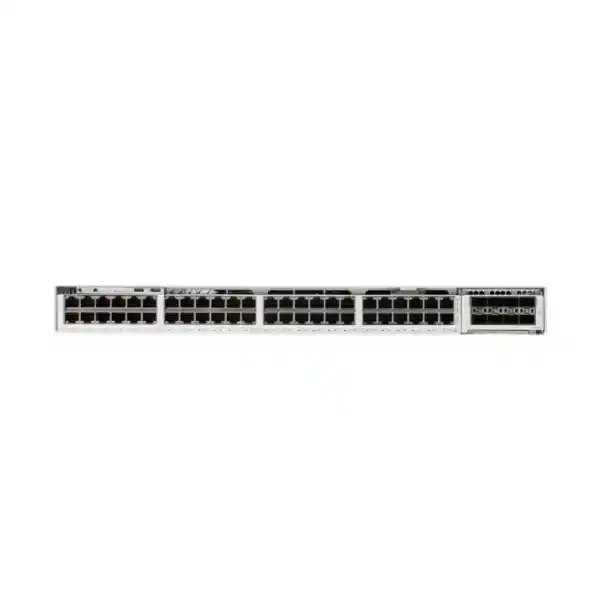
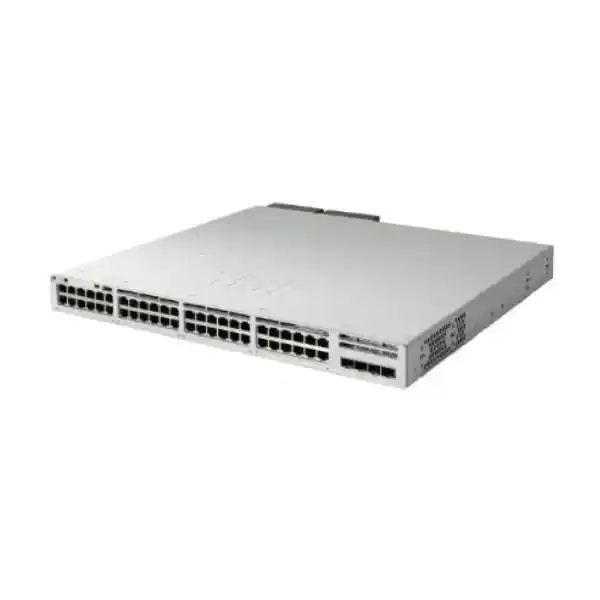
Cisco C9350-48P Smart Switch
A 48-port Gigabit Ethernet PoE+ access switch built for modern campus networks that need predictable wired performance, resilient power, high-speed uplink flexibility, large Layer 2 and Layer 3 scale, Cisco IOS XE operations, and a forward-looking Cisco Silicon One switching architecture.
Best fit
Corporate offices, campus access closets, hotel and retail floors, education buildings, healthcare networks, IP telephony, surveillance, building systems, IoT aggregation, and any UAE deployment where 48-port 1G access with standards-based PoE+ is the correct endpoint profile.
10/100/1000 Mbps copper access ports for dense endpoint connectivity.
Per-port PoE+ capability, with platform PoE capacity scaling according to installed power supplies.
A single Cisco Silicon One ASIC provides hardware-based forwarding for this model.
Model switching bandwidth specification, with 369.024 Mpps forwarding listed by Cisco.
StackWise-1.6T provides a high-capacity stacking architecture for resilient access blocks.
High-speed modular uplink choices enable 1G through 100G connectivity depending on network module.
Direct answer: who should choose the C9350-48P?
Choose the Cisco C9350-48P when your access layer is still predominantly Gigabit Ethernet at the edge, your powered devices fall within the 30-watt PoE+ class, and you want an enterprise platform with substantially more control-plane, forwarding, stacking, segmentation, automation, and uplink headroom than a basic fixed-configuration access switch. The model is especially logical where the endpoint population includes IP phones, conventional Wi-Fi access points that do not require higher-power or multigigabit access, surveillance cameras, badge readers, sensors, thin clients, meeting-room devices, printers, building-control gateways, POS terminals, desktop users, and operational-technology endpoints.
The key architectural distinction is that the C9350-48P is not merely a 48-port PoE switch. It sits in Cisco’s newer smart-switching family and uses the Silicon One A100/L ASIC. That matters to enterprise architects because the access layer is increasingly expected to do more than simple VLAN switching. It must classify users and devices, preserve quality of service, support scalable routing, expose telemetry, integrate with centralized management, enforce security policy, host edge applications where appropriate, and remain operational when a component fails. The C9350 family is designed around those broader campus requirements.
For buyers in Dubai and the wider UAE, the practical sizing question is not simply whether forty-eight ports are enough. The correct design also considers PoE draw, uplink oversubscription, stack topology, rack depth, PSU redundancy, fiber optics, licensing tier, support entitlement, environmental conditions, and future endpoint growth. FourTeck can support that engineering process through its UAE technology portfolio and can align the switch with adjacent network-security requirements through the Firewall Dubai practice.
Silicon One access architecture
At the center of the C9350-48P is one Cisco Silicon One A100/L ASIC. For an enterprise access design, the value of an ASIC is not an abstract processor specification; it is the point where forwarding decisions, QoS treatment, policy classification, table lookups, and packet movement are translated into deterministic hardware behavior. The C9350 family is designed around programmable forwarding resources and larger-scale tables so the switch can remain useful as access networks become more segmented and policy-rich.
Cisco lists up to 64,000 MAC addresses for the family and large routing capacities, including up to 192,000 IPv4 route entries in the published platform tables, with shared resources influenced by the selected SDM template and feature mix. It also supports thousands of VLANs and SVIs, jumbo frames up to 9216 bytes, multicast scale, security ACL resources, QoS ACL resources, NetFlow entries, policy-based routing resources, and tunnel capacities. Those numbers are important because high-density campus networks increasingly combine ordinary user access with cameras, IoT, guest networks, corporate wireless, voice, OT, and management segments. A switch that is adequate only at the port-count level can still become constrained at the table or policy level.
The C9350-48P’s published bandwidth specification is 496 Gbps, and Cisco lists a forwarding rate of 369.024 million packets per second for the standalone model. In a stacking context, Cisco publishes higher aggregate switching and forwarding figures because the stack fabric adds substantial inter-member bandwidth. These performance characteristics provide room for line-rate edge traffic while allowing the uplink architecture to scale well beyond the traditional 10G access-uplink model.
Why this matters in real deployments
Consider a 48-port access closet serving a mixed office floor. Twenty ports may connect user workstations, eight may serve IP phones with daisy-chained PCs, six may connect cameras, four may connect meeting-room systems, four may connect wireless access points, and the remaining ports may be reserved for printers, badge readers, building controls, spare capacity, or local infrastructure. The traffic is not homogeneous. Voice needs predictable QoS, cameras produce sustained upstream flows, wireless access points aggregate many clients, building devices may require isolation, and user segments may need dynamic policy.
The C9350 platform is valuable because those different traffic classes can be handled on one access system without reducing the design to a flat Layer 2 edge. Network architects can build routed access where appropriate, preserve traditional VLAN-based access where required, apply policy, export telemetry, and maintain a standardized operational model across multiple buildings.
The same hardware can therefore support a conservative migration today while preserving options for a more automated, segmented, and telemetry-driven campus later. That lifecycle flexibility is often more important than the first-day port count.
48-port Gigabit edge: designing the access side correctly
Every C9350-48P downlink supports 10/100/1000 Mbps over standard copper interfaces. That makes the model a natural fit for estates where Cat5e, Cat6, or Cat6A horizontal cabling is already deployed and the majority of endpoints operate at 1 Gbps or less. It also provides a low-risk replacement path for older 48-port Catalyst access switches because the logical access-layer design can often be retained while the switching, stacking, uplink, security, and management architecture is modernized.
Port-density planning should include operational reserve. A closet that needs 47 active connections on day one should not be treated as an ideal single-switch deployment simply because forty-eight physical ports exist. Patch-panel growth, failed endpoint moves, temporary project devices, extra cameras, access-control additions, and future wireless expansion can consume spare ports rapidly. A common enterprise approach is to size each access block with meaningful spare capacity or deploy multiple stack members so that changes can be absorbed without introducing an unplanned standalone switch.
The access speed also needs to match the endpoint roadmap. For conventional desktops, printers, most IP phones, many cameras, and a wide range of IoT devices, 1 Gbps remains ample. However, new high-performance Wi-Fi access points, certain workstation clusters, imaging systems, and high-throughput edge appliances may require 2.5G, 5G, or 10G copper. If a material proportion of the forty-eight ports needs multigigabit performance, a C9350 multigigabit model should be considered rather than selecting the C9350-48P simply because it has sufficient port count.
This distinction makes the C9350-48P particularly attractive for stable Gigabit edge populations. It lets organizations invest in a new-generation switching platform without paying for multigigabit PHYs and higher-power PoE capabilities on every port when those capabilities are not part of the endpoint requirement. The result can be a cleaner fit between capital expenditure, power draw, rack design, and actual device needs.
PoE+ engineering: 30W per port is only the first calculation
Endpoint class
The C9350-48P is intended for devices that can be served within the PoE+ power envelope. Validate each endpoint’s negotiated and maximum power requirement instead of assuming all PoE devices are equal.
Budget aggregation
Forty-eight ports multiplied by 30W gives a 1,440W theoretical full-port requirement. The installed PSU combination must be sized to support the actual aggregate load and redundancy target.
Growth margin
PoE design should include headroom for new phones, cameras, wireless APs, sensors, or building systems rather than running at the edge of available capacity on day one.
Resiliency
A design with sufficient power during normal operation may still be undersized after one PSU failure. Model both steady-state and failed-component conditions.
Cisco specifies 30W PoE+ capability on each of the forty-eight downlink ports and a maximum platform PoE budget of 1,440W for this SKU when the switch is configured with sufficient power supplies. The default C9350-48P ordering configuration includes an 850W-class power supply. Cisco’s power tables show that available PoE capacity increases as additional supplies are installed, which is why the bill of materials must be engineered rather than assuming the chassis always exposes the full 1,440W budget out of the box.
A practical PoE worksheet should list every powered endpoint by model, expected quantity, typical draw, maximum draw, and criticality. A 7W badge reader, a 12W phone, an 18W camera, and a 25W access point all consume very different parts of the same power pool. If a switch has twenty phones at 12W, twelve cameras at 18W, six APs at 25W, and four other devices at 10W, the maximum planning draw is already 646W before growth reserve. That may fit a normal configuration, but the redundancy model still matters. If the site requires N+1 power resiliency with no PoE shedding after a PSU failure, the engineer must size the active supplies so the remaining capacity after failure still exceeds the protected load.
PoE priorities should also reflect business impact. Security cameras, access-control controllers, emergency phones, or critical wireless APs may deserve higher priority than convenience devices. During power scarcity, deliberate prioritization can preserve the endpoints that matter most. This is particularly valuable in branch, hospitality, healthcare, and education environments where a large fraction of access-layer devices depend on the switch for both data and power.
For higher-power endpoints, the C9350 family includes models supporting 60W UPOE and 90W UPOE+. The C9350-48P should therefore be selected because 30W PoE+ is the correct requirement, not because it happens to be the first 48-port PoE model in the family. This prevents avoidable replacements when newer wireless or smart-building devices are introduced.
Modular uplinks: size the northbound path for the traffic profile
The C9350-48P uses modular uplink options rather than locking the switch into a fixed set of uplink ports. Cisco lists network modules including two-port and four-port dual-rate 100G/40G options and an eight-port module supporting combinations of 25G, 10G, and 1G, with 50G capability available in supported port modes. This modularity is strategically important because access-layer bandwidth requirements vary sharply between offices, surveillance-heavy sites, wireless-dense buildings, and routed-access campuses.
A traditional office floor may still be well served by redundant 10G uplinks. Forty-eight 1G access ports do not mean every endpoint will transmit at line rate simultaneously, and typical desktop traffic is bursty. In contrast, a surveillance network with dozens of high-resolution cameras can create sustained upstream load. A wireless-heavy floor can aggregate traffic from hundreds of clients through a smaller number of access points. A software-development office may have large image transfers, source repositories, virtualization access, or cloud synchronization. The correct uplink is determined by measured or modeled traffic rather than a fixed oversubscription ratio copied from an older design.
The uplink decision also affects optics, fiber count, distribution-switch port availability, and redundancy topology. Two physically diverse uplinks to separate upstream switches can reduce the impact of a single fiber, optic, line card, or upstream device failure. Where StackWise or equivalent upstream virtualization is used, the access layer can often build a simplified redundant topology while still providing multiple physical paths. In routed-access designs, equal-cost routing can provide an alternative to spanning-tree-dependent convergence.
For UAE projects, the module, optics, and fiber patching should be specified as part of the original switch BOM. Ordering the chassis without aligning the uplink module to the distribution/core platform can create avoidable deployment delays. The procurement package should name the exact network module, optic types, fiber mode, connector type, cable lengths, stack cables if required, and any spare optics. FourTeck’s UAE IT services team can align switching deployment with cabling, rack, migration, and operational requirements.
StackWise-1.6T: resilient access blocks without operational fragmentation
The C9350-48P supports StackWise-1.6T, giving network designers a high-bandwidth data stack for combining multiple access switches into a coordinated system. Cisco lists stack cables in different lengths, allowing the physical topology to be adapted to common rack arrangements. The business value of stacking is not simply that many switches can be managed together. A properly designed stack can reduce control-plane fragmentation, simplify uplink design, make access capacity easier to expand, and create a more predictable operating model for floor-by-floor campus deployments.
In a two-switch access block, stacking lets ninety-six Gigabit access ports be treated as part of one logical switching domain. In larger closets, additional members can extend the port count while preserving a standardized configuration pattern. Because Cisco’s C9350 stacking architecture offers 1.6 Tbps of stack bandwidth, inter-member traffic has substantial fabric capacity compared with older stack generations. That matters when endpoints on one stack member communicate with uplinks or services attached through another member.
The physical stack design still deserves engineering discipline. Stack cables should be installed in a topology that preserves connectivity after a single cable failure, labelled clearly, strain-relieved, and kept separate from power cords where practical. Stack member numbering should match the rack elevation and patch-panel plan so that interface naming corresponds to physical location. Spare stack cables should be considered for sites where rapid replacement matters. If stack power sharing is part of the design, the appropriate StackPower components and PSU capacity also need to be included in the BOM.
Operationally, stacking changes failure domains. A stack may simplify management, but engineers should understand how a member replacement, software upgrade, stack partition, or control-plane event affects service. Maintenance windows should be planned around the specific software release, high-availability capabilities, and device roles. Configuration backups should capture the logical stack as well as per-member provisioning.
For a Dubai campus with multiple wiring closets, a repeatable pattern can be created: two or more C9350-48P members per closet, dual uplinks toward redundant distribution, defined PoE redundancy, standardized IOS XE release, standard access policies, and centralized monitoring. This repeatability reduces troubleshooting time and makes spare strategy more efficient because the same model, modules, cables, and operating procedures are used throughout the site.
Layer 2, Layer 3 and scale: more than a VLAN edge
Modern access switching increasingly blends Layer 2 connectivity with Layer 3 routing and policy. The C9350 platform is built to support large numbers of VLANs, switched virtual interfaces, MAC addresses, host entries, routes, multicast entries, ACLs, NetFlow records, and other forwarding resources. Cisco publishes support for up to 4094 VLAN IDs, up to 4000 active VLANs, around 2000 SVIs, 64,000 MAC addresses, and significant IPv4 and IPv6 route scale. The exact usable scale depends on feature configuration, software, templates, and shared hardware resources, so architects should treat published maxima as engineering ceilings rather than simultaneous guarantees.
In a classic Layer 2 access design, user and device VLANs extend from the access switch to a distribution layer where default gateways and routing reside. This can be simple and familiar, but large Layer 2 domains increase dependence on spanning-tree design and can extend broadcast and failure boundaries. A routed-access model moves Layer 3 closer to the edge, limiting Layer 2 scope and using routing protocols to provide deterministic path selection and convergence. The C9350’s routing scale and high-speed uplinks make it suitable for organizations evaluating that model.
Segmentation is another major use case. A single physical access switch may carry corporate users, voice, cameras, printers, OT, guest services, building management, wireless infrastructure, and management traffic. Keeping those endpoints in one broadcast domain is rarely desirable. VLAN and VRF-based segmentation, ACLs, identity-driven policy, and firewall enforcement can create clear trust boundaries. The access switch is therefore part of the security architecture even when the primary firewall sits elsewhere in the network.
Multicast support matters for deployments such as digital signage, IPTV, financial market feeds, certain surveillance systems, building control, and collaboration applications. IGMP and MLD snooping help prevent multicast from being flooded unnecessarily to all ports. Quality of service is equally important where voice, video, interactive applications, and bulk transfers share the same uplink. Classification, marking trust, queuing, congestion management, and policing should be designed as an end-to-end policy rather than configured independently on each closet.
The result is an access switch that can remain operationally relevant even if the network evolves from simple VLAN switching toward routed access, more granular segmentation, and richer telemetry. This protects the infrastructure investment and lets the organization change architecture through software and policy instead of immediately replacing hardware.
Security at the campus edge
The wired access layer is one of the most important enforcement points in an enterprise network because it is where users, endpoints, phones, cameras, sensors, and unmanaged devices first connect. The C9350 family is designed for zero-trust-oriented campus architectures, with hardware and software capabilities that support identity, segmentation, secure onboarding, policy enforcement, encrypted connectivity, telemetry, and integration with the broader Cisco security and management ecosystem.
A secure deployment starts with access control. Enterprise designs commonly use 802.1X for managed users and devices, with alternative authentication methods for devices that cannot run a supplicant. Dynamic VLAN or policy assignment can then place endpoints into appropriate segments. Port-security, DHCP snooping, Dynamic ARP Inspection, IP source protections, control-plane policing, protected management access, SNMPv3, secure logging, and authenticated time services can all contribute to the security baseline depending on policy.
Segmentation should be matched to firewall policy. Cameras, building controls, guest networks, user networks, voice systems, and management interfaces generally should not have unrestricted east-west reachability. FourTeck can align access switching with next-generation firewall design so the switching fabric supports the intended trust zones instead of undermining them through overly broad Layer 2 connectivity.
Telemetry and visibility
Security operations depend on visibility. Flow telemetry, interface statistics, authentication events, syslog, environmental alerts, and endpoint context help network and security teams detect anomalies and troubleshoot incidents. The C9350 platform provides hardware resources for NetFlow and policy features, while IOS XE enables integration with centralized assurance and automation workflows.
A well-instrumented access layer can answer practical questions quickly: which port a device used, whether it authenticated successfully, how much traffic it generated, which uplink carried its traffic, whether the port experienced errors, whether PoE was negotiated correctly, and whether an ACL or policy affected the session. This reduces mean time to resolution and improves incident response.
For regulated or security-sensitive UAE organizations, the architecture should also define log retention, administrator role separation, configuration backup, software lifecycle, vulnerability response, and change-control procedures. The switch is one component in that governance model, but its management plane must be hardened consistently with the rest of the infrastructure.
IOS XE operations, automation and lifecycle management
Cisco IOS XE provides the operational framework for the C9350-48P. For engineering teams already standardized on Cisco enterprise switching, this continuity can simplify adoption because familiar concepts such as interfaces, VLANs, routing, AAA, QoS, SNMP, syslog, access lists, and automation remain part of the operating model. At the same time, newer management approaches can be layered on through centralized controllers, APIs, model-driven telemetry, and automation workflows.
Software lifecycle planning should begin before installation. The project should define the target IOS XE release, confirm hardware and feature compatibility, identify the organization’s preferred maintenance release policy, test the configuration in a lab where practical, and document rollback procedures. Standardizing a release across access closets reduces operational variability. It also simplifies troubleshooting because engineers can compare behavior across identical software versions rather than managing a mix of images.
Configuration automation can materially improve consistency. Instead of manually building forty switches, teams can generate standardized interface templates, VLAN definitions, routing policies, AAA parameters, NTP, DNS, logging, SNMPv3, telemetry, QoS, access-control settings, banners, and management ACLs from a controlled source of truth. Automation does not remove the need for review; it makes review more meaningful by reducing accidental syntax drift and making differences explicit.
Monitoring should combine availability with performance and environmental state. Useful indicators include uplink utilization, discards, CRC errors, interface flaps, stack health, fan status, power-supply state, PoE consumption, temperature, CPU, memory, route or adjacency changes, authentication failures, and configuration modifications. Alert thresholds should distinguish genuine service risk from normal transient behavior. A camera port with sustained high utilization may be normal, while repeated CRC errors may indicate cabling problems. A high PoE draw may be expected during AP boot, while a sudden loss of PoE capacity may signal a PSU event.
Application hosting and optional storage expand the platform’s edge-compute possibilities. Cisco publishes support for optional SSD capacity and dedicated application-hosting resources on the C9350 family. Organizations considering edge applications should validate the specific application, storage, resource, licensing, and software requirements rather than assuming every containerized workload is appropriate for the switch.
The broader operational objective is to treat the C9350-48P as part of a managed system. Hardware, software, licenses, support, configuration, telemetry, backups, spares, and change control should be planned together. This is the difference between purchasing a switch and deploying an enterprise access platform.
Power, cooling, rack and environmental design
Physical deployment details have direct reliability consequences. Cisco lists the C9350-48P chassis at approximately 1.73 x 17.5 x 15.1 inches, or 4.4 x 44.5 x 38.3 centimeters, before accounting for the additional depth of installed power supplies and cable bend radius. With the default PSU fitted, the published weight is approximately 13.54 pounds, or 6.14 kilograms. The switch uses a 1RU form factor, making it straightforward to deploy in standard enterprise racks, but rack depth, rear clearance, patching, power connectors, and airflow must still be verified.
The C9350 family supports up to three hot-swappable power supplies, enabling N+1 power designs and higher available PoE capacity. Cisco also uses field-replaceable fan modules with N+1 fan redundancy. This serviceability is valuable for enterprise closets because a failed fan or PSU does not necessarily require immediate chassis replacement. Spare strategy can focus on common field-replaceable units as well as a limited number of spare switches, reducing recovery time.
Airflow must be preserved. Patch cords, power leads, vertical managers, and adjacent equipment should not obstruct intake or exhaust. Rack temperature should be monitored, especially in small telecommunications rooms where UPS systems, access switches, firewalls, and servers may share the same enclosure. Cisco publishes an operating range extending to 45°C under specified altitude conditions, with derating at higher altitude, but a good data-closet design should not operate continuously near platform limits. Lower and stable inlet temperatures generally improve component longevity and provide more margin during cooling failures.
Power design should account for both chassis consumption and PoE load. A switch feeding hundreds of watts to endpoints imposes a larger requirement on the UPS and electrical circuit than a data-only switch. If the business expects phones, access points, security cameras, and access-control devices to remain operational during a power outage, UPS runtime calculations must include the downstream PoE load. Otherwise, an apparently generous UPS runtime may collapse once the switch begins supplying its full endpoint power demand.
Where racks also contain virtualization or application servers, power density and heat rise further. The switching BOM should therefore be coordinated with rack and compute planning. FourTeck’s Server Dubai solutions can be considered when the project combines access switching, rack infrastructure, server hardware, and power-protection requirements.
Six deployment patterns where the C9350-48P fits naturally
1. Corporate office floor
Use the switch to connect desktops, IP phones, printers, meeting-room endpoints, standard-power wireless APs, access-control readers, and building sensors. Dual high-speed uplinks can feed a redundant distribution layer while VLANs and policy separate users, voice, facilities, guest services, and management. The main sizing checks are port reserve, PoE headroom, and uplink utilization.
2. Surveillance aggregation
Forty-eight PoE+ ports can support a substantial camera population when individual cameras remain within the power envelope. Because camera traffic is sustained rather than bursty, uplink design is critical. Engineers should calculate average and peak bitrate per camera, recording architecture, multicast requirements, retention system location, and redundancy before selecting the uplink module.
3. Hospitality access
Hotels can use the switch for back-office users, IP telephony, room systems, cameras, access control, guest-network APs, IPTV support infrastructure, and building devices. Segmentation is essential because guest, corporate, facilities, security, and voice traffic have different trust requirements. Stack-based access blocks can simplify multi-floor operations.
4. Education building
Classrooms, labs, staff offices, IP phones, cameras, digital signage, and wireless APs can share the same managed access platform while remaining logically separated. High-speed modular uplinks help aggregate bursty student traffic, content delivery, assessment platforms, cloud applications, and video services toward the campus core.
5. Healthcare or clinic network
The C9350-48P can support administrative users, phones, cameras, badge systems, printers, standard Ethernet medical endpoints, and wireless infrastructure. Healthcare designs should emphasize segmentation, authentication, redundant power, monitoring, and change control. Devices with specialized regulatory or isolation requirements must be assessed separately.
6. Branch or mixed-use facility
A larger branch may consolidate user access, voice, cameras, access control, IoT, and local infrastructure on one or two C9350-48P units. The switch can route locally, connect to SD-WAN or firewall appliances, and enforce edge policy while the modular uplink provides room for future WAN or campus integration.
UAE and Dubai procurement considerations
Enterprise switch procurement in the UAE should be treated as a bill-of-materials exercise rather than a chassis-only purchase. The base C9350-48P must be matched with the required software licensing, support coverage, network module, optics, power supplies, power cords, rack-mount accessories, stack cables, StackPower components where needed, optional storage, and site-specific spares. Missing any one of these components can delay commissioning even when the switch itself is available.
The first step is to define the target topology. If the switch will operate standalone, the BOM may be simpler. If it forms part of a stack, stack cable lengths and redundancy topology must be selected. If the switch requires N+1 power, the second or third PSU must be included. If the full 1,440W PoE ceiling is required, the power design must provide the appropriate installed PSU capacity. If the uplink is 25G, 40G, 50G, or 100G, the selected network module and optics must match both the C9350 and the upstream platform.
Fiber planning should verify single-mode versus multimode, optic wavelength, connector type, supported distance, patch-panel presentation, polarity, and spare-fiber availability. It is inefficient to select a 100G uplink module if the building backbone has insufficient fiber or the distribution switch has no compatible interfaces. Conversely, a project should avoid undersizing the uplink merely because existing optics are convenient if traffic modeling shows they will become a bottleneck.
Support and software entitlement need equal attention. Enterprise organizations typically require access to software updates, technical support, and defined replacement services. The correct Cisco support offer should match business criticality and operational coverage. A 24×7 facility, hospital, hotel, or data-intensive site may justify a different service level from a small office that can tolerate a longer replacement window. The spare-parts strategy should complement, not replace, vendor support.
Regional deployment logistics include rack readiness, UPS capacity, grounding, labeling, structured cabling test results, maintenance-window approvals, and coordination with building management. For multi-site UAE rollouts, standardizing the rack elevation, patching pattern, stack member numbering, management addressing, IOS XE release, template, and acceptance test reduces variation between sites.
FourTeck can provide a consolidated approach across switching, firewall, server, structured IT services, and deployment support. That allows the access switch to be engineered in context rather than purchased as an isolated SKU.
C9350-48P versus adjacent C9350 models
| Model | Access profile | PoE class | When to choose it |
|---|---|---|---|
| C9350-48P | 48 x 1G copper | 30W PoE+ | Best for high-density Gigabit edge devices whose powered endpoints stay within PoE+ limits. |
| C9350-48U | 48 x 1G copper | 60W UPOE | Choose when endpoints need more than 30W but 1G access speed remains sufficient. |
| C9350-48HX | 48 x multigigabit up to 10G | Up to 90W UPOE+ | Use for high-performance Wi-Fi, multigigabit endpoints, and higher-power smart-building or edge devices. |
| C9350-48T | 48 x 1G copper | Data only | Select where all endpoints are independently powered and PoE capacity would be unused. |
The comparison shows why model selection should start from endpoint requirements. If nearly all ports are 1G and the powered devices require no more than PoE+, the C9350-48P is a cost-efficient and technically appropriate fit. If new Wi-Fi standards, digital signage, cameras with heaters, pan-tilt-zoom mechanisms, smart lighting, or specialized edge devices drive higher power or multigigabit bandwidth, a higher-capability model may be the better lifecycle decision. Conversely, if the site has no powered endpoints, a data-only model avoids paying for PoE capability that will never be used.
Sizing methodology for a 48-port PoE+ access block
A disciplined sizing method prevents the two most common access-switching mistakes: selecting solely by port count and sizing solely for day-one demand. Start with an endpoint inventory. For each device type, record quantity, copper speed, PoE requirement, VLAN or segment, criticality, expected traffic pattern, and projected three-to-five-year growth. This converts a rough requirement such as “we need forty ports” into an engineering model.
Next, calculate port capacity with reserve. If a floor has thirty-six current devices and expects eight more over three years, a single 48-port switch might be physically adequate, but only four ports remain for unexpected changes. If operational policy requires 15 to 20 percent spare capacity, a second stack member or different distribution of endpoints may be more appropriate. Spare ports are not wasted; they are operational flexibility.
Third, calculate PoE. Add the maximum expected draw of all powered devices and include growth. Then compare the result with the PoE capacity available under the planned PSU configuration, not merely the platform ceiling. Repeat the calculation under a failed-PSU condition if the service must remain fully powered after one supply fails. Categorize endpoints by priority so any unavoidable power shedding follows business impact.
Fourth, model uplinks. Estimate average and peak traffic by endpoint class. Desktops are bursty, cameras are sustained, APs aggregate many wireless clients, and backup or imaging systems can create large periodic flows. Add inter-VLAN routing patterns and any local services. Determine whether redundant 10G is sufficient or whether 25G, 40G, 50G, or 100G uplink capability is justified. Include failure-state traffic; if one uplink fails, the surviving link must carry the expected load without unacceptable congestion.
Fifth, validate control-plane and policy scale. Count VLANs, VRFs, routes, MAC addresses, multicast groups, ACLs, and telemetry requirements. Most access deployments will be far below C9350 platform limits, but very large campuses or highly segmented designs should confirm that chosen SDM and software profiles align with the required scale.
Sixth, design physical resiliency: PSU count, UPS capacity, fan redundancy, rack space, cable management, spare modules, stack-cable topology, fiber diversity, and environmental monitoring. The network diagram should show not only logical links but also physical path diversity where resilience depends on separate risers or routes.
Finally, validate the commercial BOM against the engineering model. Every requirement should map to a specific item: switch chassis, license, support, PSU, network module, optics, stack cable, power cable, optional SSD, mounting accessories, and spares. This traceability makes procurement easier to review and reduces the risk of receiving a technically incomplete order.
Migration from an older Catalyst access switch
Replacing an older access switch with the C9350-48P should be treated as a controlled migration rather than a like-for-like hardware swap. Begin by collecting the existing configuration, interface descriptions, VLAN assignments, voice VLANs, trunk parameters, spanning-tree state, EtherChannels, routing configuration, DHCP snooping bindings where relevant, ACLs, QoS policy, AAA settings, management addressing, SNMP, syslog, NTP, PoE usage, and connected-device inventory.
The legacy configuration should be reviewed instead of copied blindly. Old switch configurations often contain disabled interfaces that are no longer needed, obsolete VLANs, inconsistent port-security commands, old SNMP communities, weak management protocols, duplicate ACL entries, stale descriptions, unsupported commands, or historical workarounds. Migration is an opportunity to standardize the access policy and remove accumulated technical debt.
Build the C9350 configuration against the target IOS XE release and validate syntax before the maintenance window. Pre-stage management access, AAA, VLANs, uplinks, stack configuration, routing, policy, QoS, and monitoring. If the switch will be part of a new stack, assemble and test the stack in advance where possible. Confirm stack member numbering, software consistency, network-module recognition, PSU status, fan health, and optic compatibility.
During cutover, preserve patch-panel mapping. Label every cable or move one port at a time against a verified worksheet. This prevents a migration from becoming a troubleshooting exercise caused by incorrect physical mapping. Validate high-priority services first: uplinks, management, DHCP, DNS reachability, authentication, default gateway connectivity, phones, wireless APs, cameras, and critical user ports. Confirm PoE negotiation and monitor the aggregate PoE budget as devices boot.
After cutover, compare interface status and MAC-learning patterns with the pre-migration inventory. Check errors, discards, duplex or speed anomalies, spanning-tree state, routing adjacencies, authentication results, syslog, NTP synchronization, monitoring discovery, configuration backup, and alerting. A migration is not complete simply because users can browse the internet; operational visibility and resilience must also be restored.
Finally, document the deployed serial numbers, rack position, stack role, uplink optic IDs, software release, license state, support contract, IP address, power-supply population, and spare strategy. This information is essential when the network later requires maintenance or replacement.
Design details that separate a robust deployment from a basic installation
QoS trust boundary
Do not trust arbitrary DSCP markings from every endpoint. Define where markings are trusted, where traffic is reclassified, and how voice, video, control traffic, business applications, and bulk transfers map into queues. The access layer is usually where that trust boundary begins.
Management isolation
Place switch management in a protected network reachable only by authorized administrators and management systems. Restrict SSH, APIs, SNMP, and other services with AAA and management-plane filtering. Avoid exposing the switch management plane directly to user or guest segments.
Time and logs
Accurate NTP and centralized logging are foundational for troubleshooting and security. Authentication failures, interface changes, routing events, power alarms, configuration modifications, and software messages are much less useful if timestamps are inconsistent across devices.
Cable quality
Gigabit access is still dependent on physical cabling quality. CRC errors, pair faults, damaged patch leads, poor terminations, and electromagnetic interference can create intermittent performance issues that appear to be switching problems. Test and certify suspect copper runs.
Failure-state testing
Test uplink, PSU, stack-link, and upstream-switch failures during commissioning where operationally possible. A design is only resilient if expected traffic continues to pass within acceptable convergence and power limits when a component is removed.
Configuration source of truth
Maintain intended VLANs, uplinks, addresses, policy, port roles, and software versions in controlled documentation or automation. Do not let the running configuration become the only record of what the network is supposed to look like.
Licensing and feature planning
Cisco C9350 ordering includes software licensing choices with Essentials and Advantage tiers offered in various term lengths. The correct license should be selected according to the required feature set, management approach, automation capabilities, segmentation needs, and organizational Cisco agreement. Licensing should never be treated as an afterthought because a hardware feature may depend on a particular software entitlement or subscription.
The procurement team should therefore work from a requirements matrix. List the required routing protocols, advanced security functions, automation integration, controller management, telemetry, policy features, and expected subscription period. Then map that list to the appropriate Cisco licensing tier. If the organization already uses a Cisco enterprise agreement, the commercial structure may influence which license is most efficient.
Support coverage should be evaluated separately from feature licensing. Software entitlement, technical assistance, and hardware replacement services solve different operational needs. A business-critical campus may want rapid hardware replacement even if it maintains on-site spares. An organization with strong internal network expertise may still need vendor escalation for software defects or complex interoperability cases.
Renewal planning also matters. Record license start and end dates, support contract details, device serial numbers, responsible owners, and renewal lead times in the asset-management system. Waiting until a license or support service expires can create procurement pressure and operational gaps. Multi-year projects should align contract terms where possible so hundreds of switches do not renew on scattered dates.
Because Cisco licensing can change over product lifecycles, the final quote should be validated against the current ordering guide at the time of purchase. FourTeck can build the hardware and licensing BOM around the specific deployment rather than relying on a generic switch-only quotation.
Operational acceptance checklist after installation
A production handover should include more than a ping test. Verify every hardware component and every intended operational dependency. Start with inventory: chassis serial number, switch member number, network module, installed PSUs, fan modules, stack cables, optics, and software version. Confirm that the hardware inventory matches the approved BOM and that field-replaceable units show healthy status.
Validate the stack if used. Confirm all members are present, correctly numbered, running compatible software, and connected through the intended stack topology. Review stack-port status and ensure the expected ring or resilient topology is complete. Confirm that the management and control roles are stable and that configuration synchronization behaves as designed.
Check every uplink for negotiated speed, optic type, light levels where available, errors, port-channel state, routing adjacency, spanning-tree role, and failover behavior. A link that is up at the wrong speed or operating with marginal optical levels can pass initial tests while remaining a future incident. Where dual uplinks are intended for resiliency, test loss of each path independently.
For PoE, record current and available budget, powered-device count, individual port draw, and PSU state. Restart representative endpoints to confirm boot-time power requirements do not exceed budget. Test critical endpoints on the intended priority levels. If the design promises service after one PSU failure, remove or disable a supply during an approved test and confirm protected devices remain powered.
Verify security and management services: AAA login, local break-glass access, SSH, management ACLs, SNMPv3, telemetry, syslog, NTP, DNS, controller registration if used, configuration backup, and monitoring alerts. Test authentication on representative access ports, including a successful authorized client and a rejected or quarantined unauthorized device where policy permits.
The final documentation should include the as-built diagram, rack elevation, patch-panel mapping, IP plan, VLAN list, routing summary, license information, support details, software version, backup location, administrator procedure, and escalation path. A well-documented C9350 deployment is easier to operate for years and less dependent on individual engineer memory.
Why the C9350-48P is a strong lifecycle choice for Gigabit PoE access
The strongest reason to choose the C9350-48P is architectural balance. It provides forty-eight familiar Gigabit copper ports and 30W PoE+ at the edge, yet the surrounding system is engineered for much more demanding enterprise requirements. High-capacity stacking, modular uplinks, large forwarding resources, resilient field-replaceable power and cooling, modern IOS XE operations, telemetry, policy, and Silicon One forwarding give the platform room to evolve as the campus changes.
That balance is valuable because access-layer replacement cycles are long. Many organizations operate switches for seven years or more. Over that period, management practices may shift from CLI-driven administration to controller-based automation. Security requirements may move from static VLANs toward identity-based policy and deeper segmentation. Uplinks may grow from 10G to 25G or 100G. Monitoring may evolve from SNMP polling toward streaming telemetry and flow analytics. The endpoint population may expand from phones and desktops to cameras, sensors, smart-building systems, and specialized appliances.
The C9350-48P can participate in that evolution without forcing organizations to abandon 1G copper where 1G remains technically appropriate. This is an important cost consideration. Not every office needs 10G to the desktop, and not every device requires 60W or 90W PoE. A platform that concentrates investment in the switching architecture, stack fabric, uplink flexibility, security, and operations can be more sensible than deploying expensive multigigabit ports that remain unused.
The model is therefore best understood as a modern enterprise access platform optimized for conventional Gigabit PoE+ endpoints. When that description matches the environment, the C9350-48P offers a technically clean fit between current access requirements and future network-operating practices.
Frequently evaluated technical questions
Does every port support 30W PoE+?
The model supports 30W-class PoE+ on its forty-eight access ports, but the aggregate power available to all ports depends on the installed PSU configuration. Full simultaneous 30W allocation across forty-eight ports requires a 1,440W aggregate PoE budget.
Is 1G enough for Wi-Fi access points?
It depends on the AP model and client density. Many existing APs work well on 1G, while newer high-throughput APs may benefit from multigigabit access and higher PoE. Validate the AP’s Ethernet and power specifications before selecting the C9350-48P.
Can it be used beyond simple access switching?
Yes. The C9350 family provides substantial Layer 3, policy, telemetry, and automation capabilities and can participate in routed-access, distribution, or collapsed-core designs where scale and feature requirements align with the platform.
What uplink speed should be ordered?
Choose from the supported modular uplink options based on measured traffic, redundancy, upstream port compatibility, optic distance, and future growth. 10G may be sufficient for many office floors, while camera or wireless-heavy designs can justify higher speeds.
Should two power supplies always be ordered?
Not universally, but enterprise deployments often need redundant supplies or additional PoE capacity. Size the supplies against normal load, failure-state load, UPS capacity, and service-criticality objectives rather than applying one rule to every site.
Is the switch suitable for Dubai branch deployments?
Yes, provided rack cooling, power, cabling, uplinks, PoE requirements, licensing, and support are engineered correctly. The platform’s 1RU format, modularity, and resilient components fit enterprise branch and campus environments.
Decision recap
Choose C9350-48P when
You need forty-eight 1G copper ports, PoE+ up to 30W per port, high-capacity stacking, modular uplinks, enterprise IOS XE operations, and a modern Cisco access architecture.
Consider C9350-48U when
Your access ports remain 1G but a meaningful portion of endpoints require more than 30W and can benefit from 60W-class UPOE.
Consider C9350-48HX when
Your roadmap includes multigigabit clients, high-performance Wi-Fi, 10G copper edge devices, or up to 90W UPOE+ power requirements.
Do not forget
The final solution needs the correct license, network module, optics, PSU count, stack cables, support, power cords, rack plan, UPS sizing, and migration procedure.
Quotation input checklist
For an accurate Cisco C9350-48P quotation in Dubai or elsewhere in the UAE, provide the following project inputs. Supplying these details lets the BOM reflect the intended topology instead of relying on assumptions that may increase cost or omit required components.
Plan the C9350-48P as a complete access solution
FourTeck can help determine the correct C9350-48P switch quantity, license, PSU population, PoE headroom, uplink module, optics, stack accessories, rack requirements, and migration scope for Dubai and UAE enterprise networks. The aim is to deliver a configuration that is technically complete on day one and still aligned with the site’s growth and resilience objectives.
For projects extending beyond the UAE, FourTeck’s global technology platform can support wider requirements while maintaining a consistent network design standard.
Correct power
Correct uplink
Correct license
Correct migration plan

Reviews
There are no reviews yet.