
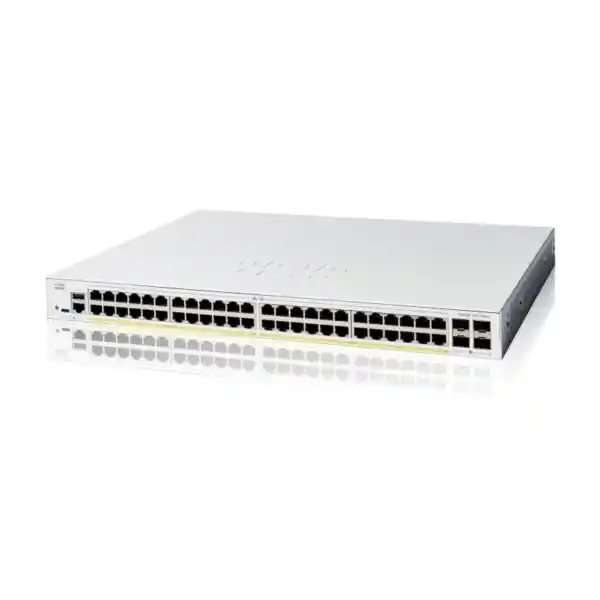
Cisco Catalyst C1200-48P-4G Network Switch Dubai
A dense Gigabit access switch for small and medium-sized organizations that need 48 PoE+ edge ports, four 1G fibre uplinks, practical Layer 2 controls, static Layer 3 routing and centralized management without moving into a larger enterprise switching platform.
Direct answer: what is the C1200-48P-4G and who is it for?
The Cisco Catalyst C1200-48P-4G is a rack-mountable smart managed access switch in the Catalyst 1200 Series. Cisco specifies 48 10/100/1000 Ethernet ports capable of PoE+ delivery, four 1 Gigabit SFP uplink ports, a total PoE budget of 375 watts, 104 Gbps of switching capacity and a forwarding rate of 77.38 million packets per second for 64-byte packets. It is mainly used to connect office endpoints, IP phones, wireless access points, cameras, printers and other Ethernet devices while providing VLAN segmentation, QoS, access control, monitoring and static Layer 3 routing.
Organizations should consider this model when 48 copper edge ports and substantial PoE capacity are useful, but the uplink requirement can remain at 1 Gigabit Ethernet. The most important design factor to confirm is not simply the number of available ports: buyers need to calculate the real PoE demand, expected uplink traffic, fibre type and distance, VLAN and routing plan, redundancy expectations, and future growth. A 48-port switch may appear large enough today but still be the wrong choice when several Wi-Fi access points, IP cameras or high-traffic application segments can collectively saturate a 1G uplink.
FourTeck can help determine whether the C1200-48P-4G is correctly sized, whether compatible SFP optics and patching are required, how it should connect to the firewall or core switch, how much UPS capacity is sensible, and whether a Catalyst 1200 model with 10G SFP+ uplinks should be evaluated instead.
Verified model identity and current specification snapshot
Cisco identifies C1200-48P-4G as a Gigabit Ethernet model in the Catalyst 1200 Series. The current Cisco Catalyst 1200 Series data sheet, updated in August 2026, lists the product ID as C1200-48P-4G and describes it as a rack-mountable switch with 48 10/100/1000 PoE+ ports and four Gigabit SFP interfaces. Those details matter because the suffix differentiates this model from nearby 48-port variants. The “P” model supplies PoE+, while “4G” denotes four Gigabit SFP uplinks. It should not be confused with a “4X” model, whose uplinks are 10 Gigabit SFP+.
| Specification | Cisco C1200-48P-4G |
|---|---|
| Access ports | 48 x 10/100/1000BASE-T RJ-45 with PoE+ |
| Uplinks | 4 x 1G SFP |
| PoE standards | IEEE 802.3af PoE and IEEE 802.3at PoE+ |
| PoE budget | 375W total, with up to 30W to a Gigabit Ethernet port until the switch budget is reached |
| Switching capacity | 104 Gbps |
| Forwarding rate | 77.38 Mpps at 64-byte packets |
| MAC address table | 8,000 addresses |
| Packet buffer | 3 MB aggregate, dynamically shared |
| Jumbo frame size | Up to 9000 bytes; Cisco lists a default MTU of 2000 bytes |
| Physical dimensions | 445 x 350 x 44 mm |
| Weight | 5.43 kg |
| Input power | 100 to 240V AC, 50 to 60 Hz, internal universal power |
| Operating temperature | -5°C to 50°C |
| Warranty | Cisco limited lifetime warranty; applicable support terms and regional conditions should be confirmed at purchase |
Why 48 PoE+ ports can be useful in a Dubai business network
The defining value of the C1200-48P-4G is the combination of port density and integrated power delivery. Forty-eight PoE+ copper ports allow a single access switch to serve a substantial floor, branch, retail location, school area, clinic, hospitality back-office network or mixed endpoint environment. The practical benefit is not merely fewer power adapters. PoE centralizes endpoint power around the network cabinet, which makes it easier to protect phones, cameras and access points through the same UPS strategy that protects the switch. It also reduces dependency on local wall sockets at each ceiling or wall-mounted device.
The 375W PoE budget should be treated as a shared design resource. A PoE+ port can provide up to 30W, but 48 devices cannot all draw 30W simultaneously from a 375W total budget. For example, a network with many low-draw IP phones can leave considerable room for access points and cameras, while a deployment dominated by higher-power wireless or surveillance devices may reach the switch budget well before all 48 ports are occupied. The correct calculation uses each endpoint’s expected or maximum power requirement, not just its PoE standard. A reasonable design also keeps operational headroom so that replacing a device with a slightly higher-power model does not immediately cause a power shortage.
For Dubai projects, this is especially relevant when one cabinet is expected to support a mixture of IP telephony, Wi-Fi and CCTV. The number of connected endpoints, the power class of each endpoint, spare-port policy and UPS runtime requirement should be documented together. That produces a far better purchasing decision than selecting a switch solely because it advertises 48 PoE+ ports.
PoE budget planning: turn 375W into a realistic endpoint plan
Inventory endpoint power
Record each proposed IP phone, wireless access point, camera, door controller or other powered device and its real PoE requirement. Use manufacturer values for the actual endpoint model. A port count alone cannot tell you whether the 375W budget is sufficient.
Preserve headroom
Do not design exactly to the theoretical total. Allow room for endpoint replacement, expansion and startup behaviour. Headroom also gives operations teams flexibility when a camera or access point is moved to a port that was originally allocated to a lower-power device.
Include UPS impact
A heavily loaded PoE switch draws far more power than an unpowered data switch. UPS sizing should include the switch itself, the power passed through to endpoints, expected runtime, battery ageing and any other equipment sharing the UPS.
PoE planning also affects fault domains. Putting every critical camera, access point and phone on one 48-port switch is simple, but it concentrates power and connectivity on one device. If a site requires higher service continuity, it may be better to distribute key endpoints across two access switches, even when a single C1200-48P-4G has enough ports. That decision depends on business impact, cabinet space, cabling routes and budget. The C1200-48P-4G provides a useful amount of PoE for an SMB access layer, but the resilience architecture is an independent design question.
Performance: what 104 Gbps and 77.38 Mpps mean in practice
Cisco lists the C1200-48P-4G as wire-speed and nonblocking with 104 Gbps switching capacity and 77.38 Mpps forwarding performance for 64-byte packets. Those numbers indicate that the switching fabric is sized for the ports provided and is not the first place most SMB buyers will encounter a bottleneck. In real deployments, the more important constraint is often traffic concentration toward servers, firewalls, storage, internet gateways or upstream switches.
Forty-eight 1G access ports can generate far more aggregate traffic than one 1G uplink can carry. The switch gives four 1G SFP uplinks, and link aggregation may be used where the upstream design supports it, but a design team still needs to understand actual application flows. An office where most users access cloud services through a 500 Mbps internet circuit has very different uplink behaviour from a production network moving large files to local servers or carrying high-bitrate video streams. The switching capacity figure therefore should not be interpreted as a promise that every possible traffic pattern will experience the same throughput to an external destination.
When heavy east-west traffic, virtualization, local storage, high-density Wi-Fi or large surveillance streams are expected, compare the C1200-48P-4G with a 48-port model that provides 10G SFP+ uplinks. Choosing the higher-uplink variant at the start can be more economical than replacing an otherwise healthy access switch later because the uplink architecture has become the limiting factor.
Understanding the four 1G SFP uplinks
The four SFP interfaces provide fibre-capable Gigabit Ethernet uplinks. They are useful for linking the access switch to an upstream distribution or core device, a firewall aggregation point or another switch when electrical isolation or longer distances make fibre appropriate. The SFP module is not the same thing as the fibre cable: the optic, fibre type, connector type, wavelength and supported distance must match the far-end equipment and the installed cabling plant.
Buyers should confirm whether the building uses multimode or single-mode fibre, the approximate length of the run, the connector presentation at the patch panel, and the optic supported by both devices. An SFP should never be selected purely because its physical shape fits the cage. The operational objective is end-to-end optical compatibility. Where copper is sufficient and the network design does not require fibre, the C1200-48P-4G is still an access switch whose four dedicated uplink interfaces are SFP, so the intended uplink medium should be understood before ordering.
The “4G” part of the model name is also a sizing signal. It tells the buyer that these are Gigabit SFP uplinks, not SFP+ 10 Gigabit uplinks. If a network is expected to aggregate many high-throughput users, Wi-Fi access points, camera streams or local server workloads, the C1200-48P-4X should be considered because the uplink capacity requirement may matter more than the access-port count. Four 1G links can be useful, including for segmented or redundant designs, but they are not equivalent to four 10G links.
Layer 2 switching features for a structured access network
The Catalyst 1200 Series data sheet lists the Layer 2 functions expected in a serious managed SMB switch. The platform supports IEEE 802.1Q VLANs and up to 255 active VLANs simultaneously, allowing traffic to be separated by role rather than placing every device in one broadcast domain. Common examples include separate user, voice, wireless guest, CCTV, building-system, printer and management networks. A good VLAN design reduces unnecessary broadcast exposure and gives the firewall or routing layer clearer policy boundaries.
Spanning Tree support includes classic STP, Rapid STP and Multiple Spanning Tree, along with Cisco PVST+ and Rapid PVST+ support listed in the data sheet. This matters whenever there is more than one Layer 2 path between switches. Redundant physical links are valuable only when loop prevention is correctly designed. A casually connected second patch lead can create a Layer 2 loop; a deliberate spanning-tree plan can provide redundancy without uncontrolled broadcast storms.
The series also supports IEEE 802.3ad LACP link aggregation. Cisco lists up to four groups and up to eight ports per group, subject to the candidate-port limits described in the data sheet. LACP can combine links for additional aggregate capacity and path resilience when the upstream device and topology are compatible. It should not be treated as a way to make a single flow exceed the speed of an individual member link, because load distribution depends on traffic hashing.
IGMP snooping and an IGMP querier are also listed. These are useful in networks carrying multicast, because they help prevent multicast traffic from being flooded to ports that do not need it. For surveillance, IPTV or specialist applications, multicast behaviour should be confirmed during design rather than enabled without understanding the source and receiver requirements.
Static Layer 3 routing: useful, but not a firewall replacement
Cisco positions the Catalyst 1200 Series above unmanaged or basic consumer switching by including static Layer 3 routing. The current data sheet lists wire-speed IPv4 routing, up to 32 static routes and up to 16 IP interfaces, as well as IPv6 routing. Layer 3 interfaces can be configured on physical ports, link aggregation groups, VLAN interfaces or loopback interfaces. DHCP relay and UDP relay functions are also available for designs where services reside in another IP subnet.
This capability can be useful when a business wants inter-VLAN routing to occur locally on the access switch rather than sending every internal flow through the internet firewall. For example, a printer VLAN and staff VLAN may need controlled local communication, while internet-bound traffic still uses the firewall as the security edge. Whether this is the right architecture depends on policy requirements and the location of security enforcement.
Static routing does not turn the C1200-48P-4G into a next-generation firewall. It does not replace functions such as advanced threat inspection, VPN termination, application control or internet-edge security policy. In many Dubai deployments the switch will sit behind a dedicated firewall. The design question is where routing and policy should occur. If compliance or segmentation requires every inter-VLAN session to cross the firewall, keep the VLAN gateway design aligned with that requirement. If simple local routing is acceptable, the switch can reduce unnecessary dependence on the router for internal paths.
Access control and switch security
The Catalyst 1200 Series includes multiple controls for reducing unauthorized access at the switching layer. Cisco lists IEEE 802.1X in the authenticator role with RADIUS integration, guest VLAN options, single- and multiple-host modes, and session controls. In an organization with a RADIUS identity platform, 802.1X can make access dependent on device or user authentication instead of assuming that anything connected to a wall socket is trusted.
Port security can lock or limit learned MAC addresses. Access control lists are another important element: Cisco lists support for up to 512 rules with matching criteria that can include MAC addresses, VLAN IDs, IPv4 or IPv6 addresses, protocols, TCP/UDP ports, DSCP and other fields, with rules applicable on ingress and egress and support for time-based ACLs. These features are useful for reducing lateral exposure inside a branch or office network, although the rules still require careful design and change control.
The series also includes storm control, denial-of-service prevention, secure management using HTTPS and SSH, RADIUS for management access, and security mechanisms around sensitive data. Spanning-tree loopback guard and general loop-detection functions can help protect network stability. These are meaningful controls, but the operational outcome depends on configuration. A switch shipped with safe defaults is not equivalent to a switch integrated into a documented security architecture.
For a new Dubai installation, decide who will administer the switch, which management VLAN will be used, whether remote management is allowed, how credentials are controlled, whether RADIUS is available, how configuration backups are stored, and which ports should be disabled when unused. Security becomes much more predictable when these decisions are made before the switch is installed rather than after an incident.
QoS for phones, video and business applications
The Catalyst 1200 Series data sheet lists eight hardware queues, strict-priority and weighted round-robin scheduling, 802.1p/CoS and DSCP-based classification, DiffServ support, traffic re-marking and rate controls. These tools matter when the network carries a mix of delay-sensitive and bursty traffic. Voice packets can be prioritized over large background transfers, and selected traffic can be shaped or policed according to business policy.
Cisco also lists a dedicated Voice VLAN capability. Voice endpoints can be identified and placed into a voice-specific VLAN so that telephony can be separated from ordinary desktop traffic and given suitable QoS treatment. In an IP PBX deployment this can simplify endpoint onboarding, although the exact phone discovery and VLAN behaviour should be validated with the handset and call-control platform in use.
QoS should be designed end to end. Marking packets on the access switch does not guarantee application quality if the firewall, WAN router, wireless network or carrier link ignores the same markings or is undersized. For a branch with internet-based voice or cloud calling, WAN bandwidth, latency, jitter and loss remain critical. The switch gives useful mechanisms to protect important traffic locally, but good voice or video quality still depends on the complete path.
Management options and day-to-day operations
Cisco describes the Catalyst 1200 Series as a smart managed platform with a redesigned web interface, command-line management and integration with Cisco Business management tools. The data sheet lists support for Cisco Business Dashboard, including an embedded probe, and the Cisco Business mobile app. The embedded probe is useful because it can reduce the need for a separate on-site appliance or virtual machine solely for discovery and monitoring within a supported Cisco Business environment.
The platform also supports SNMP, RMON, syslog-related functions, port mirroring and VLAN mirroring. These capabilities give an IT administrator ways to integrate the switch into monitoring and troubleshooting processes. Port mirroring can copy traffic to an analyzer, while RMON counters and SNMP provide visibility into behaviour over time. For a managed service provider or internal IT team, these capabilities are more valuable when alerting, backups and escalation ownership are defined in advance.
Firmware maintenance is another operational consideration. Cisco lists browser-based upgrades, TFTP and SCP-based upgrade methods, along with dual software images for more resilient firmware updates. A maintenance process should still include configuration backup, release-note review, compatibility checks and a rollback plan. Upgrading simply because a newer image exists is not a substitute for controlled change management.
The front USB Type-C port and RJ-45 console capability provide local access and file-management options described by Cisco. For production deployment, management access should be restricted to authorized administrators, preferably from a dedicated management network or controlled jump point. Ease of management is a reason to choose a smart switch, but that ease should not weaken administrative security.
Monitoring, troubleshooting and network visibility
A 48-port switch can become the aggregation point for many unrelated business symptoms. A user may report slow internet, a camera may drop frames, an access point may reboot, or a VoIP handset may sound poor. The root cause could be cabling, PoE capacity, a duplex issue, an upstream bottleneck, VLAN policy, congestion, endpoint behaviour or a wider WAN problem. The management and monitoring functions on the Catalyst 1200 Series help narrow those possibilities.
Cisco lists port and VLAN mirroring, with up to four source ports or source VLANs mirrored to one destination for analysis. That can help engineers inspect traffic with an external analyzer during troubleshooting. SNMP and RMON support can feed longer-term monitoring, while syslog can provide event context. LLDP and Cisco Discovery Protocol help identify adjacent devices and their capabilities; LLDP-MED is particularly relevant to voice endpoints.
A useful operations design does not wait for trouble. Name ports according to rooms or endpoints, document VLAN assignments, save configuration backups, monitor uplink utilization, review PoE consumption, and record the intended spanning-tree root and LACP topology. Those basic disciplines turn the switch from a black box into an understandable infrastructure component. They also make remote support faster because the engineer can distinguish expected topology from a cabling accident.
Dubai installation considerations: rack, cooling, power and acoustics
The C1200-48P-4G is a 1U rack-mountable switch measuring 445 x 350 x 44 mm and weighing 5.43 kg. Depth matters when a cabinet already contains a firewall, patch panels, UPS, cable-management bars and other equipment. Before ordering, confirm the usable rack depth, rear clearance for the power cord, front clearance for patch leads and ventilation, and the mounting arrangement. A shallow wall cabinet that accepts a smaller data-only switch may not be comfortable for a deeper 48-port PoE model plus cabling.
Cisco specifies an operating temperature of -5°C to 50°C for this model family group and 10% to 90% non-condensing operating humidity. The C1200-48P-4G uses one fan, with Cisco listing an acoustic figure of 37.3 dBA at 25°C. It therefore should not be treated as a silent fanless desktop switch. In a proper communications room this is usually unremarkable; in an open office or quiet meeting area, location and acoustic expectations may matter.
Dubai ambient conditions make cabinet cooling especially important. Manufacturer operating limits do not mean a sealed cabinet in a hot service area is a good design. Heat from the switch, PoE load, firewall, UPS and other equipment can accumulate. The cabinet should have suitable ventilation or conditioned room cooling, and dust management should match the environment. Thermal alarms and unexpectedly high fan activity are operational symptoms, not a replacement for correct room design.
The internal universal input accepts 100 to 240V AC at 50 to 60 Hz. For business continuity, power design should include an appropriately rated UPS and surge/power protection consistent with site standards. If the switch powers phones, Wi-Fi and cameras, a power outage at the switch can affect several services at once, so required runtime should be based on business priorities rather than the switch alone.
UPS sizing for a PoE access switch
UPS sizing is often underestimated because buyers look at the switch’s electronics without including the power delivered to endpoints. Cisco’s data sheet shows that the C1200-48P-4G can devote 375W to PoE, and maximum consumption rises substantially when the PoE load is high. A UPS therefore needs to support the real combined load, not a generic “one network switch” estimate.
Start with expected switch consumption under the planned PoE load, then add the firewall, modem or router, optical equipment, controller and any other devices on the same UPS. Decide the required runtime: a short ride-through for generator start is very different from maintaining telephony and Wi-Fi for an extended outage. Allow for UPS efficiency and battery ageing, and verify that the selected UPS provides the correct outlets and electrical characteristics for the rack.
Where the switch powers security cameras or access-control-related devices, involve the relevant security and facilities teams in the runtime discussion. A network UPS policy that is acceptable for desktop connectivity may be insufficient for surveillance or building systems. Centralized PoE creates an advantage because endpoint power can be protected from the rack, but it also makes that rack power system a critical dependency.
Use case: business Wi-Fi access layer
The C1200-48P-4G can provide a practical wired foundation for wireless access points that accept 802.3af or 802.3at power within the switch budget. VLANs allow corporate, guest and specialist SSIDs to map to separate network segments, while QoS and access controls can support traffic policy. LLDP can assist device discovery, and the four SFP uplinks provide fibre connectivity back to the upstream network where needed.
The sizing question is whether 1G access and 1G uplinks match the wireless design. Modern access points can generate high aggregate traffic, particularly in dense environments. Even when each AP connects at 1G, several busy APs can together pressure a 1G uplink. If the intended WLAN is high density, if local servers carry heavy traffic, or if the access points themselves require multi-gigabit Ethernet, this switch may not be the best fit. The C1200-48P-4G is a 1G access switch; it does not provide multi-gigabit copper access ports.
For a normal office WLAN with moderate traffic, it may be entirely appropriate. For a high-performance wireless refresh, evaluate the access-point Ethernet requirements and upstream capacity before deciding. The correct switch is the one that matches the AP generation and traffic model, not simply the one with enough PoE ports.
Use case: IP telephony and unified communications
IP phones are a natural workload for a 48-port PoE+ switch. Centralized power removes individual adapters from desks, and Voice VLAN functions can separate telephony from user data. The Catalyst 1200 Series also provides QoS tools to prioritize delay-sensitive voice traffic. LLDP-MED is designed to help with media endpoint discovery and related network information.
A phone deployment still needs more than PoE. Confirm whether phones include a PC pass-through port, what VLAN discovery method they use, whether the call server is on site or in the cloud, what DHCP options are required, and whether the firewall permits the necessary signaling and media flows. If handsets connect users’ PCs through the phone, endpoint port design and VLAN policy should be tested before broad rollout.
If the business requires voice continuity during a power failure, the UPS must keep the switch, firewall, WAN equipment and call-control dependencies running. Protecting only the switch does not preserve a cloud calling service when the internet router loses power. FourTeck’s IP PBX Dubai by FourTeck resource can also support broader telephony planning when switching is part of a phone-system project.
Use case: IP surveillance and camera networks
PoE cameras can make good use of the C1200-48P-4G because network and power are delivered over the same structured cable. VLANs can isolate surveillance traffic from ordinary users, ACLs can restrict which systems may reach cameras, and the 48-port density can suit locations with many fixed endpoints. The 375W budget is often generous for standard cameras, but high-power PTZ, heater-equipped or specialty devices can change the calculation quickly.
Video traffic is also an uplink-sizing issue. Multiply camera count by expected bitrate, then consider recording architecture and viewing patterns. If every camera streams continuously to a recorder located behind the uplink, the aggregate can become significant. Recording resolution, frame rate, codec, scene complexity and retention design all influence bandwidth and storage. The switch does not solve those sizing questions; it must be selected as part of the end-to-end surveillance architecture.
For critical security networks, consider failure domains and whether cameras should be divided across more than one switch. A single 48-port unit is efficient, but a single fault can affect every endpoint connected to it. Resilience requirements should come from operational risk, not from how many physical ports fit in 1U.
Use case: branch offices, schools, clinics and mixed endpoint floors
Many business sites are not dominated by one endpoint type. A floor may include desktop PCs, printers, phones, access points, cameras, meeting-room devices, door controllers and management interfaces. The C1200-48P-4G suits this kind of mixed access layer because every copper port can provide ordinary Gigabit Ethernet while PoE is available where required. Segmentation and QoS can then separate device roles without installing dedicated physical switches for every category.
The advantage of a managed design is control. Staff devices can sit in a user VLAN, phones in a voice VLAN, guest Wi-Fi in an internet-only segment, cameras in a restricted surveillance VLAN, and switch management in a dedicated administrative network. This does not automatically make the network secure, but it creates the technical boundaries on which firewall rules, ACLs and operational policies can be built.
A mixed environment also highlights the need for documentation. Port labels should reflect room and endpoint, patch-panel numbering should match the physical layout, and configuration notes should identify native and tagged VLANs. When a support engineer needs to troubleshoot one device months later, this documentation is often more valuable than any single switch feature.
A practical VLAN plan for the C1200-48P-4G
The switch supports up to 255 active VLANs, but a small business rarely benefits from creating VLANs simply because the platform allows them. Segmentation should follow security and operational boundaries. A practical design might include management, staff, voice, corporate wireless, guest wireless, surveillance and infrastructure VLANs. Each should have a clear purpose, addressing plan and policy owner.
Access ports normally carry one endpoint VLAN untagged, while trunks carry multiple VLANs toward access points, other switches, firewalls or virtualization hosts. Voice deployments may use a data VLAN for the attached PC and a tagged voice VLAN for the phone. Wireless APs commonly require multiple tagged VLANs for SSIDs. The exact configuration depends on each endpoint’s expectations, so the design should be tested with actual device models.
Decide where each VLAN gateway lives. If the gateway is on the C1200-48P-4G using static Layer 3 routing, internal traffic can move locally. If gateways live on a firewall, inter-VLAN traffic can pass through security policy there. Neither design is universally correct. The choice should reflect inspection requirements, throughput, management complexity and fault isolation.
Avoid using VLANs as a substitute for every other control. Segmentation is valuable, but endpoints still need secure configurations, authentication, patching and appropriate firewall or ACL policy. A clear, modest VLAN plan is usually easier to maintain than a very large scheme with little operational justification.
Cabling and patching requirements
Cisco specifies Category 5e or better UTP for 1000BASE-T operation. In a new installation, higher-grade structured cabling may be selected for broader building standards or future requirements, but the immediate requirement for these 1G copper ports is standards-compliant cabling with good termination and test results. PoE also makes cable quality important because the same pair infrastructure carries electrical power and data.
A 48-port switch produces significant patch-cord density at the rack. Plan horizontal or vertical cable management so front-panel airflow, labels and status LEDs remain usable. Short, correctly sized patch leads reduce clutter. Patch-panel numbering should be documented and ideally mapped to switch-port descriptions. That small operational investment pays back during every move, add, change and incident.
For fibre uplinks, identify the patch panel presentation, connector type, fibre category and distance before selecting SFPs and jumpers. If the far end is another building or a different equipment room, also consider fibre path ownership and whether diverse routing is required for resilience. The switch has four SFP cages, but the physical link design extends beyond the chassis.
Migration from an unmanaged or older switch
Replacing an unmanaged 48-port switch with the C1200-48P-4G creates opportunities for segmentation and monitoring, but those improvements should be introduced deliberately. First document the existing network: connected devices, patch-panel mapping, IP addressing, DHCP services, gateway locations, current uplinks, any loops or redundant links, voice configuration and PoE endpoints. A like-for-like cable move without this inventory can preserve hidden problems.
Create the new configuration offline where practical. Define the management IP, administrator access, VLANs, trunks, access ports, voice settings, spanning-tree policy, LACP groups, static routes, logging and monitoring. Back up the completed configuration. If the migration changes VLAN gateways or DHCP scope locations, coordinate those changes with the firewall, router and servers. Network changes that are individually simple can still fail when performed in the wrong sequence.
During the cutover, move uplinks and a small number of test endpoints first. Validate DHCP, DNS, internet access, internal services, voice registration, Wi-Fi, camera reachability and monitoring before moving the entire patch field. Watch the PoE budget as powered endpoints come online. Verify spanning-tree state and LACP membership rather than assuming that a link light means the topology is correct.
After the migration, retain the old switch only according to the business rollback plan and asset policy. Update diagrams, credentials vault entries, port maps and support records. A switch replacement is complete when the network is both working and documented.
Sizing: when the C1200-48P-4G is a strong fit
Good fit indicators
- Approximately 25 to 48 wired edge devices are expected now or during the planned life.
- A meaningful share of endpoints need 802.3af/at PoE.
- 375W provides adequate PoE capacity with headroom.
- Gigabit Ethernet access is sufficient for connected devices.
- Four 1G SFP uplinks meet the upstream traffic plan.
- SMB smart management, VLANs, ACLs, QoS and static routing meet the feature requirement.
Evaluate another option when
- 10G uplinks are required now or likely soon.
- Multi-gigabit copper access is required for newer wireless endpoints.
- PoE demand approaches or exceeds 375W.
- Hardware stacking or a more advanced enterprise campus architecture is required.
- Critical endpoints must be spread across multiple access switches for resilience.
- Only a small number of ports are required, making a 48-port switch inefficient.
Compare the closest Catalyst 1200 alternatives
Model selection is easier when the suffix is tied to a design decision. The C1200-48P-4G is not automatically the best 48-port Catalyst 1200 for every PoE deployment. Its strength is 48 PoE+ access ports with a 375W budget and four Gigabit SFP uplinks. Nearby models change the power or uplink architecture.
| Model | Access | PoE | Uplinks | Buyer reason to compare |
|---|---|---|---|---|
| C1200-48T-4G | 48 x 1G | No PoE | 4 x 1G SFP | Choose when endpoints do not need switch-supplied power. |
| C1200-48P-4G | 48 x 1G | PoE+, 375W | 4 x 1G SFP | Balanced choice for dense PoE edge access where 1G uplinks are adequate. |
| C1200-48T-4X | 48 x 1G | No PoE | 4 x 10G SFP+ | Compare for higher upstream capacity without PoE. |
| C1200-48P-4X | 48 x 1G | PoE+, 375W | 4 x 10G SFP+ | Compare when the same 48-port PoE access requirement needs substantially faster uplinks. |
A smaller 24-port Catalyst 1200 may also be sensible where the site has fewer endpoints. Overbuying ports adds chassis cost, rack usage and power capacity that may never be used. Underbuying can force another switch and extra uplinks shortly after installation. The right choice reflects port count over the planned life, not just today’s patch panel.
Important limitations and design boundaries
The most important limitation is the 1G uplink architecture. Four SFP ports provide flexibility, but each is Gigabit Ethernet. If the design needs 10G aggregation, choose a 4X model instead of assuming an SFP+ module can simply be inserted into a 1G SFP interface. The physical module family and supported interface speed are model-specific.
The second boundary is PoE capacity. The switch has 48 PoE-capable ports, yet the total budget is 375W. High-power endpoints can exhaust that shared budget with many ports still physically free. A power worksheet should therefore be part of the quotation process.
The third boundary is platform role. Catalyst 1200 is designed for small and medium-sized business switching with smart management and static Layer 3 capabilities. Organizations requiring advanced campus automation, large-scale dynamic routing, sophisticated high-availability architecture or hardware stacking should confirm whether a different Cisco platform is more appropriate. Feature names that sound similar across switch families do not imply identical scale or operational model.
Finally, this model is not fanless. Cisco lists one fan and 37.3 dBA at 25°C. That is a small detail in a network room but can be significant in a quiet office. Physical environment, noise, ventilation and cabinet depth are part of product suitability.
Licensing, software and support considerations
The Catalyst 1200 Series is positioned as an affordable smart switching platform, and many core switching features described in Cisco’s data sheet are part of the product software rather than a reason to assume a separate enterprise feature license is required. However, buyers should still distinguish switch functionality from optional support services, external management services, cloud or application subscriptions and third-party integration costs. A complete quotation should state exactly what is included.
Cisco’s current data sheet describes complimentary one-year access to the Small Business Support Center and a limited lifetime warranty with return-to-factory replacement. Warranty and service entitlements can vary by purchase channel, geography and lifecycle status, so the exact commercial terms should be confirmed against the offered SKU and authorized supply path. If the business needs defined response times, advance replacement or ongoing managed support, do not assume the base hardware warranty provides the same operational outcome.
Firmware policy also matters. Confirm who will track Cisco advisories, review software releases, test upgrades and retain configuration backups. A switch can remain operational for years, and the support plan should match that lifecycle rather than ending when the installation invoice is closed.
Procurement checklist for a Dubai quotation
An accurate quotation should include more than the switch chassis. The network design may require SFP transceivers, fibre patch cords, copper patch leads, rack accessories, cable-management hardware, a UPS, configuration services, migration work and post-installation support. Omitting these items can make an initial price look attractive while moving unavoidable costs into the installation phase.
Hardware inputs
Quantity, endpoint count, PoE load, rack depth, SFP type, fibre distance, patching and UPS requirement.
Network inputs
VLANs, IP plan, uplink topology, firewall connection, LACP, spanning tree, static routing and monitoring platform.
Service inputs
Delivery location, installation window, migration scope, testing, documentation, training and ongoing support expectations.
Where the network is part of a broader security refresh, Firewall Dubai by FourTeck can help align switching changes with firewall interfaces, VLAN gateways and security policy. For wider infrastructure implementation and support, FourTeck IT Services UAE provides a related service path.
Installation and commissioning journey
1. Discover
Inventory endpoints, power requirements, existing VLANs, uplinks, rack capacity, fibre and business-critical services.
2. Design
Confirm IP addressing, VLANs, gateway location, spanning tree, link aggregation, QoS, ACLs, PoE allocation and monitoring.
3. Stage
Update approved firmware, configure the switch, test management access, save a backup and validate representative endpoints.
4. Cut over
Move uplinks and endpoints in a controlled sequence, checking DHCP, routing, PoE, voice, wireless, surveillance and application access.
5. Validate
Review error counters, uplink utilization, spanning-tree state, LACP membership, PoE consumption, logs and monitoring visibility.
6. Handover
Deliver configuration backup, port map, VLAN plan, credentials process, support contacts and agreed maintenance responsibilities.
Operational practices after deployment
A well-installed switch should become predictable infrastructure. Establish regular configuration backups and store them somewhere other than the switch itself. Record firmware versions and the date of the last maintenance. Monitor interface errors and utilization so deteriorating cabling or a growing uplink bottleneck can be identified before users experience a major outage. Review PoE usage when endpoints are added or replaced.
Keep unused ports disabled where policy requires it, and document exceptions. Restrict management interfaces to trusted networks and administrators. If SNMP is used, configure it according to the organization’s security standard and avoid weak community-string practices. Send logs to a suitable collector if the business needs event history beyond what the switch retains locally.
Network diagrams should show the switch’s upstream links, LACP groups, VLAN trunks and gateway relationships. Port descriptions should be meaningful enough that another engineer can understand the environment without guessing. These practices are not specific to Cisco, but they make the features of a managed switch materially more useful.
Frequently asked buyer questions
Does every RJ-45 port support PoE+?
Cisco lists all 48 Gigabit Ethernet RJ-45 ports on the C1200-48P-4G as PoE-capable. The shared switch budget is 375W, so the number of simultaneously powered endpoints depends on their individual consumption.
Are the four uplinks 10 Gigabit?
No. The C1200-48P-4G provides four 1G SFP uplinks. If 10G SFP+ uplinks are required, compare the C1200-48P-4X rather than assuming the 4G interfaces can operate at 10G.
Can it route between VLANs?
Yes. Cisco lists static IPv4 and IPv6 routing for the Catalyst 1200 Series, with up to 32 IPv4 static routes and up to 16 IP interfaces. Decide whether inter-VLAN routing belongs on the switch or firewall according to policy.
Is it suitable for IP phones?
Yes, when the handset’s Ethernet and PoE requirements fit the switch. Voice VLAN, LLDP-MED and QoS features are useful for telephony, but DHCP, call control, firewall and WAN design remain separate dependencies.
Is it suitable for CCTV?
It can be a good fit for standard PoE IP cameras. Calculate camera power and aggregate video bandwidth first. High-power cameras or large continuous recording streams can make PoE or uplink capacity the deciding factor.
Does the switch include SFP modules?
The switch provides SFP slots. Optics should be selected according to fibre type, wavelength, distance and far-end compatibility. A quotation should state whether transceivers and fibre patch cords are included.
Is it fanless?
No. Cisco lists one fan for the C1200-48P-4G and an acoustic noise figure of 37.3 dBA at 25°C. It is better suited to a communications cabinet or network room than a silent desktop location.
Can it be managed remotely?
The series supports web management, CLI, SNMP and Cisco Business management options. Remote access should be restricted through the organization’s security design rather than exposing management interfaces directly to untrusted networks.
How many VLANs can it support?
Cisco lists support for up to 255 active VLANs simultaneously. Most SMB deployments should use only the VLANs needed for clear security, operational and broadcast-domain boundaries.
What should be confirmed before buying?
Confirm endpoint count, PoE load, uplink bandwidth, fibre and optic requirements, VLAN and gateway design, rack depth, cooling, UPS capacity, installation scope, support expectations and growth over the expected life.
Regional supply and project planning in the UAE
Cisco states that Catalyst 1200 products are ordered through distributors and partners rather than directly from Cisco. For a Dubai buyer, the important commercial controls are product identity, supply source, warranty entitlement, included accessories and the exact scope of installation or support. Availability and delivery dates can change, so they should be confirmed in the current quotation rather than inferred from a product page.
A UAE project may involve more than one office or an upcoming expansion. Standardizing switch models can simplify spares and support, but standardization should not force a 48-port 1G-uplink design into every site. Smaller branches may need fewer ports, while a headquarters floor may benefit from 10G uplinks. Use a common configuration approach where possible while still sizing the hardware for each location.
For wider procurement and infrastructure discussions, buyers can review FourTeck alongside the UAE-focused resources above. The purpose of the consultation is to arrive at a complete bill of materials and deployment scope, not simply a switch chassis line item.
Decision recap: the six points that determine product fit
Port fit
48 x 1G copper ports should match current endpoints plus realistic growth without excessive unused capacity.
Power fit
375W must cover the actual PoE demand with operational headroom, not just the number of PoE-capable ports.
Uplink fit
Four 1G SFP uplinks are appropriate only when the aggregate traffic plan does not require 10G SFP+.
Feature fit
VLANs, ACLs, QoS, monitoring and static routing should meet the SMB access-layer requirement without assuming enterprise features that are not part of this platform role.
Physical fit
Confirm 1U rack space, 350 mm chassis depth, cable clearance, ventilation, fan acoustics and UPS capacity.
Lifecycle fit
Define firmware, backup, monitoring, support, spares and documentation responsibilities for the operating life.
What FourTeck needs from you for an accurate quotation
To quote the C1200-48P-4G as a complete deployment rather than an isolated chassis, provide the following inputs where available. Missing details can be clarified during consultation, but each item affects technical fit or commercial scope.
- Required switch quantity and Dubai/UAE delivery location
- Current and planned wired endpoint count
- PoE device models and approximate power demand
- Existing or planned firewall/core-switch model
- Required uplink speed and fibre distance
- Fibre type and connector presentation
- VLAN, IP addressing and gateway requirements
- Rack depth, available U-space and cooling conditions
- UPS runtime requirement
- Migration, configuration, testing and documentation scope
- Monitoring and ongoing support expectations
- Any requirement to compare 10G-uplink alternatives
Plan the Cisco C1200-48P-4G around your real PoE and uplink requirements
The C1200-48P-4G can be a strong 48-port PoE+ access switch when Gigabit Ethernet is the correct edge and uplink speed. The decisive work is validating power, fibre, traffic, segmentation, rack, UPS and lifecycle requirements before the purchase order is raised. FourTeck can prepare the switch, optics, accessories and implementation scope as one coordinated Dubai quotation.

Reviews
There are no reviews yet.