
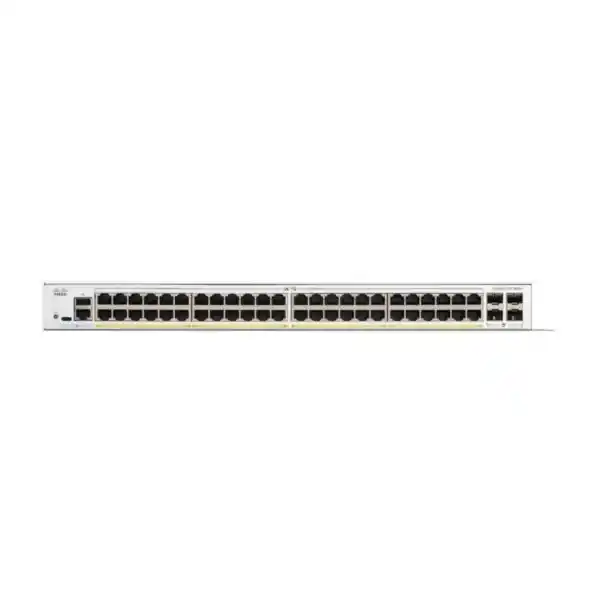
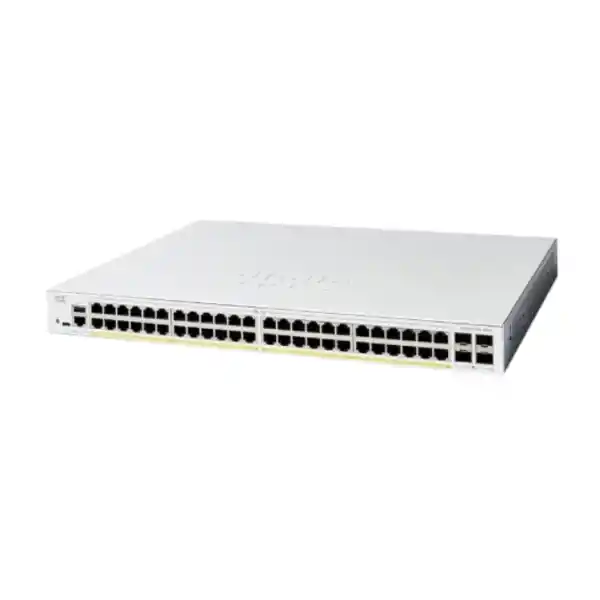
Cisco Catalyst C1200-48P-4X Network Switch Dubai
The Cisco Catalyst C1200-48P-4X is designed for organisations that need forty-eight Gigabit access ports, PoE+ power for business endpoints, and four 10 Gigabit SFP+ uplinks in a compact rack-mountable platform. For a Dubai office, school, retail operation, clinic, hospitality site, warehouse, or branch network, the main purchasing question is not simply whether forty-eight ports are enough. The more important decision is whether the 375W PoE budget, uplink topology, fibre or DAC choice, VLAN plan, resiliency expectations, and management model are appropriate for the actual environment.
Direct answer: what is the Cisco C1200-48P-4X?
The Cisco Catalyst C1200-48P-4X is a managed access-layer Ethernet switch in Cisco’s Catalyst 1200 Series for small and medium-sized business networks. Its exact hardware profile combines forty-eight 10/100/1000BASE-T RJ-45 ports capable of PoE+ delivery with four SFP+ uplink interfaces that support 10 Gigabit Ethernet. The switch has a 375W aggregate PoE budget, so it can power a substantial mix of IP phones, wireless access points, cameras, access-control devices, and other compatible powered endpoints without separate local power adapters.
It is mainly used to consolidate wired users and powered network devices at the access layer while providing significantly more uplink headroom than a model limited to 1G SFP uplinks. Organisations should consider it when they need close to forty-eight access connections, expect meaningful east-west or upstream traffic, and want practical managed-switch capabilities such as VLAN segmentation, QoS, spanning tree, link aggregation, access controls, monitoring, and static Layer 3 routing.
The most important factor to confirm before ordering is the full deployment profile: how many endpoints require PoE, their combined worst-case wattage, whether the 375W power budget is sufficient, what uplink speed and media are required, and whether the switch’s static-routing feature set matches the network design. A forty-eight-port PoE+ switch can appear oversized or undersized depending on endpoint density and power demand, so port count alone is not a reliable sizing method.
FourTeck can help map the C1200-48P-4X against the buyer’s device count, PoE load, fibre distances, transceiver requirements, VLAN architecture, rack environment, migration plan, and support expectations. That validation is especially useful when a single switch will support voice, Wi-Fi, surveillance, and business data simultaneously.
Why this exact model is different from a generic 48-port switch
The model name C1200-48P-4X carries several purchasing decisions in a compact code. The “48P” identifies a forty-eight-port PoE-capable access model, while “4X” identifies four 10 Gigabit SFP+ uplinks rather than the 1 Gigabit SFP uplinks found on the “4G” variants. That distinction is important because a fully populated access switch can aggregate a large amount of user, voice, wireless, and camera traffic. Even if no individual endpoint exceeds 1 Gbps, the combined upstream demand can make a 10G uplink architecture far more appropriate than a 1G uplink architecture.
The C1200-48P-4X also sits between simple unmanaged switching and higher-end campus switching platforms. It offers a broad set of Layer 2 controls, security features, management capabilities, and static Layer 3 routing without positioning itself as a full enterprise core or advanced routing platform. That makes the model useful for branch networks, small campuses, floor-distribution closets, and SMB environments where administrators need control and visibility but do not require the entire feature and licensing model of a larger enterprise switching family.
This placement matters in procurement. A buyer who only needs basic connectivity might spend unnecessarily on features and 10G optics they will never use. A buyer who expects dynamic routing, sophisticated stacking, redundant field-replaceable power systems, advanced campus automation, or deeper enterprise policy integration may need to evaluate a different Cisco family. The C1200-48P-4X is most compelling when its particular combination of 48 x 1G access, 375W PoE, four 10G uplinks, and SMB-oriented managed features aligns closely with the site design.
Verified hardware and performance profile
| Specification | Cisco C1200-48P-4X | Buyer relevance |
|---|---|---|
| Access ports | 48 x 10/100/1000 RJ-45 PoE+ | Supports dense wired endpoint deployment and power delivery on the access ports. |
| Uplinks | 4 x 10 Gigabit SFP+ | Provides higher aggregate uplink headroom to a router, firewall, distribution switch, server network, or another access layer. |
| PoE budget | 375W total, PoE+ up to 30W per port subject to budget | The total endpoint power plan must fit within the shared 375W limit. |
| Switching capacity | 176 Gbps | The platform is specified for wire-speed, nonblocking switching within its published port architecture. |
| Forwarding rate | 130.94 mpps for 64-byte packets | Useful when comparing the actual forwarding capability of nearby switch models. |
| Packet buffer | 3 MB aggregate, dynamically shared | Relevant to burst handling, although application behaviour also depends on traffic patterns and QoS design. |
| Memory | 1 GB DDR4 DRAM, 512 MB flash | Supports the switch operating software, configuration, monitoring, and management functions. |
| Processor | Dual-core ARM at 1.4 GHz | Provides control-plane resources for management and supported network services. |
| Physical size | 445 x 350 x 44 mm | A 1U-class rack width/depth profile that should be checked against cabinet depth and cable-management space. |
| Weight | Approximately 5.43 kg | Useful for rack planning and shipment handling. |
| Cooling / acoustics | 1 fan; published acoustic level 37.3 dBA at 25°C | Important when the switch will be installed near occupied work areas rather than a dedicated communications room. |
| Power input | Internal universal 100–240V AC, 50–60 Hz | Supports normal UAE utility environments when deployed with suitable power distribution and protection. |
Specifications should always be checked against the current Cisco data sheet and the exact regional ordering code at quotation stage, particularly if a project depends on accessory bundles, firmware support, regulatory requirements, or a specific replacement policy.
PoE planning: why 375W is the key sizing number
Per-port capability
The switch supports IEEE 802.3af PoE and 802.3at PoE+ on its RJ-45 ports, with up to 30W available to a compatible powered device on an individual port while the total switch PoE budget remains available.
Shared system budget
The 375W figure is aggregate power for connected PoE endpoints, not 30W multiplied by forty-eight. A design that assumes every port can simultaneously draw the maximum would exceed the model’s budget.
Real deployment check
Create an endpoint-by-endpoint power schedule, include growth and replacement devices, and confirm startup or peak requirements rather than relying only on typical consumption figures.
PoE capacity is one of the most common reasons a forty-eight-port switch is selected incorrectly. A buyer may see forty-eight PoE+ ports and assume that forty-eight high-power devices can be connected with no further calculation. The correct design method is to total the maximum supported or expected power draw of every powered endpoint. For example, a mix of office IP phones may use relatively little power compared with Wi-Fi access points, PTZ cameras, video endpoints, or specialised edge devices. The same switch can therefore be comfortably sized for one forty-eight-device environment and poorly sized for another with fewer but more power-hungry endpoints.
For Wi-Fi deployments, the switch’s Gigabit access ports and PoE+ capability can support many business access points, but the specific access point model must still be checked. Newer high-performance wireless systems may have multi-gigabit Ethernet interfaces or power requirements that go beyond what a 1G PoE+ access port can provide. If the proposed access points require 2.5G/5G access interfaces, PoE++ power, or a higher per-port budget, the C1200-48P-4X may not be the correct platform even if the total device count is modest.
For surveillance, count camera power at the selected operating mode, especially for PTZ, heater, infrared, or analytics-heavy models. For voice, include conference phones, video phones, and expansion modules where applicable. A responsible quotation should therefore capture device model, quantity, required PoE standard, peak watts, and planned spare capacity. That turns the 375W budget into an engineering input rather than a marketing number.
The four 10G SFP+ uplinks: where this model earns its place
The four 10 Gigabit SFP+ interfaces are the clearest reason to choose the C1200-48P-4X instead of a comparable 48-port model with 1G SFP uplinks. In a lightly used branch network, a single 1G uplink can be sufficient. In a dense access environment, however, users, cameras, phones, printers, and wireless traffic can converge toward the same upstream path. Multiple 1G endpoints do not all transmit at line rate simultaneously, but it is easy for aggregate demand to exceed what a single 1G trunk can carry during busy periods, backups, file transfers, cloud synchronization, video, or high-density Wi-Fi activity.
SFP+ ports also give designers media flexibility. A short rack-to-rack connection may use a supported direct-attach copper cable where appropriate. Multimode fibre may suit short building links, while single-mode fibre is appropriate for longer distances or infrastructure designed for future reach. Cisco’s current series documentation lists supported 1G and 10G transceiver options, including 10G SR and LR families and short direct-attach cables. The optic is not something to choose casually: fibre type, connector standard, distance, patching, optical budget, and compatibility all need to match.
The four uplinks also create design options for separate upstream paths, link aggregation, or connections to different network roles. Those options should not be confused with chassis-level or stack-level redundancy. Link aggregation can improve bandwidth and path resilience when both ends are configured correctly, while spanning tree can protect Layer 2 topologies from loops. The actual high-availability behaviour depends on the upstream device, topology, link configuration, and failure domain.
Before purchasing optics, determine whether each uplink is intended for a firewall, router, distribution switch, server, NAS, another access switch, or a service-provider handoff. Then document speed, media, connector, distance, LAG design, VLAN trunking, and redundancy requirement for every link. This prevents a common situation in which the switch arrives but the transceivers, patch leads, or matching upstream interfaces are wrong for the intended design.
Switching performance and what the published numbers mean
Cisco specifies the C1200-48P-4X with 176 Gbps switching capacity and a forwarding rate of 130.94 million packets per second using 64-byte packets. The series is described as wire-speed and nonblocking. These figures are useful because they distinguish the hardware forwarding capability from a simplistic “48 ports” comparison. A switch can have the right port count and still be a poor fit if the internal fabric or uplink architecture is substantially weaker than the traffic pattern demands.
For most SMB access deployments, the more practical question is how traffic is distributed. Desktop users may spend much of the day on SaaS and Internet applications. Cameras may send continuous streams to a local recorder. Access points may aggregate many wireless clients behind a single Ethernet port. Backup jobs and virtualisation traffic can produce bursts. Voice uses modest bandwidth but is sensitive to delay and congestion. A switch therefore has to move several traffic classes predictably while preserving control-plane responsiveness and keeping the uplinks from becoming bottlenecks.
The 3 MB dynamically shared packet buffer can help absorb short bursts, but it is not a substitute for network design. Persistent oversubscription still causes queuing and packet loss. QoS should be used when traffic classes require differentiated handling, and uplinks should be sized from observed or projected demand. If the site has substantial server-to-client transfers, multiple high-throughput Wi-Fi APs, or heavy video aggregation, traffic modelling should look beyond average utilisation and consider peaks.
It is also useful to separate data-plane performance from management features. Static routing, ACL processing, VLANs, and switching are designed into the platform, but this is not the same as buying a high-end enterprise distribution switch. If the network requires a large routing table, advanced dynamic routing, very high east-west server throughput, or large-scale campus policy, the design should be compared with a more capable platform rather than assuming that 176 Gbps switching capacity alone answers every performance question.
VLAN segmentation and Layer 2 control
VLAN architecture
The series supports port-based and IEEE 802.1Q tagged VLANs, with up to 255 active VLANs simultaneously. Voice, guest, management, user, camera, and infrastructure networks can be logically separated when the wider design supports that segmentation.
Loop prevention
STP, RSTP, MSTP, PVST+, and Rapid PVST+ options provide tools for controlling redundant Layer 2 paths. The correct protocol should match the topology and the behaviour of adjacent switches.
Link aggregation
IEEE 802.3ad LACP support allows multiple physical links to operate as a logical group where the peer supports and is configured for the same arrangement. This can increase aggregate capacity and improve link-level resilience.
Multicast handling
IGMP snooping and querier capabilities can limit multicast forwarding to interested receivers rather than flooding traffic across every access port, which is useful for supported video or multicast applications.
Voice-aware access
Voice VLAN capabilities and LLDP-MED can simplify deployment of compatible IP telephony endpoints by helping identify devices and apply voice-oriented network treatment.
VLAN capability is valuable only when the addressing, firewall policy, routing, DHCP, wireless SSIDs, voice system, and monitoring design are consistent. Creating many VLANs without a clear traffic policy can increase complexity rather than security. A sensible deployment normally begins with business functions and trust boundaries, then maps those requirements into VLANs, trunks, access ports, routing interfaces, and access controls.
Static Layer 3 routing: useful, but know its boundary
The Catalyst 1200 Series includes Layer 3 static routing capabilities that go beyond an unmanaged switch. Cisco documents wire-speed IPv4 routing with up to 32 static routes and up to 16 IP interfaces, along with IPv6 routing support and the ability to configure Layer 3 interfaces on physical ports, LAGs, VLAN interfaces, or loopback interfaces. This is enough to make the C1200-48P-4X useful for straightforward inter-VLAN routing in many small and medium business designs.
A common architecture is to keep several internal VLANs on the switch, route between them locally where permitted, and send Internet-bound or security-sensitive traffic toward a firewall or router. This can reduce unnecessary traffic through the edge device and provide clean internal segmentation. The switch also supports DHCP relay at Layer 3, which can help clients in separate IP networks reach a central DHCP service.
The limitation is equally important: static routing is not the same as a full dynamic-routing platform. Static routes must be planned and maintained deliberately. If the network has many sites, changing paths, multiple dynamic routing domains, sophisticated policy routing, or complex failover requirements, a dedicated router, firewall, or higher-tier switch may be the better Layer 3 control point. The C1200-48P-4X should therefore be evaluated as an access switch with useful static Layer 3 capability, not as a universal replacement for a campus core.
During design, define which device owns the default gateway for each VLAN, where firewall inspection must occur, how return routes are handled, and what happens during an uplink or upstream-device failure. Those answers matter more than simply enabling routing on the switch.
Security capabilities for the access layer
The C1200-48P-4X includes several security controls intended to reduce the risk of unauthorised access and protect management operations. IEEE 802.1X authentication can be used with a RADIUS-based access architecture to control who or what gains network access through a switch port. Access Control Lists can restrict traffic based on policy, while secure management protocols such as HTTPS and SSH help protect administrator sessions. SNMPv3 support adds an authenticated and encrypted option for monitoring compared with older SNMP versions.
These features should be deployed as part of a complete security model. A switch ACL can restrict certain traffic, but it does not replace a next-generation firewall for application-aware inspection, Internet threat prevention, remote-access security, or advanced security services. Similarly, 802.1X is most effective when identity services, endpoint supplicants, certificates or credentials, fallback behaviour, guest access, and operations processes are all planned. Enabling the feature without a complete access policy can cause disruption.
Management-plane protection deserves particular attention. Administrators should place the switch management interface on an appropriate management network, restrict who can reach it, use secure protocols, maintain configuration backups, and monitor authentication and configuration events. Default credentials and unused services should be handled according to the organisation’s security policy. Syslog, SNMP, and time synchronisation help make events more useful for troubleshooting and auditing.
If the C1200-48P-4X is supporting cameras, phones, building systems, or other embedded devices, segmentation is especially valuable because those endpoints may have different security and lifecycle characteristics from user laptops. The access switch can enforce logical separation, but the firewall, identity system, wireless infrastructure, endpoint security, and monitoring platform still determine the wider security posture.
QoS, voice, video, and latency-sensitive traffic
A business switch often carries very different types of traffic at the same time. File transfers and backups can tolerate brief delay. Interactive voice and video are more sensitive to jitter, congestion, and packet loss. The Catalyst 1200 Series provides Quality of Service capabilities that can help classify and prioritise traffic so delay-sensitive applications are not treated exactly like bulk data during periods of contention.
For IP telephony, voice VLAN functions and LLDP-MED can simplify endpoint onboarding in compatible environments. A phone may need both voice and workstation traffic on the same physical access port, with voice placed in a dedicated VLAN and the attached PC placed in a data VLAN. The final behaviour depends on the handset, call platform, VLAN configuration, QoS trust model, DHCP options where used, and upstream network. It is therefore useful to test at least one representative phone before a large rollout.
For video surveillance, traffic is often continuous rather than bursty. A dense camera deployment should therefore be designed from per-camera bit rate, frame rate, codec, recording mode, and retention architecture. The PoE budget answers the power question, while uplink utilisation answers the data question. Both need to be calculated. A switch with spare PoE capacity can still have a congested uplink, and a switch with abundant network bandwidth can still exhaust its power budget.
QoS is most effective when it is end to end. Markings, queues, trust boundaries, and policies should be consistent across access switches, uplinks, routers, firewalls, and WAN services. The C1200-48P-4X provides useful mechanisms at the access layer, but the outcome depends on how the entire traffic path is engineered.
Management choices: browser, dashboard, SNMP, and operational fit
Cisco positions the Catalyst 1200 Series for straightforward management in small and medium-sized networks. The switch includes a built-in web user interface for configuration and monitoring, supports Cisco Business Dashboard integration, and can be managed with established tools such as SNMP. Cisco’s documentation also describes an embedded probe capability for Cisco Business Dashboard, reducing the need for a separate onsite probe appliance in supported deployments.
For a single branch, the local web interface may be sufficient. For multiple sites or a larger fleet, central monitoring becomes more important. Administrators want consistent firmware visibility, configuration standards, alerts, inventory, and event data. The correct management approach should be selected before deployment because it influences addressing, credentials, access control, logging, backup procedures, and support workflow.
SNMP versions 1, 2c, and 3 are supported, with SNMPv3 preferable when its stronger security model is required. Syslog should be directed to a central collector where practical, and time synchronisation should be configured so events from the switch can be correlated with firewall, server, wireless, and application logs. A network incident is much easier to diagnose when the switch clock is accurate and interface events are retained centrally.
Operational ownership also matters. If an internal IT team will manage the device, document credentials, backups, firmware process, and escalation paths. If the network is managed by a service provider, define monitoring coverage, response expectations, change approval, and spare-device strategy. Buyers can explore broader infrastructure and managed support options through FourTeck IT Services UAE, while product procurement can remain aligned with the same deployment plan.
Optics, DACs, fibre, and cabling decisions
The four SFP+ uplink cages do not by themselves create a fibre connection. A complete uplink requires compatible transceivers or a supported direct-attach cable, matching interfaces at both ends, and appropriate cabling. Cisco’s current documentation for the series lists 10G SFP+ SR and LR optical options as well as short direct-attach copper assemblies. It also lists selected 1G SFP modules. The correct part depends on the required speed, media type, connector, and distance.
For multimode fibre inside a building, the existing fibre grade and patching should be inspected. Different multimode generations have different reach characteristics at 10 Gigabit Ethernet. For single-mode fibre, link length and optical design must still be validated even when the nominal transceiver reach appears sufficient. Patch panels, couplers, connector cleanliness, and fibre condition can all affect the practical optical budget. In data rooms, a direct-attach copper cable can be a simple and economical choice for short supported distances between adjacent equipment.
Copper access cabling should be Category 5e or better for 1000BASE-T according to Cisco’s stated requirement. In new installations, buyers may choose higher-category cabling for broader infrastructure reasons, but the switch’s access ports remain Gigabit Ethernet. The cable plant must also be suitable for PoE delivery. Poor termination, excessive bundle heat, damaged conductors, or low-quality components can create instability that is incorrectly blamed on the switch.
A quotation should therefore specify uplink quantity, required speed, fibre type, approximate distance, connector/patch-panel arrangement, and whether optics are needed at one or both ends. That information prevents accidental ordering of a switch without the media components necessary to put its 10G uplinks into service.
Rack, power, cooling, and acoustic planning in the UAE
The C1200-48P-4X is a rack-mountable switch measuring approximately 445 mm wide, 350 mm deep, and 44 mm high. Its depth is modest for many communications cabinets, but the physical installation still needs allowance for front patch leads, rear power cabling, airflow, rack rails or mounting hardware, vertical cable managers, and a PDU. A cabinet that is technically deep enough for the metal chassis can still become difficult to service if cable bend radius and connector clearance are ignored.
Cisco specifies an internal universal 100–240V AC, 50–60 Hz power supply for this model. Because PoE loads can raise system power consumption significantly, the electrical design should account for the switch and the endpoints it powers. UPS sizing should be based on realistic loaded power rather than only the switch’s idle draw. If the switch powers phones, cameras, access points, and access-control devices, a UPS outage runtime decision also becomes a business-continuity decision: keeping the switch alive keeps those endpoints alive only if upstream routers, firewalls, servers, controllers, and WAN equipment are backed up as well.
The model uses a fan, and Cisco publishes an acoustic level of 37.3 dBA at 25°C. That may be acceptable in a network room but should be considered carefully in a quiet meeting room, executive office, clinic room, classroom, or open workspace. Ambient temperature also affects thermal conditions. Cisco’s current series documentation lists an operating range up to 50°C for this class of model under stated conditions, but good practice is not to treat the maximum specification as the desired normal cabinet temperature.
In Dubai and the wider UAE, enclosed cabinets, ceiling spaces, warehouses, and utility rooms can experience elevated temperatures if air conditioning or ventilation is inadequate. Keep the switch in a controlled environment, maintain clear airflow, avoid dust accumulation, and include environmental checks in the site survey rather than relying solely on the theoretical operating limit.
Deployment design: one switch, many device classes
A major strength of a forty-eight-port PoE+ switch is consolidation. The same access layer can connect IP phones, wireless access points, computers, printers, cameras, door controllers, meeting-room systems, network appliances, and other Ethernet devices. Consolidation saves rack space and simplifies cabling, but it also concentrates operational risk. If the switch fails, every attached device may be affected. If the PoE budget is exhausted, new powered endpoints may not start. If uplink configuration is wrong, multiple business services can lose upstream connectivity at once.
For that reason, port allocation should be documented before installation. Reserve ports by function, label them consistently, define the expected VLAN and PoE behaviour, and keep spare capacity where practical. A simple port schedule might identify phones, APs, cameras, printers, infrastructure ports, uplinks, and future expansion. This makes commissioning faster and reduces the chance that a technician connects a device to an inappropriate VLAN or disables power on a required port.
The same preparation helps with security. Camera ports can be assigned to a surveillance VLAN, phones to a voice VLAN, staff workstations to a user VLAN, and network management to an administrative segment. Trunks to other switches can carry only the VLANs they need. ACLs and upstream firewall policy can then control traffic between zones according to business requirements.
When a branch depends heavily on one access switch, consider whether a spare unit, a second active switch, or a different topology is justified. The answer depends on downtime tolerance, local technical support, replacement logistics, and the number of critical endpoints. The C1200-48P-4X provides strong access density, but availability is a system design issue rather than a single-device feature.
Migration from an existing switch
Replacing an older switch is not simply a matter of moving forty-eight patch cables from one front panel to another. The old configuration may contain VLAN assignments, tagged trunks, access ports, voice VLANs, LAGs, spanning-tree priorities, security rules, management addresses, monitoring settings, and PoE dependencies that must be recreated deliberately. A configuration audit before the maintenance window is therefore one of the highest-value tasks in a switch replacement project.
Start by documenting the existing port map and identifying unused ports. Capture current VLANs and trunks, then confirm which networks are still required. Review uplink interfaces and their peer configuration. If the old switch uses 1G SFP links and the new C1200-48P-4X is intended to move to 10G SFP+, the transceivers and the upstream device must support the new speed. A 10G-capable switch does not automatically upgrade a link if the peer, optic, or fibre path remains limited.
PoE migration also needs care. Verify every powered device and note any endpoint using a separate local adapter today. Moving to switch power may change UPS load and fault behaviour. Conversely, a device that currently receives higher-power PoE from another platform may not be supported if its requirement exceeds 802.3at PoE+ or if the aggregate 375W budget is insufficient.
Build the new configuration in advance where possible, schedule a rollback plan, and retain the old switch until the new environment is verified. Testing should include user access, DHCP, DNS reachability, voice registration, wireless AP status, camera recording, inter-VLAN policy, Internet access, management connectivity, monitoring, and failover behaviour. Migration is successful only when services work as expected, not merely when port LEDs turn green.
For multi-site or managed migration projects, FourTeck can be referenced for broader technology engagement while the UAE deployment remains scoped around local infrastructure and support requirements.
Where the C1200-48P-4X fits well
Branch offices
A branch with several dozen users, IP phones, printers, APs, and cameras can consolidate access connectivity while using 10G uplinks to a central firewall or distribution device. Static routing can handle straightforward internal segmentation where appropriate.
Schools and training centres
Classrooms, administration, Wi-Fi, voice, cameras, and shared resources can be separated by VLAN while PoE+ supports suitable wireless and surveillance endpoints. Port density helps when one cabinet serves many nearby rooms.
Retail and hospitality
POS systems, staff devices, phones, cameras, APs, digital services, and back-office systems can share the physical switch while remaining logically segmented. Power and uptime planning should reflect the business-critical nature of those endpoints.
Clinics and professional offices
The model can support dense wired access with voice and Wi-Fi while keeping administrative, guest, infrastructure, and device networks separated. Acoustic placement matters if the cabinet is close to occupied rooms.
Warehouses and surveillance-heavy sites
Forty-eight PoE+ ports and 10G uplinks can suit cameras, APs, access-control points, workstations, and local systems, provided the total PoE draw and continuous camera bandwidth are calculated rather than estimated.
When another switch should be evaluated
The C1200-48P-4X is not automatically the right switch simply because a project needs forty-eight ports. A smaller 24-port model may be more economical when endpoint count is low and growth is limited. A 48-port non-PoE model may be preferable when nearly every attached device has its own power supply. A version with 1G SFP uplinks may be adequate when upstream traffic is modest and there is no foreseeable need for 10G. Conversely, a higher-tier platform may be necessary when requirements go beyond this model’s access-switch role.
Evaluate a different option when the endpoint power requirement exceeds the 375W budget, when connected devices need PoE++ rather than PoE+, or when wireless access points require multi-gigabit copper speeds. Also consider alternatives when a project requires advanced dynamic routing, sophisticated stack behaviour, redundant or field-replaceable power architecture, larger route scale, advanced campus automation, or a different management ecosystem.
The uplink question can push the decision in either direction. If four 10G SFP+ interfaces are unnecessary, the buyer may be paying for capacity that will not be used. If even 10G uplinks are insufficient because the access layer aggregates unusually heavy workloads, a higher-performance platform may be needed. Network design should therefore begin with traffic, power, availability, and operational requirements, then select the switch.
A balanced recommendation may result in different models at different sites. A head office might justify a higher-end access family, while a branch fits the C1200-48P-4X closely. A small remote office may need only a 16- or 24-port model. Standardisation is valuable, but only after the standard platform meets each site’s technical needs.
High availability and failure-domain planning
A network can have redundant uplinks and still depend on a single physical access switch. If the C1200-48P-4X chassis loses power or suffers a hardware fault, the endpoints connected to it lose both data connectivity and, for PoE devices, potentially their power source. This is not a criticism of the model; it is a normal characteristic of a single-switch design. Buyers need to decide whether that failure domain is acceptable for the site.
For ordinary office users, a short outage may be tolerable. For phones, cameras, security doors, or revenue-generating systems, the impact can be more serious. Resilience options include distributing critical devices across two switches, keeping a configured spare, using redundant upstream links where the topology supports them, protecting power with an appropriately sized UPS, and ensuring that firewall, router, and ISP infrastructure are also protected. Simply adding a second uplink to the same upstream device does not remove every single point of failure.
Spanning tree and LACP can help manage redundant Layer 2 links, but they need intentional design. LACP requires compatible configuration at both ends. Spanning tree root placement, port roles, and path costs influence failover behaviour. A poorly designed redundant network can create loops, unexpected blocking, or slower recovery than expected. Test failure scenarios during commissioning instead of assuming the protocol defaults will meet the business recovery objective.
If the project has strict uptime requirements, define the allowed outage duration, local support coverage, spare-part strategy, and upstream redundancy before choosing the access platform. The correct answer may still be the C1200-48P-4X, but deployed in pairs or with a spare strategy rather than as an isolated single point of access.
Installation workflow for a controlled rollout
Survey
Confirm cabinet depth, power, UPS, cooling, patching, endpoint count, PoE load, uplink media, and upstream interfaces.
Design
Prepare VLANs, addressing, trunks, LAGs, routing, ACLs, voice settings, QoS, management, and monitoring requirements.
Stage
Load the intended configuration, verify firmware policy, label ports, test representative devices, and back up the configuration.
Cut over
Move uplinks and access ports in a controlled sequence, verify link speed and PoE, then validate services by VLAN and device type.
Observe
Monitor errors, PoE consumption, uplink utilisation, logs, temperature, endpoint stability, and user experience before closing the change.
A staged workflow reduces both technical and operational risk. It creates a known-good baseline before the maintenance window, gives technicians a port map to follow, and makes rollback practical. The more services the switch supports, the more valuable this preparation becomes. In a mixed network, the acceptance test should cover not only desktop Internet access but also voice registration, Wi-Fi client traffic, camera recording, printer reachability, DHCP, DNS, inter-VLAN policy, monitoring, and remote management.
Monitoring, logging, and troubleshooting after deployment
Once the switch is in production, health monitoring should focus on the conditions that most often precede user impact: uplink saturation, interface errors, link flaps, PoE budget exhaustion, high device temperature, authentication failures, spanning-tree changes, and unexpected port status changes. SNMP can feed a network monitoring platform, while syslog provides event records that are useful for diagnosing intermittent problems. The management platform should retain enough history to identify patterns rather than only showing current state.
PoE monitoring is particularly useful on the C1200-48P-4X because the shared 375W budget can become a constraint as new devices are added. Track total consumption and identify high-draw endpoints. If a new camera or AP fails to power up, confirm the device’s standard and power requirement, the switch port configuration, cable quality, and available PoE budget before assuming hardware failure. A good asset register links each port to a device, location, VLAN, and expected power profile.
For data-path issues, check the physical layer first: negotiated speed, duplex, error counters, optic status, fibre cleanliness, patching, and link state. Then validate VLAN membership, trunk tagging, spanning-tree role, LAG state, routing, ACL policy, DHCP reachability, and upstream firewall behaviour. Many “switch problems” are actually mismatched VLANs, incorrect trunks, damaged cabling, or policy changes elsewhere in the network.
Configuration backups should be captured after successful changes. Firmware updates should follow a documented process with release-note review, maintenance planning, and rollback consideration. The objective is not frequent change for its own sake but a controlled operational state in which the switch can be restored quickly and its behaviour can be explained when an incident occurs.
Procurement checklist for a C1200-48P-4X quotation
An accurate switch quotation needs more than the model name. The items below determine whether the delivered solution can actually be installed and used as intended.
Confirm C1200-48P-4X and the number of units, including whether a project spare is required.
List powered device models, quantities, standards, and maximum watts to validate the 375W budget.
State how many 10G links are required, their destination devices, link distances, and media type.
Confirm whether supported SFP/SFP+ transceivers, DAC cables, and fibre patch leads must be included.
Provide cabinet details, PDU/UPS availability, cooling conditions, and installation location.
Identify VLAN, routing, LAG, ACL, QoS, voice, monitoring, and management requirements.
Clarify whether existing switch audit, configuration translation, cutover, testing, and rollback planning are required.
Define desired support coverage, response expectations, warranty handling, and spare strategy.
For UAE procurement and infrastructure consultation, buyers can use Firewall Dubai by FourTeck as a specialist local resource, especially when the access switch must integrate with a firewall, segmented VLAN design, secure Internet edge, or branch security architecture.
Warranty, support, lifecycle, and replacement planning
Cisco’s current Catalyst 1200 Series documentation states a limited lifetime warranty and describes complimentary one-year access to the Small Business Support Center for ongoing support. Buyers should still verify the exact warranty and support terms applicable to the regional part number, purchase channel, and current Cisco policy when ordering. Warranty is only one part of lifecycle planning; firmware availability, technical support process, local replacement logistics, and internal configuration records all affect recovery time.
The series is currently shown by Cisco as available to order, and Cisco notes that Catalyst 1200 Series products are purchased through distributors and partners rather than ordered directly by end users from Cisco. For UAE buyers, that makes supplier selection relevant not only to price but also to part-number validation, accessory matching, lead time, warranty handling, and deployment support.
A business-critical site should decide in advance how it will respond to a failed access switch. If the acceptable downtime is short, relying entirely on replacement logistics may be insufficient. A spare C1200-48P-4X can reduce recovery time if its firmware and base configuration are kept ready. Another option is to distribute critical endpoints across two switches so one failure affects fewer services. Both strategies have cost, rack-space, power, and management implications.
Lifecycle reviews should also track growth. A switch that is ideal today may become constrained by PoE power, port count, or access speed as new Wi-Fi, camera, or edge-device requirements appear. Annual reviews of utilisation, PoE headroom, uplink peaks, firmware status, and spare capacity help identify that change before it becomes an urgent replacement project.
Comparing nearby Catalyst 1200 choices
| Model type | What changes | When to consider it |
|---|---|---|
| 24-port PoE+ with 10G uplinks | Lower access-port count; PoE budget depends on the specific 24-port variant. | Sites with fewer than roughly two dozen endpoints that still need fast SFP+ uplinks. |
| 48-port data-only with 10G uplinks | Removes PoE delivery while retaining high-density Gigabit access and 10G SFP+ uplinks. | Desktop/server-edge environments where powered endpoints are rare or separately powered. |
| 48-port PoE+ with 1G uplinks | Keeps forty-eight PoE+ access ports but uses Gigabit SFP uplinks instead of 10G SFP+. | Branches with modest aggregate traffic where 10G upstream capacity is not needed. |
| Higher-power 48-port model | A larger PoE budget is available on higher-power variants in the family. | Deployments with many high-draw PoE endpoints that would exceed the 375W budget. |
The right comparison therefore depends on which resource is scarce: access ports, PoE watts, uplink capacity, or advanced feature depth. Selecting the C1200-48P-4X makes sense when the project genuinely needs all three of its defining resources—forty-eight Gigabit access ports, a substantial 375W PoE+ budget, and four 10G SFP+ uplinks.
Practical buyer questions before approval
Can every one of the 48 ports provide PoE+?
The RJ-45 access ports support PoE+ capability, but the switch has a 375W total PoE budget. The aggregate budget, endpoint requirements, and port configuration determine how many powered devices can operate simultaneously at their required wattage.
Are 10G transceivers included?
Do not assume the SFP+ optics are included. The switch provides the SFP+ interfaces, while the required transceivers or DAC cables should be specified separately according to distance, fibre type, connector, and the interface at the far end.
Can it route between VLANs?
Yes, the series supports static Layer 3 routing and VLAN interfaces, including documented IPv4 static-route and IP-interface limits. If the design needs dynamic routing or larger-scale Layer 3 control, evaluate a platform intended for that role.
Is it suitable for Wi-Fi access points?
It can be suitable for APs that are compatible with Gigabit Ethernet access and PoE+. Check each AP model. Multi-gigabit access speeds or PoE++ requirements may require a different switch.
Is it silent?
No. Cisco documents one fan for this model and publishes an acoustic level of 37.3 dBA at 25°C. Placement near quiet occupied areas should therefore be considered carefully.
Can it replace a firewall?
No. Static routing and ACLs are useful network controls, but they do not replace a firewall’s security inspection, Internet threat protection, VPN, and policy functions. The switch and firewall perform different roles.
Is it appropriate for a server core?
It is primarily an SMB access switch. A small environment may connect servers through it, but a core or high-performance server network should be sized from routing, resilience, interface speed, buffering, availability, and management requirements rather than port count alone.
UAE availability, supply, and project coordination
For a Dubai or UAE project, product availability should be checked against the exact Cisco ordering code at the time of quotation. Enterprise networking supply can vary by distribution stock, project quantity, accessory requirements, and regional part-number availability. A technically correct model can still delay a deployment if optics, patch leads, rack accessories, or replacement units are not planned at the same time.
The most efficient procurement process combines the bill of materials with the deployment design. If the project needs two switches and eight 10G optics, quote those items together. If a pair of switches will uplink to redundant firewalls, confirm the firewall interface types before choosing optics. If the site requires fibre work, include patching and testing. If the switch will be added to an existing monitored environment, include configuration and onboarding effort. This prevents the purchasing team from receiving a low device-only price that excludes necessary deployment components.
FourTeck’s UAE presence can support that combined planning through FourTeck UAE. The goal is to identify the real project scope before the order is placed: exact switch quantity, endpoint power needs, 10G media, network configuration, installation location, migration needs, testing, and support expectations.
For procurement teams, this also makes quotations easier to compare. Two quotes for the same C1200-48P-4X are not equivalent if one includes transceivers, configuration, installation, testing, warranty handling, and migration support while another lists only the chassis. Compare the complete solution and responsibilities, not only the switch line item.
Configuration decisions that should be documented
A well-designed switch deployment should leave behind documentation that another engineer can understand. At minimum, record the management IP address, management VLAN, default route, administrator access method, NTP or SNTP source, syslog destination, SNMP settings, and configuration backup location. For every access port, record the business function, VLAN, PoE state, expected device, and any authentication or security policy. For uplinks, record speed, optic or DAC type, peer device, trunk VLANs, LAG membership, and spanning-tree behaviour.
Static routing should be documented in a small routing table that explains destination networks, next hops, and the reason each route exists. VLANs should have names that correspond to real functions rather than arbitrary numbers alone. ACLs should include a policy explanation so future administrators understand whether a rule is still required. If voice VLANs or special QoS policies are configured, document the associated endpoint types and trust assumptions.
This level of documentation is not bureaucracy. It shortens incident response and reduces the risk of accidental changes. Without a port schedule, technicians may unplug a camera or uplink while tracing a desk cable. Without a VLAN map, a new AP may be placed in the wrong network. Without a PoE schedule, a future expansion may exhaust the budget unexpectedly. Without an optic inventory, a failed SFP+ link may take longer to restore.
The C1200-48P-4X has enough capability to support a structured network. The operational value comes from using those capabilities consistently and recording the decisions so the environment remains supportable after the original installer leaves.
Decision recap: is the C1200-48P-4X a strong fit?
What FourTeck needs from the buyer for an accurate quotation
A useful quotation can be prepared faster when the technical inputs are supplied together. The following information is normally enough to confirm whether the C1200-48P-4X is the right model and what accessories or services should accompany it.
This information makes it possible to separate a device-only request from a complete deployment requirement and reduces the chance of discovering missing optics, insufficient PoE capacity, or incompatible uplinks after purchase.
Frequently asked questions about Cisco Catalyst C1200-48P-4X
How many total network interfaces does the switch provide?
It provides 48 Gigabit Ethernet RJ-45 access ports plus four 10 Gigabit SFP+ uplink interfaces. The access ports are used for endpoint connectivity and PoE+, while the SFP+ ports are typically used for faster upstream or inter-switch links.
What is the total PoE budget?
The published PoE budget for the C1200-48P-4X is 375W. Individual ports can supply PoE+ power up to the supported per-port limit, but the combined load across powered endpoints must stay within the switch’s aggregate budget.
Does it support 10 Gigabit copper access ports?
No. The forty-eight RJ-45 access ports are Gigabit Ethernet. The 10 Gigabit interfaces are the four SFP+ uplinks. If users or APs require 2.5G, 5G, or 10G copper access, evaluate another access platform.
Can the switch power high-performance wireless access points?
It can power compatible PoE/PoE+ APs within the 375W budget, but the exact AP model must be checked for both power and Ethernet speed. Some newer APs benefit from multi-gigabit access and higher-power PoE standards that this model does not provide.
Can the four SFP+ ports be aggregated?
The series supports IEEE 802.3ad LACP link aggregation. The peer device must support a compatible configuration, and the network design must account for how traffic is distributed across the bundle and how failure behaviour is handled.
Does it support VLANs?
Yes. Cisco documents port-based and IEEE 802.1Q tag-based VLANs, management and guest VLAN functions, voice VLAN support, and up to 255 active VLANs simultaneously for the series.
Does it support static routing?
Yes. Cisco documents Layer 3 static routing, including IPv4 routing with up to 32 static routes and up to 16 IP interfaces, as well as IPv6 routing functions. This is suitable for straightforward internal routing but should not be confused with a full dynamic-routing platform.
What management methods are available?
The platform supports a built-in web user interface, Cisco Business Dashboard integration, Cisco Business mobile management functions, SNMP, secure management protocols such as HTTPS and SSH, and logging/monitoring features appropriate to the series.
What should be ordered with the switch?
That depends on the deployment. Typical additional items may include compatible SFP/SFP+ transceivers or DAC cables, fibre patch leads, rack accessories, patch cords, UPS capacity, and installation/configuration services. A bill of materials should be based on the actual topology.
Is the C1200-48P-4X suitable for a new Dubai office?
It can be a strong fit when the office needs dense Gigabit access, PoE+ for phones/APs/cameras, and 10G uplinks. The final decision should consider endpoint count, PoE load, Wi-Fi access speed, firewall or distribution interfaces, rack conditions, resilience, and growth.
Plan the switch as part of the network, not as an isolated box
The Cisco Catalyst C1200-48P-4X is most valuable when its hardware profile matches the surrounding design. Forty-eight Gigabit PoE+ ports can simplify a dense access layer, the 375W budget can power a substantial endpoint population, and four 10G SFP+ uplinks provide useful headroom for aggregated traffic. The same design still needs the right optics, fibre or DACs, VLAN structure, IP plan, firewall integration, UPS capacity, rack conditions, monitoring, and operational ownership.
If those inputs are already known, the model can be quoted as a straightforward product requirement. If they are not, a short design review can prevent avoidable purchasing mistakes such as under-sized PoE, incompatible optics, insufficient access speed for new APs, or a single-switch failure domain that does not meet the site’s uptime objective. For wider UAE network and infrastructure requirements, buyers can also review FourTeck IT Services UAE alongside product procurement.

Reviews
There are no reviews yet.